Enhancing Education: Strategies for Implementing Co-operative Learning

Verified

Added on  2023/06/10

|4
|585
|101
Essay
AI Summary
This essay provides an overview of co-operative learning, highlighting its potential benefits in education. It emphasizes the importance of creating a structured environment with well-defined groups, clear ground rules, and engaging activities. The essay underscores the need for tasks that promote collaboration, equal participation, and critical thinking among students. It also stresses the significance of allowing students to ask questions and seek clarification, fostering a supportive learning atmosphere. The references cited support the effectiveness of co-operative learning in enhancing student engagement and academic achievement. Desklib offers similar solved assignments and resources for students.

Document Page
Running head: CO-OPERATIVE LEARNING
Co-operative learning
Name of the student:
Name of the University:
Author note:
tabler-icon-diamond-filled.svg

Paraphrase This Document

Need a fresh take? Get an instant paraphrase of this document with our AI Paraphraser
Document Page
1CO-OPERATIVE LEARNING
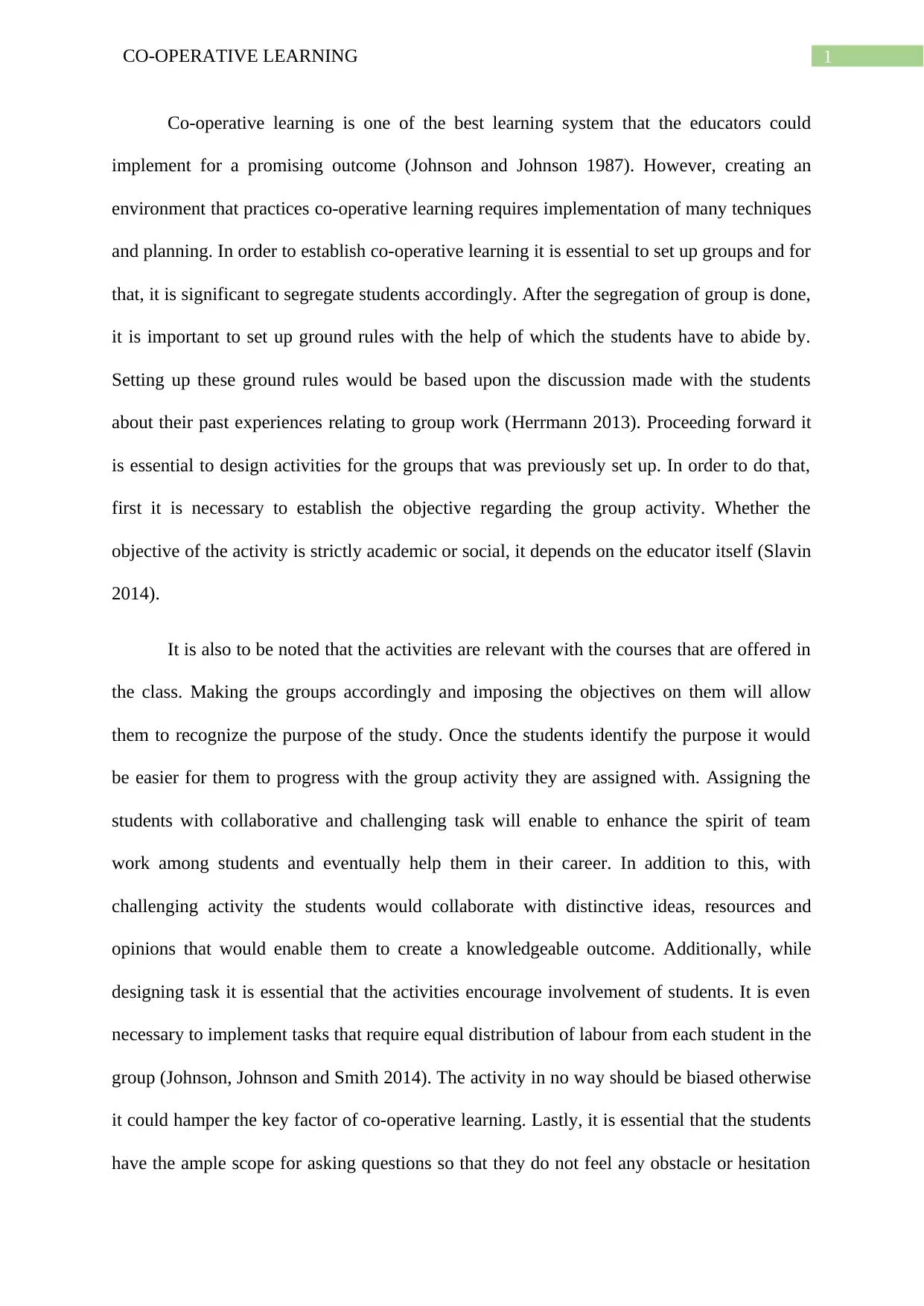
Co-operative learning is one of the best learning system that the educators could
implement for a promising outcome (Johnson and Johnson 1987). However, creating an
environment that practices co-operative learning requires implementation of many techniques
and planning. In order to establish co-operative learning it is essential to set up groups and for
that, it is significant to segregate students accordingly. After the segregation of group is done,
it is important to set up ground rules with the help of which the students have to abide by.
Setting up these ground rules would be based upon the discussion made with the students
about their past experiences relating to group work (Herrmann 2013). Proceeding forward it
is essential to design activities for the groups that was previously set up. In order to do that,
first it is necessary to establish the objective regarding the group activity. Whether the
objective of the activity is strictly academic or social, it depends on the educator itself (Slavin
2014).
It is also to be noted that the activities are relevant with the courses that are offered in
the class. Making the groups accordingly and imposing the objectives on them will allow
them to recognize the purpose of the study. Once the students identify the purpose it would
be easier for them to progress with the group activity they are assigned with. Assigning the
students with collaborative and challenging task will enable to enhance the spirit of team
work among students and eventually help them in their career. In addition to this, with
challenging activity the students would collaborate with distinctive ideas, resources and
opinions that would enable them to create a knowledgeable outcome. Additionally, while
designing task it is essential that the activities encourage involvement of students. It is even
necessary to implement tasks that require equal distribution of labour from each student in the
group (Johnson, Johnson and Smith 2014). The activity in no way should be biased otherwise
it could hamper the key factor of co-operative learning. Lastly, it is essential that the students
have the ample scope for asking questions so that they do not feel any obstacle or hesitation
Document Page
2CO-OPERATIVE LEARNING
in accomplishing the task assigned to them. This would even enable them to gain knowledge
and confidence to complete the task and the objective of the learning activity.
Document Page
3CO-OPERATIVE LEARNING
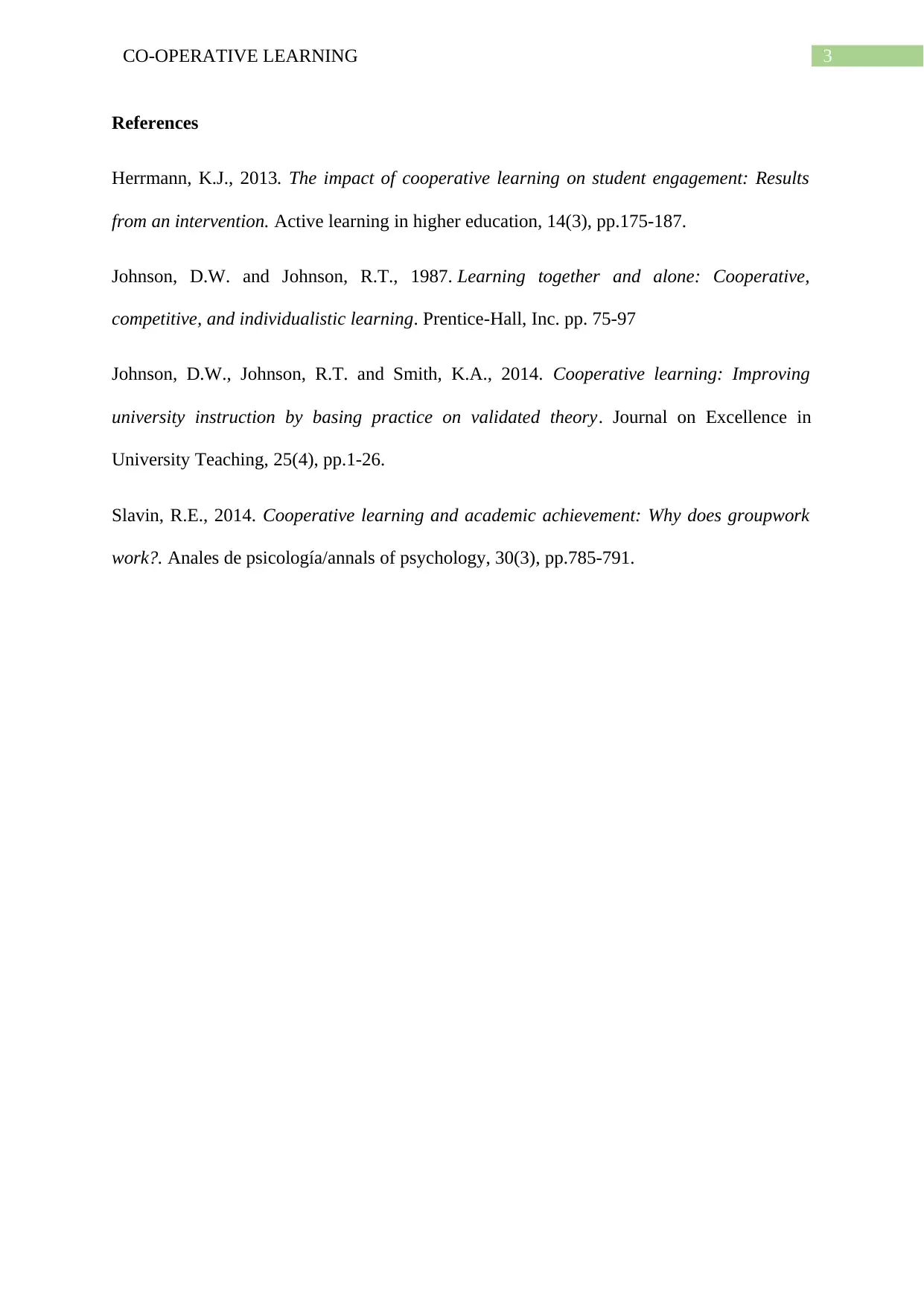
References
Herrmann, K.J., 2013. The impact of cooperative learning on student engagement: Results
from an intervention. Active learning in higher education, 14(3), pp.175-187.
Johnson, D.W. and Johnson, R.T., 1987. Learning together and alone: Cooperative,
competitive, and individualistic learning. Prentice-Hall, Inc. pp. 75-97
Johnson, D.W., Johnson, R.T. and Smith, K.A., 2014. Cooperative learning: Improving
university instruction by basing practice on validated theory. Journal on Excellence in
University Teaching, 25(4), pp.1-26.
Slavin, R.E., 2014. Cooperative learning and academic achievement: Why does groupwork
work?. Anales de psicología/annals of psychology, 30(3), pp.785-791.
chevron_up_icon
1 out of 4
circle_padding
hide_on_mobile
zoom_out_icon
[object Object]