Assessing Oxygen Therapy for Chronic Obstructive Pulmonary Disease

Verified

Added on  2023/06/15

|5
|931
|98
Report
AI Summary
This report provides an overview of Chronic Obstructive Pulmonary Disease (COPD) and the use of long-term oxygen therapy (LTOT) in its management. It highlights that COPD is a leading cause of disability and mortality, damaging lung airways and causing breathlessness. LTOT is shown to increase life expectancy in patients with severe hypoxemia. The report references studies on the cost of LTOT, its impact on survival rates, exercise performance, and quality of life. A key study revealed no significant differences in survival or symptoms among COPD patients with moderately low blood oxygen levels treated with LTOT. Short burst oxygen therapy (SBOT) is also discussed for relieving breathlessness during exercise, emphasizing the need for proper monitoring of blood oxygen tension and selective prescription based on patient preference and reported benefits. The report concludes that the effectiveness of oxygen therapy depends on careful patient monitoring and individualized treatment plans.
Document Page
Running head: CHRONIC OBSTRUCTIVE PULMONARY DISEASE
Chronic Obstructive Pulmonary Disease
Name of the Student
Name of the University
Author Note
tabler-icon-diamond-filled.svg

Paraphrase This Document

Need a fresh take? Get an instant paraphrase of this document with our AI Paraphraser
Document Page
CHRONIC OBSTRUCTIVE PULMONARY DISEASE
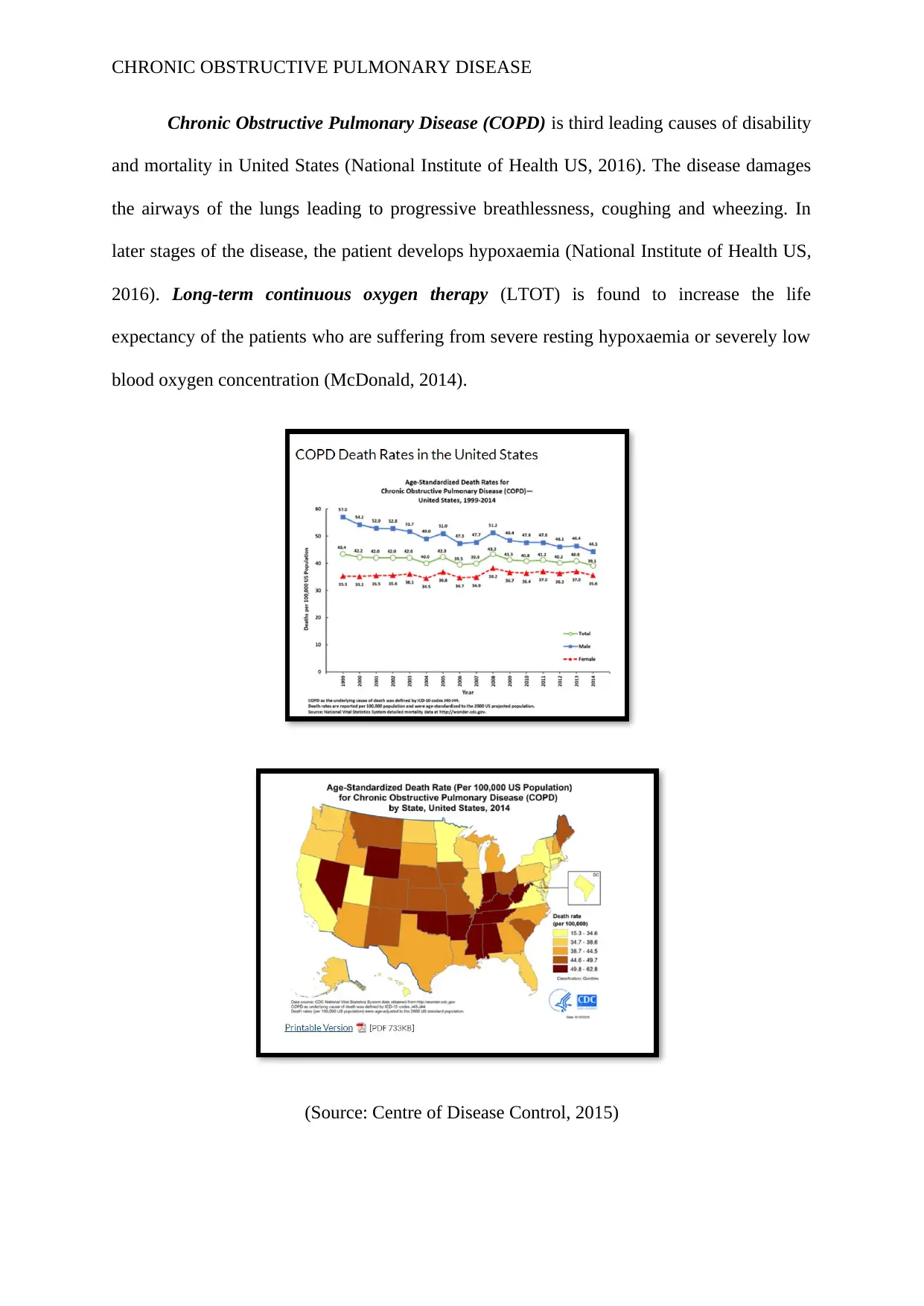
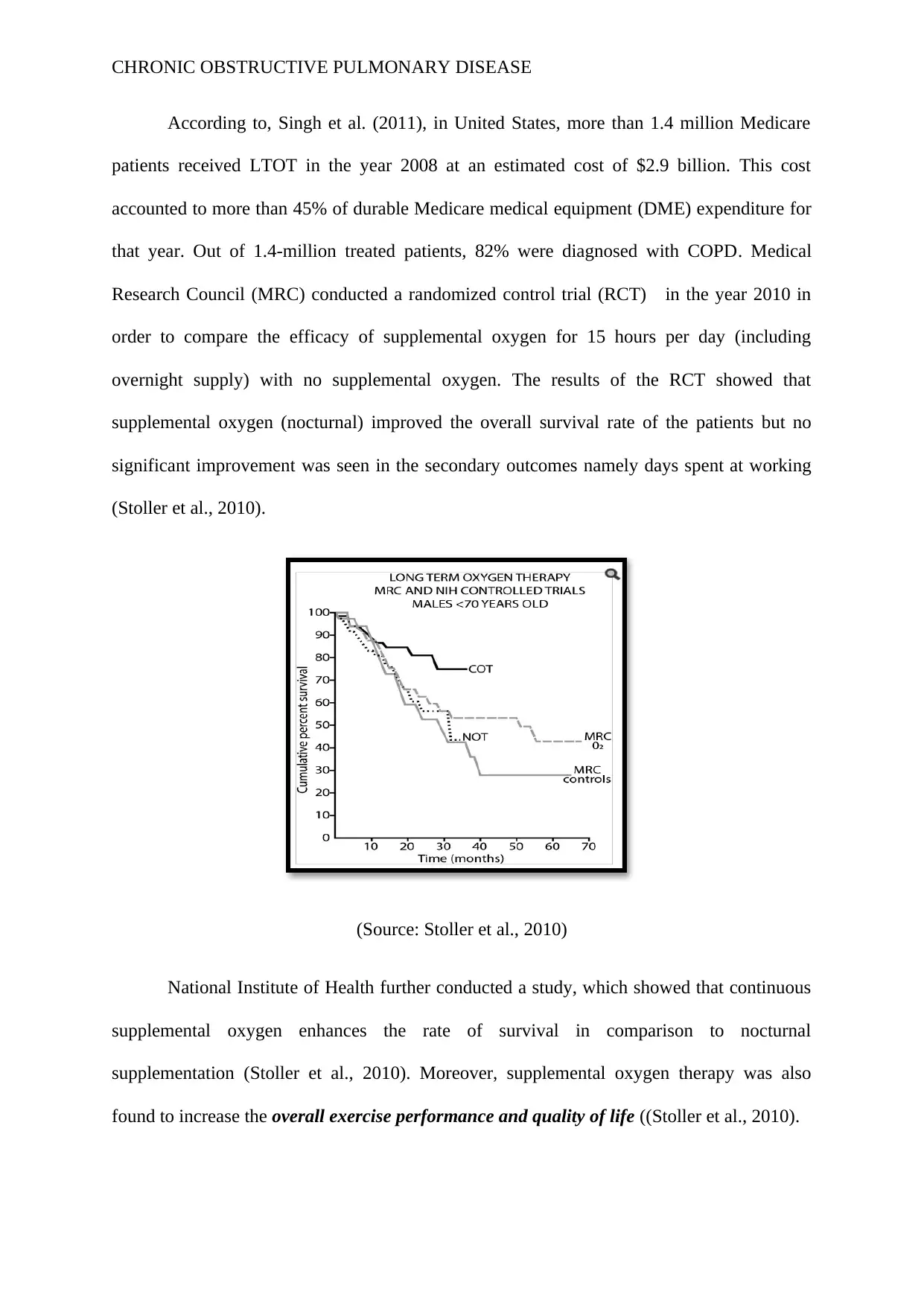
Chronic Obstructive Pulmonary Disease (COPD) is third leading causes of disability
and mortality in United States (National Institute of Health US, 2016). The disease damages
the airways of the lungs leading to progressive breathlessness, coughing and wheezing. In
later stages of the disease, the patient develops hypoxaemia (National Institute of Health US,
2016). Long-term continuous oxygen therapy (LTOT) is found to increase the life
expectancy of the patients who are suffering from severe resting hypoxaemia or severely low
blood oxygen concentration (McDonald, 2014).
(Source: Centre of Disease Control, 2015)
Document Page
CHRONIC OBSTRUCTIVE PULMONARY DISEASE
According to, Singh et al. (2011), in United States, more than 1.4 million Medicare
patients received LTOT in the year 2008 at an estimated cost of $2.9 billion. This cost
accounted to more than 45% of durable Medicare medical equipment (DME) expenditure for
that year. Out of 1.4-million treated patients, 82% were diagnosed with COPD. Medical
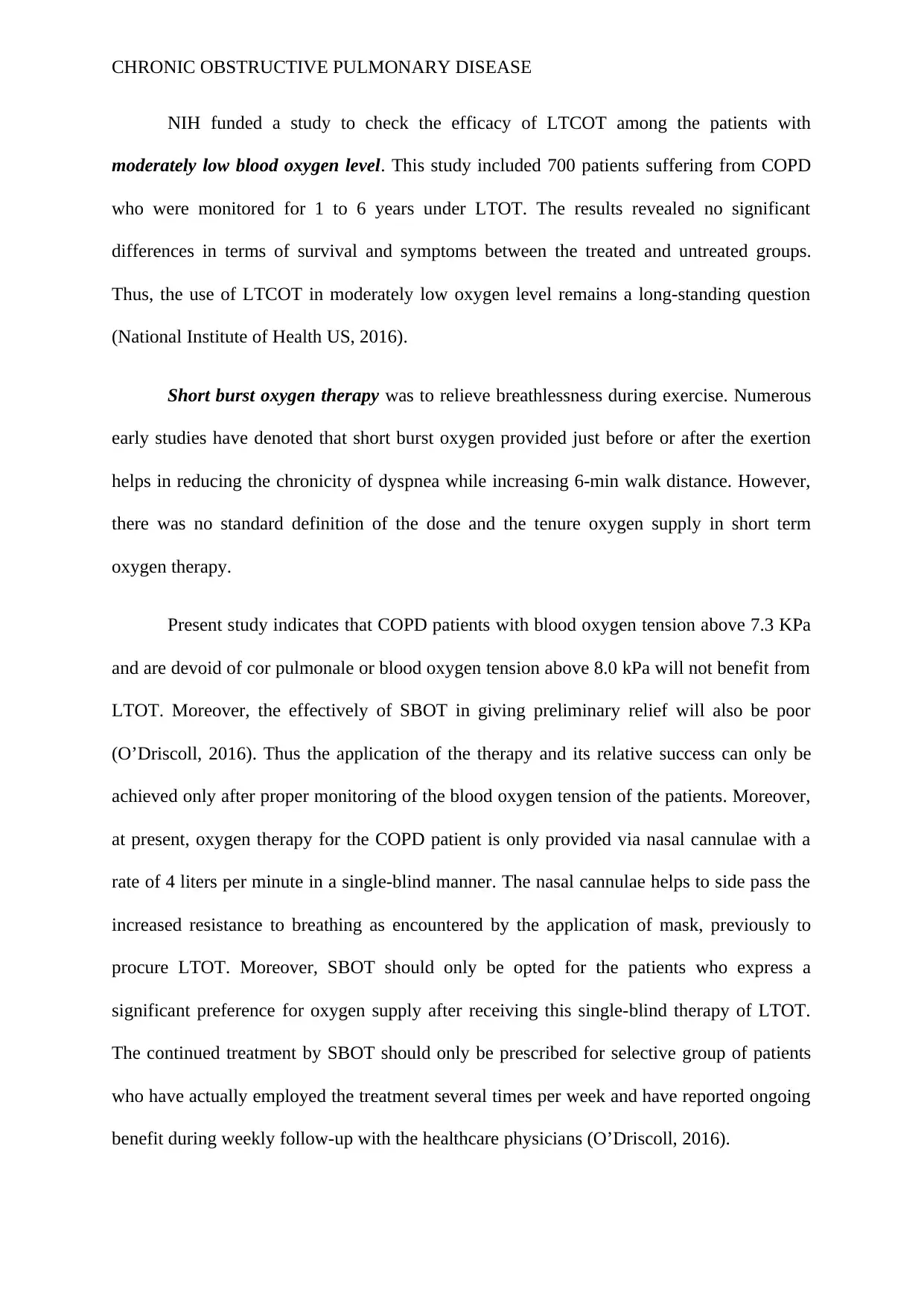
Research Council (MRC) conducted a randomized control trial (RCT) in the year 2010 in
order to compare the efficacy of supplemental oxygen for 15 hours per day (including
overnight supply) with no supplemental oxygen. The results of the RCT showed that
supplemental oxygen (nocturnal) improved the overall survival rate of the patients but no
significant improvement was seen in the secondary outcomes namely days spent at working
(Stoller et al., 2010).
(Source: Stoller et al., 2010)
National Institute of Health further conducted a study, which showed that continuous
supplemental oxygen enhances the rate of survival in comparison to nocturnal
supplementation (Stoller et al., 2010). Moreover, supplemental oxygen therapy was also
found to increase the overall exercise performance and quality of life ((Stoller et al., 2010).
Document Page
CHRONIC OBSTRUCTIVE PULMONARY DISEASE
NIH funded a study to check the efficacy of LTCOT among the patients with
moderately low blood oxygen level. This study included 700 patients suffering from COPD
who were monitored for 1 to 6 years under LTOT. The results revealed no significant
differences in terms of survival and symptoms between the treated and untreated groups.
Thus, the use of LTCOT in moderately low oxygen level remains a long-standing question
(National Institute of Health US, 2016).
Short burst oxygen therapy was to relieve breathlessness during exercise. Numerous
early studies have denoted that short burst oxygen provided just before or after the exertion
helps in reducing the chronicity of dyspnea while increasing 6-min walk distance. However,
there was no standard definition of the dose and the tenure oxygen supply in short term
oxygen therapy.
Present study indicates that COPD patients with blood oxygen tension above 7.3 KPa
and are devoid of cor pulmonale or blood oxygen tension above 8.0 kPa will not benefit from
LTOT. Moreover, the effectively of SBOT in giving preliminary relief will also be poor
(O’Driscoll, 2016). Thus the application of the therapy and its relative success can only be
achieved only after proper monitoring of the blood oxygen tension of the patients. Moreover,
at present, oxygen therapy for the COPD patient is only provided via nasal cannulae with a
rate of 4 liters per minute in a single-blind manner. The nasal cannulae helps to side pass the
increased resistance to breathing as encountered by the application of mask, previously to
procure LTOT. Moreover, SBOT should only be opted for the patients who express a
significant preference for oxygen supply after receiving this single-blind therapy of LTOT.
The continued treatment by SBOT should only be prescribed for selective group of patients
who have actually employed the treatment several times per week and have reported ongoing
benefit during weekly follow-up with the healthcare physicians (O’Driscoll, 2016).
tabler-icon-diamond-filled.svg

Paraphrase This Document

Need a fresh take? Get an instant paraphrase of this document with our AI Paraphraser
Document Page
CHRONIC OBSTRUCTIVE PULMONARY DISEASE
References
DC - Data and Statistics - Chronic Obstructive Pulmonary Disease (COPD).
(2015). Cdc.gov. Retrieved 9 February 2018, from
https://www.cdc.gov/copd/data.html
McDonald, C. F. (2014). Oxygen therapy for COPD. Journal of thoracic disease, 6(11),
1632.
O’Driscoll, B. R. (2016). Short burst oxygen therapy in patients with COPD. Monaldi
Archives for Chest Disease, 69(2).
Oxygen Therapy for Patients with COPD. (2016). NIH News in Health. Retrieved 9 February
2018, from https://newsinhealth.nih.gov/2016/12/oxygen-therapy-patients-copd
Singh, V., Gupta, P., Khatana, S., & Bhagol, A. (2011). Supplemental oxygen therapy:
Important considerations in oral and maxillofacial surgery. National journal of
maxillofacial surgery, 2(1), 10.
Stoller, J. K., Panos, R. J., Krachman, S., Doherty, D. E., & Make, B. (2010). Oxygen therapy
for patients with COPD: current evidence and the long-term oxygen treatment
trial. Chest, 138(1), 179-187
chevron_up_icon
1 out of 5
circle_padding
hide_on_mobile
zoom_out_icon
[object Object]