Report on the Impact of the Coronavirus Pandemic on Urban Inequality

Verified

Added on  2023/06/18

|7
|1501
|112
Report
AI Summary
This report examines the impact of the COVID-19 pandemic on rising urban inequality, particularly focusing on the effects on casual workers in sectors like sales, hospitality, and food preparation. It highlights the challenges faced by these workers, including job losses, reduced wages, and the slow implementation of job keeper programs. The report also discusses how businesses have adopted technology to reduce labor costs and maintain social distancing, leading to further job displacement. Furthermore, it touches on the economic consequences for countries, the importance of securing jobs for immigrants and native populations, and the role of government support in mitigating the crisis. The analysis concludes that the pandemic has significantly affected low-wage workers, emphasizing the need for government intervention to support and protect vulnerable populations.
Document Page
Impact Of The Corona virus
Pandemic Rising Urban
Inequality
tabler-icon-diamond-filled.svg

Paraphrase This Document

Need a fresh take? Get an instant paraphrase of this document with our AI Paraphraser
Document Page
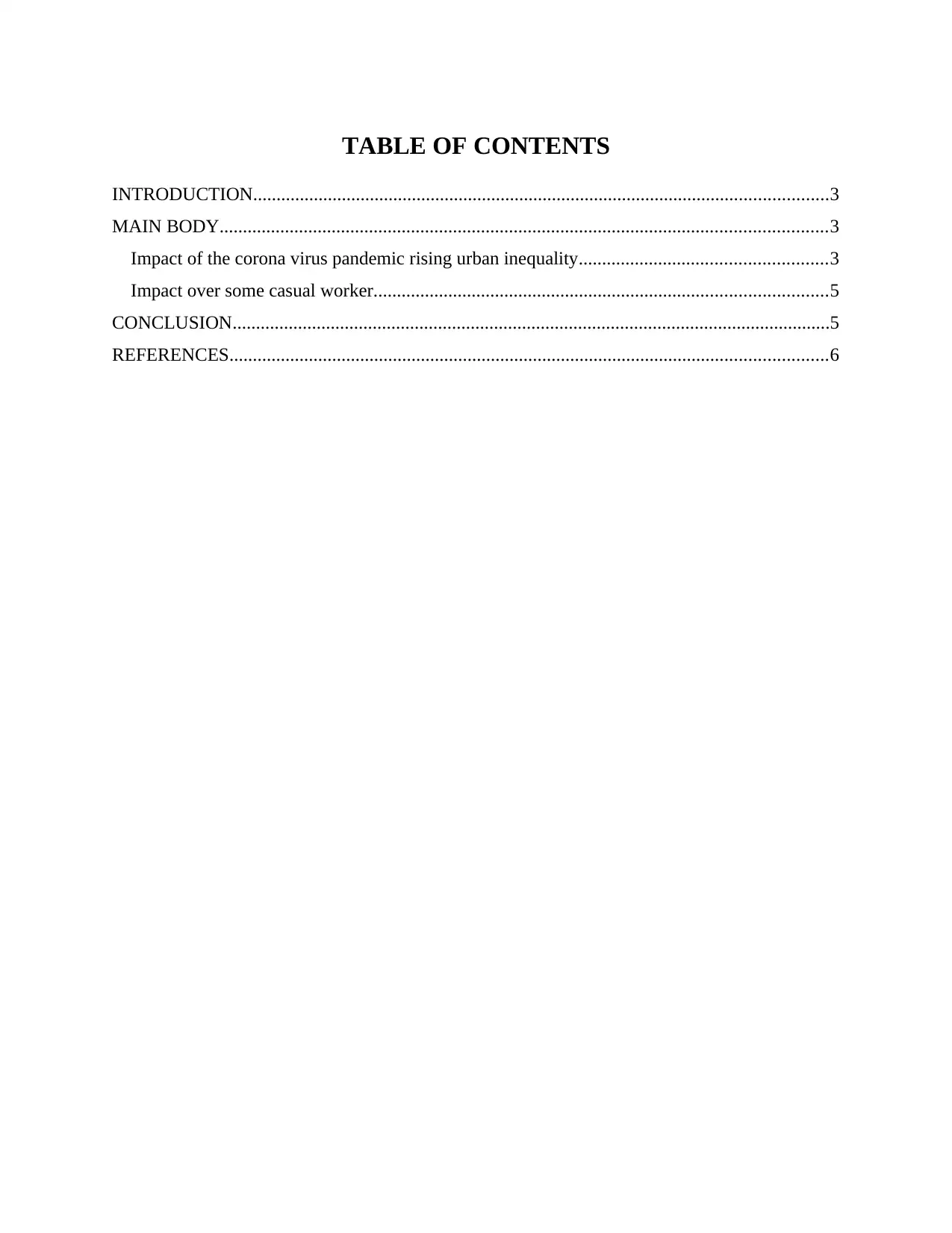
TABLE OF CONTENTS
INTRODUCTION...........................................................................................................................3
MAIN BODY..................................................................................................................................3
Impact of the corona virus pandemic rising urban inequality.....................................................3
Impact over some casual worker.................................................................................................5
CONCLUSION................................................................................................................................5
REFERENCES................................................................................................................................6
Document Page
INTRODUCTION
This report discuss about the concepts of urban manual and causal worker effected due to
having the Covid-19. It could also covering about the issue and challenges due to virus along
with this also give the entitlement to make their jobs for flexible as re-more office.
MAIN BODY
Impact of the corona virus pandemic rising urban inequality
The occupation of causal worker are sales person, carers, hospitality worker and sales
support workers or food preparation workers. This workers are being more effective due to
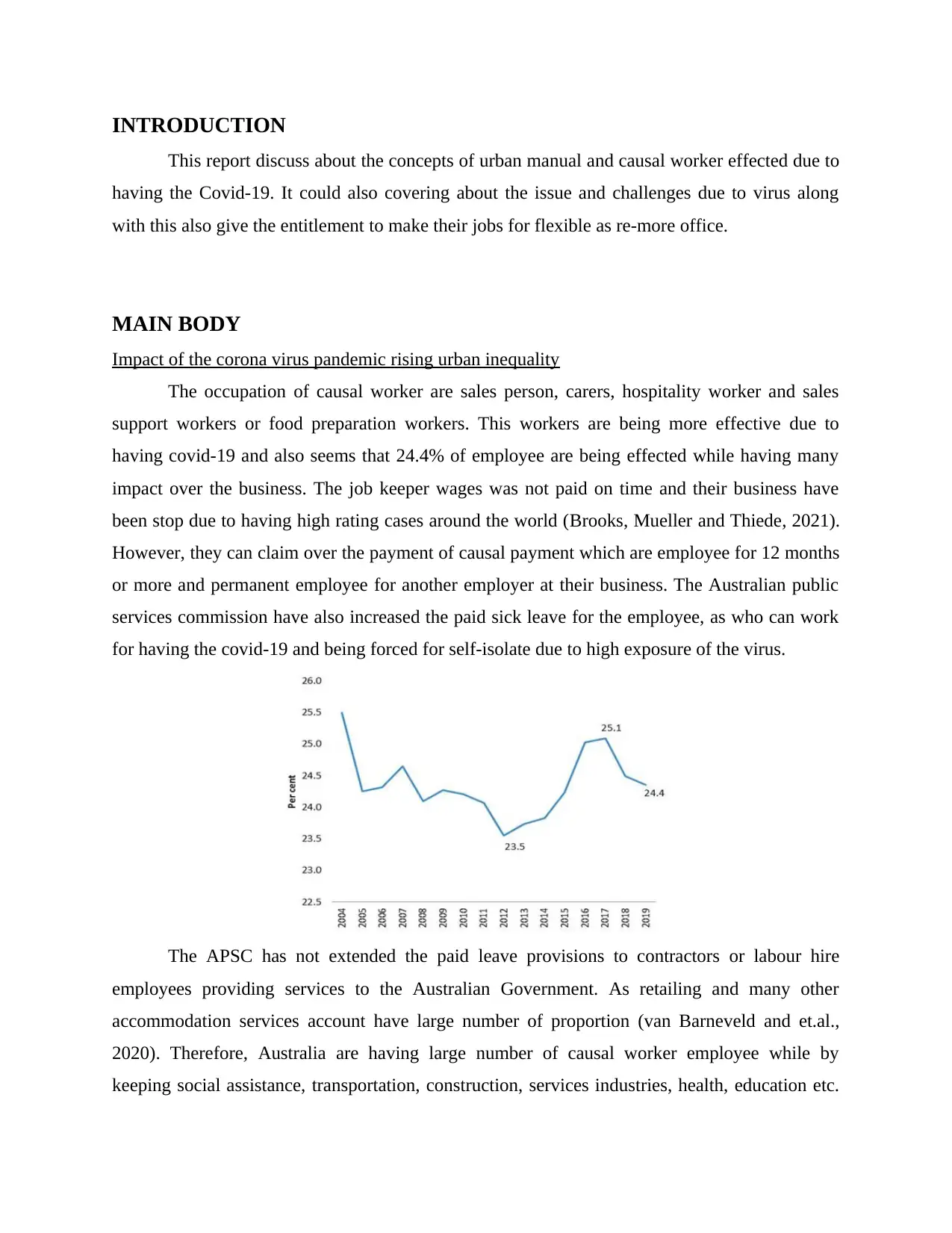
having covid-19 and also seems that 24.4% of employee are being effected while having many
impact over the business. The job keeper wages was not paid on time and their business have
been stop due to having high rating cases around the world (Brooks, Mueller and Thiede, 2021).
However, they can claim over the payment of causal payment which are employee for 12 months
or more and permanent employee for another employer at their business. The Australian public
services commission have also increased the paid sick leave for the employee, as who can work
for having the covid-19 and being forced for self-isolate due to high exposure of the virus.
The APSC has not extended the paid leave provisions to contractors or labour hire
employees providing services to the Australian Government. As retailing and many other
accommodation services account have large number of proportion (van Barneveld and et.al.,
2020). Therefore, Australia are having large number of causal worker employee while by
keeping social assistance, transportation, construction, services industries, health, education etc.
Document Page
As this worker are being more effected and government have also acquired for paying about the
activities about how the situation as they deal. In many other countries government have also
decided for paying the business who are facing issues due to having financial crisis in Covid-19.
Hence, the data have been said that large reduction have been done in urban states and that could
inequalities about their health issues and more about the job maker.
In modern time, many of the employee are being fired due to having Covid-19 and many
of the business have adopted the technology in which they cannot work with employee. Along
with this some of the organization are must be required with having high effective employee and
well-educated in which they can easily make sure for having customer satisfaction (Kelkar and
et.al., 2020). So for that they have found out some of the solution in which they have decided for
having technology things so that could care more about the social distancing. Around half of the
population have been effected due to virus and many of them have lost their jobs. Immigrants are
younger on average than having jobs and less susceptible for developing effects from the Covid-
19. Moreover, which might be important for the young people for having jobs in which they can
keep their life and families to be more secure.
Around 30% of native poverty are suffering from job in which they are not getting
payment and which might be important for them in which they are required for keeping the
effective role and make sure for having the proper jobs. Furthermore, economic system of the
countries have to also pay loss for their growth and that could also have bed impact over their
income sources (Nguyen, Hargittai and Marler, 2021). Labour professions have given more
entitlement in which they can secure more about those things which could keep their attraction
for having jobs and make their future aspects. On other hand, employment is many of sector are
still working and try to make sure for securing about their jobs in which they keep better
environment. This have been discussed that Covid-19 spread, companies have set up the non
human things which decrease the labour work and keep the work with having technology.
Various industries such as 80% of them have set up digital platform in which they have
think about the less employee and fired out many employee due to not having many income
sources. The organization have also pay the long income sources in which they cannot work and
destroy their business due to not proper income sources. Interest for robots to do certain positions
will likewise keep on rising (Kamalipour and Peimani, 2021). As Covid-19 spreads,
organizations dependence on nonhuman work will probably develop, while internet business and
tabler-icon-diamond-filled.svg

Paraphrase This Document

Need a fresh take? Get an instant paraphrase of this document with our AI Paraphraser
Document Page
e-plans of action in view of computerized stages keep growing quickly. Advanced mechanics are
likewise liable be utilized more for general wellbeing in wide reach of assignments, like
sanitization or estimating crucial signs, while ensuring forefront medical services labours.
Impact over some casual worker.
Casual worker are specific danger. An enormous portion of casual business is in areas
that are somewhat more helpless, such as assembling, discount and retail exchange,
transportation and capacity, and convenience and food administrations. Casual area work
includes low abilities, low efficiency. Furthermore, low capital venture and is dependent upon a
higher danger of work misfortunes (Beker, 2020). Also, labour in the casual area regularly
acquire low wages have little admittance to social assurance inclusion. While many of the people
are suffering with the many financial issues in which they cannot complete with their families
and their future are being finished. As the organization have also set up the e-plan for their
employee in which they can keep their customer also satisfy and employee who are working at
their store. This could be also important for understanding about the situation of the people who
cannot work and for that government have to pass out some of the rules in which they can work
and make their future bright.
The manual worker should found out some better jobs which companies have not been
effected by the lock down and make sure for securing about their jobs. While having such things
government of Australia have decided for keeping the high skills and knowledgeable employee
in which they can easily come to know about how they can deal over the situation (Allen,
Hofmann and Leblond, 2021). The casual worker are being 56% percent are working at their
organization with having proper package system from their companies side. Although, this could
important for which the concepts must be clear and that might be also essential for taking high
positive thinking about the good things which could give some power for having jobs in proper
countries along with organization.
CONCLUSION
From the above report it had been seems that, Covid-19 have been highly effected to the
worker who are working with low paid wages and for that government have to fixed something
in which they can easily make sure about their life. While this have been also seems that people
are working hard for securing about their jobs.
Document Page
REFERENCES
Books and journals
Allen, A., Hofmann, P. and Leblond, N., 2021. COVID-19: A turning point to further sanitation
justice?. Interdisciplinary Perspectives on Equality and Diversity.
Beker, V.A., 2020. Poverty and income inequality: a complex relationship. real-world economics
review, p.167.
Brooks, M.M., Mueller, J.T. and Thiede, B.C., 2021. Rural-Urban Differences in the Labor-
Force Impacts of COVID-19 in the United States. Socius. 7. p.23780231211022094.
Kamalipour, H. and Peimani, N., 2021. Informal urbanism in the state of uncertainty: forms of
informality and urban health emergencies. Urban Design International. 26(2). pp.122-
134.
Kelkar, G. and et.al., 2020. Gendered Impacts of the COVID-19 Pandemic. Journal of
Development Policy Review. 1(1). pp.101-118.
Nguyen, M.H., Hargittai, E. and Marler, W., 2021. Digital inequality in communication during a
time of physical distancing: The case of COVID-19. Computers in Human Behavior. 120.
p.106717.
van Barneveld, K. and et.al., 2020. The COVID-19 pandemic: Lessons on building more equal
and sustainable societies. The Economic and Labour Relations Review. 31(2). pp.133-
157.
Document Page
1
chevron_up_icon
1 out of 7
circle_padding
hide_on_mobile
zoom_out_icon
[object Object]