Recoverable Amount, Value-in-Use, and Fair Value in Accounting
VerifiedAdded on 2023/06/11
|11
|1385
|316
Essay
AI Summary
This essay provides a detailed explanation of the process used to compute the "recoverable amount", the "value-in-use", and the "fair value less the disposal cost" in corporate accounting. It emphasizes the importance of these calculations for maintaining accurate financial records and understanding asset impairment. The recoverable amount is defined as the higher of an asset's fair value less costs of disposal and its value in use, with IAS 36 standards guiding the calculation. The essay also explains how the value-in-use is determined by discounting future cash flows and how the fair value less disposal cost is used in asset impairment evaluations. These concepts are interconnected and crucial for determining asset and market values.
Running head: CORPORATE ACCOUNTING
Corporate Accounting
Name of the Student:
Name of the University:
Author’s Note:
Corporate Accounting
Name of the Student:
Name of the University:
Author’s Note:
Paraphrase This Document
Need a fresh take? Get an instant paraphrase of this document with our AI Paraphraser

1
CORPORATE ACCOUNTING
Table of Contents
Part A.................................................................................................................................2
Introduction.....................................................................................................................2
Calculation of the “Recoverable Amount, “Value-in-use” and “Fair value less disposal
cost”................................................................................................................................3
Conclusion......................................................................................................................7
Part B.................................................................................................................................8
Reference List..................................................................................................................10
CORPORATE ACCOUNTING
Table of Contents
Part A.................................................................................................................................2
Introduction.....................................................................................................................2
Calculation of the “Recoverable Amount, “Value-in-use” and “Fair value less disposal
cost”................................................................................................................................3
Conclusion......................................................................................................................7
Part B.................................................................................................................................8
Reference List..................................................................................................................10

2
CORPORATE ACCOUNTING
Part A
Introduction
The essay that has been taken into consideration has the intention of providing
an explanation of the process that is used in order to compute the “recoverable
amount”, the “value-in-use” and the “fair value less the disposal cost”. The companies
that are opertsational in the economy looks to maintain their financial records and
therefore constructs financial statements where all the transactions and the financial
assets and liabilities are recorded. The assets need to be given additional assistance in
order to value them in a precise way in order to understand the profit for the business in
a batter way. Therefore, the calculation of the above addressed terms is essential in
order to true and authentic financial reports.
CORPORATE ACCOUNTING
Part A
Introduction
The essay that has been taken into consideration has the intention of providing
an explanation of the process that is used in order to compute the “recoverable
amount”, the “value-in-use” and the “fair value less the disposal cost”. The companies
that are opertsational in the economy looks to maintain their financial records and
therefore constructs financial statements where all the transactions and the financial
assets and liabilities are recorded. The assets need to be given additional assistance in
order to value them in a precise way in order to understand the profit for the business in
a batter way. Therefore, the calculation of the above addressed terms is essential in
order to true and authentic financial reports.
⊘ This is a preview!⊘
Do you want full access?
Subscribe today to unlock all pages.

Trusted by 1+ million students worldwide

3
CORPORATE ACCOUNTING
Calculation of the “Recoverable Amount, “Value-in-use” and “Fair value less
disposal cost”
Recoverable Amount
This known to be a term related to accounts that addresses the asset market
value which is either higher or the value that is disclosed by the business enterprise
which are utilised in the current operational activities of the business. The concept of
this term is undertaken in order to have an understanding of the impairment of the fixed
assets (Baboukardos and Rimmel 2014). This amount is known as the optimum value,
which an asset can attain. In general there are two processes by taking help of which
this value can be computed and they are either by using the business asset or by the
sell off the asset.
The asset value of a firm is referred to the present value of the future cash flows
that is projected, that the asset makes use of. The value of the asset that is sold off is
referred to as the asset fair value deducted by the cost incurred to sell off the asset. The
recovered amount, which is seen to be higher of the two, is called the “recoverable
amount”. This amount is essential for the purpose of undertaking impairment.
“Recoverable amount” is regarded to be the highest value as the administration of a
company has the intention of selecting that alternative, which would be able to given out
the optimum capability (Price 2015).
The fundamentals of accounting ask the companies to main a record for their
activities within the balance sheet in circumstances when the “carrying value” of the
asset is more than the recovered amount. It is seen in circumstances like when a
CORPORATE ACCOUNTING
Calculation of the “Recoverable Amount, “Value-in-use” and “Fair value less
disposal cost”
Recoverable Amount
This known to be a term related to accounts that addresses the asset market
value which is either higher or the value that is disclosed by the business enterprise
which are utilised in the current operational activities of the business. The concept of
this term is undertaken in order to have an understanding of the impairment of the fixed
assets (Baboukardos and Rimmel 2014). This amount is known as the optimum value,
which an asset can attain. In general there are two processes by taking help of which
this value can be computed and they are either by using the business asset or by the
sell off the asset.
The asset value of a firm is referred to the present value of the future cash flows
that is projected, that the asset makes use of. The value of the asset that is sold off is
referred to as the asset fair value deducted by the cost incurred to sell off the asset. The
recovered amount, which is seen to be higher of the two, is called the “recoverable
amount”. This amount is essential for the purpose of undertaking impairment.
“Recoverable amount” is regarded to be the highest value as the administration of a
company has the intention of selecting that alternative, which would be able to given out
the optimum capability (Price 2015).
The fundamentals of accounting ask the companies to main a record for their
activities within the balance sheet in circumstances when the “carrying value” of the
asset is more than the recovered amount. It is seen in circumstances like when a
Paraphrase This Document
Need a fresh take? Get an instant paraphrase of this document with our AI Paraphraser

4
CORPORATE ACCOUNTING
company looks to undertake estimation that the worth of an asset is impaired, at that
moment the firm initiates a formal estimation of the amount that can be recovered. The
approach makes sense with the concept of reducing the expenses or in reduction in the
market worth that is associated to the inventory. IAS 36 has asked the financial experts
to undertake the same and this addressed with the help of the phases that have been
outlined below:
In case the asset fair value after deduction from the disposal cost is not
calculated, then the amount that is recoverable is and the value-in-use is equal
(Iasplus.com. 2018).
In circumstances when the firm is selling off the assets, then the amount that is
recoverable is equivalent to the fair value deducted by the disposal expense.
André, Dionysiou and Tsalavoutas (2018) explained that in case of an asset’s fair
value deducted by the cost of disposal and the asset worth, which is being utilised is
more than the carrying value, then it is not necessary to calculate the recoverable
amount because of the fact that the asset need not be impaired.
The recoverable value is prepared by:
“Recoverable Amount = Fair Value- Cost of Disposal”
And
“Recoverable Amount = Value-in-Use”
CORPORATE ACCOUNTING
company looks to undertake estimation that the worth of an asset is impaired, at that
moment the firm initiates a formal estimation of the amount that can be recovered. The
approach makes sense with the concept of reducing the expenses or in reduction in the
market worth that is associated to the inventory. IAS 36 has asked the financial experts
to undertake the same and this addressed with the help of the phases that have been
outlined below:
In case the asset fair value after deduction from the disposal cost is not
calculated, then the amount that is recoverable is and the value-in-use is equal
(Iasplus.com. 2018).
In circumstances when the firm is selling off the assets, then the amount that is
recoverable is equivalent to the fair value deducted by the disposal expense.
André, Dionysiou and Tsalavoutas (2018) explained that in case of an asset’s fair
value deducted by the cost of disposal and the asset worth, which is being utilised is
more than the carrying value, then it is not necessary to calculate the recoverable
amount because of the fact that the asset need not be impaired.
The recoverable value is prepared by:
“Recoverable Amount = Fair Value- Cost of Disposal”
And
“Recoverable Amount = Value-in-Use”

5
CORPORATE ACCOUNTING
“Value-in-use”
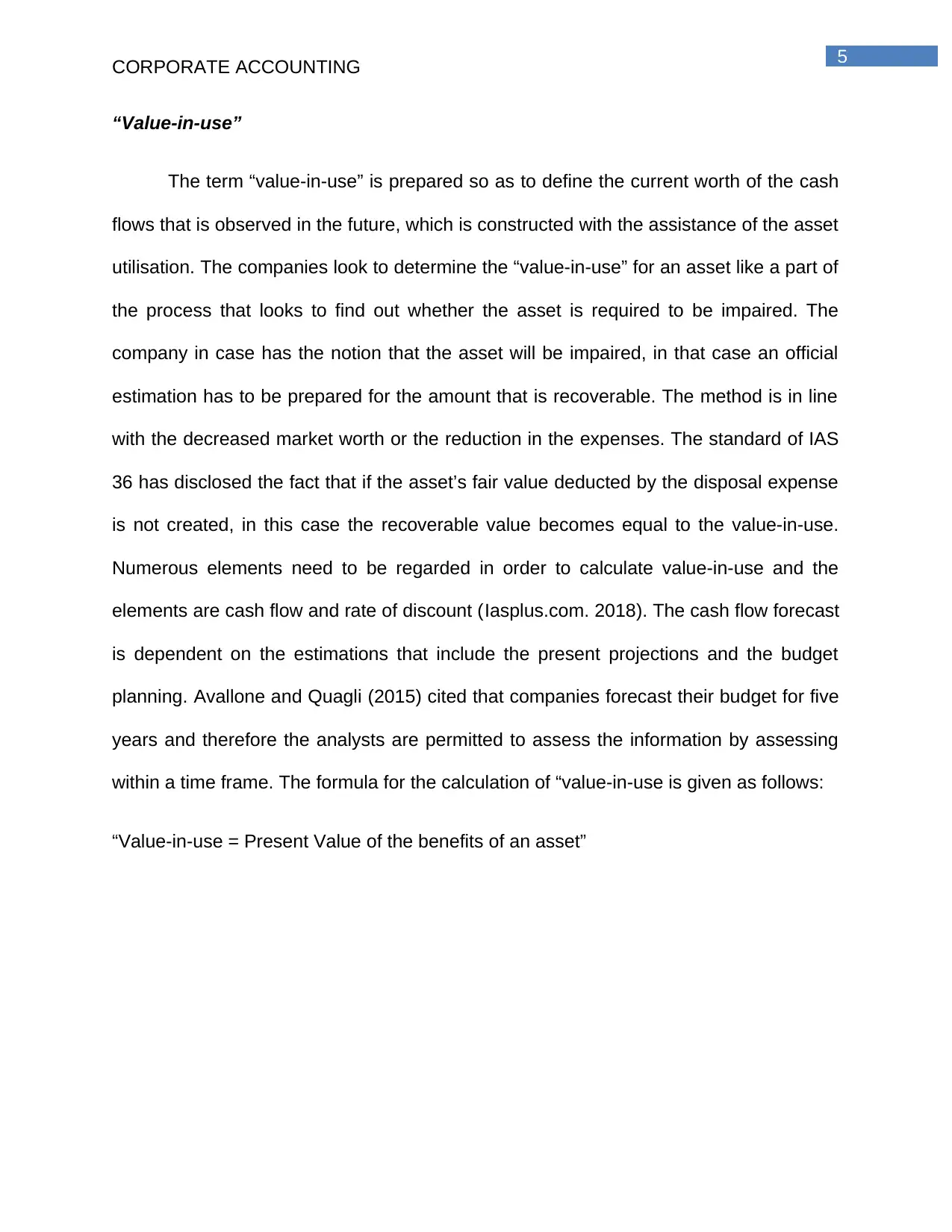
The term “value-in-use” is prepared so as to define the current worth of the cash
flows that is observed in the future, which is constructed with the assistance of the asset
utilisation. The companies look to determine the “value-in-use” for an asset like a part of
the process that looks to find out whether the asset is required to be impaired. The
company in case has the notion that the asset will be impaired, in that case an official
estimation has to be prepared for the amount that is recoverable. The method is in line
with the decreased market worth or the reduction in the expenses. The standard of IAS
36 has disclosed the fact that if the asset’s fair value deducted by the disposal expense
is not created, in this case the recoverable value becomes equal to the value-in-use.
Numerous elements need to be regarded in order to calculate value-in-use and the
elements are cash flow and rate of discount (Iasplus.com. 2018). The cash flow forecast
is dependent on the estimations that include the present projections and the budget
planning. Avallone and Quagli (2015) cited that companies forecast their budget for five
years and therefore the analysts are permitted to assess the information by assessing
within a time frame. The formula for the calculation of “value-in-use is given as follows:
“Value-in-use = Present Value of the benefits of an asset”
CORPORATE ACCOUNTING
“Value-in-use”
The term “value-in-use” is prepared so as to define the current worth of the cash
flows that is observed in the future, which is constructed with the assistance of the asset
utilisation. The companies look to determine the “value-in-use” for an asset like a part of
the process that looks to find out whether the asset is required to be impaired. The
company in case has the notion that the asset will be impaired, in that case an official
estimation has to be prepared for the amount that is recoverable. The method is in line
with the decreased market worth or the reduction in the expenses. The standard of IAS
36 has disclosed the fact that if the asset’s fair value deducted by the disposal expense
is not created, in this case the recoverable value becomes equal to the value-in-use.
Numerous elements need to be regarded in order to calculate value-in-use and the
elements are cash flow and rate of discount (Iasplus.com. 2018). The cash flow forecast
is dependent on the estimations that include the present projections and the budget
planning. Avallone and Quagli (2015) cited that companies forecast their budget for five
years and therefore the analysts are permitted to assess the information by assessing
within a time frame. The formula for the calculation of “value-in-use is given as follows:
“Value-in-use = Present Value of the benefits of an asset”
⊘ This is a preview!⊘
Do you want full access?
Subscribe today to unlock all pages.

Trusted by 1+ million students worldwide

6
CORPORATE ACCOUNTING
Fair Value less disposal cost
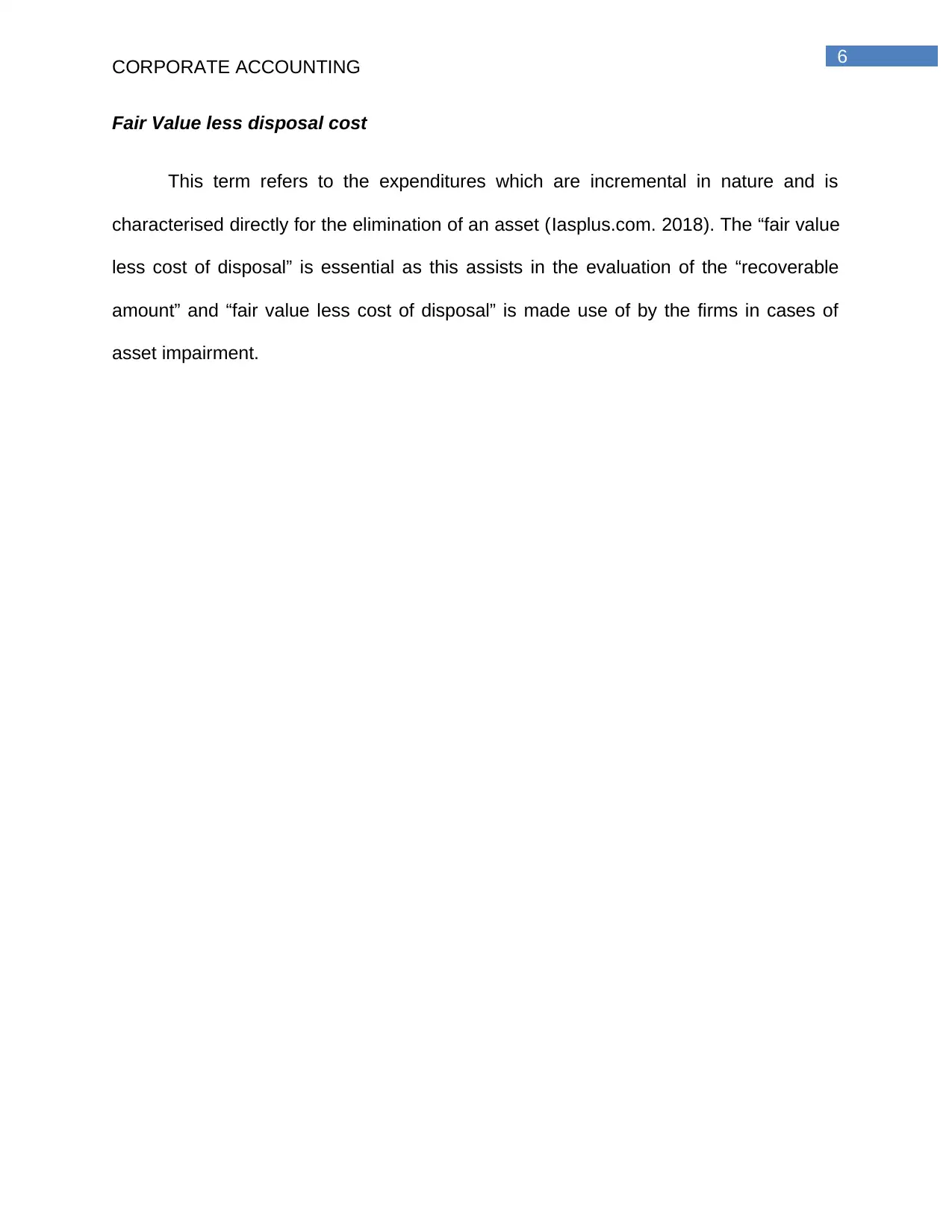
This term refers to the expenditures which are incremental in nature and is
characterised directly for the elimination of an asset (Iasplus.com. 2018). The “fair value
less cost of disposal” is essential as this assists in the evaluation of the “recoverable
amount” and “fair value less cost of disposal” is made use of by the firms in cases of
asset impairment.
CORPORATE ACCOUNTING
Fair Value less disposal cost
This term refers to the expenditures which are incremental in nature and is
characterised directly for the elimination of an asset (Iasplus.com. 2018). The “fair value
less cost of disposal” is essential as this assists in the evaluation of the “recoverable
amount” and “fair value less cost of disposal” is made use of by the firms in cases of
asset impairment.
Paraphrase This Document
Need a fresh take? Get an instant paraphrase of this document with our AI Paraphraser

7
CORPORATE ACCOUNTING
Conclusion
The explanations that have been provided in this essay are in line with the
answers that have been asked and the elucidation of the financial terms addresses the
fact that all the three words are connected to each other as these values are calculated
in a similar pattern. It is seen that during the impairment of an asset these values are
mostly calculated by the financial professionals in order to provide the companies with
the idea of the optimum amount that can be attained and can be utilised by the
companies in order to determine the asset as well as the market values.
CORPORATE ACCOUNTING
Conclusion
The explanations that have been provided in this essay are in line with the
answers that have been asked and the elucidation of the financial terms addresses the
fact that all the three words are connected to each other as these values are calculated
in a similar pattern. It is seen that during the impairment of an asset these values are
mostly calculated by the financial professionals in order to provide the companies with
the idea of the optimum amount that can be attained and can be utilised by the
companies in order to determine the asset as well as the market values.

8
CORPORATE ACCOUNTING
Part B
CORPORATE ACCOUNTING
Part B
⊘ This is a preview!⊘
Do you want full access?
Subscribe today to unlock all pages.

Trusted by 1+ million students worldwide

9
CORPORATE ACCOUNTING
Paraphrase This Document
Need a fresh take? Get an instant paraphrase of this document with our AI Paraphraser

10
CORPORATE ACCOUNTING
Reference List
André, P., Dionysiou, D. and Tsalavoutas, I., 2018. Mandated disclosures under IAS 36
Impairment of Assets and IAS 38 Intangible Assets: value relevance and impact on
analysts’ forecasts. Applied Economics, 50(7), pp.707-725.
Avallone, F. and Quagli, A., 2015. Insight into the variables used to manage the
goodwill impairment test under IAS 36. Advances in Accounting, 31(1), pp.107-114.
Baboukardos, D. and Rimmel, G., 2014, March. Goodwill under IFRS: Relevance and
disclosures in an unfavorable environment. In Accounting Forum (Vol. 38, No. 1, pp. 1-
17). Elsevier.
Iasplus.com. (2018). IAS 36 — Impairment of Assets. [online] Available at:
https://www.iasplus.com/en/standards/ias/ias36
Price, J., 2015. The regulator: Understanding impairment. Company Director, 31(7),
p.12.
CORPORATE ACCOUNTING
Reference List
André, P., Dionysiou, D. and Tsalavoutas, I., 2018. Mandated disclosures under IAS 36
Impairment of Assets and IAS 38 Intangible Assets: value relevance and impact on
analysts’ forecasts. Applied Economics, 50(7), pp.707-725.
Avallone, F. and Quagli, A., 2015. Insight into the variables used to manage the
goodwill impairment test under IAS 36. Advances in Accounting, 31(1), pp.107-114.
Baboukardos, D. and Rimmel, G., 2014, March. Goodwill under IFRS: Relevance and
disclosures in an unfavorable environment. In Accounting Forum (Vol. 38, No. 1, pp. 1-
17). Elsevier.
Iasplus.com. (2018). IAS 36 — Impairment of Assets. [online] Available at:
https://www.iasplus.com/en/standards/ias/ias36
Price, J., 2015. The regulator: Understanding impairment. Company Director, 31(7),
p.12.
1 out of 11
Related Documents
Your All-in-One AI-Powered Toolkit for Academic Success.
+13062052269
info@desklib.com
Available 24*7 on WhatsApp / Email
Unlock your academic potential
Copyright © 2020–2026 A2Z Services. All Rights Reserved. Developed and managed by ZUCOL.