Corporate Finance Report: Netflix's Dividend and Capital Structure
VerifiedAdded on 2022/08/17
|9
|1974
|14
Report
AI Summary
This report examines the corporate finance issues faced by Netflix, a leading internet streaming service. The analysis focuses on two key areas: dividend policy and capital structure. The report delves into the nature of the issues, such as the challenges of paying dividends for a growth-oriented company with significant content investment needs and the implications of negative free cash flow and increasing debt. It also addresses the capital structure policy, including the company's debt levels relative to market capitalization and the strategies for managing debt to maintain financial flexibility. The report proposes strategies for dealing with these issues, emphasizing the importance of a capital allocation strategy, maintaining an optimal debt-to-market capitalization ratio, and aligning financial strategies with long-term growth objectives. The conclusion summarizes the findings, highlighting the company-specific nature of dividend decisions and the need for Netflix to adopt appropriate strategies for managing its capital structure and financial risks. The report references several academic sources to support its analysis.
Running head: REPORT 0
Corporate finance issue
FEBRUARY 25, 2020
STUDENT DETAILS:
Corporate finance issue
FEBRUARY 25, 2020
STUDENT DETAILS:
Paraphrase This Document
Need a fresh take? Get an instant paraphrase of this document with our AI Paraphraser

REPORT 1
Contents
Introduction......................................................................................................................................2
Issue 1 – Dividend Policy................................................................................................................2
Nature of issue.............................................................................................................................2
Strategies for dealing with these issues........................................................................................3
Issue 2 – Capital structure policy.....................................................................................................3
Nature of issue.............................................................................................................................3
Strategies for dealing with these issues........................................................................................3
Conclusion.......................................................................................................................................4
References........................................................................................................................................5
Contents
Introduction......................................................................................................................................2
Issue 1 – Dividend Policy................................................................................................................2
Nature of issue.............................................................................................................................2
Strategies for dealing with these issues........................................................................................3
Issue 2 – Capital structure policy.....................................................................................................3
Nature of issue.............................................................................................................................3
Strategies for dealing with these issues........................................................................................3
Conclusion.......................................................................................................................................4
References........................................................................................................................................5

REPORT 2
Introduction
Netflix Inc. is the innovator in Internet delivery of movie as well as TV shows. It launches the
streaming service in year 2007. This company transforms the manner people watch movies and
series. The company has above thirty millions streaming subscribers in Canada, Latin America,
USA, Ireland, UK along with Nordics. It is top internet subscription service provider to enjoy
Television programmes as well as movies. For one low monthly price, the subscribers of the
Netflix can rapidly watch televisions programs and series streamed over net to PCs, TV, as well
as Macs. It can see that the decision of paying dividend is based on several factors. There are
also certain problems to be taken into consideration before returning capital to the shareholder
with dividend. Netflix looks forward to requirements of high capital required to continue to
develop business. In the following parts, the financial corporate issues of Netflix such as
dividend policy and capital structure policy are discussed. This report also discusses the
strategies for dealing with these issues.
Issue 1 – Dividend Policy
Nature of issue
The dividend is significant part of the capital allocation programmes. For this reason, various
companies are paying dividend. It is evident that the dividend is considered as appreciated source
of the income for retiree. The dividend can be helpful for the retired investor to replace income
they misplaced while they stopped doing work. It can see that expenditures are continued even
while individuals are no longer getting paycheck from the employers (Schwartz, 2016). In this
way, the dividend can be significant elements of the retirement plan approach. However, the
growing entities such as Netflix differ from the time-evaluated dividend stocks, such as Johnson
& Johnson as well as Coca-Cola. Therefore, they still require spending huge sum of capital upon
Introduction
Netflix Inc. is the innovator in Internet delivery of movie as well as TV shows. It launches the
streaming service in year 2007. This company transforms the manner people watch movies and
series. The company has above thirty millions streaming subscribers in Canada, Latin America,
USA, Ireland, UK along with Nordics. It is top internet subscription service provider to enjoy
Television programmes as well as movies. For one low monthly price, the subscribers of the
Netflix can rapidly watch televisions programs and series streamed over net to PCs, TV, as well
as Macs. It can see that the decision of paying dividend is based on several factors. There are
also certain problems to be taken into consideration before returning capital to the shareholder
with dividend. Netflix looks forward to requirements of high capital required to continue to
develop business. In the following parts, the financial corporate issues of Netflix such as
dividend policy and capital structure policy are discussed. This report also discusses the
strategies for dealing with these issues.
Issue 1 – Dividend Policy
Nature of issue
The dividend is significant part of the capital allocation programmes. For this reason, various
companies are paying dividend. It is evident that the dividend is considered as appreciated source
of the income for retiree. The dividend can be helpful for the retired investor to replace income
they misplaced while they stopped doing work. It can see that expenditures are continued even
while individuals are no longer getting paycheck from the employers (Schwartz, 2016). In this
way, the dividend can be significant elements of the retirement plan approach. However, the
growing entities such as Netflix differ from the time-evaluated dividend stocks, such as Johnson
& Johnson as well as Coca-Cola. Therefore, they still require spending huge sum of capital upon
⊘ This is a preview!⊘
Do you want full access?
Subscribe today to unlock all pages.

Trusted by 1+ million students worldwide

REPORT 3
the contents to develop. It is essential expenditure if Netflix plan to not only keep, but also
increase the subscriber’s base in upcoming period. While there are certainly good reasons for
paying a dividend, there remain valid reasons for not doing so. Paying a dividend requires cash
flow needed to cover payments. Netflix does not make consistent profitability. In this way, it will
face difficulty in finding cash to return to shareholder on the three-monthly basis (Thompson,
2019).
Further, the company spent $ 13 billion on the personal contents previous year. It was increased
by 33 % from the last years. It is required by the company to make competition with its
opponents such as Hulu, Amazon, as well as Walt Disney Company, by stating that the rate of
spending would be increased from here. The company can never make payment of dividend to
the shareholders due to this reason. Additionally, EPS of last year was $ 2.68. It was highest
annual EPS of the company (Flew, Martin and Suzor, 2018). When the organisation technically
can make payment of dividend based on this, the company continues to utilise the cash flow on
growth initiatives for enhancing the pool of subscribers. For this reason, the company has not
succeed to make positive free cash flow. In reality, Netflix had negative cash flow from the past
six years, with quickening negative cash flows over this time. In 2013, it had negative free cash
flow to some extent above $ 16 million. It had negative free cash flow of $ 3 billion in 2018. It is
found that the negative free cash flow has been reached as high as $ 3.5 billion in 2019 (Stone,
2017).
Furthermore, utilising larger amount of capital also signifies that Netflix has to access debt
marketplaces to make spending. It puts impact on the balance sheet by providing different
obstacles to the dividend in upcoming period. In the end of third quarter of 2019, the company
had $ 12.4 billion long-term debts in against of $ 4.4 billion of cash and cash equivalent. This
the contents to develop. It is essential expenditure if Netflix plan to not only keep, but also
increase the subscriber’s base in upcoming period. While there are certainly good reasons for
paying a dividend, there remain valid reasons for not doing so. Paying a dividend requires cash
flow needed to cover payments. Netflix does not make consistent profitability. In this way, it will
face difficulty in finding cash to return to shareholder on the three-monthly basis (Thompson,
2019).
Further, the company spent $ 13 billion on the personal contents previous year. It was increased
by 33 % from the last years. It is required by the company to make competition with its
opponents such as Hulu, Amazon, as well as Walt Disney Company, by stating that the rate of
spending would be increased from here. The company can never make payment of dividend to
the shareholders due to this reason. Additionally, EPS of last year was $ 2.68. It was highest
annual EPS of the company (Flew, Martin and Suzor, 2018). When the organisation technically
can make payment of dividend based on this, the company continues to utilise the cash flow on
growth initiatives for enhancing the pool of subscribers. For this reason, the company has not
succeed to make positive free cash flow. In reality, Netflix had negative cash flow from the past
six years, with quickening negative cash flows over this time. In 2013, it had negative free cash
flow to some extent above $ 16 million. It had negative free cash flow of $ 3 billion in 2018. It is
found that the negative free cash flow has been reached as high as $ 3.5 billion in 2019 (Stone,
2017).
Furthermore, utilising larger amount of capital also signifies that Netflix has to access debt
marketplaces to make spending. It puts impact on the balance sheet by providing different
obstacles to the dividend in upcoming period. In the end of third quarter of 2019, the company
had $ 12.4 billion long-term debts in against of $ 4.4 billion of cash and cash equivalent. This
Paraphrase This Document
Need a fresh take? Get an instant paraphrase of this document with our AI Paraphraser

REPORT 4
increase in interest-bearing debt makes it that much more difficult for Netflix to offer
shareholders a dividend. Based on these facts, the dividend cannot be the good choice for Netflix
to give debt repayment as well as spending higher priority for the administration (Hugh and Mac,
2018).
Strategies for dealing with these issues
It is required by Netflix to change its capital allocation strategy over the period. With the help of
improved capital allocation strategy, the payment of dividend can become more likely as the
business grows (Bahnsen, 2019). The appropriateness of return of cash to the shareholders can be
maintained by assessing the level of strong profitability, and opportunities of development.
When this is probable that the company will pay dividend one day. This is not possible.
However, if entity successfully overcomes its rivals and becomes immensely profitable, then it
can take an option to make payment of dividend at that stage. But as cost of content would
continue to bear on Netflix, with a large amount of debt on the balance sheet, the investors are
not required to expect the payment of dividend any period (Alves, 2019).
Issue 2 – Capital structure policy
Nature of issue
At -$ 276 million, the company had negative cash flows for 4th quarter in 2015 as the entity
continued making investment in the original programming (Prabhu, 2016). It is stated by the
company in earning letter to the shareholders that its investment in original programming needs
“more cash upfront relative to licensed contents that would continue to diminish free cash
flows.” It is found that the company recorded debt of $2.4 billion, as well as cash and cash
equivalents of $2.3 billion on the balance sheet in fourth quarter of 2015. It was resulted into net
debt of $ 0.1 billion. It was also stated in the earnings letter to shareholders that despite the free
increase in interest-bearing debt makes it that much more difficult for Netflix to offer
shareholders a dividend. Based on these facts, the dividend cannot be the good choice for Netflix
to give debt repayment as well as spending higher priority for the administration (Hugh and Mac,
2018).
Strategies for dealing with these issues
It is required by Netflix to change its capital allocation strategy over the period. With the help of
improved capital allocation strategy, the payment of dividend can become more likely as the
business grows (Bahnsen, 2019). The appropriateness of return of cash to the shareholders can be
maintained by assessing the level of strong profitability, and opportunities of development.
When this is probable that the company will pay dividend one day. This is not possible.
However, if entity successfully overcomes its rivals and becomes immensely profitable, then it
can take an option to make payment of dividend at that stage. But as cost of content would
continue to bear on Netflix, with a large amount of debt on the balance sheet, the investors are
not required to expect the payment of dividend any period (Alves, 2019).
Issue 2 – Capital structure policy
Nature of issue
At -$ 276 million, the company had negative cash flows for 4th quarter in 2015 as the entity
continued making investment in the original programming (Prabhu, 2016). It is stated by the
company in earning letter to the shareholders that its investment in original programming needs
“more cash upfront relative to licensed contents that would continue to diminish free cash
flows.” It is found that the company recorded debt of $2.4 billion, as well as cash and cash
equivalents of $2.3 billion on the balance sheet in fourth quarter of 2015. It was resulted into net
debt of $ 0.1 billion. It was also stated in the earnings letter to shareholders that despite the free

REPORT 5
cash flow being negative, the bond of company has BB credit rating. Additionally, the BB credit
rating states that the bond issued by entity is relatively less susceptible to the issues related to
non-payment obligations. The company also has a low debt-to-market capitalization ratio that
state it has less debts compared to the market value (Budzinski and Lindstädt-Dreusicke, 2019).
Strategies for dealing with these issues
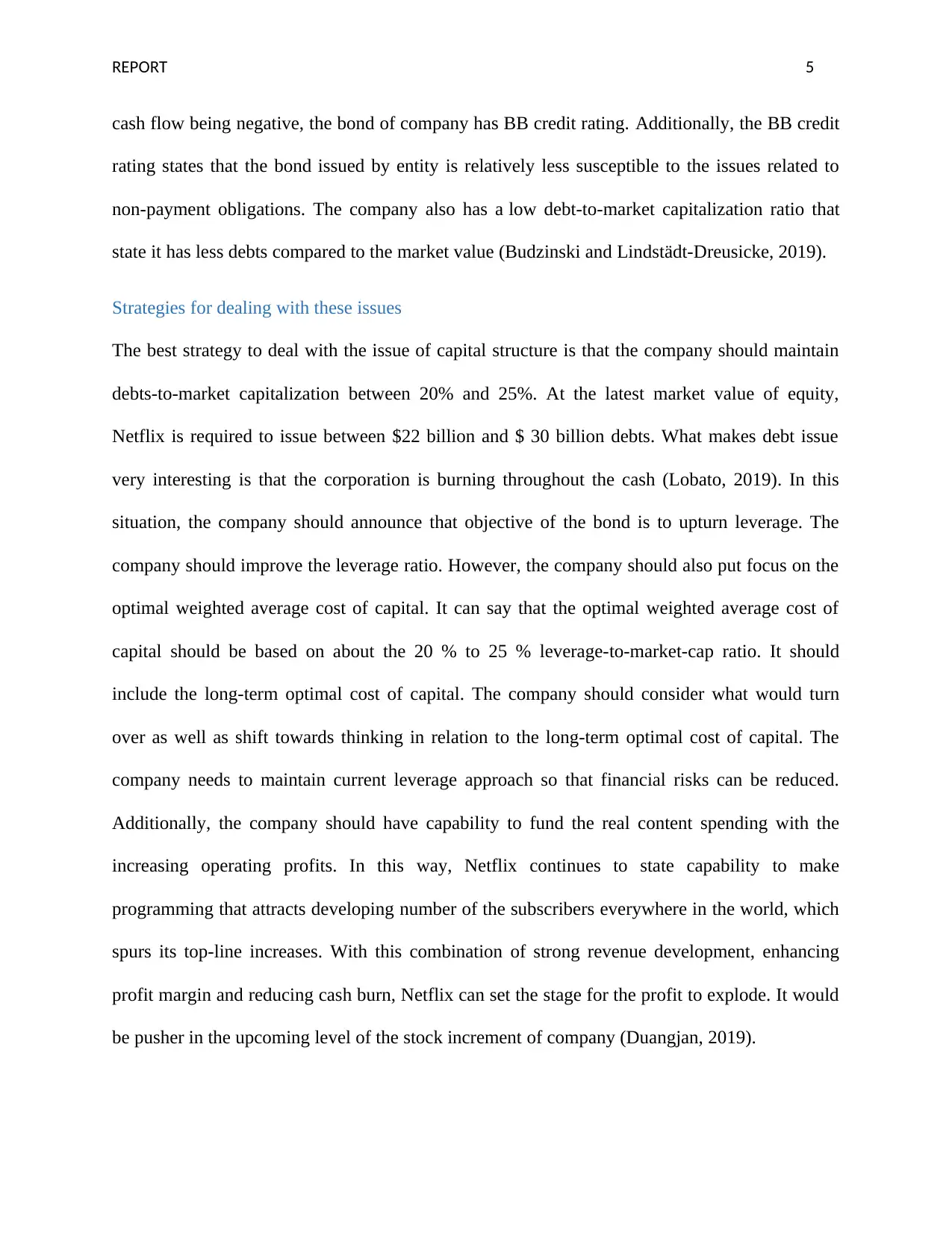
The best strategy to deal with the issue of capital structure is that the company should maintain
debts-to-market capitalization between 20% and 25%. At the latest market value of equity,
Netflix is required to issue between $22 billion and $ 30 billion debts. What makes debt issue
very interesting is that the corporation is burning throughout the cash (Lobato, 2019). In this
situation, the company should announce that objective of the bond is to upturn leverage. The
company should improve the leverage ratio. However, the company should also put focus on the
optimal weighted average cost of capital. It can say that the optimal weighted average cost of
capital should be based on about the 20 % to 25 % leverage-to-market-cap ratio. It should
include the long-term optimal cost of capital. The company should consider what would turn
over as well as shift towards thinking in relation to the long-term optimal cost of capital. The
company needs to maintain current leverage approach so that financial risks can be reduced.
Additionally, the company should have capability to fund the real content spending with the
increasing operating profits. In this way, Netflix continues to state capability to make
programming that attracts developing number of the subscribers everywhere in the world, which
spurs its top-line increases. With this combination of strong revenue development, enhancing
profit margin and reducing cash burn, Netflix can set the stage for the profit to explode. It would
be pusher in the upcoming level of the stock increment of company (Duangjan, 2019).
cash flow being negative, the bond of company has BB credit rating. Additionally, the BB credit
rating states that the bond issued by entity is relatively less susceptible to the issues related to
non-payment obligations. The company also has a low debt-to-market capitalization ratio that
state it has less debts compared to the market value (Budzinski and Lindstädt-Dreusicke, 2019).
Strategies for dealing with these issues
The best strategy to deal with the issue of capital structure is that the company should maintain
debts-to-market capitalization between 20% and 25%. At the latest market value of equity,
Netflix is required to issue between $22 billion and $ 30 billion debts. What makes debt issue
very interesting is that the corporation is burning throughout the cash (Lobato, 2019). In this
situation, the company should announce that objective of the bond is to upturn leverage. The
company should improve the leverage ratio. However, the company should also put focus on the
optimal weighted average cost of capital. It can say that the optimal weighted average cost of
capital should be based on about the 20 % to 25 % leverage-to-market-cap ratio. It should
include the long-term optimal cost of capital. The company should consider what would turn
over as well as shift towards thinking in relation to the long-term optimal cost of capital. The
company needs to maintain current leverage approach so that financial risks can be reduced.
Additionally, the company should have capability to fund the real content spending with the
increasing operating profits. In this way, Netflix continues to state capability to make
programming that attracts developing number of the subscribers everywhere in the world, which
spurs its top-line increases. With this combination of strong revenue development, enhancing
profit margin and reducing cash burn, Netflix can set the stage for the profit to explode. It would
be pusher in the upcoming level of the stock increment of company (Duangjan, 2019).
⊘ This is a preview!⊘
Do you want full access?
Subscribe today to unlock all pages.

Trusted by 1+ million students worldwide

REPORT 6
Conclusion
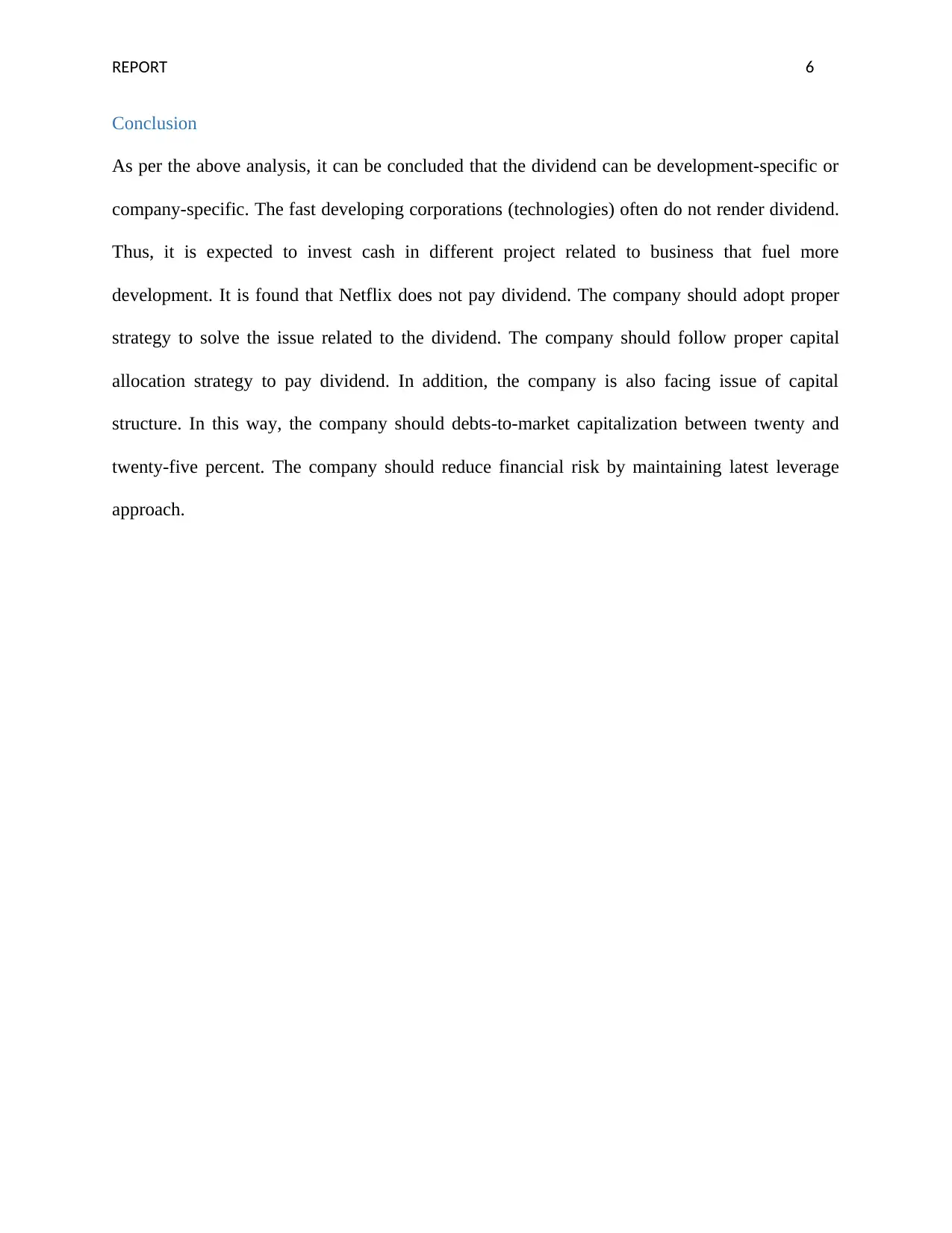
As per the above analysis, it can be concluded that the dividend can be development-specific or
company-specific. The fast developing corporations (technologies) often do not render dividend.
Thus, it is expected to invest cash in different project related to business that fuel more
development. It is found that Netflix does not pay dividend. The company should adopt proper
strategy to solve the issue related to the dividend. The company should follow proper capital
allocation strategy to pay dividend. In addition, the company is also facing issue of capital
structure. In this way, the company should debts-to-market capitalization between twenty and
twenty-five percent. The company should reduce financial risk by maintaining latest leverage
approach.
Conclusion
As per the above analysis, it can be concluded that the dividend can be development-specific or
company-specific. The fast developing corporations (technologies) often do not render dividend.
Thus, it is expected to invest cash in different project related to business that fuel more
development. It is found that Netflix does not pay dividend. The company should adopt proper
strategy to solve the issue related to the dividend. The company should follow proper capital
allocation strategy to pay dividend. In addition, the company is also facing issue of capital
structure. In this way, the company should debts-to-market capitalization between twenty and
twenty-five percent. The company should reduce financial risk by maintaining latest leverage
approach.
Paraphrase This Document
Need a fresh take? Get an instant paraphrase of this document with our AI Paraphraser

REPORT 7
References
Alves, J.P.F.R., (2018) Netflix Inc.: equity valuation (Doctoral dissertation).
Bahnsen, D.L., (2019) The Case for Dividend Growth: Investing in a Post-crisis World. USA:
Post Hill Press.
Budzinski, O. and Lindstädt-Dreusicke, N., (2019) Antitrust policy in video-on-demand markets:
the case of Germany. Journal of Antitrust Enforcement, 25(5)
Duangjan, A. (2019) The Empirical Study of CAPM on Amazon, Facebook, Apple, Netflix, and
Adobe. Facebook, Apple, Netflix, and Adobe (January 23, 2019).
Flew, T., Martin, F. and Suzor, N., (2018) Internet regulation as media policy: Rethinking the
question of digital communication platform governance. Journal of Digital Media &
Policy, 10(1), pp.33-50.
Hugh, G. and Mac, C., (2018) Due Diligence Procedures and Principles for Financial Analysis
and Corporate Governance. USA: Springer
Jenner, M., (2016) Is this TVIV? On Netflix, TVIII and binge-watching. New media &
society, 18(2), pp.257-273.
Lobato, R., (2019) Netflix nations: The geography of digital distribution. USA: NYU Press.
Parbhu, D.H.D., (2016) Equity Research: Netflix Inc (Doctoral dissertation, Instituto Superior
de Economia e Gestão). Cambridge: Cambridge university press
Schwartz, N.D. (2016) THE ABC PERSPECTIVE. USA: Springer
References
Alves, J.P.F.R., (2018) Netflix Inc.: equity valuation (Doctoral dissertation).
Bahnsen, D.L., (2019) The Case for Dividend Growth: Investing in a Post-crisis World. USA:
Post Hill Press.
Budzinski, O. and Lindstädt-Dreusicke, N., (2019) Antitrust policy in video-on-demand markets:
the case of Germany. Journal of Antitrust Enforcement, 25(5)
Duangjan, A. (2019) The Empirical Study of CAPM on Amazon, Facebook, Apple, Netflix, and
Adobe. Facebook, Apple, Netflix, and Adobe (January 23, 2019).
Flew, T., Martin, F. and Suzor, N., (2018) Internet regulation as media policy: Rethinking the
question of digital communication platform governance. Journal of Digital Media &
Policy, 10(1), pp.33-50.
Hugh, G. and Mac, C., (2018) Due Diligence Procedures and Principles for Financial Analysis
and Corporate Governance. USA: Springer
Jenner, M., (2016) Is this TVIV? On Netflix, TVIII and binge-watching. New media &
society, 18(2), pp.257-273.
Lobato, R., (2019) Netflix nations: The geography of digital distribution. USA: NYU Press.
Parbhu, D.H.D., (2016) Equity Research: Netflix Inc (Doctoral dissertation, Instituto Superior
de Economia e Gestão). Cambridge: Cambridge university press
Schwartz, N.D. (2016) THE ABC PERSPECTIVE. USA: Springer

REPORT 8
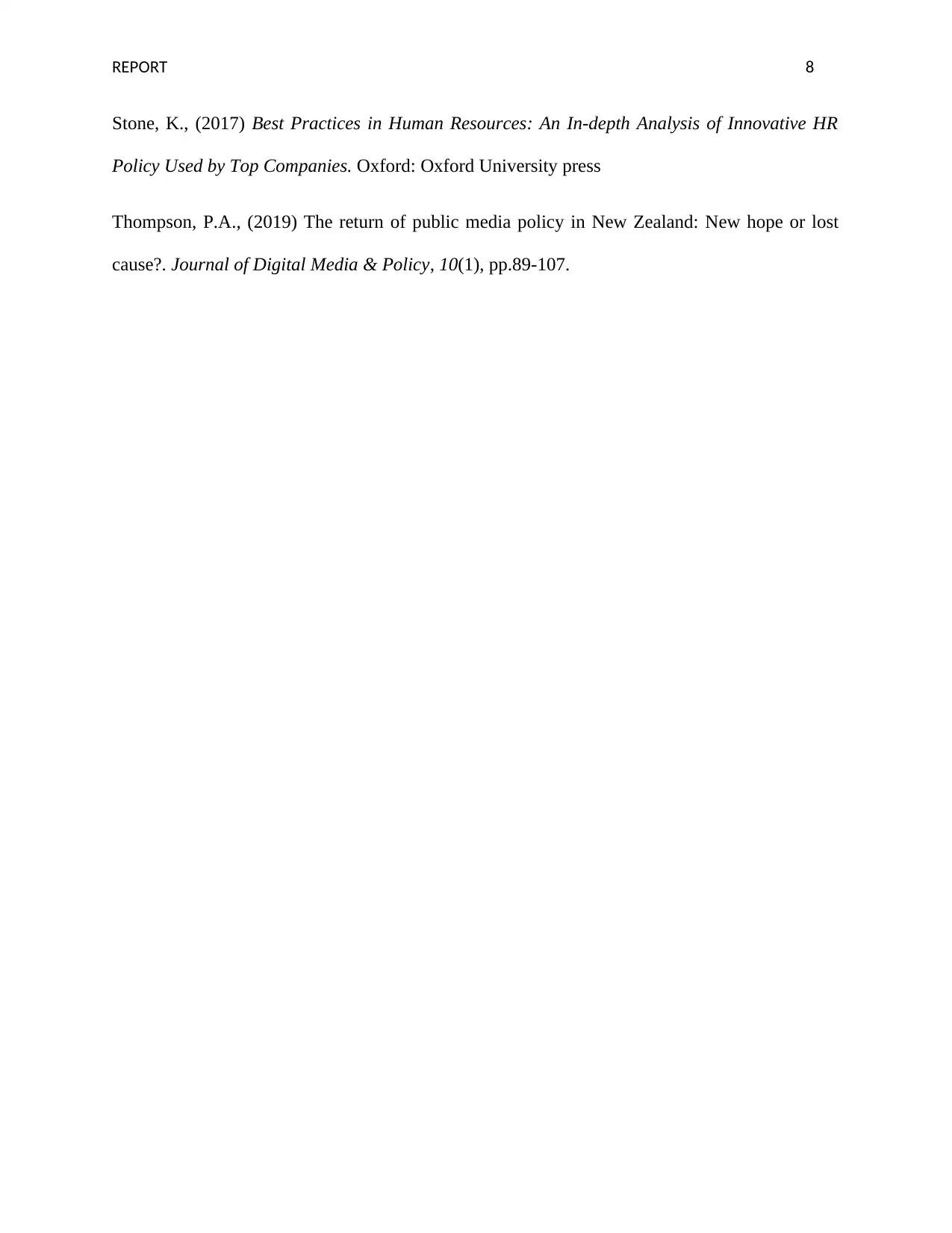
Stone, K., (2017) Best Practices in Human Resources: An In-depth Analysis of Innovative HR
Policy Used by Top Companies. Oxford: Oxford University press
Thompson, P.A., (2019) The return of public media policy in New Zealand: New hope or lost
cause?. Journal of Digital Media & Policy, 10(1), pp.89-107.
Stone, K., (2017) Best Practices in Human Resources: An In-depth Analysis of Innovative HR
Policy Used by Top Companies. Oxford: Oxford University press
Thompson, P.A., (2019) The return of public media policy in New Zealand: New hope or lost
cause?. Journal of Digital Media & Policy, 10(1), pp.89-107.
⊘ This is a preview!⊘
Do you want full access?
Subscribe today to unlock all pages.

Trusted by 1+ million students worldwide
1 out of 9
Related Documents
Your All-in-One AI-Powered Toolkit for Academic Success.
+13062052269
info@desklib.com
Available 24*7 on WhatsApp / Email
Unlock your academic potential
Copyright © 2020–2026 A2Z Services. All Rights Reserved. Developed and managed by ZUCOL.