Corporate Governance and its Contribution to Australian Firms Collapse
VerifiedAdded on 2023/06/12
|7
|1821
|461
Report
AI Summary
This report examines the role of corporate governance in the collapse of Australian firms, with a specific focus on the HIH Insurance case. It begins by defining corporate governance and outlining its key attributes, such as clear strategy, discipline, transparency, social responsibility, fairness, responsibility, accountability, independence, and self-evaluation. The report then delves into the HIH collapse, attributing it to factors like aggressive expansion, poor business strategy, underpricing, inadequate risk management, and reckless management. Further issues included false reporting, greed, fraud, self-dealing, and stock market manipulation. The report highlights the lack of independence of non-executive directors and the unreliability of information provided by external auditors as contributing factors. It concludes by emphasizing the importance of sound corporate governance practices in preventing similar failures. Desklib offers a wealth of resources, including past papers and solved assignments, to aid students in their understanding of corporate governance and related topics.
Running Head: Corporate Governance
Corporate Governance and how it contributed to the Collapsing of Australian Firms
By (Name)
(Tutor)
(University)
(Date)
Corporate Governance and how it contributed to the Collapsing of Australian Firms
By (Name)
(Tutor)
(University)
(Date)
Paraphrase This Document
Need a fresh take? Get an instant paraphrase of this document with our AI Paraphraser

Corporate Governance 2
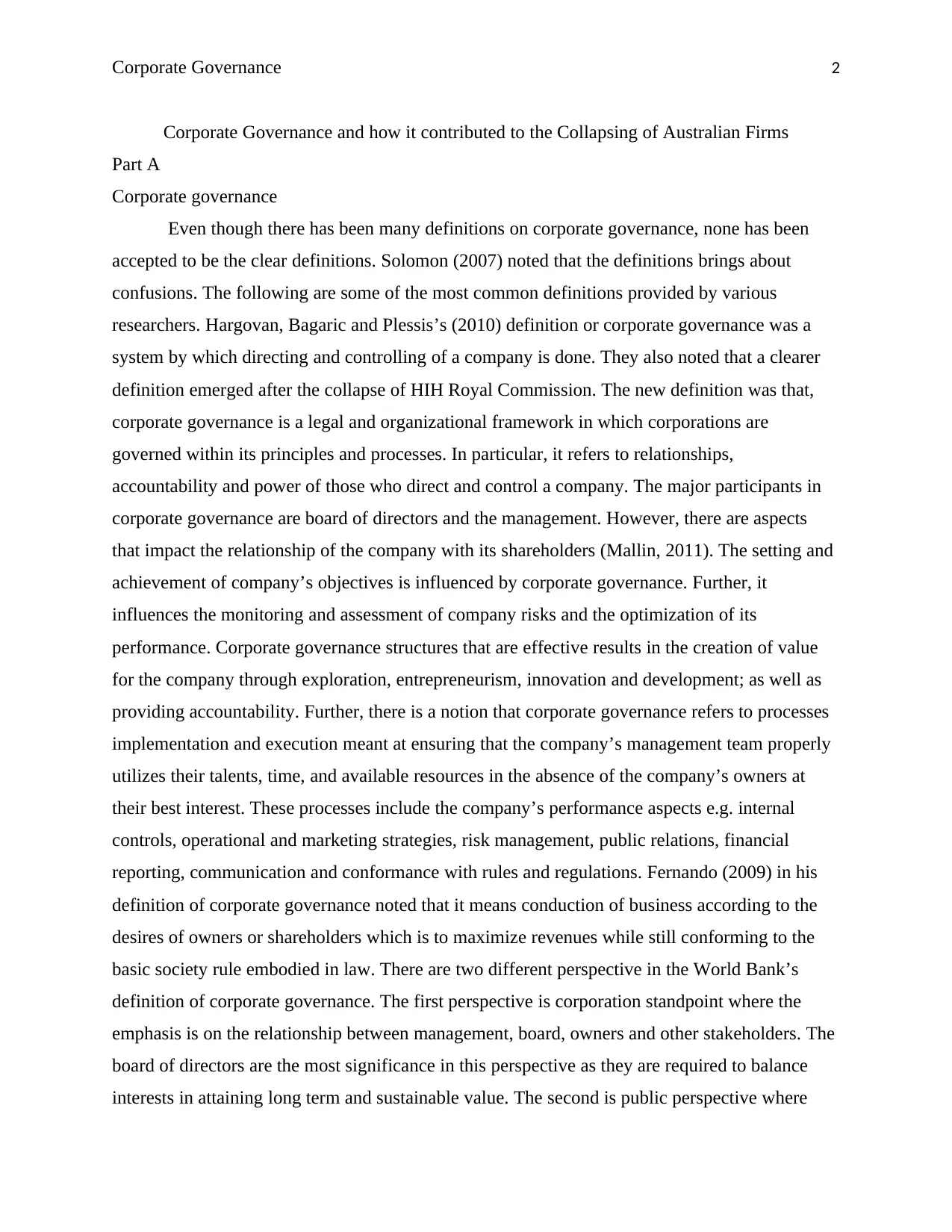
Corporate Governance and how it contributed to the Collapsing of Australian Firms
Part A
Corporate governance
Even though there has been many definitions on corporate governance, none has been
accepted to be the clear definitions. Solomon (2007) noted that the definitions brings about
confusions. The following are some of the most common definitions provided by various
researchers. Hargovan, Bagaric and Plessis’s (2010) definition or corporate governance was a
system by which directing and controlling of a company is done. They also noted that a clearer
definition emerged after the collapse of HIH Royal Commission. The new definition was that,
corporate governance is a legal and organizational framework in which corporations are
governed within its principles and processes. In particular, it refers to relationships,
accountability and power of those who direct and control a company. The major participants in
corporate governance are board of directors and the management. However, there are aspects
that impact the relationship of the company with its shareholders (Mallin, 2011). The setting and
achievement of company’s objectives is influenced by corporate governance. Further, it
influences the monitoring and assessment of company risks and the optimization of its
performance. Corporate governance structures that are effective results in the creation of value
for the company through exploration, entrepreneurism, innovation and development; as well as
providing accountability. Further, there is a notion that corporate governance refers to processes
implementation and execution meant at ensuring that the company’s management team properly
utilizes their talents, time, and available resources in the absence of the company’s owners at
their best interest. These processes include the company’s performance aspects e.g. internal
controls, operational and marketing strategies, risk management, public relations, financial
reporting, communication and conformance with rules and regulations. Fernando (2009) in his
definition of corporate governance noted that it means conduction of business according to the
desires of owners or shareholders which is to maximize revenues while still conforming to the
basic society rule embodied in law. There are two different perspective in the World Bank’s
definition of corporate governance. The first perspective is corporation standpoint where the
emphasis is on the relationship between management, board, owners and other stakeholders. The
board of directors are the most significance in this perspective as they are required to balance
interests in attaining long term and sustainable value. The second is public perspective where
Corporate Governance and how it contributed to the Collapsing of Australian Firms
Part A
Corporate governance
Even though there has been many definitions on corporate governance, none has been
accepted to be the clear definitions. Solomon (2007) noted that the definitions brings about
confusions. The following are some of the most common definitions provided by various
researchers. Hargovan, Bagaric and Plessis’s (2010) definition or corporate governance was a
system by which directing and controlling of a company is done. They also noted that a clearer
definition emerged after the collapse of HIH Royal Commission. The new definition was that,
corporate governance is a legal and organizational framework in which corporations are
governed within its principles and processes. In particular, it refers to relationships,
accountability and power of those who direct and control a company. The major participants in
corporate governance are board of directors and the management. However, there are aspects
that impact the relationship of the company with its shareholders (Mallin, 2011). The setting and
achievement of company’s objectives is influenced by corporate governance. Further, it
influences the monitoring and assessment of company risks and the optimization of its
performance. Corporate governance structures that are effective results in the creation of value
for the company through exploration, entrepreneurism, innovation and development; as well as
providing accountability. Further, there is a notion that corporate governance refers to processes
implementation and execution meant at ensuring that the company’s management team properly
utilizes their talents, time, and available resources in the absence of the company’s owners at
their best interest. These processes include the company’s performance aspects e.g. internal
controls, operational and marketing strategies, risk management, public relations, financial
reporting, communication and conformance with rules and regulations. Fernando (2009) in his
definition of corporate governance noted that it means conduction of business according to the
desires of owners or shareholders which is to maximize revenues while still conforming to the
basic society rule embodied in law. There are two different perspective in the World Bank’s
definition of corporate governance. The first perspective is corporation standpoint where the
emphasis is on the relationship between management, board, owners and other stakeholders. The
board of directors are the most significance in this perspective as they are required to balance
interests in attaining long term and sustainable value. The second is public perspective where

Corporate Governance 3
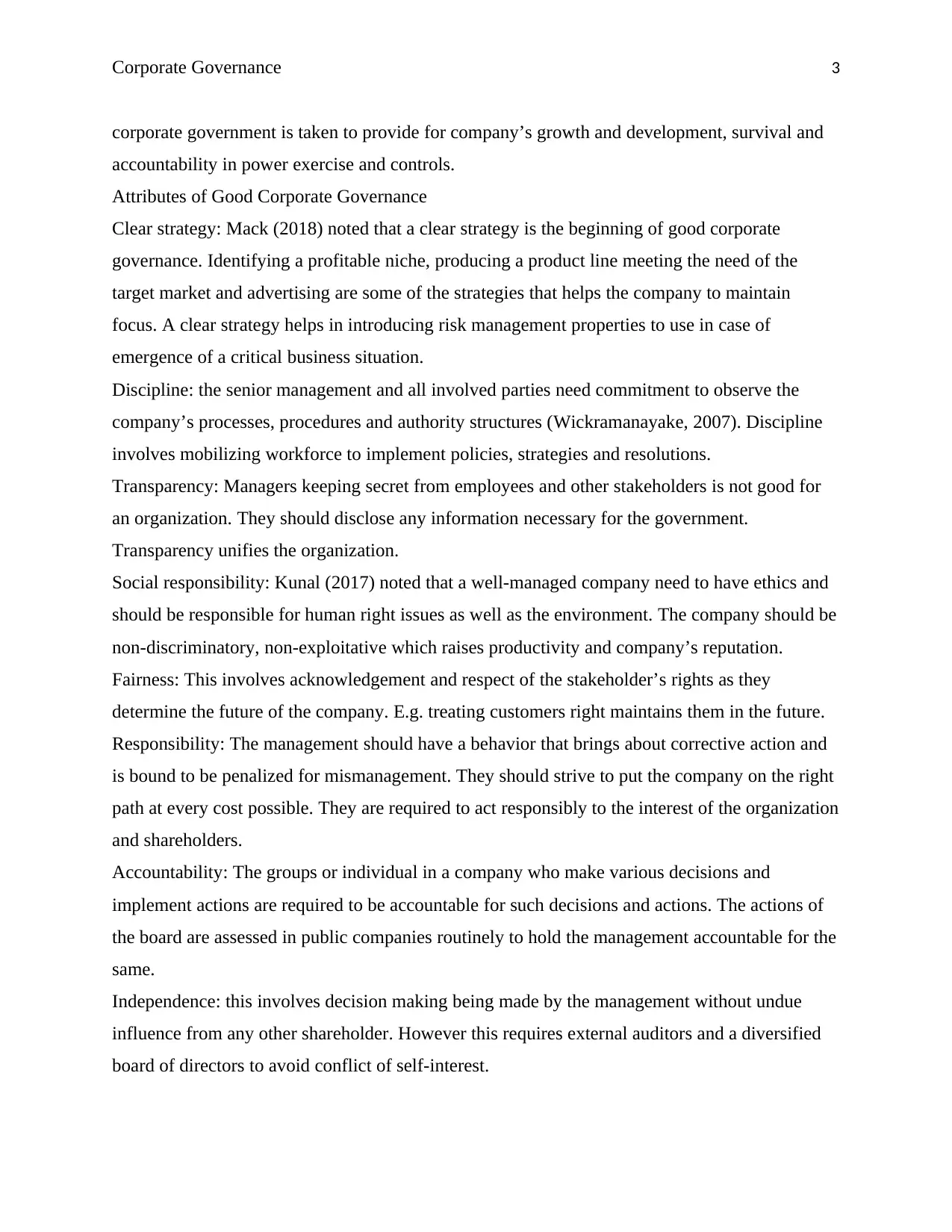
corporate government is taken to provide for company’s growth and development, survival and
accountability in power exercise and controls.
Attributes of Good Corporate Governance
Clear strategy: Mack (2018) noted that a clear strategy is the beginning of good corporate
governance. Identifying a profitable niche, producing a product line meeting the need of the
target market and advertising are some of the strategies that helps the company to maintain
focus. A clear strategy helps in introducing risk management properties to use in case of
emergence of a critical business situation.
Discipline: the senior management and all involved parties need commitment to observe the
company’s processes, procedures and authority structures (Wickramanayake, 2007). Discipline
involves mobilizing workforce to implement policies, strategies and resolutions.
Transparency: Managers keeping secret from employees and other stakeholders is not good for
an organization. They should disclose any information necessary for the government.
Transparency unifies the organization.
Social responsibility: Kunal (2017) noted that a well-managed company need to have ethics and
should be responsible for human right issues as well as the environment. The company should be
non-discriminatory, non-exploitative which raises productivity and company’s reputation.
Fairness: This involves acknowledgement and respect of the stakeholder’s rights as they
determine the future of the company. E.g. treating customers right maintains them in the future.
Responsibility: The management should have a behavior that brings about corrective action and
is bound to be penalized for mismanagement. They should strive to put the company on the right
path at every cost possible. They are required to act responsibly to the interest of the organization
and shareholders.
Accountability: The groups or individual in a company who make various decisions and
implement actions are required to be accountable for such decisions and actions. The actions of
the board are assessed in public companies routinely to hold the management accountable for the
same.
Independence: this involves decision making being made by the management without undue
influence from any other shareholder. However this requires external auditors and a diversified
board of directors to avoid conflict of self-interest.
corporate government is taken to provide for company’s growth and development, survival and
accountability in power exercise and controls.
Attributes of Good Corporate Governance
Clear strategy: Mack (2018) noted that a clear strategy is the beginning of good corporate
governance. Identifying a profitable niche, producing a product line meeting the need of the
target market and advertising are some of the strategies that helps the company to maintain
focus. A clear strategy helps in introducing risk management properties to use in case of
emergence of a critical business situation.
Discipline: the senior management and all involved parties need commitment to observe the
company’s processes, procedures and authority structures (Wickramanayake, 2007). Discipline
involves mobilizing workforce to implement policies, strategies and resolutions.
Transparency: Managers keeping secret from employees and other stakeholders is not good for
an organization. They should disclose any information necessary for the government.
Transparency unifies the organization.
Social responsibility: Kunal (2017) noted that a well-managed company need to have ethics and
should be responsible for human right issues as well as the environment. The company should be
non-discriminatory, non-exploitative which raises productivity and company’s reputation.
Fairness: This involves acknowledgement and respect of the stakeholder’s rights as they
determine the future of the company. E.g. treating customers right maintains them in the future.
Responsibility: The management should have a behavior that brings about corrective action and
is bound to be penalized for mismanagement. They should strive to put the company on the right
path at every cost possible. They are required to act responsibly to the interest of the organization
and shareholders.
Accountability: The groups or individual in a company who make various decisions and
implement actions are required to be accountable for such decisions and actions. The actions of
the board are assessed in public companies routinely to hold the management accountable for the
same.
Independence: this involves decision making being made by the management without undue
influence from any other shareholder. However this requires external auditors and a diversified
board of directors to avoid conflict of self-interest.
⊘ This is a preview!⊘
Do you want full access?
Subscribe today to unlock all pages.

Trusted by 1+ million students worldwide

Corporate Governance 4
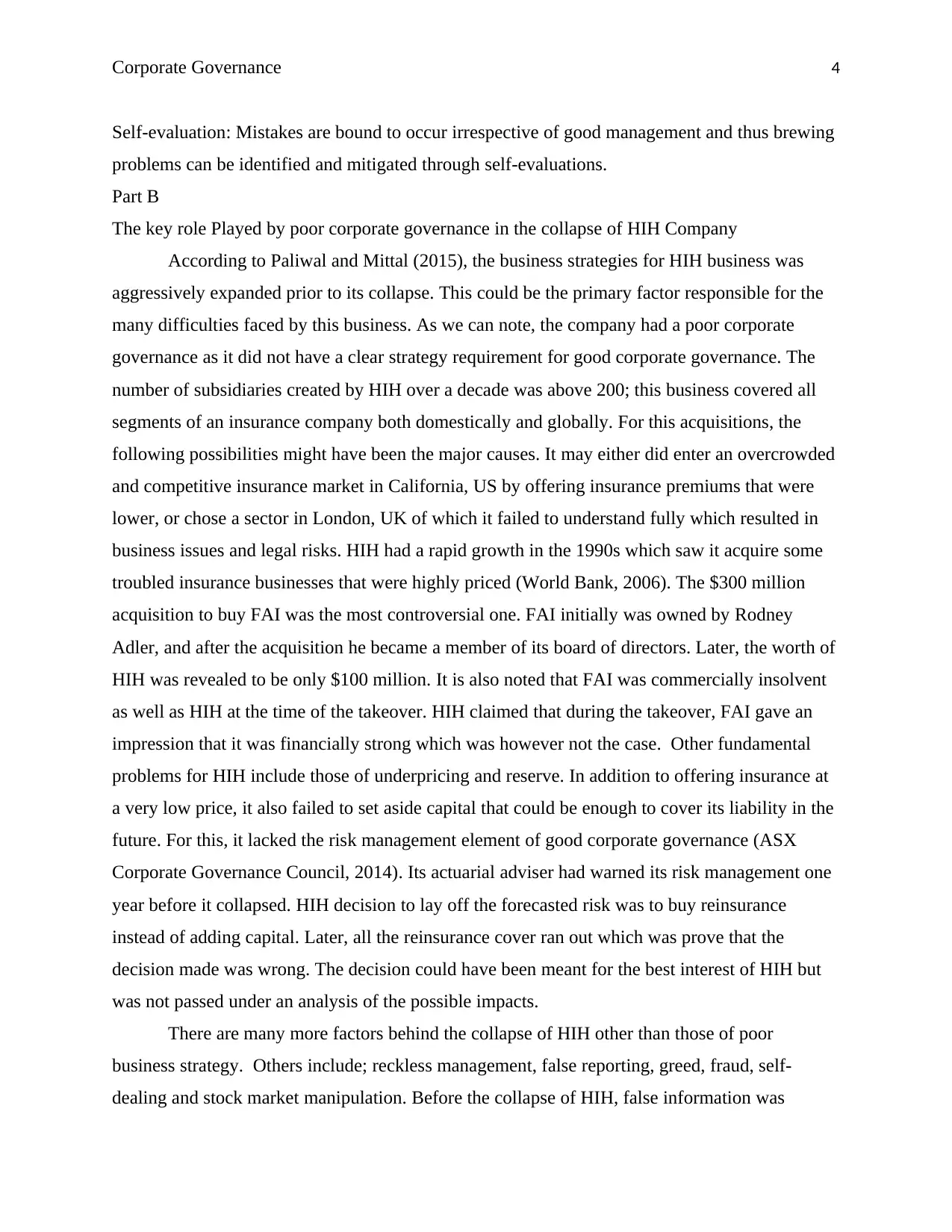
Self-evaluation: Mistakes are bound to occur irrespective of good management and thus brewing
problems can be identified and mitigated through self-evaluations.
Part B
The key role Played by poor corporate governance in the collapse of HIH Company
According to Paliwal and Mittal (2015), the business strategies for HIH business was
aggressively expanded prior to its collapse. This could be the primary factor responsible for the
many difficulties faced by this business. As we can note, the company had a poor corporate
governance as it did not have a clear strategy requirement for good corporate governance. The
number of subsidiaries created by HIH over a decade was above 200; this business covered all
segments of an insurance company both domestically and globally. For this acquisitions, the
following possibilities might have been the major causes. It may either did enter an overcrowded
and competitive insurance market in California, US by offering insurance premiums that were
lower, or chose a sector in London, UK of which it failed to understand fully which resulted in
business issues and legal risks. HIH had a rapid growth in the 1990s which saw it acquire some
troubled insurance businesses that were highly priced (World Bank, 2006). The $300 million
acquisition to buy FAI was the most controversial one. FAI initially was owned by Rodney
Adler, and after the acquisition he became a member of its board of directors. Later, the worth of
HIH was revealed to be only $100 million. It is also noted that FAI was commercially insolvent
as well as HIH at the time of the takeover. HIH claimed that during the takeover, FAI gave an
impression that it was financially strong which was however not the case. Other fundamental
problems for HIH include those of underpricing and reserve. In addition to offering insurance at
a very low price, it also failed to set aside capital that could be enough to cover its liability in the
future. For this, it lacked the risk management element of good corporate governance (ASX
Corporate Governance Council, 2014). Its actuarial adviser had warned its risk management one
year before it collapsed. HIH decision to lay off the forecasted risk was to buy reinsurance
instead of adding capital. Later, all the reinsurance cover ran out which was prove that the
decision made was wrong. The decision could have been meant for the best interest of HIH but
was not passed under an analysis of the possible impacts.
There are many more factors behind the collapse of HIH other than those of poor
business strategy. Others include; reckless management, false reporting, greed, fraud, self-
dealing and stock market manipulation. Before the collapse of HIH, false information was
Self-evaluation: Mistakes are bound to occur irrespective of good management and thus brewing
problems can be identified and mitigated through self-evaluations.
Part B
The key role Played by poor corporate governance in the collapse of HIH Company
According to Paliwal and Mittal (2015), the business strategies for HIH business was
aggressively expanded prior to its collapse. This could be the primary factor responsible for the
many difficulties faced by this business. As we can note, the company had a poor corporate
governance as it did not have a clear strategy requirement for good corporate governance. The
number of subsidiaries created by HIH over a decade was above 200; this business covered all
segments of an insurance company both domestically and globally. For this acquisitions, the
following possibilities might have been the major causes. It may either did enter an overcrowded
and competitive insurance market in California, US by offering insurance premiums that were
lower, or chose a sector in London, UK of which it failed to understand fully which resulted in
business issues and legal risks. HIH had a rapid growth in the 1990s which saw it acquire some
troubled insurance businesses that were highly priced (World Bank, 2006). The $300 million
acquisition to buy FAI was the most controversial one. FAI initially was owned by Rodney
Adler, and after the acquisition he became a member of its board of directors. Later, the worth of
HIH was revealed to be only $100 million. It is also noted that FAI was commercially insolvent
as well as HIH at the time of the takeover. HIH claimed that during the takeover, FAI gave an
impression that it was financially strong which was however not the case. Other fundamental
problems for HIH include those of underpricing and reserve. In addition to offering insurance at
a very low price, it also failed to set aside capital that could be enough to cover its liability in the
future. For this, it lacked the risk management element of good corporate governance (ASX
Corporate Governance Council, 2014). Its actuarial adviser had warned its risk management one
year before it collapsed. HIH decision to lay off the forecasted risk was to buy reinsurance
instead of adding capital. Later, all the reinsurance cover ran out which was prove that the
decision made was wrong. The decision could have been meant for the best interest of HIH but
was not passed under an analysis of the possible impacts.
There are many more factors behind the collapse of HIH other than those of poor
business strategy. Others include; reckless management, false reporting, greed, fraud, self-
dealing and stock market manipulation. Before the collapse of HIH, false information was
Paraphrase This Document
Need a fresh take? Get an instant paraphrase of this document with our AI Paraphraser

Corporate Governance 5
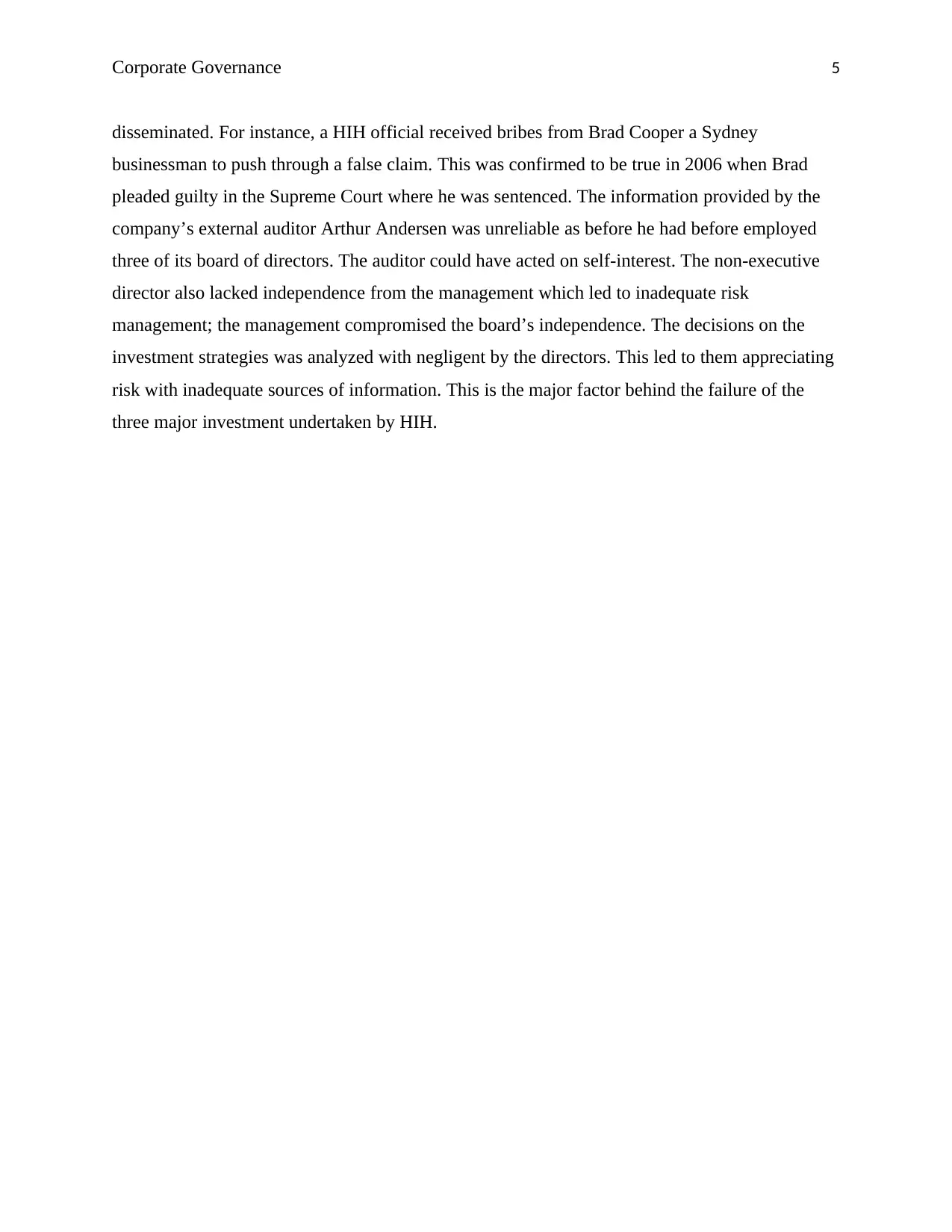
disseminated. For instance, a HIH official received bribes from Brad Cooper a Sydney
businessman to push through a false claim. This was confirmed to be true in 2006 when Brad
pleaded guilty in the Supreme Court where he was sentenced. The information provided by the
company’s external auditor Arthur Andersen was unreliable as before he had before employed
three of its board of directors. The auditor could have acted on self-interest. The non-executive
director also lacked independence from the management which led to inadequate risk
management; the management compromised the board’s independence. The decisions on the
investment strategies was analyzed with negligent by the directors. This led to them appreciating
risk with inadequate sources of information. This is the major factor behind the failure of the
three major investment undertaken by HIH.
disseminated. For instance, a HIH official received bribes from Brad Cooper a Sydney
businessman to push through a false claim. This was confirmed to be true in 2006 when Brad
pleaded guilty in the Supreme Court where he was sentenced. The information provided by the
company’s external auditor Arthur Andersen was unreliable as before he had before employed
three of its board of directors. The auditor could have acted on self-interest. The non-executive
director also lacked independence from the management which led to inadequate risk
management; the management compromised the board’s independence. The decisions on the
investment strategies was analyzed with negligent by the directors. This led to them appreciating
risk with inadequate sources of information. This is the major factor behind the failure of the
three major investment undertaken by HIH.

Corporate Governance 6
References
ASX Corporate Governance Council (2014). Corporate Governance Principles and
Recommendations. [Online] Asx.com.au. Available at: https://www.asx.com.au/documents/asx-
compliance/cgc-principles-and-recommendations-3rd-edn.pdf [Accessed 21 May 2018].
Fernando, C. (2009). Corporate governance: principles, policies and practices. New Delhi,
Pearson Education.
Hargovan, A., Bagaric, M. and Plessis, J. (2010). Principles of Contemporary Corporate
Governance. 2nd ed. West Nyack: Cambridge University Press.
Kunal, K. (2017). Seven Characteristics of Good Corporate Governance. [Online] Bizfluent.
Available at: https://bizfluent.com/info-8371727-seven-characteristics-good-corporate-
governance.html [Accessed 21 May 2018].
Mack, S. (2018). Seven Characteristics of Good Corporate Governance. [Online]
Smallbusiness.chron.com. Available at: http://smallbusiness.chron.com/seven-characteristics-
good-corporate-governance-57207.html [Accessed 21 May 2018].
Mallin, A. (2011). Handbook on international corporate governance: country analyses.
Cheltenham, U.K.; Northampton, Mass: Edward Elgar.
Paliwal, P. and Mittal, K. (2015). Corporate failure for HIH insurance. [Online] Slideshare.net.
Available at: https://www.slideshare.net/Kmittal928/corporate-failure-for-hih-insurance
[Accessed 21 May 2018].
Solomon, J. (2007). Corporate governance and accountability. Chichester, Wiley.
Wickramanayake, K. (2007). Seven Characteristics of Corporate Governance. [Online]
Swview.org. Available at: http://www.swview.org/blog/seven-characteristics-corporate-
governance [Accessed 21 May 2018].
World Bank (2006). HIH Case Study on Corporate Governance. [Online] Iaisweb.org. Available
at: https://www.iaisweb.org/modules/cciais/assets/files/pdf/061004_C1-
9_hih_corpgov_round01.pdf [Accessed 21 May 2018].
References
ASX Corporate Governance Council (2014). Corporate Governance Principles and
Recommendations. [Online] Asx.com.au. Available at: https://www.asx.com.au/documents/asx-
compliance/cgc-principles-and-recommendations-3rd-edn.pdf [Accessed 21 May 2018].
Fernando, C. (2009). Corporate governance: principles, policies and practices. New Delhi,
Pearson Education.
Hargovan, A., Bagaric, M. and Plessis, J. (2010). Principles of Contemporary Corporate
Governance. 2nd ed. West Nyack: Cambridge University Press.
Kunal, K. (2017). Seven Characteristics of Good Corporate Governance. [Online] Bizfluent.
Available at: https://bizfluent.com/info-8371727-seven-characteristics-good-corporate-
governance.html [Accessed 21 May 2018].
Mack, S. (2018). Seven Characteristics of Good Corporate Governance. [Online]
Smallbusiness.chron.com. Available at: http://smallbusiness.chron.com/seven-characteristics-
good-corporate-governance-57207.html [Accessed 21 May 2018].
Mallin, A. (2011). Handbook on international corporate governance: country analyses.
Cheltenham, U.K.; Northampton, Mass: Edward Elgar.
Paliwal, P. and Mittal, K. (2015). Corporate failure for HIH insurance. [Online] Slideshare.net.
Available at: https://www.slideshare.net/Kmittal928/corporate-failure-for-hih-insurance
[Accessed 21 May 2018].
Solomon, J. (2007). Corporate governance and accountability. Chichester, Wiley.
Wickramanayake, K. (2007). Seven Characteristics of Corporate Governance. [Online]
Swview.org. Available at: http://www.swview.org/blog/seven-characteristics-corporate-
governance [Accessed 21 May 2018].
World Bank (2006). HIH Case Study on Corporate Governance. [Online] Iaisweb.org. Available
at: https://www.iaisweb.org/modules/cciais/assets/files/pdf/061004_C1-
9_hih_corpgov_round01.pdf [Accessed 21 May 2018].
⊘ This is a preview!⊘
Do you want full access?
Subscribe today to unlock all pages.

Trusted by 1+ million students worldwide

Corporate Governance 7
1 out of 7
Related Documents
Your All-in-One AI-Powered Toolkit for Academic Success.
+13062052269
info@desklib.com
Available 24*7 on WhatsApp / Email
Unlock your academic potential
Copyright © 2020–2026 A2Z Services. All Rights Reserved. Developed and managed by ZUCOL.