BISY2002/ISY2002: SDN Company Network Upgrade Proposal Report
VerifiedAdded on 2022/10/01
|11
|2990
|188
Report
AI Summary
This report provides a comprehensive network upgrade proposal for SDN Company, a retail company anticipating significant growth. The project scope encompasses a detailed plan to enhance the existing network infrastructure to accommodate the anticipated 100% growth within five years. The proposal addresses various technical requirements, including scalability, manageability, adaptability, availability, and maintainability. It explores different network media types, recommending a combination of coaxial cables and wireless communication. The report delves into subnetting and IP addressing, including IPv4 addressing and the implementation of dual stacking to prepare for IPv6 migration. Detailed subnetting calculations are provided, along with IPv4 and IPv6 addressing schemes for each location. Furthermore, the report outlines the selection of network devices and presents the network topology. The document also includes calculation tables and hardware component details.

Course code and Title
Student Name:
Lecturer Name:
Submission Date:
Student Name:
Lecturer Name:
Submission Date:

Paraphrase This Document
Need a fresh take? Get an instant paraphrase of this document with our AI Paraphraser
Executive summary
Networking and communication has pushed itself in the business environment such that business
organizations consider themselves incomplete with IT infrastructure services. However, business
organization have impressed the existence of IT services in their operations. Business organizations have
organizations have found a lot of importance in IT services. IT infrastructure services in the context of
Information technology refers to the business organization’s wholesome collection of software, data
centers, hardware, networks, equipment and related facilities used in the development, operations,
tests, management, monitoring or support of information technology services. Information technology
services include and are not limited to internet, security, file sharing, file storage, dynamic host
configuration protocol (DHCP), domain name server (DNS), content management system, print service,
electronic mail, messaging, web service etc.
Business organizations having discovered the criticality of IT services in its operations, any
improvements in IT has to be implement in organizations. Note that organizations are not forced to
implement the latest technology in their operations, however, the changing needs of customers, the
need to remain relevant in the present market and the quality of services offered by competitors are the
primary forces that push these business enterprises to have latest technology upgrade in their premise.
Another factor is the anticipated growth of an organization. This the exact factor which is pushing SDN
Company to have its network upgraded.
Networking and communication has pushed itself in the business environment such that business
organizations consider themselves incomplete with IT infrastructure services. However, business
organization have impressed the existence of IT services in their operations. Business organizations have
organizations have found a lot of importance in IT services. IT infrastructure services in the context of
Information technology refers to the business organization’s wholesome collection of software, data
centers, hardware, networks, equipment and related facilities used in the development, operations,
tests, management, monitoring or support of information technology services. Information technology
services include and are not limited to internet, security, file sharing, file storage, dynamic host
configuration protocol (DHCP), domain name server (DNS), content management system, print service,
electronic mail, messaging, web service etc.
Business organizations having discovered the criticality of IT services in its operations, any
improvements in IT has to be implement in organizations. Note that organizations are not forced to
implement the latest technology in their operations, however, the changing needs of customers, the
need to remain relevant in the present market and the quality of services offered by competitors are the
primary forces that push these business enterprises to have latest technology upgrade in their premise.
Another factor is the anticipated growth of an organization. This the exact factor which is pushing SDN
Company to have its network upgraded.
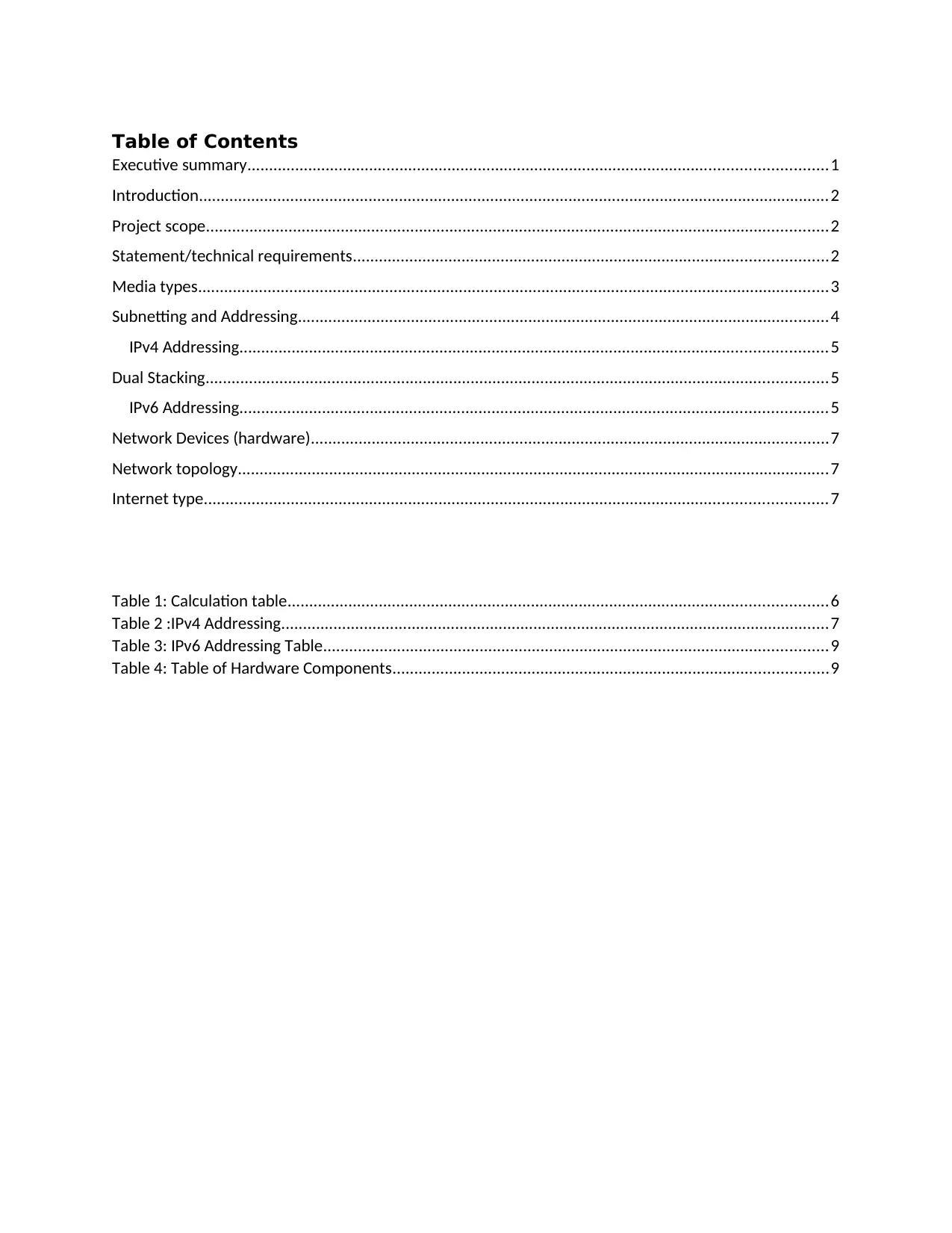
Table of Contents
Executive summary.....................................................................................................................................1
Introduction.................................................................................................................................................2
Project scope...............................................................................................................................................2
Statement/technical requirements.............................................................................................................2
Media types.................................................................................................................................................3
Subnetting and Addressing..........................................................................................................................4
IPv4 Addressing.......................................................................................................................................5
Dual Stacking...............................................................................................................................................5
IPv6 Addressing.......................................................................................................................................5
Network Devices (hardware).......................................................................................................................7
Network topology........................................................................................................................................7
Internet type...............................................................................................................................................7
Table 1: Calculation table............................................................................................................................6
Table 2 :IPv4 Addressing..............................................................................................................................7
Table 3: IPv6 Addressing Table....................................................................................................................9
Table 4: Table of Hardware Components....................................................................................................9
Executive summary.....................................................................................................................................1
Introduction.................................................................................................................................................2
Project scope...............................................................................................................................................2
Statement/technical requirements.............................................................................................................2
Media types.................................................................................................................................................3
Subnetting and Addressing..........................................................................................................................4
IPv4 Addressing.......................................................................................................................................5
Dual Stacking...............................................................................................................................................5
IPv6 Addressing.......................................................................................................................................5
Network Devices (hardware).......................................................................................................................7
Network topology........................................................................................................................................7
Internet type...............................................................................................................................................7
Table 1: Calculation table............................................................................................................................6
Table 2 :IPv4 Addressing..............................................................................................................................7
Table 3: IPv6 Addressing Table....................................................................................................................9
Table 4: Table of Hardware Components....................................................................................................9
⊘ This is a preview!⊘
Do you want full access?
Subscribe today to unlock all pages.

Trusted by 1+ million students worldwide

Introduction
SDN (Smart Digital Networks Company) is a small medium sized company dealing with retail in electronic
devices. The company has its head office in the city with subsidiary branches in Parramatta, Sutherland
and Hornsby. In in addition to this, SDN Company has two remote small offices in Bankstwon and
Epping. Due favorable factors in the market, the company has anticipated hundred percent growth in
the next five years.
In response to the anticipated growth, the SDN Company has strategized to upgrade its network
overhaul the limited services. The company needs its network services upgraded to accommodate the
anticipated. It should be noted that server farm will fully support the current and the anticipated
growth, therefore no action will be taken on the server farm.
Project scope
The scope of this assignment is to provide a proposal for the network upgrade plan for SDN Company.
SDN company population is anticipated to grow by 100% in the next five years. Therefore the
management has setup a plan counter this by upgrading its service delivery elements. Network in SDN
Company is one of the service delivery elements. In the network upgrade exercise, we will calculate the
expected growth number of hosts per location and perform subnetting on the basis of VLSM principle.
Furthermore, dual stacking will be introduced in the present network in preparation for the
implementation of IPv6 addressing in SDN Company (Skibniewski, 2014). Communication and
networking components which will support our network upgrade will be selected together with reasons
why they are chosen. Without forgetting the network media, we will suggest the best media to be used
within the organization. Note that media to be used between locations shall not be selected since they
will be provided by the ISP who will suggest to us the best options.
Statement/technical requirements
In every networking project or any other project to be implemented, there must be set goals and
objectives which are set to be achieved at the end of the project. These are the technical requirements.
For any IT infrastructure implementation project, there are standard technical requirements which have
to be accomplished (Rogers, 2014). In our network upgrade for SDN company, the below are the
technical requirements which are anticipated to have been fulfilled before signing off the project;
Scalability – scalability is the ability of a network design to allow relocation and addition of computer
nodes to a networked system without disruption of the operations of the business. Furthermore,
scalability allows the addition of end nodes without redefining and redesigning the network
infrastructure. Our proposed network design will be scalable allowing relocation of network computing
devices without disrupting business functions (Mason, 2019).
Manageability – manageability is the capability of a network to be controlled. The proposed network
will be easy to manage by the SDN it specialties without giving them difficulties (Pandya, 2013).
SDN (Smart Digital Networks Company) is a small medium sized company dealing with retail in electronic
devices. The company has its head office in the city with subsidiary branches in Parramatta, Sutherland
and Hornsby. In in addition to this, SDN Company has two remote small offices in Bankstwon and
Epping. Due favorable factors in the market, the company has anticipated hundred percent growth in
the next five years.
In response to the anticipated growth, the SDN Company has strategized to upgrade its network
overhaul the limited services. The company needs its network services upgraded to accommodate the
anticipated. It should be noted that server farm will fully support the current and the anticipated
growth, therefore no action will be taken on the server farm.
Project scope
The scope of this assignment is to provide a proposal for the network upgrade plan for SDN Company.
SDN company population is anticipated to grow by 100% in the next five years. Therefore the
management has setup a plan counter this by upgrading its service delivery elements. Network in SDN
Company is one of the service delivery elements. In the network upgrade exercise, we will calculate the
expected growth number of hosts per location and perform subnetting on the basis of VLSM principle.
Furthermore, dual stacking will be introduced in the present network in preparation for the
implementation of IPv6 addressing in SDN Company (Skibniewski, 2014). Communication and
networking components which will support our network upgrade will be selected together with reasons
why they are chosen. Without forgetting the network media, we will suggest the best media to be used
within the organization. Note that media to be used between locations shall not be selected since they
will be provided by the ISP who will suggest to us the best options.
Statement/technical requirements
In every networking project or any other project to be implemented, there must be set goals and
objectives which are set to be achieved at the end of the project. These are the technical requirements.
For any IT infrastructure implementation project, there are standard technical requirements which have
to be accomplished (Rogers, 2014). In our network upgrade for SDN company, the below are the
technical requirements which are anticipated to have been fulfilled before signing off the project;
Scalability – scalability is the ability of a network design to allow relocation and addition of computer
nodes to a networked system without disruption of the operations of the business. Furthermore,
scalability allows the addition of end nodes without redefining and redesigning the network
infrastructure. Our proposed network design will be scalable allowing relocation of network computing
devices without disrupting business functions (Mason, 2019).
Manageability – manageability is the capability of a network to be controlled. The proposed network
will be easy to manage by the SDN it specialties without giving them difficulties (Pandya, 2013).
Paraphrase This Document
Need a fresh take? Get an instant paraphrase of this document with our AI Paraphraser
Adaptability – a network is attributed to be adaptable if it has the capability of being able to cope up
with unforeseen system changes. The proposed network design will be able to stand business
environment turbulences and hence business stability.
Availability – a network design is featured to be available if it can offer 99.99999% uptime. This is
measured as the percentage of time that the system has been up and running and available to the
clients. A network system can be absent from users due to power disruptions, failure of a networking
hardware component, failure of the software component, network failure by itself or unfavorable
conditions imposed to the network. It is worth noting that scheduled down time due to service,
maintenance or upgrade is not considered as system unavailability to users (Cox, 2014).
Maintainability – maintainability is the predefined probability that our proposed network design can be
repaired within a specified period of scheduled time. Our initial network design will be easy and will
allow SDN Company network engineer to manage and maintain without posing challenges.
Media types
A network media refers to communication routes or paths or channels used to interlink computer nodes
on a network system. Let us discuss the existing network media before we select with reasons the best
network that suites best our proposed network design.
Twisted Pair cable – this media cable is mostly used in the telephony communication and Ethernet
networks. It has a pair of wires which forms the circuit which is able to transmit information. The pairs of
the cable are twisted so as to offer protection against noise generated by the close pairs – crosstalk.
There are two categories of twisted pair cable, shielded pair cable and the unshielded pair cable. The
unshielded twisted pair cable reefers to a medium of four pairs of wires. Each of the eight cables are
covered with a plastic material. Furthermore, each of the pairs are twisted. The UTP cable finds its glory
in twisting which cancels the crosstalk effect. On the other hand, the shielded twisted pair cable
incorporates the methods of cancellation, wire twisting and shielding. For each pair of the wires is
enclosed in a metallic foil. All of the four pairs are then enclosed in an overall metallic braid. This kind of
cable is specific to for deployment in Ethernet networks (Teare, et al., 2014).
Coaxial cable – this cable entails a hollow outer cylinder-shaped conductor which surroundings the inner
cable wire comprised of conducting elements. The copper conductor is one of this elements found at the
center. This cable supports 10 – 100 Mbps and is relatively less expensive. However, it is expensive as
compared to UTP on per meter basis. For LANS, the coaxial cables provide advantages. They include
running with few boosts from the repeaters for long distances among the network nodes.
Wireless media communication – this media of communication uses radio frequency waves to transmit
information between networking components on the LAN. Wireless LAN has found its application in
various communication environment. They include access of the internet by use of cellular phone, beam
of data among handheld devices, establishment of business and home internet connection via the
satellite, use of wireless keyboards and mouse. In our proposed network, wireless media will be used to
in data communication.
with unforeseen system changes. The proposed network design will be able to stand business
environment turbulences and hence business stability.
Availability – a network design is featured to be available if it can offer 99.99999% uptime. This is
measured as the percentage of time that the system has been up and running and available to the
clients. A network system can be absent from users due to power disruptions, failure of a networking
hardware component, failure of the software component, network failure by itself or unfavorable
conditions imposed to the network. It is worth noting that scheduled down time due to service,
maintenance or upgrade is not considered as system unavailability to users (Cox, 2014).
Maintainability – maintainability is the predefined probability that our proposed network design can be
repaired within a specified period of scheduled time. Our initial network design will be easy and will
allow SDN Company network engineer to manage and maintain without posing challenges.
Media types
A network media refers to communication routes or paths or channels used to interlink computer nodes
on a network system. Let us discuss the existing network media before we select with reasons the best
network that suites best our proposed network design.
Twisted Pair cable – this media cable is mostly used in the telephony communication and Ethernet
networks. It has a pair of wires which forms the circuit which is able to transmit information. The pairs of
the cable are twisted so as to offer protection against noise generated by the close pairs – crosstalk.
There are two categories of twisted pair cable, shielded pair cable and the unshielded pair cable. The
unshielded twisted pair cable reefers to a medium of four pairs of wires. Each of the eight cables are
covered with a plastic material. Furthermore, each of the pairs are twisted. The UTP cable finds its glory
in twisting which cancels the crosstalk effect. On the other hand, the shielded twisted pair cable
incorporates the methods of cancellation, wire twisting and shielding. For each pair of the wires is
enclosed in a metallic foil. All of the four pairs are then enclosed in an overall metallic braid. This kind of
cable is specific to for deployment in Ethernet networks (Teare, et al., 2014).
Coaxial cable – this cable entails a hollow outer cylinder-shaped conductor which surroundings the inner
cable wire comprised of conducting elements. The copper conductor is one of this elements found at the
center. This cable supports 10 – 100 Mbps and is relatively less expensive. However, it is expensive as
compared to UTP on per meter basis. For LANS, the coaxial cables provide advantages. They include
running with few boosts from the repeaters for long distances among the network nodes.
Wireless media communication – this media of communication uses radio frequency waves to transmit
information between networking components on the LAN. Wireless LAN has found its application in
various communication environment. They include access of the internet by use of cellular phone, beam
of data among handheld devices, establishment of business and home internet connection via the
satellite, use of wireless keyboards and mouse. In our proposed network, wireless media will be used to
in data communication.
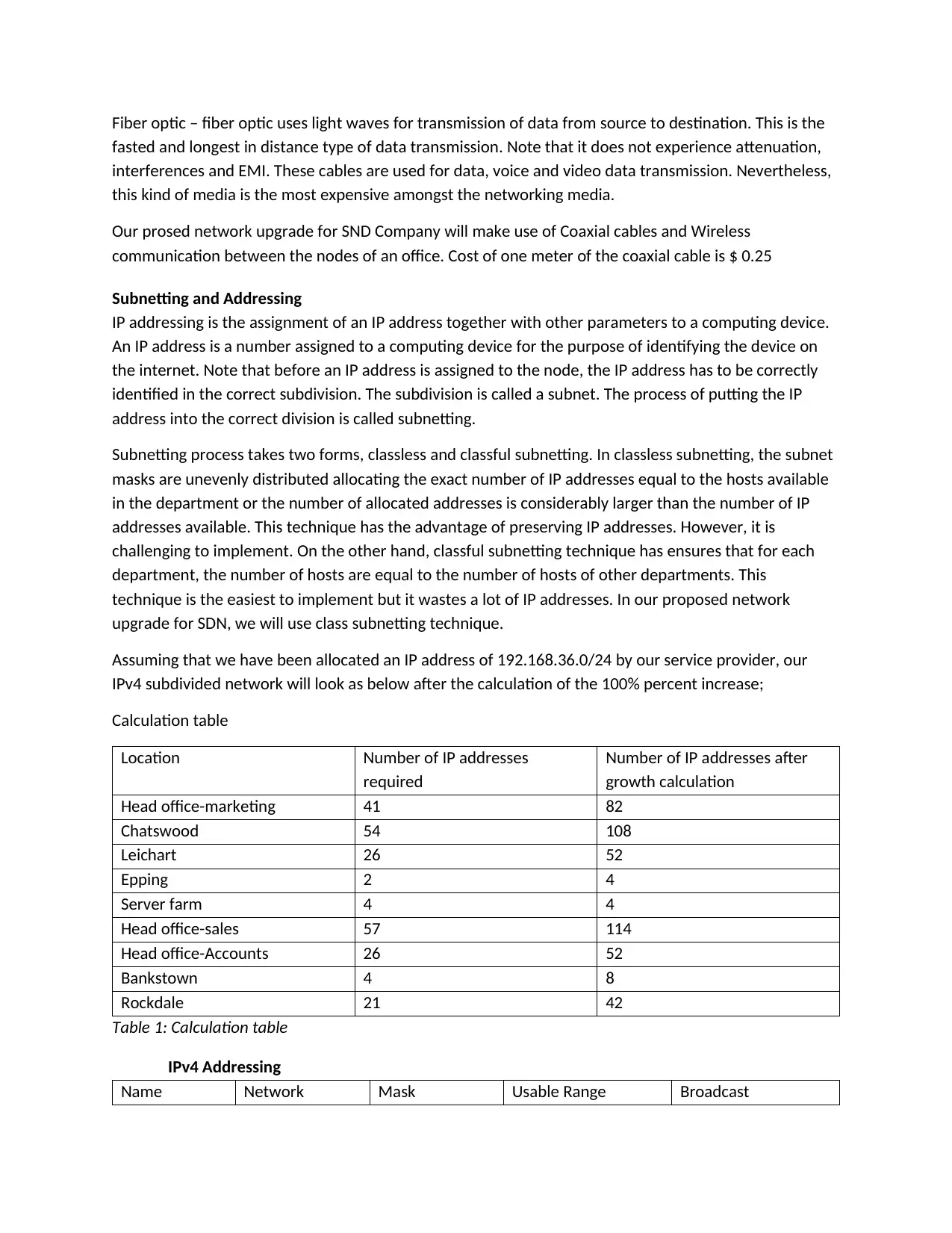
Fiber optic – fiber optic uses light waves for transmission of data from source to destination. This is the
fasted and longest in distance type of data transmission. Note that it does not experience attenuation,
interferences and EMI. These cables are used for data, voice and video data transmission. Nevertheless,
this kind of media is the most expensive amongst the networking media.
Our prosed network upgrade for SND Company will make use of Coaxial cables and Wireless
communication between the nodes of an office. Cost of one meter of the coaxial cable is $ 0.25
Subnetting and Addressing
IP addressing is the assignment of an IP address together with other parameters to a computing device.
An IP address is a number assigned to a computing device for the purpose of identifying the device on
the internet. Note that before an IP address is assigned to the node, the IP address has to be correctly
identified in the correct subdivision. The subdivision is called a subnet. The process of putting the IP
address into the correct division is called subnetting.
Subnetting process takes two forms, classless and classful subnetting. In classless subnetting, the subnet
masks are unevenly distributed allocating the exact number of IP addresses equal to the hosts available
in the department or the number of allocated addresses is considerably larger than the number of IP
addresses available. This technique has the advantage of preserving IP addresses. However, it is
challenging to implement. On the other hand, classful subnetting technique has ensures that for each
department, the number of hosts are equal to the number of hosts of other departments. This
technique is the easiest to implement but it wastes a lot of IP addresses. In our proposed network
upgrade for SDN, we will use class subnetting technique.
Assuming that we have been allocated an IP address of 192.168.36.0/24 by our service provider, our
IPv4 subdivided network will look as below after the calculation of the 100% percent increase;
Calculation table
Location Number of IP addresses
required
Number of IP addresses after
growth calculation
Head office-marketing 41 82
Chatswood 54 108
Leichart 26 52
Epping 2 4
Server farm 4 4
Head office-sales 57 114
Head office-Accounts 26 52
Bankstown 4 8
Rockdale 21 42
Table 1: Calculation table
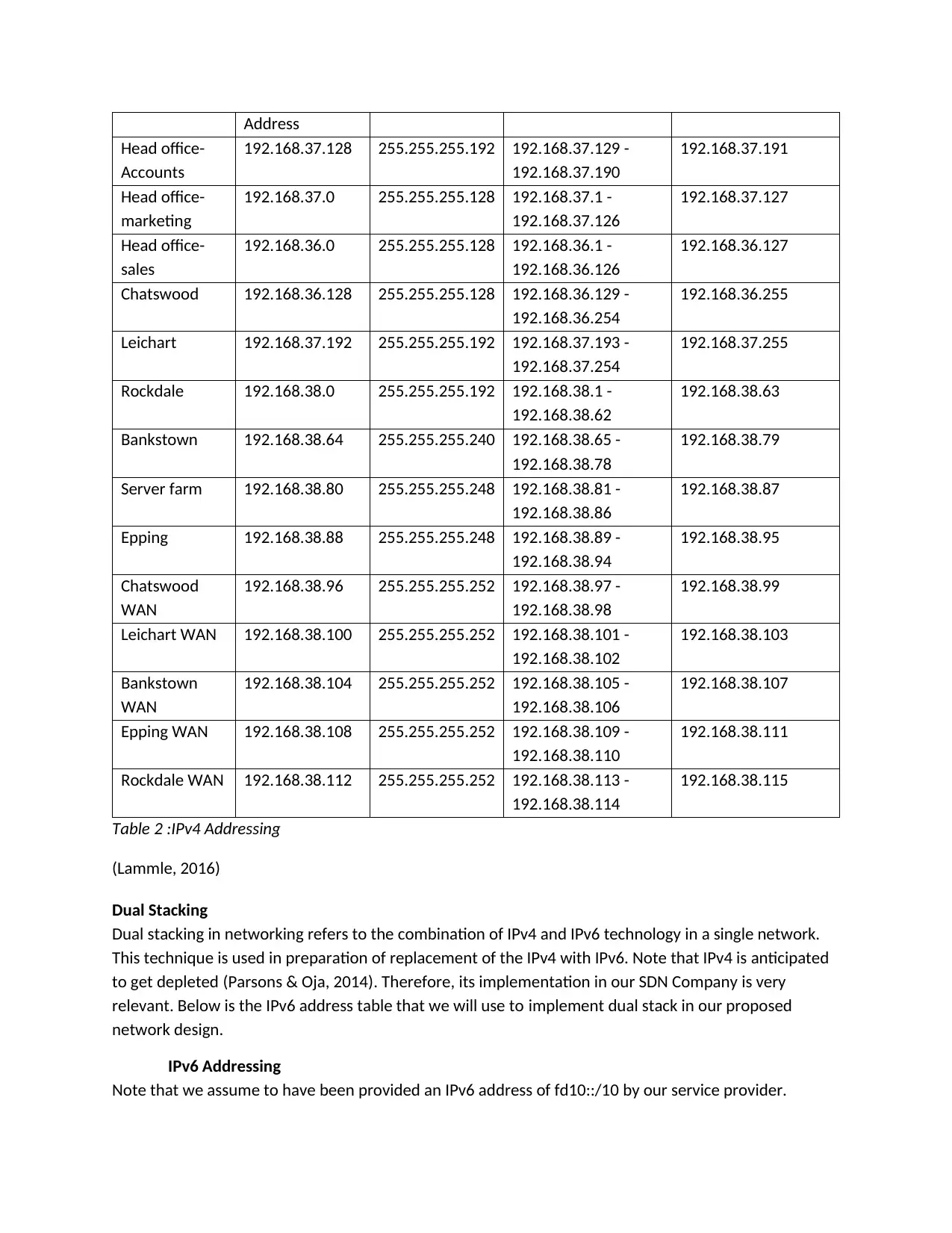
IPv4 Addressing
Name Network Mask Usable Range Broadcast
fasted and longest in distance type of data transmission. Note that it does not experience attenuation,
interferences and EMI. These cables are used for data, voice and video data transmission. Nevertheless,
this kind of media is the most expensive amongst the networking media.
Our prosed network upgrade for SND Company will make use of Coaxial cables and Wireless
communication between the nodes of an office. Cost of one meter of the coaxial cable is $ 0.25
Subnetting and Addressing
IP addressing is the assignment of an IP address together with other parameters to a computing device.
An IP address is a number assigned to a computing device for the purpose of identifying the device on
the internet. Note that before an IP address is assigned to the node, the IP address has to be correctly
identified in the correct subdivision. The subdivision is called a subnet. The process of putting the IP
address into the correct division is called subnetting.
Subnetting process takes two forms, classless and classful subnetting. In classless subnetting, the subnet
masks are unevenly distributed allocating the exact number of IP addresses equal to the hosts available
in the department or the number of allocated addresses is considerably larger than the number of IP
addresses available. This technique has the advantage of preserving IP addresses. However, it is
challenging to implement. On the other hand, classful subnetting technique has ensures that for each
department, the number of hosts are equal to the number of hosts of other departments. This
technique is the easiest to implement but it wastes a lot of IP addresses. In our proposed network
upgrade for SDN, we will use class subnetting technique.
Assuming that we have been allocated an IP address of 192.168.36.0/24 by our service provider, our
IPv4 subdivided network will look as below after the calculation of the 100% percent increase;
Calculation table
Location Number of IP addresses
required
Number of IP addresses after
growth calculation
Head office-marketing 41 82
Chatswood 54 108
Leichart 26 52
Epping 2 4
Server farm 4 4
Head office-sales 57 114
Head office-Accounts 26 52
Bankstown 4 8
Rockdale 21 42
Table 1: Calculation table
IPv4 Addressing
Name Network Mask Usable Range Broadcast
⊘ This is a preview!⊘
Do you want full access?
Subscribe today to unlock all pages.
Trusted by 1+ million students worldwide
Address
Head office-
Accounts
192.168.37.128 255.255.255.192 192.168.37.129 -
192.168.37.190
192.168.37.191
Head office-
marketing
192.168.37.0 255.255.255.128 192.168.37.1 -
192.168.37.126
192.168.37.127
Head office-
sales
192.168.36.0 255.255.255.128 192.168.36.1 -
192.168.36.126
192.168.36.127
Chatswood 192.168.36.128 255.255.255.128 192.168.36.129 -
192.168.36.254
192.168.36.255
Leichart 192.168.37.192 255.255.255.192 192.168.37.193 -
192.168.37.254
192.168.37.255
Rockdale 192.168.38.0 255.255.255.192 192.168.38.1 -
192.168.38.62
192.168.38.63
Bankstown 192.168.38.64 255.255.255.240 192.168.38.65 -
192.168.38.78
192.168.38.79
Server farm 192.168.38.80 255.255.255.248 192.168.38.81 -
192.168.38.86
192.168.38.87
Epping 192.168.38.88 255.255.255.248 192.168.38.89 -
192.168.38.94
192.168.38.95
Chatswood
WAN
192.168.38.96 255.255.255.252 192.168.38.97 -
192.168.38.98
192.168.38.99
Leichart WAN 192.168.38.100 255.255.255.252 192.168.38.101 -
192.168.38.102
192.168.38.103
Bankstown
WAN
192.168.38.104 255.255.255.252 192.168.38.105 -
192.168.38.106
192.168.38.107
Epping WAN 192.168.38.108 255.255.255.252 192.168.38.109 -
192.168.38.110
192.168.38.111
Rockdale WAN 192.168.38.112 255.255.255.252 192.168.38.113 -
192.168.38.114
192.168.38.115
Table 2 :IPv4 Addressing
(Lammle, 2016)
Dual Stacking
Dual stacking in networking refers to the combination of IPv4 and IPv6 technology in a single network.
This technique is used in preparation of replacement of the IPv4 with IPv6. Note that IPv4 is anticipated
to get depleted (Parsons & Oja, 2014). Therefore, its implementation in our SDN Company is very
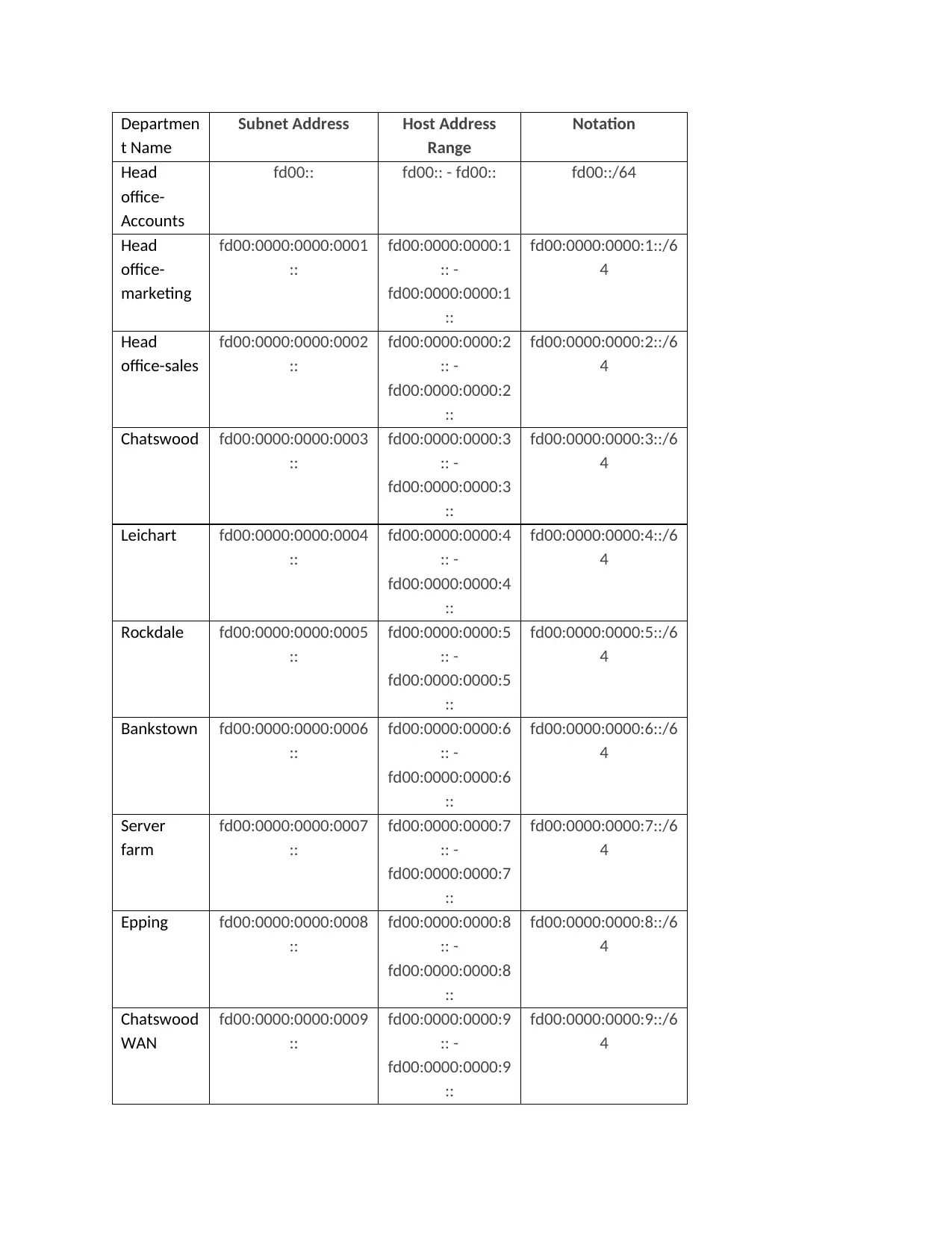
relevant. Below is the IPv6 address table that we will use to implement dual stack in our proposed
network design.
IPv6 Addressing
Note that we assume to have been provided an IPv6 address of fd10::/10 by our service provider.
Head office-
Accounts
192.168.37.128 255.255.255.192 192.168.37.129 -
192.168.37.190
192.168.37.191
Head office-
marketing
192.168.37.0 255.255.255.128 192.168.37.1 -
192.168.37.126
192.168.37.127
Head office-
sales
192.168.36.0 255.255.255.128 192.168.36.1 -
192.168.36.126
192.168.36.127
Chatswood 192.168.36.128 255.255.255.128 192.168.36.129 -
192.168.36.254
192.168.36.255
Leichart 192.168.37.192 255.255.255.192 192.168.37.193 -
192.168.37.254
192.168.37.255
Rockdale 192.168.38.0 255.255.255.192 192.168.38.1 -
192.168.38.62
192.168.38.63
Bankstown 192.168.38.64 255.255.255.240 192.168.38.65 -
192.168.38.78
192.168.38.79
Server farm 192.168.38.80 255.255.255.248 192.168.38.81 -
192.168.38.86
192.168.38.87
Epping 192.168.38.88 255.255.255.248 192.168.38.89 -
192.168.38.94
192.168.38.95
Chatswood
WAN
192.168.38.96 255.255.255.252 192.168.38.97 -
192.168.38.98
192.168.38.99
Leichart WAN 192.168.38.100 255.255.255.252 192.168.38.101 -
192.168.38.102
192.168.38.103
Bankstown
WAN
192.168.38.104 255.255.255.252 192.168.38.105 -
192.168.38.106
192.168.38.107
Epping WAN 192.168.38.108 255.255.255.252 192.168.38.109 -
192.168.38.110
192.168.38.111
Rockdale WAN 192.168.38.112 255.255.255.252 192.168.38.113 -
192.168.38.114
192.168.38.115
Table 2 :IPv4 Addressing
(Lammle, 2016)
Dual Stacking
Dual stacking in networking refers to the combination of IPv4 and IPv6 technology in a single network.
This technique is used in preparation of replacement of the IPv4 with IPv6. Note that IPv4 is anticipated
to get depleted (Parsons & Oja, 2014). Therefore, its implementation in our SDN Company is very
relevant. Below is the IPv6 address table that we will use to implement dual stack in our proposed
network design.
IPv6 Addressing
Note that we assume to have been provided an IPv6 address of fd10::/10 by our service provider.
Paraphrase This Document
Need a fresh take? Get an instant paraphrase of this document with our AI Paraphraser
Departmen
t Name
Subnet Address Host Address
Range
Notation
Head
office-
Accounts
fd00:: fd00:: - fd00:: fd00::/64
Head
office-
marketing
fd00:0000:0000:0001
::
fd00:0000:0000:1
:: -
fd00:0000:0000:1
::
fd00:0000:0000:1::/6
4
Head
office-sales
fd00:0000:0000:0002
::
fd00:0000:0000:2
:: -
fd00:0000:0000:2
::
fd00:0000:0000:2::/6
4
Chatswood fd00:0000:0000:0003
::
fd00:0000:0000:3
:: -
fd00:0000:0000:3
::
fd00:0000:0000:3::/6
4
Leichart fd00:0000:0000:0004
::
fd00:0000:0000:4
:: -
fd00:0000:0000:4
::
fd00:0000:0000:4::/6
4
Rockdale fd00:0000:0000:0005
::
fd00:0000:0000:5
:: -
fd00:0000:0000:5
::
fd00:0000:0000:5::/6
4
Bankstown fd00:0000:0000:0006
::
fd00:0000:0000:6
:: -
fd00:0000:0000:6
::
fd00:0000:0000:6::/6
4
Server
farm
fd00:0000:0000:0007
::
fd00:0000:0000:7
:: -
fd00:0000:0000:7
::
fd00:0000:0000:7::/6
4
Epping fd00:0000:0000:0008
::
fd00:0000:0000:8
:: -
fd00:0000:0000:8
::
fd00:0000:0000:8::/6
4
Chatswood
WAN
fd00:0000:0000:0009
::
fd00:0000:0000:9
:: -
fd00:0000:0000:9
::
fd00:0000:0000:9::/6
4
t Name
Subnet Address Host Address
Range
Notation
Head
office-
Accounts
fd00:: fd00:: - fd00:: fd00::/64
Head
office-
marketing
fd00:0000:0000:0001
::
fd00:0000:0000:1
:: -
fd00:0000:0000:1
::
fd00:0000:0000:1::/6
4
Head
office-sales
fd00:0000:0000:0002
::
fd00:0000:0000:2
:: -
fd00:0000:0000:2
::
fd00:0000:0000:2::/6
4
Chatswood fd00:0000:0000:0003
::
fd00:0000:0000:3
:: -
fd00:0000:0000:3
::
fd00:0000:0000:3::/6
4
Leichart fd00:0000:0000:0004
::
fd00:0000:0000:4
:: -
fd00:0000:0000:4
::
fd00:0000:0000:4::/6
4
Rockdale fd00:0000:0000:0005
::
fd00:0000:0000:5
:: -
fd00:0000:0000:5
::
fd00:0000:0000:5::/6
4
Bankstown fd00:0000:0000:0006
::
fd00:0000:0000:6
:: -
fd00:0000:0000:6
::
fd00:0000:0000:6::/6
4
Server
farm
fd00:0000:0000:0007
::
fd00:0000:0000:7
:: -
fd00:0000:0000:7
::
fd00:0000:0000:7::/6
4
Epping fd00:0000:0000:0008
::
fd00:0000:0000:8
:: -
fd00:0000:0000:8
::
fd00:0000:0000:8::/6
4
Chatswood
WAN
fd00:0000:0000:0009
::
fd00:0000:0000:9
:: -
fd00:0000:0000:9
::
fd00:0000:0000:9::/6
4
Leichart
WAN
fd00:0000:0000:000a
::
fd00:0000:0000:a
:: -
fd00:0000:0000:a
::
fd00:0000:0000:a::/
64
Bankstown
WAN
fd00:0000:0000:000b
::
fd00:0000:0000:b
:: -
fd00:0000:0000:b
::
fd00:0000:0000:b::/
64
Epping
WAN
fd00:0000:0000:000c
::
fd00:0000:0000:c
:: -
fd00:0000:0000:c
::
fd00:0000:0000:c::/
64
Rockdale
WAN
fd00:0000:0000:000d
::
fd00:0000:0000:d
:: -
fd00:0000:0000:d
::
fd00:0000:0000:d::/
64
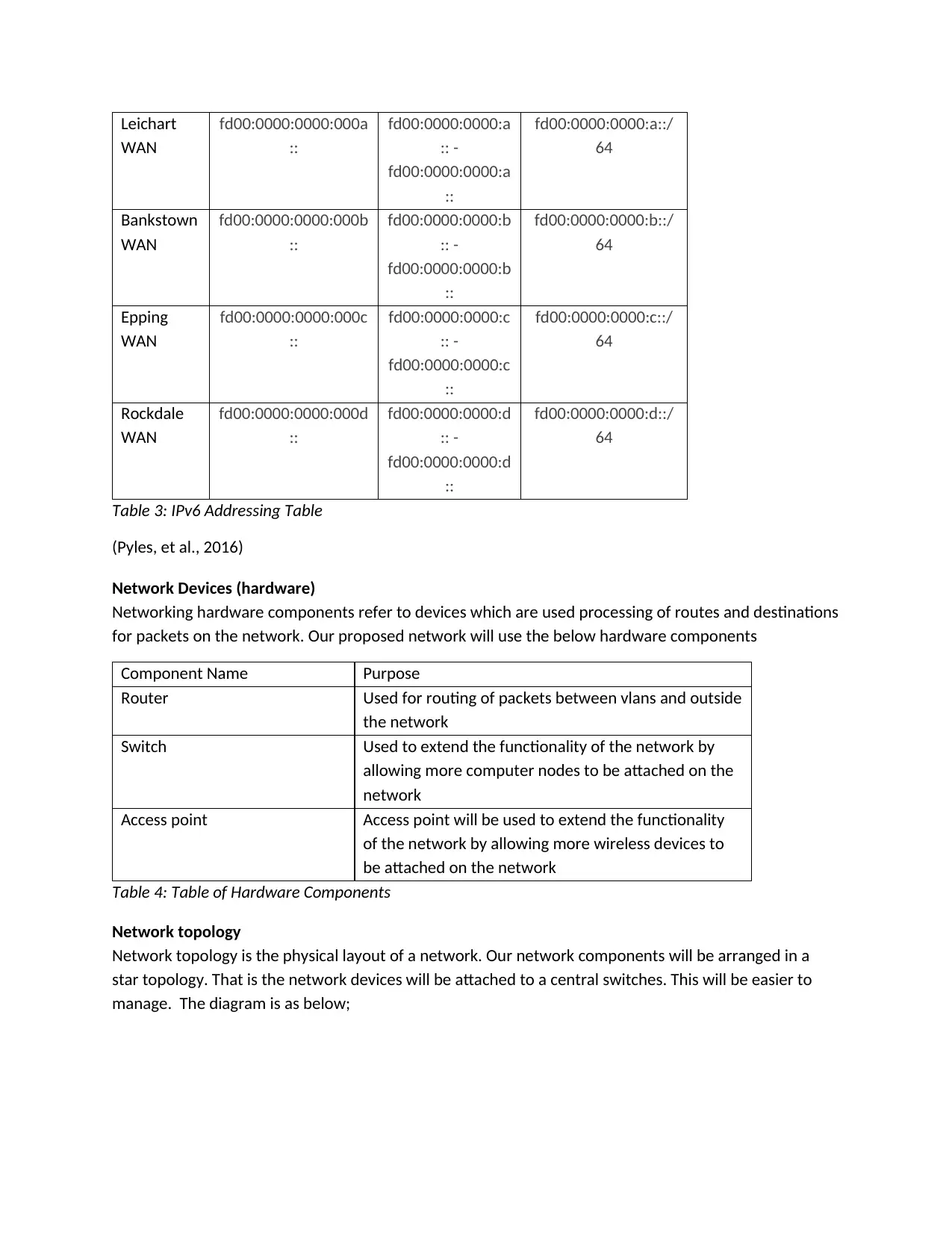
Table 3: IPv6 Addressing Table
(Pyles, et al., 2016)
Network Devices (hardware)
Networking hardware components refer to devices which are used processing of routes and destinations
for packets on the network. Our proposed network will use the below hardware components
Component Name Purpose
Router Used for routing of packets between vlans and outside
the network
Switch Used to extend the functionality of the network by
allowing more computer nodes to be attached on the
network
Access point Access point will be used to extend the functionality
of the network by allowing more wireless devices to
be attached on the network
Table 4: Table of Hardware Components
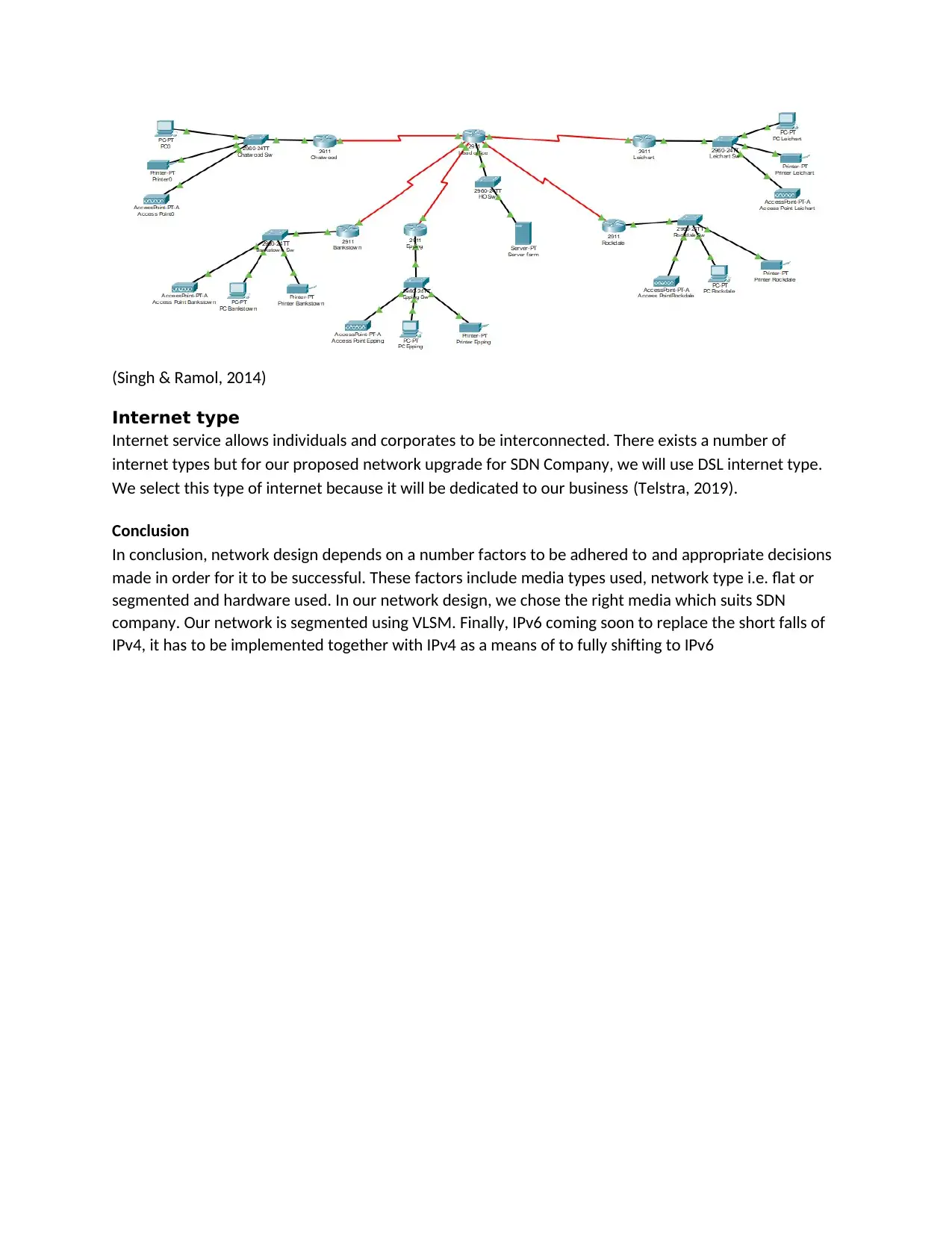
Network topology
Network topology is the physical layout of a network. Our network components will be arranged in a
star topology. That is the network devices will be attached to a central switches. This will be easier to
manage. The diagram is as below;
WAN
fd00:0000:0000:000a
::
fd00:0000:0000:a
:: -
fd00:0000:0000:a
::
fd00:0000:0000:a::/
64
Bankstown
WAN
fd00:0000:0000:000b
::
fd00:0000:0000:b
:: -
fd00:0000:0000:b
::
fd00:0000:0000:b::/
64
Epping
WAN
fd00:0000:0000:000c
::
fd00:0000:0000:c
:: -
fd00:0000:0000:c
::
fd00:0000:0000:c::/
64
Rockdale
WAN
fd00:0000:0000:000d
::
fd00:0000:0000:d
:: -
fd00:0000:0000:d
::
fd00:0000:0000:d::/
64
Table 3: IPv6 Addressing Table
(Pyles, et al., 2016)
Network Devices (hardware)
Networking hardware components refer to devices which are used processing of routes and destinations
for packets on the network. Our proposed network will use the below hardware components
Component Name Purpose
Router Used for routing of packets between vlans and outside
the network
Switch Used to extend the functionality of the network by
allowing more computer nodes to be attached on the
network
Access point Access point will be used to extend the functionality
of the network by allowing more wireless devices to
be attached on the network
Table 4: Table of Hardware Components
Network topology
Network topology is the physical layout of a network. Our network components will be arranged in a
star topology. That is the network devices will be attached to a central switches. This will be easier to
manage. The diagram is as below;
⊘ This is a preview!⊘
Do you want full access?
Subscribe today to unlock all pages.
Trusted by 1+ million students worldwide
(Singh & Ramol, 2014)
Internet type
Internet service allows individuals and corporates to be interconnected. There exists a number of
internet types but for our proposed network upgrade for SDN Company, we will use DSL internet type.
We select this type of internet because it will be dedicated to our business (Telstra, 2019).
Conclusion
In conclusion, network design depends on a number factors to be adhered to and appropriate decisions
made in order for it to be successful. These factors include media types used, network type i.e. flat or
segmented and hardware used. In our network design, we chose the right media which suits SDN
company. Our network is segmented using VLSM. Finally, IPv6 coming soon to replace the short falls of
IPv4, it has to be implemented together with IPv4 as a means of to fully shifting to IPv6
Internet type
Internet service allows individuals and corporates to be interconnected. There exists a number of
internet types but for our proposed network upgrade for SDN Company, we will use DSL internet type.
We select this type of internet because it will be dedicated to our business (Telstra, 2019).
Conclusion
In conclusion, network design depends on a number factors to be adhered to and appropriate decisions
made in order for it to be successful. These factors include media types used, network type i.e. flat or
segmented and hardware used. In our network design, we chose the right media which suits SDN
company. Our network is segmented using VLSM. Finally, IPv6 coming soon to replace the short falls of
IPv4, it has to be implemented together with IPv4 as a means of to fully shifting to IPv6
Paraphrase This Document
Need a fresh take? Get an instant paraphrase of this document with our AI Paraphraser
References
Cox, S. A., 2014. Managing Information in Organizations. 4th ed. New York City: Macmillan International
Higher Education.
Lammle, T., 2016. CCNA Routing and Switching Complete Study Guide. 4th ed. Hoboken: John Wiley &
Sons.
Mason, D., 2019. Computer Networking; A Top-Down Approach. Los Angeles: Rico Publications.
Pandya, K., 2013. Network Structure or Topology. International Journal of Advance Research in
Computer Science and Management Studies, 1(2), pp. 1-6.
Parsons, J. J. & Oja, ., 2014. New Perspectives on Computer Concepts 2014. 2 ed. Boston: Cengage
Learning.
Pyles, a., Carrell, . L. & Tittel, ., 2016. Guide to TCP/IP: IPv6 and IPv4. 2nd ed. Boston: Cengage Learning.
Rogers, B. E., 2014. CompTIA Mobility+ Certification All-in-One Exam Guide (Exam MB0-001). 4th ed.
Pennsylvania Plaza New York City: McGraw Hill Professional.
Singh, V. & Ramol, J., 2014. Computer Network Topology. International Journal for Research in Applied
Science & Engineering Technology, 2(9), pp. 1-6.
Skibniewski, M., 2014. Research Trends in Information Technology Applications in Construction Safety
Engineering and Management. Frontiers of Engineering Management, 8(5), p. 246.
Teare, D., Vachon, . & Graziani, ., 2014. Implementing Cisco IP Routing (ROUTE) Foundation Learning
Guide. 3rd ed. Indianapolis: Cisco Press.
Telstra, 2019. Network Services. [Online]
Available at: https://www.telstra.com.au/business-enterprise/solutions/network-services
[Accessed 6 Otober 2019].
Cox, S. A., 2014. Managing Information in Organizations. 4th ed. New York City: Macmillan International
Higher Education.
Lammle, T., 2016. CCNA Routing and Switching Complete Study Guide. 4th ed. Hoboken: John Wiley &
Sons.
Mason, D., 2019. Computer Networking; A Top-Down Approach. Los Angeles: Rico Publications.
Pandya, K., 2013. Network Structure or Topology. International Journal of Advance Research in
Computer Science and Management Studies, 1(2), pp. 1-6.
Parsons, J. J. & Oja, ., 2014. New Perspectives on Computer Concepts 2014. 2 ed. Boston: Cengage
Learning.
Pyles, a., Carrell, . L. & Tittel, ., 2016. Guide to TCP/IP: IPv6 and IPv4. 2nd ed. Boston: Cengage Learning.
Rogers, B. E., 2014. CompTIA Mobility+ Certification All-in-One Exam Guide (Exam MB0-001). 4th ed.
Pennsylvania Plaza New York City: McGraw Hill Professional.
Singh, V. & Ramol, J., 2014. Computer Network Topology. International Journal for Research in Applied
Science & Engineering Technology, 2(9), pp. 1-6.
Skibniewski, M., 2014. Research Trends in Information Technology Applications in Construction Safety
Engineering and Management. Frontiers of Engineering Management, 8(5), p. 246.
Teare, D., Vachon, . & Graziani, ., 2014. Implementing Cisco IP Routing (ROUTE) Foundation Learning
Guide. 3rd ed. Indianapolis: Cisco Press.
Telstra, 2019. Network Services. [Online]
Available at: https://www.telstra.com.au/business-enterprise/solutions/network-services
[Accessed 6 Otober 2019].

1 out of 11


Related Documents


Your All-in-One AI-Powered Toolkit for Academic Success.
+13062052269
info@desklib.com
Available 24*7 on WhatsApp / Email
![[object Object]](/_next/static/media/star-bottom.7253800d.svg)
Unlock your academic potential
Copyright © 2020–2026 A2Z Services. All Rights Reserved. Developed and managed by ZUCOL.