Walmart Case Study: Ethical Analysis Using the FIAS COVER Model

Verified

Added on  2022/09/21

|6
|1260
|22
Case Study
AI Summary
This case study analysis examines the ethical issues faced by Walmart, a leading business in the United States. The analysis focuses on the ethical challenges related to competitive pricing and its impact on stakeholders, including competitors, employees, and suppliers. The FIAS COVER model (Facts, Issues, Alternatives, Stakeholders; Codes, Outcomes, Values, Editorial, Rules) is applied to dissect these issues, highlighting the implications of Walmart's pricing strategies and their effects on market dynamics and employee wages. The study identifies the key ethical issues, such as the impact on competitive stakeholders due to low prices, and evaluates various alternatives to address these concerns. The analysis concludes that the issue of competitiveness should be eradicated as it is unethical for the business, and that Walmart needs to consider the ethical implications of its business practices to maintain a sustainable and ethical business model. References from various ethical and business management sources are included.
Document Page
Running head: COVER MODEL ANALYSIS
Cover Model Analysis for Walmart Juggles Risks and Rewards Case Study
Name of the Student
Name of the University
Author’s Note:
tabler-icon-diamond-filled.svg

Paraphrase This Document

Need a fresh take? Get an instant paraphrase of this document with our AI Paraphraser
Document Page
1
COVER MODEL ANALYSIS
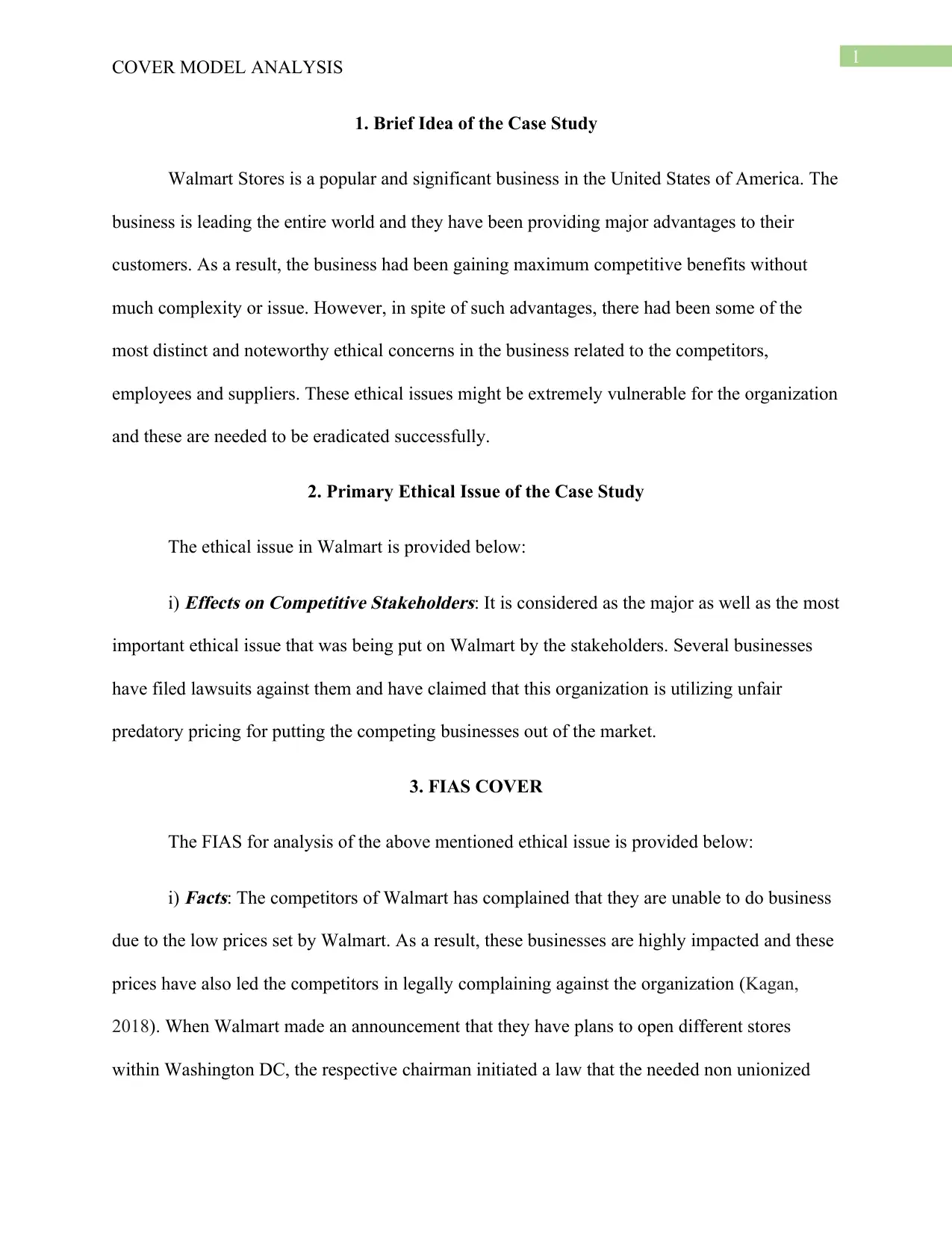
1. Brief Idea of the Case Study
Walmart Stores is a popular and significant business in the United States of America. The
business is leading the entire world and they have been providing major advantages to their
customers. As a result, the business had been gaining maximum competitive benefits without
much complexity or issue. However, in spite of such advantages, there had been some of the
most distinct and noteworthy ethical concerns in the business related to the competitors,
employees and suppliers. These ethical issues might be extremely vulnerable for the organization
and these are needed to be eradicated successfully.
2. Primary Ethical Issue of the Case Study
The ethical issue in Walmart is provided below:
i)
Effects on Competitive Stakeholders: It is considered as the major as well as the most
important ethical issue that was being put on Walmart by the stakeholders. Several businesses
have filed lawsuits against them and have claimed that this organization is utilizing unfair
predatory pricing for putting the competing businesses out of the market.
3. FIAS COVER
The FIAS for analysis of the above mentioned ethical issue is provided below:
i)
Facts: The competitors of Walmart has complained that they are unable to do business
due to the low prices set by Walmart. As a result, these businesses are highly impacted and these
prices have also led the competitors in legally complaining against the organization (Kagan,
2018). When Walmart made an announcement that they have plans to open different stores
within Washington DC, the respective chairman initiated a law that the needed non unionized
Document Page
2
COVER MODEL ANALYSIS
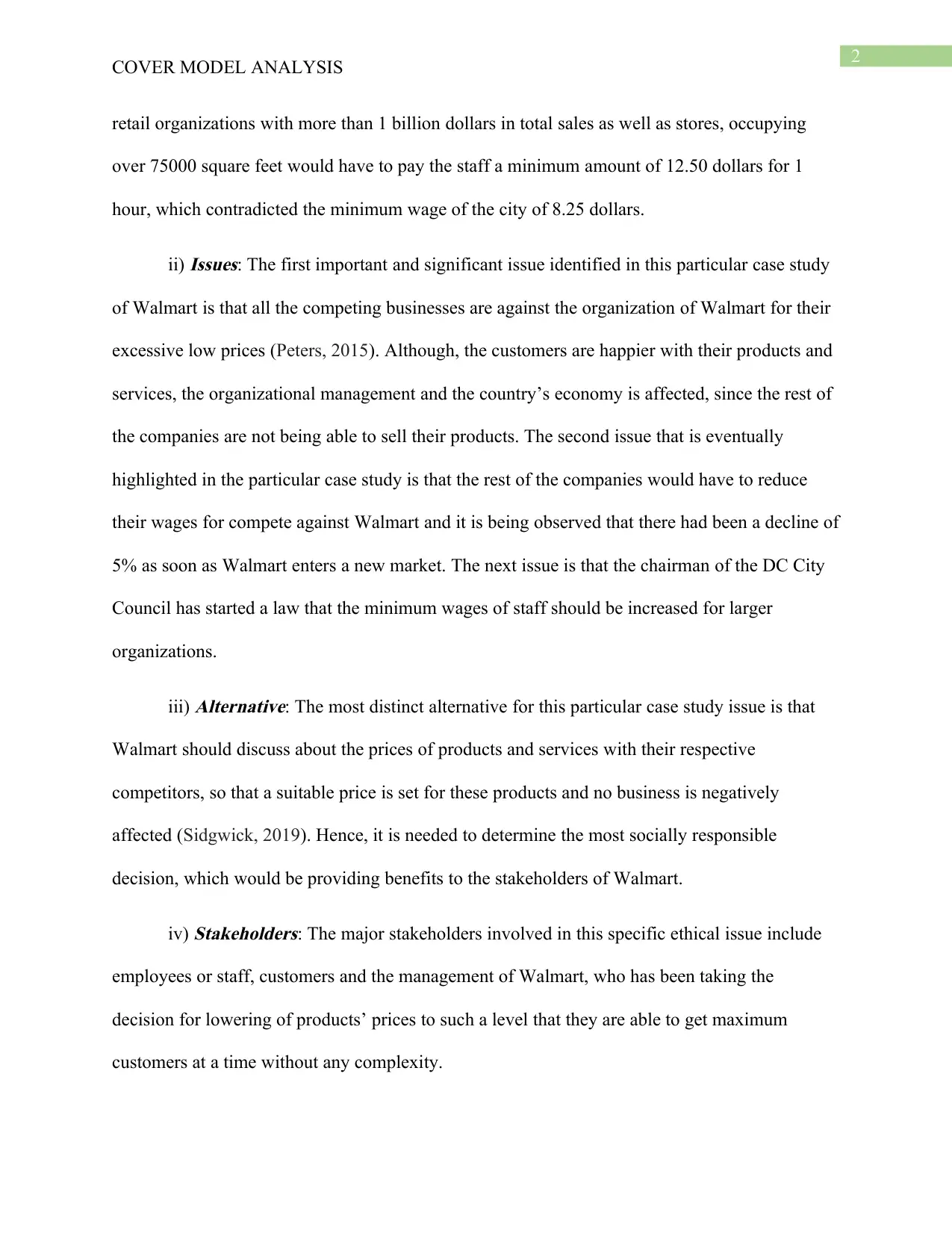
retail organizations with more than 1 billion dollars in total sales as well as stores, occupying
over 75000 square feet would have to pay the staff a minimum amount of 12.50 dollars for 1
hour, which contradicted the minimum wage of the city of 8.25 dollars.
ii)
Issues: The first important and significant issue identified in this particular case study
of Walmart is that all the competing businesses are against the organization of Walmart for their
excessive low prices (Peters, 2015). Although, the customers are happier with their products and
services, the organizational management and the country’s economy is affected, since the rest of
the companies are not being able to sell their products. The second issue that is eventually
highlighted in the particular case study is that the rest of the companies would have to reduce
their wages for compete against Walmart and it is being observed that there had been a decline of
5% as soon as Walmart enters a new market. The next issue is that the chairman of the DC City
Council has started a law that the minimum wages of staff should be increased for larger
organizations.
iii)
Alternative: The most distinct alternative for this particular case study issue is that
Walmart should discuss about the prices of products and services with their respective
competitors, so that a suitable price is set for these products and no business is negatively
affected (Sidgwick, 2019). Hence, it is needed to determine the most socially responsible
decision, which would be providing benefits to the stakeholders of Walmart.
iv)
Stakeholders: The major stakeholders involved in this specific ethical issue include
employees or staff, customers and the management of Walmart, who has been taking the
decision for lowering of products’ prices to such a level that they are able to get maximum
customers at a time without any complexity.
Document Page
3
COVER MODEL ANALYSIS
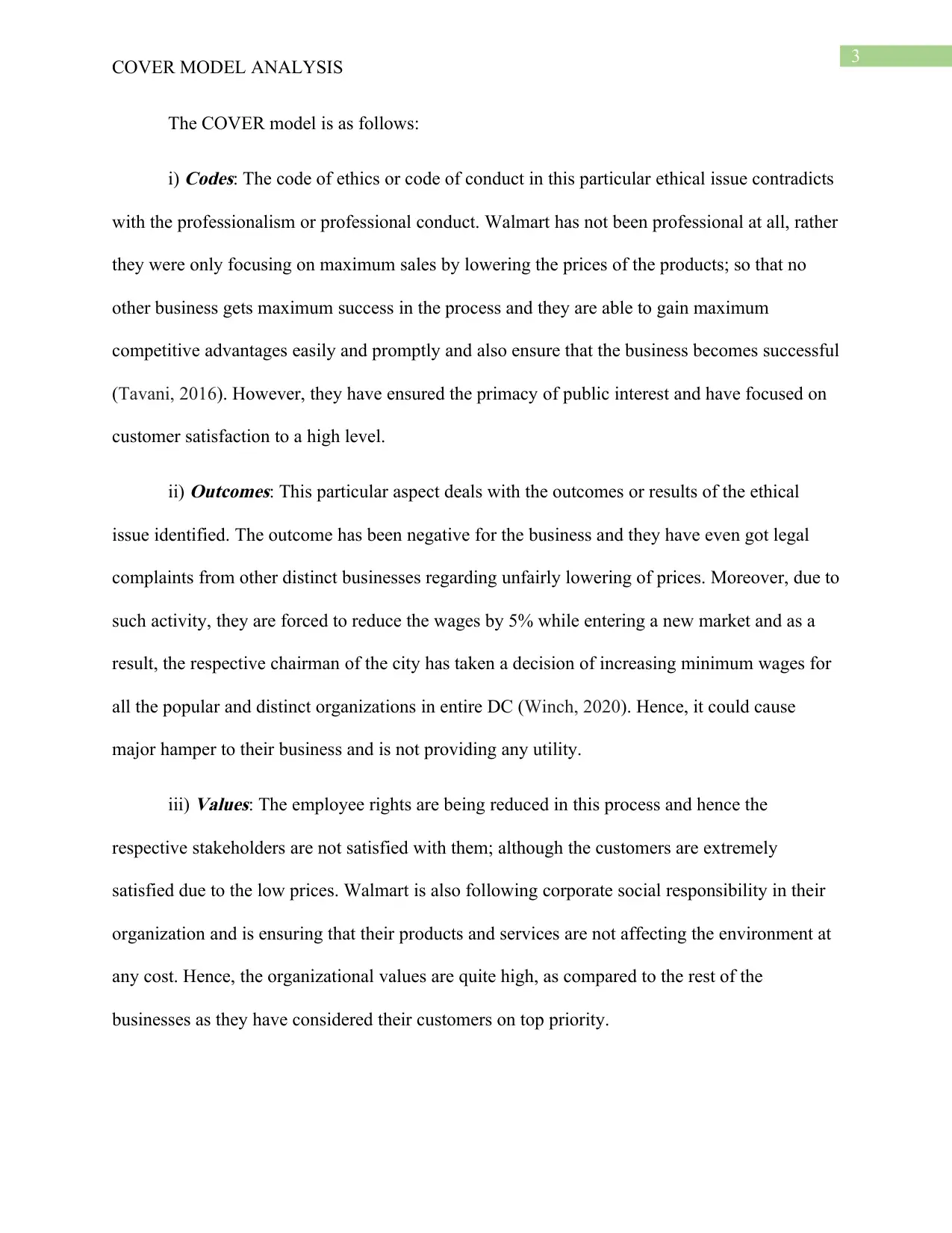
The COVER model is as follows:
i)
Codes: The code of ethics or code of conduct in this particular ethical issue contradicts
with the professionalism or professional conduct. Walmart has not been professional at all, rather
they were only focusing on maximum sales by lowering the prices of the products; so that no
other business gets maximum success in the process and they are able to gain maximum
competitive advantages easily and promptly and also ensure that the business becomes successful
(Tavani, 2016). However, they have ensured the primacy of public interest and have focused on
customer satisfaction to a high level.
ii)
Outcomes: This particular aspect deals with the outcomes or results of the ethical
issue identified. The outcome has been negative for the business and they have even got legal
complaints from other distinct businesses regarding unfairly lowering of prices. Moreover, due to
such activity, they are forced to reduce the wages by 5% while entering a new market and as a
result, the respective chairman of the city has taken a decision of increasing minimum wages for
all the popular and distinct organizations in entire DC (Winch, 2020). Hence, it could cause
major hamper to their business and is not providing any utility.
iii)
Values: The employee rights are being reduced in this process and hence the
respective stakeholders are not satisfied with them; although the customers are extremely
satisfied due to the low prices. Walmart is also following corporate social responsibility in their
organization and is ensuring that their products and services are not affecting the environment at
any cost. Hence, the organizational values are quite high, as compared to the rest of the
businesses as they have considered their customers on top priority.
tabler-icon-diamond-filled.svg

Paraphrase This Document

Need a fresh take? Get an instant paraphrase of this document with our AI Paraphraser
Document Page
4
COVER MODEL ANALYSIS
iv)
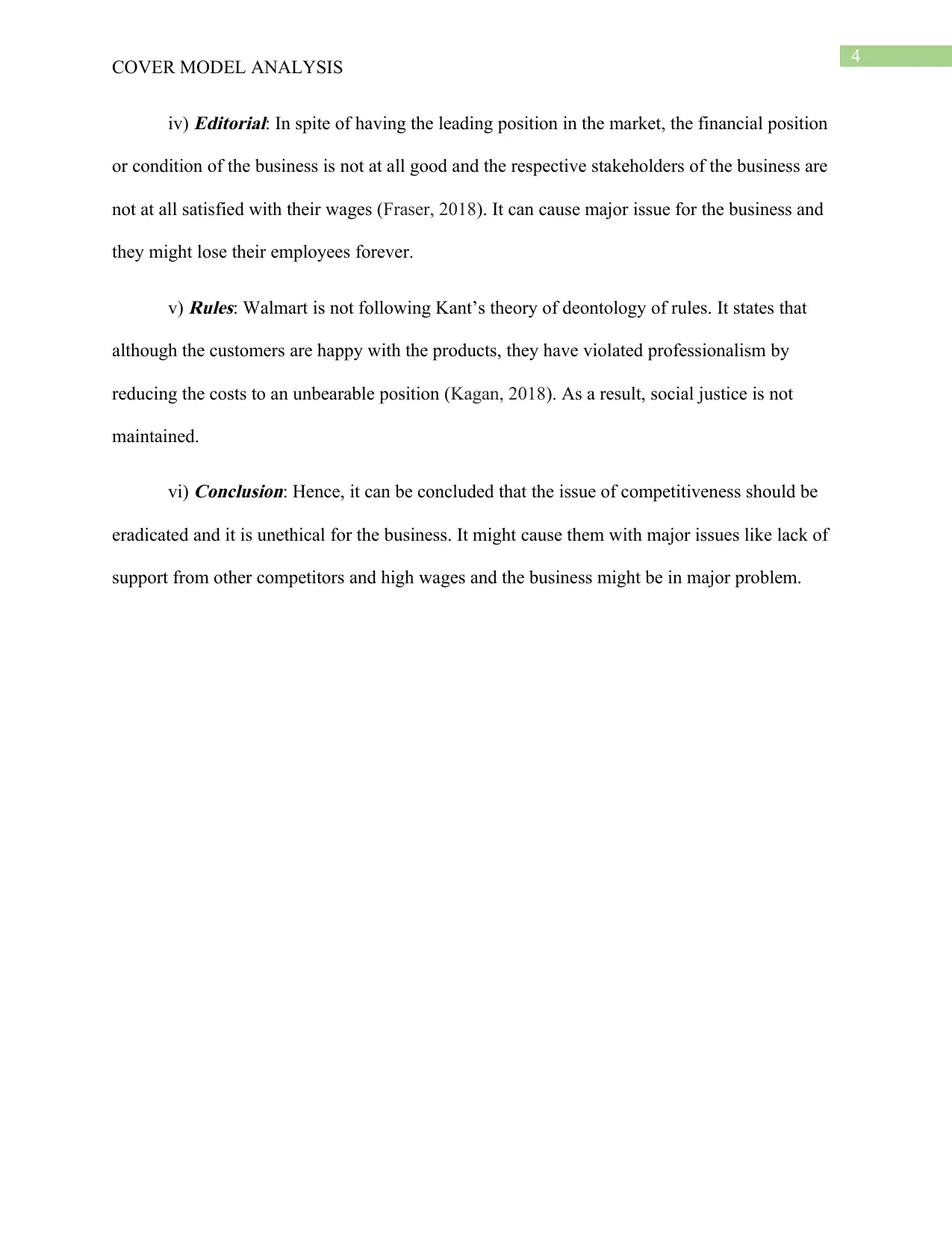
Editorial: In spite of having the leading position in the market, the financial position
or condition of the business is not at all good and the respective stakeholders of the business are
not at all satisfied with their wages (Fraser, 2018). It can cause major issue for the business and
they might lose their employees forever.
v)
Rules: Walmart is not following Kant’s theory of deontology of rules. It states that
although the customers are happy with the products, they have violated professionalism by
reducing the costs to an unbearable position (Kagan, 2018). As a result, social justice is not
maintained.
vi)
Conclusion: Hence, it can be concluded that the issue of competitiveness should be
eradicated and it is unethical for the business. It might cause them with major issues like lack of
support from other competitors and high wages and the business might be in major problem.
Document Page
5
COVER MODEL ANALYSIS
References
Fraser, N. (2018). Recognition without ethics?. In The culture of toleration in diverse societies.
Manchester University Press.
Kagan, S. (2018). Normative ethics. Routledge.
Peters, R. S. (2015). Ethics and Education (Routledge Revivals). Routledge.
Sidgwick, H. (2019). The methods of ethics. Good Press.
Tavani, H. T. (2016). Ethics and technology. Wiley.
Winch, P. (2020). Ethics and action. Routledge.
chevron_up_icon
1 out of 6
circle_padding
hide_on_mobile
zoom_out_icon
[object Object]