CREATIVITY vs. DANGEROUS IDEAS: Philosophical Analysis of Concepts
VerifiedAdded on 2020/04/07
|10
|2317
|291
Essay
AI Summary
This essay provides a detailed examination of creativity and dangerous ideas, exploring the creative process and its various phases. The essay begins by outlining the six phases of the creative process: inspiration, perspiration, incubation, clarification, distillation, and evaluation, highlighting the importance of each stage and their iterative nature. It then delves into the philosophical perspectives on creativity, discussing how creativity drives progress across various fields and exploring the views of philosophers such as Plato, Aristotle, Kant, Schopenhauer, and Nietzsche. The essay emphasizes the importance of creative thinking in problem-solving, idea generation, and the development of innovative solutions. It concludes by reinforcing the idea that creative thinking can be strengthened through training and offers practical advice on improving creative deduction. The essay also emphasizes the value of creative individuals and their ability to bring fresh perspectives and insights to their work, ultimately benefiting organizations and departments.
CREATIVITY vs. DANGEROUS IDEAS 1
CREATIVITY AND DANGEROUS IDEAS
Name
Professor
Institution
Course
Date
CREATIVITY AND DANGEROUS IDEAS
Name
Professor
Institution
Course
Date
Paraphrase This Document
Need a fresh take? Get an instant paraphrase of this document with our AI Paraphraser

CREATIVITY vs. DANGEROUS IDEAS 2
Section A
Creative process is made up of some six working phases and these include: inspiration,
perspiration, incubation, clarification and evaluation. In every piece of creative work, each of
these phases should be experienced severally, without any specific order and in most of the
times for a short period of time (Gurteen, 2013).
Inspiration
This is whereby a good quantity of ideas is made. It is the enquiry that is based on the
generation of ideas. The process is not abandoned by the investigation, instinct and taking of
risks. Most individuals are surprised by where the creative people get their creativity from. The
answer to the latter question is amongst the use of the huge piles of the bad ones (Fererabend,
2012). Creativity in most occasions is like mining of diamonds since most of what is dug is
thrown. However, the throwing away of what is not needed does not make the excavating a
waste of spell. Given that a person is not able think of anything that he or she is having difficulty
in this phase of inspiration, then most probably this person is too self-critical or having the
expectation of the ideas coming too quickly and with ease.
The inspiration phase is not given an association with a search for in the field of the
creative arts and with the given attempt to summon some deep feelings related to empathy,
spirituality or an intense identification with the subject matter.
This is not a kind of a phase which to have a negative or get a worry form practicality or quality
is applied.
Section A
Creative process is made up of some six working phases and these include: inspiration,
perspiration, incubation, clarification and evaluation. In every piece of creative work, each of
these phases should be experienced severally, without any specific order and in most of the
times for a short period of time (Gurteen, 2013).
Inspiration
This is whereby a good quantity of ideas is made. It is the enquiry that is based on the
generation of ideas. The process is not abandoned by the investigation, instinct and taking of
risks. Most individuals are surprised by where the creative people get their creativity from. The
answer to the latter question is amongst the use of the huge piles of the bad ones (Fererabend,
2012). Creativity in most occasions is like mining of diamonds since most of what is dug is
thrown. However, the throwing away of what is not needed does not make the excavating a
waste of spell. Given that a person is not able think of anything that he or she is having difficulty
in this phase of inspiration, then most probably this person is too self-critical or having the
expectation of the ideas coming too quickly and with ease.
The inspiration phase is not given an association with a search for in the field of the
creative arts and with the given attempt to summon some deep feelings related to empathy,
spirituality or an intense identification with the subject matter.
This is not a kind of a phase which to have a negative or get a worry form practicality or quality
is applied.

CREATIVITY vs. DANGEROUS IDEAS 3
Clarification
The main objective in clarification phase is to give a clarification or the objective of the
work that is being done. Losing a sense of direction is easy while handling difficulties in the
imaginative work. There is hence a requirement to at given times have disengagement to these
from barriers and ask yourself what exactly you are trying to do (De Bono, 2015). In case you
get stuck in the middle of the project, instead of coming up with a series of alternatives, it is
advisable to get a clarification concerning your destination and then having that in mind, then
how to get there is always very easy and straight forward. Clarification has a history of getting
people of mire. However, there is a requirement when for example a designer is in a position to
agonize between two approaches which are equally attractive and this kind of decision needs a
very clear intelligence of objective.
If one is stuck, lost, confused or even not certain on how he or she is going to work it out,
then he or she needs what is called clarification phase and then have the eye set on the ball, have
strategy and be logic enough and keep focus on how the final work will look like
(Turner, 2014).
Distillation
In this phase, the ideas are sifted and then the judgement is evaluated in the light of
findings that were obtained in the clarification phase. There is the selection of the best ideas for
more development or else for better sieving to get better ideas (Beghetto R, 2013). This phase is
self-critical since it requires composed scrutiny and decision instead of the slap contented
Clarification
The main objective in clarification phase is to give a clarification or the objective of the
work that is being done. Losing a sense of direction is easy while handling difficulties in the
imaginative work. There is hence a requirement to at given times have disengagement to these
from barriers and ask yourself what exactly you are trying to do (De Bono, 2015). In case you
get stuck in the middle of the project, instead of coming up with a series of alternatives, it is
advisable to get a clarification concerning your destination and then having that in mind, then
how to get there is always very easy and straight forward. Clarification has a history of getting
people of mire. However, there is a requirement when for example a designer is in a position to
agonize between two approaches which are equally attractive and this kind of decision needs a
very clear intelligence of objective.
If one is stuck, lost, confused or even not certain on how he or she is going to work it out,
then he or she needs what is called clarification phase and then have the eye set on the ball, have
strategy and be logic enough and keep focus on how the final work will look like
(Turner, 2014).
Distillation
In this phase, the ideas are sifted and then the judgement is evaluated in the light of
findings that were obtained in the clarification phase. There is the selection of the best ideas for
more development or else for better sieving to get better ideas (Beghetto R, 2013). This phase is
self-critical since it requires composed scrutiny and decision instead of the slap contented
⊘ This is a preview!⊘
Do you want full access?
Subscribe today to unlock all pages.

Trusted by 1+ million students worldwide

CREATIVITY vs. DANGEROUS IDEAS 4
artlessness. This should nevertheless be so serious so as to inhibit the entire output. The ideas
that one has should not be however viewed as solutions.
Perspiration
This is the phase in which the actual work is done. Here, one is determined and persistent
in the efforts towards ones aims and objectives (Torrance & Goff, 2013). This is known to
involve some further distillation and inspiration and also the clarification phases.
Evaluation
This is whereby the examination of the entire work is done for the identification of the
strengths and weaknesses. There is then the need to consider the kind of work and also the
methods that can be used for its enhancement by the removal of the weaknesses and also the
capitalization on its strengths (Dix, et al., 2012). There is then the need for another form of
perspiration phase for the purposes of having a positive response and to the suggestions
concerning the improvements (Fererabend, 2012). Having known that nothing comes easy to
anyone, it is then advisable to cope like the creative people who are easily adaptive to
improvements.
Most people do not like the evaluation phase at first but those people who are highly
creative nearly have the inveterate revisers easily. They are able to tinker with work that is able
of making other people gape in happiness
(Beghetto R, 2013). This phase of evaluation in most cases is very rewarding and there is not even
a single work that can be given in tis absentia.
artlessness. This should nevertheless be so serious so as to inhibit the entire output. The ideas
that one has should not be however viewed as solutions.
Perspiration
This is the phase in which the actual work is done. Here, one is determined and persistent
in the efforts towards ones aims and objectives (Torrance & Goff, 2013). This is known to
involve some further distillation and inspiration and also the clarification phases.
Evaluation
This is whereby the examination of the entire work is done for the identification of the
strengths and weaknesses. There is then the need to consider the kind of work and also the
methods that can be used for its enhancement by the removal of the weaknesses and also the
capitalization on its strengths (Dix, et al., 2012). There is then the need for another form of
perspiration phase for the purposes of having a positive response and to the suggestions
concerning the improvements (Fererabend, 2012). Having known that nothing comes easy to
anyone, it is then advisable to cope like the creative people who are easily adaptive to
improvements.
Most people do not like the evaluation phase at first but those people who are highly
creative nearly have the inveterate revisers easily. They are able to tinker with work that is able
of making other people gape in happiness
(Beghetto R, 2013). This phase of evaluation in most cases is very rewarding and there is not even
a single work that can be given in tis absentia.
Paraphrase This Document
Need a fresh take? Get an instant paraphrase of this document with our AI Paraphraser

CREATIVITY vs. DANGEROUS IDEAS 5
Incubation
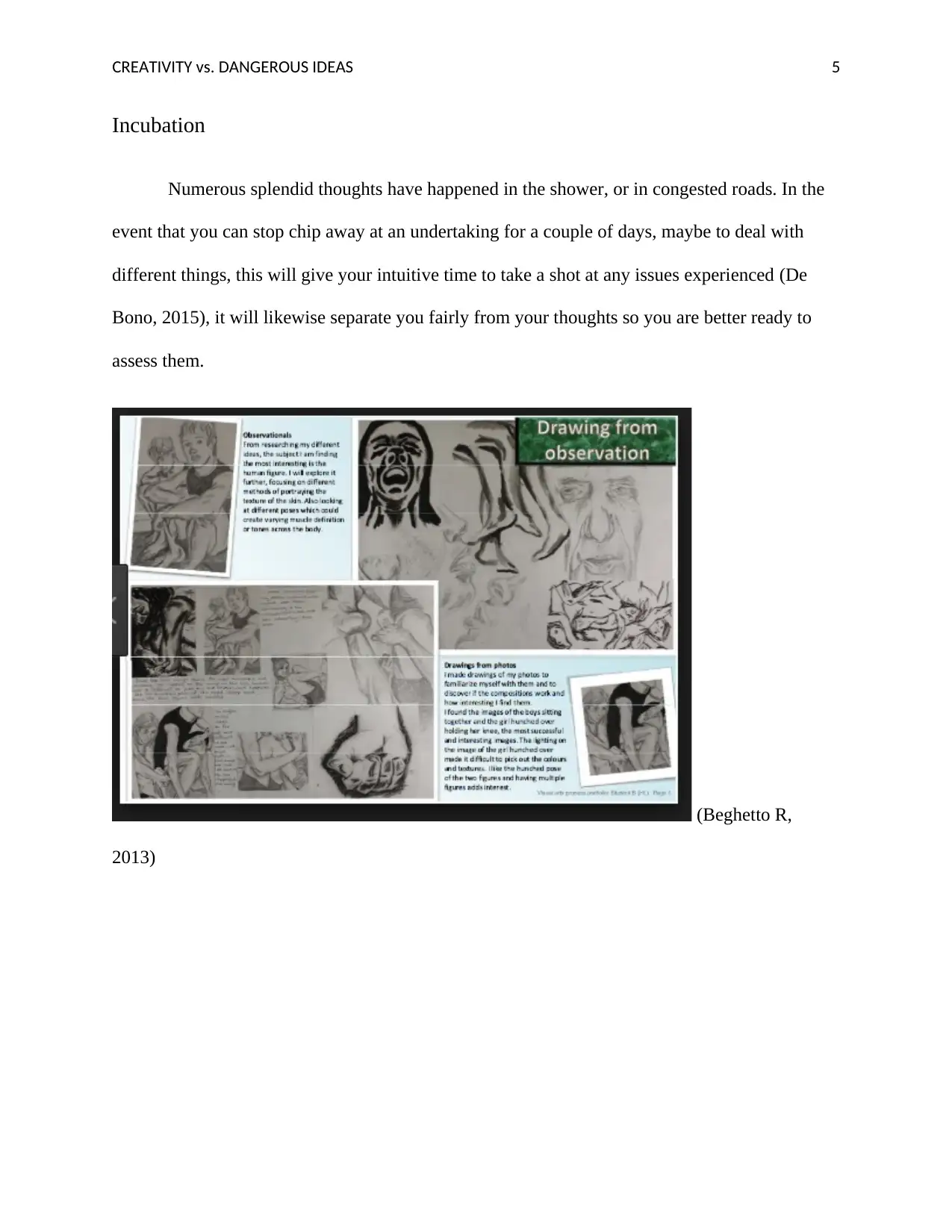
Numerous splendid thoughts have happened in the shower, or in congested roads. In the
event that you can stop chip away at an undertaking for a couple of days, maybe to deal with
different things, this will give your intuitive time to take a shot at any issues experienced (De
Bono, 2015), it will likewise separate you fairly from your thoughts so you are better ready to
assess them.
(Beghetto R,
2013)
Incubation
Numerous splendid thoughts have happened in the shower, or in congested roads. In the
event that you can stop chip away at an undertaking for a couple of days, maybe to deal with
different things, this will give your intuitive time to take a shot at any issues experienced (De
Bono, 2015), it will likewise separate you fairly from your thoughts so you are better ready to
assess them.
(Beghetto R,
2013)

CREATIVITY vs. DANGEROUS IDEAS 6
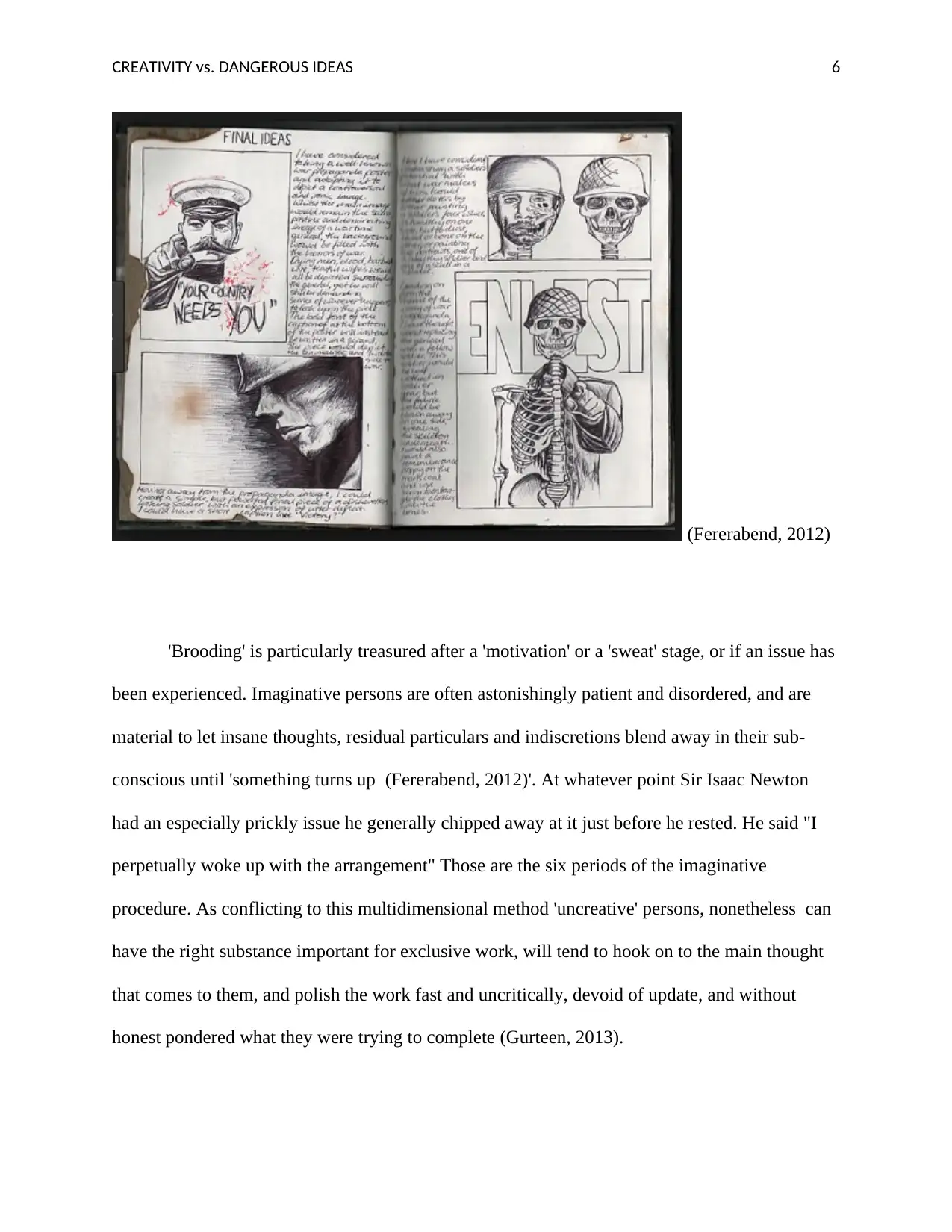
(Fererabend, 2012)
'Brooding' is particularly treasured after a 'motivation' or a 'sweat' stage, or if an issue has
been experienced. Imaginative persons are often astonishingly patient and disordered, and are
material to let insane thoughts, residual particulars and indiscretions blend away in their sub-
conscious until 'something turns up (Fererabend, 2012)'. At whatever point Sir Isaac Newton
had an especially prickly issue he generally chipped away at it just before he rested. He said "I
perpetually woke up with the arrangement" Those are the six periods of the imaginative
procedure. As conflicting to this multidimensional method 'uncreative' persons, nonetheless can
have the right substance important for exclusive work, will tend to hook on to the main thought
that comes to them, and polish the work fast and uncritically, devoid of update, and without
honest pondered what they were trying to complete (Gurteen, 2013).
(Fererabend, 2012)
'Brooding' is particularly treasured after a 'motivation' or a 'sweat' stage, or if an issue has
been experienced. Imaginative persons are often astonishingly patient and disordered, and are
material to let insane thoughts, residual particulars and indiscretions blend away in their sub-
conscious until 'something turns up (Fererabend, 2012)'. At whatever point Sir Isaac Newton
had an especially prickly issue he generally chipped away at it just before he rested. He said "I
perpetually woke up with the arrangement" Those are the six periods of the imaginative
procedure. As conflicting to this multidimensional method 'uncreative' persons, nonetheless can
have the right substance important for exclusive work, will tend to hook on to the main thought
that comes to them, and polish the work fast and uncritically, devoid of update, and without
honest pondered what they were trying to complete (Gurteen, 2013).
⊘ This is a preview!⊘
Do you want full access?
Subscribe today to unlock all pages.

Trusted by 1+ million students worldwide

CREATIVITY vs. DANGEROUS IDEAS 7
The primary letters of these six stages can be orchestrated to spell "icedip" which may
help you to recall them. Keep in mind however, that each of these "icedip" stages ought to be
experienced commonly, in some cases for brief periods, and not really in a specific succession.
Section B
There does not exist so much of anything that shapes the human experience that as much
as creativity. Creativity is known to drive progress in every aspect of human endeavors, ranging
from the field of sciences and cutting down to the arts (Torrance & Goff, 2013). We give
celebrations and honor to different people as a result of their levels of creativity and the
identification of the eminent personnel as well as the whole culture and society due to their great
creative achievement. Creativity is the main body of the entire self-expression and it is what
defines us as the kind of individuals we are. A person may therefore expect creativity to be
identified as a core topic in philosophy more so because it gives rise to the interesting
philosophical questions.
Some of the philosophers of the olden days have been up to date taken with the wonders
of creativity. A good examples is Plato as the Socrates say in some several dialogues that when
some given poets come up with truly great and recommendable poetry, they do it out of
inspiration and through the knowledge and mastery that they have. Literally, they are said to be
breathed in by cogitates or in a state of possession that shows an exhibition of some kind of
madness (Dix, et al., 2012). Aristocrat on the other hand had described the work of a poet as
being rational objective coordinated movement of making (poeisis), in which the poet utilizes
different means, (for example, thoughtful characters and plots including spots of destiny) to
accomplish an end (of inspiring different feelings in the audience) (Turner, 2014). Kant
The primary letters of these six stages can be orchestrated to spell "icedip" which may
help you to recall them. Keep in mind however, that each of these "icedip" stages ought to be
experienced commonly, in some cases for brief periods, and not really in a specific succession.
Section B
There does not exist so much of anything that shapes the human experience that as much
as creativity. Creativity is known to drive progress in every aspect of human endeavors, ranging
from the field of sciences and cutting down to the arts (Torrance & Goff, 2013). We give
celebrations and honor to different people as a result of their levels of creativity and the
identification of the eminent personnel as well as the whole culture and society due to their great
creative achievement. Creativity is the main body of the entire self-expression and it is what
defines us as the kind of individuals we are. A person may therefore expect creativity to be
identified as a core topic in philosophy more so because it gives rise to the interesting
philosophical questions.
Some of the philosophers of the olden days have been up to date taken with the wonders
of creativity. A good examples is Plato as the Socrates say in some several dialogues that when
some given poets come up with truly great and recommendable poetry, they do it out of
inspiration and through the knowledge and mastery that they have. Literally, they are said to be
breathed in by cogitates or in a state of possession that shows an exhibition of some kind of
madness (Dix, et al., 2012). Aristocrat on the other hand had described the work of a poet as
being rational objective coordinated movement of making (poeisis), in which the poet utilizes
different means, (for example, thoughtful characters and plots including spots of destiny) to
accomplish an end (of inspiring different feelings in the audience) (Turner, 2014). Kant
Paraphrase This Document
Need a fresh take? Get an instant paraphrase of this document with our AI Paraphraser

CREATIVITY vs. DANGEROUS IDEAS 8
considered aesthetic skillful as an intrinsic ability to deliver works of "commendable creativity"
through the free play of the creative ability, a procedure which does not comprise in following
principles, can neither be educated nor instructed, and is strange even to prodigies themselves.
Schopenhauer focused on that the best craftsmen are recognized not just by the specialized
aptitude they utilize in the generation of craftsmanship, yet additionally by the ability to "lose
themselves" in the experience of what is wonderful and sublime (Beghetto R, 2013). Nietzsche
saw the best accomplishments of imagination, exemplified in the appalling verse of old Greece,
as being conceived out of an uncommon participation between the "Dionysian" soul of joyful
inebriation, which saturates the work with essentialness and energy, and the "Apollonian" soul of
calm limitation, which tempers disorder with arrange and form. This is quite recently the barest
look at what each of these logicians needed to say in regards to innovativeness, and numerous
different figures could be added to their number (De Bono, 2015).
The swell of interest for the study of creativity is a moving case for the philosophy of
creativity, however more critically; it offers an asset that thinkers ought to be aware of as they
seek after this exertion. Tragically, logicians composing on inventiveness have once in a while
had a tendency to overlook the philosophical writing (Fererabend, 2012). Now and again, they
have gone so far as to assert—in the wake of referring to only a couple of studies—that creativity
is by its exceptionally nature erratic and in this way past the extent of science. Although the topic
of whether creativity is reasonable is a philosophical inquiry, it isn't one that is impenetrable to
exact work. All factors considered, any individual who pronounces from the easy chair that
something can't be disclosed is obligated to be discredited if scientists do discover approaches to
reveal clarifications. The subject of whether creativity can be clarified experimentally is itself, in
any event halfway, an observational inquiry (Fererabend, 2012).
considered aesthetic skillful as an intrinsic ability to deliver works of "commendable creativity"
through the free play of the creative ability, a procedure which does not comprise in following
principles, can neither be educated nor instructed, and is strange even to prodigies themselves.
Schopenhauer focused on that the best craftsmen are recognized not just by the specialized
aptitude they utilize in the generation of craftsmanship, yet additionally by the ability to "lose
themselves" in the experience of what is wonderful and sublime (Beghetto R, 2013). Nietzsche
saw the best accomplishments of imagination, exemplified in the appalling verse of old Greece,
as being conceived out of an uncommon participation between the "Dionysian" soul of joyful
inebriation, which saturates the work with essentialness and energy, and the "Apollonian" soul of
calm limitation, which tempers disorder with arrange and form. This is quite recently the barest
look at what each of these logicians needed to say in regards to innovativeness, and numerous
different figures could be added to their number (De Bono, 2015).
The swell of interest for the study of creativity is a moving case for the philosophy of
creativity, however more critically; it offers an asset that thinkers ought to be aware of as they
seek after this exertion. Tragically, logicians composing on inventiveness have once in a while
had a tendency to overlook the philosophical writing (Fererabend, 2012). Now and again, they
have gone so far as to assert—in the wake of referring to only a couple of studies—that creativity
is by its exceptionally nature erratic and in this way past the extent of science. Although the topic
of whether creativity is reasonable is a philosophical inquiry, it isn't one that is impenetrable to
exact work. All factors considered, any individual who pronounces from the easy chair that
something can't be disclosed is obligated to be discredited if scientists do discover approaches to
reveal clarifications. The subject of whether creativity can be clarified experimentally is itself, in
any event halfway, an observational inquiry (Fererabend, 2012).

CREATIVITY vs. DANGEROUS IDEAS 9
Conclusion
Creative thinking is the kind of thinking that helps people in the generation and
assessment of information, the amplification of concepts, ideas and the seeking of the
possibilities, the deliberation of alternatives and the finding of solutions to given problems.
Creative thinking is known to involve the learners into thinking broadly and very deeply by
making use of the skills, conducts, and the dispositions that include reasoning, logic, imagination
and the exemplary innovation in all learning perspectives and in the applications of life after
school.
The kind of thinking that is productive, purposeful and intentional is primary to the
effective learning. Through the application of a series of creative skills, there is the development
of a more complex understanding of the processes of usage in the cases were they are met with
difficulties.
A few people are normally more imaginative than others, yet innovative speculation can
be reinforced with training. You can improve imaginative deduction by explaining questions, by
getting to be plainly mindful of and relinquishing your presumptions, and through play—
anything unstructured and unwinding. Notwithstanding staring off into space can offer
assistance.
Imaginative individuals can devise better approaches to complete undertakings, take care
of issues, and address difficulties. They bring a crisp and once in a while unconventional
viewpoint to their work and can help divisions and associations to move in more beneficial ways
.
Conclusion
Creative thinking is the kind of thinking that helps people in the generation and
assessment of information, the amplification of concepts, ideas and the seeking of the
possibilities, the deliberation of alternatives and the finding of solutions to given problems.
Creative thinking is known to involve the learners into thinking broadly and very deeply by
making use of the skills, conducts, and the dispositions that include reasoning, logic, imagination
and the exemplary innovation in all learning perspectives and in the applications of life after
school.
The kind of thinking that is productive, purposeful and intentional is primary to the
effective learning. Through the application of a series of creative skills, there is the development
of a more complex understanding of the processes of usage in the cases were they are met with
difficulties.
A few people are normally more imaginative than others, yet innovative speculation can
be reinforced with training. You can improve imaginative deduction by explaining questions, by
getting to be plainly mindful of and relinquishing your presumptions, and through play—
anything unstructured and unwinding. Notwithstanding staring off into space can offer
assistance.
Imaginative individuals can devise better approaches to complete undertakings, take care
of issues, and address difficulties. They bring a crisp and once in a while unconventional
viewpoint to their work and can help divisions and associations to move in more beneficial ways
.
⊘ This is a preview!⊘
Do you want full access?
Subscribe today to unlock all pages.

Trusted by 1+ million students worldwide

CREATIVITY vs. DANGEROUS IDEAS 10
Work cited
Beghetto R, A., 2013. Killing Ideas Softly? The promise and Perils of Creativity. s.l.:s.n.
De Bono, E., 2015. Serious creativity: How to be Creative under Pressure and turn ideas into action.
s.l.:s.n.
Dix, A., Ormerod, T. & Silva, S., 2012. Why bad ideas are good Ideas. creativty and bad ideas , pp. 34(3)
pp.23-65.
Fererabend, P., 2012. creativity and Harmful Ideas:critical enquiry. s.l.:s.n.
Gurteen, D., 2013. Knowledge,creativity and Innovation:journal of innovation management 4(6) pp.7-13.
s.l.:s.n.
Torrance, E. & Goff, K., 2013. Fostering academic creativity in gifted students. s.l.:s.n.
Turner, M., 2014. The Origin of Ideas: Blending Creativity and the Human Spark. s.l.:Oxford niversity
Press.
Work cited
Beghetto R, A., 2013. Killing Ideas Softly? The promise and Perils of Creativity. s.l.:s.n.
De Bono, E., 2015. Serious creativity: How to be Creative under Pressure and turn ideas into action.
s.l.:s.n.
Dix, A., Ormerod, T. & Silva, S., 2012. Why bad ideas are good Ideas. creativty and bad ideas , pp. 34(3)
pp.23-65.
Fererabend, P., 2012. creativity and Harmful Ideas:critical enquiry. s.l.:s.n.
Gurteen, D., 2013. Knowledge,creativity and Innovation:journal of innovation management 4(6) pp.7-13.
s.l.:s.n.
Torrance, E. & Goff, K., 2013. Fostering academic creativity in gifted students. s.l.:s.n.
Turner, M., 2014. The Origin of Ideas: Blending Creativity and the Human Spark. s.l.:Oxford niversity
Press.
1 out of 10
Related Documents
Your All-in-One AI-Powered Toolkit for Academic Success.
+13062052269
info@desklib.com
Available 24*7 on WhatsApp / Email
Unlock your academic potential
Copyright © 2020–2025 A2Z Services. All Rights Reserved. Developed and managed by ZUCOL.