Evaluating Credible and Unreliable Nutrition Information Sources

Verified

Added on  2022/08/24

|4
|412
|15
Homework Assignment
AI Summary
This assignment analyzes search results for the keyword "Micronutrients," evaluating the credibility of various online sources. The student searched on Google and provided the number of search results for the keyword. The assignment compares UNICEF, a credible source for micronutrient information, with a ScienceDaily blog, which lacked proper citations. The assignment highlights the importance of evaluating the reliability of health information, emphasizing the need for credible sources like UNICEF reports and the need to verify information found on blogs and websites, especially those that do not provide references. The assignment also provides an overview of micronutrients, their functions, and dietary sources. The student effectively differentiates between reliable and unreliable sources, based on factors such as the source's authority, the presence of citations, and the accuracy of the information presented. The assignment concludes with a call to action to critically assess online resources.
Document Page
Running head: CREDIBLE NUTRITION SOURCES
Credible Nutrition Sources
Name of the Student
Name of the University
Author Note
tabler-icon-diamond-filled.svg

Paraphrase This Document

Need a fresh take? Get an instant paraphrase of this document with our AI Paraphraser
Document Page
1Credible Nutrition Sources
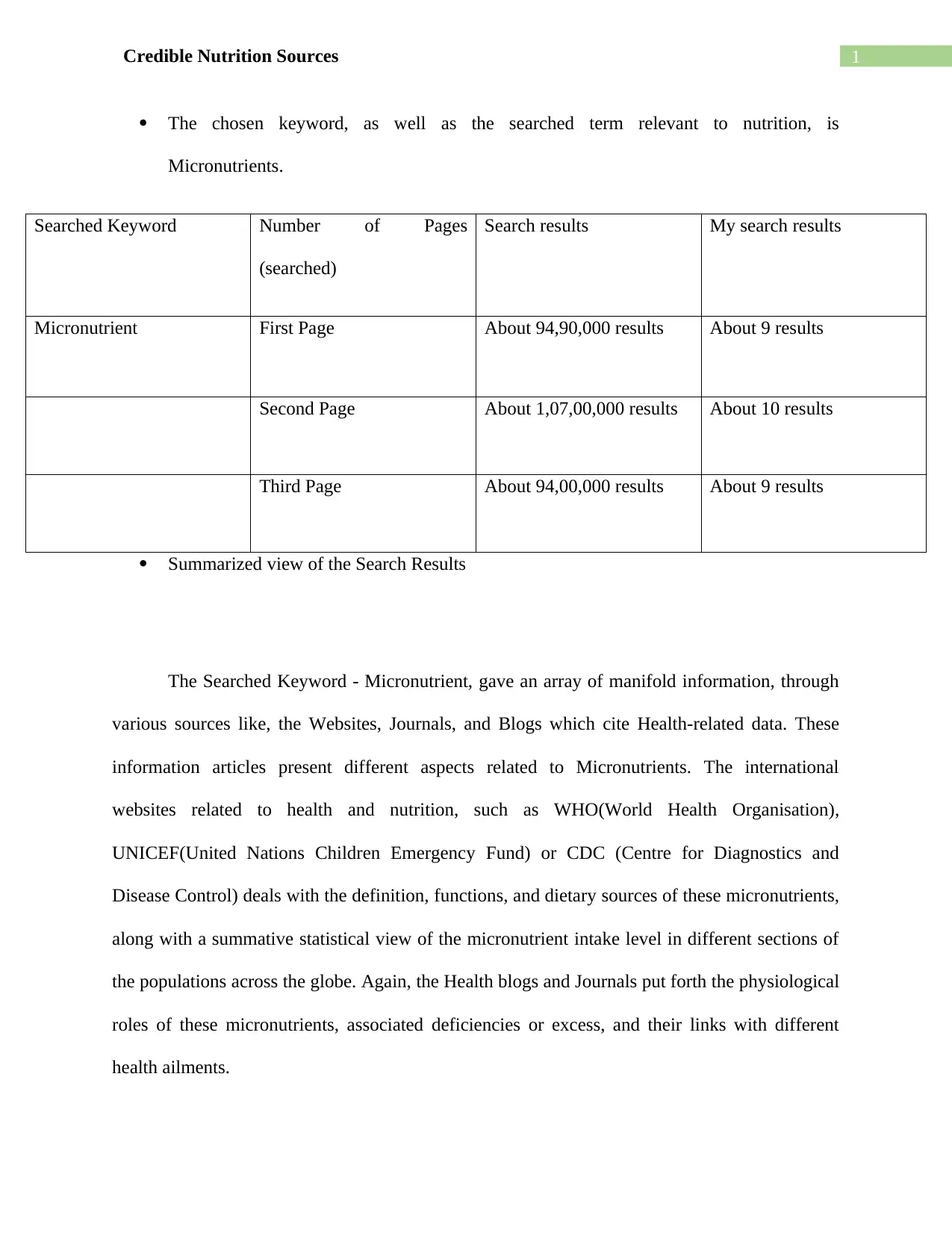
The chosen keyword, as well as the searched term relevant to nutrition, is
Micronutrients.
Searched Keyword Number of Pages
(searched)
Search results My search results
Micronutrient First Page About 94,90,000 results About 9 results
Second Page About 1,07,00,000 results About 10 results
Third Page About 94,00,000 results About 9 results
Summarized view of the Search Results
The Searched Keyword - Micronutrient, gave an array of manifold information, through
various sources like, the Websites, Journals, and Blogs which cite Health-related data. These
information articles present different aspects related to Micronutrients. The international
websites related to health and nutrition, such as WHO(World Health Organisation),
UNICEF(United Nations Children Emergency Fund) or CDC (Centre for Diagnostics and
Disease Control) deals with the definition, functions, and dietary sources of these micronutrients,
along with a summative statistical view of the micronutrient intake level in different sections of
the populations across the globe. Again, the Health blogs and Journals put forth the physiological
roles of these micronutrients, associated deficiencies or excess, and their links with different
health ailments.
Document Page
2Credible Nutrition Sources
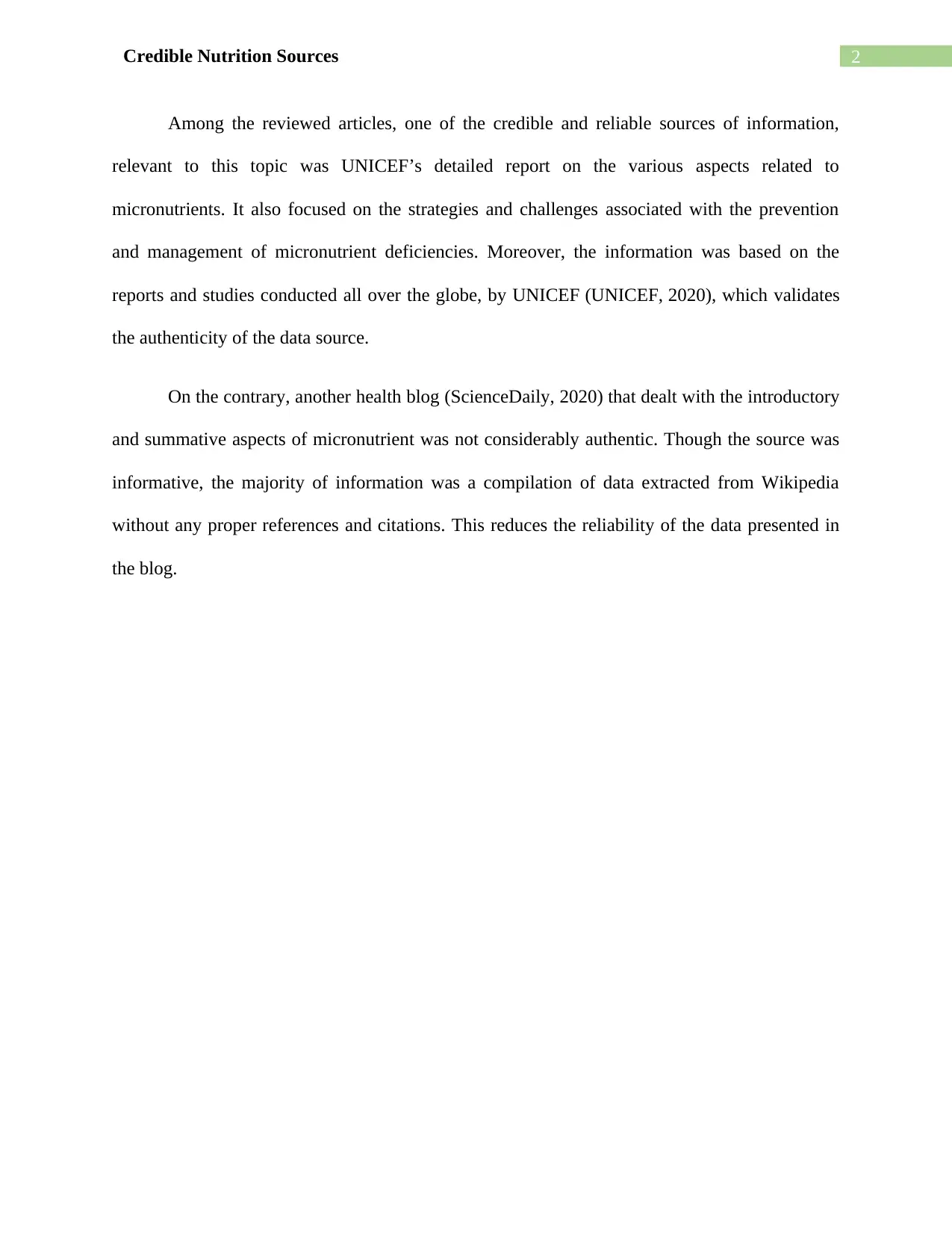
Among the reviewed articles, one of the credible and reliable sources of information,
relevant to this topic was UNICEF’s detailed report on the various aspects related to
micronutrients. It also focused on the strategies and challenges associated with the prevention
and management of micronutrient deficiencies. Moreover, the information was based on the
reports and studies conducted all over the globe, by UNICEF (UNICEF, 2020), which validates
the authenticity of the data source.
On the contrary, another health blog (ScienceDaily, 2020) that dealt with the introductory
and summative aspects of micronutrient was not considerably authentic. Though the source was
informative, the majority of information was a compilation of data extracted from Wikipedia
without any proper references and citations. This reduces the reliability of the data presented in
the blog.
Document Page
3Credible Nutrition Sources
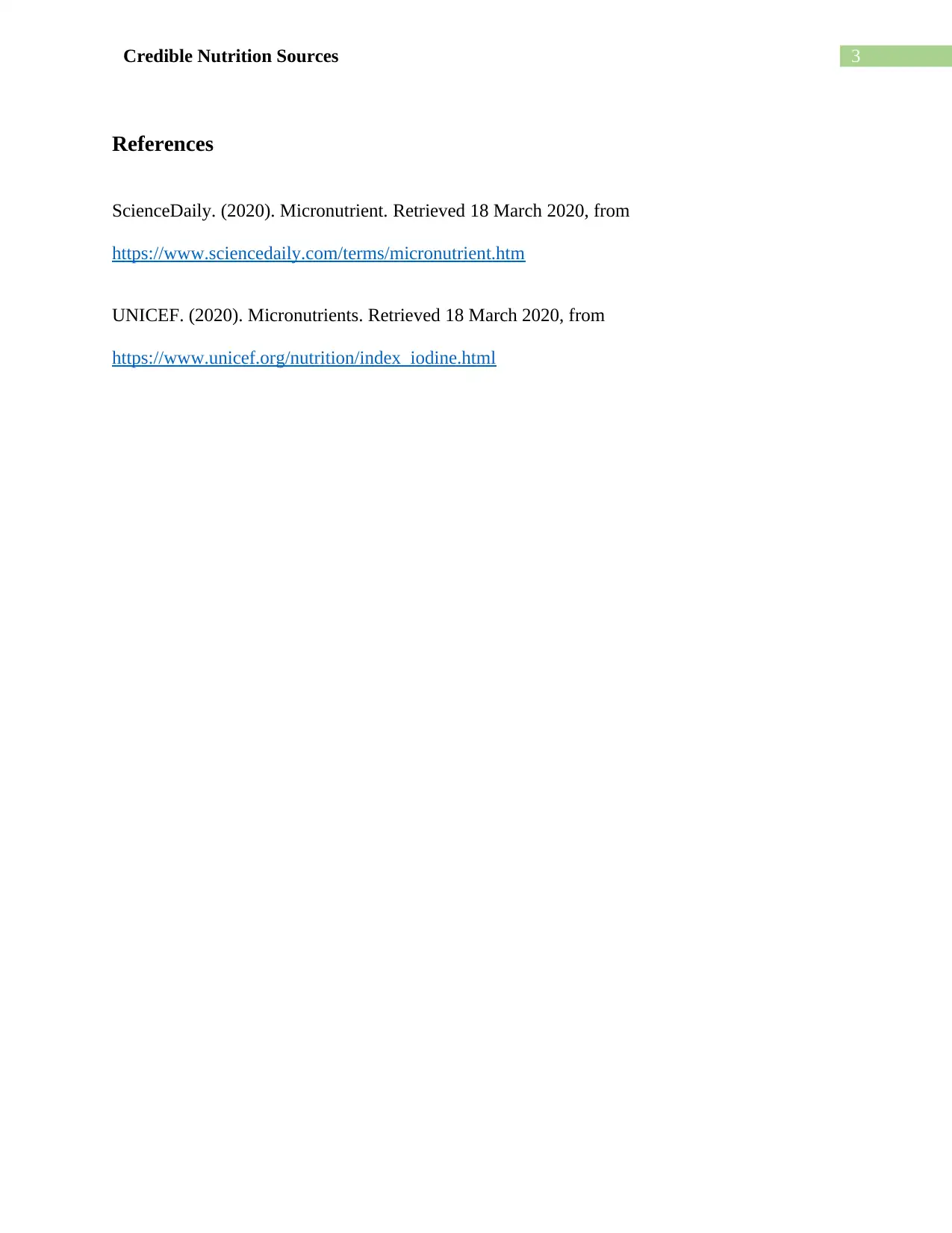
References
ScienceDaily. (2020). Micronutrient. Retrieved 18 March 2020, from
https://www.sciencedaily.com/terms/micronutrient.htm
UNICEF. (2020). Micronutrients. Retrieved 18 March 2020, from
https://www.unicef.org/nutrition/index_iodine.html
chevron_up_icon
1 out of 4
circle_padding
hide_on_mobile
zoom_out_icon
[object Object]