Crime Reduction: Impacts, Roles of Public Service, Strategies
VerifiedAdded on 2023/03/17
|12
|3912
|42
Report
AI Summary
This report provides a comprehensive analysis of crime reduction, focusing on its multifaceted impacts on victims, communities, and society as a whole. It delves into the emotional, psychological, and physical consequences of crime, differentiating between direct and indirect victims, and exploring the effects on families, friends, and wider social networks. The report examines the economic and social costs associated with crime, including the financial burden on individuals, businesses, and the justice system. Furthermore, it investigates the crucial roles of public services, such as the police, health organizations, and multi-agency groups, in enhancing community safety and implementing crime reduction strategies. The report also reviews the effectiveness of various crime reduction strategies, including opportunity elimination, character intervention, and enhancements to the criminal justice system, providing insights into their successes and limitations. The report concludes by highlighting the importance of understanding and addressing the root causes of crime to develop effective and sustainable solutions.

Crime Reduction
CRIME REDUCTION
Author
Class (Course)
Professor (Tutor)
The school (University)
City and State
Date
CRIME REDUCTION
Author
Class (Course)
Professor (Tutor)
The school (University)
City and State
Date

Paraphrase This Document
Need a fresh take? Get an instant paraphrase of this document with our AI Paraphraser
Crime Reduction 1
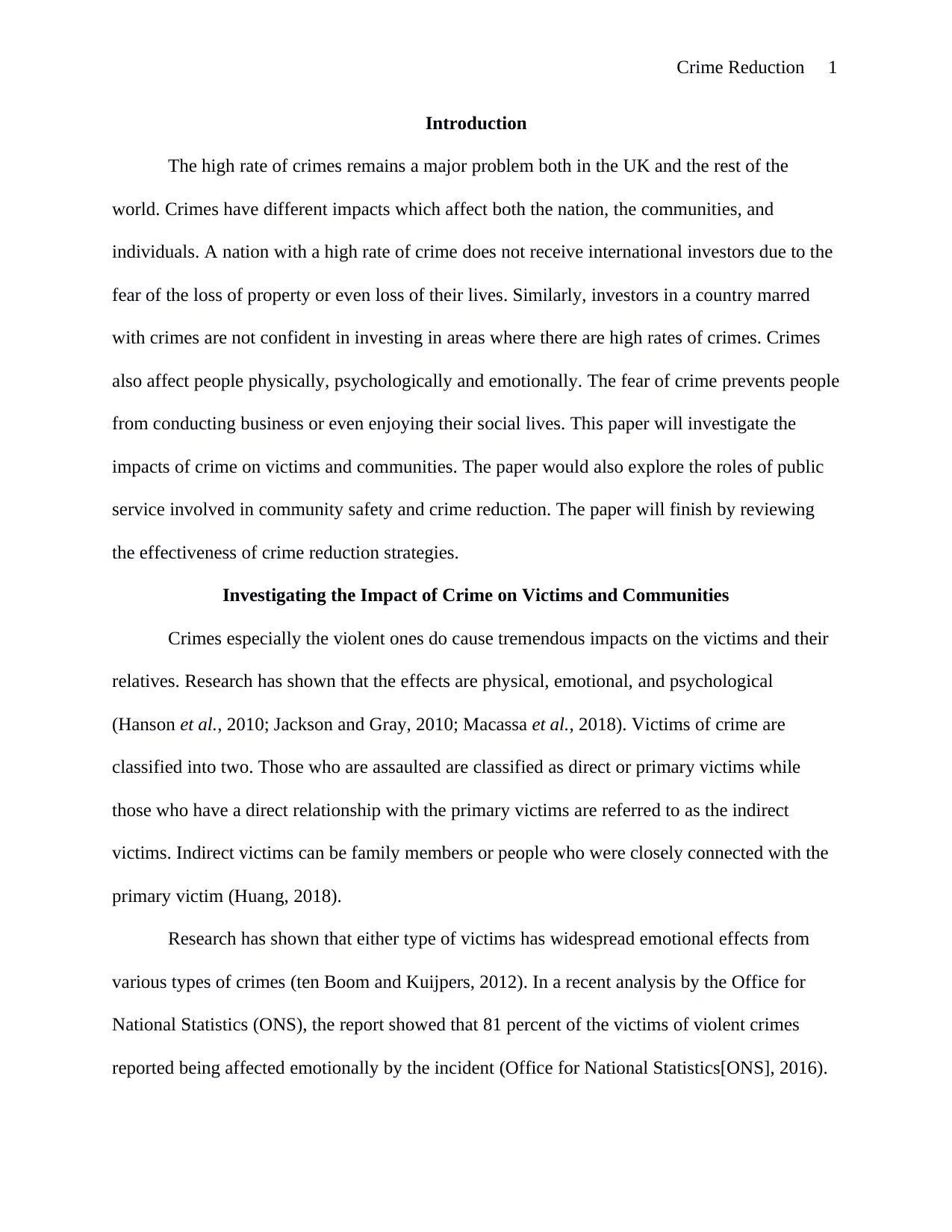
Introduction
The high rate of crimes remains a major problem both in the UK and the rest of the
world. Crimes have different impacts which affect both the nation, the communities, and
individuals. A nation with a high rate of crime does not receive international investors due to the
fear of the loss of property or even loss of their lives. Similarly, investors in a country marred
with crimes are not confident in investing in areas where there are high rates of crimes. Crimes
also affect people physically, psychologically and emotionally. The fear of crime prevents people
from conducting business or even enjoying their social lives. This paper will investigate the
impacts of crime on victims and communities. The paper would also explore the roles of public
service involved in community safety and crime reduction. The paper will finish by reviewing
the effectiveness of crime reduction strategies.
Investigating the Impact of Crime on Victims and Communities
Crimes especially the violent ones do cause tremendous impacts on the victims and their
relatives. Research has shown that the effects are physical, emotional, and psychological
(Hanson et al., 2010; Jackson and Gray, 2010; Macassa et al., 2018). Victims of crime are
classified into two. Those who are assaulted are classified as direct or primary victims while
those who have a direct relationship with the primary victims are referred to as the indirect
victims. Indirect victims can be family members or people who were closely connected with the
primary victim (Huang, 2018).
Research has shown that either type of victims has widespread emotional effects from
various types of crimes (ten Boom and Kuijpers, 2012). In a recent analysis by the Office for
National Statistics (ONS), the report showed that 81 percent of the victims of violent crimes
reported being affected emotionally by the incident (Office for National Statistics[ONS], 2016).
Introduction
The high rate of crimes remains a major problem both in the UK and the rest of the
world. Crimes have different impacts which affect both the nation, the communities, and
individuals. A nation with a high rate of crime does not receive international investors due to the
fear of the loss of property or even loss of their lives. Similarly, investors in a country marred
with crimes are not confident in investing in areas where there are high rates of crimes. Crimes
also affect people physically, psychologically and emotionally. The fear of crime prevents people
from conducting business or even enjoying their social lives. This paper will investigate the
impacts of crime on victims and communities. The paper would also explore the roles of public
service involved in community safety and crime reduction. The paper will finish by reviewing
the effectiveness of crime reduction strategies.
Investigating the Impact of Crime on Victims and Communities
Crimes especially the violent ones do cause tremendous impacts on the victims and their
relatives. Research has shown that the effects are physical, emotional, and psychological
(Hanson et al., 2010; Jackson and Gray, 2010; Macassa et al., 2018). Victims of crime are
classified into two. Those who are assaulted are classified as direct or primary victims while
those who have a direct relationship with the primary victims are referred to as the indirect
victims. Indirect victims can be family members or people who were closely connected with the
primary victim (Huang, 2018).
Research has shown that either type of victims has widespread emotional effects from
various types of crimes (ten Boom and Kuijpers, 2012). In a recent analysis by the Office for
National Statistics (ONS), the report showed that 81 percent of the victims of violent crimes
reported being affected emotionally by the incident (Office for National Statistics[ONS], 2016).
Crime Reduction 2
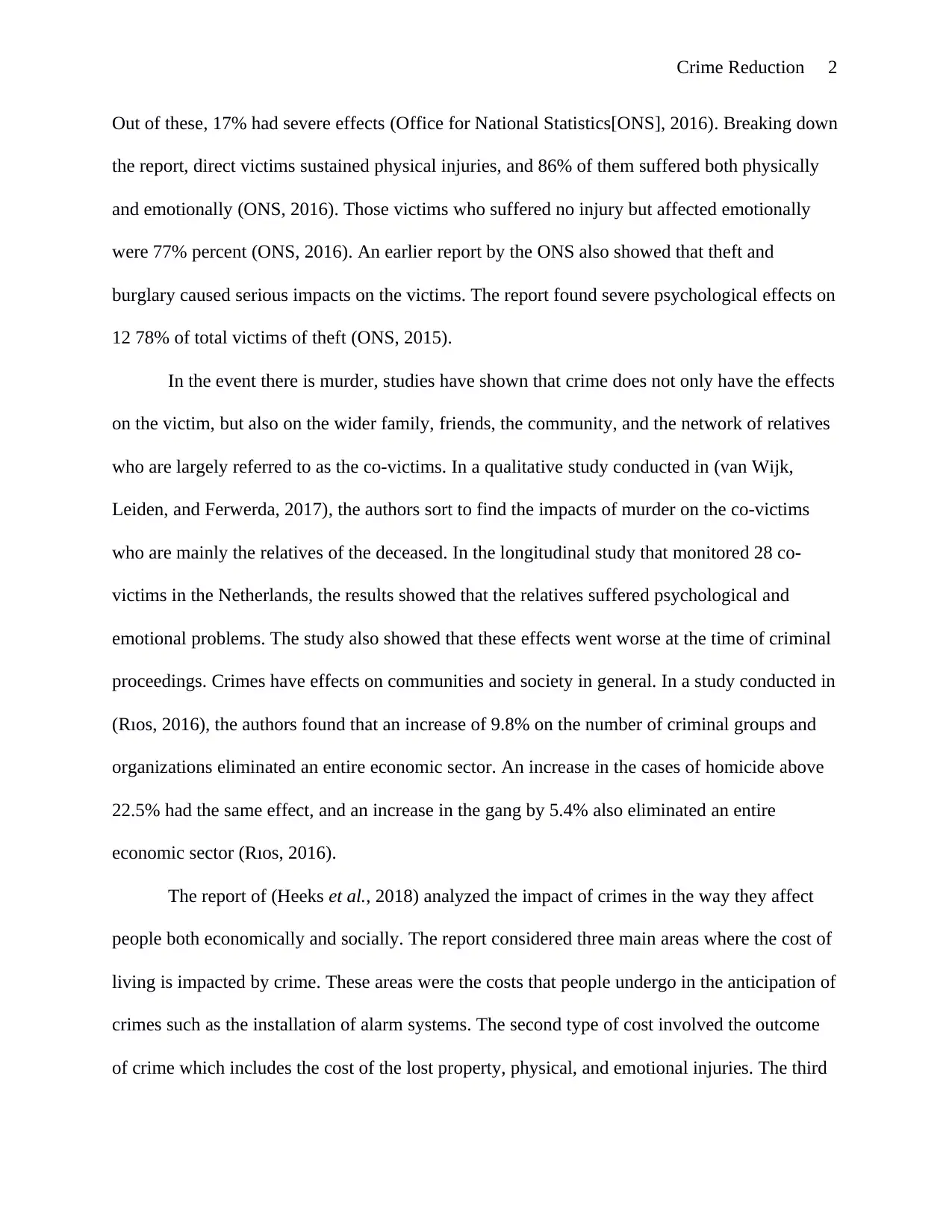
Out of these, 17% had severe effects (Office for National Statistics[ONS], 2016). Breaking down
the report, direct victims sustained physical injuries, and 86% of them suffered both physically
and emotionally (ONS, 2016). Those victims who suffered no injury but affected emotionally
were 77% percent (ONS, 2016). An earlier report by the ONS also showed that theft and
burglary caused serious impacts on the victims. The report found severe psychological effects on
12 78% of total victims of theft (ONS, 2015).
In the event there is murder, studies have shown that crime does not only have the effects
on the victim, but also on the wider family, friends, the community, and the network of relatives
who are largely referred to as the co-victims. In a qualitative study conducted in (van Wijk,
Leiden, and Ferwerda, 2017), the authors sort to find the impacts of murder on the co-victims
who are mainly the relatives of the deceased. In the longitudinal study that monitored 28 co-
victims in the Netherlands, the results showed that the relatives suffered psychological and
emotional problems. The study also showed that these effects went worse at the time of criminal
proceedings. Crimes have effects on communities and society in general. In a study conducted in
(Rıos, 2016), the authors found that an increase of 9.8% on the number of criminal groups and
organizations eliminated an entire economic sector. An increase in the cases of homicide above
22.5% had the same effect, and an increase in the gang by 5.4% also eliminated an entire
economic sector (Rıos, 2016).
The report of (Heeks et al., 2018) analyzed the impact of crimes in the way they affect
people both economically and socially. The report considered three main areas where the cost of
living is impacted by crime. These areas were the costs that people undergo in the anticipation of
crimes such as the installation of alarm systems. The second type of cost involved the outcome
of crime which includes the cost of the lost property, physical, and emotional injuries. The third
Out of these, 17% had severe effects (Office for National Statistics[ONS], 2016). Breaking down
the report, direct victims sustained physical injuries, and 86% of them suffered both physically
and emotionally (ONS, 2016). Those victims who suffered no injury but affected emotionally
were 77% percent (ONS, 2016). An earlier report by the ONS also showed that theft and
burglary caused serious impacts on the victims. The report found severe psychological effects on
12 78% of total victims of theft (ONS, 2015).
In the event there is murder, studies have shown that crime does not only have the effects
on the victim, but also on the wider family, friends, the community, and the network of relatives
who are largely referred to as the co-victims. In a qualitative study conducted in (van Wijk,
Leiden, and Ferwerda, 2017), the authors sort to find the impacts of murder on the co-victims
who are mainly the relatives of the deceased. In the longitudinal study that monitored 28 co-
victims in the Netherlands, the results showed that the relatives suffered psychological and
emotional problems. The study also showed that these effects went worse at the time of criminal
proceedings. Crimes have effects on communities and society in general. In a study conducted in
(Rıos, 2016), the authors found that an increase of 9.8% on the number of criminal groups and
organizations eliminated an entire economic sector. An increase in the cases of homicide above
22.5% had the same effect, and an increase in the gang by 5.4% also eliminated an entire
economic sector (Rıos, 2016).
The report of (Heeks et al., 2018) analyzed the impact of crimes in the way they affect
people both economically and socially. The report considered three main areas where the cost of
living is impacted by crime. These areas were the costs that people undergo in the anticipation of
crimes such as the installation of alarm systems. The second type of cost involved the outcome
of crime which includes the cost of the lost property, physical, and emotional injuries. The third
⊘ This is a preview!⊘
Do you want full access?
Subscribe today to unlock all pages.

Trusted by 1+ million students worldwide
Crime Reduction 3
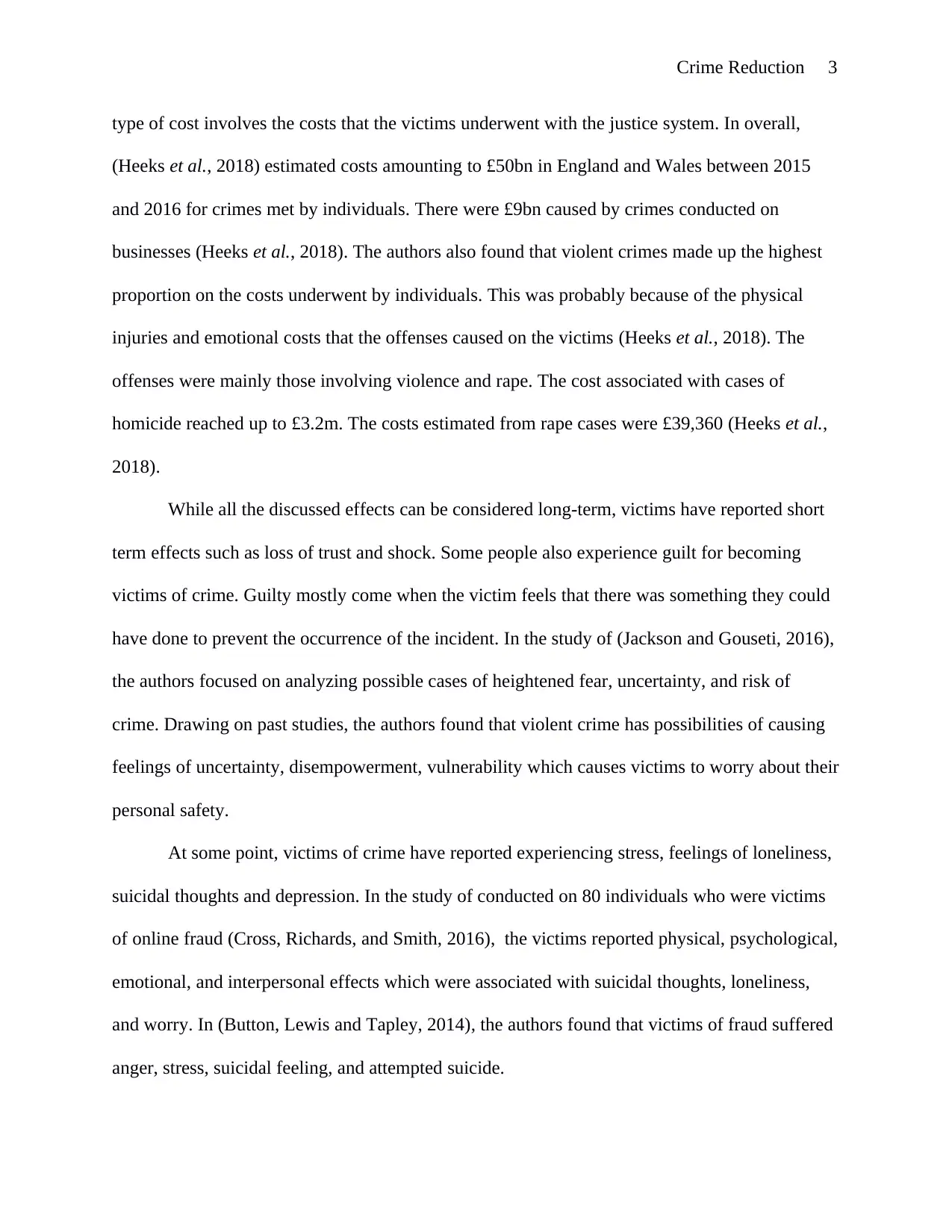
type of cost involves the costs that the victims underwent with the justice system. In overall,
(Heeks et al., 2018) estimated costs amounting to £50bn in England and Wales between 2015
and 2016 for crimes met by individuals. There were £9bn caused by crimes conducted on
businesses (Heeks et al., 2018). The authors also found that violent crimes made up the highest
proportion on the costs underwent by individuals. This was probably because of the physical
injuries and emotional costs that the offenses caused on the victims (Heeks et al., 2018). The
offenses were mainly those involving violence and rape. The cost associated with cases of
homicide reached up to £3.2m. The costs estimated from rape cases were £39,360 (Heeks et al.,
2018).
While all the discussed effects can be considered long-term, victims have reported short
term effects such as loss of trust and shock. Some people also experience guilt for becoming
victims of crime. Guilty mostly come when the victim feels that there was something they could
have done to prevent the occurrence of the incident. In the study of (Jackson and Gouseti, 2016),
the authors focused on analyzing possible cases of heightened fear, uncertainty, and risk of
crime. Drawing on past studies, the authors found that violent crime has possibilities of causing
feelings of uncertainty, disempowerment, vulnerability which causes victims to worry about their
personal safety.
At some point, victims of crime have reported experiencing stress, feelings of loneliness,
suicidal thoughts and depression. In the study of conducted on 80 individuals who were victims
of online fraud (Cross, Richards, and Smith, 2016), the victims reported physical, psychological,
emotional, and interpersonal effects which were associated with suicidal thoughts, loneliness,
and worry. In (Button, Lewis and Tapley, 2014), the authors found that victims of fraud suffered
anger, stress, suicidal feeling, and attempted suicide.
type of cost involves the costs that the victims underwent with the justice system. In overall,
(Heeks et al., 2018) estimated costs amounting to £50bn in England and Wales between 2015
and 2016 for crimes met by individuals. There were £9bn caused by crimes conducted on
businesses (Heeks et al., 2018). The authors also found that violent crimes made up the highest
proportion on the costs underwent by individuals. This was probably because of the physical
injuries and emotional costs that the offenses caused on the victims (Heeks et al., 2018). The
offenses were mainly those involving violence and rape. The cost associated with cases of
homicide reached up to £3.2m. The costs estimated from rape cases were £39,360 (Heeks et al.,
2018).
While all the discussed effects can be considered long-term, victims have reported short
term effects such as loss of trust and shock. Some people also experience guilt for becoming
victims of crime. Guilty mostly come when the victim feels that there was something they could
have done to prevent the occurrence of the incident. In the study of (Jackson and Gouseti, 2016),
the authors focused on analyzing possible cases of heightened fear, uncertainty, and risk of
crime. Drawing on past studies, the authors found that violent crime has possibilities of causing
feelings of uncertainty, disempowerment, vulnerability which causes victims to worry about their
personal safety.
At some point, victims of crime have reported experiencing stress, feelings of loneliness,
suicidal thoughts and depression. In the study of conducted on 80 individuals who were victims
of online fraud (Cross, Richards, and Smith, 2016), the victims reported physical, psychological,
emotional, and interpersonal effects which were associated with suicidal thoughts, loneliness,
and worry. In (Button, Lewis and Tapley, 2014), the authors found that victims of fraud suffered
anger, stress, suicidal feeling, and attempted suicide.
Paraphrase This Document
Need a fresh take? Get an instant paraphrase of this document with our AI Paraphraser
Crime Reduction 4
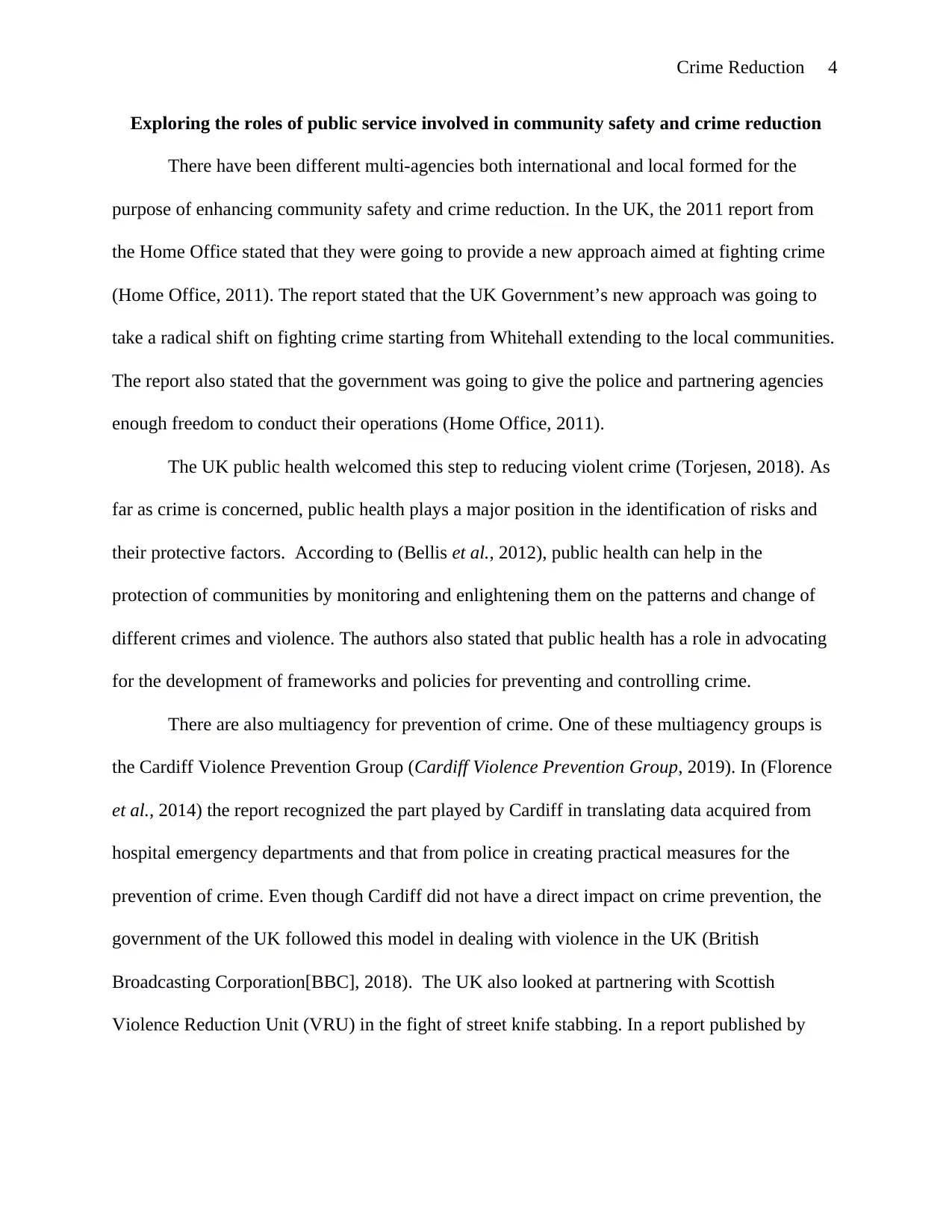
Exploring the roles of public service involved in community safety and crime reduction
There have been different multi-agencies both international and local formed for the
purpose of enhancing community safety and crime reduction. In the UK, the 2011 report from
the Home Office stated that they were going to provide a new approach aimed at fighting crime
(Home Office, 2011). The report stated that the UK Government’s new approach was going to
take a radical shift on fighting crime starting from Whitehall extending to the local communities.
The report also stated that the government was going to give the police and partnering agencies
enough freedom to conduct their operations (Home Office, 2011).
The UK public health welcomed this step to reducing violent crime (Torjesen, 2018). As
far as crime is concerned, public health plays a major position in the identification of risks and
their protective factors. According to (Bellis et al., 2012), public health can help in the
protection of communities by monitoring and enlightening them on the patterns and change of
different crimes and violence. The authors also stated that public health has a role in advocating
for the development of frameworks and policies for preventing and controlling crime.
There are also multiagency for prevention of crime. One of these multiagency groups is
the Cardiff Violence Prevention Group (Cardiff Violence Prevention Group, 2019). In (Florence
et al., 2014) the report recognized the part played by Cardiff in translating data acquired from
hospital emergency departments and that from police in creating practical measures for the
prevention of crime. Even though Cardiff did not have a direct impact on crime prevention, the
government of the UK followed this model in dealing with violence in the UK (British
Broadcasting Corporation[BBC], 2018). The UK also looked at partnering with Scottish
Violence Reduction Unit (VRU) in the fight of street knife stabbing. In a report published by
Exploring the roles of public service involved in community safety and crime reduction
There have been different multi-agencies both international and local formed for the
purpose of enhancing community safety and crime reduction. In the UK, the 2011 report from
the Home Office stated that they were going to provide a new approach aimed at fighting crime
(Home Office, 2011). The report stated that the UK Government’s new approach was going to
take a radical shift on fighting crime starting from Whitehall extending to the local communities.
The report also stated that the government was going to give the police and partnering agencies
enough freedom to conduct their operations (Home Office, 2011).
The UK public health welcomed this step to reducing violent crime (Torjesen, 2018). As
far as crime is concerned, public health plays a major position in the identification of risks and
their protective factors. According to (Bellis et al., 2012), public health can help in the
protection of communities by monitoring and enlightening them on the patterns and change of
different crimes and violence. The authors also stated that public health has a role in advocating
for the development of frameworks and policies for preventing and controlling crime.
There are also multiagency for prevention of crime. One of these multiagency groups is
the Cardiff Violence Prevention Group (Cardiff Violence Prevention Group, 2019). In (Florence
et al., 2014) the report recognized the part played by Cardiff in translating data acquired from
hospital emergency departments and that from police in creating practical measures for the
prevention of crime. Even though Cardiff did not have a direct impact on crime prevention, the
government of the UK followed this model in dealing with violence in the UK (British
Broadcasting Corporation[BBC], 2018). The UK also looked at partnering with Scottish
Violence Reduction Unit (VRU) in the fight of street knife stabbing. In a report published by
Crime Reduction 5
(Younge and Barr, 2017), the VRU, a Scotland funded agency made a tremendous contribution
to the reduction of knife deaths that resulted from stabbing.
The main legislation for dealing with crime in the UK is the (Police and Criminal
Evidence Act[PACE], 1984). Among other powers, the Act allows the police to stop and search
people though limitations are put where such powers are used discriminatively. In a meta-
analysis conducted in (Quinton, Tiratelli and Bradford, 2017), the authors found that stop and
search had a notable impact on crime reduction, but the result did not match the expected
outcome. When used in the right way, the powers of stop and search allows the police to only use
them where there are practical reasons for suspecting someone. Under the Terrorism Act 2000,
the police are also allowed to search a person they suspect of being a terrorist.
Another Legislation formed in the UK for crime prevention and the reduction was the
Police and Justice Act 2006. One contribution of this Act made was the setup of the National
Policing Improvement Agency and the College of Policing (NPIA) (Tilley and Laycock, 2018).
The NPIA roles were to identify, develop, and promulgate good police practice in dealing with
crimes. According to policing (Tilley and Laycock, 2018), much of this role was later adopted in
the roles of the commissioner of police which was established in 2013, the same year of the
establishment of NPIA.
Review the Effectiveness of Crime Reduction Strategies
According to (Home Office, 2016), a new approach focusing on the crime reduction
would be focusing on the six main factors that lead to crime. The first driver of crime identified
by the report was the opportunity to crime. By elimination factors that lure people into crimes,
the government finds that such a move would reduce greatly reduce criminal behaviors. Past
studies have shown that strategies aimed at eliminating opportunities for offending can be
(Younge and Barr, 2017), the VRU, a Scotland funded agency made a tremendous contribution
to the reduction of knife deaths that resulted from stabbing.
The main legislation for dealing with crime in the UK is the (Police and Criminal
Evidence Act[PACE], 1984). Among other powers, the Act allows the police to stop and search
people though limitations are put where such powers are used discriminatively. In a meta-
analysis conducted in (Quinton, Tiratelli and Bradford, 2017), the authors found that stop and
search had a notable impact on crime reduction, but the result did not match the expected
outcome. When used in the right way, the powers of stop and search allows the police to only use
them where there are practical reasons for suspecting someone. Under the Terrorism Act 2000,
the police are also allowed to search a person they suspect of being a terrorist.
Another Legislation formed in the UK for crime prevention and the reduction was the
Police and Justice Act 2006. One contribution of this Act made was the setup of the National
Policing Improvement Agency and the College of Policing (NPIA) (Tilley and Laycock, 2018).
The NPIA roles were to identify, develop, and promulgate good police practice in dealing with
crimes. According to policing (Tilley and Laycock, 2018), much of this role was later adopted in
the roles of the commissioner of police which was established in 2013, the same year of the
establishment of NPIA.
Review the Effectiveness of Crime Reduction Strategies
According to (Home Office, 2016), a new approach focusing on the crime reduction
would be focusing on the six main factors that lead to crime. The first driver of crime identified
by the report was the opportunity to crime. By elimination factors that lure people into crimes,
the government finds that such a move would reduce greatly reduce criminal behaviors. Past
studies have shown that strategies aimed at eliminating opportunities for offending can be
⊘ This is a preview!⊘
Do you want full access?
Subscribe today to unlock all pages.
Trusted by 1+ million students worldwide
Crime Reduction 6
effective in reducing crime. In an evaluation that involved 102 situational focused crime-
prevention, (Guerette and Bowers, 2009) found that there were diffusion and displacement
effects due to the removal of crime opportunities. Strategies for eliminating opportunities are
focused on making the surrounding environment unfavorable for crime such as the installation of
CCTV, and installation of lights. An analysis of (Farrell, 2016) showed that crime dropped due
to delays caused by strategies for eliminating crime opportunities. Some of the initiatives
employed for these strategies are the WePROTECT initiative, Cyber Streetwise, Talk about
abuse’ campaign, and Senior Steering Group on Electronic Vehicle Theft among others.
Another strategy employed by the government is Character intervention. These are
focused on early interventions to those people exposed to circumstances that might lead them
into crime. While opportunities play a role in the engagement to criminal activities, studies have
shown that certain groups of people who are subjected to stigmatization and labeling may
indulge in crimes as a defense mechanism. In a study conducted in (Moore, Stuewig and
Tangney, 2016), the findings showed that stigma and racism prevented released offenders from
readjusting their behavior. In the work of (Besemer, Farrington and Bijleveld, 2017), the authors
found that children of convicted parents were likely to engage in crime due to stigma and
labeling. The initiatives employed for building character and resilience include the youth
programmes, teaching pupils and students to identify exploitive and unhealthy relationships,
National Citizen Service, and Education Endowment Foundation among others.
The Home Office is also focused on enhancing the effectiveness of the criminal justice
system (CJS). By ensuring proper function of the CJS in deterring crimes, studies have shown
that such approaches are effective in reducing crimes. Other than sentences, the study of
(Abramovaite et al., 2018) showed that non-custodial sentences employed in England and Wales
effective in reducing crime. In an evaluation that involved 102 situational focused crime-
prevention, (Guerette and Bowers, 2009) found that there were diffusion and displacement
effects due to the removal of crime opportunities. Strategies for eliminating opportunities are
focused on making the surrounding environment unfavorable for crime such as the installation of
CCTV, and installation of lights. An analysis of (Farrell, 2016) showed that crime dropped due
to delays caused by strategies for eliminating crime opportunities. Some of the initiatives
employed for these strategies are the WePROTECT initiative, Cyber Streetwise, Talk about
abuse’ campaign, and Senior Steering Group on Electronic Vehicle Theft among others.
Another strategy employed by the government is Character intervention. These are
focused on early interventions to those people exposed to circumstances that might lead them
into crime. While opportunities play a role in the engagement to criminal activities, studies have
shown that certain groups of people who are subjected to stigmatization and labeling may
indulge in crimes as a defense mechanism. In a study conducted in (Moore, Stuewig and
Tangney, 2016), the findings showed that stigma and racism prevented released offenders from
readjusting their behavior. In the work of (Besemer, Farrington and Bijleveld, 2017), the authors
found that children of convicted parents were likely to engage in crime due to stigma and
labeling. The initiatives employed for building character and resilience include the youth
programmes, teaching pupils and students to identify exploitive and unhealthy relationships,
National Citizen Service, and Education Endowment Foundation among others.
The Home Office is also focused on enhancing the effectiveness of the criminal justice
system (CJS). By ensuring proper function of the CJS in deterring crimes, studies have shown
that such approaches are effective in reducing crimes. Other than sentences, the study of
(Abramovaite et al., 2018) showed that non-custodial sentences employed in England and Wales
Paraphrase This Document
Need a fresh take? Get an instant paraphrase of this document with our AI Paraphraser
Crime Reduction 7
worked effectively in the reduction of property crime. The initiatives that are taken by the CJS
focus on deterrence, incapacitation, satellite tracker-tags, enforcement of Sexual Harm
Prevention Orders and Sexual Risk Orders, rehabilitation and reforms on prisons.
Making it hard for criminals to benefit from their activities is also an effective
mechanism for reducing crimes. According to (Home Office, 2016), the estimated revenue
earned from organized crimes were £3.7 billion per year, fraud was £8.9 billion and immigration
crimes had £240 million. Another major focus is the reduction of the use of drugs as a
contributor to drugs. Initiatives for eliminating profiting on crimes include Joint Fraud
Taskforce, Collective Response on fast-tracking intelligence, identification of vulnerable victims,
and deterrence of solicitors. The UK came up with drug strategies which ensure that there is
restricted supply among the users. Drug programmes are focused on the treatment of users, and
enforcement of drug laws. Along with drugs, the government has strict rules for the consumption
of alcohol. These strategies include partnering with local entrepreneurs, improvement of local
intelligence, the addition of powers to the police and local authorities.
While considering programs for reduction of crime, the government of the UK has
focused mainly on the youth who are easily lured into crimes. Youth crime prevention
programmes are aimed to prevent young people from engaging in crime. These programs are run
within the communities by community members, parents, and families. Youths are enrolled in
these programs if they have been involved with the justice system and the police. They may also
be enrolled in the programme if they are considered toe at risk of involvement in the crime. Also,
the community enrolls them if they start showing anti-social behaviors.
worked effectively in the reduction of property crime. The initiatives that are taken by the CJS
focus on deterrence, incapacitation, satellite tracker-tags, enforcement of Sexual Harm
Prevention Orders and Sexual Risk Orders, rehabilitation and reforms on prisons.
Making it hard for criminals to benefit from their activities is also an effective
mechanism for reducing crimes. According to (Home Office, 2016), the estimated revenue
earned from organized crimes were £3.7 billion per year, fraud was £8.9 billion and immigration
crimes had £240 million. Another major focus is the reduction of the use of drugs as a
contributor to drugs. Initiatives for eliminating profiting on crimes include Joint Fraud
Taskforce, Collective Response on fast-tracking intelligence, identification of vulnerable victims,
and deterrence of solicitors. The UK came up with drug strategies which ensure that there is
restricted supply among the users. Drug programmes are focused on the treatment of users, and
enforcement of drug laws. Along with drugs, the government has strict rules for the consumption
of alcohol. These strategies include partnering with local entrepreneurs, improvement of local
intelligence, the addition of powers to the police and local authorities.
While considering programs for reduction of crime, the government of the UK has
focused mainly on the youth who are easily lured into crimes. Youth crime prevention
programmes are aimed to prevent young people from engaging in crime. These programs are run
within the communities by community members, parents, and families. Youths are enrolled in
these programs if they have been involved with the justice system and the police. They may also
be enrolled in the programme if they are considered toe at risk of involvement in the crime. Also,
the community enrolls them if they start showing anti-social behaviors.
Crime Reduction 8
Conclusion
This paper intended to investigate the impacts of crime on victims and communities. In
this focus, the paper analyzed issue such as physical, emotional, and psychological problems that
people suffer as a result of the crime. In addition to these, the paper also found that their other
outcomes such as economic effects. The paper further explored the roles of public service
involved in community safety and crime reduction. Here the paper looked at various bodies and
multi-agencies in the UK charged with prevention and reduction of crime. Finally, the paper also
looked at the strategies employed for the reduction of crime. While looking at these strategies,
the paper also assessed their effectiveness by looking at past studies. The paper will finish by
reviewing the effectiveness of crime reduction strategies
Conclusion
This paper intended to investigate the impacts of crime on victims and communities. In
this focus, the paper analyzed issue such as physical, emotional, and psychological problems that
people suffer as a result of the crime. In addition to these, the paper also found that their other
outcomes such as economic effects. The paper further explored the roles of public service
involved in community safety and crime reduction. Here the paper looked at various bodies and
multi-agencies in the UK charged with prevention and reduction of crime. Finally, the paper also
looked at the strategies employed for the reduction of crime. While looking at these strategies,
the paper also assessed their effectiveness by looking at past studies. The paper will finish by
reviewing the effectiveness of crime reduction strategies
⊘ This is a preview!⊘
Do you want full access?
Subscribe today to unlock all pages.
Trusted by 1+ million students worldwide
Crime Reduction 9
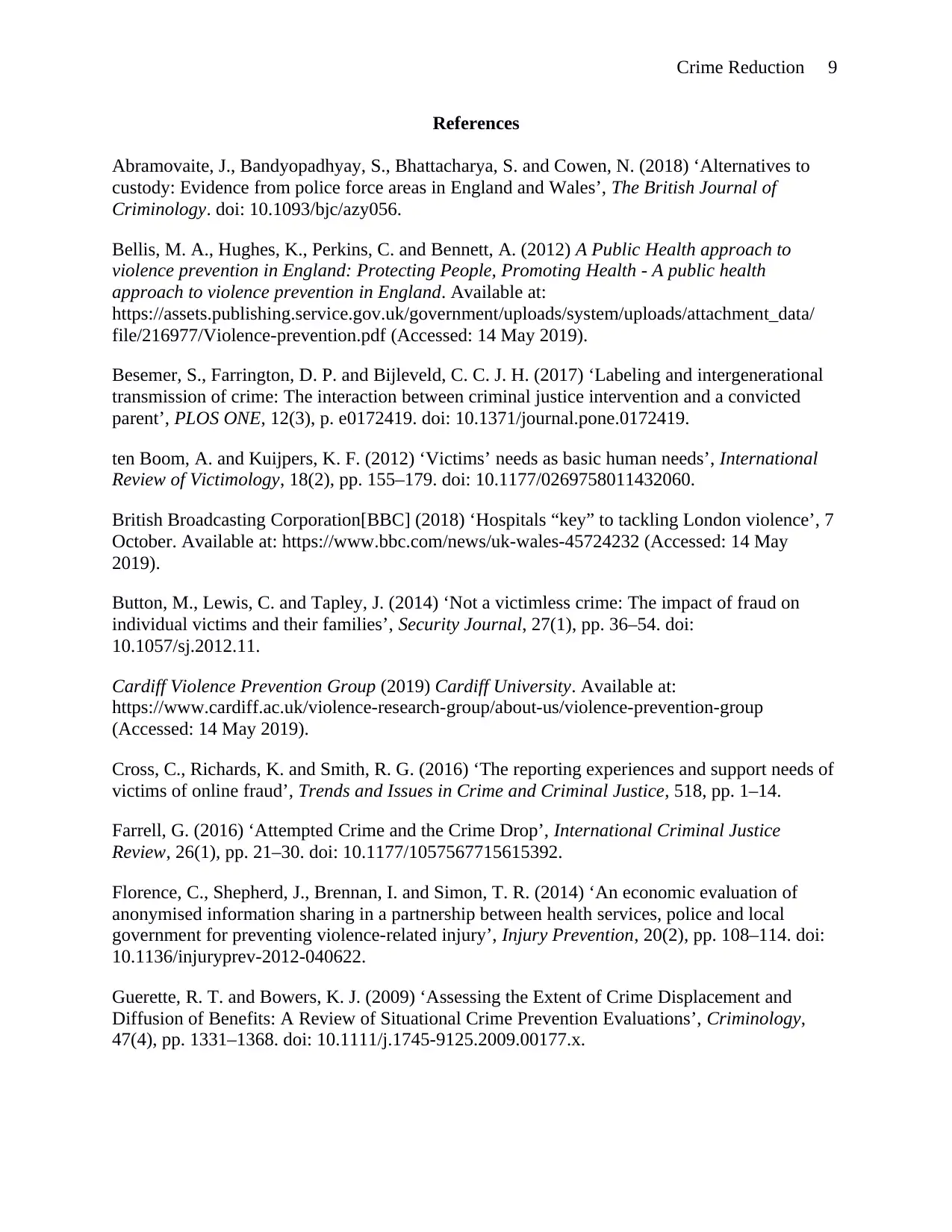
References
Abramovaite, J., Bandyopadhyay, S., Bhattacharya, S. and Cowen, N. (2018) ‘Alternatives to
custody: Evidence from police force areas in England and Wales’, The British Journal of
Criminology. doi: 10.1093/bjc/azy056.
Bellis, M. A., Hughes, K., Perkins, C. and Bennett, A. (2012) A Public Health approach to
violence prevention in England: Protecting People, Promoting Health - A public health
approach to violence prevention in England. Available at:
https://assets.publishing.service.gov.uk/government/uploads/system/uploads/attachment_data/
file/216977/Violence-prevention.pdf (Accessed: 14 May 2019).
Besemer, S., Farrington, D. P. and Bijleveld, C. C. J. H. (2017) ‘Labeling and intergenerational
transmission of crime: The interaction between criminal justice intervention and a convicted
parent’, PLOS ONE, 12(3), p. e0172419. doi: 10.1371/journal.pone.0172419.
ten Boom, A. and Kuijpers, K. F. (2012) ‘Victims’ needs as basic human needs’, International
Review of Victimology, 18(2), pp. 155–179. doi: 10.1177/0269758011432060.
British Broadcasting Corporation[BBC] (2018) ‘Hospitals “key” to tackling London violence’, 7
October. Available at: https://www.bbc.com/news/uk-wales-45724232 (Accessed: 14 May
2019).
Button, M., Lewis, C. and Tapley, J. (2014) ‘Not a victimless crime: The impact of fraud on
individual victims and their families’, Security Journal, 27(1), pp. 36–54. doi:
10.1057/sj.2012.11.
Cardiff Violence Prevention Group (2019) Cardiff University. Available at:
https://www.cardiff.ac.uk/violence-research-group/about-us/violence-prevention-group
(Accessed: 14 May 2019).
Cross, C., Richards, K. and Smith, R. G. (2016) ‘The reporting experiences and support needs of
victims of online fraud’, Trends and Issues in Crime and Criminal Justice, 518, pp. 1–14.
Farrell, G. (2016) ‘Attempted Crime and the Crime Drop’, International Criminal Justice
Review, 26(1), pp. 21–30. doi: 10.1177/1057567715615392.
Florence, C., Shepherd, J., Brennan, I. and Simon, T. R. (2014) ‘An economic evaluation of
anonymised information sharing in a partnership between health services, police and local
government for preventing violence-related injury’, Injury Prevention, 20(2), pp. 108–114. doi:
10.1136/injuryprev-2012-040622.
Guerette, R. T. and Bowers, K. J. (2009) ‘Assessing the Extent of Crime Displacement and
Diffusion of Benefits: A Review of Situational Crime Prevention Evaluations’, Criminology,
47(4), pp. 1331–1368. doi: 10.1111/j.1745-9125.2009.00177.x.
References
Abramovaite, J., Bandyopadhyay, S., Bhattacharya, S. and Cowen, N. (2018) ‘Alternatives to
custody: Evidence from police force areas in England and Wales’, The British Journal of
Criminology. doi: 10.1093/bjc/azy056.
Bellis, M. A., Hughes, K., Perkins, C. and Bennett, A. (2012) A Public Health approach to
violence prevention in England: Protecting People, Promoting Health - A public health
approach to violence prevention in England. Available at:
https://assets.publishing.service.gov.uk/government/uploads/system/uploads/attachment_data/
file/216977/Violence-prevention.pdf (Accessed: 14 May 2019).
Besemer, S., Farrington, D. P. and Bijleveld, C. C. J. H. (2017) ‘Labeling and intergenerational
transmission of crime: The interaction between criminal justice intervention and a convicted
parent’, PLOS ONE, 12(3), p. e0172419. doi: 10.1371/journal.pone.0172419.
ten Boom, A. and Kuijpers, K. F. (2012) ‘Victims’ needs as basic human needs’, International
Review of Victimology, 18(2), pp. 155–179. doi: 10.1177/0269758011432060.
British Broadcasting Corporation[BBC] (2018) ‘Hospitals “key” to tackling London violence’, 7
October. Available at: https://www.bbc.com/news/uk-wales-45724232 (Accessed: 14 May
2019).
Button, M., Lewis, C. and Tapley, J. (2014) ‘Not a victimless crime: The impact of fraud on
individual victims and their families’, Security Journal, 27(1), pp. 36–54. doi:
10.1057/sj.2012.11.
Cardiff Violence Prevention Group (2019) Cardiff University. Available at:
https://www.cardiff.ac.uk/violence-research-group/about-us/violence-prevention-group
(Accessed: 14 May 2019).
Cross, C., Richards, K. and Smith, R. G. (2016) ‘The reporting experiences and support needs of
victims of online fraud’, Trends and Issues in Crime and Criminal Justice, 518, pp. 1–14.
Farrell, G. (2016) ‘Attempted Crime and the Crime Drop’, International Criminal Justice
Review, 26(1), pp. 21–30. doi: 10.1177/1057567715615392.
Florence, C., Shepherd, J., Brennan, I. and Simon, T. R. (2014) ‘An economic evaluation of
anonymised information sharing in a partnership between health services, police and local
government for preventing violence-related injury’, Injury Prevention, 20(2), pp. 108–114. doi:
10.1136/injuryprev-2012-040622.
Guerette, R. T. and Bowers, K. J. (2009) ‘Assessing the Extent of Crime Displacement and
Diffusion of Benefits: A Review of Situational Crime Prevention Evaluations’, Criminology,
47(4), pp. 1331–1368. doi: 10.1111/j.1745-9125.2009.00177.x.
Paraphrase This Document
Need a fresh take? Get an instant paraphrase of this document with our AI Paraphraser
Crime Reduction
10
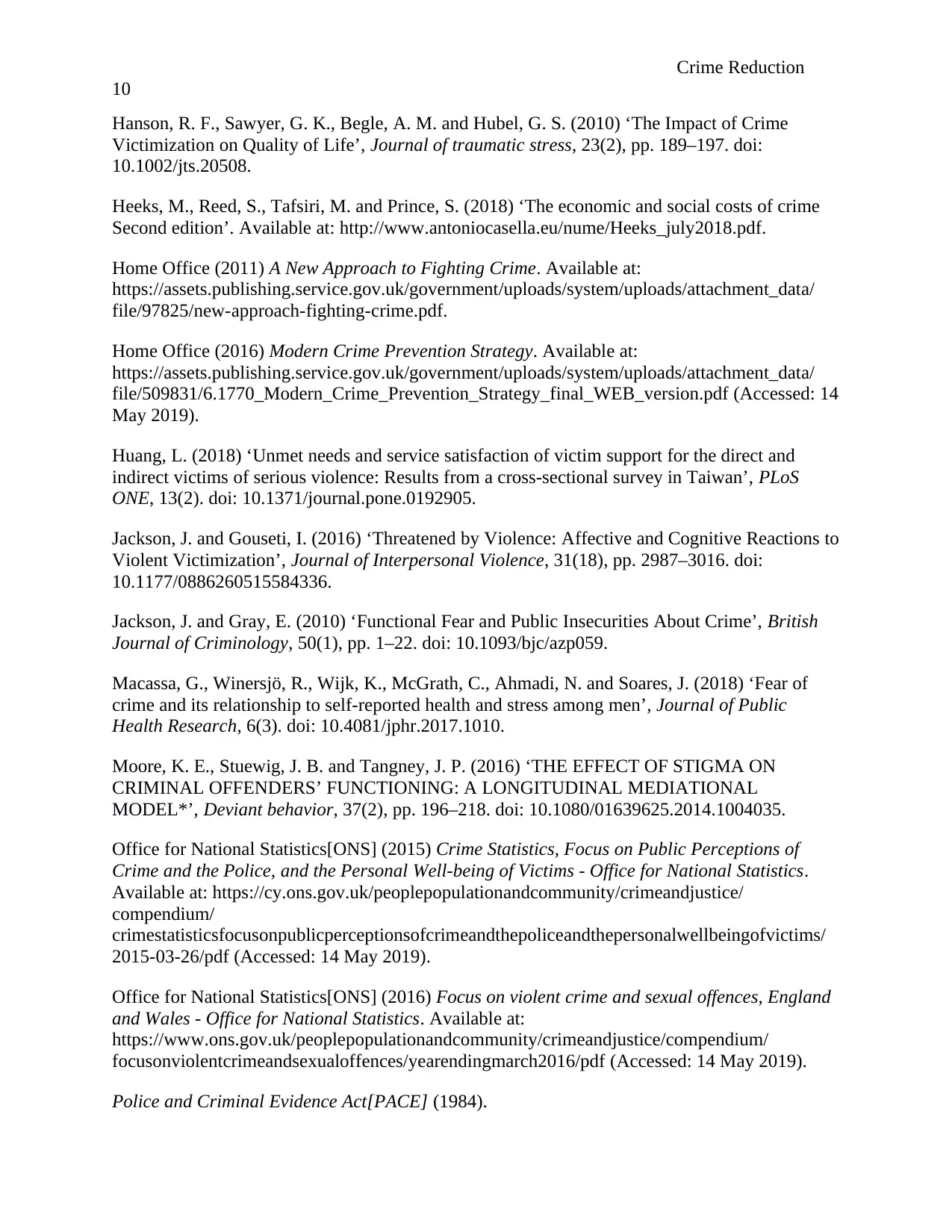
Hanson, R. F., Sawyer, G. K., Begle, A. M. and Hubel, G. S. (2010) ‘The Impact of Crime
Victimization on Quality of Life’, Journal of traumatic stress, 23(2), pp. 189–197. doi:
10.1002/jts.20508.
Heeks, M., Reed, S., Tafsiri, M. and Prince, S. (2018) ‘The economic and social costs of crime
Second edition’. Available at: http://www.antoniocasella.eu/nume/Heeks_july2018.pdf.
Home Office (2011) A New Approach to Fighting Crime. Available at:
https://assets.publishing.service.gov.uk/government/uploads/system/uploads/attachment_data/
file/97825/new-approach-fighting-crime.pdf.
Home Office (2016) Modern Crime Prevention Strategy. Available at:
https://assets.publishing.service.gov.uk/government/uploads/system/uploads/attachment_data/
file/509831/6.1770_Modern_Crime_Prevention_Strategy_final_WEB_version.pdf (Accessed: 14
May 2019).
Huang, L. (2018) ‘Unmet needs and service satisfaction of victim support for the direct and
indirect victims of serious violence: Results from a cross-sectional survey in Taiwan’, PLoS
ONE, 13(2). doi: 10.1371/journal.pone.0192905.
Jackson, J. and Gouseti, I. (2016) ‘Threatened by Violence: Affective and Cognitive Reactions to
Violent Victimization’, Journal of Interpersonal Violence, 31(18), pp. 2987–3016. doi:
10.1177/0886260515584336.
Jackson, J. and Gray, E. (2010) ‘Functional Fear and Public Insecurities About Crime’, British
Journal of Criminology, 50(1), pp. 1–22. doi: 10.1093/bjc/azp059.
Macassa, G., Winersjö, R., Wijk, K., McGrath, C., Ahmadi, N. and Soares, J. (2018) ‘Fear of
crime and its relationship to self-reported health and stress among men’, Journal of Public
Health Research, 6(3). doi: 10.4081/jphr.2017.1010.
Moore, K. E., Stuewig, J. B. and Tangney, J. P. (2016) ‘THE EFFECT OF STIGMA ON
CRIMINAL OFFENDERS’ FUNCTIONING: A LONGITUDINAL MEDIATIONAL
MODEL*’, Deviant behavior, 37(2), pp. 196–218. doi: 10.1080/01639625.2014.1004035.
Office for National Statistics[ONS] (2015) Crime Statistics, Focus on Public Perceptions of
Crime and the Police, and the Personal Well-being of Victims - Office for National Statistics.
Available at: https://cy.ons.gov.uk/peoplepopulationandcommunity/crimeandjustice/
compendium/
crimestatisticsfocusonpublicperceptionsofcrimeandthepoliceandthepersonalwellbeingofvictims/
2015-03-26/pdf (Accessed: 14 May 2019).
Office for National Statistics[ONS] (2016) Focus on violent crime and sexual offences, England
and Wales - Office for National Statistics. Available at:
https://www.ons.gov.uk/peoplepopulationandcommunity/crimeandjustice/compendium/
focusonviolentcrimeandsexualoffences/yearendingmarch2016/pdf (Accessed: 14 May 2019).
Police and Criminal Evidence Act[PACE] (1984).
10
Hanson, R. F., Sawyer, G. K., Begle, A. M. and Hubel, G. S. (2010) ‘The Impact of Crime
Victimization on Quality of Life’, Journal of traumatic stress, 23(2), pp. 189–197. doi:
10.1002/jts.20508.
Heeks, M., Reed, S., Tafsiri, M. and Prince, S. (2018) ‘The economic and social costs of crime
Second edition’. Available at: http://www.antoniocasella.eu/nume/Heeks_july2018.pdf.
Home Office (2011) A New Approach to Fighting Crime. Available at:
https://assets.publishing.service.gov.uk/government/uploads/system/uploads/attachment_data/
file/97825/new-approach-fighting-crime.pdf.
Home Office (2016) Modern Crime Prevention Strategy. Available at:
https://assets.publishing.service.gov.uk/government/uploads/system/uploads/attachment_data/
file/509831/6.1770_Modern_Crime_Prevention_Strategy_final_WEB_version.pdf (Accessed: 14
May 2019).
Huang, L. (2018) ‘Unmet needs and service satisfaction of victim support for the direct and
indirect victims of serious violence: Results from a cross-sectional survey in Taiwan’, PLoS
ONE, 13(2). doi: 10.1371/journal.pone.0192905.
Jackson, J. and Gouseti, I. (2016) ‘Threatened by Violence: Affective and Cognitive Reactions to
Violent Victimization’, Journal of Interpersonal Violence, 31(18), pp. 2987–3016. doi:
10.1177/0886260515584336.
Jackson, J. and Gray, E. (2010) ‘Functional Fear and Public Insecurities About Crime’, British
Journal of Criminology, 50(1), pp. 1–22. doi: 10.1093/bjc/azp059.
Macassa, G., Winersjö, R., Wijk, K., McGrath, C., Ahmadi, N. and Soares, J. (2018) ‘Fear of
crime and its relationship to self-reported health and stress among men’, Journal of Public
Health Research, 6(3). doi: 10.4081/jphr.2017.1010.
Moore, K. E., Stuewig, J. B. and Tangney, J. P. (2016) ‘THE EFFECT OF STIGMA ON
CRIMINAL OFFENDERS’ FUNCTIONING: A LONGITUDINAL MEDIATIONAL
MODEL*’, Deviant behavior, 37(2), pp. 196–218. doi: 10.1080/01639625.2014.1004035.
Office for National Statistics[ONS] (2015) Crime Statistics, Focus on Public Perceptions of
Crime and the Police, and the Personal Well-being of Victims - Office for National Statistics.
Available at: https://cy.ons.gov.uk/peoplepopulationandcommunity/crimeandjustice/
compendium/
crimestatisticsfocusonpublicperceptionsofcrimeandthepoliceandthepersonalwellbeingofvictims/
2015-03-26/pdf (Accessed: 14 May 2019).
Office for National Statistics[ONS] (2016) Focus on violent crime and sexual offences, England
and Wales - Office for National Statistics. Available at:
https://www.ons.gov.uk/peoplepopulationandcommunity/crimeandjustice/compendium/
focusonviolentcrimeandsexualoffences/yearendingmarch2016/pdf (Accessed: 14 May 2019).
Police and Criminal Evidence Act[PACE] (1984).
Crime Reduction
11
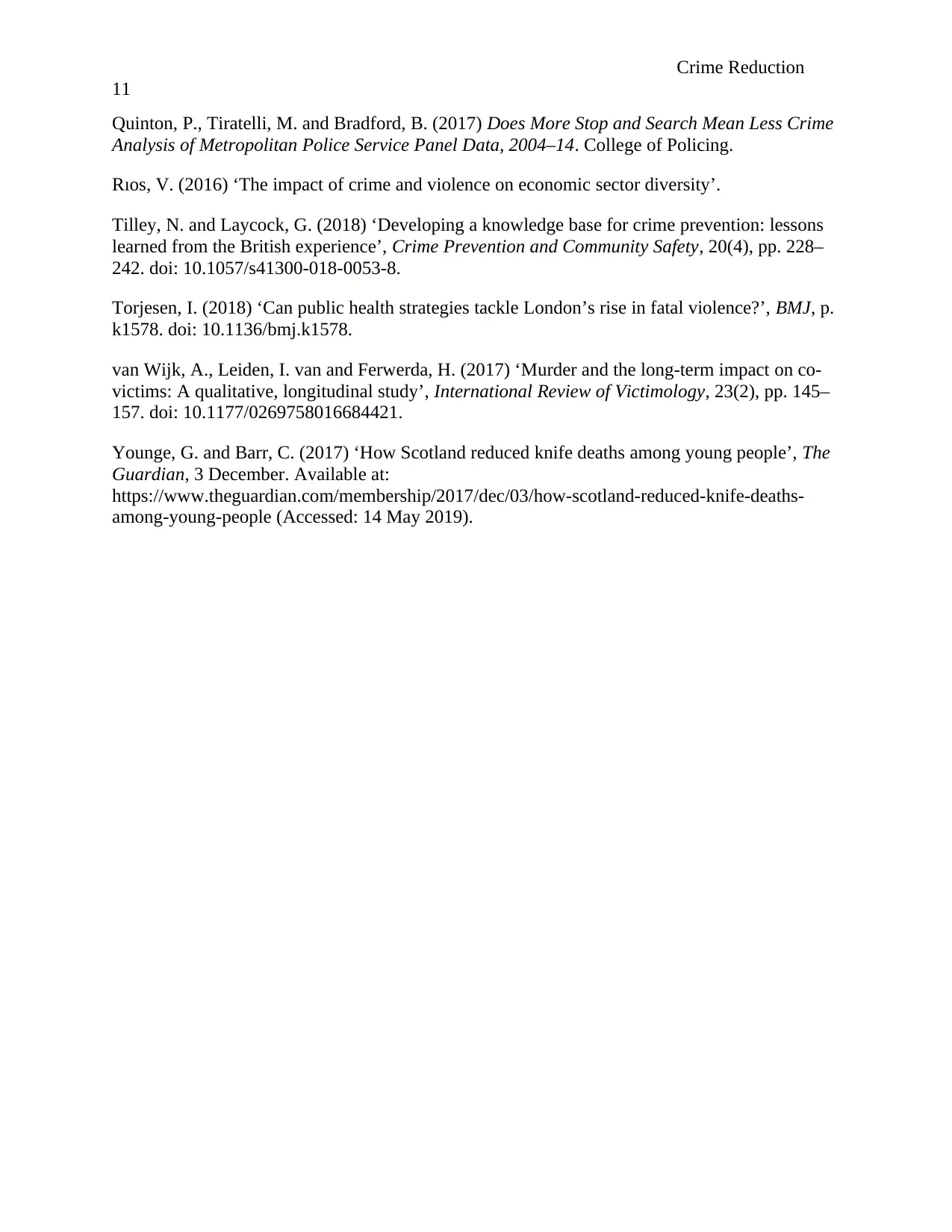
Quinton, P., Tiratelli, M. and Bradford, B. (2017) Does More Stop and Search Mean Less Crime
Analysis of Metropolitan Police Service Panel Data, 2004–14. College of Policing.
Rıos, V. (2016) ‘The impact of crime and violence on economic sector diversity’.
Tilley, N. and Laycock, G. (2018) ‘Developing a knowledge base for crime prevention: lessons
learned from the British experience’, Crime Prevention and Community Safety, 20(4), pp. 228–
242. doi: 10.1057/s41300-018-0053-8.
Torjesen, I. (2018) ‘Can public health strategies tackle London’s rise in fatal violence?’, BMJ, p.
k1578. doi: 10.1136/bmj.k1578.
van Wijk, A., Leiden, I. van and Ferwerda, H. (2017) ‘Murder and the long-term impact on co-
victims: A qualitative, longitudinal study’, International Review of Victimology, 23(2), pp. 145–
157. doi: 10.1177/0269758016684421.
Younge, G. and Barr, C. (2017) ‘How Scotland reduced knife deaths among young people’, The
Guardian, 3 December. Available at:
https://www.theguardian.com/membership/2017/dec/03/how-scotland-reduced-knife-deaths-
among-young-people (Accessed: 14 May 2019).
11
Quinton, P., Tiratelli, M. and Bradford, B. (2017) Does More Stop and Search Mean Less Crime
Analysis of Metropolitan Police Service Panel Data, 2004–14. College of Policing.
Rıos, V. (2016) ‘The impact of crime and violence on economic sector diversity’.
Tilley, N. and Laycock, G. (2018) ‘Developing a knowledge base for crime prevention: lessons
learned from the British experience’, Crime Prevention and Community Safety, 20(4), pp. 228–
242. doi: 10.1057/s41300-018-0053-8.
Torjesen, I. (2018) ‘Can public health strategies tackle London’s rise in fatal violence?’, BMJ, p.
k1578. doi: 10.1136/bmj.k1578.
van Wijk, A., Leiden, I. van and Ferwerda, H. (2017) ‘Murder and the long-term impact on co-
victims: A qualitative, longitudinal study’, International Review of Victimology, 23(2), pp. 145–
157. doi: 10.1177/0269758016684421.
Younge, G. and Barr, C. (2017) ‘How Scotland reduced knife deaths among young people’, The
Guardian, 3 December. Available at:
https://www.theguardian.com/membership/2017/dec/03/how-scotland-reduced-knife-deaths-
among-young-people (Accessed: 14 May 2019).
⊘ This is a preview!⊘
Do you want full access?
Subscribe today to unlock all pages.
Trusted by 1+ million students worldwide

1 out of 12


Related Documents


Your All-in-One AI-Powered Toolkit for Academic Success.
+13062052269
info@desklib.com
Available 24*7 on WhatsApp / Email
![[object Object]](/_next/static/media/star-bottom.7253800d.svg)
Unlock your academic potential
Copyright © 2020–2026 A2Z Services. All Rights Reserved. Developed and managed by ZUCOL.