2019LAW Tutorial Question 1: Criminal Law Intoxication Defense

Verified

Added on  2022/11/26

|5
|625
|412
Homework Assignment
AI Summary
This assignment addresses a criminal law scenario where Mike is charged with grievous bodily harm after stabbing Sam. The core issue revolves around the potential defense of involuntary intoxication. The assignment analyzes the impact of Sam's joke, which induced a state of shock and stupefaction in Mike, potentially negating his ability to form intent. It references section 28(1) of the Criminal Code, which addresses intoxication and its effects on criminal responsibility. The defense argues that Mike's actions were a result of his inability to understand or control his actions due to the shock and the beers consumed. The assignment further explores the lack of prior intent to harm Sam, and how this supports the intoxication defense. The document includes references to relevant legal literature supporting the arguments presented.
Document Page
Running head: CRIMINAL LAW 1
Criminal Law
Student’s Name
Date
tabler-icon-diamond-filled.svg

Paraphrase This Document

Need a fresh take? Get an instant paraphrase of this document with our AI Paraphraser
Document Page
CRIMINAL LAW 2
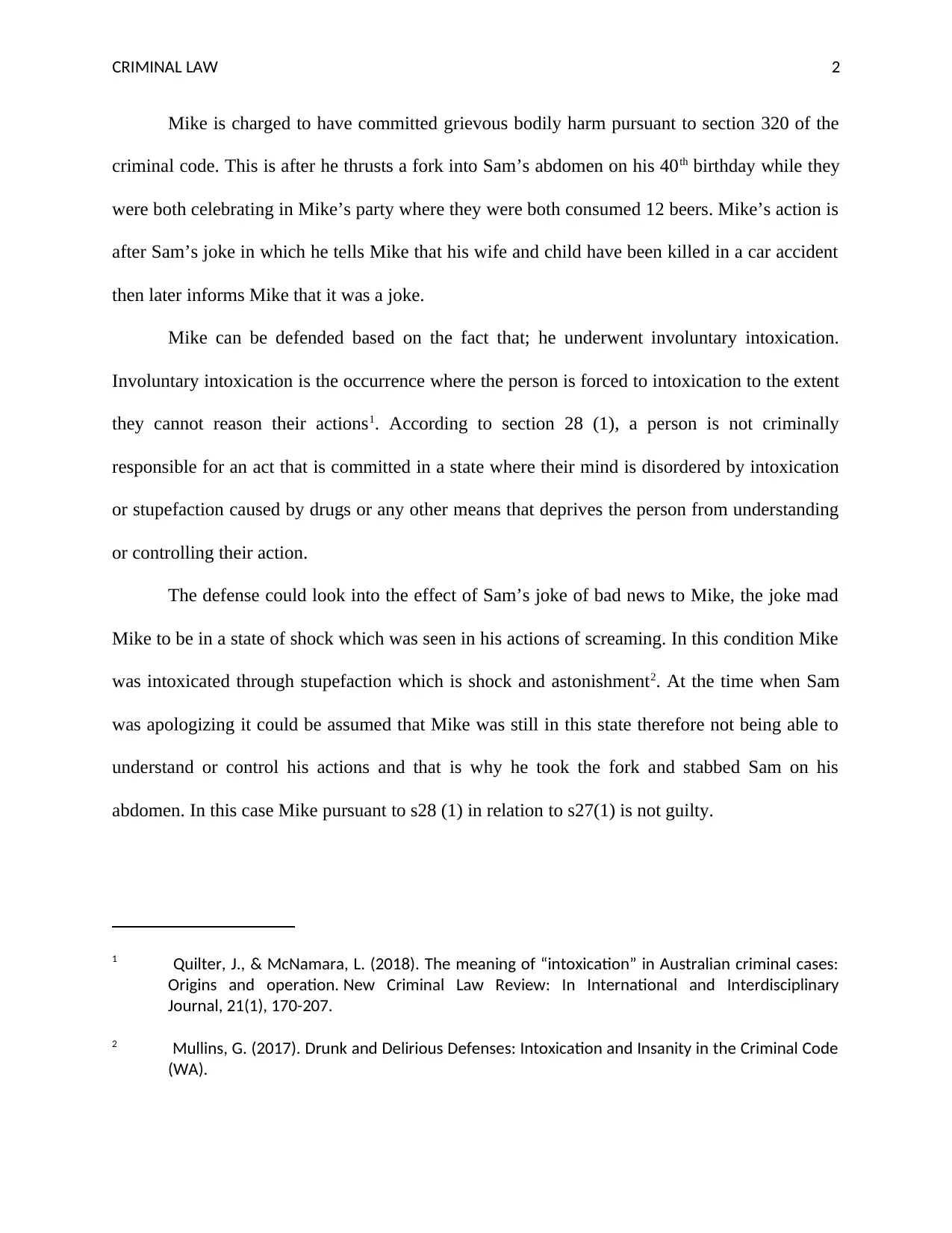
Mike is charged to have committed grievous bodily harm pursuant to section 320 of the
criminal code. This is after he thrusts a fork into Sam’s abdomen on his 40th birthday while they
were both celebrating in Mike’s party where they were both consumed 12 beers. Mike’s action is
after Sam’s joke in which he tells Mike that his wife and child have been killed in a car accident
then later informs Mike that it was a joke.
Mike can be defended based on the fact that; he underwent involuntary intoxication.
Involuntary intoxication is the occurrence where the person is forced to intoxication to the extent
they cannot reason their actions1. According to section 28 (1), a person is not criminally
responsible for an act that is committed in a state where their mind is disordered by intoxication
or stupefaction caused by drugs or any other means that deprives the person from understanding
or controlling their action.
The defense could look into the effect of Sam’s joke of bad news to Mike, the joke mad
Mike to be in a state of shock which was seen in his actions of screaming. In this condition Mike
was intoxicated through stupefaction which is shock and astonishment2. At the time when Sam
was apologizing it could be assumed that Mike was still in this state therefore not being able to
understand or control his actions and that is why he took the fork and stabbed Sam on his
abdomen. In this case Mike pursuant to s28 (1) in relation to s27(1) is not guilty.
1 Quilter, J., & McNamara, L. (2018). The meaning of “intoxication” in Australian criminal cases:
Origins and operation. New Criminal Law Review: In International and Interdisciplinary
Journal, 21(1), 170-207.
2 Mullins, G. (2017). Drunk and Delirious Defenses: Intoxication and Insanity in the Criminal Code
(WA).
Document Page
CRIMINAL LAW 3
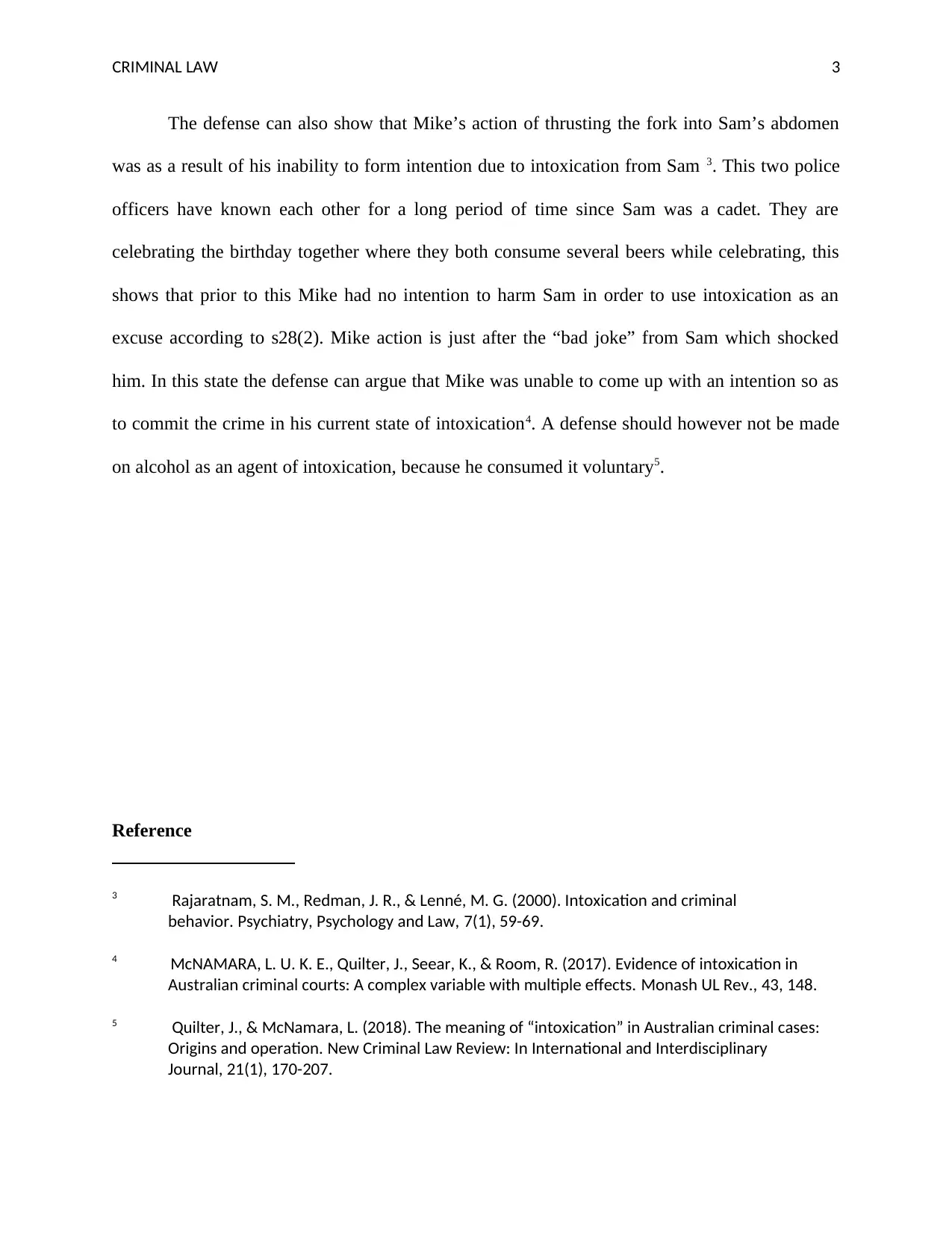
The defense can also show that Mike’s action of thrusting the fork into Sam’s abdomen
was as a result of his inability to form intention due to intoxication from Sam 3. This two police
officers have known each other for a long period of time since Sam was a cadet. They are
celebrating the birthday together where they both consume several beers while celebrating, this
shows that prior to this Mike had no intention to harm Sam in order to use intoxication as an
excuse according to s28(2). Mike action is just after the “bad joke” from Sam which shocked
him. In this state the defense can argue that Mike was unable to come up with an intention so as
to commit the crime in his current state of intoxication4. A defense should however not be made
on alcohol as an agent of intoxication, because he consumed it voluntary5.
Reference
3 Rajaratnam, S. M., Redman, J. R., & Lenné, M. G. (2000). Intoxication and criminal
behavior. Psychiatry, Psychology and Law, 7(1), 59-69.
4 McNAMARA, L. U. K. E., Quilter, J., Seear, K., & Room, R. (2017). Evidence of intoxication in
Australian criminal courts: A complex variable with multiple effects. Monash UL Rev., 43, 148.
5 Quilter, J., & McNamara, L. (2018). The meaning of “intoxication” in Australian criminal cases:
Origins and operation. New Criminal Law Review: In International and Interdisciplinary
Journal, 21(1), 170-207.
Document Page
CRIMINAL LAW 4
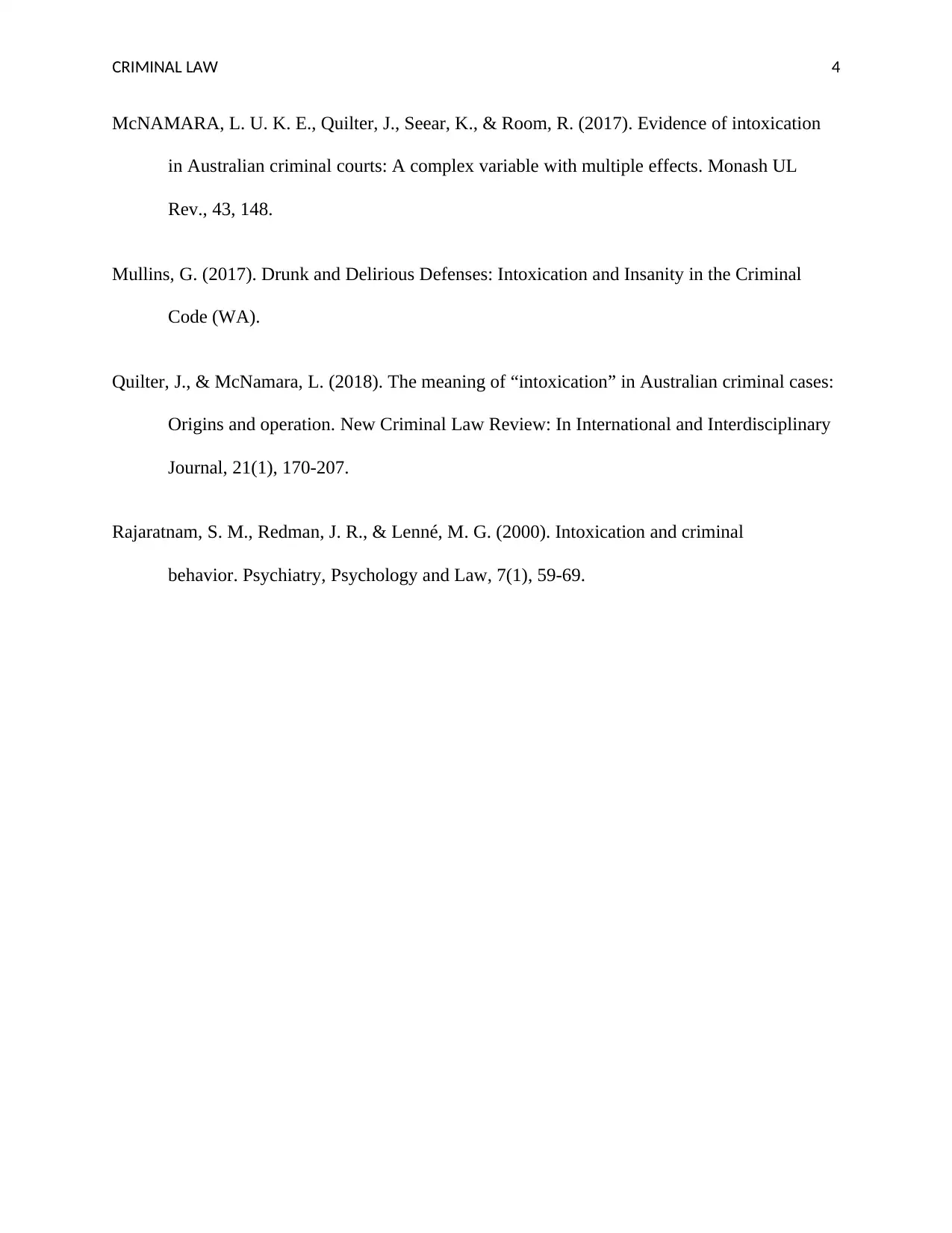
McNAMARA, L. U. K. E., Quilter, J., Seear, K., & Room, R. (2017). Evidence of intoxication
in Australian criminal courts: A complex variable with multiple effects. Monash UL
Rev., 43, 148.
Mullins, G. (2017). Drunk and Delirious Defenses: Intoxication and Insanity in the Criminal
Code (WA).
Quilter, J., & McNamara, L. (2018). The meaning of “intoxication” in Australian criminal cases:
Origins and operation. New Criminal Law Review: In International and Interdisciplinary
Journal, 21(1), 170-207.
Rajaratnam, S. M., Redman, J. R., & Lenné, M. G. (2000). Intoxication and criminal
behavior. Psychiatry, Psychology and Law, 7(1), 59-69.
tabler-icon-diamond-filled.svg

Paraphrase This Document

Need a fresh take? Get an instant paraphrase of this document with our AI Paraphraser
Document Page
CRIMINAL LAW 5
chevron_up_icon
1 out of 5
circle_padding
hide_on_mobile
zoom_out_icon
[object Object]