Criminology Essay: Analyzing Crime Rates Based on Socioeconomics

Verified

Added on  2023/06/15

|5
|985
|133
Essay
AI Summary
This criminology essay analyzes crime rates in four different areas, focusing on the impact of socioeconomic factors and applying relevant criminological theories. Area 1, characterized by high unemployment and school dropout rates, exhibits a high crime rate explained by the cultural transmission theory. Area 2, also a low-income area but with higher employment and homeownership, shows a lower crime rate. Area 3 faces high unemployment and violent crime, analyzed through strain, control, and social learning theories. Area 4, with a mix of high and low-income families, experiences burglaries in wealthier neighborhoods, attributed to feelings of injustice among the lower-income group. The essay recommends government intervention through economic and social empowerment, improved school systems, and skills training to reduce unemployment and, consequently, crime rates. Desklib provides access to similar solved assignments and study tools.
Document Page
Running head: CRIMINOLOGY 1
Criminology
Name:
Institution:
Date:
tabler-icon-diamond-filled.svg

Paraphrase This Document

Need a fresh take? Get an instant paraphrase of this document with our AI Paraphraser
Document Page
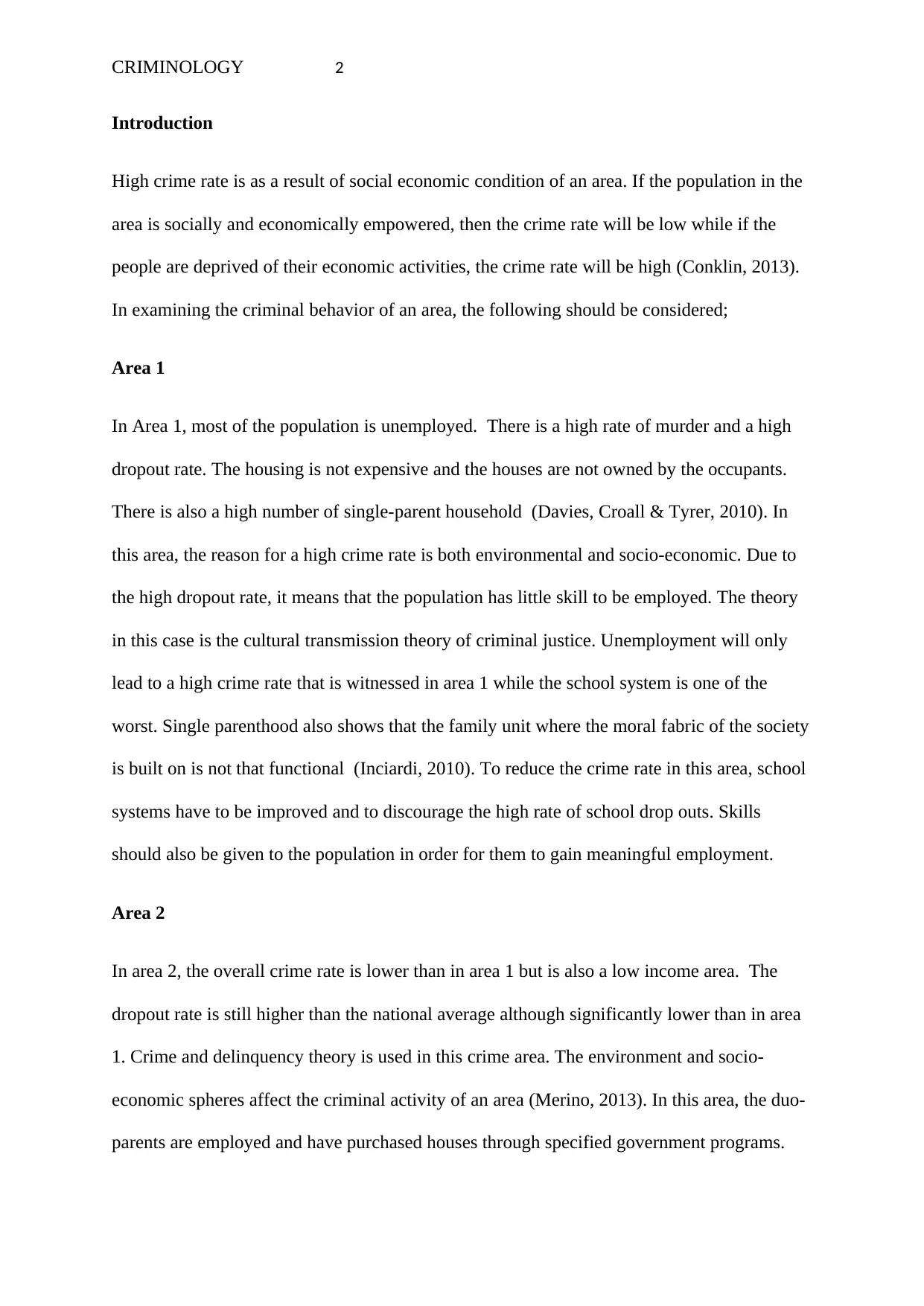
CRIMINOLOGY 2
Introduction
High crime rate is as a result of social economic condition of an area. If the population in the
area is socially and economically empowered, then the crime rate will be low while if the
people are deprived of their economic activities, the crime rate will be high (Conklin, 2013).
In examining the criminal behavior of an area, the following should be considered;
Area 1
In Area 1, most of the population is unemployed. There is a high rate of murder and a high
dropout rate. The housing is not expensive and the houses are not owned by the occupants.
There is also a high number of single-parent household (Davies, Croall & Tyrer, 2010). In
this area, the reason for a high crime rate is both environmental and socio-economic. Due to
the high dropout rate, it means that the population has little skill to be employed. The theory
in this case is the cultural transmission theory of criminal justice. Unemployment will only
lead to a high crime rate that is witnessed in area 1 while the school system is one of the
worst. Single parenthood also shows that the family unit where the moral fabric of the society
is built on is not that functional (Inciardi, 2010). To reduce the crime rate in this area, school
systems have to be improved and to discourage the high rate of school drop outs. Skills
should also be given to the population in order for them to gain meaningful employment.
Area 2
In area 2, the overall crime rate is lower than in area 1 but is also a low income area. The
dropout rate is still higher than the national average although significantly lower than in area
1. Crime and delinquency theory is used in this crime area. The environment and socio-
economic spheres affect the criminal activity of an area (Merino, 2013). In this area, the duo-
parents are employed and have purchased houses through specified government programs.
Document Page
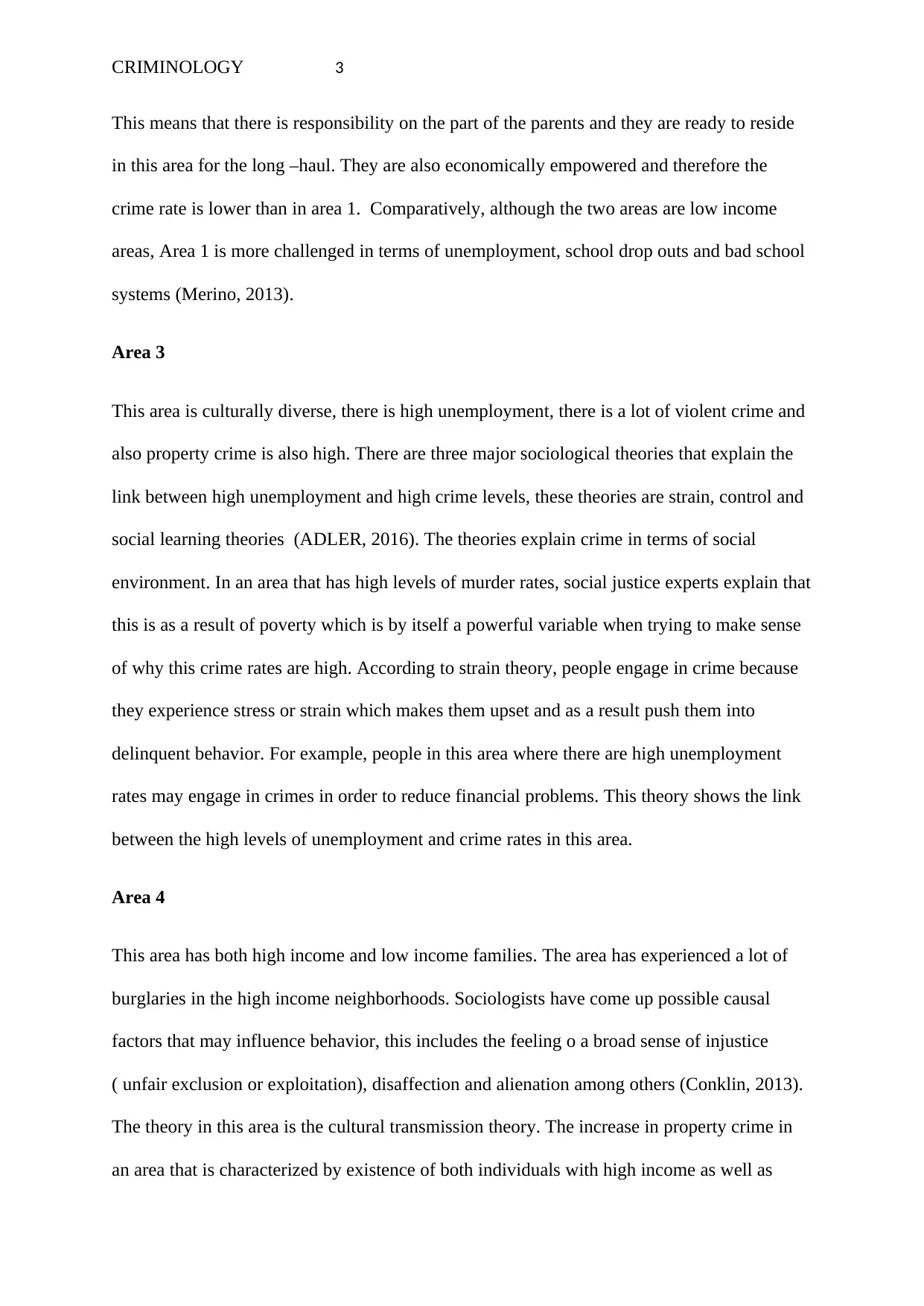
CRIMINOLOGY 3
This means that there is responsibility on the part of the parents and they are ready to reside
in this area for the long –haul. They are also economically empowered and therefore the
crime rate is lower than in area 1. Comparatively, although the two areas are low income
areas, Area 1 is more challenged in terms of unemployment, school drop outs and bad school
systems (Merino, 2013).
Area 3
This area is culturally diverse, there is high unemployment, there is a lot of violent crime and
also property crime is also high. There are three major sociological theories that explain the
link between high unemployment and high crime levels, these theories are strain, control and
social learning theories (ADLER, 2016). The theories explain crime in terms of social
environment. In an area that has high levels of murder rates, social justice experts explain that
this is as a result of poverty which is by itself a powerful variable when trying to make sense
of why this crime rates are high. According to strain theory, people engage in crime because
they experience stress or strain which makes them upset and as a result push them into
delinquent behavior. For example, people in this area where there are high unemployment
rates may engage in crimes in order to reduce financial problems. This theory shows the link
between the high levels of unemployment and crime rates in this area.
Area 4
This area has both high income and low income families. The area has experienced a lot of
burglaries in the high income neighborhoods. Sociologists have come up possible causal
factors that may influence behavior, this includes the feeling o a broad sense of injustice
( unfair exclusion or exploitation), disaffection and alienation among others (Conklin, 2013).
The theory in this area is the cultural transmission theory. The increase in property crime in
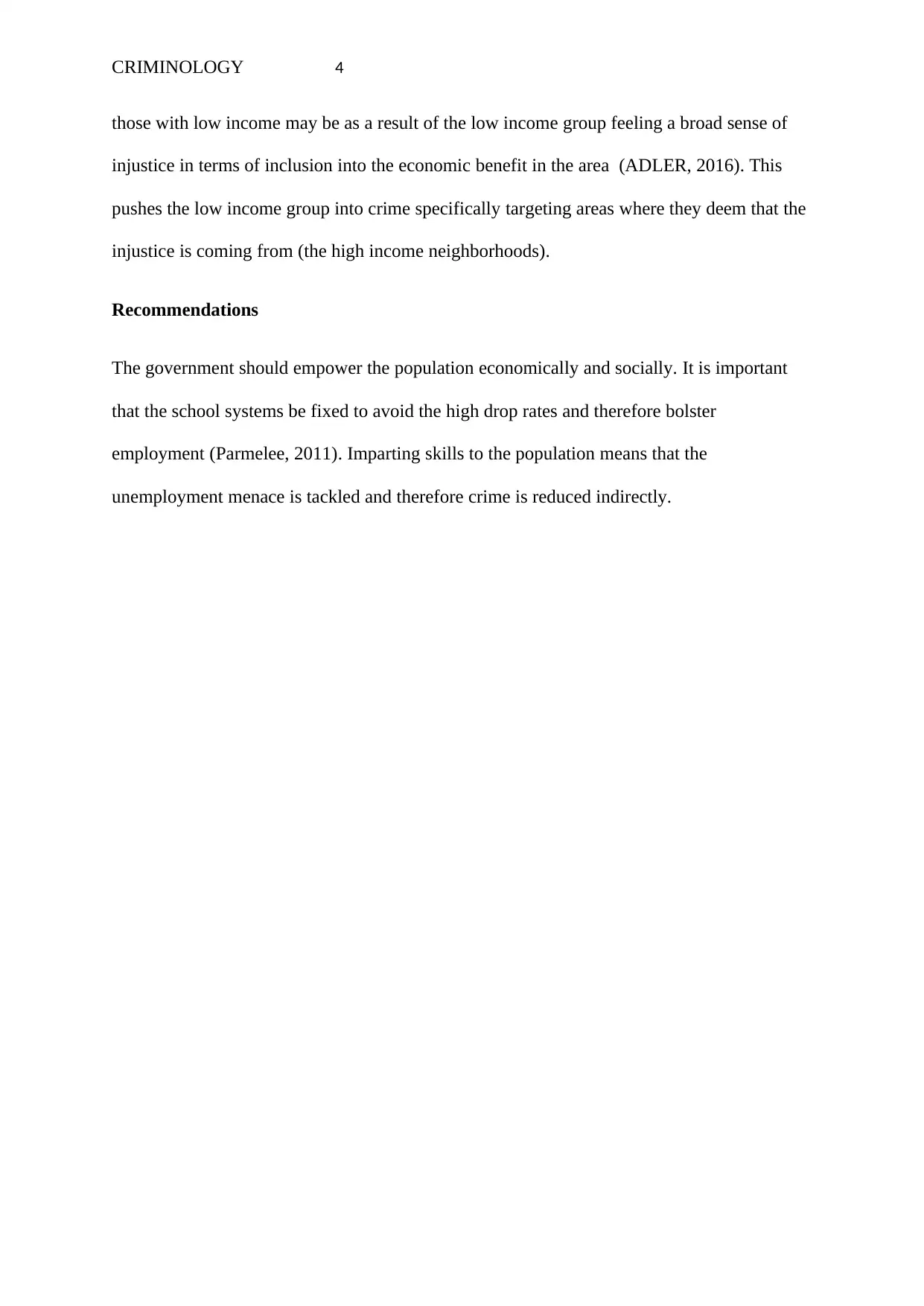
an area that is characterized by existence of both individuals with high income as well as
Document Page
CRIMINOLOGY 4
those with low income may be as a result of the low income group feeling a broad sense of
injustice in terms of inclusion into the economic benefit in the area (ADLER, 2016). This
pushes the low income group into crime specifically targeting areas where they deem that the
injustice is coming from (the high income neighborhoods).
Recommendations
The government should empower the population economically and socially. It is important
that the school systems be fixed to avoid the high drop rates and therefore bolster
employment (Parmelee, 2011). Imparting skills to the population means that the
unemployment menace is tackled and therefore crime is reduced indirectly.
tabler-icon-diamond-filled.svg

Paraphrase This Document

Need a fresh take? Get an instant paraphrase of this document with our AI Paraphraser
Document Page
CRIMINOLOGY 5
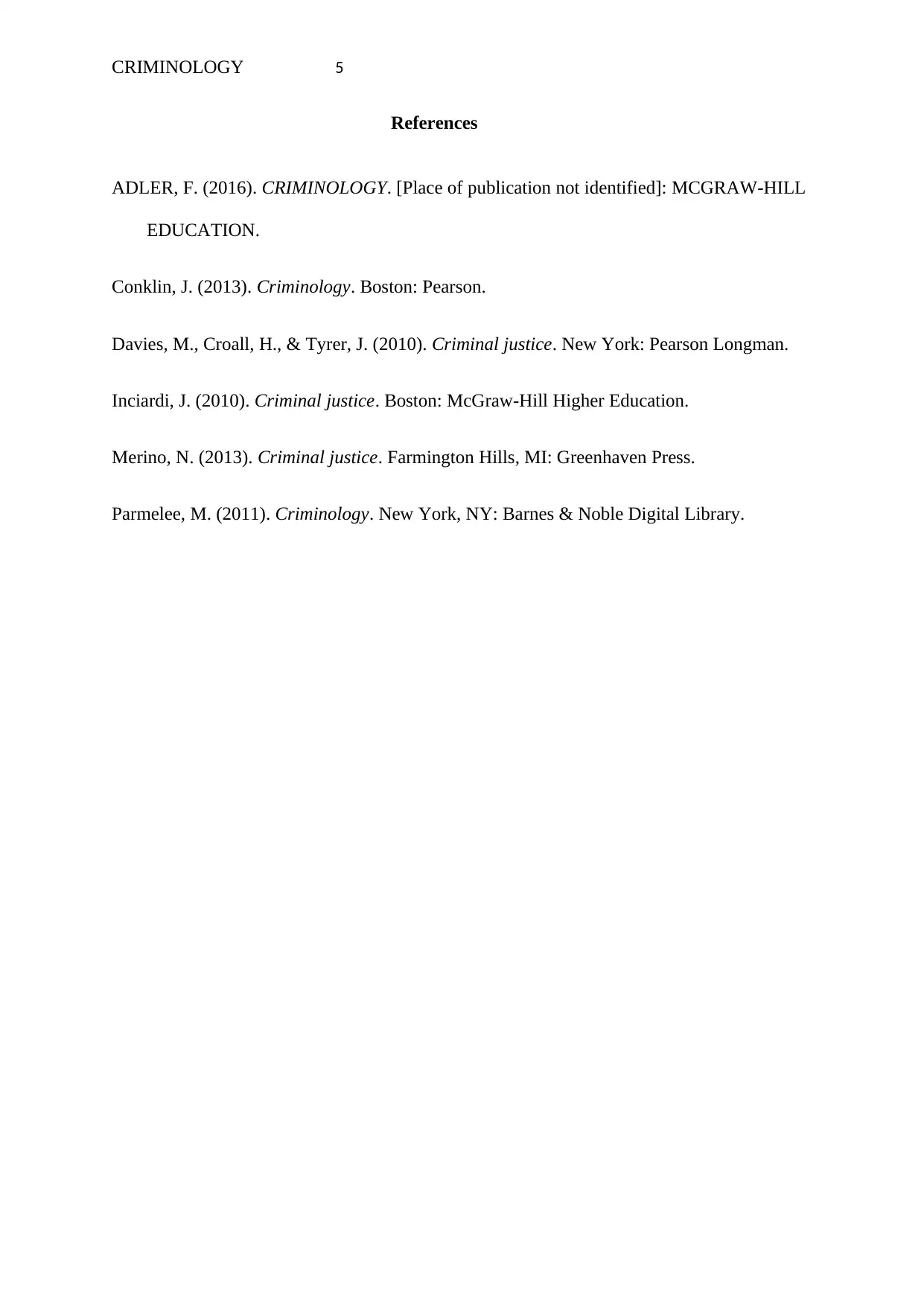
References
ADLER, F. (2016). CRIMINOLOGY. [Place of publication not identified]: MCGRAW-HILL
EDUCATION.
Conklin, J. (2013). Criminology. Boston: Pearson.
Davies, M., Croall, H., & Tyrer, J. (2010). Criminal justice. New York: Pearson Longman.
Inciardi, J. (2010). Criminal justice. Boston: McGraw-Hill Higher Education.
Merino, N. (2013). Criminal justice. Farmington Hills, MI: Greenhaven Press.
Parmelee, M. (2011). Criminology. New York, NY: Barnes & Noble Digital Library.
chevron_up_icon
1 out of 5
circle_padding
hide_on_mobile
zoom_out_icon
[object Object]