University Humanitarian Studies: Integrity Sector Critical Analysis

Verified

Added on  2022/08/21

|7
|1749
|12
Presentation
AI Summary
This assignment provides a critical analysis of integrity in the humanitarian sector, addressing the historical context of policies and practices. It examines the evolution of political economy and society in relation to humanitarianism, discussing the roles of various stakeholders and the impact of geopolitical changes. The analysis highlights the importance of historical perspectives in humanitarian actions, the challenges faced by aid-related organizations, and the evolving relationship between humanitarian aid and political considerations. The paper also explores the need for accountability, the impact of aid on populations, and the significance of international legal frameworks, including IHL, in safeguarding civilians and humanitarian workers. The analysis underscores the need for a more integrated approach to humanitarian action, emphasizing the importance of coordination, stakeholder collaboration, and the adaptation of aid strategies to meet the evolving challenges of conflict and crisis.
Document Page
Addressing integrity in the humanitarian sector
Critical Analysis
1/24/2020
University
Student Credentials
tabler-icon-diamond-filled.svg

Paraphrase This Document

Need a fresh take? Get an instant paraphrase of this document with our AI Paraphraser
Document Page
Critical Analysis 1
Addressing integrity in the humanitarian sector
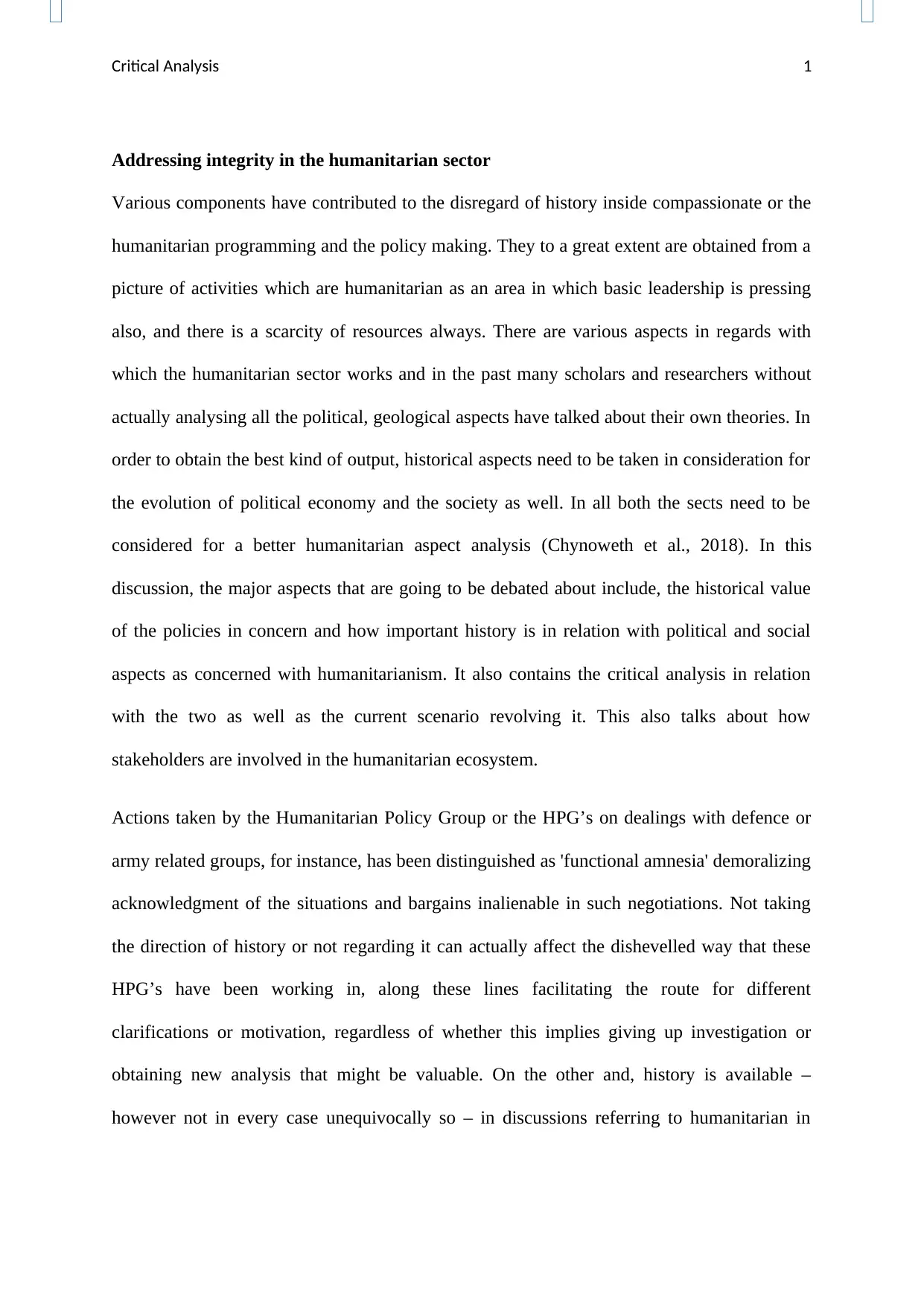
Various components have contributed to the disregard of history inside compassionate or the
humanitarian programming and the policy making. They to a great extent are obtained from a
picture of activities which are humanitarian as an area in which basic leadership is pressing
also, and there is a scarcity of resources always. There are various aspects in regards with
which the humanitarian sector works and in the past many scholars and researchers without
actually analysing all the political, geological aspects have talked about their own theories. In
order to obtain the best kind of output, historical aspects need to be taken in consideration for
the evolution of political economy and the society as well. In all both the sects need to be
considered for a better humanitarian aspect analysis (Chynoweth et al., 2018). In this
discussion, the major aspects that are going to be debated about include, the historical value
of the policies in concern and how important history is in relation with political and social
aspects as concerned with humanitarianism. It also contains the critical analysis in relation
with the two as well as the current scenario revolving it. This also talks about how
stakeholders are involved in the humanitarian ecosystem.
Actions taken by the Humanitarian Policy Group or the HPG’s on dealings with defence or
army related groups, for instance, has been distinguished as 'functional amnesia' demoralizing
acknowledgment of the situations and bargains inalienable in such negotiations. Not taking
the direction of history or not regarding it can actually affect the dishevelled way that these
HPG’s have been working in, along these lines facilitating the route for different
clarifications or motivation, regardless of whether this implies giving up investigation or
obtaining new analysis that might be valuable. On the other and, history is available –
however not in every case unequivocally so – in discussions referring to humanitarian in
Document Page
Critical Analysis 2
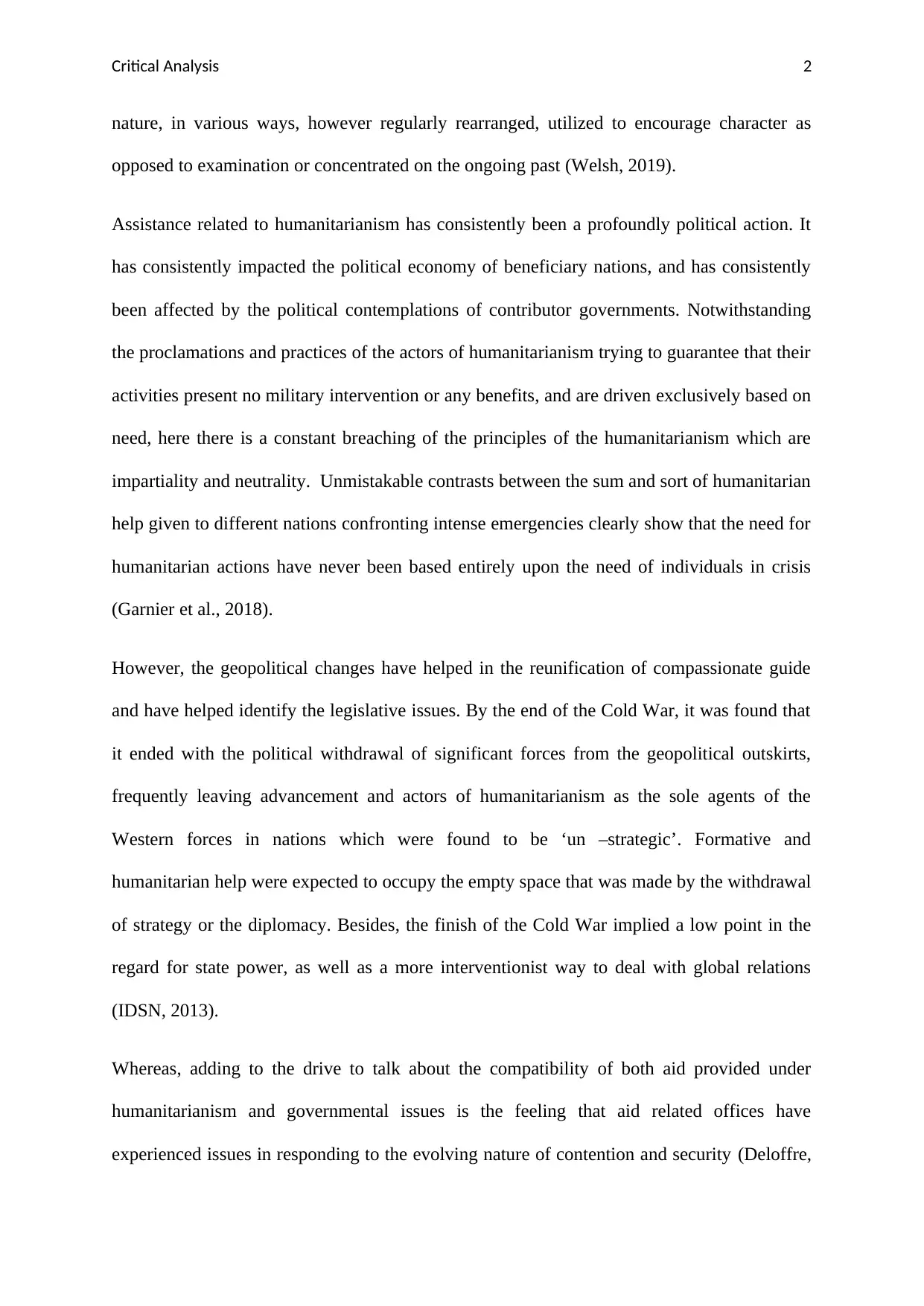
nature, in various ways, however regularly rearranged, utilized to encourage character as
opposed to examination or concentrated on the ongoing past (Welsh, 2019).
Assistance related to humanitarianism has consistently been a profoundly political action. It
has consistently impacted the political economy of beneficiary nations, and has consistently
been affected by the political contemplations of contributor governments. Notwithstanding
the proclamations and practices of the actors of humanitarianism trying to guarantee that their
activities present no military intervention or any benefits, and are driven exclusively based on
need, here there is a constant breaching of the principles of the humanitarianism which are
impartiality and neutrality. Unmistakable contrasts between the sum and sort of humanitarian
help given to different nations confronting intense emergencies clearly show that the need for
humanitarian actions have never been based entirely upon the need of individuals in crisis
(Garnier et al., 2018).
However, the geopolitical changes have helped in the reunification of compassionate guide
and have helped identify the legislative issues. By the end of the Cold War, it was found that
it ended with the political withdrawal of significant forces from the geopolitical outskirts,
frequently leaving advancement and actors of humanitarianism as the sole agents of the
Western forces in nations which were found to be ‘un –strategic’. Formative and
humanitarian help were expected to occupy the empty space that was made by the withdrawal
of strategy or the diplomacy. Besides, the finish of the Cold War implied a low point in the
regard for state power, as well as a more interventionist way to deal with global relations
(IDSN, 2013).
Whereas, adding to the drive to talk about the compatibility of both aid provided under
humanitarianism and governmental issues is the feeling that aid related offices have
experienced issues in responding to the evolving nature of contention and security (Deloffre,
Document Page
Critical Analysis 3
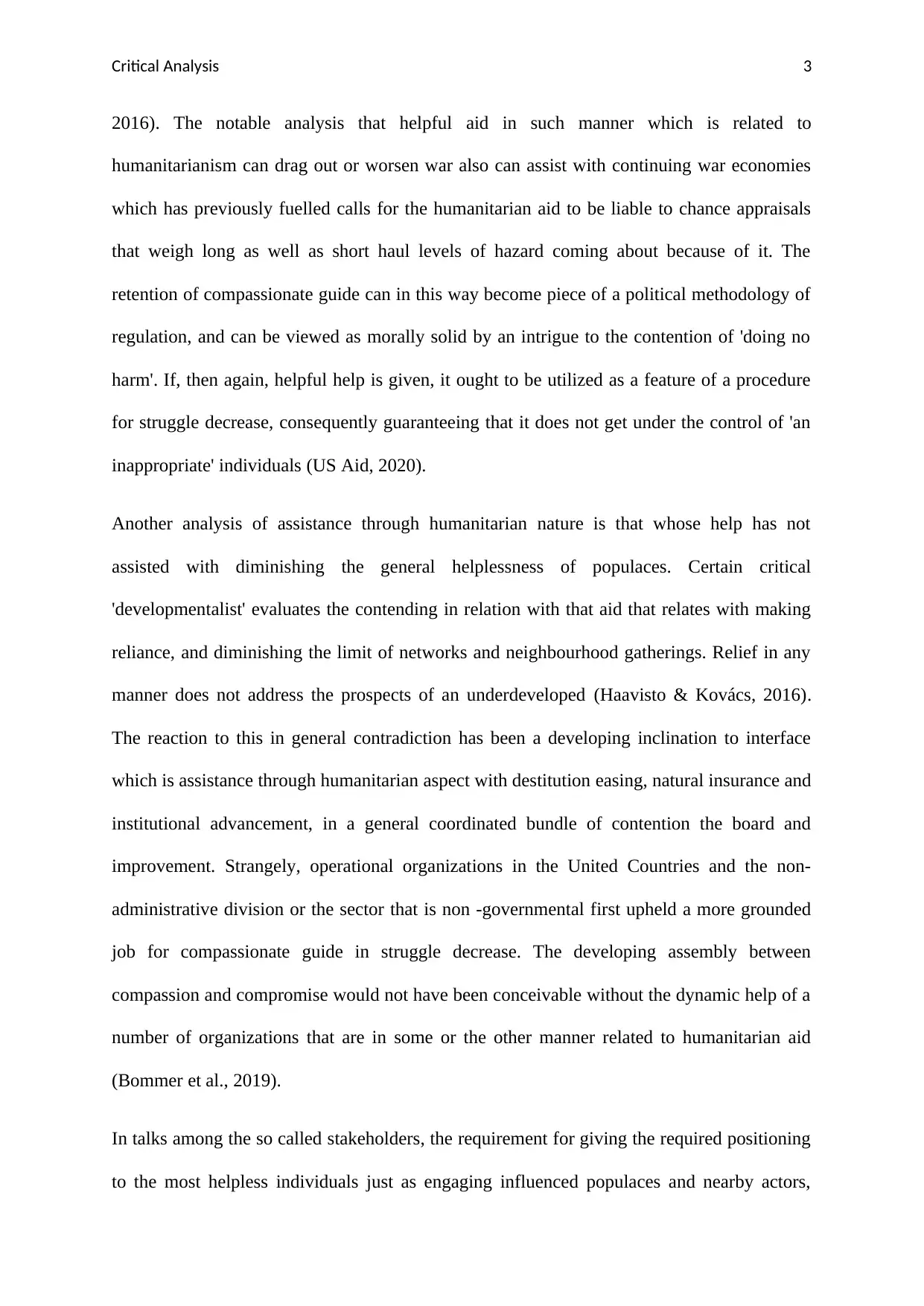
2016). The notable analysis that helpful aid in such manner which is related to
humanitarianism can drag out or worsen war also can assist with continuing war economies
which has previously fuelled calls for the humanitarian aid to be liable to chance appraisals
that weigh long as well as short haul levels of hazard coming about because of it. The
retention of compassionate guide can in this way become piece of a political methodology of
regulation, and can be viewed as morally solid by an intrigue to the contention of 'doing no
harm'. If, then again, helpful help is given, it ought to be utilized as a feature of a procedure
for struggle decrease, consequently guaranteeing that it does not get under the control of 'an
inappropriate' individuals (US Aid, 2020).
Another analysis of assistance through humanitarian nature is that whose help has not
assisted with diminishing the general helplessness of populaces. Certain critical
'developmentalist' evaluates the contending in relation with that aid that relates with making
reliance, and diminishing the limit of networks and neighbourhood gatherings. Relief in any
manner does not address the prospects of an underdeveloped (Haavisto & Kovács, 2016).
The reaction to this in general contradiction has been a developing inclination to interface
which is assistance through humanitarian aspect with destitution easing, natural insurance and
institutional advancement, in a general coordinated bundle of contention the board and
improvement. Strangely, operational organizations in the United Countries and the non-
administrative division or the sector that is non -governmental first upheld a more grounded
job for compassionate guide in struggle decrease. The developing assembly between
compassion and compromise would not have been conceivable without the dynamic help of a
number of organizations that are in some or the other manner related to humanitarian aid
(Bommer et al., 2019).
In talks among the so called stakeholders, the requirement for giving the required positioning
to the most helpless individuals just as engaging influenced populaces and nearby actors,
tabler-icon-diamond-filled.svg

Paraphrase This Document

Need a fresh take? Get an instant paraphrase of this document with our AI Paraphraser
Document Page
Critical Analysis 4
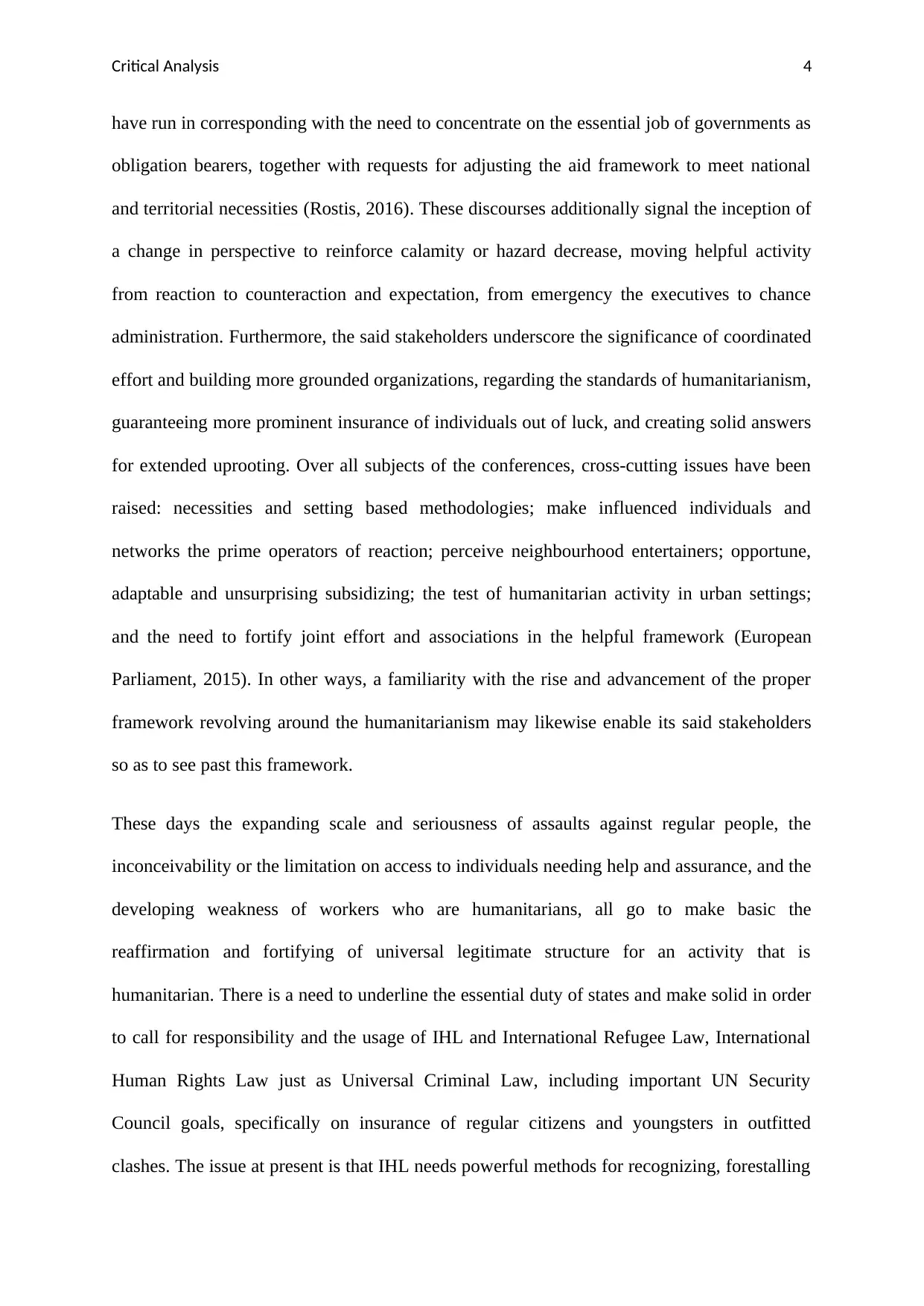
have run in corresponding with the need to concentrate on the essential job of governments as
obligation bearers, together with requests for adjusting the aid framework to meet national
and territorial necessities (Rostis, 2016). These discourses additionally signal the inception of
a change in perspective to reinforce calamity or hazard decrease, moving helpful activity
from reaction to counteraction and expectation, from emergency the executives to chance
administration. Furthermore, the said stakeholders underscore the significance of coordinated
effort and building more grounded organizations, regarding the standards of humanitarianism,
guaranteeing more prominent insurance of individuals out of luck, and creating solid answers
for extended uprooting. Over all subjects of the conferences, cross-cutting issues have been
raised: necessities and setting based methodologies; make influenced individuals and
networks the prime operators of reaction; perceive neighbourhood entertainers; opportune,
adaptable and unsurprising subsidizing; the test of humanitarian activity in urban settings;
and the need to fortify joint effort and associations in the helpful framework (European
Parliament, 2015). In other ways, a familiarity with the rise and advancement of the proper
framework revolving around the humanitarianism may likewise enable its said stakeholders
so as to see past this framework.
These days the expanding scale and seriousness of assaults against regular people, the
inconceivability or the limitation on access to individuals needing help and assurance, and the
developing weakness of workers who are humanitarians, all go to make basic the
reaffirmation and fortifying of universal legitimate structure for an activity that is
humanitarian. There is a need to underline the essential duty of states and make solid in order
to call for responsibility and the usage of IHL and International Refugee Law, International
Human Rights Law just as Universal Criminal Law, including important UN Security
Council goals, specifically on insurance of regular citizens and youngsters in outfitted
clashes. The issue at present is that IHL needs powerful methods for recognizing, forestalling
Document Page
Critical Analysis 5
and ending infringement while they are happening. The systems inside IHL that do exist are
once in a while, if at any time utilized. Also, they are just material in global equipped clash,
though most of current clashes is non-universal.
Bibliography
Bommer, C., Dreher, & Pérez-Alvarez, , 2019. Humanitarian aid and political motives: The
role of country leaders’ birth regions. [Online] Available at:
https://voxeu.org/article/humanitarian-aid-and-political-motives [Accessed 25 January 2020].
Chynoweth, S.K., Zwi, A.B. & Whelan, A., 2018. Socializing accountability in humanitarian
settings: A proposed framework.. World Development, 109, pp.149-62.
Deloffre, M.Z., 2016. Global accountability communities: NGO self-regulation in the
humanitarian sector.. Review of International Studies, 42(4), pp.724-47.
European Parliament, 2015. Towards more effective global humanitarian action: How the EU
can contribute. [Online] Available at:
http://www.europarl.europa.eu/RegData/etudes/STUD/2015/549048/EXPO_STU
%282015%29549048_EN.pdf [Accessed 25 January 2020].
Garnier, A., Jubilut, L.L. & Sandvik, K.B., 2018. Refugee resettlement: power, politics, and
humanitarian governance. 38th ed. Berghahn Books.
Haavisto, I. & Kovács, G., 2016. Sustainability in Humanitarian Organisations. In
Sustainable Value Chain Management. Routledge. pp.537-56.
IDSN, 2013. Equality in Aid. [Online] Available at:
http://idsn.org/wp-content/uploads/2014/02/EqualityInAid_web_version.pdf [Accessed 25
January 2020].
Document Page
Critical Analysis 6
Rostis, A., 2016. Organizing disaster: The construction of humanitarianism. Emerald Group
Publishing.
US Aid, 2020. OFFICE OF U.S. FOREIGN DISASTER ASSISTANCE. [Online] Available at:
https://www.usaid.gov/who-we-are/organization/bureaus/bureau-democracy-conflict-and-
humanitarian-assistance/office-us [Accessed 25 January 2020].
Welsh, J.M., 2019. A Scattergun Attack on Humanitarian Intervention.. Journal of Genocide
Research, 21(1), pp.114-19.
chevron_up_icon
1 out of 7
circle_padding
hide_on_mobile
zoom_out_icon
[object Object]