Circles of Change Revisited: Deconstructing Research with Children

Verified

Added on  2023/06/08

|3
|1552
|481
Homework Assignment
AI Summary
This assignment, titled "Circles of Change Revisited," deconstructs the issues surrounding children's participation in research programs. It examines the challenges children face, such as unequal access to benefits and age-related learning differences, using the framework of "Deconstruct, Confront, Theorise, Think Otherwise". The author reflects on personal experiences, linking theoretical concepts like childhood development theories to practical applications. The assignment explores how visual and interactive methods, such as videos and storytelling, can enhance children's engagement and understanding. It challenges conventional thinking, emphasizing the importance of individual context and interest over age in the learning process and proposes improvements in teaching practices by incorporating group activities and extracurricular programs to boost children's confidence. References include various academic sources related to child development, family systems, and research methodologies.
Document Page
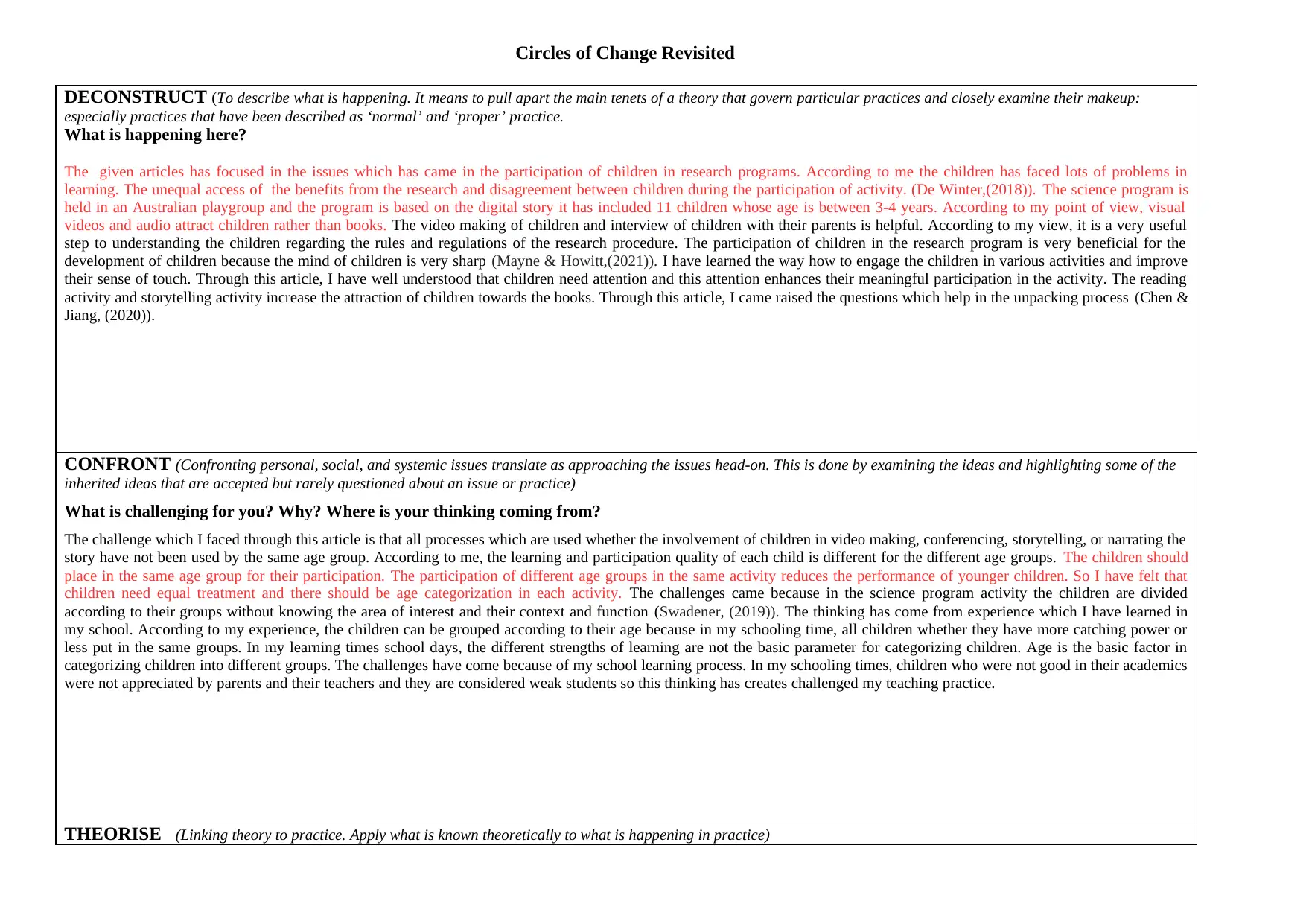
Circles of Change Revisited
DECONSTRUCT (To describe what is happening. It means to pull apart the main tenets of a theory that govern particular practices and closely examine their makeup:
especially practices that have been described as ‘normal’ and ‘proper’ practice.
What is happening here?
The given articles has focused in the issues which has came in the participation of children in research programs. According to me the children has faced lots of problems in
learning. The unequal access of the benefits from the research and disagreement between children during the participation of activity. (De Winter,(2018)). The science program is
held in an Australian playgroup and the program is based on the digital story it has included 11 children whose age is between 3-4 years. According to my point of view, visual
videos and audio attract children rather than books. The video making of children and interview of children with their parents is helpful. According to my view, it is a very useful
step to understanding the children regarding the rules and regulations of the research procedure. The participation of children in the research program is very beneficial for the
development of children because the mind of children is very sharp (Mayne & Howitt,(2021)). I have learned the way how to engage the children in various activities and improve
their sense of touch. Through this article, I have well understood that children need attention and this attention enhances their meaningful participation in the activity. The reading
activity and storytelling activity increase the attraction of children towards the books. Through this article, I came raised the questions which help in the unpacking process (Chen &
Jiang, (2020)).
CONFRONT (Confronting personal, social, and systemic issues translate as approaching the issues head-on. This is done by examining the ideas and highlighting some of the
inherited ideas that are accepted but rarely questioned about an issue or practice)
What is challenging for you? Why? Where is your thinking coming from?
The challenge which I faced through this article is that all processes which are used whether the involvement of children in video making, conferencing, storytelling, or narrating the
story have not been used by the same age group. According to me, the learning and participation quality of each child is different for the different age groups. The children should
place in the same age group for their participation. The participation of different age groups in the same activity reduces the performance of younger children. So I have felt that
children need equal treatment and there should be age categorization in each activity. The challenges came because in the science program activity the children are divided
according to their groups without knowing the area of interest and their context and function (Swadener, (2019)). The thinking has come from experience which I have learned in
my school. According to my experience, the children can be grouped according to their age because in my schooling time, all children whether they have more catching power or
less put in the same groups. In my learning times school days, the different strengths of learning are not the basic parameter for categorizing children. Age is the basic factor in
categorizing children into different groups. The challenges have come because of my school learning process. In my schooling times, children who were not good in their academics
were not appreciated by parents and their teachers and they are considered weak students so this thinking has creates challenged my teaching practice.
THEORISE (Linking theory to practice. Apply what is known theoretically to what is happening in practice)
tabler-icon-diamond-filled.svg

Paraphrase This Document

Need a fresh take? Get an instant paraphrase of this document with our AI Paraphraser
Document Page
What theory/ research/literature helps to understand what is happening around this issue from other perspectives?
The theories and research which help me to understand what are the issues in the current situations from other perspectives are the theory of childhood and complexity by Smith et
al., (2013) has developed my perspective regarding the learning variability according to their development, age, and many more prospective. The different theory has understood me
that characterizing variability and structure of variability and developmental change in variability is a very important part of learning. The theories of developmental changes in
variability have understood me that the strength and weaknesses of each child affect the possibilities and limitations of the performance. Another theory psychosexual development
theory states that child development occurs in different series and includes the different areas of bodies (Munford, & Sanders, (2020)). This theory has understood me that the
children in the science research program do not include a series of steps for learning the different activities. The theory of Behavioural child development theory states that the
behaviour of each child depends on their environmental factors. The bookish knowledge is not enough for the proper growth of children. The campaign and activity enhances the
knowledge of the children. Piaget's cognitive developmental theory describes that process of learning should be based on the thought process and mental states. This theory has
realized me that there should be different stages provided by the science activity program like the sensorimotor stage which comes between birth and age two, the pre-operational
age between 2 years and 6 years, and the concrete operational stage between the 7 to 11 years.
THINK OTHERWISE (Challenge yourself to think outside the usual ways of thinking. Consider the multiple perspectives and what this means for practice).
What are you thinking now? What has changed in your thinking? How will this influence practice?
The new ways of embedding young children in participation in research and interactive narrative approaches have changed my thinking. This way of learning has changed my
thinking I have learned from childhood that academic learning is the one way of enhancing childhood studies and child development. This article has changed my thinking that only
academic and book knowledge is not enough for the development of a child. The other thing which has changed my thinking is that, children need a proper environment for their
participation in research. This article has changed my thinking about the teaching process. The thinking which I have developed since my childhood is that age is the main factor in
the learning process. Here, I have learned that the personal context of each child and their area of interest is very important for their development (Kelledy & Lyons, (2019)). In my
time of learning the age is the main factor for learning but here I have learned that personal context of each child is the main factor in their learning. The modern learning program
which has been held in the science activity program which enhances meaningful interaction has influenced me to improve t he way of learning and teaching process. I would
develop my teaching process by increasing the interaction of children in group activities and debate programs. The extra curricular activity will boost confidence level of children.
(Cutroneo, Sangiorgi & Lucchi, (2022)).
Document Page
REFERENCES
Books and journals
Chen, X., & Jiang, X. (2020). Children's immigrant generational status and delinquency: the mediating effects of friendship networks. Social science research, 90, 102444.
https://doi.org/10.1016/j.ssresearch.2020.102444
Cutroneo, A. S., Sangiorgi, D., & Lucchi, F. (2022). Self-fulfilling Prophecies in Service Design: Strategies to Address Virtuous and Vicious Circles for Mental Healthcare
Transformation. In Service Design Practices for Healthcare Innovation (pp. 467-496). Springer, Cham. https://link.springer.com/chapter/10.1007/978-3-030-87273-1_23
De Winter, M. (2018). Children as fellow citizens: participation and commitment. CRC Press. https://doi.org/10.1201/9781315381008
Kelledy, L., & Lyons, B. (2019). Circular Causality in Family Systems Theory. Encyclopedia of Couple and Family Therapy, 431-434.
Mayne, F., & Howitt, C. (2021). Parental roles in supporting their young children's participation in research through a Narrative Approach Informing Story. In The Narrative
Approach to Informed Consent (pp. 122-136). Routledge. https://www.taylorfrancis.com/chapters/edit/10.4324/9780429330100-11
Munford, R., & Sanders, J. (2020). Introduction: Making a difference. In Making a Difference in Families (pp. 1-14). Routledge.
https://www.taylorfrancis.com/chapters/edit/10.4324/9781003116349-1
Swadener, B. B. (2019). Introduction: Young children’s participation rights. In The Routledge International Handbook of Young Children’s Rights (pp. 389-394). Routledge.
https://www.taylorfrancis.com/chapters/edit/10.4324/9780367142025-1
chevron_up_icon
1 out of 3
circle_padding
hide_on_mobile
zoom_out_icon
[object Object]