Business Development: Critical Analysis of Haneen's Statement

Verified

Added on  2021/12/16

|3
|418
|76
Report
AI Summary
This report presents a critical evaluation of Haneen's statement regarding business development. The analysis focuses on the utilization of quantitative data, research design, and data collection methods. The report references sources to support the viability of the quantitative data, the importance of self-reflection before data collection, and the time-consuming nature of gathering quantitative data. The report highlights the importance of concise questionnaires and the overall effectiveness of the statement. The report emphasizes the significance of quantitative data collection, including the time-consuming aspect, and the importance of concise questionnaires for effective research.

Document Page
CRITICAL EVALUATION OF HANNEN’S STATEMENT
tabler-icon-diamond-filled.svg

Paraphrase This Document

Need a fresh take? Get an instant paraphrase of this document with our AI Paraphraser
Document Page
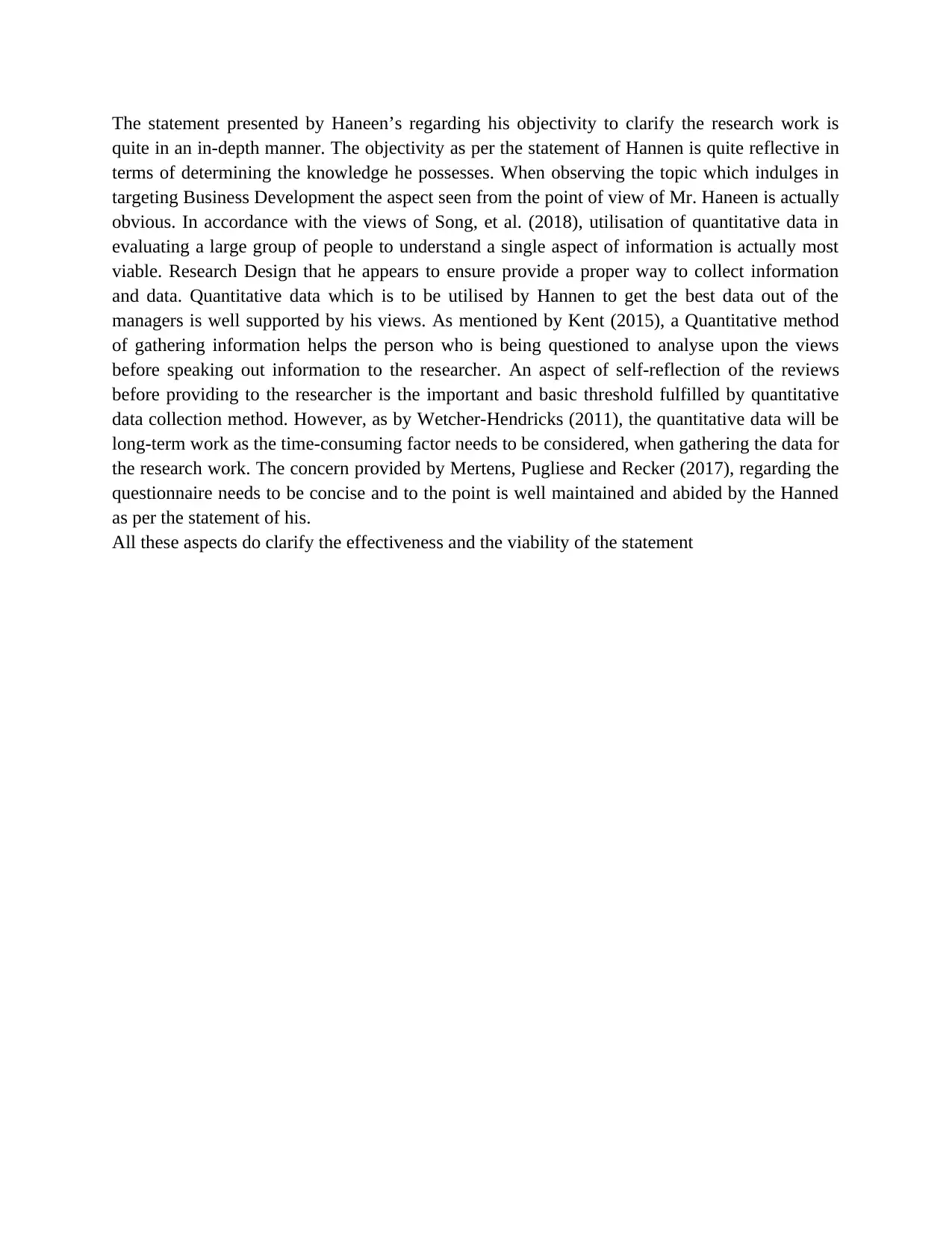
The statement presented by Haneen’s regarding his objectivity to clarify the research work is
quite in an in-depth manner. The objectivity as per the statement of Hannen is quite reflective in
terms of determining the knowledge he possesses. When observing the topic which indulges in
targeting Business Development the aspect seen from the point of view of Mr. Haneen is actually
obvious. In accordance with the views of Song, et al. (2018), utilisation of quantitative data in
evaluating a large group of people to understand a single aspect of information is actually most
viable. Research Design that he appears to ensure provide a proper way to collect information
and data. Quantitative data which is to be utilised by Hannen to get the best data out of the
managers is well supported by his views. As mentioned by Kent (2015), a Quantitative method
of gathering information helps the person who is being questioned to analyse upon the views
before speaking out information to the researcher. An aspect of self-reflection of the reviews
before providing to the researcher is the important and basic threshold fulfilled by quantitative
data collection method. However, as by Wetcher-Hendricks (2011), the quantitative data will be
long-term work as the time-consuming factor needs to be considered, when gathering the data for
the research work. The concern provided by Mertens, Pugliese and Recker (2017), regarding the
questionnaire needs to be concise and to the point is well maintained and abided by the Hanned
as per the statement of his.
All these aspects do clarify the effectiveness and the viability of the statement
Document Page
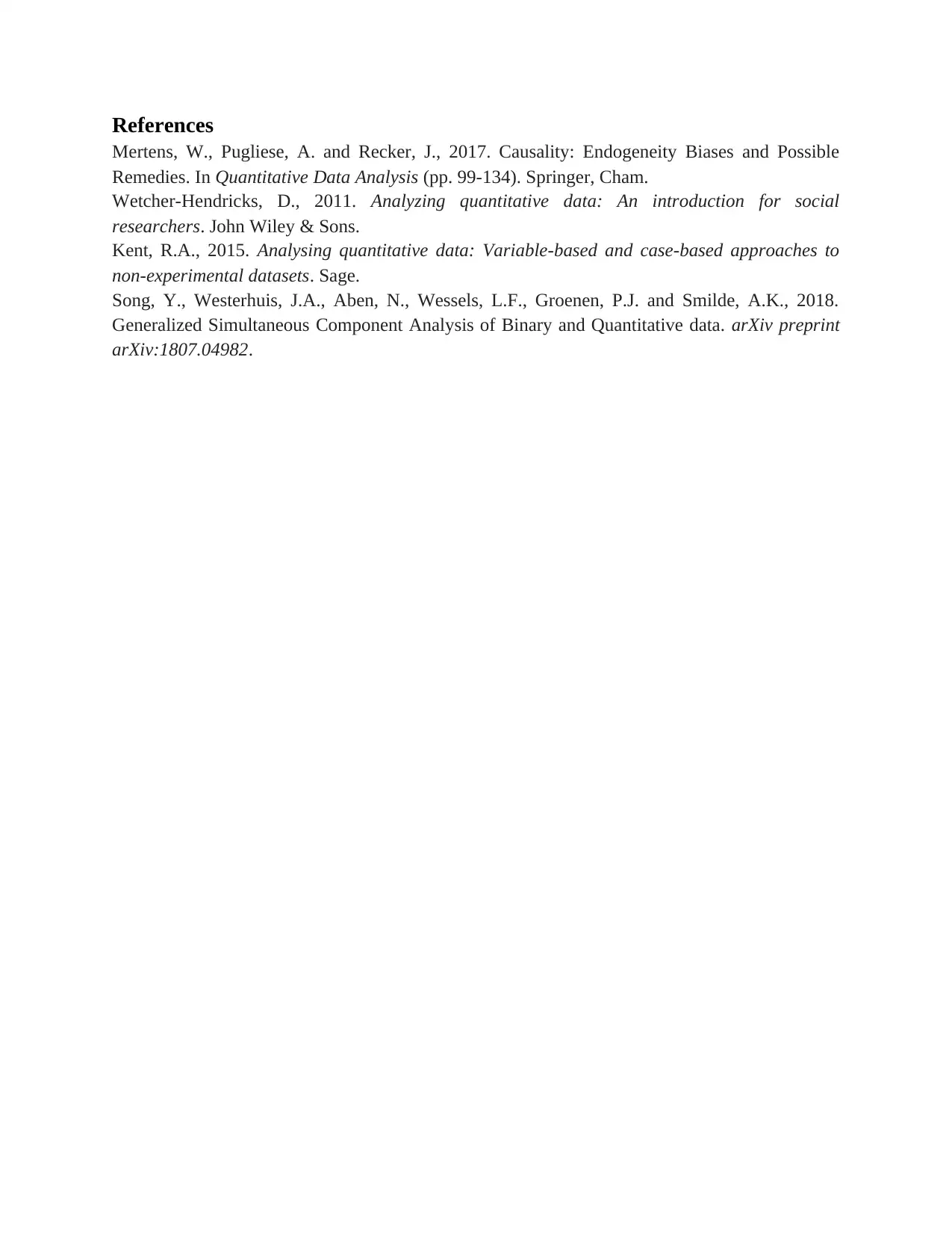
References
Mertens, W., Pugliese, A. and Recker, J., 2017. Causality: Endogeneity Biases and Possible
Remedies. In Quantitative Data Analysis (pp. 99-134). Springer, Cham.
Wetcher-Hendricks, D., 2011. Analyzing quantitative data: An introduction for social
researchers. John Wiley & Sons.
Kent, R.A., 2015. Analysing quantitative data: Variable-based and case-based approaches to
non-experimental datasets. Sage.
Song, Y., Westerhuis, J.A., Aben, N., Wessels, L.F., Groenen, P.J. and Smilde, A.K., 2018.
Generalized Simultaneous Component Analysis of Binary and Quantitative data. arXiv preprint
arXiv:1807.04982.
chevron_up_icon
1 out of 3
circle_padding
hide_on_mobile
zoom_out_icon
[object Object]