Critical Reflection Essay: Social Work and Personal Experiences
VerifiedAdded on 2023/01/07
|10
|2776
|25
Essay
AI Summary
This essay provides a critical reflection on the importance of self-reflection for social workers, emphasizing the need for continuous learning and development. It defines social location and explores the author's personal experiences, including their gender, ethnicity, religion, and socio-economic status. The essay examines instances of unearned privilege and experiences of oppression, offering personal examples to illustrate these concepts. It further analyzes how these factors affect the author's critical social work practice, highlighting potential biases and strategies for overcoming them to ensure non-judgmental practice. The author discusses the intersections of personal privileges and oppression, and how this understanding can be applied to improve social work practices. Finally, the essay concludes with a discussion of the author's approach to overcome biases and become non-judgemental in nature for doing social work.
CRITICAL REFLECTION

Paraphrase This Document
Need a fresh take? Get an instant paraphrase of this document with our AI Paraphraser
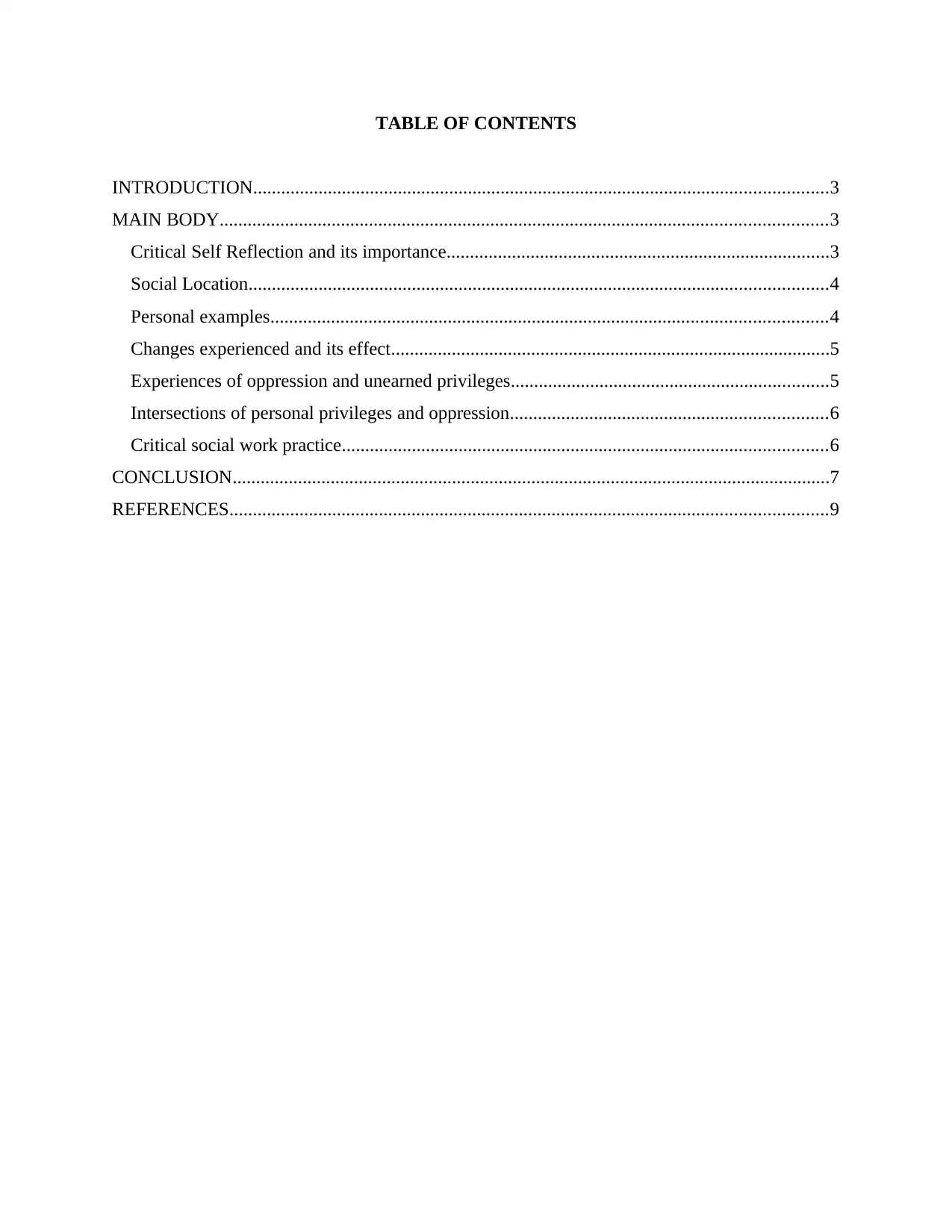
TABLE OF CONTENTS
INTRODUCTION...........................................................................................................................3
MAIN BODY..................................................................................................................................3
Critical Self Reflection and its importance..................................................................................3
Social Location............................................................................................................................4
Personal examples.......................................................................................................................4
Changes experienced and its effect..............................................................................................5
Experiences of oppression and unearned privileges....................................................................5
Intersections of personal privileges and oppression....................................................................6
Critical social work practice........................................................................................................6
CONCLUSION................................................................................................................................7
REFERENCES................................................................................................................................9
INTRODUCTION...........................................................................................................................3
MAIN BODY..................................................................................................................................3
Critical Self Reflection and its importance..................................................................................3
Social Location............................................................................................................................4
Personal examples.......................................................................................................................4
Changes experienced and its effect..............................................................................................5
Experiences of oppression and unearned privileges....................................................................5
Intersections of personal privileges and oppression....................................................................6
Critical social work practice........................................................................................................6
CONCLUSION................................................................................................................................7
REFERENCES................................................................................................................................9
INTRODUCTION
The activity of critical reflection can be mainly illustrated as the activity of critically
reviewing the actions that an individual has taken in the past and the consequences or the results
that were experienced (Fook, 2007). The current essay will highlight the importance of critical
reflection for their social workers and the social location will also be discussed. Further the
unearned privileges as well experiences of oppression will also be presented by proper
justification based on personal examples. Further the impact that social work practice has on the
individual and their practices will be highlighted and lastly the approach adopted to overcome
such biases will also be represented in the report.
MAIN BODY
Critical Self Reflection and its importance
Critical self reflection is basically indicated by the ability to evaluate the actions that have
been undertaken and the results that have been obtained accordingly. The actions that an
individual undertakes always have a deeper significance and meaning and this is basically
indicated by the critical self reflection where an individual analyses both the positive attributes as
well as negative attributes that have been associated with the entire experience as well as the
actions that were taken by the individual (Heron, 2005). The activity of self reflection is not
entirely easy to implement and it often takes deep insight into oneself and the kind of personality
that an individual has so that the critical reflection activity can be carried out and implemented
accordingly. It is also essential to note that the in the social work altogether as well, the activity
of self reflection is of key importance where the emphasis lies on the need to reflect critically
and the continuous learning as well as development is also encouraged through this perspective
of critical self reflection.
For the social workers, I can adequately state that critical self reflection is an important
tool and helps in emphasising their self learning and are a part of continuous learning and
development. The self reflection helps the professionals working as social workers in identifying
what are the good practices that have been implemented by them and what are the poor or bad
practices. Based on the reflection on the past actions and the results that were obtained, the social
workers can develop a broader framework or tools that can acts as a standard or benchmark for
further treatments and cures (Fook, 2016). The activity of self reflection also helps the social
workers in critically analysing themselves and this can prove to be extremely beneficial in case
3
The activity of critical reflection can be mainly illustrated as the activity of critically
reviewing the actions that an individual has taken in the past and the consequences or the results
that were experienced (Fook, 2007). The current essay will highlight the importance of critical
reflection for their social workers and the social location will also be discussed. Further the
unearned privileges as well experiences of oppression will also be presented by proper
justification based on personal examples. Further the impact that social work practice has on the
individual and their practices will be highlighted and lastly the approach adopted to overcome
such biases will also be represented in the report.
MAIN BODY
Critical Self Reflection and its importance
Critical self reflection is basically indicated by the ability to evaluate the actions that have
been undertaken and the results that have been obtained accordingly. The actions that an
individual undertakes always have a deeper significance and meaning and this is basically
indicated by the critical self reflection where an individual analyses both the positive attributes as
well as negative attributes that have been associated with the entire experience as well as the
actions that were taken by the individual (Heron, 2005). The activity of self reflection is not
entirely easy to implement and it often takes deep insight into oneself and the kind of personality
that an individual has so that the critical reflection activity can be carried out and implemented
accordingly. It is also essential to note that the in the social work altogether as well, the activity
of self reflection is of key importance where the emphasis lies on the need to reflect critically
and the continuous learning as well as development is also encouraged through this perspective
of critical self reflection.
For the social workers, I can adequately state that critical self reflection is an important
tool and helps in emphasising their self learning and are a part of continuous learning and
development. The self reflection helps the professionals working as social workers in identifying
what are the good practices that have been implemented by them and what are the poor or bad
practices. Based on the reflection on the past actions and the results that were obtained, the social
workers can develop a broader framework or tools that can acts as a standard or benchmark for
further treatments and cures (Fook, 2016). The activity of self reflection also helps the social
workers in critically analysing themselves and this can prove to be extremely beneficial in case
3
⊘ This is a preview!⊘
Do you want full access?
Subscribe today to unlock all pages.

Trusted by 1+ million students worldwide
of a situation of crisis or if any problematic situation arises in the organisation i.e. when they are
dealing with any individual or patient (Westfield, 2016). Based on the actions that were taken
and the reflection that was conducted, the social worker can effectively help in analysing that
what are the future course of actions or steps that they must take in order to exercise deliberate
care and caution as it is required from them.
Lastly, I can also state that the activity of critical self reflection amongst the social worker
helps in the ultimate improvement of the kind of care practices that they adopt and the
professionalism as well as skills that they implement and exercise in order to ultimately improve
the overall productivity and professionalism amongst the employees i.e. social workers in the
present context.
Social Location
Social location, as illustrated by Lundy (2004), is basically the combination of a variety of
factors that determine the overall social status and positioning of an individual such as their
gender, social class, nationality, race, sexual orientation etc. (Lundy, 2004). I can evidently say
that I am a female with the ethnicity or origin country as Nepalese and the culture that I follow is
Nepalese despite living in Australia. I am a Hindu in terms of religion and I belong to middle
class in the social status. I would also like to state that my sexual orientation is heterosexual and
I am an able bodied individual fully capable of self care. I cannot quote my exact age for the
privacy reasons but the age bracket to which I belong ranges between the 25 to 30 year groups. I
can further illustrate that my geo- political location within Australia is based in the Northern
Territory, Australia and therefore do not belong to the community of aboriginal Australians or
people of Torres Islanders.
Personal examples
I can evidently state that I am a strict believer of God and I also believe that doing good
and serving other individuals will always bring good back to me i.e. I believe in Karma. The
religion that I follow i.e. Hinduism also teaches the working of karma where we all believe that
good can come to you only when you act out of goodness and kindness. This is the reason
mainly behind the fact that various family members in my life have been involved in hospital and
healthcare services where they believe that to serve humanity is to live the life with the ulterior
motive.
4
dealing with any individual or patient (Westfield, 2016). Based on the actions that were taken
and the reflection that was conducted, the social worker can effectively help in analysing that
what are the future course of actions or steps that they must take in order to exercise deliberate
care and caution as it is required from them.
Lastly, I can also state that the activity of critical self reflection amongst the social worker
helps in the ultimate improvement of the kind of care practices that they adopt and the
professionalism as well as skills that they implement and exercise in order to ultimately improve
the overall productivity and professionalism amongst the employees i.e. social workers in the
present context.
Social Location
Social location, as illustrated by Lundy (2004), is basically the combination of a variety of
factors that determine the overall social status and positioning of an individual such as their
gender, social class, nationality, race, sexual orientation etc. (Lundy, 2004). I can evidently say
that I am a female with the ethnicity or origin country as Nepalese and the culture that I follow is
Nepalese despite living in Australia. I am a Hindu in terms of religion and I belong to middle
class in the social status. I would also like to state that my sexual orientation is heterosexual and
I am an able bodied individual fully capable of self care. I cannot quote my exact age for the
privacy reasons but the age bracket to which I belong ranges between the 25 to 30 year groups. I
can further illustrate that my geo- political location within Australia is based in the Northern
Territory, Australia and therefore do not belong to the community of aboriginal Australians or
people of Torres Islanders.
Personal examples
I can evidently state that I am a strict believer of God and I also believe that doing good
and serving other individuals will always bring good back to me i.e. I believe in Karma. The
religion that I follow i.e. Hinduism also teaches the working of karma where we all believe that
good can come to you only when you act out of goodness and kindness. This is the reason
mainly behind the fact that various family members in my life have been involved in hospital and
healthcare services where they believe that to serve humanity is to live the life with the ulterior
motive.
4
Paraphrase This Document
Need a fresh take? Get an instant paraphrase of this document with our AI Paraphraser
Changes experienced and its effect
When I shifted to Australia in order to study and work, the cultural differences that I
experienced were significant. There were a variety of changes that affected not just my lifestyle
but my mental state, emotional state etc.
The major changes that occurred were regarding the self perception, my social interaction
abilities, my personality changes and the outlook that I had towards the life earlier (Thompson,
2018). When I began living in Australia, I identified that there were many things which I
perceived in a different manner and which others here locally thought differently about. For
instance back in Nepal we have food four times in a single day but in Australia, there is no such
fixed timing and number of meals. Additionally, I was shocked at how limited the knowledge
people have here regarding our country and the type of people we are or the progress that it had
made. Initially due to lack of proper social circle I became introvert to an extent despite having
extrovert personality where I love to talk and communicate. However, this was soon resolved
after I made friends and then again I was able to retain my original thought and process.
Experiences of oppression and unearned privileges
The society and a significant part of the world is structured unequally with relational
divisions on the basis of gender, caste, religion, ethnicity, social class, physical abilities and
many more. The privileged people remain unaccountable and not responsible for the
continuation and maintenance of the various forms of inequality (Pease, 2013). Many instances
from my life reflect upon my unearned privileges and discrimination in the society. One such
instance can be the times I have been offered only unpaid internships, more that Australian
counterparts. Another instance is the issue of pay gap, when I used to get paid less than my male
counterparts for a similar errand. I belong to a middle-class family so I have completed my high
school graduation from a public school, as the private school are still reserved for the elite
groups. There is no place of worship for my religion- that is a Hindu temple, in my residential
community. Moreover, some norms of inequality in the Australian society have become normal
that they don’t bother the majority of people. These inequalities that people like me face is
directly related to the stereotypes, group attitudes and personal prejudices. There is an increased
invisibility of privilege that is not recognised by ones who get it. Challenging oppression of any
form is the only guide to an anti-privilege and anti-oppressive society at individual, structural
5
When I shifted to Australia in order to study and work, the cultural differences that I
experienced were significant. There were a variety of changes that affected not just my lifestyle
but my mental state, emotional state etc.
The major changes that occurred were regarding the self perception, my social interaction
abilities, my personality changes and the outlook that I had towards the life earlier (Thompson,
2018). When I began living in Australia, I identified that there were many things which I
perceived in a different manner and which others here locally thought differently about. For
instance back in Nepal we have food four times in a single day but in Australia, there is no such
fixed timing and number of meals. Additionally, I was shocked at how limited the knowledge
people have here regarding our country and the type of people we are or the progress that it had
made. Initially due to lack of proper social circle I became introvert to an extent despite having
extrovert personality where I love to talk and communicate. However, this was soon resolved
after I made friends and then again I was able to retain my original thought and process.
Experiences of oppression and unearned privileges
The society and a significant part of the world is structured unequally with relational
divisions on the basis of gender, caste, religion, ethnicity, social class, physical abilities and
many more. The privileged people remain unaccountable and not responsible for the
continuation and maintenance of the various forms of inequality (Pease, 2013). Many instances
from my life reflect upon my unearned privileges and discrimination in the society. One such
instance can be the times I have been offered only unpaid internships, more that Australian
counterparts. Another instance is the issue of pay gap, when I used to get paid less than my male
counterparts for a similar errand. I belong to a middle-class family so I have completed my high
school graduation from a public school, as the private school are still reserved for the elite
groups. There is no place of worship for my religion- that is a Hindu temple, in my residential
community. Moreover, some norms of inequality in the Australian society have become normal
that they don’t bother the majority of people. These inequalities that people like me face is
directly related to the stereotypes, group attitudes and personal prejudices. There is an increased
invisibility of privilege that is not recognised by ones who get it. Challenging oppression of any
form is the only guide to an anti-privilege and anti-oppressive society at individual, structural
5
and cultural levels. Social work should adopt to assist the oppressed people and disregard the
norms of privilege and oppression (Mullaly and West, 2018).
Intersections of personal privileges and oppression
Intersectionality helps in the understanding of how certain aspects; social and political
identities together overlap to form various modes of discrimination and privileges. I can use this
tool for critical reflection of the situations I face with factors like gender, social class, religion,
geo political location, ethnicity etc. and how these are complex and have risks of being
undetected and neutralized (Mattsson, 2014). Many generalised social movements like feminism
don’t address the complete narrative of other factors like belonging to a religious minority along
with a victim of patriarchy which overlap resulting in different issues. I being a female and well
as from different ethnicity and religion face issues in different ways than other Australian
women. In order to integrate the issues, all perspectives from all differences have to be taken into
consideration rather than a generalised or simplified definition of a movement. There are
differences in oppression and lack of awareness. I belong to the northern territory in Australia
where white Australians seem to be treated with more respect than the indigenous people who
are brought down to stereotypes and face lack of opportunities like transportation, infrastructure,
medical facilities. I on the other hand face issues like discrimination on the base of my skin
colour or religion but enjoy all infrastructure and facilities equally (Collins & Bilge, 2020).
Critical social work practice
The above factors tend to affect my critical social work practice in many ways as humans
we all have empathy towards people who go through similar issues like we do. I have faced
certain level of disrespect and discrimination of various occasions which were not implied
directly but always existed in the society, language, behaviour and body language of people.
Social work practice deals with these social work problems which are mostly multidimensional,
complex and difficult to assess. To tackle these problems, along with thinking creatively and
eclectically, one has to think in terms of social, structural, therapeutic and psychological
perspective for social work (Lundy, 2004). These problems can be address when social workers
represent own experiences with different groups. I tend to work with a diverse group of people
and although I tackle every issue sensitively, still few hurdles like biasness are ingrained in our
6
norms of privilege and oppression (Mullaly and West, 2018).
Intersections of personal privileges and oppression
Intersectionality helps in the understanding of how certain aspects; social and political
identities together overlap to form various modes of discrimination and privileges. I can use this
tool for critical reflection of the situations I face with factors like gender, social class, religion,
geo political location, ethnicity etc. and how these are complex and have risks of being
undetected and neutralized (Mattsson, 2014). Many generalised social movements like feminism
don’t address the complete narrative of other factors like belonging to a religious minority along
with a victim of patriarchy which overlap resulting in different issues. I being a female and well
as from different ethnicity and religion face issues in different ways than other Australian
women. In order to integrate the issues, all perspectives from all differences have to be taken into
consideration rather than a generalised or simplified definition of a movement. There are
differences in oppression and lack of awareness. I belong to the northern territory in Australia
where white Australians seem to be treated with more respect than the indigenous people who
are brought down to stereotypes and face lack of opportunities like transportation, infrastructure,
medical facilities. I on the other hand face issues like discrimination on the base of my skin
colour or religion but enjoy all infrastructure and facilities equally (Collins & Bilge, 2020).
Critical social work practice
The above factors tend to affect my critical social work practice in many ways as humans
we all have empathy towards people who go through similar issues like we do. I have faced
certain level of disrespect and discrimination of various occasions which were not implied
directly but always existed in the society, language, behaviour and body language of people.
Social work practice deals with these social work problems which are mostly multidimensional,
complex and difficult to assess. To tackle these problems, along with thinking creatively and
eclectically, one has to think in terms of social, structural, therapeutic and psychological
perspective for social work (Lundy, 2004). These problems can be address when social workers
represent own experiences with different groups. I tend to work with a diverse group of people
and although I tackle every issue sensitively, still few hurdles like biasness are ingrained in our
6
⊘ This is a preview!⊘
Do you want full access?
Subscribe today to unlock all pages.
Trusted by 1+ million students worldwide
minds. I am vey empathetic towards the females who face patriarchal issues, homosexual people
who face discrimination and are boycotted from the society, ethnical minorities like immigrants,
indigenous Australians, people of colour who are frequently denied opportunities and face
oppression in different contexts. I might be neutral to the issues of women from affluent groups
face in terms of patriarchy and minor problems which are not being emphasized due to my
reservations (Heron, 2005). I also might have biases for people who ask for privileges in spite of
being from affluent backgrounds. These include people and having unearned advantages like
people from a developed country of western culture and homosexual men from elite groups
whose social problems are less severe than a homosexual black woman from a religious minority
and poor background. In order to overcome my biasness to become non-judgemental in nature
for doing my social work, I need to focus on the removal of certain myths that underpin
subordination and oppression. These include myth of scarcity, myth of objective information,
myth of might is right, casual stereotyping, blaming the victim, hierarchy, competition,
separation, myth of class and myth of supremacy. In order to mediate the differences between
personal privilege and oppression and those from diverse background, I have to look at people as
individuals rather than basing them on the stereotypes and spend time with them on a relatively
personal level. For navigating myself in different work contexts I can use the perspectives of
identity, work, social identity, role and narrative (Fook, 2016). For reducing reflexive actions or
reactions, I should take time to replace my biases with positive instances and examples of the
stereotyped group. Adjusting the perspective by putting myself in similar position and settings is
another way to use empathy to overcome the barriers. Other ways are increasing the exposure by
spending more time with diverse people from different ethnicities and racial backgrounds,
increasing the knowledge about the historical aspects, learning about their culture through
exhibits, community events etc (Smith & et.al 2018).
CONCLUSION
The above essay a critical reflection regarding my social location, oppression and
privilege were analysed. The benefits of critical self-reflection and its importance for social
workers were described. My social location was described as a middle class, female, Nepalese,
Hindu, heterosexual, able-bodied, age group 25-30 (millennial) and geo political location being
northern Territory, Australia. The intersections of unearned privileges were described by certain
7
who face discrimination and are boycotted from the society, ethnical minorities like immigrants,
indigenous Australians, people of colour who are frequently denied opportunities and face
oppression in different contexts. I might be neutral to the issues of women from affluent groups
face in terms of patriarchy and minor problems which are not being emphasized due to my
reservations (Heron, 2005). I also might have biases for people who ask for privileges in spite of
being from affluent backgrounds. These include people and having unearned advantages like
people from a developed country of western culture and homosexual men from elite groups
whose social problems are less severe than a homosexual black woman from a religious minority
and poor background. In order to overcome my biasness to become non-judgemental in nature
for doing my social work, I need to focus on the removal of certain myths that underpin
subordination and oppression. These include myth of scarcity, myth of objective information,
myth of might is right, casual stereotyping, blaming the victim, hierarchy, competition,
separation, myth of class and myth of supremacy. In order to mediate the differences between
personal privilege and oppression and those from diverse background, I have to look at people as
individuals rather than basing them on the stereotypes and spend time with them on a relatively
personal level. For navigating myself in different work contexts I can use the perspectives of
identity, work, social identity, role and narrative (Fook, 2016). For reducing reflexive actions or
reactions, I should take time to replace my biases with positive instances and examples of the
stereotyped group. Adjusting the perspective by putting myself in similar position and settings is
another way to use empathy to overcome the barriers. Other ways are increasing the exposure by
spending more time with diverse people from different ethnicities and racial backgrounds,
increasing the knowledge about the historical aspects, learning about their culture through
exhibits, community events etc (Smith & et.al 2018).
CONCLUSION
The above essay a critical reflection regarding my social location, oppression and
privilege were analysed. The benefits of critical self-reflection and its importance for social
workers were described. My social location was described as a middle class, female, Nepalese,
Hindu, heterosexual, able-bodied, age group 25-30 (millennial) and geo political location being
northern Territory, Australia. The intersections of unearned privileges were described by certain
7
Paraphrase This Document
Need a fresh take? Get an instant paraphrase of this document with our AI Paraphraser
examples from personal experiences like issues of ethnical discrimination, patriarchy etc.
Challenging oppression of any form leads to anti-privilege and anti-oppressive society at
individual, structural and cultural levels. The issues with intersectional inequalities were
described from personal perspective and its impact of my critical social work was analysed.
Apart from that ways to navigate myself to become more non-judgemental and overcome my
biases were illustrated.
8
Challenging oppression of any form leads to anti-privilege and anti-oppressive society at
individual, structural and cultural levels. The issues with intersectional inequalities were
described from personal perspective and its impact of my critical social work was analysed.
Apart from that ways to navigate myself to become more non-judgemental and overcome my
biases were illustrated.
8
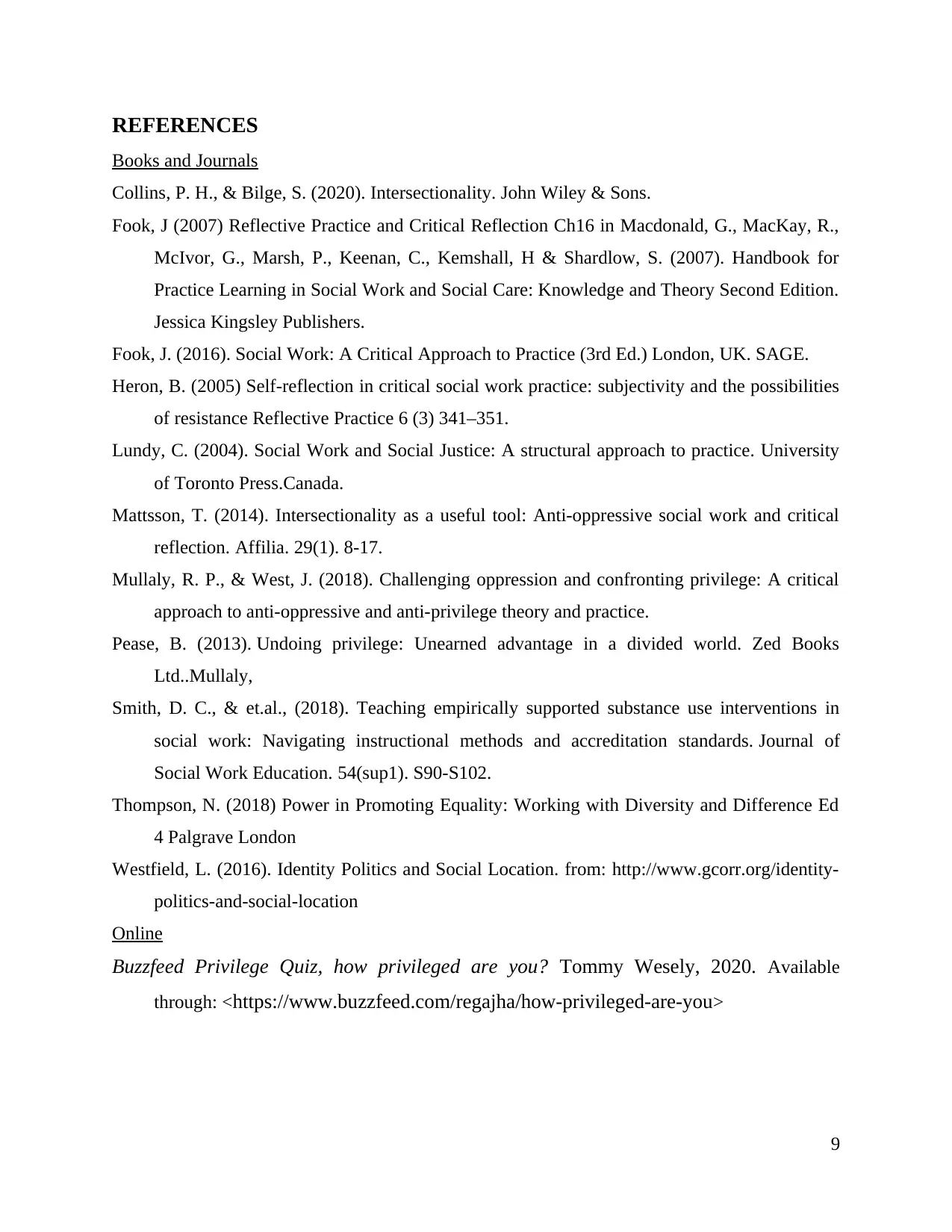
REFERENCES
Books and Journals
Collins, P. H., & Bilge, S. (2020). Intersectionality. John Wiley & Sons.
Fook, J (2007) Reflective Practice and Critical Reflection Ch16 in Macdonald, G., MacKay, R.,
McIvor, G., Marsh, P., Keenan, C., Kemshall, H & Shardlow, S. (2007). Handbook for
Practice Learning in Social Work and Social Care: Knowledge and Theory Second Edition.
Jessica Kingsley Publishers.
Fook, J. (2016). Social Work: A Critical Approach to Practice (3rd Ed.) London, UK. SAGE.
Heron, B. (2005) Self-reflection in critical social work practice: subjectivity and the possibilities
of resistance Reflective Practice 6 (3) 341–351.
Lundy, C. (2004). Social Work and Social Justice: A structural approach to practice. University
of Toronto Press.Canada.
Mattsson, T. (2014). Intersectionality as a useful tool: Anti-oppressive social work and critical
reflection. Affilia. 29(1). 8-17.
Mullaly, R. P., & West, J. (2018). Challenging oppression and confronting privilege: A critical
approach to anti-oppressive and anti-privilege theory and practice.
Pease, B. (2013). Undoing privilege: Unearned advantage in a divided world. Zed Books
Ltd..Mullaly,
Smith, D. C., & et.al., (2018). Teaching empirically supported substance use interventions in
social work: Navigating instructional methods and accreditation standards. Journal of
Social Work Education. 54(sup1). S90-S102.
Thompson, N. (2018) Power in Promoting Equality: Working with Diversity and Difference Ed
4 Palgrave London
Westfield, L. (2016). Identity Politics and Social Location. from: http://www.gcorr.org/identity-
politics-and-social-location
Online
Buzzfeed Privilege Quiz, how privileged are you? Tommy Wesely, 2020. Available
through: <https://www.buzzfeed.com/regajha/how-privileged-are-you>
9
Books and Journals
Collins, P. H., & Bilge, S. (2020). Intersectionality. John Wiley & Sons.
Fook, J (2007) Reflective Practice and Critical Reflection Ch16 in Macdonald, G., MacKay, R.,
McIvor, G., Marsh, P., Keenan, C., Kemshall, H & Shardlow, S. (2007). Handbook for
Practice Learning in Social Work and Social Care: Knowledge and Theory Second Edition.
Jessica Kingsley Publishers.
Fook, J. (2016). Social Work: A Critical Approach to Practice (3rd Ed.) London, UK. SAGE.
Heron, B. (2005) Self-reflection in critical social work practice: subjectivity and the possibilities
of resistance Reflective Practice 6 (3) 341–351.
Lundy, C. (2004). Social Work and Social Justice: A structural approach to practice. University
of Toronto Press.Canada.
Mattsson, T. (2014). Intersectionality as a useful tool: Anti-oppressive social work and critical
reflection. Affilia. 29(1). 8-17.
Mullaly, R. P., & West, J. (2018). Challenging oppression and confronting privilege: A critical
approach to anti-oppressive and anti-privilege theory and practice.
Pease, B. (2013). Undoing privilege: Unearned advantage in a divided world. Zed Books
Ltd..Mullaly,
Smith, D. C., & et.al., (2018). Teaching empirically supported substance use interventions in
social work: Navigating instructional methods and accreditation standards. Journal of
Social Work Education. 54(sup1). S90-S102.
Thompson, N. (2018) Power in Promoting Equality: Working with Diversity and Difference Ed
4 Palgrave London
Westfield, L. (2016). Identity Politics and Social Location. from: http://www.gcorr.org/identity-
politics-and-social-location
Online
Buzzfeed Privilege Quiz, how privileged are you? Tommy Wesely, 2020. Available
through: <https://www.buzzfeed.com/regajha/how-privileged-are-you>
9
⊘ This is a preview!⊘
Do you want full access?
Subscribe today to unlock all pages.
Trusted by 1+ million students worldwide

10

1 out of 10


Related Documents


Your All-in-One AI-Powered Toolkit for Academic Success.
+13062052269
info@desklib.com
Available 24*7 on WhatsApp / Email
![[object Object]](/_next/static/media/star-bottom.7253800d.svg)
Unlock your academic potential
Copyright © 2020–2026 A2Z Services. All Rights Reserved. Developed and managed by ZUCOL.