Cross Training's Role in Employee Retention: A Literature Review

Verified

Added on  2022/09/12

|5
|1363
|19
Report
AI Summary
This report, focusing on cross-training and its impact on employee retention, begins by posing research questions about the nature of cross-training and its influence on employee retention based on human capital theory. The research objective centers on understanding cross-training's role in retaining employees. The literature review synthesizes various scholarly sources, including Nemeth (2017), Ninan et al. (2019), and Salem & Abdien (2017), to define cross-training and its benefits such as enhanced problem-solving, employee motivation, and knowledge sharing. It highlights human capital theory, emphasizing training's role in building employee skills and morale, as suggested by Hayek (2016). The review underscores cross-training's relevance in the hospitality sector, as noted by Hirsh (2017), and its ability to reduce turnover and increase productivity, as discussed by Jaworski (2018). The review also highlights the importance of cross-training in boosting morale, fostering teamwork and improving overall competency, as described by Hage (2017), Ashurst (2019) and Maphisa et al. (2017).

Document Page
Running Head: CROSS TRAINING 0
CROSS TRAINING 0
Business research
tabler-icon-diamond-filled.svg

Paraphrase This Document

Need a fresh take? Get an instant paraphrase of this document with our AI Paraphraser
Document Page
Assessment 1
Research questions
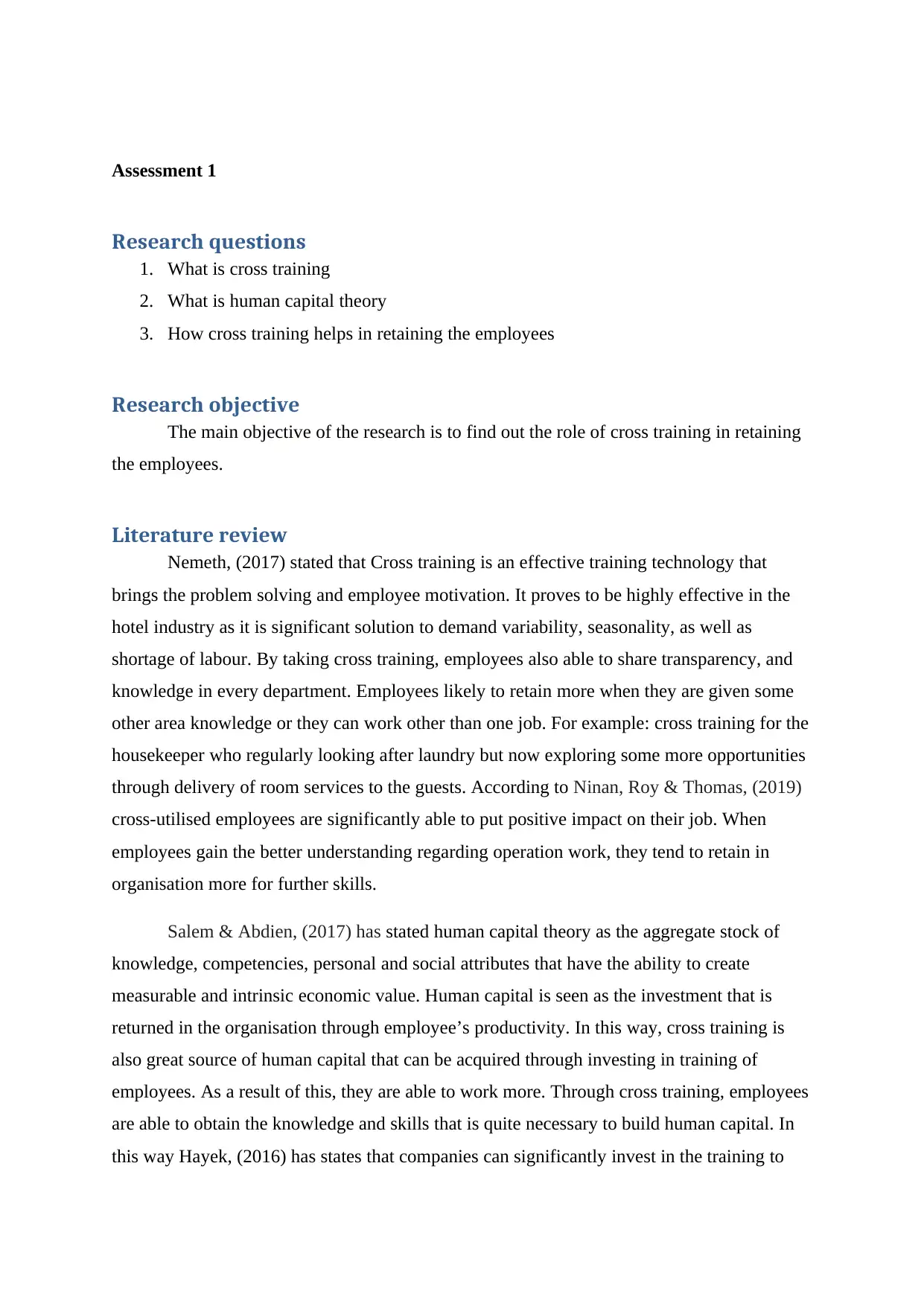
1. What is cross training
2. What is human capital theory
3. How cross training helps in retaining the employees
Research objective
The main objective of the research is to find out the role of cross training in retaining
the employees.
Literature review
Nemeth, (2017) stated that Cross training is an effective training technology that
brings the problem solving and employee motivation. It proves to be highly effective in the
hotel industry as it is significant solution to demand variability, seasonality, as well as
shortage of labour. By taking cross training, employees also able to share transparency, and
knowledge in every department. Employees likely to retain more when they are given some
other area knowledge or they can work other than one job. For example: cross training for the
housekeeper who regularly looking after laundry but now exploring some more opportunities
through delivery of room services to the guests. According to Ninan, Roy & Thomas, (2019)
cross-utilised employees are significantly able to put positive impact on their job. When
employees gain the better understanding regarding operation work, they tend to retain in
organisation more for further skills.
Salem & Abdien, (2017) has stated human capital theory as the aggregate stock of
knowledge, competencies, personal and social attributes that have the ability to create
measurable and intrinsic economic value. Human capital is seen as the investment that is
returned in the organisation through employee’s productivity. In this way, cross training is
also great source of human capital that can be acquired through investing in training of
employees. As a result of this, they are able to work more. Through cross training, employees
are able to obtain the knowledge and skills that is quite necessary to build human capital. In
this way Hayek, (2016) has states that companies can significantly invest in the training to
Document Page
improve employees morale and retention. The human resource can be transfer as a greater
value to the organisation if equipped with right amount of training. it is obvious that chances
of employee retention increases when they are given the chance to work in different fields.
According to Hirsh, (2017) hospitality industry is labour intensive industry whose
competitive advantage and survival depends on the good quality personal who can operate,
deliver as well as manage the organisation. Therefore, cross training in this case is seen as the
learning opportunity whose main goal is to reduce the employee turnover, employee
motivation and increase the productivity. In this regard, Jaworski, (2018) highlighted that
with the help cross training, employees can apply for different job openings than becoming
expert in only one department. Cross training also provides the opportunity to show their
skills what they have attained. Employees like to retain the organisation when they are happy
and are motivated at workplace. Through the cross training program, employees will be
trained in several areas and they feel motivated when they gain the knowledge of more than
one area. Not only this Hage, (2017) included that, cross training leads to better competency
overall. It is true that a housekeeping supervisor who was trained in different departments
including guest service, room service, and hotel restaurant will improve her or his vision. Not
only is this, cross training found to be the great source of retention and engagement strategy.
It is because cross training employees tend to gain those skills that they are required to
perform outside of the usual roles. Furthermore, it develops employees by making them more
prominent. Cross training is also seen as the source of morale booster that directly ties with
the retention of employees in the hotel. When employees know that the organisation will
provide them cross training and it will definitely help in progressing better toward the future.
In such a situation, they remain in the organisation for long time.
Ashurst, (2019) said that employees will definitely look for getting some benefits
when he or she is entering in organisation. Training not only assist them but also helps in
identifying their capabilities and polish them for handling the responsibilities in better way.
According to him-win-win situation is seen when employees are sent to different sections of
the similar department for getting better understanding of those areas. Not only has this, cross
training also allowed the employees to go to other properties for learning different cultures.
This helps in keeping the higher level of motivation among employees and attracts highly
motivated employees as well as retaining the staff for long. As compare to this, Maphisa,
Zwane & Nyide, (2017) stated that employees likely to retain in the organisation when they
are able to build positive relationships with their colleagues. In this regard, cross training
Document Page
provides employees the capability to function properly in the team environment. This tends to
expand the employees skills and knowledge to perform different tasks. As a result, it
improves quality, productivity, and customer satisfaction. It also defines performance as the
achievement of any specific task. Training is found to be the most significant variable that
assist in improving the productivity. Cross training helps in performing effectively at the
team environment. Hotel industries can allow the employees to perform on-the-job training
where it allows the new employees to perform and learn different skill. A positive
environment can be built at the time of cross training which will ensure the happiness and
motivation of employees. Employees also likely to retain in the organisation when they are
given some non-monetary benefits. In this way, it can be stated that cross training helps in
improving the performance of employees.
tabler-icon-diamond-filled.svg

Paraphrase This Document

Need a fresh take? Get an instant paraphrase of this document with our AI Paraphraser
Document Page
References
Ashurst, A. (2019). Improving staff retention with learning opportunities. Nursing And
Residential Care, 21(2), 115-117.
Hage, J. (2017). Human Capital. The Wiley
Blackwell Encyclopedia of Social Theory, 1-2.
Hayek, M., Thomas, C. H., Novicevic, M. M., & Montalvo, D. (2016). Contextualizing
human capital theory in a non-Western setting: Testing the pay-for-performance
assumption. Journal of Business Research, 69(2), 928-935.
Hirsh, B. (2017). Evaluating Staff Roles and Retention'. The Emerald Handbook of Modern
Information Management. Emerald Publishing Limited, 653-671.
Jaworski, C., Ravichandran, S., Karpinski, A. C., & Singh, S. (2018). The effects of training
satisfaction, employee benefits, and incentives on part-time employees’
commitment. International Journal of Hospitality Management, 74, 1-12.
Maphisa, S. B., Zwane, B. K., & Nyide, C. J. (2017). Succession planning and staff retention
challenges: an industrial outlook and major risks. Risk governance & control:
financial markets & institutions, 7(3).
Nemeth, J. (2017). Human capital theory in the framework of organization theory. Strategic
Management, 22(3), 29-35.
Ninan, N., Roy, J. C., & Thomas, M. R. (2019). Benefits of Cross-Training: Scale
Development and Validity. Prabandhan: Indian Journal of Management, 12(6), 41-
56.
Salem, I. E. B., & Abdien, M. K. (2017). Implementation of employee cross-training during
perilous conditions in hotels. Tourism Management Perspectives, 23, 68-74.
chevron_up_icon
1 out of 5
circle_padding
hide_on_mobile
zoom_out_icon
[object Object]