Project Report: Techniques to Improve Crystallization Equipment

Verified

Added on  2023/06/15

|6
|583
|347
Report
AI Summary
This report details methods to improve crystallization equipment for better crystal formation. It discusses slow cooling techniques using a Dewar flask and water bath setup, emphasizing controlled solvent evaporation. The report also covers reactant diffusion procedures, where solutions are allowed to diffuse and react, forming crystals. Specific steps for each method are outlined, providing a comprehensive overview of equipment enhancement for optimized crystallization processes. The document includes diagrams and references to support the explained methodologies.
Document Page
1
PROJECT DESIGN
Name of Student
Institution Affiliation
tabler-icon-diamond-filled.svg

Paraphrase This Document

Need a fresh take? Get an instant paraphrase of this document with our AI Paraphraser
Document Page
2
How to improve the equipment to have a better crystallization.
Cooling
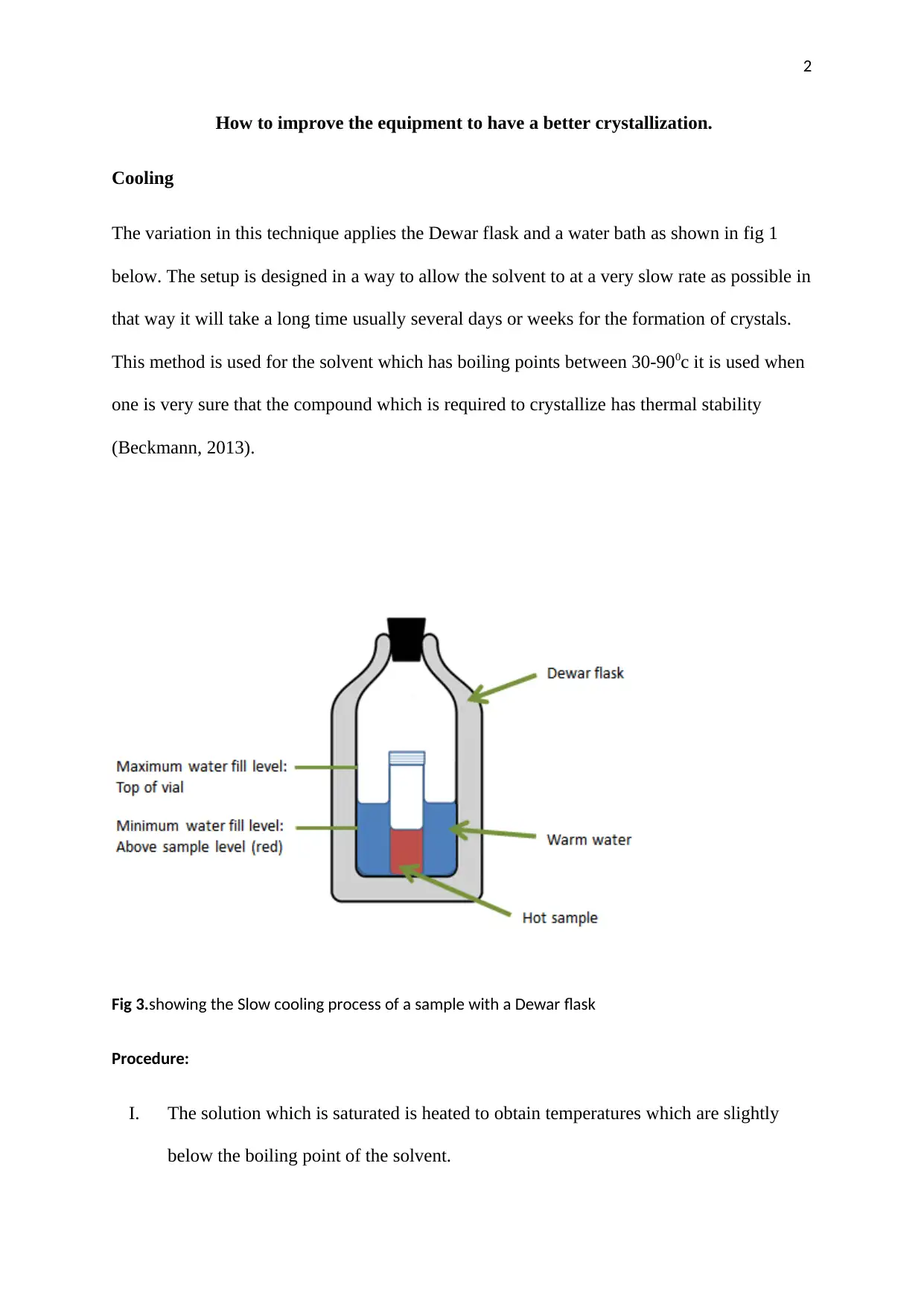
The variation in this technique applies the Dewar flask and a water bath as shown in fig 1
below. The setup is designed in a way to allow the solvent to at a very slow rate as possible in
that way it will take a long time usually several days or weeks for the formation of crystals.
This method is used for the solvent which has boiling points between 30-900c it is used when
one is very sure that the compound which is required to crystallize has thermal stability
(Beckmann, 2013).
Fig 3.showing the Slow cooling process of a sample with a Dewar flask
Procedure:
I. The solution which is saturated is heated to obtain temperatures which are slightly
below the boiling point of the solvent.
Document Page
3
II. The heated solvent is transferred into a tube with a stopper.
III. Water which is usually 2 to 3 degree Celsius cooler than the solvent is filled into the
Dewar flask containing the tube with the solvent.
IV. The level of water which is filled into the Dewar flask must be above the solvent and
below the stopper.
V. The Dewar flask which contains the tube is kept safely till the solvent cools to room
temperatures and the crystals form.
Slow Evaporation
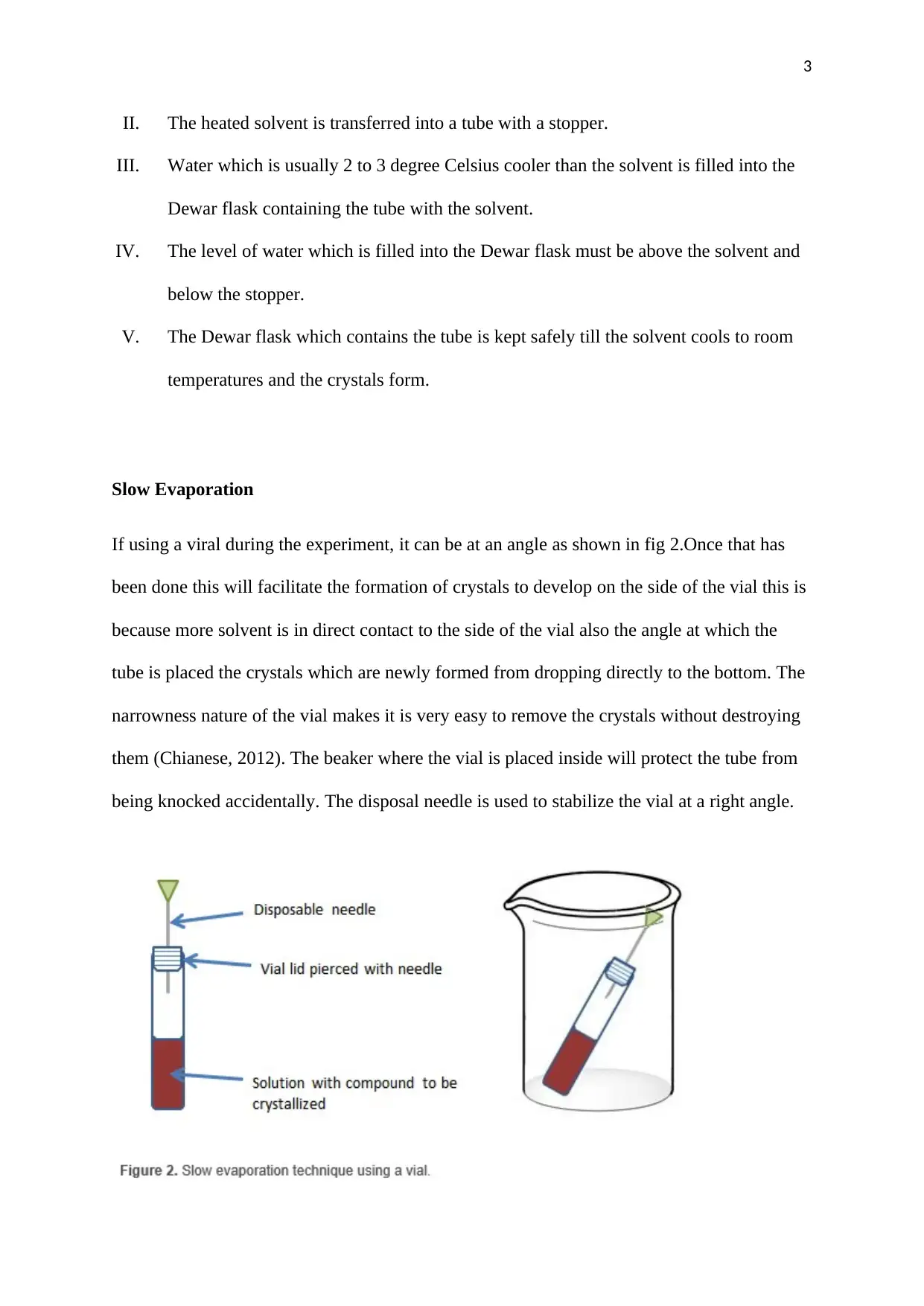
If using a viral during the experiment, it can be at an angle as shown in fig 2.Once that has
been done this will facilitate the formation of crystals to develop on the side of the vial this is
because more solvent is in direct contact to the side of the vial also the angle at which the
tube is placed the crystals which are newly formed from dropping directly to the bottom. The
narrowness nature of the vial makes it is very easy to remove the crystals without destroying
them (Chianese, 2012). The beaker where the vial is placed inside will protect the tube from
being knocked accidentally. The disposal needle is used to stabilize the vial at a right angle.
Document Page
4
Reactant Diffusion
Procedures:
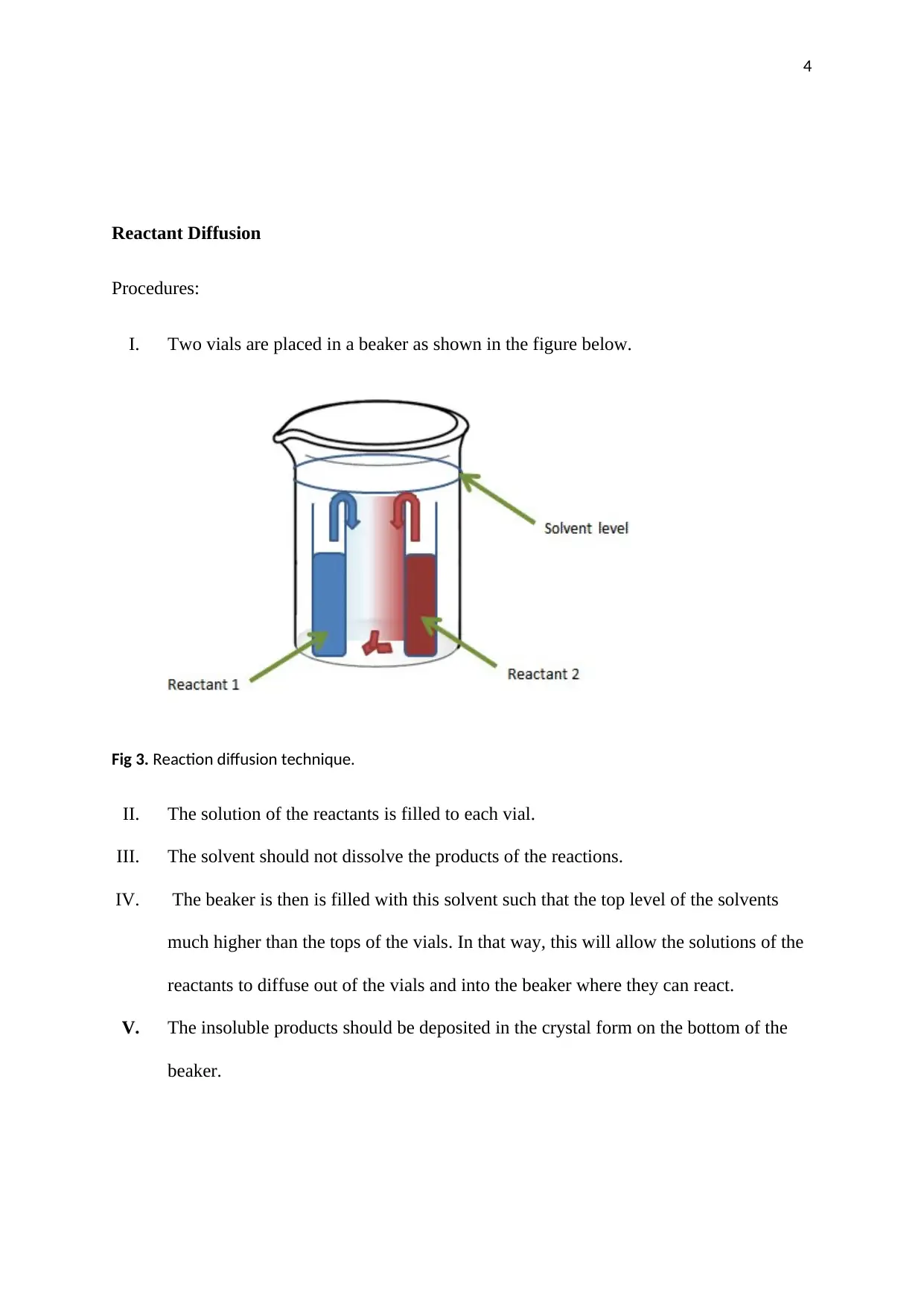
I. Two vials are placed in a beaker as shown in the figure below.
Fig 3. Reaction diffusion technique.
II. The solution of the reactants is filled to each vial.
III. The solvent should not dissolve the products of the reactions.
IV. The beaker is then is filled with this solvent such that the top level of the solvents
much higher than the tops of the vials. In that way, this will allow the solutions of the
reactants to diffuse out of the vials and into the beaker where they can react.
V. The insoluble products should be deposited in the crystal form on the bottom of the
beaker.
tabler-icon-diamond-filled.svg

Paraphrase This Document

Need a fresh take? Get an instant paraphrase of this document with our AI Paraphraser
Document Page
5
References;
Beckmann, W. (2013). Crystallization: Basic Concepts and Industrial Applications. London:
John Wiley & Sons.
Chianese, A. (2012). Industrial Crystallization Process Monitoring and Control. Texas: John
Wiley & Sons.
Jones, A. G. (2013). Crystallization Process Systems. Paris: Elsevier,.
Mullin, J. W. (2014). Crystallization. Chicago: Elsevier.
Document Page
6
chevron_up_icon
1 out of 6
circle_padding
hide_on_mobile
zoom_out_icon
[object Object]