ANTH 3007: Ecological Anthropology and the Impact of French Theory
VerifiedAdded on 2023/05/28
|9
|2327
|80
Essay
AI Summary
This essay provides a comprehensive analysis of ecological anthropology, defining it as the study of the relationships between social organization, population dynamics, human culture, and the environment. It explores how ecological anthropology aids in the contemporary interpretation of cultures by linking it to human evolution and enabling the examination of cultural beliefs and practices. The essay also delves into the significant impact of French theorists Michel Foucault and Pierre Bourdieu on anthropological theory, highlighting their contributions to understanding power dynamics, cultural capital, and the interplay between knowledge and power in shaping social structures. It concludes by emphasizing the lasting influence of these theorists on anthropological thought and the importance of ecological anthropology in interpreting cultural phenomena.
Running head: CULTURAL ANTHROPOLOGY 1
Cultural Anthropology
Name
Institution
Cultural Anthropology
Name
Institution

Paraphrase This Document
Need a fresh take? Get an instant paraphrase of this document with our AI Paraphraser
CULTURAL ANTHROPOLOGY 2
CULTURAL ANTHROPOLOGY
Introduction
This paper answers the questions that relate to cultural anthropology. It is a branch of
anthropology that deals with the study of beliefs, cultures, values, practices, technologies,
economies, as well as other domains of a cognitive and social organization. This paper contains
two set of questions. The first part offers a clear definition of ecological anthropology, and it also
states the application of ecological anthropology in the contemporary interpretation of cultures.
The second part deals with the French theorists who have a significant impact on anthropology
theory.
Definition of Ecological Anthropology
Ecological Anthropology is the study of relations among social organization, population
dynamic, the culture of humans as well as the environments in which the human population live
(Armstrong et.al, 2017). The process involves comparative research and analyses of a particular
population from both diachronic and synchronic perspective. It deals with cultural adaptations of
human to their environments. It also refers to the study of the role played by culture in the
interaction of humans with the ecosystem. Ecological anthropology studies the relationships
between humans’ population and their environments. The main focus of its research is to show
how cultural practices and beliefs assisted humans to acclimatize to their environment, and how
the general population used components of their culture to preserve their ecosystems. The notion
is that human being shapes the outward environment that they are living in; humans also shape
the culture of that same population (Szabó, 2015). The general population may fail to interact
with the whole environment; there are particular aspects of the space that it will live in as a
habitat. The example is that humans who practice hunting and gathering would differ from those
CULTURAL ANTHROPOLOGY
Introduction
This paper answers the questions that relate to cultural anthropology. It is a branch of
anthropology that deals with the study of beliefs, cultures, values, practices, technologies,
economies, as well as other domains of a cognitive and social organization. This paper contains
two set of questions. The first part offers a clear definition of ecological anthropology, and it also
states the application of ecological anthropology in the contemporary interpretation of cultures.
The second part deals with the French theorists who have a significant impact on anthropology
theory.
Definition of Ecological Anthropology
Ecological Anthropology is the study of relations among social organization, population
dynamic, the culture of humans as well as the environments in which the human population live
(Armstrong et.al, 2017). The process involves comparative research and analyses of a particular
population from both diachronic and synchronic perspective. It deals with cultural adaptations of
human to their environments. It also refers to the study of the role played by culture in the
interaction of humans with the ecosystem. Ecological anthropology studies the relationships
between humans’ population and their environments. The main focus of its research is to show
how cultural practices and beliefs assisted humans to acclimatize to their environment, and how
the general population used components of their culture to preserve their ecosystems. The notion
is that human being shapes the outward environment that they are living in; humans also shape
the culture of that same population (Szabó, 2015). The general population may fail to interact
with the whole environment; there are particular aspects of the space that it will live in as a
habitat. The example is that humans who practice hunting and gathering would differ from those
CULTURAL ANTHROPOLOGY 3
who practice farming as a form of their life. The hunter and gatherers would be nomadic, moving
from one place to another, developing modern technologies for hunting, as well as building
temporary homes. On the other hand, a farming population would depend on a rural area; their
land would be used for raising livestock and cultivating crops. The two groups of people would
establish suitable methods of survival depending on their environment.
How ecological anthropology help in contemporary interpretations of specific cultures
Ecological anthropology help in the contemporary interpretation of cultures in that it is
linked to the science of human evolution, therefore regarding ecology, it will involve everything
such as food web, different environment cycles, as well as how they influence each other. So if
you can understand them fully then the interpretation of culture will be more straightforward. It
also allows for sharing of beliefs and behavior of a particular ethnic, social, or age group. It will
then provide a materialist examination of human activities which are an essential aspect of
people cultures (Rademacher, Cadenasso & Pickett, 2018). Through ecology, there will be the
study of the interaction of humans and their surrounding environment. It will attempt to describe
differences and similarities in the culture of different people about the environment. Ecological
anthropology also allows for comparison of different cultures to find out factors that affect
similar cultural development. Because it deals with the study of customs, ideas, as well as social
behavior of society and a particular people, it helps in the provision of added information on
people culture (Bernstein et.al, 2018).
Ecological anthropology enables the examination of the role of cultural beliefs and
practices. Through this study, the interpretation of the Cultures would be made easier as it will
shows how humans adapt to their environments (Yamagiwa, 2010). It also studies the economic
activities of the people and religion belief thereby enabling the interpretation of cultures.
who practice farming as a form of their life. The hunter and gatherers would be nomadic, moving
from one place to another, developing modern technologies for hunting, as well as building
temporary homes. On the other hand, a farming population would depend on a rural area; their
land would be used for raising livestock and cultivating crops. The two groups of people would
establish suitable methods of survival depending on their environment.
How ecological anthropology help in contemporary interpretations of specific cultures
Ecological anthropology help in the contemporary interpretation of cultures in that it is
linked to the science of human evolution, therefore regarding ecology, it will involve everything
such as food web, different environment cycles, as well as how they influence each other. So if
you can understand them fully then the interpretation of culture will be more straightforward. It
also allows for sharing of beliefs and behavior of a particular ethnic, social, or age group. It will
then provide a materialist examination of human activities which are an essential aspect of
people cultures (Rademacher, Cadenasso & Pickett, 2018). Through ecology, there will be the
study of the interaction of humans and their surrounding environment. It will attempt to describe
differences and similarities in the culture of different people about the environment. Ecological
anthropology also allows for comparison of different cultures to find out factors that affect
similar cultural development. Because it deals with the study of customs, ideas, as well as social
behavior of society and a particular people, it helps in the provision of added information on
people culture (Bernstein et.al, 2018).
Ecological anthropology enables the examination of the role of cultural beliefs and
practices. Through this study, the interpretation of the Cultures would be made easier as it will
shows how humans adapt to their environments (Yamagiwa, 2010). It also studies the economic
activities of the people and religion belief thereby enabling the interpretation of cultures.
⊘ This is a preview!⊘
Do you want full access?
Subscribe today to unlock all pages.

Trusted by 1+ million students worldwide
CULTURAL ANTHROPOLOGY 4
Ecological anthropology also enables the analysis of different culture from this analysis there
will be a description of how people interact in the ecosystem. It also aids in the interpretation of
culture by elaborating the relationships between humans and their environments. It explains in
detail how humans used different aspects of culture to preserve their ecosystem (Dean, 2017).
Ecological approaches provide advance knowledge to Anthropologist. Through the use of
the anthropological knowledge, interpretation of culture becomes easier and very first.
Ecological anthropology also leads to the establishment of suitable model of humankind.
Through study of indigenous people and research in an ecological framework, many people
especially anthropologist will learn more about relationships between human populations as well
as their environment. Ecological anthropologist mainly focused on studying the aspects of
cultural behavior of humans. They will therefore provide more information about people
cultures.
Ecological anthropology aid in the interpretation of cultures through the use of
different approach such as:
Cultural relativism is an essential methodological tool that helps in studying local life
world on their terms. The view of this is that societies have their inner logic that is unique and
the communities are qualitatively diverse from one another (Pretty, 2011). Cultural relativist
framework attempts to classify societies in neutral terms. Therefore, this approach enables
people to understand other people without sharing their appearance or outlook.
The power of ethnography also allows for the collection of data relating to culture. This
tool can be used in the collection of data relating to other people culture. It enables people to
develop a proper understanding and sound knowledge of the sociocultural world. The method
used in a collection of data is through interviewing and participant observation.
Ecological anthropology also enables the analysis of different culture from this analysis there
will be a description of how people interact in the ecosystem. It also aids in the interpretation of
culture by elaborating the relationships between humans and their environments. It explains in
detail how humans used different aspects of culture to preserve their ecosystem (Dean, 2017).
Ecological approaches provide advance knowledge to Anthropologist. Through the use of
the anthropological knowledge, interpretation of culture becomes easier and very first.
Ecological anthropology also leads to the establishment of suitable model of humankind.
Through study of indigenous people and research in an ecological framework, many people
especially anthropologist will learn more about relationships between human populations as well
as their environment. Ecological anthropologist mainly focused on studying the aspects of
cultural behavior of humans. They will therefore provide more information about people
cultures.
Ecological anthropology aid in the interpretation of cultures through the use of
different approach such as:
Cultural relativism is an essential methodological tool that helps in studying local life
world on their terms. The view of this is that societies have their inner logic that is unique and
the communities are qualitatively diverse from one another (Pretty, 2011). Cultural relativist
framework attempts to classify societies in neutral terms. Therefore, this approach enables
people to understand other people without sharing their appearance or outlook.
The power of ethnography also allows for the collection of data relating to culture. This
tool can be used in the collection of data relating to other people culture. It enables people to
develop a proper understanding and sound knowledge of the sociocultural world. The method
used in a collection of data is through interviewing and participant observation.
Paraphrase This Document
Need a fresh take? Get an instant paraphrase of this document with our AI Paraphraser
CULTURAL ANTHROPOLOGY 5
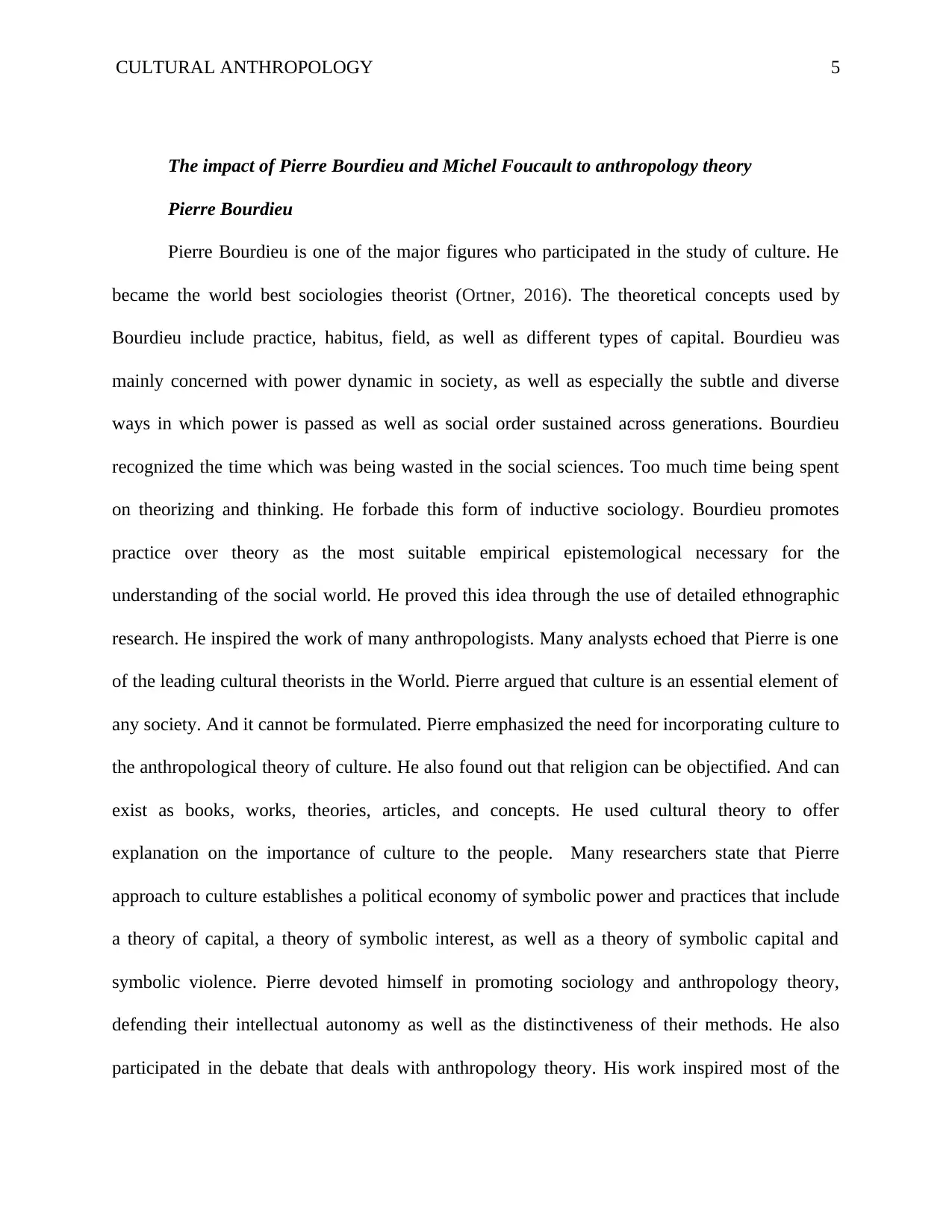
The impact of Pierre Bourdieu and Michel Foucault to anthropology theory
Pierre Bourdieu
Pierre Bourdieu is one of the major figures who participated in the study of culture. He
became the world best sociologies theorist (Ortner, 2016). The theoretical concepts used by
Bourdieu include practice, habitus, field, as well as different types of capital. Bourdieu was
mainly concerned with power dynamic in society, as well as especially the subtle and diverse
ways in which power is passed as well as social order sustained across generations. Bourdieu
recognized the time which was being wasted in the social sciences. Too much time being spent
on theorizing and thinking. He forbade this form of inductive sociology. Bourdieu promotes
practice over theory as the most suitable empirical epistemological necessary for the
understanding of the social world. He proved this idea through the use of detailed ethnographic
research. He inspired the work of many anthropologists. Many analysts echoed that Pierre is one
of the leading cultural theorists in the World. Pierre argued that culture is an essential element of
any society. And it cannot be formulated. Pierre emphasized the need for incorporating culture to
the anthropological theory of culture. He also found out that religion can be objectified. And can
exist as books, works, theories, articles, and concepts. He used cultural theory to offer
explanation on the importance of culture to the people. Many researchers state that Pierre
approach to culture establishes a political economy of symbolic power and practices that include
a theory of capital, a theory of symbolic interest, as well as a theory of symbolic capital and
symbolic violence. Pierre devoted himself in promoting sociology and anthropology theory,
defending their intellectual autonomy as well as the distinctiveness of their methods. He also
participated in the debate that deals with anthropology theory. His work inspired most of the
The impact of Pierre Bourdieu and Michel Foucault to anthropology theory
Pierre Bourdieu
Pierre Bourdieu is one of the major figures who participated in the study of culture. He
became the world best sociologies theorist (Ortner, 2016). The theoretical concepts used by
Bourdieu include practice, habitus, field, as well as different types of capital. Bourdieu was
mainly concerned with power dynamic in society, as well as especially the subtle and diverse
ways in which power is passed as well as social order sustained across generations. Bourdieu
recognized the time which was being wasted in the social sciences. Too much time being spent
on theorizing and thinking. He forbade this form of inductive sociology. Bourdieu promotes
practice over theory as the most suitable empirical epistemological necessary for the
understanding of the social world. He proved this idea through the use of detailed ethnographic
research. He inspired the work of many anthropologists. Many analysts echoed that Pierre is one
of the leading cultural theorists in the World. Pierre argued that culture is an essential element of
any society. And it cannot be formulated. Pierre emphasized the need for incorporating culture to
the anthropological theory of culture. He also found out that religion can be objectified. And can
exist as books, works, theories, articles, and concepts. He used cultural theory to offer
explanation on the importance of culture to the people. Many researchers state that Pierre
approach to culture establishes a political economy of symbolic power and practices that include
a theory of capital, a theory of symbolic interest, as well as a theory of symbolic capital and
symbolic violence. Pierre devoted himself in promoting sociology and anthropology theory,
defending their intellectual autonomy as well as the distinctiveness of their methods. He also
participated in the debate that deals with anthropology theory. His work inspired most of the
CULTURAL ANTHROPOLOGY 6
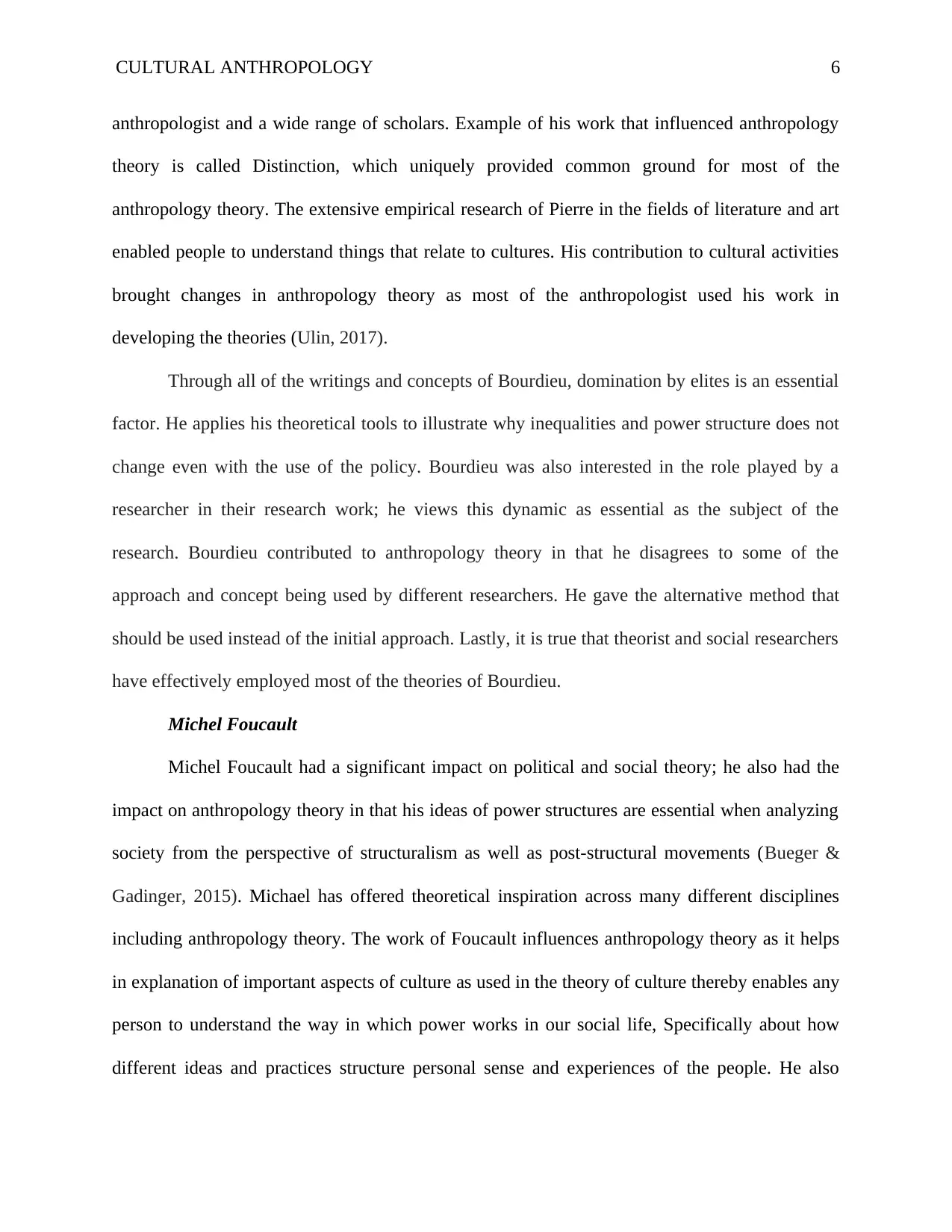
anthropologist and a wide range of scholars. Example of his work that influenced anthropology
theory is called Distinction, which uniquely provided common ground for most of the
anthropology theory. The extensive empirical research of Pierre in the fields of literature and art
enabled people to understand things that relate to cultures. His contribution to cultural activities
brought changes in anthropology theory as most of the anthropologist used his work in
developing the theories (Ulin, 2017).
Through all of the writings and concepts of Bourdieu, domination by elites is an essential
factor. He applies his theoretical tools to illustrate why inequalities and power structure does not
change even with the use of the policy. Bourdieu was also interested in the role played by a
researcher in their research work; he views this dynamic as essential as the subject of the
research. Bourdieu contributed to anthropology theory in that he disagrees to some of the
approach and concept being used by different researchers. He gave the alternative method that
should be used instead of the initial approach. Lastly, it is true that theorist and social researchers
have effectively employed most of the theories of Bourdieu.
Michel Foucault
Michel Foucault had a significant impact on political and social theory; he also had the
impact on anthropology theory in that his ideas of power structures are essential when analyzing
society from the perspective of structuralism as well as post-structural movements (Bueger &
Gadinger, 2015). Michael has offered theoretical inspiration across many different disciplines
including anthropology theory. The work of Foucault influences anthropology theory as it helps
in explanation of important aspects of culture as used in the theory of culture thereby enables any
person to understand the way in which power works in our social life, Specifically about how
different ideas and practices structure personal sense and experiences of the people. He also
anthropologist and a wide range of scholars. Example of his work that influenced anthropology
theory is called Distinction, which uniquely provided common ground for most of the
anthropology theory. The extensive empirical research of Pierre in the fields of literature and art
enabled people to understand things that relate to cultures. His contribution to cultural activities
brought changes in anthropology theory as most of the anthropologist used his work in
developing the theories (Ulin, 2017).
Through all of the writings and concepts of Bourdieu, domination by elites is an essential
factor. He applies his theoretical tools to illustrate why inequalities and power structure does not
change even with the use of the policy. Bourdieu was also interested in the role played by a
researcher in their research work; he views this dynamic as essential as the subject of the
research. Bourdieu contributed to anthropology theory in that he disagrees to some of the
approach and concept being used by different researchers. He gave the alternative method that
should be used instead of the initial approach. Lastly, it is true that theorist and social researchers
have effectively employed most of the theories of Bourdieu.
Michel Foucault
Michel Foucault had a significant impact on political and social theory; he also had the
impact on anthropology theory in that his ideas of power structures are essential when analyzing
society from the perspective of structuralism as well as post-structural movements (Bueger &
Gadinger, 2015). Michael has offered theoretical inspiration across many different disciplines
including anthropology theory. The work of Foucault influences anthropology theory as it helps
in explanation of important aspects of culture as used in the theory of culture thereby enables any
person to understand the way in which power works in our social life, Specifically about how
different ideas and practices structure personal sense and experiences of the people. He also
⊘ This is a preview!⊘
Do you want full access?
Subscribe today to unlock all pages.
Trusted by 1+ million students worldwide
CULTURAL ANTHROPOLOGY 7
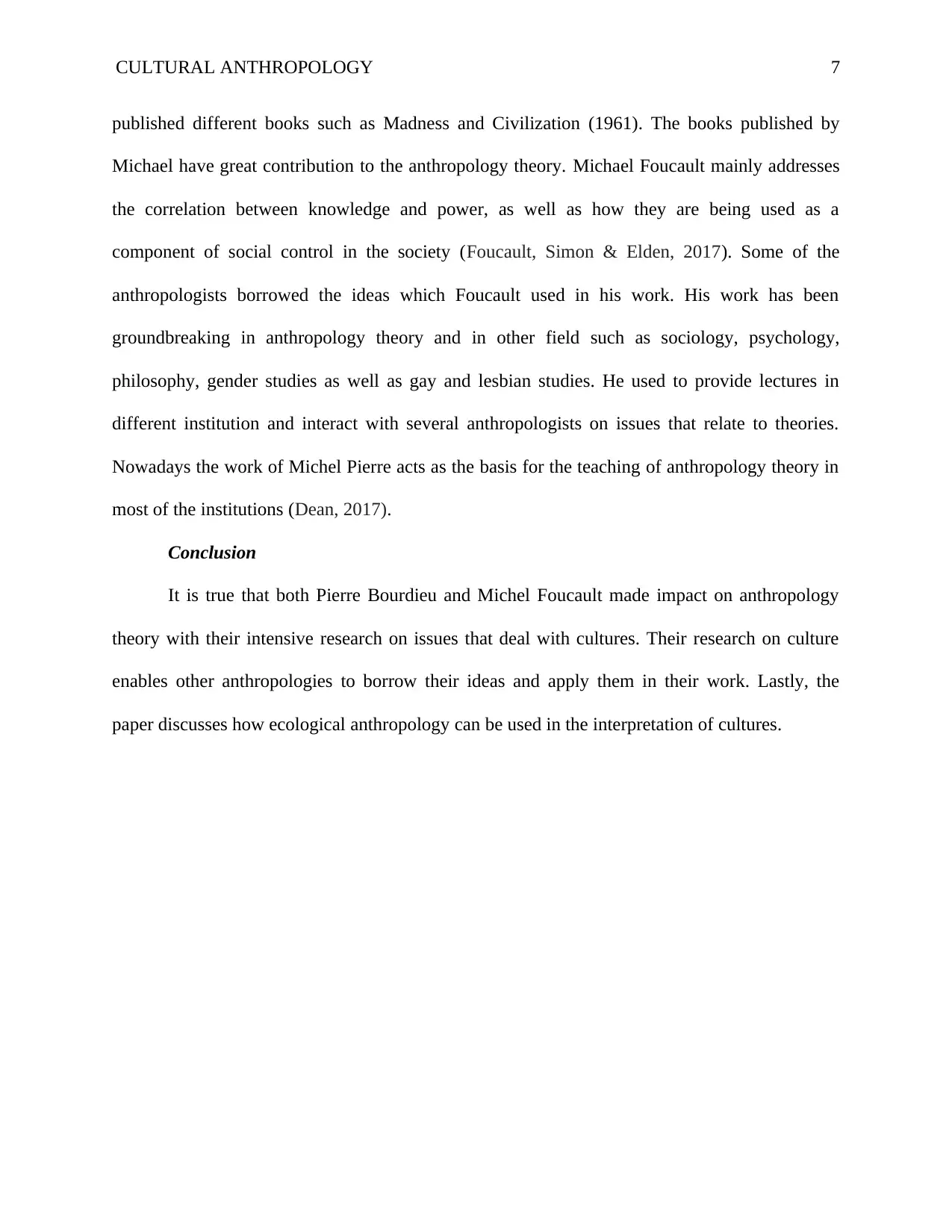
published different books such as Madness and Civilization (1961). The books published by
Michael have great contribution to the anthropology theory. Michael Foucault mainly addresses
the correlation between knowledge and power, as well as how they are being used as a
component of social control in the society (Foucault, Simon & Elden, 2017). Some of the
anthropologists borrowed the ideas which Foucault used in his work. His work has been
groundbreaking in anthropology theory and in other field such as sociology, psychology,
philosophy, gender studies as well as gay and lesbian studies. He used to provide lectures in
different institution and interact with several anthropologists on issues that relate to theories.
Nowadays the work of Michel Pierre acts as the basis for the teaching of anthropology theory in
most of the institutions (Dean, 2017).
Conclusion
It is true that both Pierre Bourdieu and Michel Foucault made impact on anthropology
theory with their intensive research on issues that deal with cultures. Their research on culture
enables other anthropologies to borrow their ideas and apply them in their work. Lastly, the
paper discusses how ecological anthropology can be used in the interpretation of cultures.
published different books such as Madness and Civilization (1961). The books published by
Michael have great contribution to the anthropology theory. Michael Foucault mainly addresses
the correlation between knowledge and power, as well as how they are being used as a
component of social control in the society (Foucault, Simon & Elden, 2017). Some of the
anthropologists borrowed the ideas which Foucault used in his work. His work has been
groundbreaking in anthropology theory and in other field such as sociology, psychology,
philosophy, gender studies as well as gay and lesbian studies. He used to provide lectures in
different institution and interact with several anthropologists on issues that relate to theories.
Nowadays the work of Michel Pierre acts as the basis for the teaching of anthropology theory in
most of the institutions (Dean, 2017).
Conclusion
It is true that both Pierre Bourdieu and Michel Foucault made impact on anthropology
theory with their intensive research on issues that deal with cultures. Their research on culture
enables other anthropologies to borrow their ideas and apply them in their work. Lastly, the
paper discusses how ecological anthropology can be used in the interpretation of cultures.
Paraphrase This Document
Need a fresh take? Get an instant paraphrase of this document with our AI Paraphraser
CULTURAL ANTHROPOLOGY 8
References
Armstrong, C. G., Shoemaker, A. C., McKechnie, I., Ekblom, A., Szabó, P., Lane, P. J., ... &
Gibbons, K. S. (2017). Anthropological contributions to historical ecology: 50 questions,
infinite prospects. PloS one, 12(2), e0171883.
Bernstein, H., Friedmann, H., van der Ploeg, J. D., Shanin, T., & White, B. (2018). Fifty years of
debate on peasantries, 1966–2016. The Journal of Peasant Studies, 45(4), 689-714.
Bueger, C., & Gadinger, F. (2015). The play of international practice. International Studies
Quarterly, 59(3), 449-460.
Dean, M. (2017). Governmentality. The Wiley
‐Blackwell Encyclopedia of Social Theory, 1-2.
Foucault, M., Simon, J., & Elden, S. (2017). Danger, crime and rights: a conversation between
Michel Foucault and Jonathan Simon. Theory, Culture & Society, 34(1), 3-27.
Ortner, S. B. (2016). Dark anthropology and its others: Theory since the eighties. HAU: Journal
of Ethnographic Theory, 6(1), 47-73.
Pretty, J. (2011). Interdisciplinary progress in approaches to address social-ecological and
ecocultural systems. Environmental Conservation, 38(2), 127-139.Crate, S. A. (2011).
Climate and culture: anthropology in the era of contemporary climate change. Annual
Review of Anthropology, 40, 175-194.
References
Armstrong, C. G., Shoemaker, A. C., McKechnie, I., Ekblom, A., Szabó, P., Lane, P. J., ... &
Gibbons, K. S. (2017). Anthropological contributions to historical ecology: 50 questions,
infinite prospects. PloS one, 12(2), e0171883.
Bernstein, H., Friedmann, H., van der Ploeg, J. D., Shanin, T., & White, B. (2018). Fifty years of
debate on peasantries, 1966–2016. The Journal of Peasant Studies, 45(4), 689-714.
Bueger, C., & Gadinger, F. (2015). The play of international practice. International Studies
Quarterly, 59(3), 449-460.
Dean, M. (2017). Governmentality. The Wiley
‐Blackwell Encyclopedia of Social Theory, 1-2.
Foucault, M., Simon, J., & Elden, S. (2017). Danger, crime and rights: a conversation between
Michel Foucault and Jonathan Simon. Theory, Culture & Society, 34(1), 3-27.
Ortner, S. B. (2016). Dark anthropology and its others: Theory since the eighties. HAU: Journal
of Ethnographic Theory, 6(1), 47-73.
Pretty, J. (2011). Interdisciplinary progress in approaches to address social-ecological and
ecocultural systems. Environmental Conservation, 38(2), 127-139.Crate, S. A. (2011).
Climate and culture: anthropology in the era of contemporary climate change. Annual
Review of Anthropology, 40, 175-194.
CULTURAL ANTHROPOLOGY 9
Rademacher, A., Cadenasso, M. L., & Pickett, S. T. (2018). From feedbacks to coproduction:
toward an integrated conceptual framework for urban ecosystems. Urban Ecosystems, 1-
12.
Szabó, P. (2015). Historical ecology: past, present and future. Biological Reviews, 90(4), 997-
1014.
Ulin, R. C. (2017). An Epistemological Shift in the History of Anthropology. Historicizing
Theories, Identities, and Nations, 11, 135.
Yamagiwa, J. (2010). Ecological anthropology and primatology: Fieldwork practices and mutual
benefits. Centralizing Fieldwork: Critical Perspectives from Biological and Social
Anthropology, 84-103.
Rademacher, A., Cadenasso, M. L., & Pickett, S. T. (2018). From feedbacks to coproduction:
toward an integrated conceptual framework for urban ecosystems. Urban Ecosystems, 1-
12.
Szabó, P. (2015). Historical ecology: past, present and future. Biological Reviews, 90(4), 997-
1014.
Ulin, R. C. (2017). An Epistemological Shift in the History of Anthropology. Historicizing
Theories, Identities, and Nations, 11, 135.
Yamagiwa, J. (2010). Ecological anthropology and primatology: Fieldwork practices and mutual
benefits. Centralizing Fieldwork: Critical Perspectives from Biological and Social
Anthropology, 84-103.
⊘ This is a preview!⊘
Do you want full access?
Subscribe today to unlock all pages.
Trusted by 1+ million students worldwide

1 out of 9


Related Documents


Your All-in-One AI-Powered Toolkit for Academic Success.
+13062052269
info@desklib.com
Available 24*7 on WhatsApp / Email
![[object Object]](/_next/static/media/star-bottom.7253800d.svg)
Unlock your academic potential
Copyright © 2020–2026 A2Z Services. All Rights Reserved. Developed and managed by ZUCOL.