Global Business: Understanding Cultural Differences and Communication

Verified

Added on  2023/06/05

|8
|853
|417
Essay
AI Summary
This essay examines the impact of cultural differences and communication in the context of global business. It defines and classifies cultural diversity, highlighting its benefits such as improved understanding of customer demands and the generation of diverse ideas within teams, ultimately supporting business profitability. However, it also addresses the risks associated with cross-cultural diversity, including increased conflict between local and expatriate employees and potential failures in negotiation processes. The essay emphasizes the importance of effective international cross-cultural management to mitigate these risks, advocating for a clear understanding of the host country's culture to facilitate effective communication, negotiation, and customer understanding. By fostering respect for the host culture, organizations can minimize conflicts and optimize their supply chain management, ensuring prosperity and achieving organizational goals. References to various academic sources support the analysis and recommendations presented.
Document Page
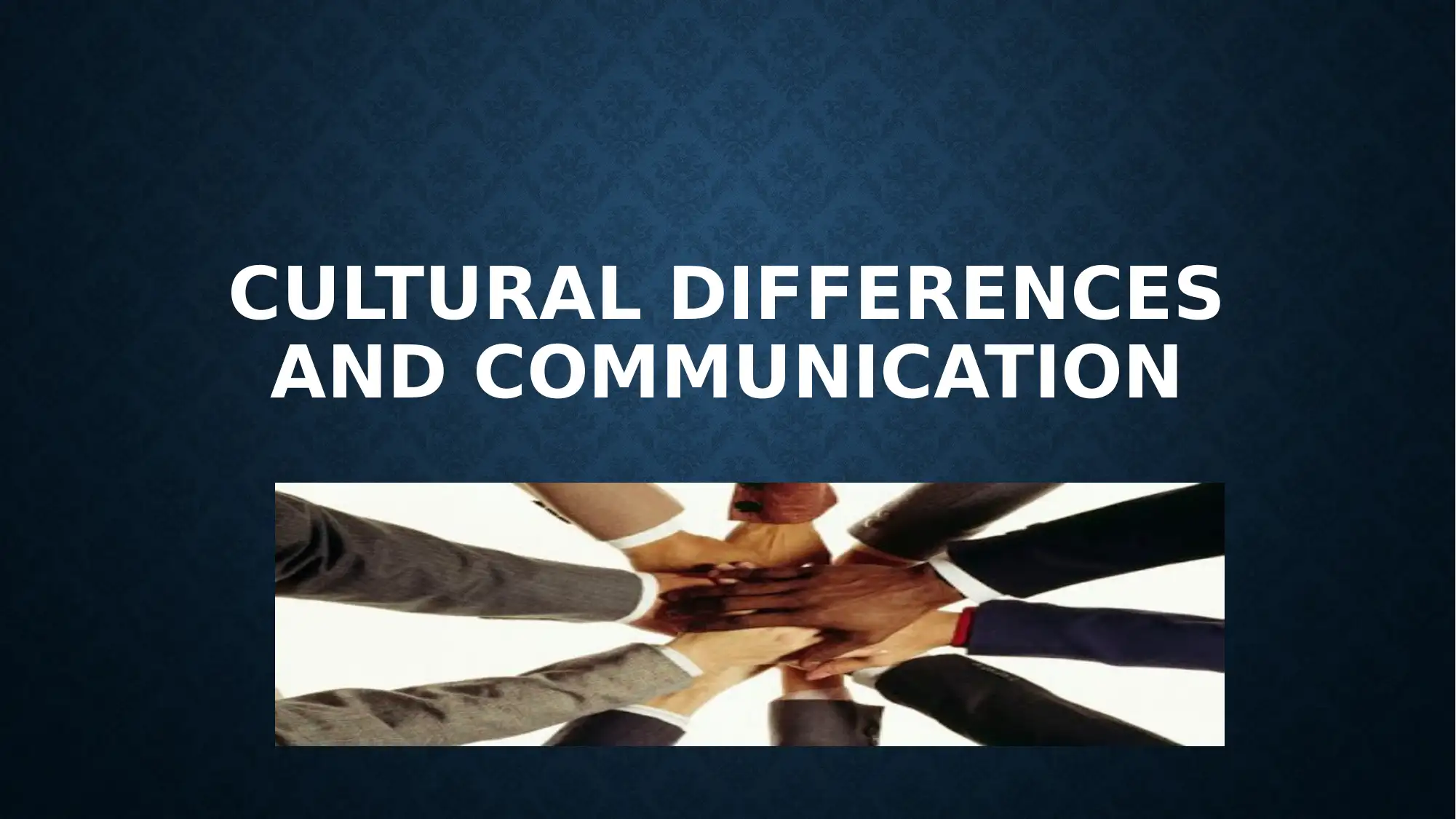
CULTURAL DIFFERENCES
AND COMMUNICATION
tabler-icon-diamond-filled.svg

Paraphrase This Document

Need a fresh take? Get an instant paraphrase of this document with our AI Paraphraser
Document Page
Due to globalisation of business and pursuit of effective
competition the organizations are entering the market of the
different countries,
These countries are having different cultures which are affecting
the organizational culture of the companies itself (Peeters, Dehon
& Garcia-Prieto, 2015).
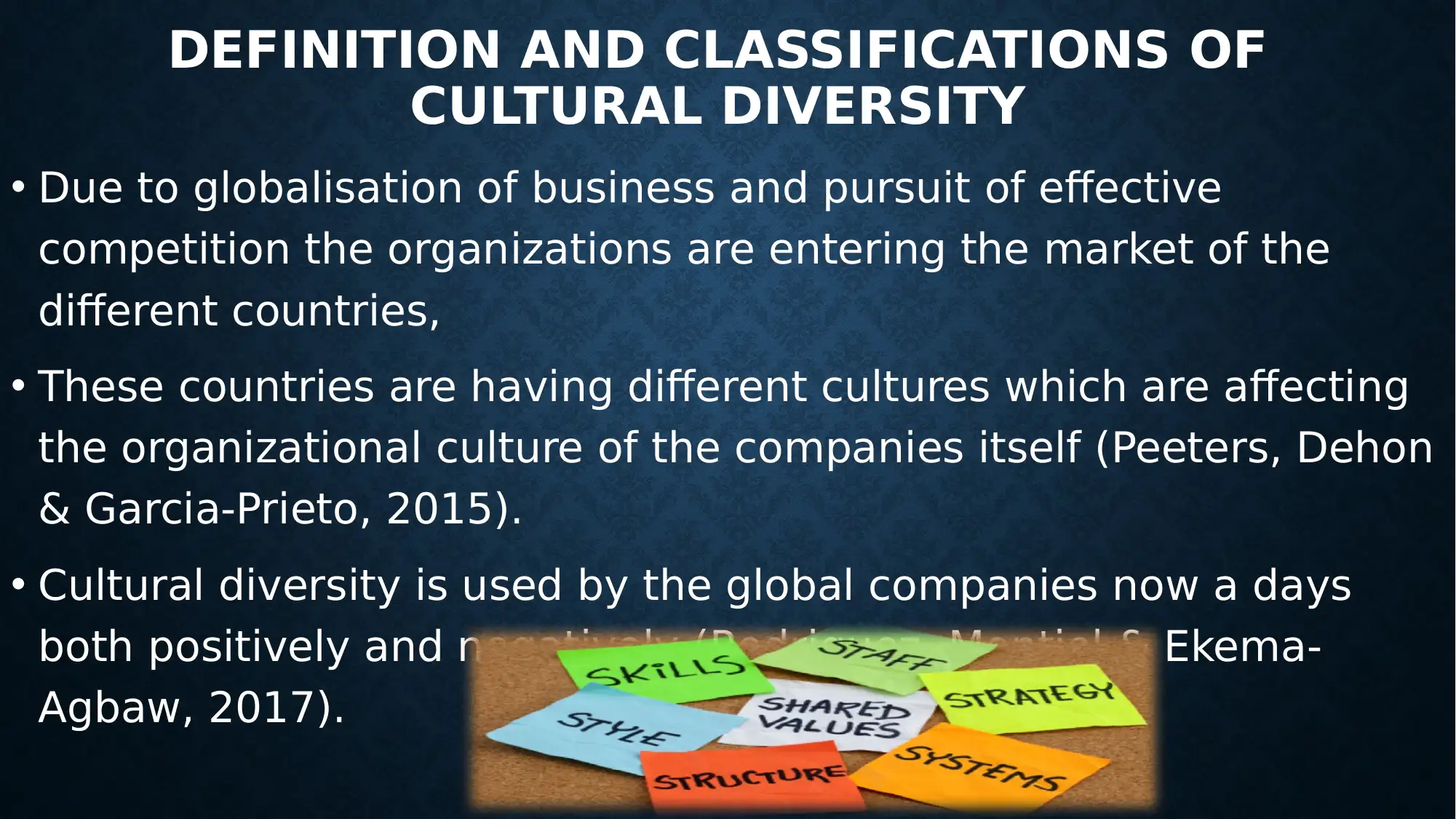
Cultural diversity is used by the global companies now a days
both positively and negatively (Rodriguez, Montiel & Ekema-
Agbaw, 2017).
DEFINITION AND CLASSIFICATIONS OF
CULTURAL DIVERSITY
Document Page
BENEFITS OF TOPIC
The global organisations are using cross cultural issues
and diversity in order to support the profitability of their
own business.
These companies get proper understanding of the
customer demands and preferences by using the cultural
diversity in the firms (Mazanec et al. 2015).
Document Page
BENEFITS OF TOPIC
The teams of these global corporations are
growing diverse which relates to the diversity of
ideas (Brouthers, Marshall & Keig, 2016).
These ideas then are applied to manage the
supply chain or convincing the partners at the
time of negotiation.
Proper international management of cultural
diversity leads to prosperity of the firms.
tabler-icon-diamond-filled.svg

Paraphrase This Document

Need a fresh take? Get an instant paraphrase of this document with our AI Paraphraser
Document Page
RISK OF TOPIC
Cross cultural diversity of the firms often leads to increase
the conflict among the local and expatriate employees
(Gurung & Prater, 2017).
The firms if not aware with the cross cultural management,
cannot utilise the workforce properly which also affects in
managing the supply chain.
The companies in case fail to understand the proper
negotiation process, fail to achieve the organisational
goals and often to bankruptcy (Stahl et al., 2017).
Document Page
SOLUTION TO REDUCE THE RISK OF
TOPIC
Proper method of international cross-cultural management is
therefore necessary.
In order to reduce these risks, the organizations need to have
clear understanding of the culture where they are going to
enter for business (Ferris et al., 2018).
This will help them to indulge in effective communication,
negotiation and proper understanding of the customer’s
demands.
Proper understanding and respect for the culture of the host
country can mitigate any type of conflict among the workers
as well as the supply chain (Brouthers, Marshall & Keig, 2016).
Document Page
REFERENCES
Beugelsdijk, S., Maseland, R., & Van Hoorn, A. (2015). Are Scores on H ofstede's Dimensions of National Culture Stable over Time? A
Cohort Analysis. Global Strategy Journal, 5(3), 223-240.
Brouthers, L. E., Marshall, V. B., & Keig, D. L. (2016). Solving the single-country sample problem in cultural distance studies. Journal
of International Business Studies, 47(4), 471-479.
Ferris, D. L., Reb, J., Lian, H., Sim, S., & Ang, D. (2018). What goes up must... Keep going up? Cultural differences in cognitive styles
influence evaluations of dynamic performance. Journal of Applied Psychology, 103(3), 347.
Gurung, A., & Prater, E. (2017). A research framework for the impact of cultural differences on IT outsourcing. In Global Sourcing of
Services: Strategies, Issues and Challenges (pp. 49-82).
Hofstede, G. (2016). Culture's Consequences: Comparing values, behaviors, institutions, and organizations across nations. Collegiate
Aviation Review, 34(2), 108.
Mazanec, J. A., Crotts, J. C., Gursoy, D., & Lu, L. (2015). Homogeneity versus heterogeneity of cultural values: An item-response
theoretical approach applying Hofstede's cultural dimensions in a single nation. Tourism Management, 48, 299-304.
Peeters, C., Dehon, C., & Garcia-Prieto, P. (2015). The attention stimulus of cultural differences in global services sourcing. Journal of
International Business Studies, 46(2), 241-251.
Rodriguez, L. C., Montiel, I., & Ekema-Agbaw, M. L. (2017, July). The Effects Of Culture And Country Risk On The Choice Of Corporate
Sustainability Practices. In Proceedings of the International Association for Business and Society (Vol. 28, pp. 267-276).
Salman, M. (2015). Hofstede dimensions of culture: A brief comparison of Pakistan and New Zealand.
Stahl, G. K., Miska, C., Lee, H. J., & De Luque, M. S. (2017). The upside of cultural differences: Towards a more balanced treatment of
culture in cross-cultural management research. Cross Cultural & Strategic Management, 24(1), 2-12.
tabler-icon-diamond-filled.svg

Paraphrase This Document

Need a fresh take? Get an instant paraphrase of this document with our AI Paraphraser
Document Page
chevron_up_icon
1 out of 8
circle_padding
hide_on_mobile
zoom_out_icon
[object Object]