Analyzing Culturally Effective Communication in Healthcare Settings

Verified

Added on  2023/06/04

|8
|698
|499
Report
AI Summary
This report delves into the critical aspects of culturally effective communication within the healthcare setting. It emphasizes the importance of understanding cultural integrity, comprehension of words, and avoiding incorrect assumptions to foster better patient-provider relationships. The report highlights the significance of health literacy and the need for capacity-building programs to equip healthcare professionals with the necessary skills. It addresses the potential negative impacts of poor communication, such as reduced patient adherence and increased medical errors, while advocating for strategies that promote patient empowerment and improved health outcomes. The assignment emphasizes the need for healthcare providers to be aware of the influence of culture on how patients understand, process, and apply health-related information. The report also examines the role of the interpreter and the potential benefits of effective communication for patients, healthcare providers, and the healthcare system. It references several academic sources that support the findings and recommendations.
Document Page
Culturally Effective
Communication
tabler-icon-diamond-filled.svg

Paraphrase This Document

Need a fresh take? Get an instant paraphrase of this document with our AI Paraphraser
Document Page
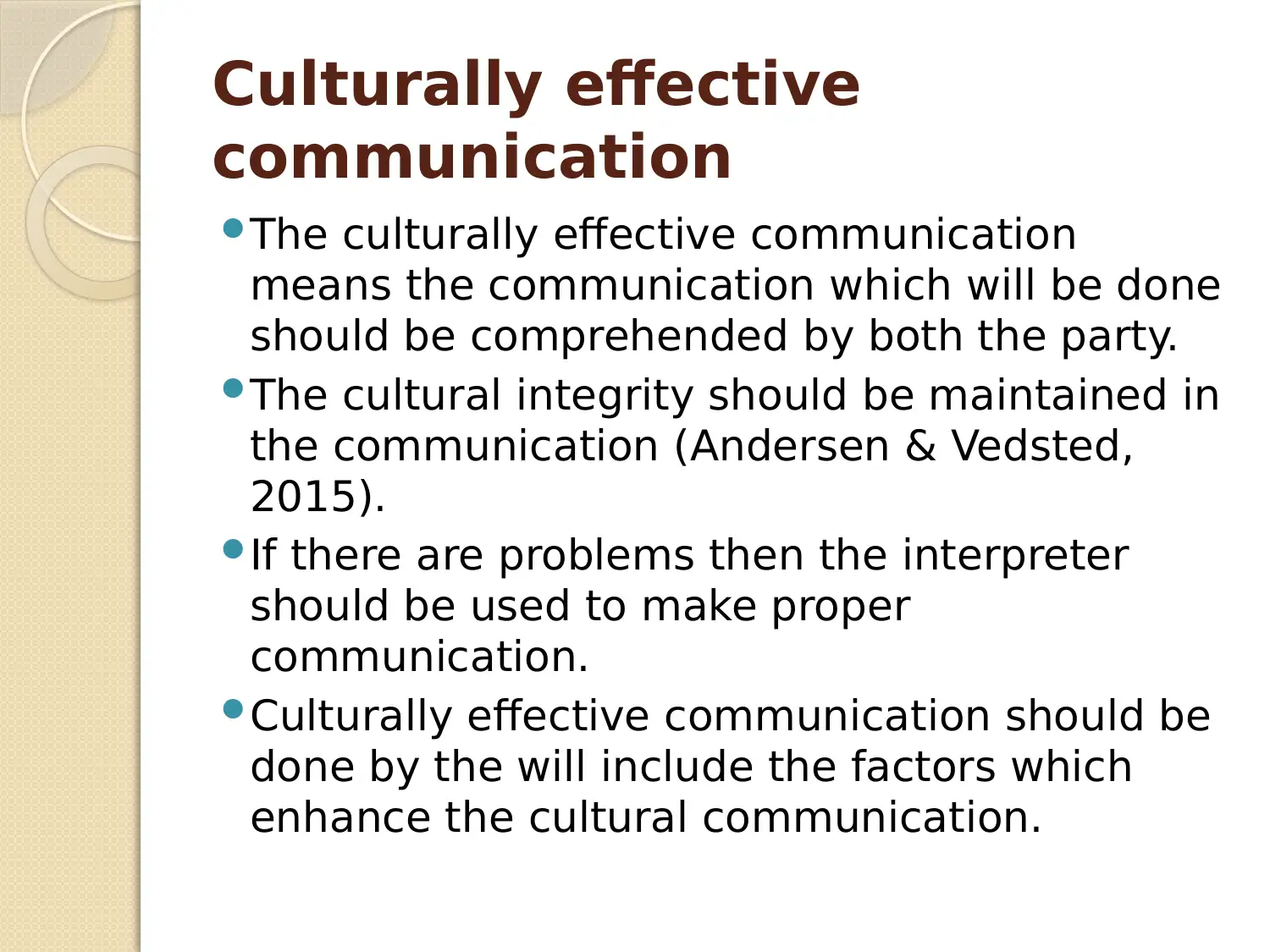
Culturally effective
communication
The culturally effective communication
means the communication which will be done
should be comprehended by both the party.
The cultural integrity should be maintained in
the communication (Andersen & Vedsted,
2015).
If there are problems then the interpreter
should be used to make proper
communication.
Culturally effective communication should be
done by the will include the factors which
enhance the cultural communication.
Document Page
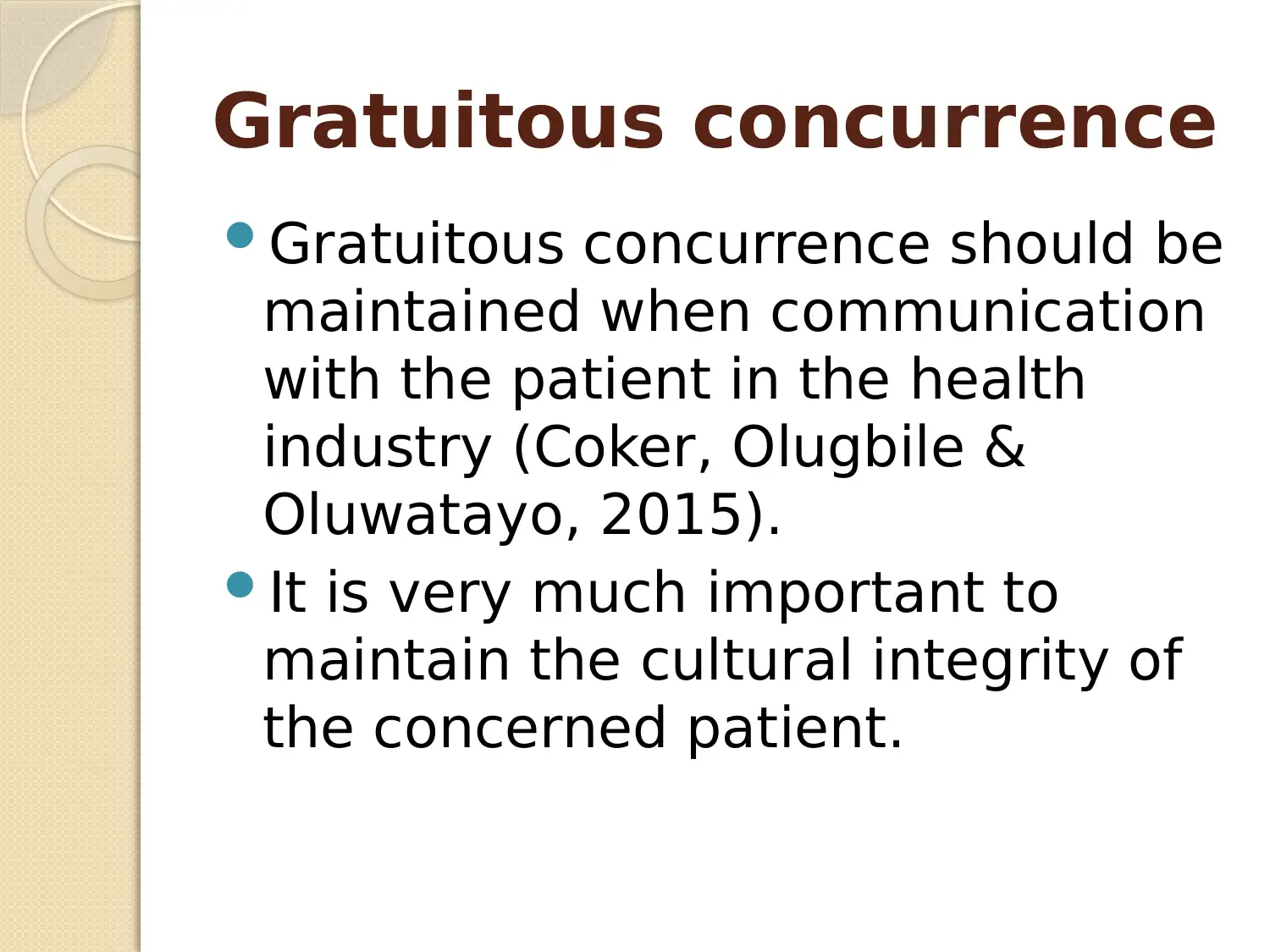
Gratuitous concurrence
Gratuitous concurrence should be
maintained when communication
with the patient in the health
industry (Coker, Olugbile &
Oluwatayo, 2015).
It is very much important to
maintain the cultural integrity of
the concerned patient.
Document Page
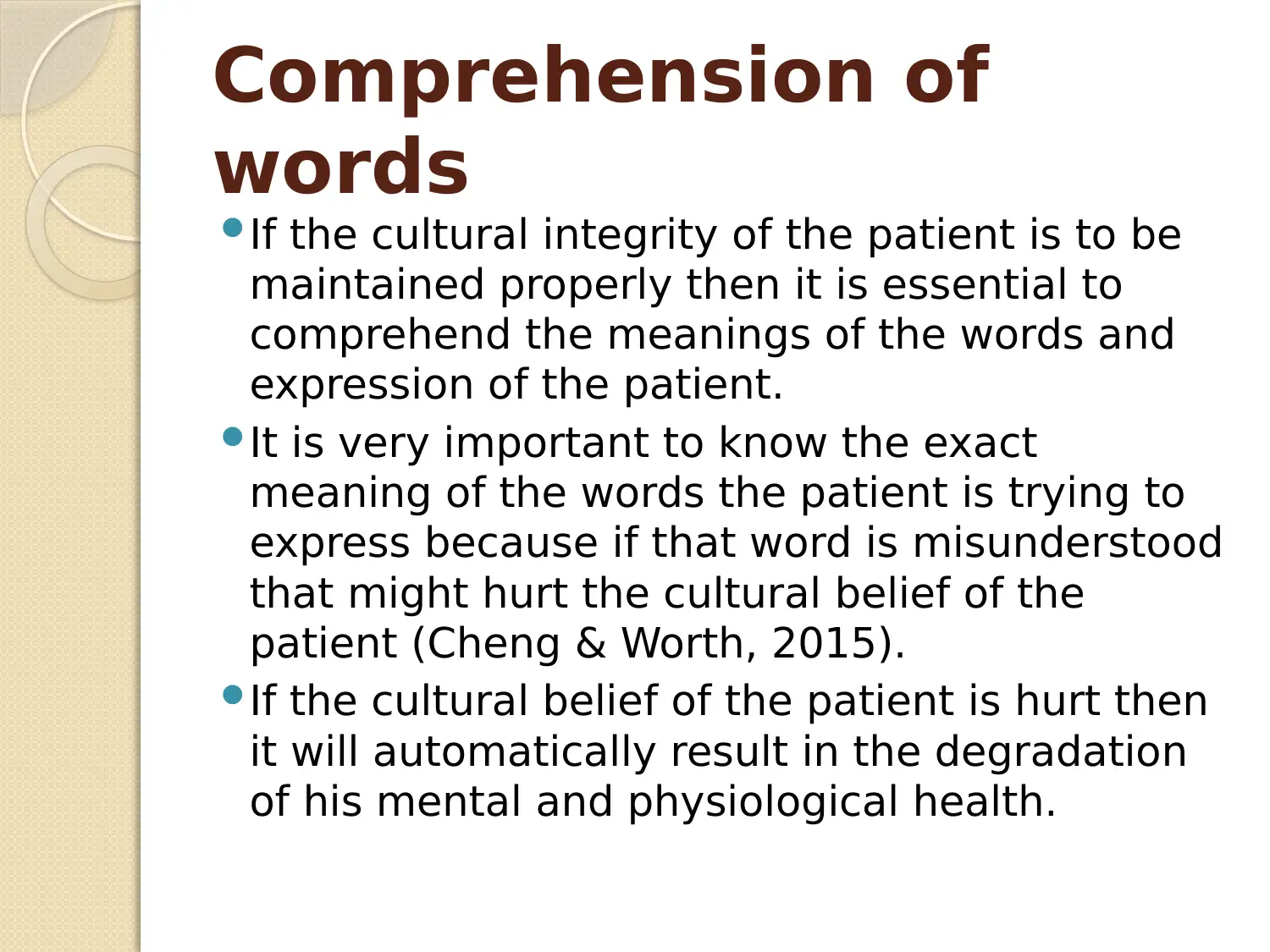
Comprehension of
words
If the cultural integrity of the patient is to be
maintained properly then it is essential to
comprehend the meanings of the words and
expression of the patient.
It is very important to know the exact
meaning of the words the patient is trying to
express because if that word is misunderstood
that might hurt the cultural belief of the
patient (Cheng & Worth, 2015).
If the cultural belief of the patient is hurt then
it will automatically result in the degradation
of his mental and physiological health.
tabler-icon-diamond-filled.svg

Paraphrase This Document

Need a fresh take? Get an instant paraphrase of this document with our AI Paraphraser
Document Page
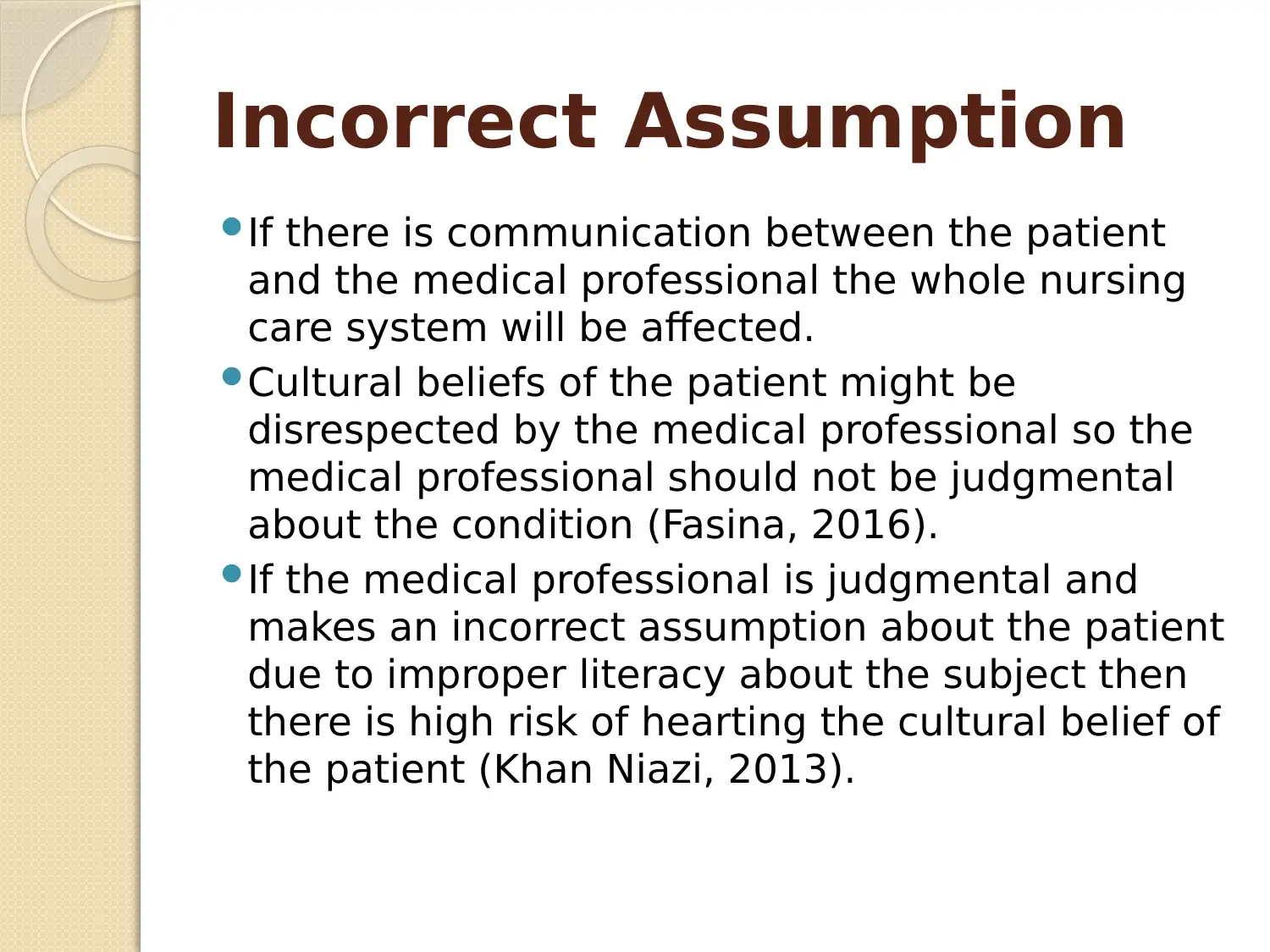
Incorrect Assumption
If there is communication between the patient
and the medical professional the whole nursing
care system will be affected.
Cultural beliefs of the patient might be
disrespected by the medical professional so the
medical professional should not be judgmental
about the condition (Fasina, 2016).
If the medical professional is judgmental and
makes an incorrect assumption about the patient
due to improper literacy about the subject then
there is high risk of hearting the cultural belief of
the patient (Khan Niazi, 2013).
Document Page
Proper literacy in the health
care industry
It is very much required for the
proper literacy of the medical
professional.
Since there is no margin of error
in the medical profession proper
literacy about the health issue is
essential for the proper
assessment and diagnosis of the
patient (Goldstuck, 2014).
Document Page
Capacity building programs
regarding literacy
It is very much essential to build
the capacity of the employees so
that the professional’s posses
required amount of literacy to
combat the complex health
issues of the patient (Guimaro &
Carvalho, 2014).
Effectively of the health care will
increase through proper literacy
program.
tabler-icon-diamond-filled.svg

Paraphrase This Document

Need a fresh take? Get an instant paraphrase of this document with our AI Paraphraser
Document Page
References
Andersen, R., & Vedsted, P. (2015). Juggling efficiency. An ethnographic study
exploring healthcare seeking practices and institutional logics in Danish primary care
settings. Social Science & Medicine, 128, 239-245. doi:
10.1016/j.socscimed.2015.01.037
Cheng, A., & Worth, L. (2015). Cultural dimensions relevant to antimicrobial
stewardship: the contribution of individualism and power distance to perioperative
prescribing practices in European hospitals. Healthcare Infection, 20(3-4), 124-127.
doi: 10.1071/hi15010
Coker, A., Olugbile, O., & Oluwatayo, O. (2015). Integration of mental healthcare into
primary healthcare in Lagos, Nigeria: the way forward. Healthcare In Low-Resource
Settings, 3(2). doi: 10.4081/hls.2015.3786
Fasina, A. (2016). Healthcare in Low-Resource Settings: the long view for
healthcare. Healthcare In Low-Resource Settings, 4(2). doi: 10.4081/hls.2016.6396
Goldstuck, N. (2014). Healthcare in Low-resource Settings: the individual
perspective. Healthcare In Low-Resource Settings, 2(2). doi: 10.4081/hls.2014.4572
Guimaro, C., & Carvalho, J. (2014). Cultural change in healthcare organisations
through lean practices. European J. Of Cross-Cultural Competence And
Management, 3(3/4), 212. doi: 10.1504/ejccm.2014.071959
Khan Niazi, A. (2013). The diverse issues of Healthcare in Low-resource
Settings. Healthcare In Low-Resource Settings, 1(1), 15. doi: 10.4081/hls.2013.e15
chevron_up_icon
1 out of 8
circle_padding
hide_on_mobile
zoom_out_icon
[object Object]