Data and Knowledge Management for Decision Support - Assignment 3

Verified

Added on  2022/08/22

|9
|1751
|22
Homework Assignment
AI Summary
This assignment, part of the INS 655 Data and Knowledge Management for Decision Support course, focuses on data mining and decision support systems (DSS). Part A involves using Microsoft Azure ML Studio to analyze a churn dataset using the K-Means (Random) algorithm and comparing its performance with K-Means++ and Evenly algorithms. The analysis includes evaluating the success rates of the algorithms and visualizing the clustered data. Part B explores the role of social media in decision support, examining how user-generated content influences decision-making, both for customers and businesses. It discusses the vulnerabilities of social media in decision support, such as trust and relatability of information, while acknowledging its growing relevance. The assignment references several academic papers to support the analysis and conclusions.

Document Page
Data and Knowledge Management for Decision Support
tabler-icon-diamond-filled.svg

Paraphrase This Document

Need a fresh take? Get an instant paraphrase of this document with our AI Paraphraser
Document Page
Data and Knowledge Management for Decision Support
Part A
Question 1
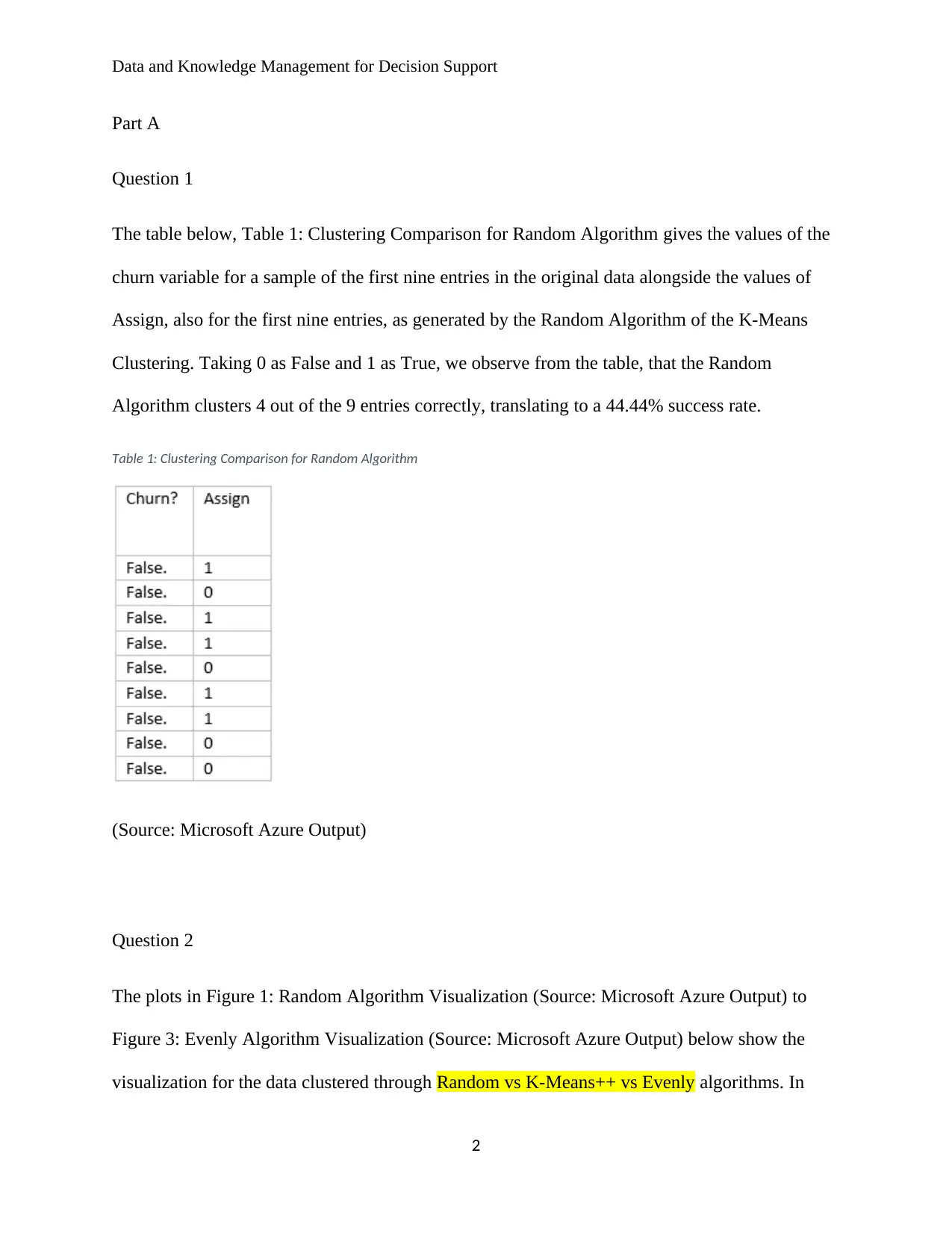
The table below, Table 1: Clustering Comparison for Random Algorithm gives the values of the
churn variable for a sample of the first nine entries in the original data alongside the values of
Assign, also for the first nine entries, as generated by the Random Algorithm of the K-Means
Clustering. Taking 0 as False and 1 as True, we observe from the table, that the Random
Algorithm clusters 4 out of the 9 entries correctly, translating to a 44.44% success rate.
Table 1: Clustering Comparison for Random Algorithm
(Source: Microsoft Azure Output)
Question 2
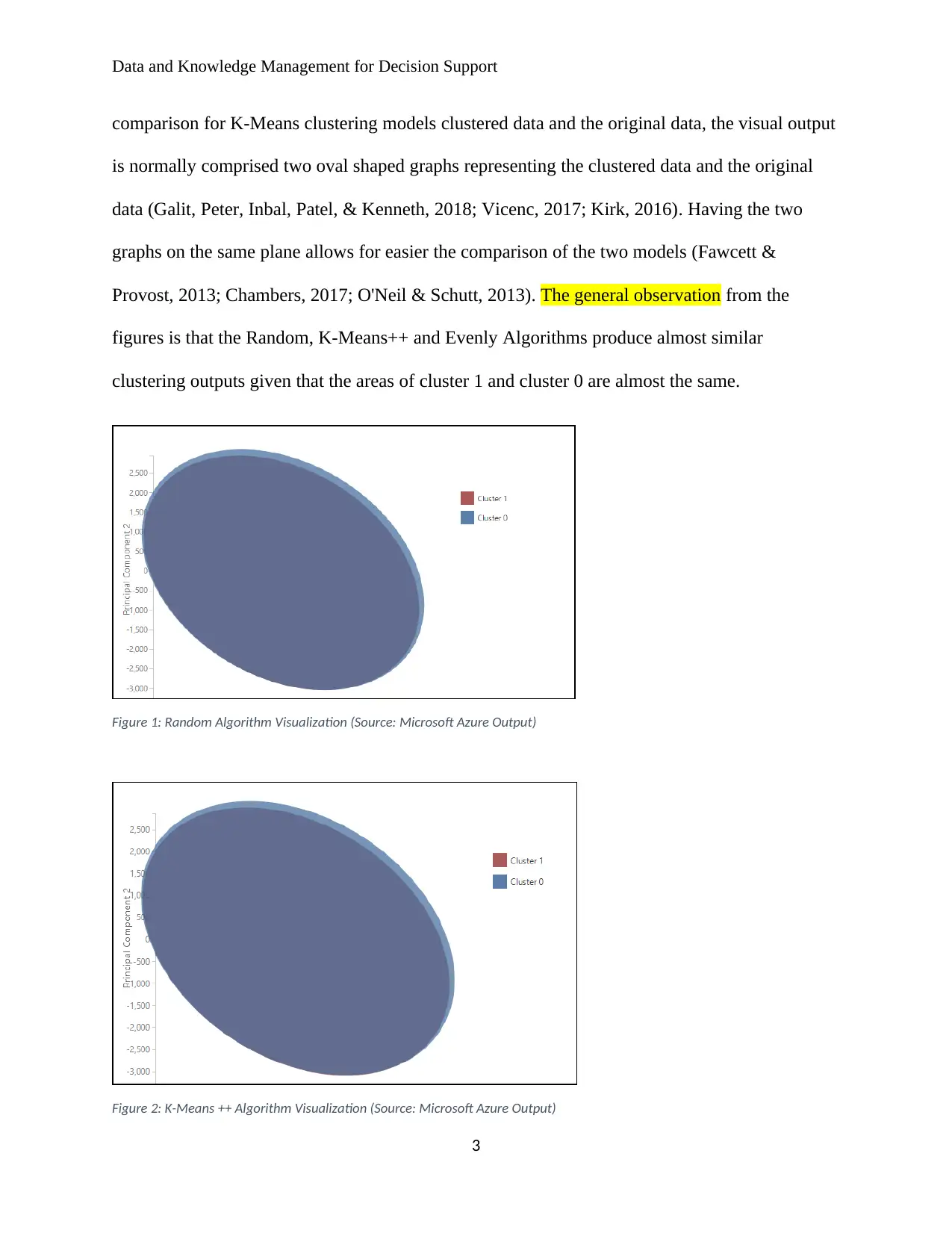
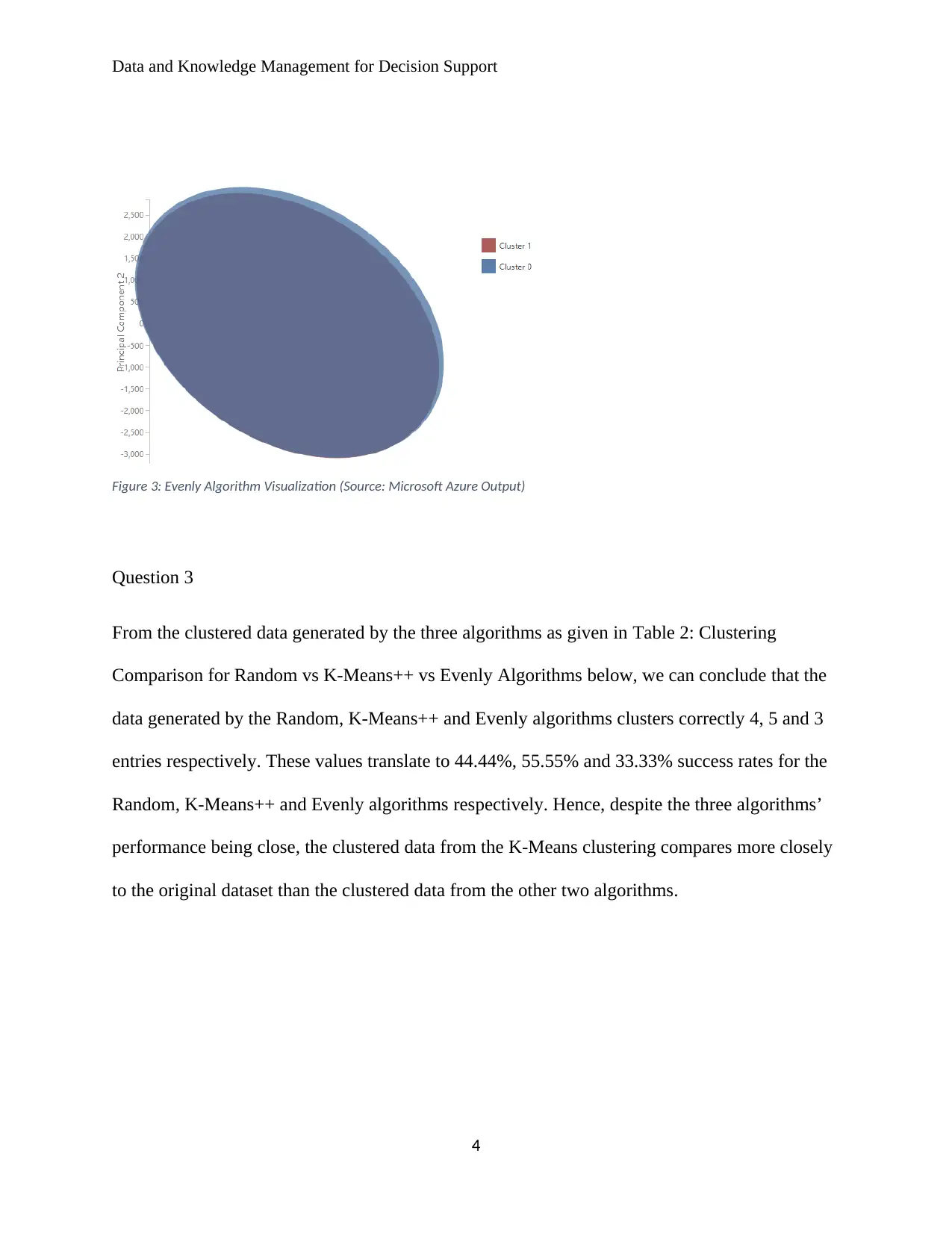
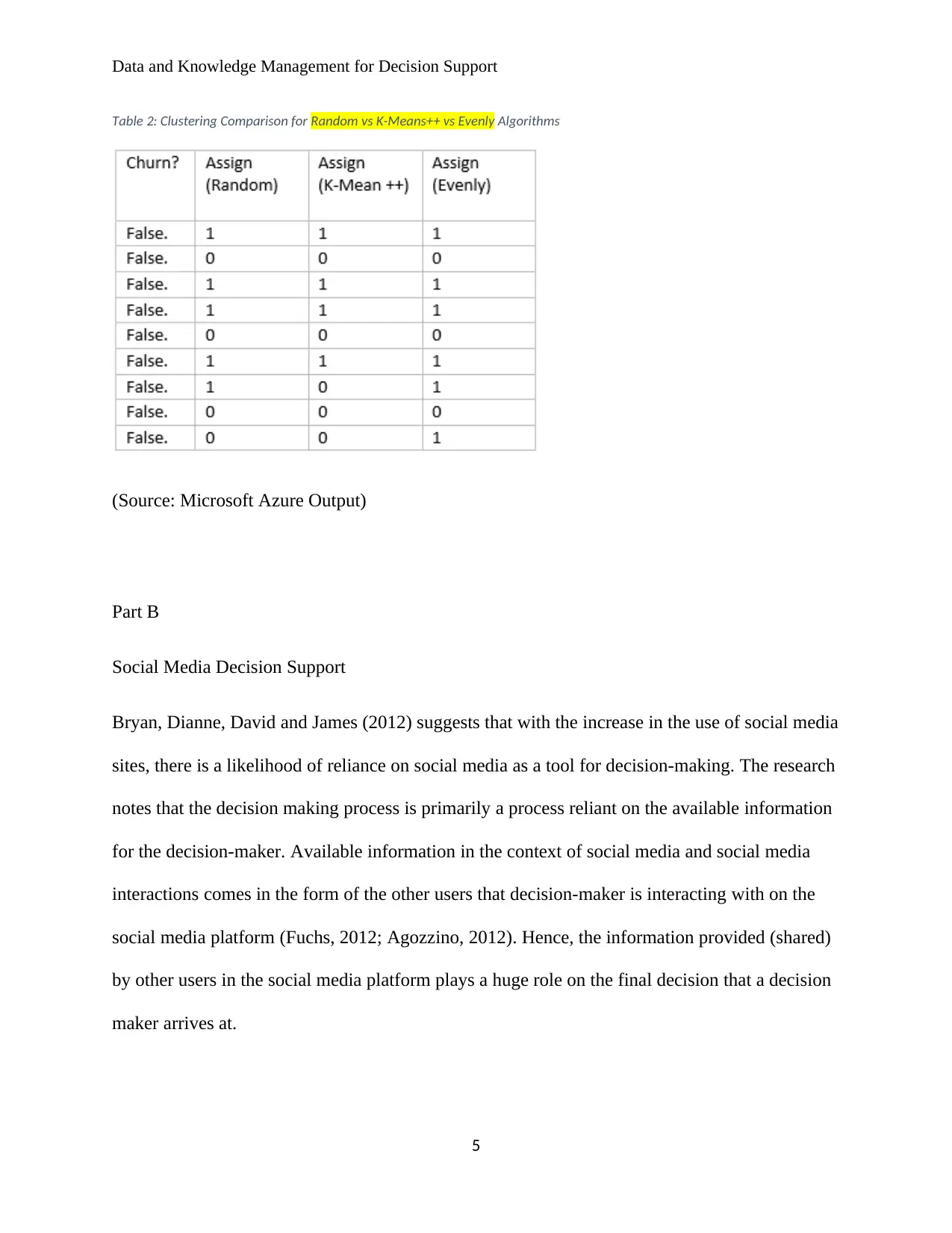
The plots in Figure 1: Random Algorithm Visualization (Source: Microsoft Azure Output) to
Figure 3: Evenly Algorithm Visualization (Source: Microsoft Azure Output) below show the
visualization for the data clustered through Random vs K-Means++ vs Evenly algorithms. In
2
Document Page
Data and Knowledge Management for Decision Support
comparison for K-Means clustering models clustered data and the original data, the visual output
is normally comprised two oval shaped graphs representing the clustered data and the original
data (Galit, Peter, Inbal, Patel, & Kenneth, 2018; Vicenc, 2017; Kirk, 2016). Having the two
graphs on the same plane allows for easier the comparison of the two models (Fawcett &
Provost, 2013; Chambers, 2017; O'Neil & Schutt, 2013). The general observation from the
figures is that the Random, K-Means++ and Evenly Algorithms produce almost similar
clustering outputs given that the areas of cluster 1 and cluster 0 are almost the same.
Figure 1: Random Algorithm Visualization (Source: Microsoft Azure Output)
Figure 2: K-Means ++ Algorithm Visualization (Source: Microsoft Azure Output)
3
Document Page
Data and Knowledge Management for Decision Support
Figure 3: Evenly Algorithm Visualization (Source: Microsoft Azure Output)
Question 3
From the clustered data generated by the three algorithms as given in Table 2: Clustering
Comparison for Random vs K-Means++ vs Evenly Algorithms below, we can conclude that the
data generated by the Random, K-Means++ and Evenly algorithms clusters correctly 4, 5 and 3
entries respectively. These values translate to 44.44%, 55.55% and 33.33% success rates for the
Random, K-Means++ and Evenly algorithms respectively. Hence, despite the three algorithms’
performance being close, the clustered data from the K-Means clustering compares more closely
to the original dataset than the clustered data from the other two algorithms.
4
tabler-icon-diamond-filled.svg

Paraphrase This Document

Need a fresh take? Get an instant paraphrase of this document with our AI Paraphraser
Document Page
Data and Knowledge Management for Decision Support
Table 2: Clustering Comparison for Random vs K-Means++ vs Evenly Algorithms
(Source: Microsoft Azure Output)
Part B
Social Media Decision Support
Bryan, Dianne, David and James (2012) suggests that with the increase in the use of social media
sites, there is a likelihood of reliance on social media as a tool for decision-making. The research
notes that the decision making process is primarily a process reliant on the available information
for the decision-maker. Available information in the context of social media and social media
interactions comes in the form of the other users that decision-maker is interacting with on the
social media platform (Fuchs, 2012; Agozzino, 2012). Hence, the information provided (shared)
by other users in the social media platform plays a huge role on the final decision that a decision
maker arrives at.
5
Document Page
Data and Knowledge Management for Decision Support
Social media sites are highly dependent on user-generated content (Piskorski, 2014). This
concept of the social media makes it more attractive and subsequently popular not only as a
means of communication but also as a source of information. The aspect of source of information
is the most interesting part for decision support with respect to social media (Andrey & Dmitrii,
2018; Hong, Ling, & Sumeet, 2018). Traditional media, that is, television, radio, newspapers,
magazines and even newspaper sites can broadly be said to be sources of controlled content. The
authors in these media control the information available for the users (readers) for their decision-
making. This restricted the users access to information and hence the increase in the popularity
of social media where there is no limit to the amount of information accessible.
The informational interactions on social media make it a point of interest for businesses and
general decision support applications. For instance, the type of information shared about a
product on social media has the ability to change the decision made by a potential buyer of the
product. In this respect, the informative interactions on social media can be viewed from two
angles; customer and businesses. In term of the customer, the posts that are shared, within the
customer’s social media circles, about the product, may affect a decision to either purchase or
not purchase a product (service) (Igor, Igor, & Sergey, 2019). This makes it a form of decision
support for customer, informing on their purchasing characteristics. In terms of the businesses,
seeking the opinion of social media users on a product or service provides information that can
support the decision that is eventually made about the product (service) (Bettina, Katarzyna,
Wiesław, & Radoslaw, 2018).
Despite social media proving to be a viable tool of decision support, it has vulnerabilities that
may make the relevant information available inaccurate. Bryan, Dianne, David and James (2012)
notes two key vulnerabilities with social media decision support; first is the concept of trust on
6
Document Page
Data and Knowledge Management for Decision Support
social media platforms. The study in Bryan, Dianne, David and James (2012) questions what
informs the level of trust a user will have on the information shared by other users on the
platform. How much a user trusts other user within their social media circles determine whether
they will use the information they access from them for decision-making.
The second is the relatability of the information shared on social media platforms. Bryan,
Dianne, David and James (2012) also questions whether the users on social media hold similar
opinions as those they hold in real life. When there is a difference between an individual’s
opinion in real life and their opinion on their avatar (on social media), then the information they
share may be misleading especially when used as means of decision support (Yufei, Yuanyuan,
Wei, & Xitong, 2019). Additionally, the concept of product promotion on social media may give
a false image of a product being popular (Kwok & Henry, 2019). The promotion drives on social
media are aimed at marketing products but may as well mislead decision-makers. Despite the
challenges, the expansion of the usage of social media make it a decision support medium that
will become even more relevant with time.
References
7
tabler-icon-diamond-filled.svg

Paraphrase This Document

Need a fresh take? Get an instant paraphrase of this document with our AI Paraphraser
Document Page
Data and Knowledge Management for Decision Support
Agozzino, A. Building a Personal Relationship Through Social Media: A Study of Millenial
Students's Brand Engagement. Ohio Communication Journal, 2012, 50, 1, 528-543.
Andrey, T., & Dmitrii, Z. Verification and online updating of decision making control logic for
onboard real-time control systems. Procedia Computer Science, 2018, 126, 1457-1466.
Bettina, H., Katarzyna, A., Wiesław, K., & Radoslaw, N. Influence of consumer reviews on
online purchasing decisions in older and younger adults. Decision Support Systems, 2018,
113, 1-10.
Bryan, H., Dianne, H., David, P., & James, C. F. Journal of the Association for Information
Systems. A Look Toward the Future: Decision Support Systems Research is Alive and
Well, 2012, 13, 315-340.
Chambers, J. M. Graphical Methods for Data Analysis, 1st ed, Chapman and Hall/CRC: New
York, 2017.
Fawcett, T., & Provost, F. Data Science for Business, 1st ed, London: O'Reilly Media Inc:
London, 2013.
Fuchs, C. Social Media: A Critical Introduction, 1st ed, Sage: London, 2012.
Galit, S., Peter, B. C., Inbal, Y., Patel, N. R., & Kenneth, L. C. Data Mining for Business
Analytics, 1st ed, New Delhi: John Wiley & Sons, Inc: New Delhi, 2018.
Hong, Z., Ling, Z., & Sumeet, G. The role of online product recommendations on customer
decision making and loyalty in social shopping communities. International Journal of
Information Management, 2018, 38, 1, 150-166.
8
Document Page
Data and Knowledge Management for Decision Support
Igor, K., Igor, S., & Sergey, A. Hierarchical fuzzy situational networks for online decision-
making: Application to telecommunication systems. Knowledge-Based Systems, 2019,
185, 43-57.
Kirk, A. Data Visualization: A Handbook for Data Driven Design, 2nd ed, Sage Publications,
Ltd: Thousand Oaks, CA, 2016.
Kwok, P. K., & Henry, L. Hotel selection using a modified TOPSIS-based decision support
algorithm. Decision Support System , 2019, 120, 95-105.
O'Neil, C., & Schutt, R. Doing Data Science, 3rd ed, O'Reily: London, 2013.
Piskorski, M. J. A Social Strategy: How We Profit from Social Media, 1st ed, Princeton
University Press: Princeton, New Jersey, 2014.
Vicenc, T. Studies in Big Data, 1st ed, Springer International Publishing: Chicago, 2017.
Yufei, L., Yuanyuan, S., Wei, Z., & Xitong, G. Exploring the Role of Online Health Community
Information in Patients’ Decisions to Switch from Online to Offline Medical Services.
International Journal of Medical Informatics, 2019, 130, 234-245.
9
chevron_up_icon
1 out of 9
circle_padding
hide_on_mobile
zoom_out_icon
[object Object]