Choosing Effective Qualitative Data Collection Methods for IPRs
VerifiedAdded on 2022/09/09
|2
|1825
|27
Report
AI Summary
This report examines various qualitative data collection methods, crucial for research, particularly in healthcare settings. It explores surveys, interviews, focus groups, observations, and textual analysis, detailing their respective strengths and limitations. The report emphasizes the importance of aligning the chosen method with the research question and context. It provides practical guidance on designing effective data collection strategies, including considerations for sample size, interviewer training, and the role of the researcher. The report also highlights the significance of analyzing qualitative data and offers examples of research questions suitable for each method. It concludes by encouraging researchers to build communities and use a range of methods to develop a broad program of qualitative research. The report underscores the value of qualitative research in understanding complex social phenomena and generating valuable insights to improve healthcare practices.
Design: Selection of Data Collection Methods
Elise Paradis,PhD
Bridget O’Brien,PhD
Laura Nimmon,PhD
Glen Bandiera,MD
Maria Athina (Tina) Martimianakis,PhD
The Challenge
Imagine that residents in your program have been less
than complimentary aboutinterprofessionalrounds
(IPRs). The program director asks you to determine what
residents are learning about in collaboration with other
health professionals during IPRs. If you construct a survey
asking Likert-type questions such as ‘‘How much are you
learning?’’ you likely will not gather the information you
need to answerthis question.You understand that
qualitative data dealwith words rather than numbers
and could provide the needed answers.How do you
collect ‘‘good’’words? Should you use open-ended
questionsin a survey format? Should you conduct
interviews, focus groups, or conduct direct observation?
What should you consider when making these decisions?
Introduction
Qualitative research is often employed when there is a
problem and no clear solutions exist, as in the case above
that elicits the following questions:Why are residents
complaining about rounds? How could we make rounds
better? In this context, collecting ‘‘good’’ information or
words (qualitative data) is intended to produce informa-
tion that helps you to answer your research questions,
capture the phenomenon ofinterest,and accountfor
context and the rich texture of the human experience. You
may also aim to challenge previous thinking and invite
further inquiry.
Coherence oralignmentbetween allaspectsof the
research project is essential. In this Rip Out we focus on
data collection,but in qualitative research,the entire
project must be considered.1,2 Careful design of the data
collection phase requires the following: deciding who will
do what, where, when, and how at the different stages of
the research process;acknowledging therole of the
researcheras an instrumentof data collection;and
carefully considering the context studied and the partic-
ipants and informants involved in the research.
Types of Data Collection Methods
Data collection methods are important, because how the
information collected is used and what explanations it
can generate are determined by the methodology and
analytical approach applied by the researcher.1,2 Five key
data collection methods are presented here,with their
strengths and limitations described in the online supple-
mental material.
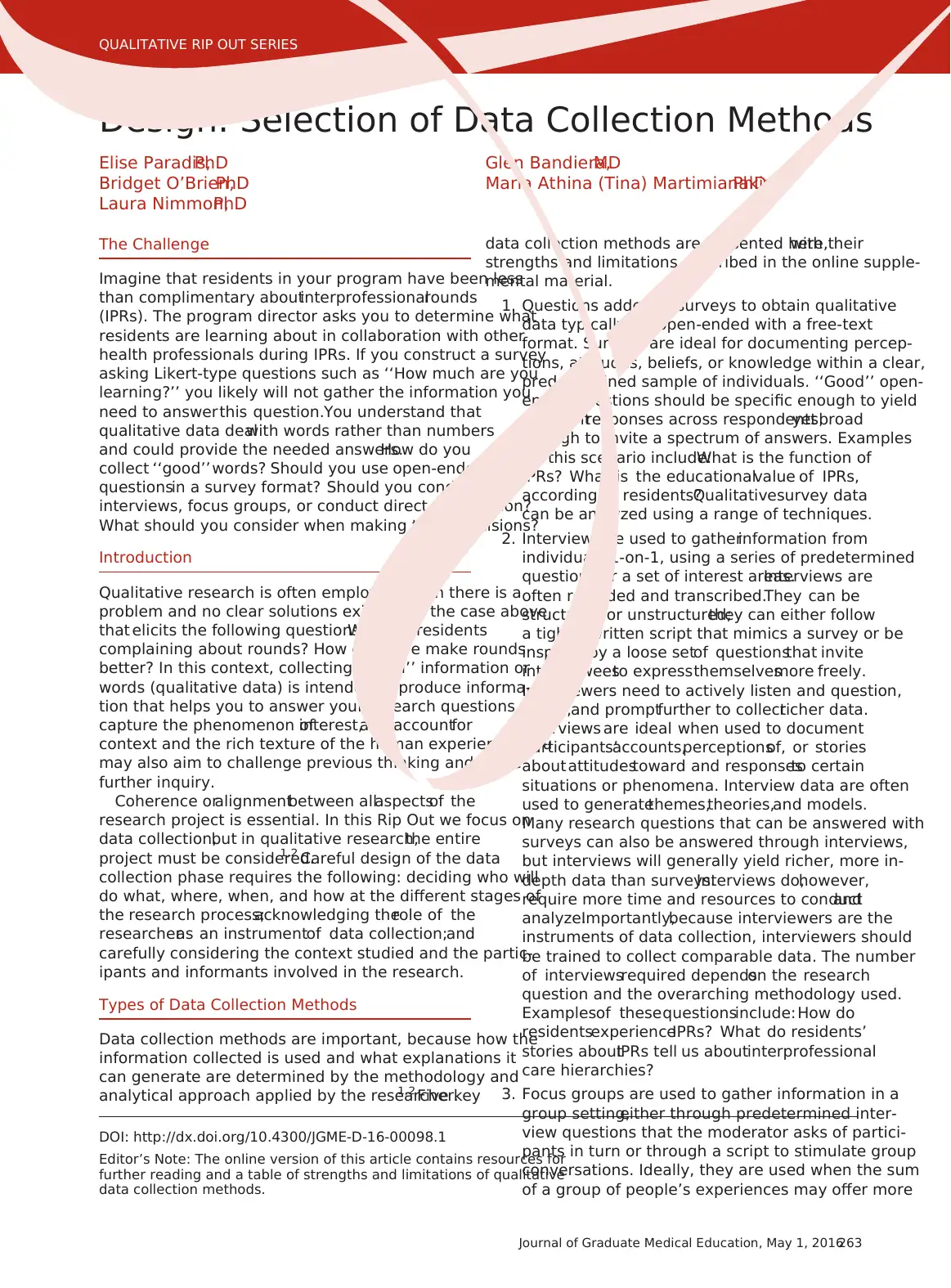
1. Questions added to surveys to obtain qualitative
data typically areopen-ended with a free-text
format. Surveys are ideal for documenting percep-
tions, attitudes, beliefs, or knowledge within a clear,
predetermined sample of individuals. ‘‘Good’’ open-
ended questions should be specific enough to yield
coherentresponses across respondents,yet broad
enough to invite a spectrum of answers. Examples
for this scenario include:What is the function of
IPRs? What is the educationalvalue of IPRs,
according to residents?Qualitativesurvey data
can be analyzed using a range of techniques.
2. Interviewsare used to gatherinformation from
individuals 1-on-1, using a series of predetermined
questions or a set of interest areas.Interviews are
often recorded and transcribed.They can be
structured or unstructured;they can either follow
a tightly written script that mimics a survey or be
inspired by a loose setof questionsthat invite
intervieweesto expressthemselvesmore freely.
Interviewers need to actively listen and question,
probe,and promptfurther to collectricher data.
Interviews are ideal when used to document
participants’accounts,perceptionsof, or stories
aboutattitudestoward and responsesto certain
situations or phenomena. Interview data are often
used to generatethemes,theories,and models.
Many research questions that can be answered with
surveys can also be answered through interviews,
but interviews will generally yield richer, more in-
depth data than surveys.Interviews do,however,
require more time and resources to conductand
analyze.Importantly,because interviewers are the
instruments of data collection, interviewers should
be trained to collect comparable data. The number
of interviewsrequired dependson the research
question and the overarching methodology used.
Examplesof thesequestionsinclude: How do
residentsexperienceIPRs? What do residents’
stories aboutIPRs tell us aboutinterprofessional
care hierarchies?
3. Focus groups are used to gather information in a
group setting,either through predetermined inter-
view questions that the moderator asks of partici-
pants in turn or through a script to stimulate group
conversations. Ideally, they are used when the sum
of a group of people’s experiences may offer more
DOI: http://dx.doi.org/10.4300/JGME-D-16-00098.1
Editor’s Note: The online version of this article contains resources for
further reading and a table of strengths and limitations of qualitative
data collection methods.
Journal of Graduate Medical Education, May 1, 2016263
QUALITATIVE RIP OUT SERIES
Elise Paradis,PhD
Bridget O’Brien,PhD
Laura Nimmon,PhD
Glen Bandiera,MD
Maria Athina (Tina) Martimianakis,PhD
The Challenge
Imagine that residents in your program have been less
than complimentary aboutinterprofessionalrounds
(IPRs). The program director asks you to determine what
residents are learning about in collaboration with other
health professionals during IPRs. If you construct a survey
asking Likert-type questions such as ‘‘How much are you
learning?’’ you likely will not gather the information you
need to answerthis question.You understand that
qualitative data dealwith words rather than numbers
and could provide the needed answers.How do you
collect ‘‘good’’words? Should you use open-ended
questionsin a survey format? Should you conduct
interviews, focus groups, or conduct direct observation?
What should you consider when making these decisions?
Introduction
Qualitative research is often employed when there is a
problem and no clear solutions exist, as in the case above
that elicits the following questions:Why are residents
complaining about rounds? How could we make rounds
better? In this context, collecting ‘‘good’’ information or
words (qualitative data) is intended to produce informa-
tion that helps you to answer your research questions,
capture the phenomenon ofinterest,and accountfor
context and the rich texture of the human experience. You
may also aim to challenge previous thinking and invite
further inquiry.
Coherence oralignmentbetween allaspectsof the
research project is essential. In this Rip Out we focus on
data collection,but in qualitative research,the entire
project must be considered.1,2 Careful design of the data
collection phase requires the following: deciding who will
do what, where, when, and how at the different stages of
the research process;acknowledging therole of the
researcheras an instrumentof data collection;and
carefully considering the context studied and the partic-
ipants and informants involved in the research.
Types of Data Collection Methods
Data collection methods are important, because how the
information collected is used and what explanations it
can generate are determined by the methodology and
analytical approach applied by the researcher.1,2 Five key
data collection methods are presented here,with their
strengths and limitations described in the online supple-
mental material.
1. Questions added to surveys to obtain qualitative
data typically areopen-ended with a free-text
format. Surveys are ideal for documenting percep-
tions, attitudes, beliefs, or knowledge within a clear,
predetermined sample of individuals. ‘‘Good’’ open-
ended questions should be specific enough to yield
coherentresponses across respondents,yet broad
enough to invite a spectrum of answers. Examples
for this scenario include:What is the function of
IPRs? What is the educationalvalue of IPRs,
according to residents?Qualitativesurvey data
can be analyzed using a range of techniques.
2. Interviewsare used to gatherinformation from
individuals 1-on-1, using a series of predetermined
questions or a set of interest areas.Interviews are
often recorded and transcribed.They can be
structured or unstructured;they can either follow
a tightly written script that mimics a survey or be
inspired by a loose setof questionsthat invite
intervieweesto expressthemselvesmore freely.
Interviewers need to actively listen and question,
probe,and promptfurther to collectricher data.
Interviews are ideal when used to document
participants’accounts,perceptionsof, or stories
aboutattitudestoward and responsesto certain
situations or phenomena. Interview data are often
used to generatethemes,theories,and models.
Many research questions that can be answered with
surveys can also be answered through interviews,
but interviews will generally yield richer, more in-
depth data than surveys.Interviews do,however,
require more time and resources to conductand
analyze.Importantly,because interviewers are the
instruments of data collection, interviewers should
be trained to collect comparable data. The number
of interviewsrequired dependson the research
question and the overarching methodology used.
Examplesof thesequestionsinclude: How do
residentsexperienceIPRs? What do residents’
stories aboutIPRs tell us aboutinterprofessional
care hierarchies?
3. Focus groups are used to gather information in a
group setting,either through predetermined inter-
view questions that the moderator asks of partici-
pants in turn or through a script to stimulate group
conversations. Ideally, they are used when the sum
of a group of people’s experiences may offer more
DOI: http://dx.doi.org/10.4300/JGME-D-16-00098.1
Editor’s Note: The online version of this article contains resources for
further reading and a table of strengths and limitations of qualitative
data collection methods.
Journal of Graduate Medical Education, May 1, 2016263
QUALITATIVE RIP OUT SERIES
Paraphrase This Document
Need a fresh take? Get an instant paraphrase of this document with our AI Paraphraser

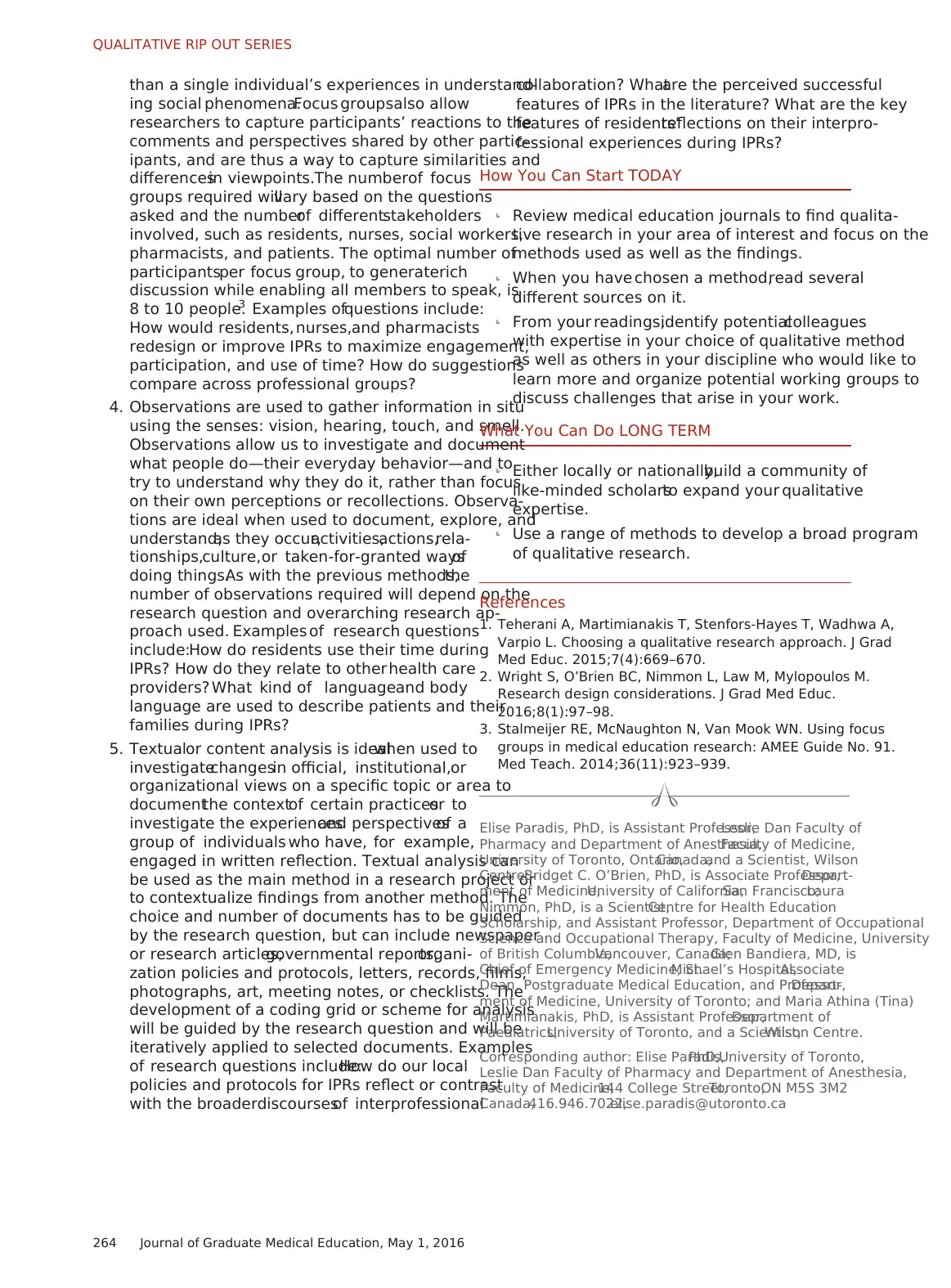
than a single individual’s experiences in understand-
ing social phenomena.Focus groupsalso allow
researchers to capture participants’ reactions to the
comments and perspectives shared by other partic-
ipants, and are thus a way to capture similarities and
differencesin viewpoints.The numberof focus
groups required willvary based on the questions
asked and the numberof differentstakeholders
involved, such as residents, nurses, social workers,
pharmacists, and patients. The optimal number of
participantsper focus group, to generaterich
discussion while enabling all members to speak, is
8 to 10 people.3 Examples ofquestions include:
How would residents, nurses,and pharmacists
redesign or improve IPRs to maximize engagement,
participation, and use of time? How do suggestions
compare across professional groups?
4. Observations are used to gather information in situ
using the senses: vision, hearing, touch, and smell.
Observations allow us to investigate and document
what people do—their everyday behavior—and to
try to understand why they do it, rather than focus
on their own perceptions or recollections. Observa-
tions are ideal when used to document, explore, and
understand,as they occur,activities,actions,rela-
tionships,culture,or taken-for-granted waysof
doing things.As with the previous methods,the
number of observations required will depend on the
research question and overarching research ap-
proach used. Examples of research questions
include:How do residents use their time during
IPRs? How do they relate to other health care
providers? What kind of languageand body
language are used to describe patients and their
families during IPRs?
5. Textualor content analysis is idealwhen used to
investigatechangesin official, institutional,or
organizational views on a specific topic or area to
documentthe contextof certain practicesor to
investigate the experiencesand perspectivesof a
group of individuals who have, for example,
engaged in written reflection. Textual analysis can
be used as the main method in a research project or
to contextualize findings from another method. The
choice and number of documents has to be guided
by the research question, but can include newspaper
or research articles,governmental reports,organi-
zation policies and protocols, letters, records, films,
photographs, art, meeting notes, or checklists. The
development of a coding grid or scheme for analysis
will be guided by the research question and will be
iteratively applied to selected documents. Examples
of research questions include:How do our local
policies and protocols for IPRs reflect or contrast
with the broaderdiscoursesof interprofessional
collaboration? Whatare the perceived successful
features of IPRs in the literature? What are the key
features of residents’reflections on their interpro-
fessional experiences during IPRs?
How You Can Start TODAY
& Review medical education journals to find qualita-
tive research in your area of interest and focus on the
methods used as well as the findings.
& When you have chosen a method,read several
different sources on it.
& From your readings,identify potentialcolleagues
with expertise in your choice of qualitative method
as well as others in your discipline who would like to
learn more and organize potential working groups to
discuss challenges that arise in your work.
What You Can Do LONG TERM
& Either locally or nationally,build a community of
like-minded scholarsto expand your qualitative
expertise.
& Use a range of methods to develop a broad program
of qualitative research.
References
1. Teherani A, Martimianakis T, Stenfors-Hayes T, Wadhwa A,
Varpio L. Choosing a qualitative research approach. J Grad
Med Educ. 2015;7(4):669–670.
2. Wright S, O’Brien BC, Nimmon L, Law M, Mylopoulos M.
Research design considerations. J Grad Med Educ.
2016;8(1):97–98.
3. Stalmeijer RE, McNaughton N, Van Mook WN. Using focus
groups in medical education research: AMEE Guide No. 91.
Med Teach. 2014;36(11):923–939.
Elise Paradis, PhD, is Assistant Professor,Leslie Dan Faculty of
Pharmacy and Department of Anesthesia,Faculty of Medicine,
University of Toronto, Ontario,Canada,and a Scientist, Wilson
Centre;Bridget C. O’Brien, PhD, is Associate Professor,Depart-
ment of Medicine,University of California,San Francisco;Laura
Nimmon, PhD, is a Scientist,Centre for Health Education
Scholarship, and Assistant Professor, Department of Occupational
Science and Occupational Therapy, Faculty of Medicine, University
of British Columbia,Vancouver, Canada;Glen Bandiera, MD, is
Chief of Emergency Medicine, St.Michael’s Hospital,Associate
Dean, Postgraduate Medical Education, and Professor,Depart-
ment of Medicine, University of Toronto; and Maria Athina (Tina)
Martimianakis, PhD, is Assistant Professor,Department of
Paediatrics,University of Toronto, and a Scientist,Wilson Centre.
Corresponding author: Elise Paradis,PhD,University of Toronto,
Leslie Dan Faculty of Pharmacy and Department of Anesthesia,
Faculty of Medicine,144 College Street,Toronto,ON M5S 3M2
Canada,416.946.7022,elise.paradis@utoronto.ca
QUALITATIVE RIP OUT SERIES
264 Journal of Graduate Medical Education, May 1, 2016
ing social phenomena.Focus groupsalso allow
researchers to capture participants’ reactions to the
comments and perspectives shared by other partic-
ipants, and are thus a way to capture similarities and
differencesin viewpoints.The numberof focus
groups required willvary based on the questions
asked and the numberof differentstakeholders
involved, such as residents, nurses, social workers,
pharmacists, and patients. The optimal number of
participantsper focus group, to generaterich
discussion while enabling all members to speak, is
8 to 10 people.3 Examples ofquestions include:
How would residents, nurses,and pharmacists
redesign or improve IPRs to maximize engagement,
participation, and use of time? How do suggestions
compare across professional groups?
4. Observations are used to gather information in situ
using the senses: vision, hearing, touch, and smell.
Observations allow us to investigate and document
what people do—their everyday behavior—and to
try to understand why they do it, rather than focus
on their own perceptions or recollections. Observa-
tions are ideal when used to document, explore, and
understand,as they occur,activities,actions,rela-
tionships,culture,or taken-for-granted waysof
doing things.As with the previous methods,the
number of observations required will depend on the
research question and overarching research ap-
proach used. Examples of research questions
include:How do residents use their time during
IPRs? How do they relate to other health care
providers? What kind of languageand body
language are used to describe patients and their
families during IPRs?
5. Textualor content analysis is idealwhen used to
investigatechangesin official, institutional,or
organizational views on a specific topic or area to
documentthe contextof certain practicesor to
investigate the experiencesand perspectivesof a
group of individuals who have, for example,
engaged in written reflection. Textual analysis can
be used as the main method in a research project or
to contextualize findings from another method. The
choice and number of documents has to be guided
by the research question, but can include newspaper
or research articles,governmental reports,organi-
zation policies and protocols, letters, records, films,
photographs, art, meeting notes, or checklists. The
development of a coding grid or scheme for analysis
will be guided by the research question and will be
iteratively applied to selected documents. Examples
of research questions include:How do our local
policies and protocols for IPRs reflect or contrast
with the broaderdiscoursesof interprofessional
collaboration? Whatare the perceived successful
features of IPRs in the literature? What are the key
features of residents’reflections on their interpro-
fessional experiences during IPRs?
How You Can Start TODAY
& Review medical education journals to find qualita-
tive research in your area of interest and focus on the
methods used as well as the findings.
& When you have chosen a method,read several
different sources on it.
& From your readings,identify potentialcolleagues
with expertise in your choice of qualitative method
as well as others in your discipline who would like to
learn more and organize potential working groups to
discuss challenges that arise in your work.
What You Can Do LONG TERM
& Either locally or nationally,build a community of
like-minded scholarsto expand your qualitative
expertise.
& Use a range of methods to develop a broad program
of qualitative research.
References
1. Teherani A, Martimianakis T, Stenfors-Hayes T, Wadhwa A,
Varpio L. Choosing a qualitative research approach. J Grad
Med Educ. 2015;7(4):669–670.
2. Wright S, O’Brien BC, Nimmon L, Law M, Mylopoulos M.
Research design considerations. J Grad Med Educ.
2016;8(1):97–98.
3. Stalmeijer RE, McNaughton N, Van Mook WN. Using focus
groups in medical education research: AMEE Guide No. 91.
Med Teach. 2014;36(11):923–939.
Elise Paradis, PhD, is Assistant Professor,Leslie Dan Faculty of
Pharmacy and Department of Anesthesia,Faculty of Medicine,
University of Toronto, Ontario,Canada,and a Scientist, Wilson
Centre;Bridget C. O’Brien, PhD, is Associate Professor,Depart-
ment of Medicine,University of California,San Francisco;Laura
Nimmon, PhD, is a Scientist,Centre for Health Education
Scholarship, and Assistant Professor, Department of Occupational
Science and Occupational Therapy, Faculty of Medicine, University
of British Columbia,Vancouver, Canada;Glen Bandiera, MD, is
Chief of Emergency Medicine, St.Michael’s Hospital,Associate
Dean, Postgraduate Medical Education, and Professor,Depart-
ment of Medicine, University of Toronto; and Maria Athina (Tina)
Martimianakis, PhD, is Assistant Professor,Department of
Paediatrics,University of Toronto, and a Scientist,Wilson Centre.
Corresponding author: Elise Paradis,PhD,University of Toronto,
Leslie Dan Faculty of Pharmacy and Department of Anesthesia,
Faculty of Medicine,144 College Street,Toronto,ON M5S 3M2
Canada,416.946.7022,elise.paradis@utoronto.ca
QUALITATIVE RIP OUT SERIES
264 Journal of Graduate Medical Education, May 1, 2016
1 out of 2
Related Documents
Your All-in-One AI-Powered Toolkit for Academic Success.
+13062052269
info@desklib.com
Available 24*7 on WhatsApp / Email
Unlock your academic potential
Copyright © 2020–2025 A2Z Services. All Rights Reserved. Developed and managed by ZUCOL.