University Psychology Assignment: Decreasing Smoking Behavior Analysis
VerifiedAdded on 2022/09/28
|12
|2957
|20
Report
AI Summary
This report provides a comprehensive analysis of smoking behavior from a psychological perspective, focusing on the application of behavioral theories to understand and modify the habit. The report begins with an examination of the main principles and concept domains of current psychological research and practice, highlighting the importance of functional assessment in identifying the antecedents and consequences of smoking. It then delves into the behavioral processes that contribute to the development and maintenance of smoking, including social learning theory, reinforcement (both positive and negative), and classical conditioning. Section 2 focuses on behavior modification techniques, exploring strategies based on social learning theory, negative reinforcement, and punishment to achieve smoking cessation. The report concludes by evaluating the strengths and weaknesses of behavioral approaches to smoking cessation, considering factors such as patient motivation, choice of contingencies, and contiguity in the context of treatment effectiveness.
Running head: DECREASING SMOKING BEHAVIOR 1
Decreasing Smoking Behavior
Name
University Affiliation
Decreasing Smoking Behavior
Name
University Affiliation

Paraphrase This Document
Need a fresh take? Get an instant paraphrase of this document with our AI Paraphraser
DECREASING SMOKING BEHAVIOR 2
Decreasing Smoking Behavior
Section 1: Main Principles and Concept Domains of Current Psychological Research and
Practice
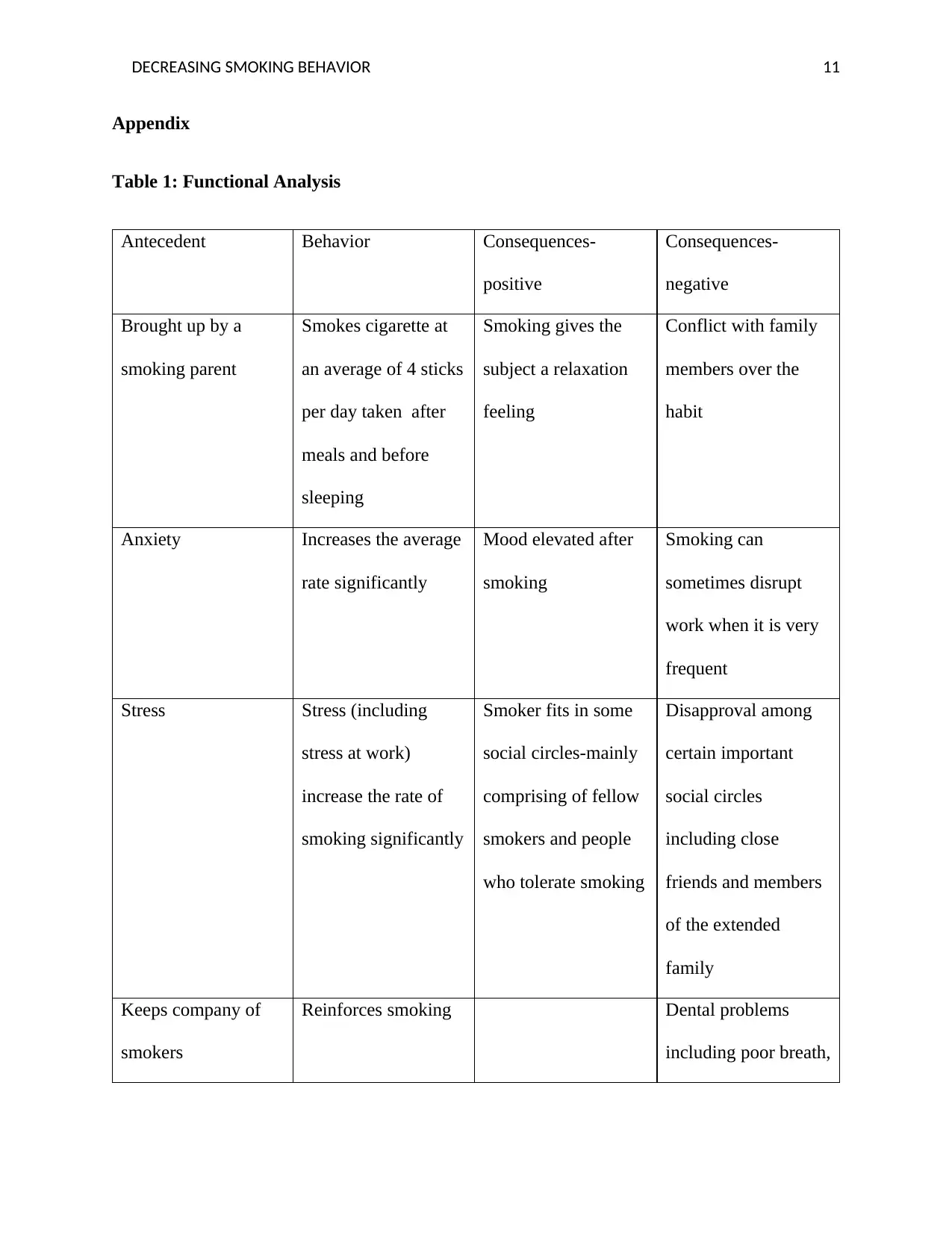
According to Cole and Bonem (2010), the purpose of a functional assessment for
cigarette smoking is to identify the series of events that culminate in an individual smoking and
to identify the specific consequences of the behavior. The approach is based on the idea that
smoking is initiated and maintained by multiple factors and serves different purposes for
different people. One of the main benefits of the analysis is to make a patient aware that
‘smoking does not just happen’. Rather, smoking has a variety of antecedents and consequences.
Cole and Bonem (2010) found that a person could invent causes of smoking when he is not
aware of the personal antecedents to smoking. This reduces the chances of the person
implementing an effective cessation strategy. Therefore, a functional assessment of the behavior
allows an individual to better understand his problem and actively engage in formulating and
implementing a cessation strategy. This paper presents a functional assessment of the author’s
smoking habit using behavioral theory to establish how the behavior developed and subsequently
maintained. This section presents an overview of the behavioral processes that were most
important in developing and maintaining the behavior from the author’s perspective.
The social learning theory is among the most influential behavioral theories that can
explain the development of the habit of cigarette smoking. The theory presents that human
behavior can develop through imitation or observation. In the context of smoking, an individual
can start smoking after staying in the company of smokers for some time. The theory does not
require that behavior be reinforced directly or through motor reproduction. Rather, the social
Decreasing Smoking Behavior
Section 1: Main Principles and Concept Domains of Current Psychological Research and
Practice
According to Cole and Bonem (2010), the purpose of a functional assessment for
cigarette smoking is to identify the series of events that culminate in an individual smoking and
to identify the specific consequences of the behavior. The approach is based on the idea that
smoking is initiated and maintained by multiple factors and serves different purposes for
different people. One of the main benefits of the analysis is to make a patient aware that
‘smoking does not just happen’. Rather, smoking has a variety of antecedents and consequences.
Cole and Bonem (2010) found that a person could invent causes of smoking when he is not
aware of the personal antecedents to smoking. This reduces the chances of the person
implementing an effective cessation strategy. Therefore, a functional assessment of the behavior
allows an individual to better understand his problem and actively engage in formulating and
implementing a cessation strategy. This paper presents a functional assessment of the author’s
smoking habit using behavioral theory to establish how the behavior developed and subsequently
maintained. This section presents an overview of the behavioral processes that were most
important in developing and maintaining the behavior from the author’s perspective.
The social learning theory is among the most influential behavioral theories that can
explain the development of the habit of cigarette smoking. The theory presents that human
behavior can develop through imitation or observation. In the context of smoking, an individual
can start smoking after staying in the company of smokers for some time. The theory does not
require that behavior be reinforced directly or through motor reproduction. Rather, the social
DECREASING SMOKING BEHAVIOR 3
learning theory presents that learning can occur because of mere observation or direct instruction
(Ennett, et al., 2010). In the case of smoking, direct instruction is quite rare; it is rare for an
individual to sit another down to teach him how to smoke. However, observation is prevalent.
For instance, the children of a smoker parent will observe him/her smoking when he/her smokes
in their presence. Similarly, age mates who have smokers in their social circles are likely to
witness their friend smoke on multiple occasions during social interactions. According to the
social learning theory, this kind of exposure can initiate and maintain smoking behavior.
Reinforcement is another plausible explanation for the smoking behavior. Reinforcement
is an outcome of behavior that encourages an organism to behave in a certain manner in future.
Reinforcement can be negative or positive. This means that the outcome of behaving in a certain
manner can encourage or dissuade an organism from behaving in a similar manner later. For a
smoker, there are multiple subjective reinforcements to the behavior. Physiologically, nicotine
inhalation produces some form of nervous stimulation (Hiscocka, et al., 2013). A person can
continue smoking while pursuing this stimulation. At the same time, smoking can have some
social benefits that enhance the development of the behavior. For instance, a teenager can initiate
smoking because of peer pressure and the need to belong to a group. There are negative
reinforcements that could dissuade an individual from pursuing the habit. For instance, smoking
is generally considered an anti-social behavior. Smokers who face rejection in their social circles
due to the habit can feel the urge to stop the habit to regain their social standing (Ennett, et al.,
2010).
Finally, the classical conditioning also presents a plausible argument for the development
and maintenance of the habit of smoking. Classical conditioning is a situation where a
conditioned response is linked to an unconditioned stimulus. The conditioned response is a
learning theory presents that learning can occur because of mere observation or direct instruction
(Ennett, et al., 2010). In the case of smoking, direct instruction is quite rare; it is rare for an
individual to sit another down to teach him how to smoke. However, observation is prevalent.
For instance, the children of a smoker parent will observe him/her smoking when he/her smokes
in their presence. Similarly, age mates who have smokers in their social circles are likely to
witness their friend smoke on multiple occasions during social interactions. According to the
social learning theory, this kind of exposure can initiate and maintain smoking behavior.
Reinforcement is another plausible explanation for the smoking behavior. Reinforcement
is an outcome of behavior that encourages an organism to behave in a certain manner in future.
Reinforcement can be negative or positive. This means that the outcome of behaving in a certain
manner can encourage or dissuade an organism from behaving in a similar manner later. For a
smoker, there are multiple subjective reinforcements to the behavior. Physiologically, nicotine
inhalation produces some form of nervous stimulation (Hiscocka, et al., 2013). A person can
continue smoking while pursuing this stimulation. At the same time, smoking can have some
social benefits that enhance the development of the behavior. For instance, a teenager can initiate
smoking because of peer pressure and the need to belong to a group. There are negative
reinforcements that could dissuade an individual from pursuing the habit. For instance, smoking
is generally considered an anti-social behavior. Smokers who face rejection in their social circles
due to the habit can feel the urge to stop the habit to regain their social standing (Ennett, et al.,
2010).
Finally, the classical conditioning also presents a plausible argument for the development
and maintenance of the habit of smoking. Classical conditioning is a situation where a
conditioned response is linked to an unconditioned stimulus. The conditioned response is a
⊘ This is a preview!⊘
Do you want full access?
Subscribe today to unlock all pages.

Trusted by 1+ million students worldwide
DECREASING SMOKING BEHAVIOR 4
biological response such as feeling hungry or thirsty. A good example of classical conditioning is
the case of a dog that salivates every time a bell is rung just before the animal is fed. The dog
learns to associate the sound of the bell with the presence of food. In a similar manner, a smoker
can learn to associate certain events with the urge to smoke. For instance, a smoker who only
smokes during social events such as drinking parties could end up feeling an intense urge to
smoke whenever he attends such events. In this case, presence at a beer party is an unconditioned
stimulant that produces a conditioned response; the urge to consume nicotine.
Section 2: Behavior Modification
From the foregoing discussion, smoking cessation can be achieved in several ways. First,
a cessation plan can be based on the social learning theory. As pointed out in the previous
section, the social learning theory presents that an individual can adopt a behavior through
observation or direct instruction. According to Slama, Chiang, and Enarson (2017) smokers can
apply the social learning theory to quit smoking by breaking all situational and emotional ties to
smoking. For instance, a friend who is pushed to smoke by peer pressure can quit smoking by
changing his friends. Similarly, an individual who feels a strong urge to smoke whenever he is in
a ceratin situation (such as when out drinking alcohol) can achieve cessation by avoiding such
situations. Avoidng these situations denies the individual an opportunity to observe the act of
smoking. This strategy is particularly effective for smokers in the innitiation stage (Ennett, et al.,
2010). Since such individuals are yet to develop intense nicotine dependence, it is easy for them
to dissociate from the habit by avoiding exposure to smokers. Smoking of cigarette and others
causes some severe consequences to the smoker. For instance, the smoker can be diagonised with
lung cancer. This can affect the family directly and indirectly. For example, the affected person
can spend millions of money while treating the disease in the long run, also, the affected person
biological response such as feeling hungry or thirsty. A good example of classical conditioning is
the case of a dog that salivates every time a bell is rung just before the animal is fed. The dog
learns to associate the sound of the bell with the presence of food. In a similar manner, a smoker
can learn to associate certain events with the urge to smoke. For instance, a smoker who only
smokes during social events such as drinking parties could end up feeling an intense urge to
smoke whenever he attends such events. In this case, presence at a beer party is an unconditioned
stimulant that produces a conditioned response; the urge to consume nicotine.
Section 2: Behavior Modification
From the foregoing discussion, smoking cessation can be achieved in several ways. First,
a cessation plan can be based on the social learning theory. As pointed out in the previous
section, the social learning theory presents that an individual can adopt a behavior through
observation or direct instruction. According to Slama, Chiang, and Enarson (2017) smokers can
apply the social learning theory to quit smoking by breaking all situational and emotional ties to
smoking. For instance, a friend who is pushed to smoke by peer pressure can quit smoking by
changing his friends. Similarly, an individual who feels a strong urge to smoke whenever he is in
a ceratin situation (such as when out drinking alcohol) can achieve cessation by avoiding such
situations. Avoidng these situations denies the individual an opportunity to observe the act of
smoking. This strategy is particularly effective for smokers in the innitiation stage (Ennett, et al.,
2010). Since such individuals are yet to develop intense nicotine dependence, it is easy for them
to dissociate from the habit by avoiding exposure to smokers. Smoking of cigarette and others
causes some severe consequences to the smoker. For instance, the smoker can be diagonised with
lung cancer. This can affect the family directly and indirectly. For example, the affected person
can spend millions of money while treating the disease in the long run, also, the affected person
Paraphrase This Document
Need a fresh take? Get an instant paraphrase of this document with our AI Paraphraser
DECREASING SMOKING BEHAVIOR 5
due to spending the millions in the hospital bills may fail to pay school fees for her children in
the long run. In the same case, the affected children may fail the sense of denial as their guardian
may fail to deliver basic need such as education among others. On other cases the case may be
far ending.
Second, using negative or alternative reinforcement is an approach to the application of
social learning theory to change the habit of smoking. Smoking is encouraged by positive
reinforcers such as peer approval and the instantenous relaxation that an individual feels when he
smokes. In a similar manner, the habit can be discouraged through negative reinforcement. In the
context of smoking, negative reinforcement is where an unfavourable or unwanted consequence
is imposed after smoking. According to Slama, Chiang, & Enarson (2017), drugs in general are a
positive reinforcer of continued drug consumption. This is because a drug is desirable to an
abuser. Therefore, imposing some negative consequences for taking a given drug could
counteract the positove reinforcement of drug abuse. The effectivenness of negative
reinforcement is highly dependent on the individual to whom the therapy is applied. Therefore,
there are individuals for whom simple deterrents such as disapproving comments from strangers
can produce significant willingness to quit. On the other hand, some patients may require more
intense negative consequences to influence behaviour change.
Next, smoking cessation can be encouraged through punishment. Punishment is closely
related to negative reinforcement. By definition, punishment is a form of operant conditioning
whereby engaging in a certain behaviour is discouraged by an unfavourable change in the
individual’s environment. Like the case of reinforcement, punishment is not metted on the
individual. Rather, punishment is metted on the behaviour. In this context, punishment does not
necessarily imply a hostile outcome. However, it is any change in the environment that
due to spending the millions in the hospital bills may fail to pay school fees for her children in
the long run. In the same case, the affected children may fail the sense of denial as their guardian
may fail to deliver basic need such as education among others. On other cases the case may be
far ending.
Second, using negative or alternative reinforcement is an approach to the application of
social learning theory to change the habit of smoking. Smoking is encouraged by positive
reinforcers such as peer approval and the instantenous relaxation that an individual feels when he
smokes. In a similar manner, the habit can be discouraged through negative reinforcement. In the
context of smoking, negative reinforcement is where an unfavourable or unwanted consequence
is imposed after smoking. According to Slama, Chiang, & Enarson (2017), drugs in general are a
positive reinforcer of continued drug consumption. This is because a drug is desirable to an
abuser. Therefore, imposing some negative consequences for taking a given drug could
counteract the positove reinforcement of drug abuse. The effectivenness of negative
reinforcement is highly dependent on the individual to whom the therapy is applied. Therefore,
there are individuals for whom simple deterrents such as disapproving comments from strangers
can produce significant willingness to quit. On the other hand, some patients may require more
intense negative consequences to influence behaviour change.
Next, smoking cessation can be encouraged through punishment. Punishment is closely
related to negative reinforcement. By definition, punishment is a form of operant conditioning
whereby engaging in a certain behaviour is discouraged by an unfavourable change in the
individual’s environment. Like the case of reinforcement, punishment is not metted on the
individual. Rather, punishment is metted on the behaviour. In this context, punishment does not
necessarily imply a hostile outcome. However, it is any change in the environment that
DECREASING SMOKING BEHAVIOR 6
discourages a repeat of a given behaviour. Punishment can be positive oor negative. Positive
punishment is aversive change in an individual’s environment. This could be some form of mild
pain. For instance, a smoker can put on a rubber band on his arm. Anytime he feels the urge to
smoke, he could pull and release the rubber band once or several times. This action causes the
subject some mild pain. When repeated severally, the action will condition the brain to associate
the urge to smoke with pain. In some cases, this therapy can produce significant cessation to
smoking. On the other hand, negative punishment is that which involves the withdrawal of an
appetitive stimulant each time a behaviour is observed. For instance, a person who spends his
leisure time watching movies can decrease his watching time by some amount each time he fails
to meet his cessation targets. Consistent punishment encourages cessation by reinforcing
punishment avoiding behaviour (Cole & Bonem, 2010). For a smoker, the individual is
motivated to meet cessation targets to avoid punishment. Smoking of cigarette and others causes
some severe consequences to the smoker. For instance, the smoker can be diagnosed with lung
cancer. This can affect the family directly and indirectly. For example, the affected person can
spend millions of money while treating the disease in the long run, also, the affected person due
to spending the millions in the hospital bills may fail to pay school fees for her children in the
long run. In the same case, the affected children may fail the sense of denial as their guardian
may fail to deliver basic need such as education among others. On other cases the case may be
far ending.
Section 3: The Strengths and Weaknesses of Behavioral Approaches to Smoking Cessation
Behavioral approaches to reducing smoking, such as the ones discussed in the previous
sections, have their advantages and disadvantages. A key advantage of behavioral approaches to
changing the behaviour of smoking and reverting any drug abuse problem in general is that the
discourages a repeat of a given behaviour. Punishment can be positive oor negative. Positive
punishment is aversive change in an individual’s environment. This could be some form of mild
pain. For instance, a smoker can put on a rubber band on his arm. Anytime he feels the urge to
smoke, he could pull and release the rubber band once or several times. This action causes the
subject some mild pain. When repeated severally, the action will condition the brain to associate
the urge to smoke with pain. In some cases, this therapy can produce significant cessation to
smoking. On the other hand, negative punishment is that which involves the withdrawal of an
appetitive stimulant each time a behaviour is observed. For instance, a person who spends his
leisure time watching movies can decrease his watching time by some amount each time he fails
to meet his cessation targets. Consistent punishment encourages cessation by reinforcing
punishment avoiding behaviour (Cole & Bonem, 2010). For a smoker, the individual is
motivated to meet cessation targets to avoid punishment. Smoking of cigarette and others causes
some severe consequences to the smoker. For instance, the smoker can be diagnosed with lung
cancer. This can affect the family directly and indirectly. For example, the affected person can
spend millions of money while treating the disease in the long run, also, the affected person due
to spending the millions in the hospital bills may fail to pay school fees for her children in the
long run. In the same case, the affected children may fail the sense of denial as their guardian
may fail to deliver basic need such as education among others. On other cases the case may be
far ending.
Section 3: The Strengths and Weaknesses of Behavioral Approaches to Smoking Cessation
Behavioral approaches to reducing smoking, such as the ones discussed in the previous
sections, have their advantages and disadvantages. A key advantage of behavioral approaches to
changing the behaviour of smoking and reverting any drug abuse problem in general is that the
⊘ This is a preview!⊘
Do you want full access?
Subscribe today to unlock all pages.
Trusted by 1+ million students worldwide
DECREASING SMOKING BEHAVIOR 7
methods are acceptable to a wide range of subjects with the problem. According to Hiscocka et
al (2013), behhavioral approaches are also advatageous because they have a solid ground in
evidence based behaviour theories and principles. The approaches used, including the ones
described in this paper, are strongly supported by empirical evidence. This implies that the
methods used are tested and have been proven to work with a significantly high degree of
certainty. As a result of the empirical basis of these approaches, the treatment goals for plans
using the approaches are clearly defined and there are established guidelines for tracking the
progress of treatment. In addition, the behavioral approaches are highly flexible (Deardof, 2018).
This makes it easy to adapt them to different treatment situations with a few changes.
On the other hand, the behavioral approaches to treating substance abuse have a few
notable weaknesses. Chief among these is the low emphasis on a patient’s motivation to change.
Motivation is an important factor influencing human behaviour. Therefore, absence of
motivation to change can reduce the effectivenness of therapy based on behavioral approaches.
In addition to low emphasis on patient motivation, the group of behavioral approaches have no
procedures for assesing or managing a patient’s willingness to change (Cole & Bonem, 2010;
Leventhal & Zvolensky, 2015). Low motivation and unwillingness to change are significant
factors that can undermine the success of behavioral approaches to cessation of smoking.
A key determinant of the success of behavioral approaches to reducing smoking is poor
choice of contingencies. For instance, for negative reinforcement and punishment to work
effectively, the punishment or negative reinforcement used should be related to the behaviour.
The subject of treatment should at least perceive some form of relationship between the
punishment metted and the behaviour. At the same time, some forms of punishment may
ultimately reinforce the behaviour they are meant to discourage (Guimarães, Nardi, & Cardoso,
methods are acceptable to a wide range of subjects with the problem. According to Hiscocka et
al (2013), behhavioral approaches are also advatageous because they have a solid ground in
evidence based behaviour theories and principles. The approaches used, including the ones
described in this paper, are strongly supported by empirical evidence. This implies that the
methods used are tested and have been proven to work with a significantly high degree of
certainty. As a result of the empirical basis of these approaches, the treatment goals for plans
using the approaches are clearly defined and there are established guidelines for tracking the
progress of treatment. In addition, the behavioral approaches are highly flexible (Deardof, 2018).
This makes it easy to adapt them to different treatment situations with a few changes.
On the other hand, the behavioral approaches to treating substance abuse have a few
notable weaknesses. Chief among these is the low emphasis on a patient’s motivation to change.
Motivation is an important factor influencing human behaviour. Therefore, absence of
motivation to change can reduce the effectivenness of therapy based on behavioral approaches.
In addition to low emphasis on patient motivation, the group of behavioral approaches have no
procedures for assesing or managing a patient’s willingness to change (Cole & Bonem, 2010;
Leventhal & Zvolensky, 2015). Low motivation and unwillingness to change are significant
factors that can undermine the success of behavioral approaches to cessation of smoking.
A key determinant of the success of behavioral approaches to reducing smoking is poor
choice of contingencies. For instance, for negative reinforcement and punishment to work
effectively, the punishment or negative reinforcement used should be related to the behaviour.
The subject of treatment should at least perceive some form of relationship between the
punishment metted and the behaviour. At the same time, some forms of punishment may
ultimately reinforce the behaviour they are meant to discourage (Guimarães, Nardi, & Cardoso,
Paraphrase This Document
Need a fresh take? Get an instant paraphrase of this document with our AI Paraphraser
DECREASING SMOKING BEHAVIOR 8
2014). For instance, an individual who smokes in pursuit of relaxation may smoke more if the
punishment used increases distress. Therefore, the choice of a contingency is an important
determiner of the extent to which the therapy used succeeds.
Another barrier to the implementation of behavioral approaches is contiguity. In the case
of negative reinforcement and punishment, contiguity implies the degree of seperation in time
and location between an instance of the target behaviour and the negative reinforcement or
punishment. To be effective, the negative reinforcement should be delivered as close as possible
to the instance of the target behaviour. This allows the subject to relate the behaviour with the
outcome. Allowing some time delay between the occurrence of an instance of the target
behaviour and the punishment lessens the effectivenness of the treatment approach significantly
(Leventhal & Zvolensky, 2015). During the delay, other forms of behaviour may occur causing
the subject to apportion the punishment to other behaviours other than the target behaviour.
Conclusion
In conclusion, smoking cessation can be encouraged through punishment. Punishment is closely
related to negative reinforcement. By definition, punishment is a form of operant conditioning
whereby engaging in a certain behaviour is discouraged by an unfavourable change in the
individual’s environment. Like the case of reinforcement, punishment is not metted on the
individual. In this context, punishment does not necessarily imply a hostile outcome. However, it
is any change in the environment that discourages a repeat of a given behaviour. Punishment can
be positive oor negative. Positive punishment is aversive change in an individual’s environment.
This could be some form of mild pain. For instance, a smoker can put on a rubber band on his
arm. Anytime he feels the urge to smoke, he could pull and release the rubber band once or
2014). For instance, an individual who smokes in pursuit of relaxation may smoke more if the
punishment used increases distress. Therefore, the choice of a contingency is an important
determiner of the extent to which the therapy used succeeds.
Another barrier to the implementation of behavioral approaches is contiguity. In the case
of negative reinforcement and punishment, contiguity implies the degree of seperation in time
and location between an instance of the target behaviour and the negative reinforcement or
punishment. To be effective, the negative reinforcement should be delivered as close as possible
to the instance of the target behaviour. This allows the subject to relate the behaviour with the
outcome. Allowing some time delay between the occurrence of an instance of the target
behaviour and the punishment lessens the effectivenness of the treatment approach significantly
(Leventhal & Zvolensky, 2015). During the delay, other forms of behaviour may occur causing
the subject to apportion the punishment to other behaviours other than the target behaviour.
Conclusion
In conclusion, smoking cessation can be encouraged through punishment. Punishment is closely
related to negative reinforcement. By definition, punishment is a form of operant conditioning
whereby engaging in a certain behaviour is discouraged by an unfavourable change in the
individual’s environment. Like the case of reinforcement, punishment is not metted on the
individual. In this context, punishment does not necessarily imply a hostile outcome. However, it
is any change in the environment that discourages a repeat of a given behaviour. Punishment can
be positive oor negative. Positive punishment is aversive change in an individual’s environment.
This could be some form of mild pain. For instance, a smoker can put on a rubber band on his
arm. Anytime he feels the urge to smoke, he could pull and release the rubber band once or
DECREASING SMOKING BEHAVIOR 9
several times. This action causes the subject some mild pain. When repeated severally, the action
will condition the brain to associate the urge to smoke with pain. In some cases, this therapy can
produce significant cessation to smoking.
References
several times. This action causes the subject some mild pain. When repeated severally, the action
will condition the brain to associate the urge to smoke with pain. In some cases, this therapy can
produce significant cessation to smoking.
References
⊘ This is a preview!⊘
Do you want full access?
Subscribe today to unlock all pages.
Trusted by 1+ million students worldwide
DECREASING SMOKING BEHAVIOR 10
Axelrod, S. (2011). Smoking Cessation through Functional Analysis. Journal of Applied
Behaviour Analysis.
Cole, M. L., & Bonem, M. K. (2010). The ABCs of Smoking Cessation: Using Behavioral
Strategies to Help Undergraduates Stop Smoking. The Behavior Analyst Today.
Deardof, W. (2018). Psychological-Behavioral Approaches to Quit Smoking. Not known: Veritas
Health.
Ennett, S. T., Foshee, V. A., Bauman, K. E., Hussong, A., Faris, R., Hipp, J. R., & Cai, L.
(2010). A social contextual analysis of youth cigarette smoking development. Oxford
Journals, 950-962.
Guimarães, F. M., Nardi, A. E., & Cardoso, A. (2014). Cognitive behavioral therapy treatment
for smoking alcoholics in outpatients. Medical Express.
Hiscocka, R., Murray, S., S.Brose, L., McEwencd, A., Leonard, J., Dobbie, F., & Bauld, L.
(2013). Behavioural therapy for smoking cessation: The effectiveness of different
intervention types for disadvantaged and affluent smokers. Addictive Behaviours.
Leventhal, A. M., & Zvolensky, M. J. (2015). Anxiety, Depression, and Cigarette Smoking: A
Transdiagnostic Vulnerability Framework to Understanding Emotion-Smoking
Comorbidity. Psychology Bulletin.
Slama, K., Chiang, C., & Enarson, D. (2017). Helping patients to stop smoking. International
Journal of Tuberculosis and Lung Diseases, 733-738.
Axelrod, S. (2011). Smoking Cessation through Functional Analysis. Journal of Applied
Behaviour Analysis.
Cole, M. L., & Bonem, M. K. (2010). The ABCs of Smoking Cessation: Using Behavioral
Strategies to Help Undergraduates Stop Smoking. The Behavior Analyst Today.
Deardof, W. (2018). Psychological-Behavioral Approaches to Quit Smoking. Not known: Veritas
Health.
Ennett, S. T., Foshee, V. A., Bauman, K. E., Hussong, A., Faris, R., Hipp, J. R., & Cai, L.
(2010). A social contextual analysis of youth cigarette smoking development. Oxford
Journals, 950-962.
Guimarães, F. M., Nardi, A. E., & Cardoso, A. (2014). Cognitive behavioral therapy treatment
for smoking alcoholics in outpatients. Medical Express.
Hiscocka, R., Murray, S., S.Brose, L., McEwencd, A., Leonard, J., Dobbie, F., & Bauld, L.
(2013). Behavioural therapy for smoking cessation: The effectiveness of different
intervention types for disadvantaged and affluent smokers. Addictive Behaviours.
Leventhal, A. M., & Zvolensky, M. J. (2015). Anxiety, Depression, and Cigarette Smoking: A
Transdiagnostic Vulnerability Framework to Understanding Emotion-Smoking
Comorbidity. Psychology Bulletin.
Slama, K., Chiang, C., & Enarson, D. (2017). Helping patients to stop smoking. International
Journal of Tuberculosis and Lung Diseases, 733-738.
Paraphrase This Document
Need a fresh take? Get an instant paraphrase of this document with our AI Paraphraser
DECREASING SMOKING BEHAVIOR 11
Appendix
Table 1: Functional Analysis
Antecedent Behavior Consequences-
positive
Consequences-
negative
Brought up by a
smoking parent
Smokes cigarette at
an average of 4 sticks
per day taken after
meals and before
sleeping
Smoking gives the
subject a relaxation
feeling
Conflict with family
members over the
habit
Anxiety Increases the average
rate significantly
Mood elevated after
smoking
Smoking can
sometimes disrupt
work when it is very
frequent
Stress Stress (including
stress at work)
increase the rate of
smoking significantly
Smoker fits in some
social circles-mainly
comprising of fellow
smokers and people
who tolerate smoking
Disapproval among
certain important
social circles
including close
friends and members
of the extended
family
Keeps company of
smokers
Reinforces smoking Dental problems
including poor breath,
Appendix
Table 1: Functional Analysis
Antecedent Behavior Consequences-
positive
Consequences-
negative
Brought up by a
smoking parent
Smokes cigarette at
an average of 4 sticks
per day taken after
meals and before
sleeping
Smoking gives the
subject a relaxation
feeling
Conflict with family
members over the
habit
Anxiety Increases the average
rate significantly
Mood elevated after
smoking
Smoking can
sometimes disrupt
work when it is very
frequent
Stress Stress (including
stress at work)
increase the rate of
smoking significantly
Smoker fits in some
social circles-mainly
comprising of fellow
smokers and people
who tolerate smoking
Disapproval among
certain important
social circles
including close
friends and members
of the extended
family
Keeps company of
smokers
Reinforces smoking Dental problems
including poor breath,
DECREASING SMOKING BEHAVIOR 12
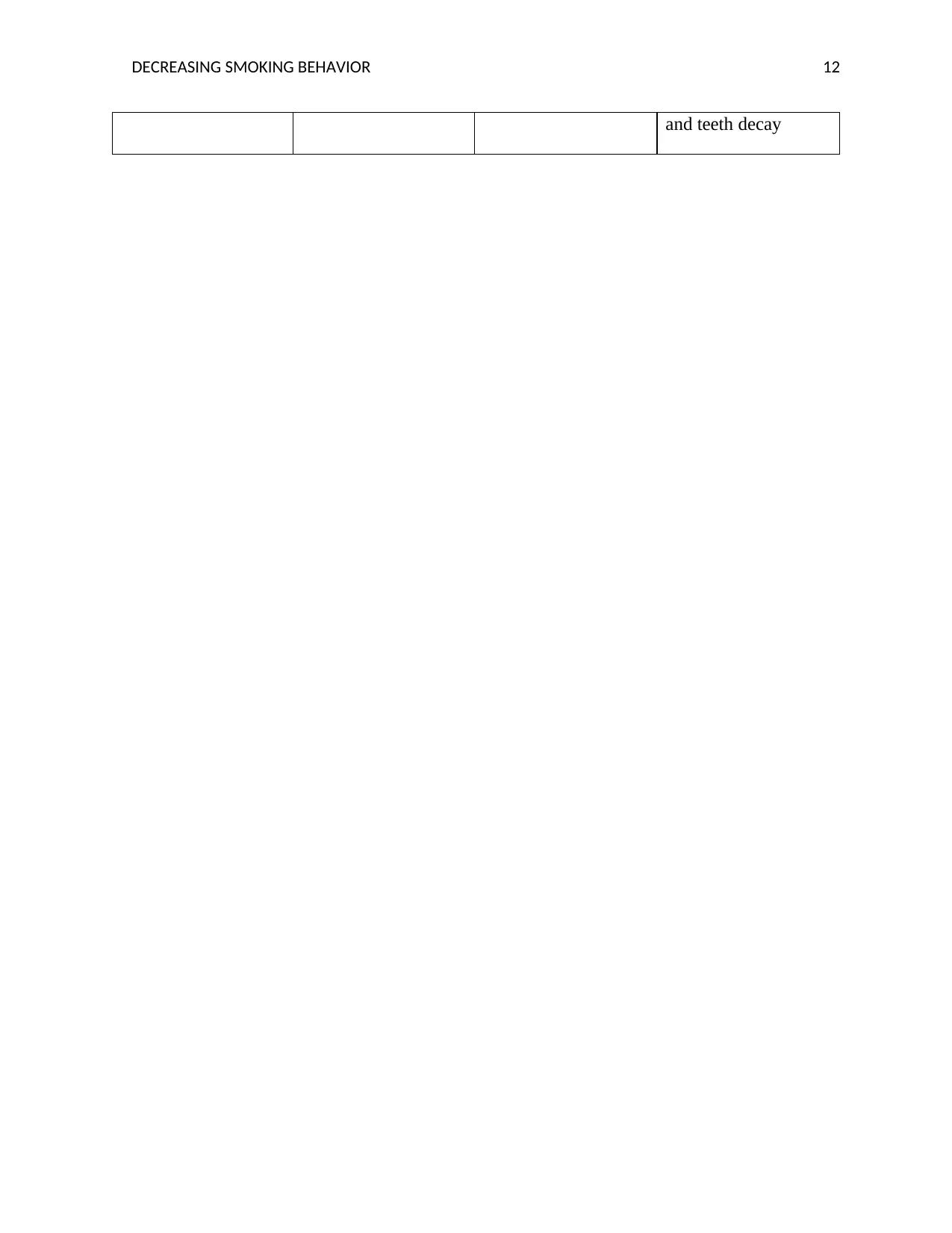
and teeth decay
and teeth decay
⊘ This is a preview!⊘
Do you want full access?
Subscribe today to unlock all pages.
Trusted by 1+ million students worldwide

1 out of 12


Related Documents


Your All-in-One AI-Powered Toolkit for Academic Success.
+13062052269
info@desklib.com
Available 24*7 on WhatsApp / Email
![[object Object]](/_next/static/media/star-bottom.7253800d.svg)
Unlock your academic potential
Copyright © 2020–2026 A2Z Services. All Rights Reserved. Developed and managed by ZUCOL.