COMP640: Technological Changes and Student Effects Capstone Project

Verified

Added on  2022/09/09

|36
|10456
|19
Capstone Project
AI Summary
This capstone project, prepared for COMP640 – Forecasting and Management Technology at the University of the Potomac, investigates the multifaceted impacts of technology on students. The project addresses the increasing dependency on technology and its influence on learning outcomes. It begins by outlining the problem, research questions, and hypotheses, emphasizing the need to understand technology's effects in education. The literature review explores existing research on technology's integration in classrooms and its cognitive and behavioral effects on students. The methodology section details the research approach, data collection methods, and analysis techniques used to assess the impact of various technologies, including e-learning and artificial intelligence. The findings and conclusions summarize the research outcomes, offering insights into how technological changes affect student performance, engagement, and overall development. The project provides a comprehensive analysis, drawing on relevant literature and data, to provide a valuable contribution to the field of educational technology and its implications for student success. The project also includes the use of acronyms, a table of contents, and a list of references.
Document Page
We witness astounding developmentsin this age of information and
communication. Technology has influenced all the aspects of our live
causing inevitable changes and improvements in every field. Naturally, the
world of science has greatly benefited from this change and development.
In consequence, the rapid circulation of information and technology in the
scientific world has increased the cooperation among scientists.This
cooperation highly contributes to researches and studies in the fields
language, history, literature, education, economy, social and cultural
politics, sports, tourism, and media and communication along with m
other areas. Thus, this book contains new horizons in Educational Sciences
in parallel with the improvements in the world of science. In this context,
educational sciences, classroom education, geography education, phys
education, Turkish education, language education, science education,
environmental education, psychological guidance and counseling spec
education, teacher preparation, teaching methods and approaches, voices
on education, social issues and researches about art education studies are
included.
Turhan Çetin was born in Afyonkarahisar.Currentlyhe has been working
in GaziUniversity,Ankara.
AyferŞahin was born in Turkey.Currently she has been working in Kırşehir
Ahi Evran University.
AlmasaMulalićand NudžejmaObralıćhavebeen workingin
InternationalUniversityof SarajevoFacultyof Education Departmentof
EnglishLanguageand Literature,Bosniaand Herzegovina.
978-613-9-92748-7
tabler-icon-diamond-filled.svg

Paraphrase This Document

Need a fresh take? Get an instant paraphrase of this document with our AI Paraphraser
Document Page
Document Page
Document Page
tabler-icon-diamond-filled.svg

Paraphrase This Document

Need a fresh take? Get an instant paraphrase of this document with our AI Paraphraser
Document Page
NEW HORIZONS IN EDUCATIONAL SCIENCES - I
EDITORS
Prof. Dr. Turhan ÇET•N
Gazi University Faculty of Educaiton
Ankara, Turkey.
Assoc. Prof. Dr. Ayfer !AH•N
K•r•ehir Ahi Evran University Faculty of Educaiton
K•r•ehir, Turkey
Assist. Prof. Dr. Almasa MULALI"
International University of Sarajevo Faculty of Educaiton
Sarajevo, Bosnia and Herzegovina
Assist. Prof. Dr. Nudžejma OBRALI"
International University of Sarajevo Faculty of Education
Sarajevo, Bosnia and Herzegovina
All legal responsibility of the references, quotes, ideas, findings, tables,
figures, pictures and the content used in the published article in NEW
HORIZONS IN EDUCATIONAL SCIENCES - I belongs to authors.
Financial and legal responsibility that may be subject to national and
international copyrights belongs to the authors. Editors and publishers do
not accept any responsibility for the content of the published sections. All
Rights Reserved. No part of this book may be reproduced in any form or by
any means (electronic, photocopying, recording or otherwise) without the
written consent of the editors, authors and the publisher.
ISBN 978-613-9-92748-7 LAP Lambert Academic Publication
Lambert AcademicPublication Press, Riga 2018
Document Page
______________________________________________________
New Horizons in Educational Sciences | II
Foreword
We witness astounding developments in this age of information and
communication. Technology has influenced all the aspects of our
lives by causing inevitable changes and improvements in every field.
Naturally, the world of science has greatly benefited from this
change and development. In consequence, the rapid circulation of
information and technology in the scientific world has increased the
cooperation among scientists. This cooperation highly contributes to
researches and studies in the fields of language, history, literature,
education, economy, social and cultural life, politics, sports, tourism,
and media and communication along with many other areas.
Thus, this book contains new horizons in Educational Sciences in
parallel with the improvements in the world of science. In this
context, educational sciences, classroom education, geography
education, physical education, Turkish education, language
education, science education, environmental education,
psychological guidance and counseling special education, teacher
preparation, teaching methods and approaches, voices on education,
social issues and researches about art education studies are included.
It took about one year to prepare and print the book. We would like
to express our deepest gratitude to our friends who contributed to
this process.
Finally, very special thanks go to the authors who contributed to our
book with their researches. It is our greatest wish that this book will
increase the cooperation among scientists to make the world a better
place.
Kind Regards…
Editors
10. 10. 2018
Document Page
tabler-icon-diamond-filled.svg

Paraphrase This Document

Need a fresh take? Get an instant paraphrase of this document with our AI Paraphraser
Document Page
Document Page
Document Page
tabler-icon-diamond-filled.svg

Paraphrase This Document

Need a fresh take? Get an instant paraphrase of this document with our AI Paraphraser
Document Page
Chapter 13 | Kara, F. et al
__________________________________________________________________
New Horizons in Educational Sciences | 242
CHAPTER 13
VIEWS OF GRADUATE AND
UNDERGRADUATE STUDENTS OF SCIENCE
TEACHING ON TECHNOLOGY USE IN
CLASSES 1
Ferda KARA 2, Merve EKER 3, Semra BENZER *4
1. INTRODUCTION
Today, technology has been developing rapidly. Especially in the
last 20 years, the races to produce technology among developed
countries and the madness of consumption have increased. Turkey,
as a major developing country is not yet at the desired level and
needs to change this situation. For this purpose, it is imperative that
our children, whom we rely on for our future, should receive a good
education. In this regard, the task of science teachers is very
undeniable.
In the science curriculum updated in 2017, it is aimed to "educate
students as science literate individuals". At the same time, it is one
of the expectations of the program to educate individuals with an
understanding of science, engineering, technology, society and
environment and having psychomotor skills (MEB, 2017).
In order for pupils to have psychomotor skills related to technology,
teachers who will train them first must have the aforementioned
skills. For this reason, Gazi University Faculty of Education provides
students with the ability to integrate technology into the
1 This work was presented at the International Congress on Science and Education
(UBEK ICSE 2018) and its abstract was published in the conference abstract book.
2 MSc Student, Gazi University, Institute of Educational Sciences,
ferdakara34@gmail.com
3 MSc Student, Gazi University, Institute of Educational Sciences,
merveker1@gmail.com
4 Assoc. Prof. Dr., Gazi University, Gazi Education Faculty, sbenzer@gazi.edu.tr
*Correspending author
Document Page
Chapter 13 | Kara, F. et al
__________________________________________________________________
243 | New Horizons in Educational Sciences
Technological Pedagogical Content Knowledge (TPACK) and
Science Course for students studying Science Teaching.
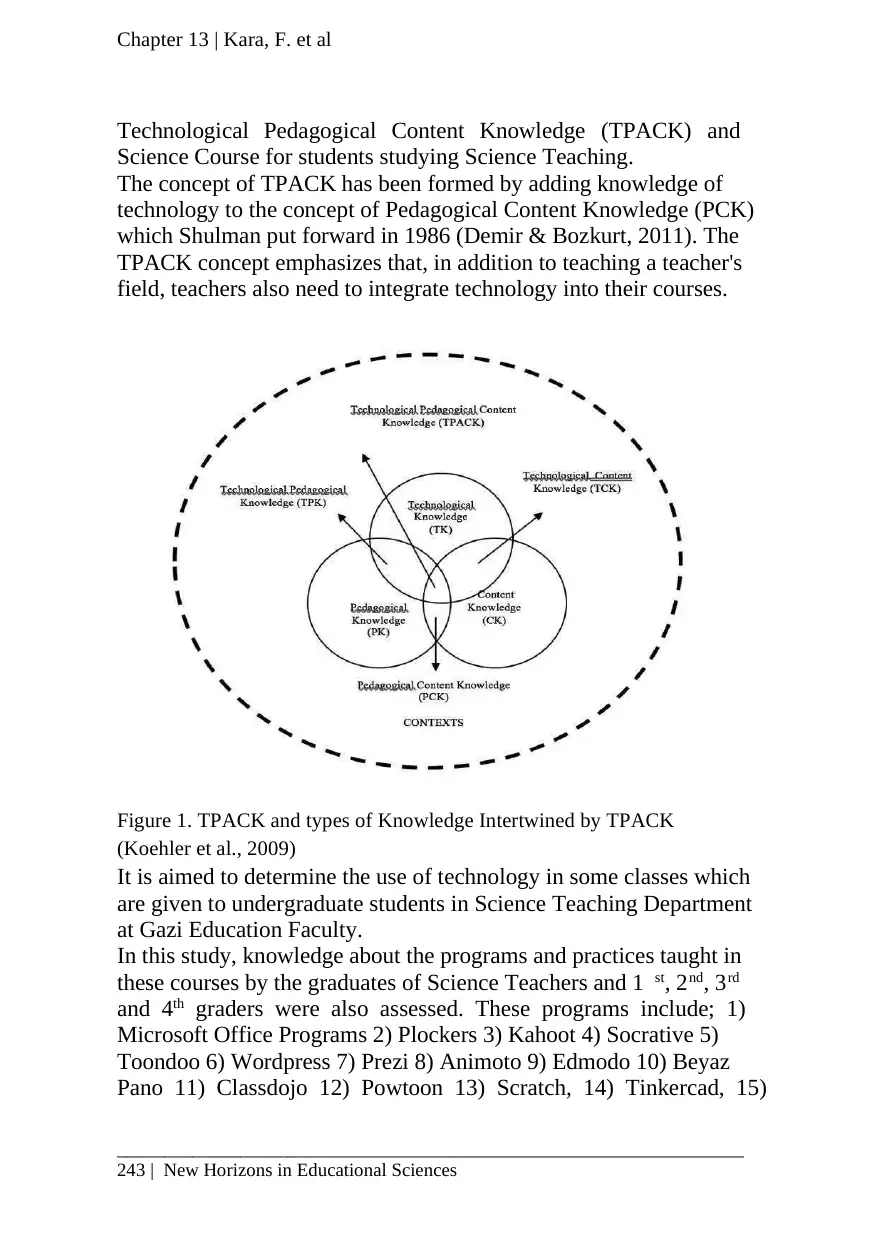
The concept of TPACK has been formed by adding knowledge of
technology to the concept of Pedagogical Content Knowledge (PCK)
which Shulman put forward in 1986 (Demir & Bozkurt, 2011). The
TPACK concept emphasizes that, in addition to teaching a teacher's
field, teachers also need to integrate technology into their courses.
Figure 1. TPACK and types of Knowledge Intertwined by TPACK
(Koehler et al., 2009)
It is aimed to determine the use of technology in some classes which
are given to undergraduate students in Science Teaching Department
at Gazi Education Faculty.
In this study, knowledge about the programs and practices taught in
these courses by the graduates of Science Teachers and 1 st, 2nd, 3rd
and 4th graders were also assessed. These programs include; 1)
Microsoft Office Programs 2) Plockers 3) Kahoot 4) Socrative 5)
Toondoo 6) Wordpress 7) Prezi 8) Animoto 9) Edmodo 10) Beyaz
Pano 11) Classdojo 12) Powtoon 13) Scratch, 14) Tinkercad, 15)
chevron_up_icon
1 out of 36
circle_padding
hide_on_mobile
zoom_out_icon
[object Object]