Management Accounting Report: Imda Tech (UK) Limited Analysis
VerifiedAdded on 2020/01/07
|15
|4132
|185
Report
AI Summary
This report provides a comprehensive overview of management accounting principles and their application within a business context. It begins by defining and distinguishing management accounting from financial accounting, emphasizing its role in providing crucial information for departmental managers to achieve organizational goals. The report then delves into various cost accounting systems, including actual, normal, and standard costing, explaining their methodologies and how they can improve the functionality of different departments. Inventory management systems, such as Just-In-Time and Materials Requirement Planning, are also discussed. Furthermore, the report presents income statements prepared using both absorption and marginal costing methods for Imda Tech (UK) Limited. It explores different types of budgets, their advantages and disadvantages, and the process of preparing them, along with a discussion of pricing strategies. Finally, the report examines the Balanced Scorecard approach and its application in measuring a range of performance metrics. The report aims to enhance financial governance and effective strategies for business development.
MANAGEMENT ACCOUNTING
1
1

Paraphrase This Document
Need a fresh take? Get an instant paraphrase of this document with our AI Paraphraser
Table of contents
Introduction......................................................................................................................................3
Task 1...............................................................................................................................................3
a) Preparation of research report based on the function of management accounting......................3
b) Discussing the different types of cost accounting system and explaining the ways it can be
used to improve the functionality of various departments...............................................................4
Task 2...............................................................................................................................................6
a) Preparing the income statements for the month of September....................................................6
Task 3.............................................................................................................................................10
a) Discussing different types of budgets in the research report and explaining their advantages
and disadvantages..........................................................................................................................10
b) Discussing the process of preparing various budgets................................................................11
c) Discussing the pricing strategies...............................................................................................11
Task 4.............................................................................................................................................12
a) Explaining the approach of balance score card and describing how it can be used to measure
range of performance.....................................................................................................................12
Conclusion.....................................................................................................................................13
Reference list.................................................................................................................................14
2
Introduction......................................................................................................................................3
Task 1...............................................................................................................................................3
a) Preparation of research report based on the function of management accounting......................3
b) Discussing the different types of cost accounting system and explaining the ways it can be
used to improve the functionality of various departments...............................................................4
Task 2...............................................................................................................................................6
a) Preparing the income statements for the month of September....................................................6
Task 3.............................................................................................................................................10
a) Discussing different types of budgets in the research report and explaining their advantages
and disadvantages..........................................................................................................................10
b) Discussing the process of preparing various budgets................................................................11
c) Discussing the pricing strategies...............................................................................................11
Task 4.............................................................................................................................................12
a) Explaining the approach of balance score card and describing how it can be used to measure
range of performance.....................................................................................................................12
Conclusion.....................................................................................................................................13
Reference list.................................................................................................................................14
2
Introduction
Management accounting may be defined as the process identifying and measuring the business
information with an aim to evaluate, interpret and communicate them with the departmental
managers for achieving goals and objectives. The study aims to express the management
accounting along with its need in the context of emerging business for achieving specific targets,
based on the measurement of performance of the business. It has also been aimed to understand
the various types of cost accounting both theoretically and practically to deliver the need if
budgeting and pricing strategy. In addition to these, with the help of balance score card, it has
been aimed to improve financials governance and effective strategies.
Task 1
a) Preparation of research report based on the function of management
accounting
1) Defining and distinguishing management accounting with financial accounting
Cost accounting may sometimes refer to the management accounting, which is completely
different from financial accounting. In management accounting, both business and financial
information are identified, measured, analyzed and interpreted with an aim to communicate them
with various management departments to achieve goal and objectives. It simply encompasses all
the relevant fields of accounting that are aimed to inform the business operation metrics to the
management. In this approach, information related to the cost of the goods and services
purchased and produced by the organization are considered (Fullerton et al. 2014). It can be said
that management accounting or cost accounting are the basis of financial accounting, because,
without the result of cost accounting any decision made by the department will become void and
the actual cause and effect of the cost of production will remain unknown. Therefore, it will
become impossible to know the actual volume of sale, revenue, and profit (Fullerton et al. 2013).
In cost accounting, various budgets are prepared to estimate the various requirement of the
department and once the actual results are disclosed, the estimated value is compared with the
actual results to understand the variance.
However, in financial accounting, especially the financial information are identified, measured,
interpreted, summarized and recorded in a chronological order with an aim to communications
3
Management accounting may be defined as the process identifying and measuring the business
information with an aim to evaluate, interpret and communicate them with the departmental
managers for achieving goals and objectives. The study aims to express the management
accounting along with its need in the context of emerging business for achieving specific targets,
based on the measurement of performance of the business. It has also been aimed to understand
the various types of cost accounting both theoretically and practically to deliver the need if
budgeting and pricing strategy. In addition to these, with the help of balance score card, it has
been aimed to improve financials governance and effective strategies.
Task 1
a) Preparation of research report based on the function of management
accounting
1) Defining and distinguishing management accounting with financial accounting
Cost accounting may sometimes refer to the management accounting, which is completely
different from financial accounting. In management accounting, both business and financial
information are identified, measured, analyzed and interpreted with an aim to communicate them
with various management departments to achieve goal and objectives. It simply encompasses all
the relevant fields of accounting that are aimed to inform the business operation metrics to the
management. In this approach, information related to the cost of the goods and services
purchased and produced by the organization are considered (Fullerton et al. 2014). It can be said
that management accounting or cost accounting are the basis of financial accounting, because,
without the result of cost accounting any decision made by the department will become void and
the actual cause and effect of the cost of production will remain unknown. Therefore, it will
become impossible to know the actual volume of sale, revenue, and profit (Fullerton et al. 2013).
In cost accounting, various budgets are prepared to estimate the various requirement of the
department and once the actual results are disclosed, the estimated value is compared with the
actual results to understand the variance.
However, in financial accounting, especially the financial information are identified, measured,
interpreted, summarized and recorded in a chronological order with an aim to communications
3
⊘ This is a preview!⊘
Do you want full access?
Subscribe today to unlock all pages.

Trusted by 1+ million students worldwide
the financial information with the stakeholders (internal and external users of financial
statements). Financial accounting is done based on certain accounting principles or policies or
accounting standards since the concept of relevancy, reliability, and objectivity gets attracted, so
that it cannot divert the mindset of the users of financial accounting (Beatty and Liao, 2014).
Thus, it can be said that financial accounting is the sum or aggregation of all the financial
information of the business.
2) Describing the importance of cost accounting and how it can be considered as the
decision making tool for the various departmental managers
Management accounting helps in making short-term and long-term decisions by the managers
with the help of financial and statistical information periodically. Cost accounting helps in
forecasting decision, making or buying decision, evaluating the rate of return and predicting the
cash flows. In a broader concept, managerial accounting deals with the preparation of report,
which includes budgeting for estimating and forecasting. Variance analysis is used for making
comparison of actual with the standards and identifying any reason behind favorable and
unfavorable variance (Christ and Burritt, 2015). In addition to these, trend analysis helps the
managers to make future estimation regarding their ability of achieving the targets by comparing
with historical records and other records of other organization. Thus, it can be said that cost
accounting is the key decision making tool for various departmental managers, like production
manager, sales manager, purchase manager, etc.
b) Discussing the different types of cost accounting system and explaining the
ways it can be used to improve the functionality of various departments
1) Describing different cost accounting system individually
Actual costing
Actual costing is the part of the accounting system, where the actual cost of the actual qualities
of the product is used along with the direct cost rates in the production unit to ascertain the cost
of a particular good. Generally, in actual cost accounting system, the direct cost of the object is
traced which can be measured in terms of labor cost and material cost, which are directly linked
with the production unit (Greenberg and Wilner, 2015). With the help of actual costing method,
managers evaluate the actual time and cost required for the production of goods and services. In
other words, it addresses the time to be taken for manufacturing the product with respect to the
4
statements). Financial accounting is done based on certain accounting principles or policies or
accounting standards since the concept of relevancy, reliability, and objectivity gets attracted, so
that it cannot divert the mindset of the users of financial accounting (Beatty and Liao, 2014).
Thus, it can be said that financial accounting is the sum or aggregation of all the financial
information of the business.
2) Describing the importance of cost accounting and how it can be considered as the
decision making tool for the various departmental managers
Management accounting helps in making short-term and long-term decisions by the managers
with the help of financial and statistical information periodically. Cost accounting helps in
forecasting decision, making or buying decision, evaluating the rate of return and predicting the
cash flows. In a broader concept, managerial accounting deals with the preparation of report,
which includes budgeting for estimating and forecasting. Variance analysis is used for making
comparison of actual with the standards and identifying any reason behind favorable and
unfavorable variance (Christ and Burritt, 2015). In addition to these, trend analysis helps the
managers to make future estimation regarding their ability of achieving the targets by comparing
with historical records and other records of other organization. Thus, it can be said that cost
accounting is the key decision making tool for various departmental managers, like production
manager, sales manager, purchase manager, etc.
b) Discussing the different types of cost accounting system and explaining the
ways it can be used to improve the functionality of various departments
1) Describing different cost accounting system individually
Actual costing
Actual costing is the part of the accounting system, where the actual cost of the actual qualities
of the product is used along with the direct cost rates in the production unit to ascertain the cost
of a particular good. Generally, in actual cost accounting system, the direct cost of the object is
traced which can be measured in terms of labor cost and material cost, which are directly linked
with the production unit (Greenberg and Wilner, 2015). With the help of actual costing method,
managers evaluate the actual time and cost required for the production of goods and services. In
other words, it addresses the time to be taken for manufacturing the product with respect to the
4
Paraphrase This Document
Need a fresh take? Get an instant paraphrase of this document with our AI Paraphraser
actual cost incurred in that product. Direct labor hour rate determines how long the particular
product takes to get converted into finished goods based on the cost incurred on the raw
materials.
Normal costing
Normal costing helps in deriving the cost of a particular product. Normal costing is used in
measuring the value of the manufactured product in accordance with the actual material and
direct labor cost and manufacturing overhead (Kutač et al. 2014). However, these three costs of
production determine the cost of goods sold and ascertains the inventory valuation. In this
approach variance between the actual cost incurred in the production and the budgeted overhead
is analyzed. If the amount of variance is found insignificant to the actual production cost, it will
simply be assigned to the cost of goods sold. On the other hand, if the amount of variance is
found significant, it will simply be assigned to the cost of goods sold and work in progress on a
proportionate ratio basis.
Standard costing
Standard costing may be defined as the process of estimating the cost or expenses, which
normally occurs during the manufacturing of the product. In simple words, standard costing
helps in determining the amount of cost or expenses that a business organization will incur in
producing a particular product under the normal condition (Badem et al. 2013). However,
standard costing can be used in two different ways, which are discussed below.
● In the first way it can be used to make plan that how future production process can be
done and how efficiencies of production can be increased
● In the second way, it can be used to determine whether the cost incurred in the production
process are reasonable or not and if it is found reasonable then to what extent
2) Describing inventory management systems
Inventory management may be defined as the practice of monitoring and overseeing the
ordering, storing and using the components of production items in order to sell them afterward.
In other words, inventory management is the practice of controlling the quantities of finished
products stored for sealing purpose (Ozguven and Ozbay, 2013). Inventory is the major assets of
a business and it can be represented as the investment of the business that is tied up until it is
sold out. The cost of purchasing inventory, the cost of storing and insuring inventory are the key
parts of inventory management within the business organization. Thus, it becomes very
5
product takes to get converted into finished goods based on the cost incurred on the raw
materials.
Normal costing
Normal costing helps in deriving the cost of a particular product. Normal costing is used in
measuring the value of the manufactured product in accordance with the actual material and
direct labor cost and manufacturing overhead (Kutač et al. 2014). However, these three costs of
production determine the cost of goods sold and ascertains the inventory valuation. In this
approach variance between the actual cost incurred in the production and the budgeted overhead
is analyzed. If the amount of variance is found insignificant to the actual production cost, it will
simply be assigned to the cost of goods sold. On the other hand, if the amount of variance is
found significant, it will simply be assigned to the cost of goods sold and work in progress on a
proportionate ratio basis.
Standard costing
Standard costing may be defined as the process of estimating the cost or expenses, which
normally occurs during the manufacturing of the product. In simple words, standard costing
helps in determining the amount of cost or expenses that a business organization will incur in
producing a particular product under the normal condition (Badem et al. 2013). However,
standard costing can be used in two different ways, which are discussed below.
● In the first way it can be used to make plan that how future production process can be
done and how efficiencies of production can be increased
● In the second way, it can be used to determine whether the cost incurred in the production
process are reasonable or not and if it is found reasonable then to what extent
2) Describing inventory management systems
Inventory management may be defined as the practice of monitoring and overseeing the
ordering, storing and using the components of production items in order to sell them afterward.
In other words, inventory management is the practice of controlling the quantities of finished
products stored for sealing purpose (Ozguven and Ozbay, 2013). Inventory is the major assets of
a business and it can be represented as the investment of the business that is tied up until it is
sold out. The cost of purchasing inventory, the cost of storing and insuring inventory are the key
parts of inventory management within the business organization. Thus, it becomes very
5
important for an organization to manage the inventories of the business properly because if the
inventories are mismatched or mismanaged, it might create a huge difference in the financial
statements. Hence, in order to successfully manage the inventories of the business, it becomes
important to create purchase plan ensuring the required inventories are available whenever they
are required. However, it is necessary to keep track on the inventories or monitoring the
inventories, so that excess or under requirements of the inventories are not purchased. The two
common and important strategies for managing inventories are followed by the management,
which is described below.
Just In Time method (JIT)
In this method, inventories are purchased whenever they are required instead of maintaining high
level of stock for future use. This approach helps the companies not only to reduce the wastage
of inventories, but also reducing the cost of carrying, storing and insuring the inventories.
Maximum Requirement Planning (MRP)
In this method deliveries of the material are determined based on the sales forecast. In simpler
words, the management makes accurate sales records to make appropriate planning for carrying
inventories.
3) Describing price optimizing system
Price optimization system is a mathematical approach for determining the response of the
consumers towards different prices of the products manufactured by the company through
different channels. Price optimization technique also helps in determining the price of the
produced goods in the most profitable way, so that cost of production is covered along with the
profit maximization through the selling of that product (Ubando et al. 2014). Companies make
use of this technique to ascertain the price structure for initial, promotional and discount pricing.
In this method, the demand of the consumers is reviewed to know how it varies at different price
points. Based on the evaluation of varied demand of the customers at different price points and
inventory levels, the profitable price point is developed.
Task 2
a) Preparing the income statements for the month of September
1) Absorption costing method
6
inventories are mismatched or mismanaged, it might create a huge difference in the financial
statements. Hence, in order to successfully manage the inventories of the business, it becomes
important to create purchase plan ensuring the required inventories are available whenever they
are required. However, it is necessary to keep track on the inventories or monitoring the
inventories, so that excess or under requirements of the inventories are not purchased. The two
common and important strategies for managing inventories are followed by the management,
which is described below.
Just In Time method (JIT)
In this method, inventories are purchased whenever they are required instead of maintaining high
level of stock for future use. This approach helps the companies not only to reduce the wastage
of inventories, but also reducing the cost of carrying, storing and insuring the inventories.
Maximum Requirement Planning (MRP)
In this method deliveries of the material are determined based on the sales forecast. In simpler
words, the management makes accurate sales records to make appropriate planning for carrying
inventories.
3) Describing price optimizing system
Price optimization system is a mathematical approach for determining the response of the
consumers towards different prices of the products manufactured by the company through
different channels. Price optimization technique also helps in determining the price of the
produced goods in the most profitable way, so that cost of production is covered along with the
profit maximization through the selling of that product (Ubando et al. 2014). Companies make
use of this technique to ascertain the price structure for initial, promotional and discount pricing.
In this method, the demand of the consumers is reviewed to know how it varies at different price
points. Based on the evaluation of varied demand of the customers at different price points and
inventory levels, the profitable price point is developed.
Task 2
a) Preparing the income statements for the month of September
1) Absorption costing method
6
⊘ This is a preview!⊘
Do you want full access?
Subscribe today to unlock all pages.
Trusted by 1+ million students worldwide
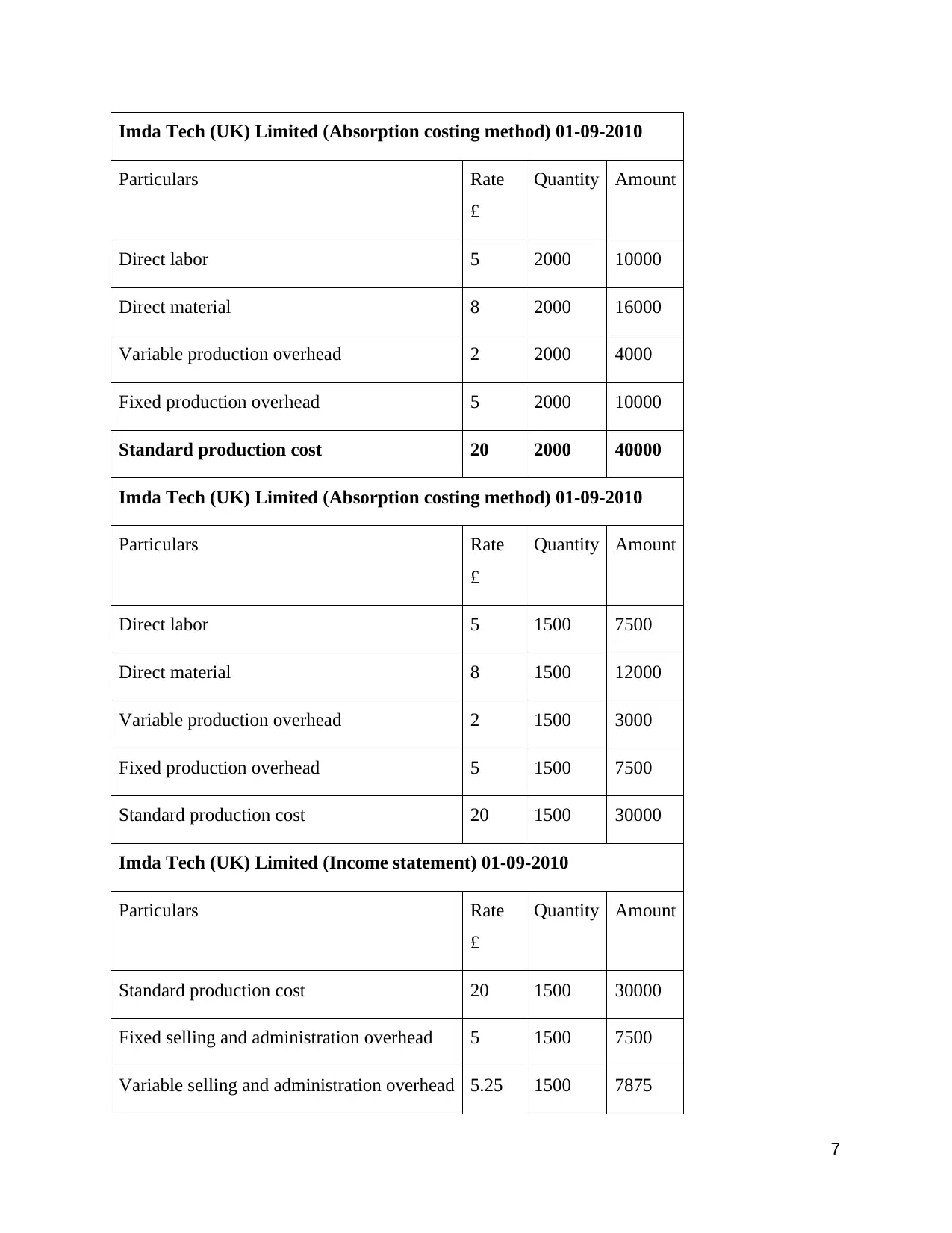
Imda Tech (UK) Limited (Absorption costing method) 01-09-2010
Particulars Rate
£
Quantity Amount
Direct labor 5 2000 10000
Direct material 8 2000 16000
Variable production overhead 2 2000 4000
Fixed production overhead 5 2000 10000
Standard production cost 20 2000 40000
Imda Tech (UK) Limited (Absorption costing method) 01-09-2010
Particulars Rate
£
Quantity Amount
Direct labor 5 1500 7500
Direct material 8 1500 12000
Variable production overhead 2 1500 3000
Fixed production overhead 5 1500 7500
Standard production cost 20 1500 30000
Imda Tech (UK) Limited (Income statement) 01-09-2010
Particulars Rate
£
Quantity Amount
Standard production cost 20 1500 30000
Fixed selling and administration overhead 5 1500 7500
Variable selling and administration overhead 5.25 1500 7875
7
Particulars Rate
£
Quantity Amount
Direct labor 5 2000 10000
Direct material 8 2000 16000
Variable production overhead 2 2000 4000
Fixed production overhead 5 2000 10000
Standard production cost 20 2000 40000
Imda Tech (UK) Limited (Absorption costing method) 01-09-2010
Particulars Rate
£
Quantity Amount
Direct labor 5 1500 7500
Direct material 8 1500 12000
Variable production overhead 2 1500 3000
Fixed production overhead 5 1500 7500
Standard production cost 20 1500 30000
Imda Tech (UK) Limited (Income statement) 01-09-2010
Particulars Rate
£
Quantity Amount
Standard production cost 20 1500 30000
Fixed selling and administration overhead 5 1500 7500
Variable selling and administration overhead 5.25 1500 7875
7
Paraphrase This Document
Need a fresh take? Get an instant paraphrase of this document with our AI Paraphraser
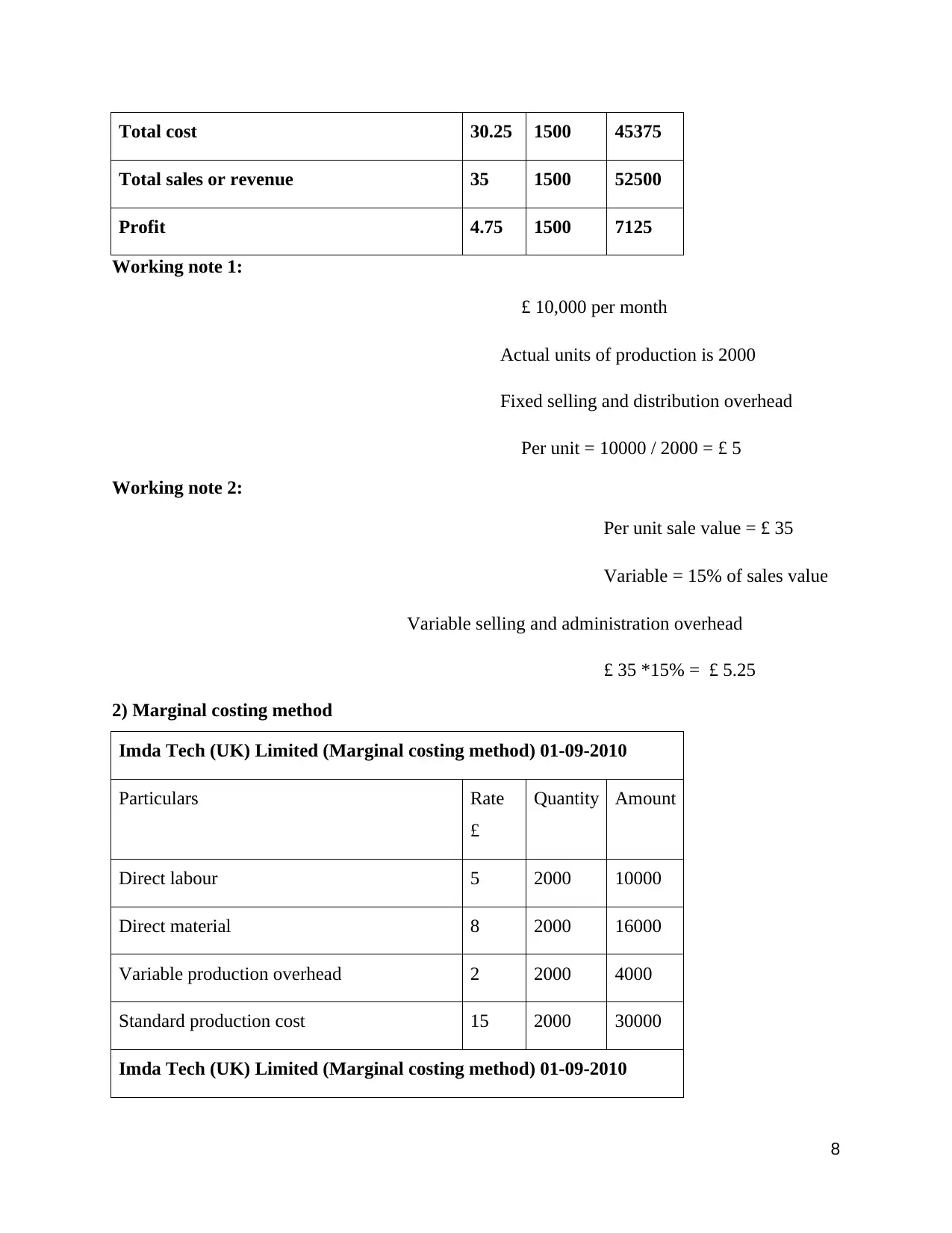
Total cost 30.25 1500 45375
Total sales or revenue 35 1500 52500
Profit 4.75 1500 7125
Working note 1:
£ 10,000 per month
Actual units of production is 2000
Fixed selling and distribution overhead
Per unit = 10000 / 2000 = £ 5
Working note 2:
Per unit sale value = £ 35
Variable = 15% of sales value
Variable selling and administration overhead
£ 35 *15% = £ 5.25
2) Marginal costing method
Imda Tech (UK) Limited (Marginal costing method) 01-09-2010
Particulars Rate
£
Quantity Amount
Direct labour 5 2000 10000
Direct material 8 2000 16000
Variable production overhead 2 2000 4000
Standard production cost 15 2000 30000
Imda Tech (UK) Limited (Marginal costing method) 01-09-2010
8
Total sales or revenue 35 1500 52500
Profit 4.75 1500 7125
Working note 1:
£ 10,000 per month
Actual units of production is 2000
Fixed selling and distribution overhead
Per unit = 10000 / 2000 = £ 5
Working note 2:
Per unit sale value = £ 35
Variable = 15% of sales value
Variable selling and administration overhead
£ 35 *15% = £ 5.25
2) Marginal costing method
Imda Tech (UK) Limited (Marginal costing method) 01-09-2010
Particulars Rate
£
Quantity Amount
Direct labour 5 2000 10000
Direct material 8 2000 16000
Variable production overhead 2 2000 4000
Standard production cost 15 2000 30000
Imda Tech (UK) Limited (Marginal costing method) 01-09-2010
8
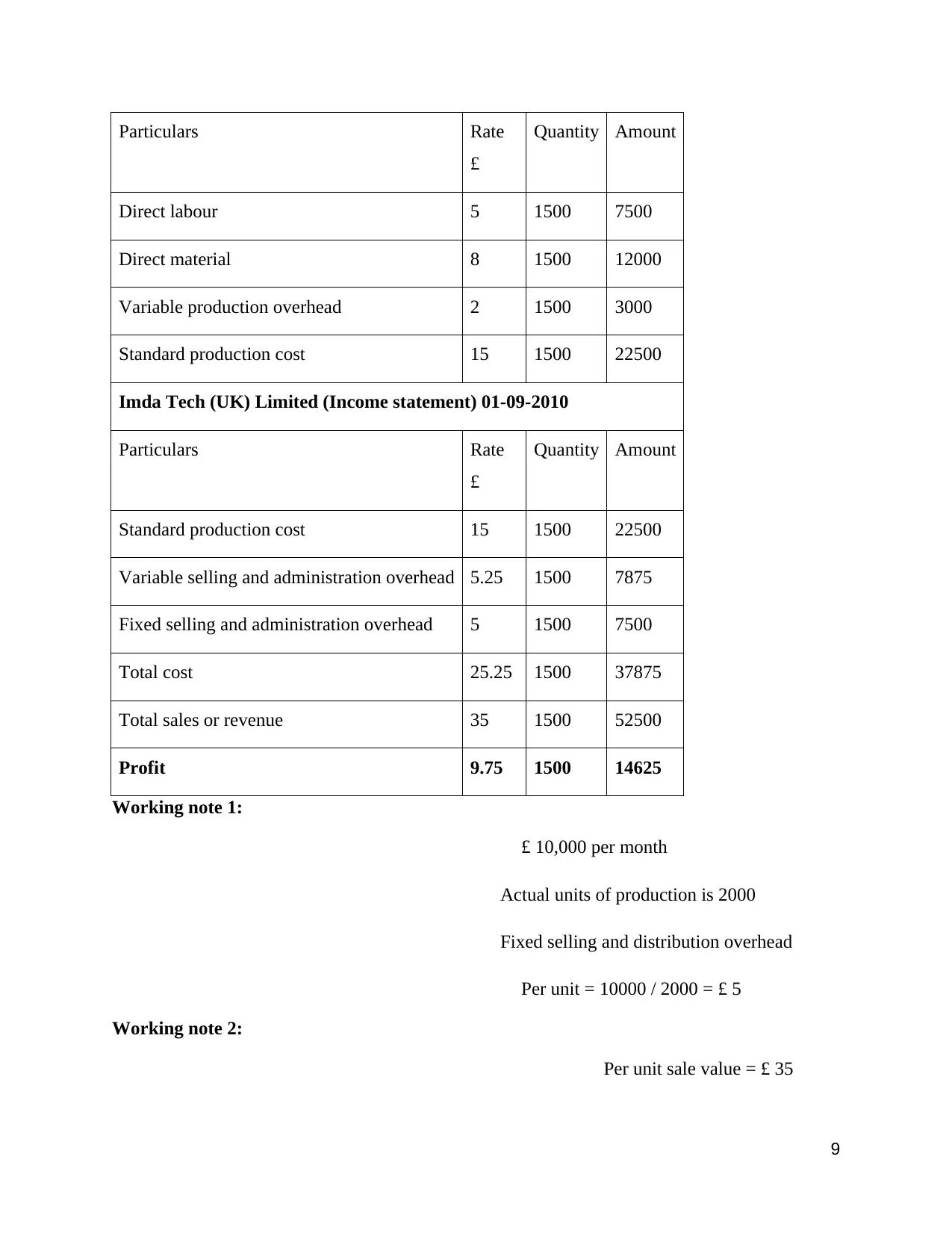
Particulars Rate
£
Quantity Amount
Direct labour 5 1500 7500
Direct material 8 1500 12000
Variable production overhead 2 1500 3000
Standard production cost 15 1500 22500
Imda Tech (UK) Limited (Income statement) 01-09-2010
Particulars Rate
£
Quantity Amount
Standard production cost 15 1500 22500
Variable selling and administration overhead 5.25 1500 7875
Fixed selling and administration overhead 5 1500 7500
Total cost 25.25 1500 37875
Total sales or revenue 35 1500 52500
Profit 9.75 1500 14625
Working note 1:
£ 10,000 per month
Actual units of production is 2000
Fixed selling and distribution overhead
Per unit = 10000 / 2000 = £ 5
Working note 2:
Per unit sale value = £ 35
9
£
Quantity Amount
Direct labour 5 1500 7500
Direct material 8 1500 12000
Variable production overhead 2 1500 3000
Standard production cost 15 1500 22500
Imda Tech (UK) Limited (Income statement) 01-09-2010
Particulars Rate
£
Quantity Amount
Standard production cost 15 1500 22500
Variable selling and administration overhead 5.25 1500 7875
Fixed selling and administration overhead 5 1500 7500
Total cost 25.25 1500 37875
Total sales or revenue 35 1500 52500
Profit 9.75 1500 14625
Working note 1:
£ 10,000 per month
Actual units of production is 2000
Fixed selling and distribution overhead
Per unit = 10000 / 2000 = £ 5
Working note 2:
Per unit sale value = £ 35
9
⊘ This is a preview!⊘
Do you want full access?
Subscribe today to unlock all pages.
Trusted by 1+ million students worldwide
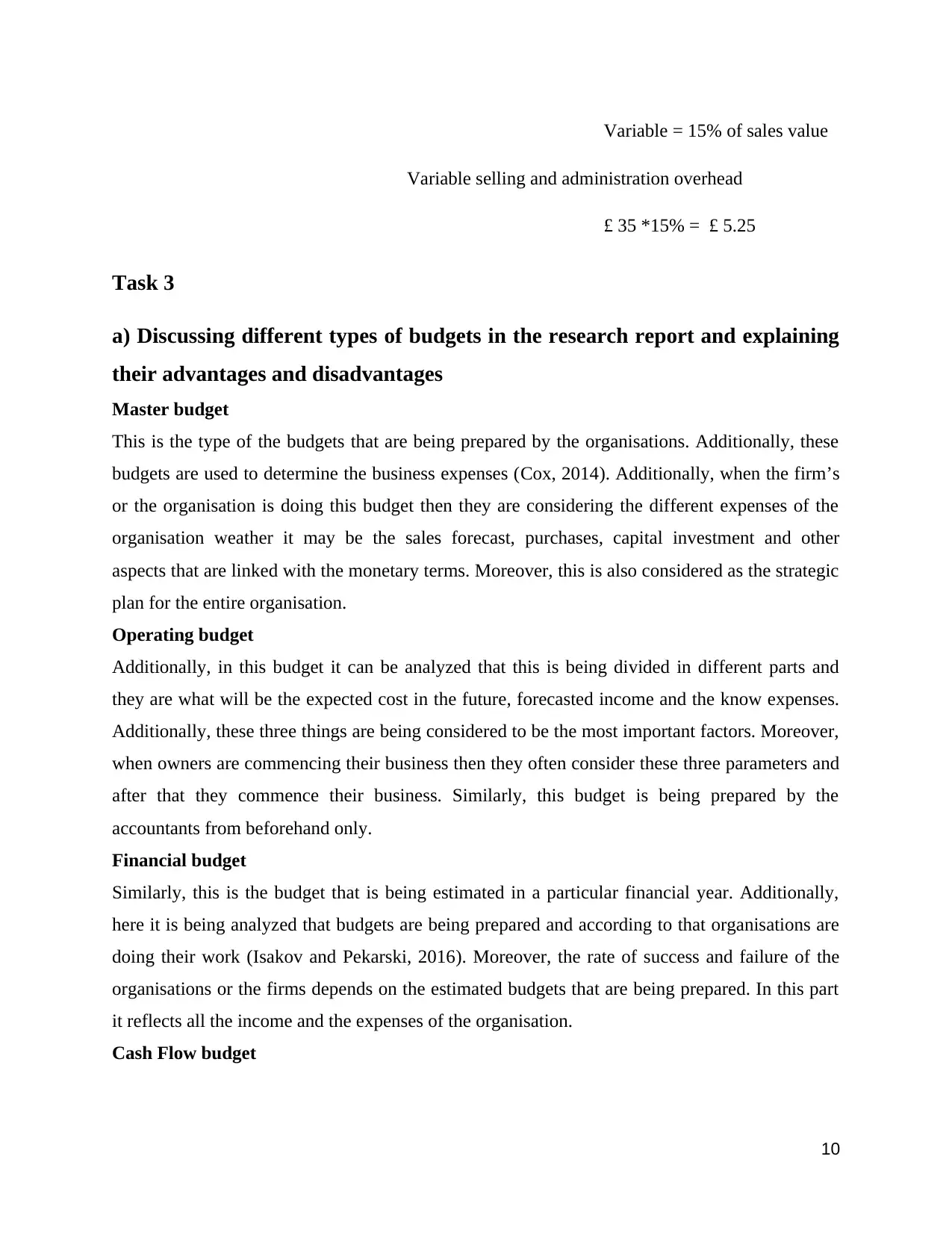
Variable = 15% of sales value
Variable selling and administration overhead
£ 35 *15% = £ 5.25
Task 3
a) Discussing different types of budgets in the research report and explaining
their advantages and disadvantages
Master budget
This is the type of the budgets that are being prepared by the organisations. Additionally, these
budgets are used to determine the business expenses (Cox, 2014). Additionally, when the firm’s
or the organisation is doing this budget then they are considering the different expenses of the
organisation weather it may be the sales forecast, purchases, capital investment and other
aspects that are linked with the monetary terms. Moreover, this is also considered as the strategic
plan for the entire organisation.
Operating budget
Additionally, in this budget it can be analyzed that this is being divided in different parts and
they are what will be the expected cost in the future, forecasted income and the know expenses.
Additionally, these three things are being considered to be the most important factors. Moreover,
when owners are commencing their business then they often consider these three parameters and
after that they commence their business. Similarly, this budget is being prepared by the
accountants from beforehand only.
Financial budget
Similarly, this is the budget that is being estimated in a particular financial year. Additionally,
here it is being analyzed that budgets are being prepared and according to that organisations are
doing their work (Isakov and Pekarski, 2016). Moreover, the rate of success and failure of the
organisations or the firms depends on the estimated budgets that are being prepared. In this part
it reflects all the income and the expenses of the organisation.
Cash Flow budget
10
Variable selling and administration overhead
£ 35 *15% = £ 5.25
Task 3
a) Discussing different types of budgets in the research report and explaining
their advantages and disadvantages
Master budget
This is the type of the budgets that are being prepared by the organisations. Additionally, these
budgets are used to determine the business expenses (Cox, 2014). Additionally, when the firm’s
or the organisation is doing this budget then they are considering the different expenses of the
organisation weather it may be the sales forecast, purchases, capital investment and other
aspects that are linked with the monetary terms. Moreover, this is also considered as the strategic
plan for the entire organisation.
Operating budget
Additionally, in this budget it can be analyzed that this is being divided in different parts and
they are what will be the expected cost in the future, forecasted income and the know expenses.
Additionally, these three things are being considered to be the most important factors. Moreover,
when owners are commencing their business then they often consider these three parameters and
after that they commence their business. Similarly, this budget is being prepared by the
accountants from beforehand only.
Financial budget
Similarly, this is the budget that is being estimated in a particular financial year. Additionally,
here it is being analyzed that budgets are being prepared and according to that organisations are
doing their work (Isakov and Pekarski, 2016). Moreover, the rate of success and failure of the
organisations or the firms depends on the estimated budgets that are being prepared. In this part
it reflects all the income and the expenses of the organisation.
Cash Flow budget
10
Paraphrase This Document
Need a fresh take? Get an instant paraphrase of this document with our AI Paraphraser
Moreover, this budget also sheds light on the income or the monetary gained that are being
earned by the organisations. Additionally, organisations can make different analysis on the
different facts that from where monetary income will be earned in the organisations. Moreover,
this budget also projects that from which organisations are having a probable chances to gain
money.
Flexible budget
Flexible budget is also called variable budget and it is a financial plan of budgeted income and
expenses. It is prepared based on the current actual output (Tarasi et al. 2013). In simpler terms,
flexible budget is prepared to know how the revenues and expenses changes with the change in
output and due to this, flexible budget are also known as variable budget.
b) Discussing the process of preparing various budgets
The process of preparing budget begins with the submission of budget forms that need to be
completed by cost centre to the finance office. After the submission budget form or first draft,
budget hearing is then held to justify the request of the cost centre. Finally after the Senate’s
consideration, the final budget is prepared for the Board of Trustees and then the approval of
preparing budgets is given. The steps of preparing various budgets are given below.
● Updating budget assumption
● Reviewing bottlenecks
● Determining amount of funding
● Creating budget package
● Issuing budget package
● Obtaining revenue forecast
● Obtaining budgets prepared by various departments
● Obtaining capital budget request
● Updating budget model including all the relevant budget information into the master
budget
● Reviewing the budget with the senior management team
● Issuing and lodging the budget
c) Discussing the pricing strategies
Skimming pricing
11
earned by the organisations. Additionally, organisations can make different analysis on the
different facts that from where monetary income will be earned in the organisations. Moreover,
this budget also projects that from which organisations are having a probable chances to gain
money.
Flexible budget
Flexible budget is also called variable budget and it is a financial plan of budgeted income and
expenses. It is prepared based on the current actual output (Tarasi et al. 2013). In simpler terms,
flexible budget is prepared to know how the revenues and expenses changes with the change in
output and due to this, flexible budget are also known as variable budget.
b) Discussing the process of preparing various budgets
The process of preparing budget begins with the submission of budget forms that need to be
completed by cost centre to the finance office. After the submission budget form or first draft,
budget hearing is then held to justify the request of the cost centre. Finally after the Senate’s
consideration, the final budget is prepared for the Board of Trustees and then the approval of
preparing budgets is given. The steps of preparing various budgets are given below.
● Updating budget assumption
● Reviewing bottlenecks
● Determining amount of funding
● Creating budget package
● Issuing budget package
● Obtaining revenue forecast
● Obtaining budgets prepared by various departments
● Obtaining capital budget request
● Updating budget model including all the relevant budget information into the master
budget
● Reviewing the budget with the senior management team
● Issuing and lodging the budget
c) Discussing the pricing strategies
Skimming pricing
11
This is the pricing strategies that are being applied by the organisations. Additionally, in this
strategy prices are being fixed high for the products that are being sold in the market.
Additionally, producers are fixing these prices and high prices reflect high level of revenue for
the organisation.
Penetration pricing
Similarly, there are different organisations that are charging low prices for the products and
when low prices are being charged by the organisations then customers are having a perception
in their mind that when organisations have lowered the price then they will increase the sales of
the entire products (Spann et al. 2014). Additionally, Imda Tech limited is following this strategy
to retain the customers for a long period of time.
Psychological pricing
Here organisations are fixing the prices in such a manner so that customers have perceptions in
the mind that they are paying low prices for the products (Sun et al. 2016). It can be understood
with the help of the following example. If an organisation is selling particular products and they
are charging $99 for the products instead of charging $100 for the products. Moreover, this is
creating positive impacts in the minds of the customers regarding the organisation.
Task 4
a) Explaining the approach of balance score card and describing how it can be
used to measure range of performance
1) Explaining how balanced scorecard can be used to identify and respond to financial
problems
In strategic management, a balanced scorecard is used as the performance metric, where various
internal business functions along with their outcomes are identified and improved. The balanced
scorecard is used by the managements of the organization to strengthen the good behavioral
system in the organization by diversifying the four different areas that are required to be
analyzed. In the context of financial problems that need to be resolved, balance scorecard
exclusively helps in identifying and responding to the financial problems (Hoque, 2014). The
fourth leg of the balanced scorecard deals with measuring financial information, like sales,
incomes, and expenses to understand the financial performance of the business. Certain financial
ratios, income targets and budget variances and budget variances are critically measured and
12
strategy prices are being fixed high for the products that are being sold in the market.
Additionally, producers are fixing these prices and high prices reflect high level of revenue for
the organisation.
Penetration pricing
Similarly, there are different organisations that are charging low prices for the products and
when low prices are being charged by the organisations then customers are having a perception
in their mind that when organisations have lowered the price then they will increase the sales of
the entire products (Spann et al. 2014). Additionally, Imda Tech limited is following this strategy
to retain the customers for a long period of time.
Psychological pricing
Here organisations are fixing the prices in such a manner so that customers have perceptions in
the mind that they are paying low prices for the products (Sun et al. 2016). It can be understood
with the help of the following example. If an organisation is selling particular products and they
are charging $99 for the products instead of charging $100 for the products. Moreover, this is
creating positive impacts in the minds of the customers regarding the organisation.
Task 4
a) Explaining the approach of balance score card and describing how it can be
used to measure range of performance
1) Explaining how balanced scorecard can be used to identify and respond to financial
problems
In strategic management, a balanced scorecard is used as the performance metric, where various
internal business functions along with their outcomes are identified and improved. The balanced
scorecard is used by the managements of the organization to strengthen the good behavioral
system in the organization by diversifying the four different areas that are required to be
analyzed. In the context of financial problems that need to be resolved, balance scorecard
exclusively helps in identifying and responding to the financial problems (Hoque, 2014). The
fourth leg of the balanced scorecard deals with measuring financial information, like sales,
incomes, and expenses to understand the financial performance of the business. Certain financial
ratios, income targets and budget variances and budget variances are critically measured and
12
⊘ This is a preview!⊘
Do you want full access?
Subscribe today to unlock all pages.
Trusted by 1+ million students worldwide

1 out of 15


Related Documents


Your All-in-One AI-Powered Toolkit for Academic Success.
+13062052269
info@desklib.com
Available 24*7 on WhatsApp / Email
![[object Object]](/_next/static/media/star-bottom.7253800d.svg)
Unlock your academic potential
Copyright © 2020–2026 A2Z Services. All Rights Reserved. Developed and managed by ZUCOL.