Design Thinking Reflection Report - CQU, Module on Design Thinking
VerifiedAdded on 2023/06/07
|18
|4068
|87
Report
AI Summary
This report provides a comprehensive reflection on the design thinking process, as experienced by a student. The report begins with an executive summary outlining the core concepts of design thinking, emphasizing its importance in understanding users and questioning assumptions. The main body of the report is structured chronologically, week-by-week, detailing the student's learning journey through the course. Key topics covered include the introduction to design thinking, visualization exercises, critical thinking skills, problem-solving methodologies, the use of personas, ideation techniques, value chain analysis, and learning launches. The student reflects on the application of various design thinking tools, such as spotting the obvious, mind mapping, and the 5 Whys, and how they contribute to innovation and problem-solving. The report integrates theoretical frameworks and real-world examples, demonstrating the student's understanding of the design thinking process and its practical implications in business development. The report concludes with an action plan and overall conclusions, summarizing the key takeaways and suggesting future applications of design thinking principles.
Running head: DESIGN THINKING REFLECTION 1
DESIGN THINKING REFLECTION
Student Name
Institutional Affiliation
DESIGN THINKING REFLECTION
Student Name
Institutional Affiliation

Paraphrase This Document
Need a fresh take? Get an instant paraphrase of this document with our AI Paraphraser
DESIGN THINKING REFLECTION 2
Executive Summary
Design thinking is connected with the strong concern of establishing an understanding of
the individuals whom we are designing the services or products. It assists in developing and
observing empathy with the target consumer. Besides, it assists in the questioning process:
questioning assumptions, problem, and implications. It is an important problem-solving method
particular to design, which entails evaluating known problem aspects and determining the more
peripheral or ambiguous factors that cause that problem. It is a continuous process whereby
knowledge is consistently being acquired and questioned so it can assist in redefining a problem
with the intentions of identifying alternative solutions and strategies that might be instantly
questionable based on the initial level of understanding. Design thinking can also be called
thinking out of the box, as designers are trying to create new thinking ways that do not follow the
more common or dominant problem-solving techniques. The aim of design thinking is to boost
products by assessing how end-users relate with them and examining the situations in which they
operate.
Executive Summary
Design thinking is connected with the strong concern of establishing an understanding of
the individuals whom we are designing the services or products. It assists in developing and
observing empathy with the target consumer. Besides, it assists in the questioning process:
questioning assumptions, problem, and implications. It is an important problem-solving method
particular to design, which entails evaluating known problem aspects and determining the more
peripheral or ambiguous factors that cause that problem. It is a continuous process whereby
knowledge is consistently being acquired and questioned so it can assist in redefining a problem
with the intentions of identifying alternative solutions and strategies that might be instantly
questionable based on the initial level of understanding. Design thinking can also be called
thinking out of the box, as designers are trying to create new thinking ways that do not follow the
more common or dominant problem-solving techniques. The aim of design thinking is to boost
products by assessing how end-users relate with them and examining the situations in which they
operate.
DESIGN THINKING REFLECTION 3
Table of Contents
Executive Summary.........................................................................................................................2
Introduction......................................................................................................................................4
Week 1.............................................................................................................................................4
Week 2.............................................................................................................................................6
Week 3.............................................................................................................................................7
Week 4.............................................................................................................................................8
Week 5.............................................................................................................................................9
Week 6...........................................................................................................................................10
Week 7...........................................................................................................................................11
Week 8...........................................................................................................................................12
Week 9...........................................................................................................................................13
Action Plan....................................................................................................................................14
Conclusion.....................................................................................................................................15
References......................................................................................................................................16
Table of Contents
Executive Summary.........................................................................................................................2
Introduction......................................................................................................................................4
Week 1.............................................................................................................................................4
Week 2.............................................................................................................................................6
Week 3.............................................................................................................................................7
Week 4.............................................................................................................................................8
Week 5.............................................................................................................................................9
Week 6...........................................................................................................................................10
Week 7...........................................................................................................................................11
Week 8...........................................................................................................................................12
Week 9...........................................................................................................................................13
Action Plan....................................................................................................................................14
Conclusion.....................................................................................................................................15
References......................................................................................................................................16
⊘ This is a preview!⊘
Do you want full access?
Subscribe today to unlock all pages.

Trusted by 1+ million students worldwide
DESIGN THINKING REFLECTION 4
Introduction
Design thinking is a repetitive process in which one tries to understand challenge
presuppositions, the user, and reevaluate issues with the intention of identifying alternative
solutions and strategies that might be instantly questionable based on the initial level of
understanding. Design thinking is connected with the strong concern of establishing an
understanding of the individuals whom we are designing the services or products. It assists in
developing and observing empathy with the target consumer. Besides, it assists in the
questioning process: questioning assumptions, problem, and implications.
Week 1
On the first week Doctor Mike introduced himself to us, share his experience and
connection with CQU. He further shared his contact details and consultation hours and gave us
an in-depth overview of what will be covered in the unit. Before the unit started I had a
preconceived perception of how the unit was going to be but when Dr. Mike involved us in the
first activity my perception changed and I realized that design thinking is actually fun and
involving. I agree with Orthel, (2015) that design thinking is a kind of thinking that is based on
coming up with constructive solutions. It involves coming up with solutions that makes the
interaction among the various world aspect more constructive and meaningful. The first design
thinking activity that I undertook was visualization where Dr. Mike a chance to visualize on
certain topics. This activity gave me more confidence in my imaginative strengths and helped
determine the weaknesses in my creativity and think outside the box. This changed my
perception as we engaged deeply with the visualizing process. I really enjoyed this activity
Introduction
Design thinking is a repetitive process in which one tries to understand challenge
presuppositions, the user, and reevaluate issues with the intention of identifying alternative
solutions and strategies that might be instantly questionable based on the initial level of
understanding. Design thinking is connected with the strong concern of establishing an
understanding of the individuals whom we are designing the services or products. It assists in
developing and observing empathy with the target consumer. Besides, it assists in the
questioning process: questioning assumptions, problem, and implications.
Week 1
On the first week Doctor Mike introduced himself to us, share his experience and
connection with CQU. He further shared his contact details and consultation hours and gave us
an in-depth overview of what will be covered in the unit. Before the unit started I had a
preconceived perception of how the unit was going to be but when Dr. Mike involved us in the
first activity my perception changed and I realized that design thinking is actually fun and
involving. I agree with Orthel, (2015) that design thinking is a kind of thinking that is based on
coming up with constructive solutions. It involves coming up with solutions that makes the
interaction among the various world aspect more constructive and meaningful. The first design
thinking activity that I undertook was visualization where Dr. Mike a chance to visualize on
certain topics. This activity gave me more confidence in my imaginative strengths and helped
determine the weaknesses in my creativity and think outside the box. This changed my
perception as we engaged deeply with the visualizing process. I really enjoyed this activity
Paraphrase This Document
Need a fresh take? Get an instant paraphrase of this document with our AI Paraphraser
DESIGN THINKING REFLECTION 5
because it was an active approach as learning by imagining and doing made the entire experience
more fun conforming to Knippers, (2013). This activity left me wrapping my head on how
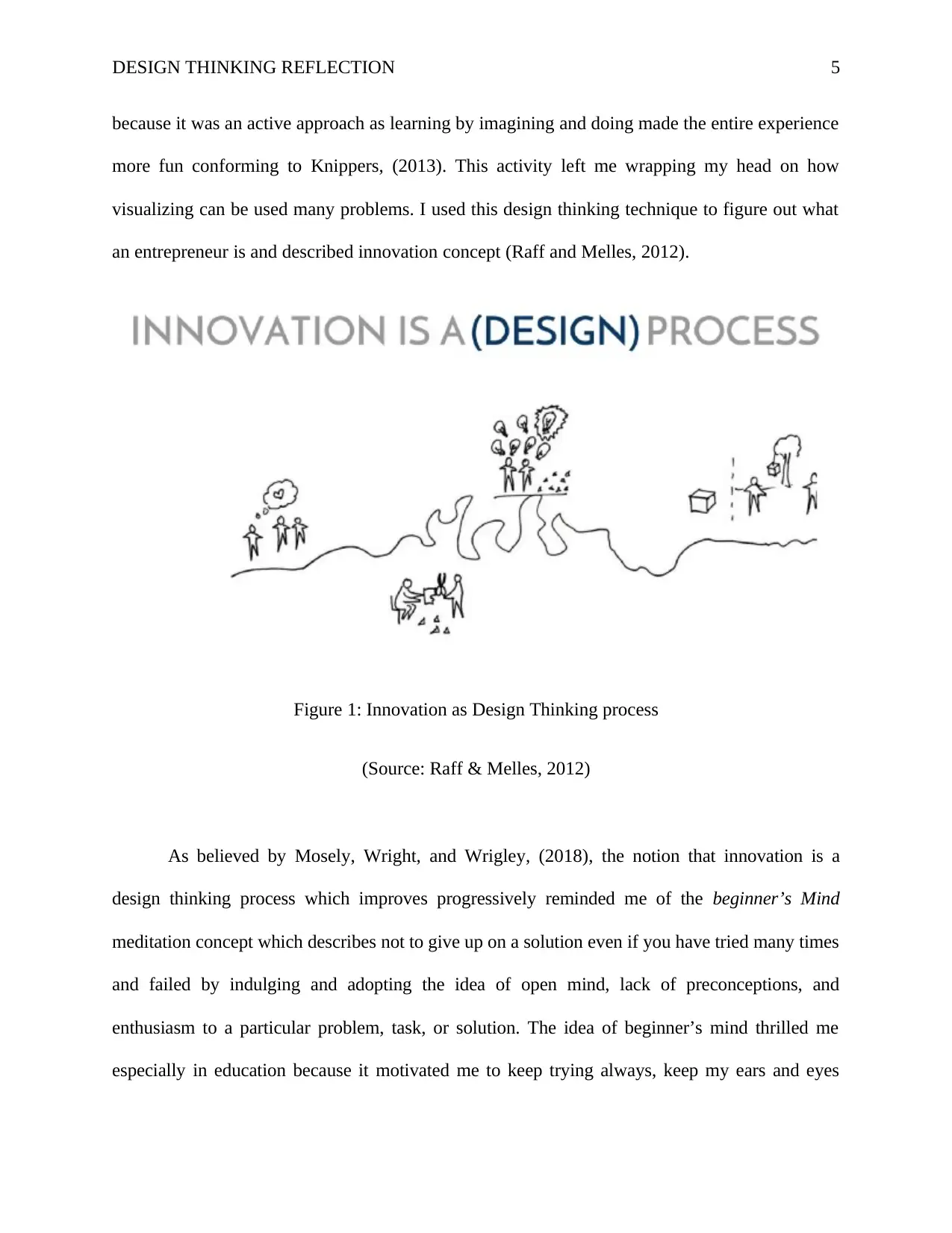
visualizing can be used many problems. I used this design thinking technique to figure out what
an entrepreneur is and described innovation concept (Raff and Melles, 2012).
Figure 1: Innovation as Design Thinking process
(Source: Raff & Melles, 2012)
As believed by Mosely, Wright, and Wrigley, (2018), the notion that innovation is a
design thinking process which improves progressively reminded me of the beginner’s Mind
meditation concept which describes not to give up on a solution even if you have tried many times
and failed by indulging and adopting the idea of open mind, lack of preconceptions, and
enthusiasm to a particular problem, task, or solution. The idea of beginner’s mind thrilled me
especially in education because it motivated me to keep trying always, keep my ears and eyes
because it was an active approach as learning by imagining and doing made the entire experience
more fun conforming to Knippers, (2013). This activity left me wrapping my head on how
visualizing can be used many problems. I used this design thinking technique to figure out what
an entrepreneur is and described innovation concept (Raff and Melles, 2012).
Figure 1: Innovation as Design Thinking process
(Source: Raff & Melles, 2012)
As believed by Mosely, Wright, and Wrigley, (2018), the notion that innovation is a
design thinking process which improves progressively reminded me of the beginner’s Mind
meditation concept which describes not to give up on a solution even if you have tried many times
and failed by indulging and adopting the idea of open mind, lack of preconceptions, and
enthusiasm to a particular problem, task, or solution. The idea of beginner’s mind thrilled me
especially in education because it motivated me to keep trying always, keep my ears and eyes
DESIGN THINKING REFLECTION 6
open for fresh ideas, and consider different perspective of seeing things. Innovation perspective
keeps reminding me that ‘I can do better’ and there is no limit to innovation and is a concept to
hold on to for a long haul.
Week 2
In week 2, Doctor Mike defined design thinking. One of the definitions explained was
thinking like a designer. I learnt that designers live in the future. Designers are well updated with
emerging trends and they embrace change. They give shape to an ambition or vision, drawing an
image of what good looks like to others. In addition, designers think in the round. They think
comprehensively on how to develop and innovate new services and products without interfering
with the current business. Besides, I learnt that designers are willing to solve issues. They
understand that design goes beyond providing solutions and options. It involves engaging
shareholders, acquiring more knowledge through iteration and testing, and adapting new outlook
as the project progresses.
As we progressed with the design process topic, I realized that to create something new we
need to develop skills of critical thinking and think outside the box. Some of the critical thinking
skills that I learned include:
Analyzing: breaking or separating a whole into sections to discover their functionality,
nature and relationships.
Employing standards: deciding according to developed professional, personal, or social
criteria or rules.
open for fresh ideas, and consider different perspective of seeing things. Innovation perspective
keeps reminding me that ‘I can do better’ and there is no limit to innovation and is a concept to
hold on to for a long haul.
Week 2
In week 2, Doctor Mike defined design thinking. One of the definitions explained was
thinking like a designer. I learnt that designers live in the future. Designers are well updated with
emerging trends and they embrace change. They give shape to an ambition or vision, drawing an
image of what good looks like to others. In addition, designers think in the round. They think
comprehensively on how to develop and innovate new services and products without interfering
with the current business. Besides, I learnt that designers are willing to solve issues. They
understand that design goes beyond providing solutions and options. It involves engaging
shareholders, acquiring more knowledge through iteration and testing, and adapting new outlook
as the project progresses.
As we progressed with the design process topic, I realized that to create something new we
need to develop skills of critical thinking and think outside the box. Some of the critical thinking
skills that I learned include:
Analyzing: breaking or separating a whole into sections to discover their functionality,
nature and relationships.
Employing standards: deciding according to developed professional, personal, or social
criteria or rules.
⊘ This is a preview!⊘
Do you want full access?
Subscribe today to unlock all pages.
Trusted by 1+ million students worldwide
DESIGN THINKING REFLECTION 7
Discriminating: identifying similarities and differences among situations or things and
differentiating carefully as to rank or category
Information searching: looking for facts, proof, or knowledge by recognizing important
sources collecting subjective, current, objective and historical data from those sources
Week 3
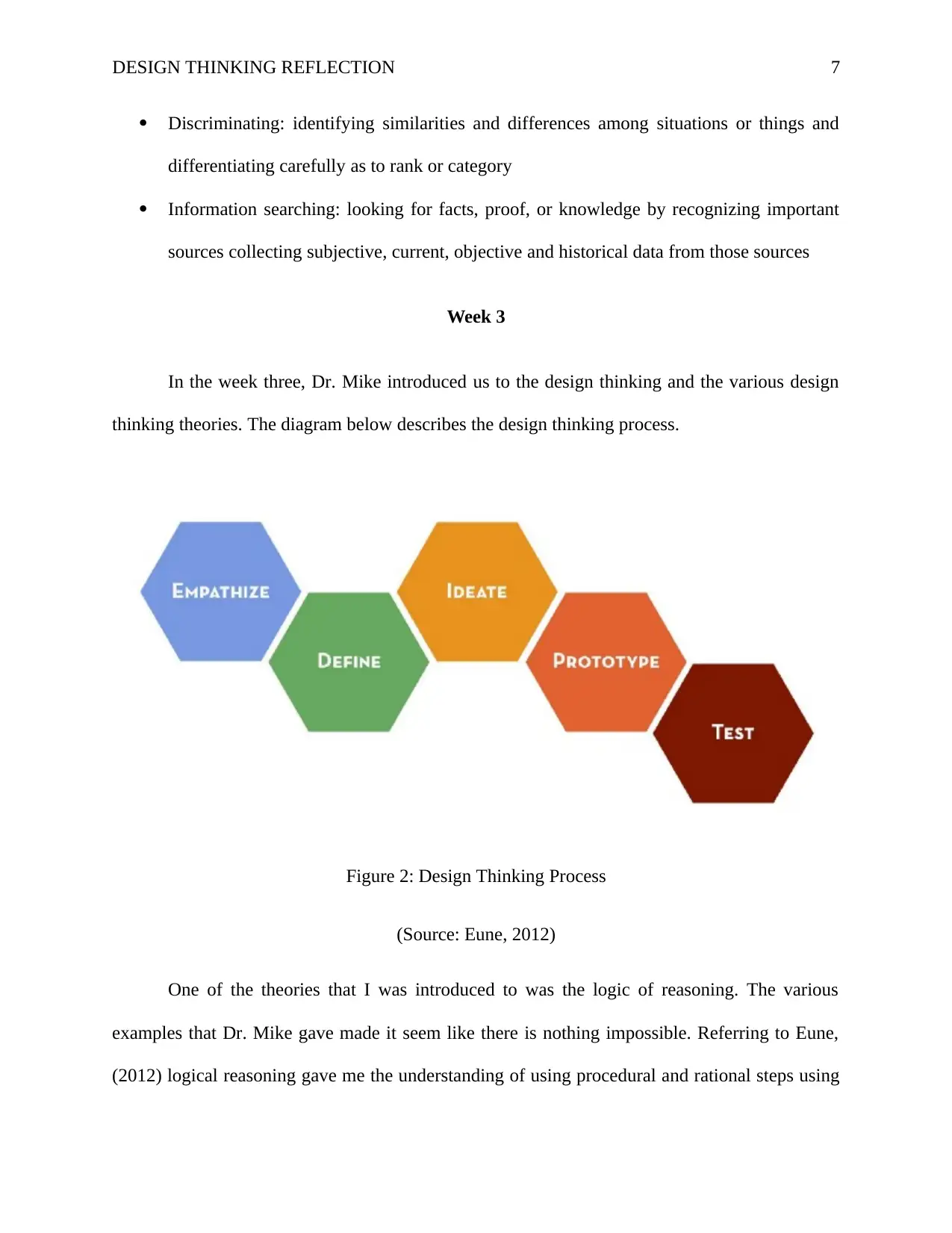
In the week three, Dr. Mike introduced us to the design thinking and the various design
thinking theories. The diagram below describes the design thinking process.
Figure 2: Design Thinking Process
(Source: Eune, 2012)
One of the theories that I was introduced to was the logic of reasoning. The various
examples that Dr. Mike gave made it seem like there is nothing impossible. Referring to Eune,
(2012) logical reasoning gave me the understanding of using procedural and rational steps using
Discriminating: identifying similarities and differences among situations or things and
differentiating carefully as to rank or category
Information searching: looking for facts, proof, or knowledge by recognizing important
sources collecting subjective, current, objective and historical data from those sources
Week 3
In the week three, Dr. Mike introduced us to the design thinking and the various design
thinking theories. The diagram below describes the design thinking process.
Figure 2: Design Thinking Process
(Source: Eune, 2012)
One of the theories that I was introduced to was the logic of reasoning. The various
examples that Dr. Mike gave made it seem like there is nothing impossible. Referring to Eune,
(2012) logical reasoning gave me the understanding of using procedural and rational steps using
Paraphrase This Document
Need a fresh take? Get an instant paraphrase of this document with our AI Paraphraser
DESIGN THINKING REFLECTION 8
mathematical expressions to come to a solution. Convergent thinking however, thought me on
how to determine a well-established single solution to a challenge. I was able to note that this
kind of thinking is a creative problem-solving tool. In the opinion of Oxman, (2017), solving a
problem using critical thinking approach requires careful use of probabilities and standards to
make judgement. Contrastingly, in divergent thinking finding solution requires that judgment is
deferred.
Week 4
Week four was one of the most interesting one. Dr. Mike introduced us to problem
finding and solving, identifying problems by spotting the obvious, using the Persona and
visualization as design thinking tools. I agree with Hocking and Vernon, (2017) that there exist
many methods that I can use to find and analyze the problems and design thinking is more
focused on identifying problem more than solving it. One of the activities that I participated
during this week was spotting the obvious where the faculty grouped as into teams and was
tasked to find problems in the picture on the screen that relates to the topic a day at the beach.
Before one can solve a problem, you need to first identify it and they better be worthy of solving
them. We were able to point out some problems but everyone had a different solution. This
confirmed to me that human beings look at things from totally different perspectives and they all
believe they have the most relevant solution which is an idea that Santovec, (2012) inferred in
his article.
Visualization is all about using pictures, this is the technique that technique that we used
to imagine how the master program will be like in 2050. This is a visual thinking technique and
drives us beyond the use of language and word alone. It enables people to think nonverbally by
mathematical expressions to come to a solution. Convergent thinking however, thought me on
how to determine a well-established single solution to a challenge. I was able to note that this
kind of thinking is a creative problem-solving tool. In the opinion of Oxman, (2017), solving a
problem using critical thinking approach requires careful use of probabilities and standards to
make judgement. Contrastingly, in divergent thinking finding solution requires that judgment is
deferred.
Week 4
Week four was one of the most interesting one. Dr. Mike introduced us to problem
finding and solving, identifying problems by spotting the obvious, using the Persona and
visualization as design thinking tools. I agree with Hocking and Vernon, (2017) that there exist
many methods that I can use to find and analyze the problems and design thinking is more
focused on identifying problem more than solving it. One of the activities that I participated
during this week was spotting the obvious where the faculty grouped as into teams and was
tasked to find problems in the picture on the screen that relates to the topic a day at the beach.
Before one can solve a problem, you need to first identify it and they better be worthy of solving
them. We were able to point out some problems but everyone had a different solution. This
confirmed to me that human beings look at things from totally different perspectives and they all
believe they have the most relevant solution which is an idea that Santovec, (2012) inferred in
his article.
Visualization is all about using pictures, this is the technique that technique that we used
to imagine how the master program will be like in 2050. This is a visual thinking technique and
drives us beyond the use of language and word alone. It enables people to think nonverbally by
DESIGN THINKING REFLECTION 9
unlocking the various parts of our minds that we do not usually utilize argues Hidayat,
Susilaningsih and Kurniawan, (2018).
Designing a persona can be fun because you visualize yourself as another person and try
see things from their perspectives. When my team was given the task to design a persona of an
Australian citizen who joined the workforce in 1990 after completing schools and that the
employer would fire the employees who did not have a degree yet he had not attended a
university. If he would not enroll to an undergraduate he would lose his job.
Week 5
Before starting week five workshop I decided to go through some available resources to
seek to understand the unit better. When I watched IDEO video I realized that ideation is actually
how brainstorming works and how the entire process of ideation stimulates the feelings and
thinking of a person to come up with new innovation ideas as mentioned by Volkova and
Jākobsone (2016). The design process is better described using the four what’s, that is, what if?
what is? what wows? And what works. This approach gave me a well-ordered method of coming
up with new ideas to solve a problem. According to Kristensson and Magnusson (2010), ideation
actually involves the entire process of coming up with ideas and solution by engaging in
activities such as prototyping, brainwriting, brainstorming, sketching, ideation wealth, and worst
possible idea (Sofiana, 2014).
In consonance to Sofiana (2014) work, what is? Focuses on the current challenge or
problem that needs to be solved. This entails being keen and observing what frustrates or what
the users are struggling with. What if? Focuses on new trends, possibilities, and uncertainties that
the future may bring. What wows? Focuses on the ideation process wealth that makes the user
unlocking the various parts of our minds that we do not usually utilize argues Hidayat,
Susilaningsih and Kurniawan, (2018).
Designing a persona can be fun because you visualize yourself as another person and try
see things from their perspectives. When my team was given the task to design a persona of an
Australian citizen who joined the workforce in 1990 after completing schools and that the
employer would fire the employees who did not have a degree yet he had not attended a
university. If he would not enroll to an undergraduate he would lose his job.
Week 5
Before starting week five workshop I decided to go through some available resources to
seek to understand the unit better. When I watched IDEO video I realized that ideation is actually
how brainstorming works and how the entire process of ideation stimulates the feelings and
thinking of a person to come up with new innovation ideas as mentioned by Volkova and
Jākobsone (2016). The design process is better described using the four what’s, that is, what if?
what is? what wows? And what works. This approach gave me a well-ordered method of coming
up with new ideas to solve a problem. According to Kristensson and Magnusson (2010), ideation
actually involves the entire process of coming up with ideas and solution by engaging in
activities such as prototyping, brainwriting, brainstorming, sketching, ideation wealth, and worst
possible idea (Sofiana, 2014).
In consonance to Sofiana (2014) work, what is? Focuses on the current challenge or
problem that needs to be solved. This entails being keen and observing what frustrates or what
the users are struggling with. What if? Focuses on new trends, possibilities, and uncertainties that
the future may bring. What wows? Focuses on the ideation process wealth that makes the user
⊘ This is a preview!⊘
Do you want full access?
Subscribe today to unlock all pages.
Trusted by 1+ million students worldwide
DESIGN THINKING REFLECTION 10
happy. This process is repetitive until the most ideal solution that hits the sweet spots of the users
is achieved. What works? Is actually the best solution from all the prototypes that is presented to
the user.
Week 6
Week six introduced me to the business world and all the time I used to think that the
customer was interested in the product quality and after sales services but actually that is not the
case. The real deal is the way a business transforms raw materials to finished products, that is,
the value chain (Endmann & Keßner, 2016). The faculty gave an in-depth explanation of the
porter’s generic value chain that give a business competitive advantage. Preparing the value
chain for Wollworths was quite a challenging task to me but after Dr. Mike gave us the idea of
approaching it from bottom-top approach made the entire process so easy (Leeds, Kudrowitz &
Kwon, 2018). This all boils down to how we see things and my skills of seeing problems from
different perspectives. The value of the product is added at every stage of the value chain which
offers an in-depth understanding as why the business sets the various prices of their products and
the reason for using one service or product to substitute another.
One of the activities that in undertook during this workshop is thinking outside the box. I
had 4 unsuccessful attempts in creating the value chain but I was able to apply my critical
thinking skills to think outside the box and it did actually work (Bonner, 2010). My team mates
appreciated my effort and I was happy with myself. The interesting activity was 5 why’s where
we persistently ask why a particular problem is happening until we get a reason. This made me
discover that my weaknesses and problems are actually two different aspects.
happy. This process is repetitive until the most ideal solution that hits the sweet spots of the users
is achieved. What works? Is actually the best solution from all the prototypes that is presented to
the user.
Week 6
Week six introduced me to the business world and all the time I used to think that the
customer was interested in the product quality and after sales services but actually that is not the
case. The real deal is the way a business transforms raw materials to finished products, that is,
the value chain (Endmann & Keßner, 2016). The faculty gave an in-depth explanation of the
porter’s generic value chain that give a business competitive advantage. Preparing the value
chain for Wollworths was quite a challenging task to me but after Dr. Mike gave us the idea of
approaching it from bottom-top approach made the entire process so easy (Leeds, Kudrowitz &
Kwon, 2018). This all boils down to how we see things and my skills of seeing problems from
different perspectives. The value of the product is added at every stage of the value chain which
offers an in-depth understanding as why the business sets the various prices of their products and
the reason for using one service or product to substitute another.
One of the activities that in undertook during this workshop is thinking outside the box. I
had 4 unsuccessful attempts in creating the value chain but I was able to apply my critical
thinking skills to think outside the box and it did actually work (Bonner, 2010). My team mates
appreciated my effort and I was happy with myself. The interesting activity was 5 why’s where
we persistently ask why a particular problem is happening until we get a reason. This made me
discover that my weaknesses and problems are actually two different aspects.
Paraphrase This Document
Need a fresh take? Get an instant paraphrase of this document with our AI Paraphraser
DESIGN THINKING REFLECTION 11
Mind mapping is another activity that I participated in and it actually requires immense
mental thinking. Mind mapping gives better results when done in a team based on the experience
I got during this activity (Endmann & Keßner, 2016). Using mind maps requires several steps
that radiates to a complex idea from a simple core idea as commented by Leeds, Kudrowitz and
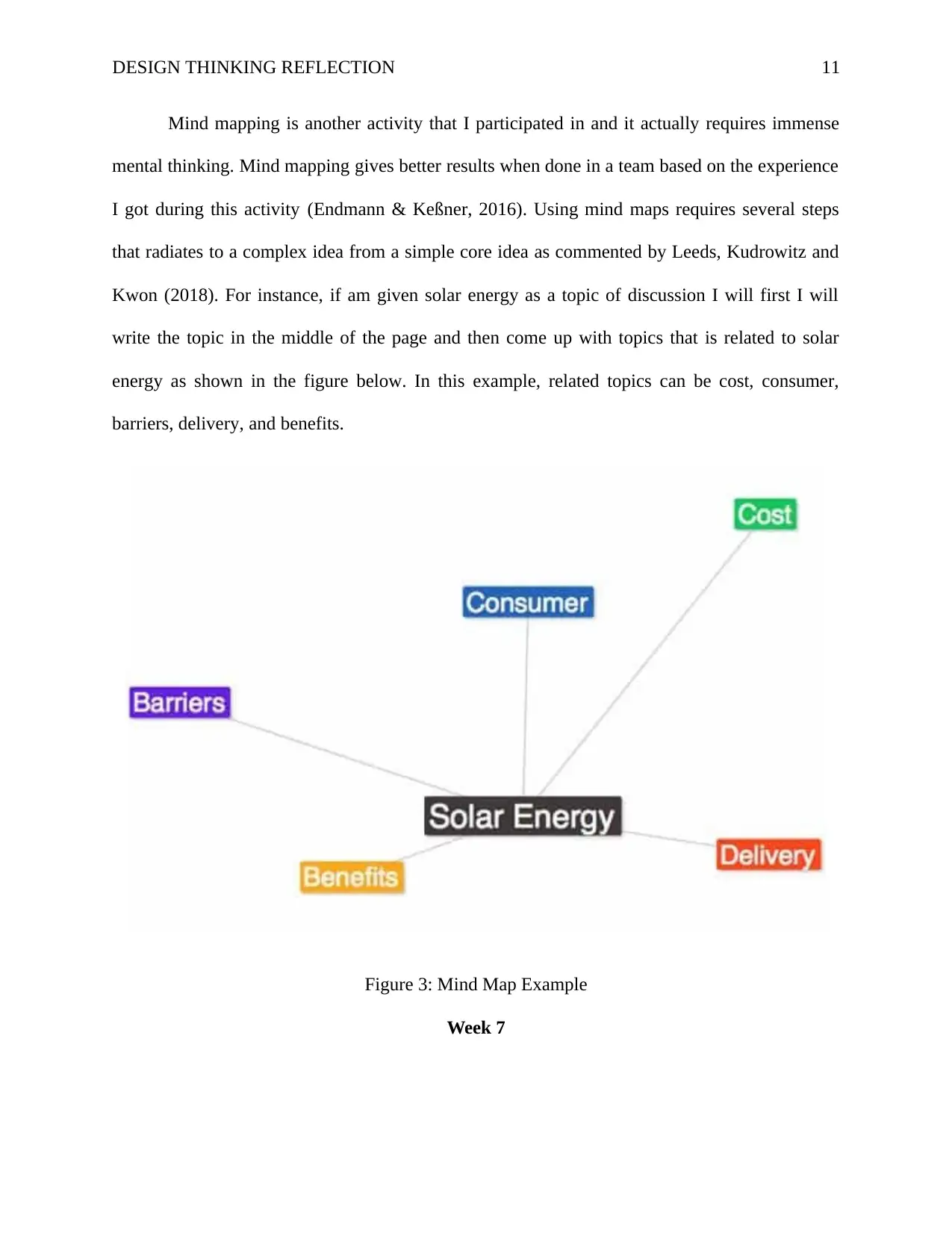
Kwon (2018). For instance, if am given solar energy as a topic of discussion I will first I will
write the topic in the middle of the page and then come up with topics that is related to solar
energy as shown in the figure below. In this example, related topics can be cost, consumer,
barriers, delivery, and benefits.
Figure 3: Mind Map Example
Week 7
Mind mapping is another activity that I participated in and it actually requires immense
mental thinking. Mind mapping gives better results when done in a team based on the experience
I got during this activity (Endmann & Keßner, 2016). Using mind maps requires several steps
that radiates to a complex idea from a simple core idea as commented by Leeds, Kudrowitz and
Kwon (2018). For instance, if am given solar energy as a topic of discussion I will first I will
write the topic in the middle of the page and then come up with topics that is related to solar
energy as shown in the figure below. In this example, related topics can be cost, consumer,
barriers, delivery, and benefits.
Figure 3: Mind Map Example
Week 7
DESIGN THINKING REFLECTION 12
On week 7, the professors began with a short introduction to research. The two types of
data source were illustrated namely primary data and secondary data. I learnt that primary data
also referred to as raw or first-hand data is information created by analyst for the first time
through direct experiences and efforts, particularly for the aim of solving research problem
(Lowry, 2015). Besides, I found out that primary data can be collected through different methods
such as observations, mailed questionnaires, personal interviews, focus groups, surveys, physical
testing, telephonic interviews, and case studies, among others.
In addition, I learnt that secondary data entails second-hand data which is already
gathered and documented by any individual apart from the user for an aim that is different from
the existing research problem. Secondary data is the readily available form of information
gathered from different sources such as government publications, reports, journal articles,
censuses, organization’s internal records, books, websites and others.
We later studied interview for design thinking. I learnt that as an interviewer, I need to have
good verbal reasoning skills and be consistent with my questions (Kaul & Hanson, 2013). I
should allocate adequate time to each question and employ open-minded questions to allow the
applicants to put more input. While my colleagues are interviewing me, I realized that I need to
be honest, confident and observe my non-verbal cues such as gestures, body movements,
significant pauses, facial expressions, tone of voice, laughter, among others.
Week 8
In week 8, I learnt that a prototype is an early model, sample, or release of a product
developed to examine a process or concept. I learnt that although a prototype can be represented
On week 7, the professors began with a short introduction to research. The two types of
data source were illustrated namely primary data and secondary data. I learnt that primary data
also referred to as raw or first-hand data is information created by analyst for the first time
through direct experiences and efforts, particularly for the aim of solving research problem
(Lowry, 2015). Besides, I found out that primary data can be collected through different methods
such as observations, mailed questionnaires, personal interviews, focus groups, surveys, physical
testing, telephonic interviews, and case studies, among others.
In addition, I learnt that secondary data entails second-hand data which is already
gathered and documented by any individual apart from the user for an aim that is different from
the existing research problem. Secondary data is the readily available form of information
gathered from different sources such as government publications, reports, journal articles,
censuses, organization’s internal records, books, websites and others.
We later studied interview for design thinking. I learnt that as an interviewer, I need to have
good verbal reasoning skills and be consistent with my questions (Kaul & Hanson, 2013). I
should allocate adequate time to each question and employ open-minded questions to allow the
applicants to put more input. While my colleagues are interviewing me, I realized that I need to
be honest, confident and observe my non-verbal cues such as gestures, body movements,
significant pauses, facial expressions, tone of voice, laughter, among others.
Week 8
In week 8, I learnt that a prototype is an early model, sample, or release of a product
developed to examine a process or concept. I learnt that although a prototype can be represented
⊘ This is a preview!⊘
Do you want full access?
Subscribe today to unlock all pages.
Trusted by 1+ million students worldwide

1 out of 18


Related Documents


Your All-in-One AI-Powered Toolkit for Academic Success.
+13062052269
info@desklib.com
Available 24*7 on WhatsApp / Email
![[object Object]](/_next/static/media/star-bottom.7253800d.svg)
Unlock your academic potential
Copyright © 2020–2026 A2Z Services. All Rights Reserved. Developed and managed by ZUCOL.