IP Addressing Scheme Design for CI5210/CI5220 Networking Coursework

Verified

Added on  2019/09/18

|3
|1023
|365
Project
AI Summary
This assignment focuses on designing an IP addressing scheme for an enterprise, specifically a sailing equipment tele-sales supplier with multiple sites. The task involves developing a fixed-length subnet mask IP addressing scheme based on the company's specification and physical network design, including the assignment of IP addresses to subnets and router connections. The solution requires a clear description of the methodology, the calculation of subnet and supernet masks, and the assignment of addresses in dot notation. The enterprise has been assigned the network address 210.8.224.0. The network design includes sites in Port Solent and Stansted, each with different workgroup sizes and network configurations. The solution must consider the number of workstations per workgroup to create an efficient addressing scheme. The marking criteria assess the IP addressing scheme, address assignments, and the presentation of the methodology. The student is encouraged to show all working steps and consider assumptions made during the design process. The document includes a marking scheme that evaluates the correctness of the IP addressing scheme, the proper assignment of addresses, and the clarity of the methodology description.
Document Page
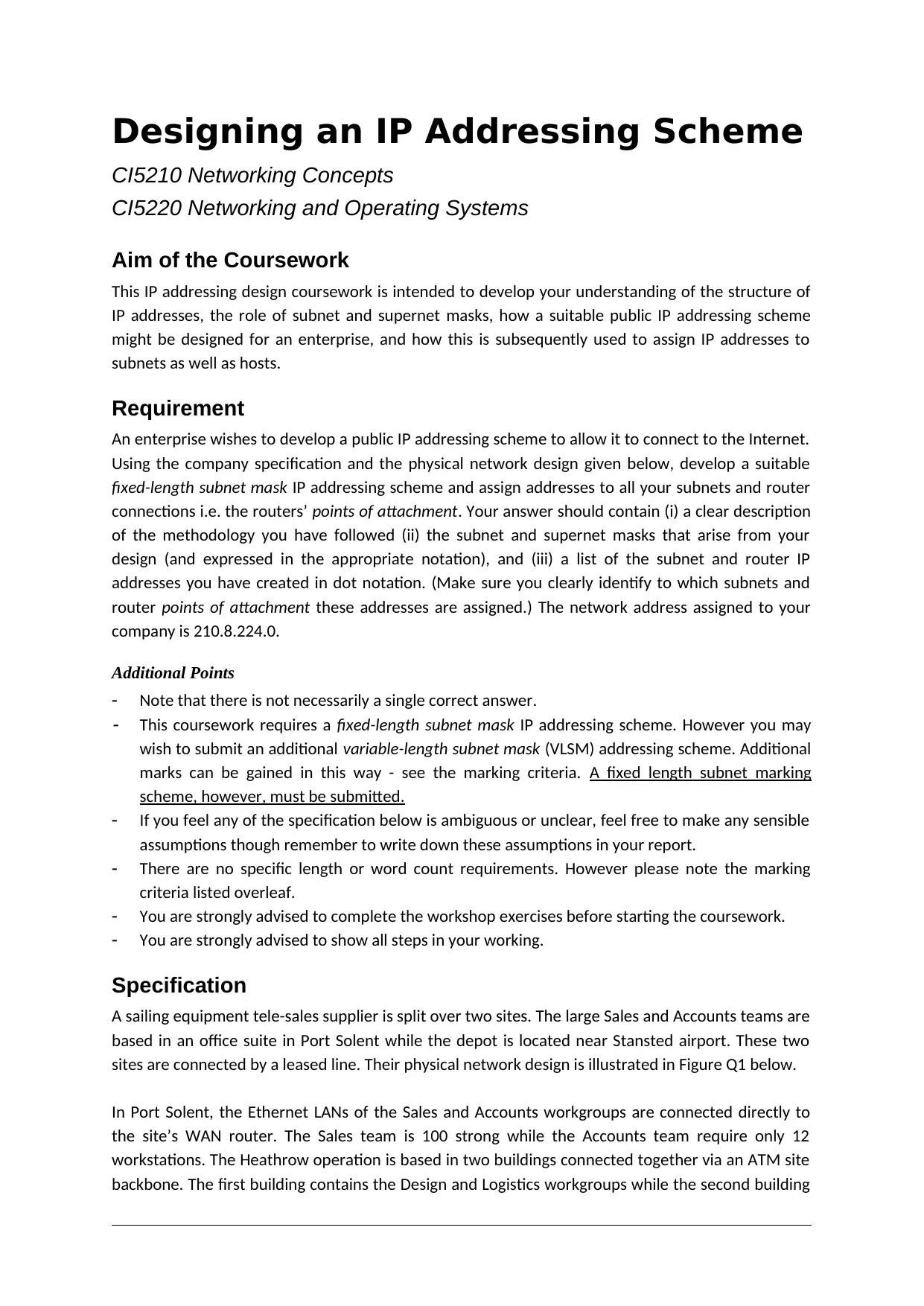
Designing an IP Addressing Scheme
CI5210 Networking Concepts
CI5220 Networking and Operating Systems
Aim of the Coursework
This IP addressing design coursework is intended to develop your understanding of the structure of
IP addresses, the role of subnet and supernet masks, how a suitable public IP addressing scheme
might be designed for an enterprise, and how this is subsequently used to assign IP addresses to
subnets as well as hosts.
Requirement
An enterprise wishes to develop a public IP addressing scheme to allow it to connect to the Internet.
Using the company specification and the physical network design given below, develop a suitable
fixed-length subnet mask IP addressing scheme and assign addresses to all your subnets and router
connections i.e. the routers’ points of attachment. Your answer should contain (i) a clear description
of the methodology you have followed (ii) the subnet and supernet masks that arise from your
design (and expressed in the appropriate notation), and (iii) a list of the subnet and router IP
addresses you have created in dot notation. (Make sure you clearly identify to which subnets and
router points of attachment these addresses are assigned.) The network address assigned to your
company is 210.8.224.0.
Additional Points
Note that there is not necessarily a single correct answer. This coursework requires a fixed-length subnet mask IP addressing scheme. However you may
wish to submit an additional variable-length subnet mask (VLSM) addressing scheme. Additional
marks can be gained in this way - see the marking criteria. A fixed length subnet marking
scheme, however, must be submitted.
If you feel any of the specification below is ambiguous or unclear, feel free to make any sensible
assumptions though remember to write down these assumptions in your report.
There are no specific length or word count requirements. However please note the marking
criteria listed overleaf.
You are strongly advised to complete the workshop exercises before starting the coursework.
You are strongly advised to show all steps in your working.
Specification
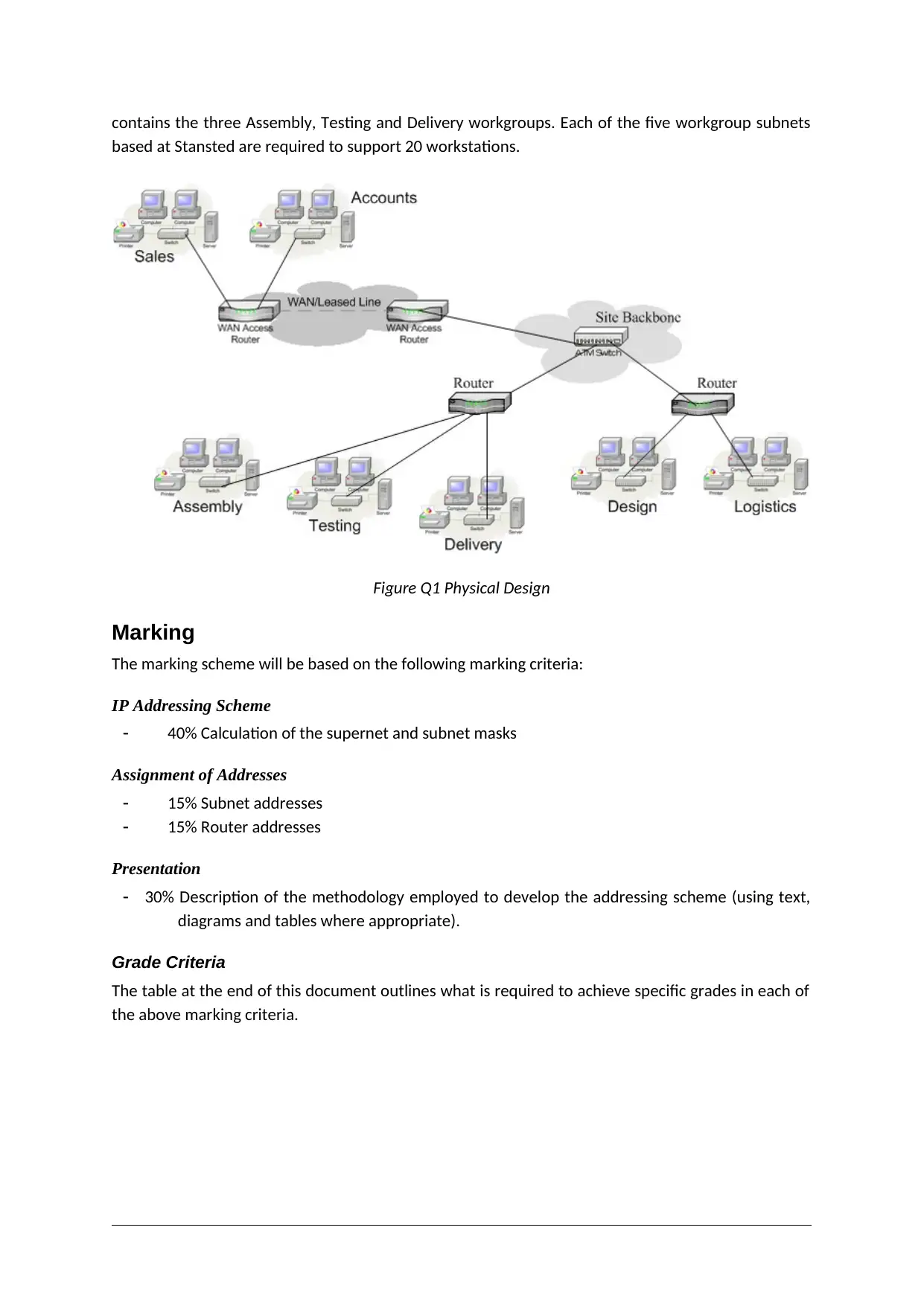
A sailing equipment tele-sales supplier is split over two sites. The large Sales and Accounts teams are
based in an office suite in Port Solent while the depot is located near Stansted airport. These two
sites are connected by a leased line. Their physical network design is illustrated in Figure Q1 below.
In Port Solent, the Ethernet LANs of the Sales and Accounts workgroups are connected directly to
the site’s WAN router. The Sales team is 100 strong while the Accounts team require only 12
workstations. The Heathrow operation is based in two buildings connected together via an ATM site
backbone. The first building contains the Design and Logistics workgroups while the second building
tabler-icon-diamond-filled.svg

Paraphrase This Document

Need a fresh take? Get an instant paraphrase of this document with our AI Paraphraser
Document Page
contains the three Assembly, Testing and Delivery workgroups. Each of the five workgroup subnets
based at Stansted are required to support 20 workstations.
Figure Q1 Physical Design
Marking
The marking scheme will be based on the following marking criteria:
IP Addressing Scheme
40% Calculation of the supernet and subnet masks
Assignment of Addresses
15% Subnet addresses
15% Router addresses
Presentation
30% Description of the methodology employed to develop the addressing scheme (using text,
diagrams and tables where appropriate).
Grade Criteria
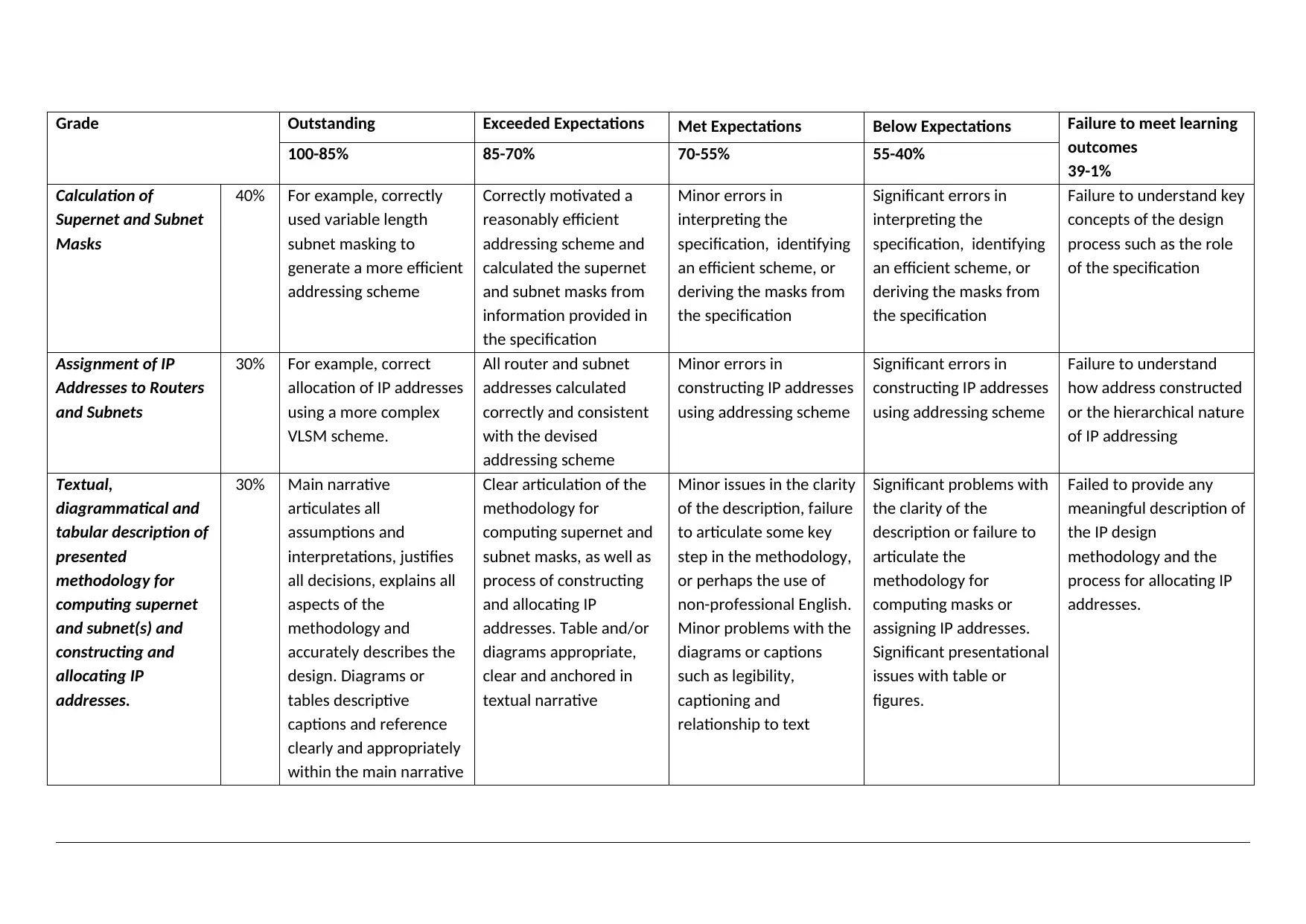
The table at the end of this document outlines what is required to achieve specific grades in each of
the above marking criteria.
Document Page
Grade Outstanding Exceeded Expectations Met Expectations Below Expectations Failure to meet learning
outcomes
39-1%
100-85% 85-70% 70-55% 55-40%
Calculation of
Supernet and Subnet
Masks
40% For example, correctly
used variable length
subnet masking to
generate a more efficient
addressing scheme
Correctly motivated a
reasonably efficient
addressing scheme and
calculated the supernet
and subnet masks from
information provided in
the specification
Minor errors in
interpreting the
specification, identifying
an efficient scheme, or
deriving the masks from
the specification
Significant errors in
interpreting the
specification, identifying
an efficient scheme, or
deriving the masks from
the specification
Failure to understand key
concepts of the design
process such as the role
of the specification
Assignment of IP
Addresses to Routers
and Subnets
30% For example, correct
allocation of IP addresses
using a more complex
VLSM scheme.
All router and subnet
addresses calculated
correctly and consistent
with the devised
addressing scheme
Minor errors in
constructing IP addresses
using addressing scheme
Significant errors in
constructing IP addresses
using addressing scheme
Failure to understand
how address constructed
or the hierarchical nature
of IP addressing
Textual,
diagrammatical and
tabular description of
presented
methodology for
computing supernet
and subnet(s) and
constructing and
allocating IP
addresses.
30% Main narrative
articulates all
assumptions and
interpretations, justifies
all decisions, explains all
aspects of the
methodology and
accurately describes the
design. Diagrams or
tables descriptive
captions and reference
clearly and appropriately
within the main narrative
Clear articulation of the
methodology for
computing supernet and
subnet masks, as well as
process of constructing
and allocating IP
addresses. Table and/or
diagrams appropriate,
clear and anchored in
textual narrative
Minor issues in the clarity
of the description, failure
to articulate some key
step in the methodology,
or perhaps the use of
non-professional English.
Minor problems with the
diagrams or captions
such as legibility,
captioning and
relationship to text
Significant problems with
the clarity of the
description or failure to
articulate the
methodology for
computing masks or
assigning IP addresses.
Significant presentational
issues with table or
figures.
Failed to provide any
meaningful description of
the IP design
methodology and the
process for allocating IP
addresses.
chevron_up_icon
1 out of 3
circle_padding
hide_on_mobile
zoom_out_icon
[object Object]