BEA111 Economics: Game Theory and Externalities - Assignment Solution
VerifiedAdded on 2023/06/11
|7
|953
|257
Homework Assignment
AI Summary
This economics assignment solution delves into game theory, analyzing dominant strategies and Nash equilibrium with payoff matrices. It further explores market externalities, particularly positive externalities, explaining how they lead to underproduction and deadweight loss in unregulated markets using supply and demand diagrams. The assignment clarifies the difference between private and social benefits and costs, highlighting the inefficiency caused by externalities. The document concludes by correcting a statement about overproduction, emphasizing that positive externalities result in underproduction. Desklib offers a platform to explore more such solved assignments and past papers for students.
Running Head: ECONOMICS
Economics
Name of the Student
Name of the University
Course ID
Economics
Name of the Student
Name of the University
Course ID
Paraphrase This Document
Need a fresh take? Get an instant paraphrase of this document with our AI Paraphraser

1ECONOMICS
Table of Contents
Answer 1..........................................................................................................................................2
Answer 2..........................................................................................................................................2
Answer 3..........................................................................................................................................3
Answer 4..........................................................................................................................................6
Table of Contents
Answer 1..........................................................................................................................................2
Answer 2..........................................................................................................................................2
Answer 3..........................................................................................................................................3
Answer 4..........................................................................................................................................6

2ECONOMICS
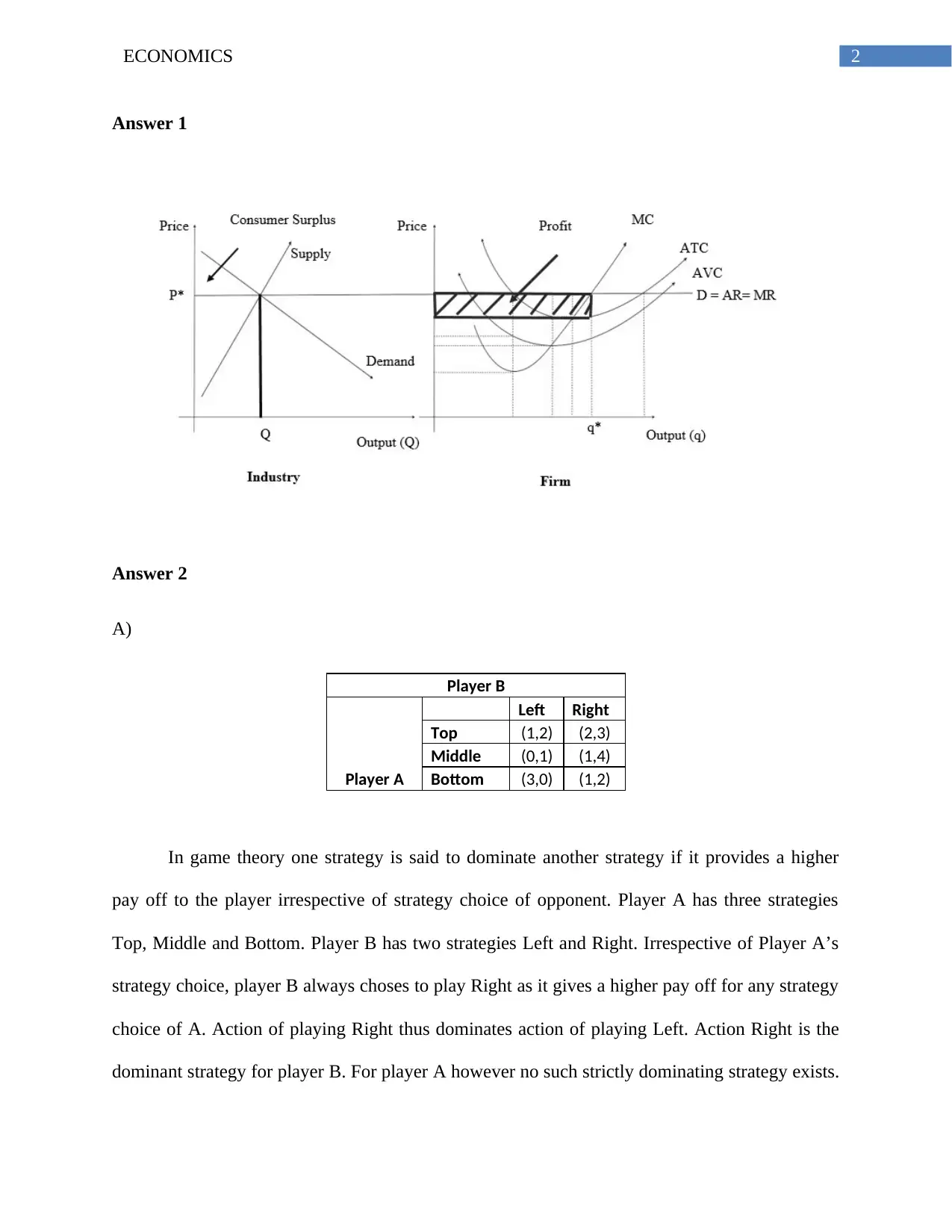
Answer 1
Answer 2
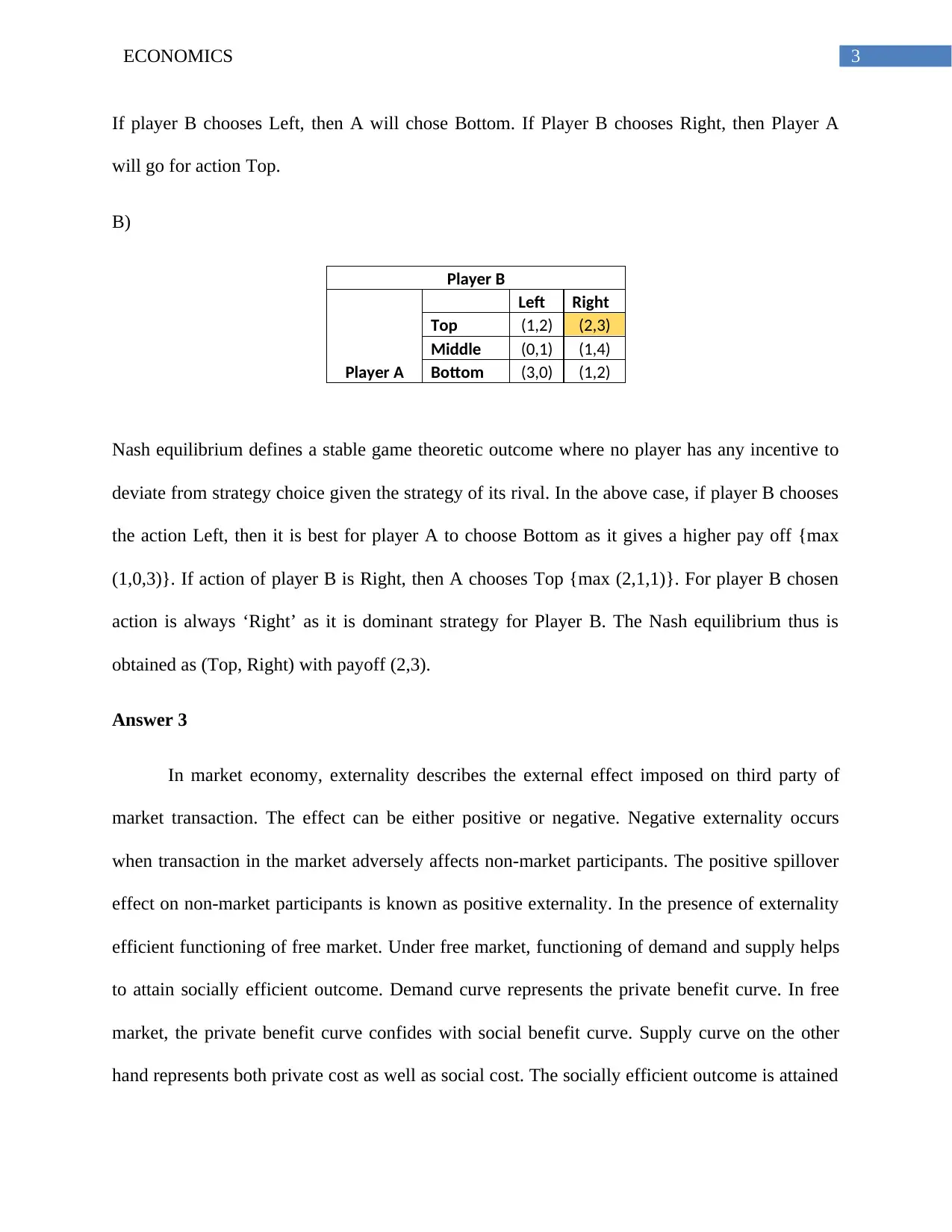
A)
Player B
Player A
Left Right
Top (1,2) (2,3)
Middle (0,1) (1,4)
Bottom (3,0) (1,2)
In game theory one strategy is said to dominate another strategy if it provides a higher
pay off to the player irrespective of strategy choice of opponent. Player A has three strategies
Top, Middle and Bottom. Player B has two strategies Left and Right. Irrespective of Player A’s
strategy choice, player B always choses to play Right as it gives a higher pay off for any strategy
choice of A. Action of playing Right thus dominates action of playing Left. Action Right is the
dominant strategy for player B. For player A however no such strictly dominating strategy exists.
Answer 1
Answer 2
A)
Player B
Player A
Left Right
Top (1,2) (2,3)
Middle (0,1) (1,4)
Bottom (3,0) (1,2)
In game theory one strategy is said to dominate another strategy if it provides a higher
pay off to the player irrespective of strategy choice of opponent. Player A has three strategies
Top, Middle and Bottom. Player B has two strategies Left and Right. Irrespective of Player A’s
strategy choice, player B always choses to play Right as it gives a higher pay off for any strategy
choice of A. Action of playing Right thus dominates action of playing Left. Action Right is the
dominant strategy for player B. For player A however no such strictly dominating strategy exists.
⊘ This is a preview!⊘
Do you want full access?
Subscribe today to unlock all pages.

Trusted by 1+ million students worldwide

3ECONOMICS
If player B chooses Left, then A will chose Bottom. If Player B chooses Right, then Player A
will go for action Top.
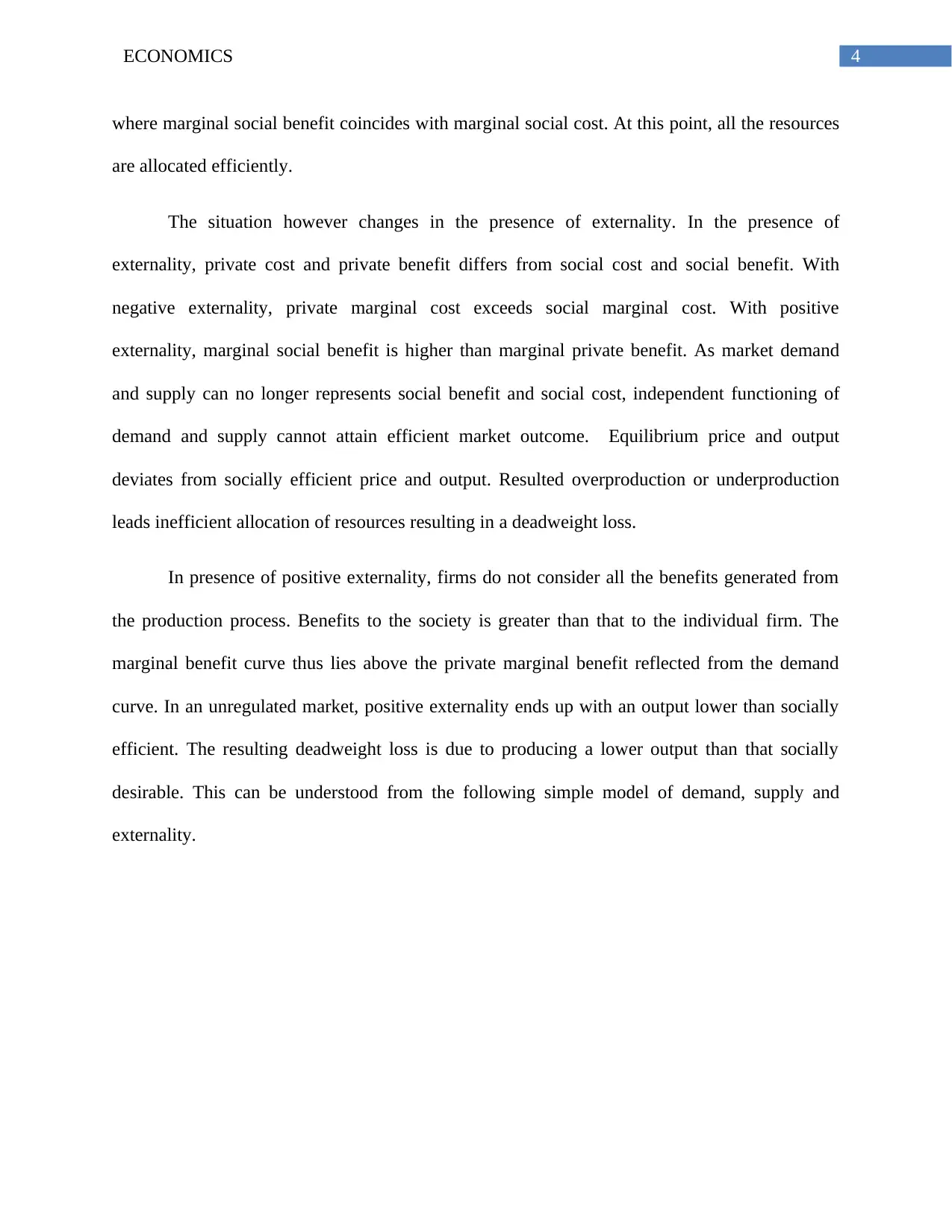
B)
Player B
Player A
Left Right
Top (1,2) (2,3)
Middle (0,1) (1,4)
Bottom (3,0) (1,2)
Nash equilibrium defines a stable game theoretic outcome where no player has any incentive to
deviate from strategy choice given the strategy of its rival. In the above case, if player B chooses
the action Left, then it is best for player A to choose Bottom as it gives a higher pay off {max
(1,0,3)}. If action of player B is Right, then A chooses Top {max (2,1,1)}. For player B chosen
action is always ‘Right’ as it is dominant strategy for Player B. The Nash equilibrium thus is
obtained as (Top, Right) with payoff (2,3).
Answer 3
In market economy, externality describes the external effect imposed on third party of
market transaction. The effect can be either positive or negative. Negative externality occurs
when transaction in the market adversely affects non-market participants. The positive spillover
effect on non-market participants is known as positive externality. In the presence of externality
efficient functioning of free market. Under free market, functioning of demand and supply helps
to attain socially efficient outcome. Demand curve represents the private benefit curve. In free
market, the private benefit curve confides with social benefit curve. Supply curve on the other
hand represents both private cost as well as social cost. The socially efficient outcome is attained
If player B chooses Left, then A will chose Bottom. If Player B chooses Right, then Player A
will go for action Top.
B)
Player B
Player A
Left Right
Top (1,2) (2,3)
Middle (0,1) (1,4)
Bottom (3,0) (1,2)
Nash equilibrium defines a stable game theoretic outcome where no player has any incentive to
deviate from strategy choice given the strategy of its rival. In the above case, if player B chooses
the action Left, then it is best for player A to choose Bottom as it gives a higher pay off {max
(1,0,3)}. If action of player B is Right, then A chooses Top {max (2,1,1)}. For player B chosen
action is always ‘Right’ as it is dominant strategy for Player B. The Nash equilibrium thus is
obtained as (Top, Right) with payoff (2,3).
Answer 3
In market economy, externality describes the external effect imposed on third party of
market transaction. The effect can be either positive or negative. Negative externality occurs
when transaction in the market adversely affects non-market participants. The positive spillover
effect on non-market participants is known as positive externality. In the presence of externality
efficient functioning of free market. Under free market, functioning of demand and supply helps
to attain socially efficient outcome. Demand curve represents the private benefit curve. In free
market, the private benefit curve confides with social benefit curve. Supply curve on the other
hand represents both private cost as well as social cost. The socially efficient outcome is attained
Paraphrase This Document
Need a fresh take? Get an instant paraphrase of this document with our AI Paraphraser

4ECONOMICS
where marginal social benefit coincides with marginal social cost. At this point, all the resources
are allocated efficiently.
The situation however changes in the presence of externality. In the presence of
externality, private cost and private benefit differs from social cost and social benefit. With
negative externality, private marginal cost exceeds social marginal cost. With positive
externality, marginal social benefit is higher than marginal private benefit. As market demand
and supply can no longer represents social benefit and social cost, independent functioning of
demand and supply cannot attain efficient market outcome. Equilibrium price and output
deviates from socially efficient price and output. Resulted overproduction or underproduction
leads inefficient allocation of resources resulting in a deadweight loss.
In presence of positive externality, firms do not consider all the benefits generated from
the production process. Benefits to the society is greater than that to the individual firm. The
marginal benefit curve thus lies above the private marginal benefit reflected from the demand
curve. In an unregulated market, positive externality ends up with an output lower than socially
efficient. The resulting deadweight loss is due to producing a lower output than that socially
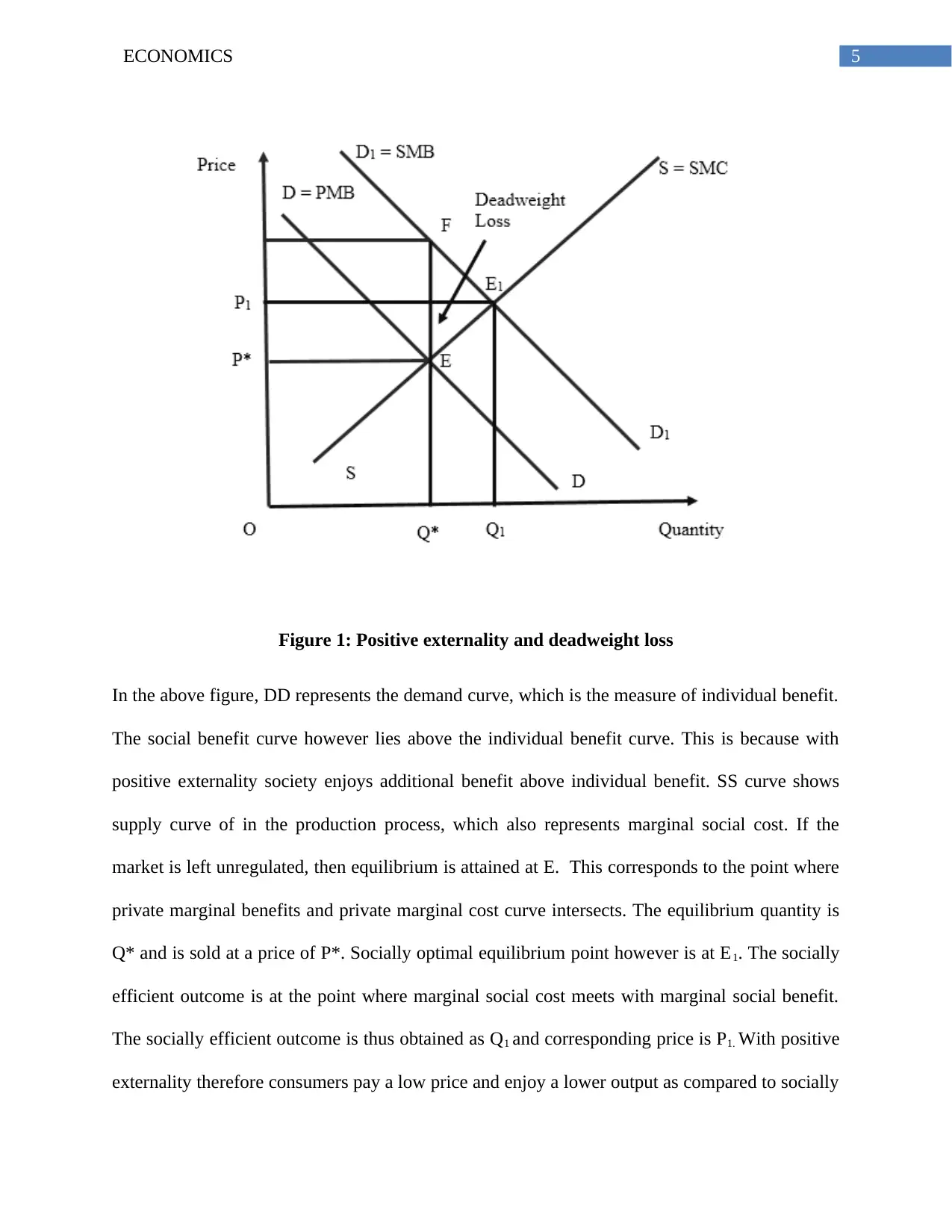
desirable. This can be understood from the following simple model of demand, supply and
externality.
where marginal social benefit coincides with marginal social cost. At this point, all the resources
are allocated efficiently.
The situation however changes in the presence of externality. In the presence of
externality, private cost and private benefit differs from social cost and social benefit. With
negative externality, private marginal cost exceeds social marginal cost. With positive
externality, marginal social benefit is higher than marginal private benefit. As market demand
and supply can no longer represents social benefit and social cost, independent functioning of
demand and supply cannot attain efficient market outcome. Equilibrium price and output
deviates from socially efficient price and output. Resulted overproduction or underproduction
leads inefficient allocation of resources resulting in a deadweight loss.
In presence of positive externality, firms do not consider all the benefits generated from
the production process. Benefits to the society is greater than that to the individual firm. The
marginal benefit curve thus lies above the private marginal benefit reflected from the demand
curve. In an unregulated market, positive externality ends up with an output lower than socially
efficient. The resulting deadweight loss is due to producing a lower output than that socially
desirable. This can be understood from the following simple model of demand, supply and
externality.

5ECONOMICS
Figure 1: Positive externality and deadweight loss
In the above figure, DD represents the demand curve, which is the measure of individual benefit.
The social benefit curve however lies above the individual benefit curve. This is because with
positive externality society enjoys additional benefit above individual benefit. SS curve shows
supply curve of in the production process, which also represents marginal social cost. If the
market is left unregulated, then equilibrium is attained at E. This corresponds to the point where
private marginal benefits and private marginal cost curve intersects. The equilibrium quantity is
Q* and is sold at a price of P*. Socially optimal equilibrium point however is at E1. The socially
efficient outcome is at the point where marginal social cost meets with marginal social benefit.
The socially efficient outcome is thus obtained as Q1 and corresponding price is P1. With positive
externality therefore consumers pay a low price and enjoy a lower output as compared to socially
Figure 1: Positive externality and deadweight loss
In the above figure, DD represents the demand curve, which is the measure of individual benefit.
The social benefit curve however lies above the individual benefit curve. This is because with
positive externality society enjoys additional benefit above individual benefit. SS curve shows
supply curve of in the production process, which also represents marginal social cost. If the
market is left unregulated, then equilibrium is attained at E. This corresponds to the point where
private marginal benefits and private marginal cost curve intersects. The equilibrium quantity is
Q* and is sold at a price of P*. Socially optimal equilibrium point however is at E1. The socially
efficient outcome is at the point where marginal social cost meets with marginal social benefit.
The socially efficient outcome is thus obtained as Q1 and corresponding price is P1. With positive
externality therefore consumers pay a low price and enjoy a lower output as compared to socially
⊘ This is a preview!⊘
Do you want full access?
Subscribe today to unlock all pages.

Trusted by 1+ million students worldwide

6ECONOMICS
efficient one. The inefficient from positive externality is shown from the area of the triangle
EE1F.
The discussion so far made suggests that though deadweight loss generated in presence of
positive externality but it is not due to overproduction, rather it is due to underproduction. This
falsify the given statement.
Answer 4
efficient one. The inefficient from positive externality is shown from the area of the triangle
EE1F.
The discussion so far made suggests that though deadweight loss generated in presence of
positive externality but it is not due to overproduction, rather it is due to underproduction. This
falsify the given statement.
Answer 4
1 out of 7
Your All-in-One AI-Powered Toolkit for Academic Success.
+13062052269
info@desklib.com
Available 24*7 on WhatsApp / Email
Unlock your academic potential
Copyright © 2020–2026 A2Z Services. All Rights Reserved. Developed and managed by ZUCOL.