MAT260 Assignment: Sums, Coefficients, and Combinatorial Proofs

Verified

Added on  2023/06/15

|10
|2178
|295
Homework Assignment
AI Summary
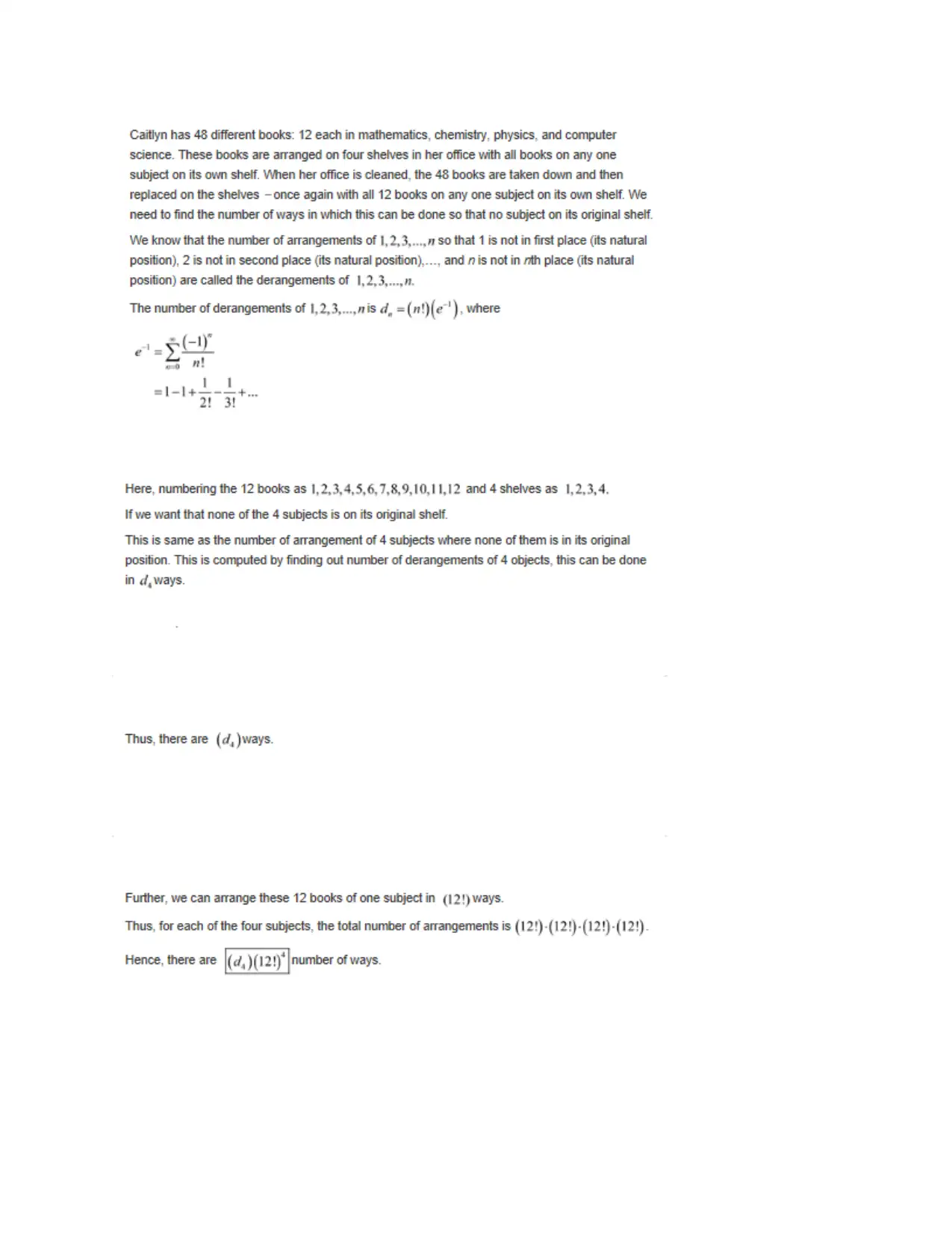
This assignment solution covers several problems in combinatorics, including evaluating sums using the binomial theorem, finding coefficients in multinomial expansions, and proving combinatorial identities. Specifically, it evaluates a sum involving binomial coefficients and powers of -10, determines the coefficient of a term in the expansion of a multinomial expression, proves a combinatorial identity using set theory reasoning, and demonstrates an inductive proof. Furthermore, it finds the generating function for a given sequence and applies the multinomial theorem. The document concludes with a problem related to arranging letters with repetitions. Desklib provides this and other solved assignments to aid students in their studies.
Document Page
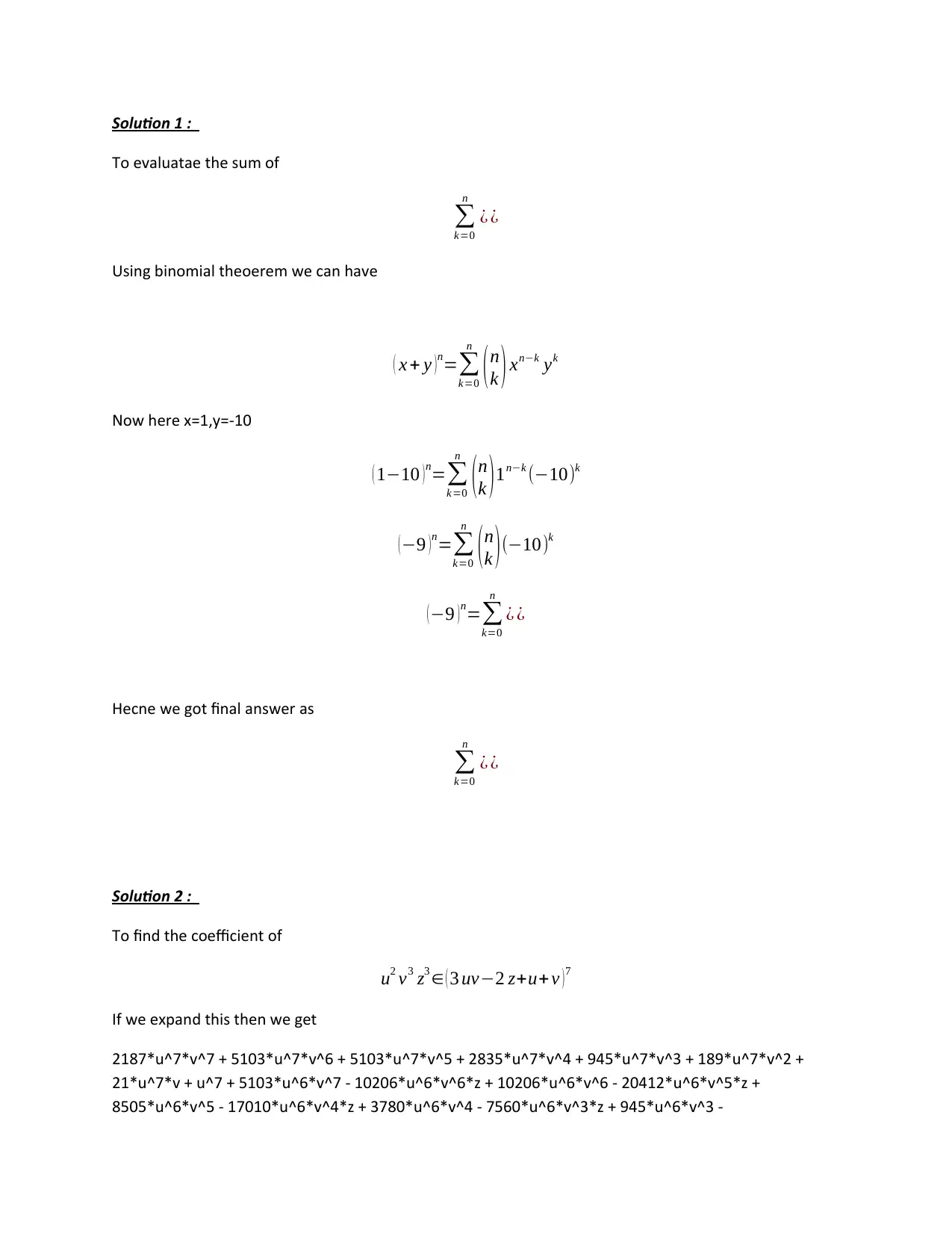
Solution 1 :
To evaluatae the sum of

k=0
n
¿ ¿
Using binomial theoerem we can have
( x + y )n=
k=0
n
(n
k ) xnk yk
Now here x=1,y=-10
( 110 )n=
k=0
n
(n
k )1nk (10)k
(9 )n=
k=0
n
(n
k )(10)k
(9 )n=
k=0
n
¿ ¿
Hecne we got final answer as

k=0
n
¿ ¿
Solution 2 :
To find the coefficient of
u2 v3 z3 ( 3 uv2 z+u+v )7
If we expand this then we get
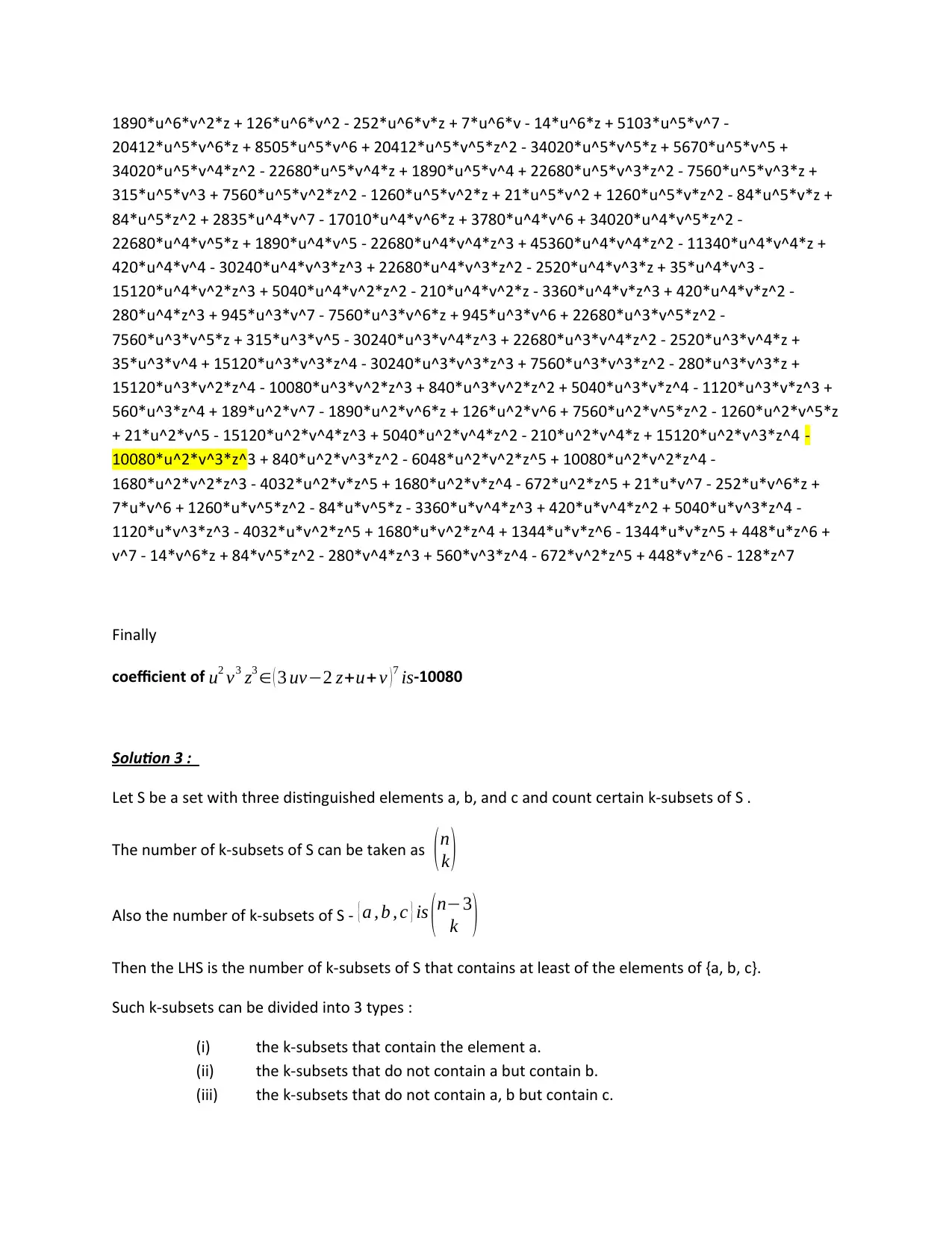
2187*u^7*v^7 + 5103*u^7*v^6 + 5103*u^7*v^5 + 2835*u^7*v^4 + 945*u^7*v^3 + 189*u^7*v^2 +
21*u^7*v + u^7 + 5103*u^6*v^7 - 10206*u^6*v^6*z + 10206*u^6*v^6 - 20412*u^6*v^5*z +
8505*u^6*v^5 - 17010*u^6*v^4*z + 3780*u^6*v^4 - 7560*u^6*v^3*z + 945*u^6*v^3 -
tabler-icon-diamond-filled.svg

Paraphrase This Document

Need a fresh take? Get an instant paraphrase of this document with our AI Paraphraser
Document Page
1890*u^6*v^2*z + 126*u^6*v^2 - 252*u^6*v*z + 7*u^6*v - 14*u^6*z + 5103*u^5*v^7 -
20412*u^5*v^6*z + 8505*u^5*v^6 + 20412*u^5*v^5*z^2 - 34020*u^5*v^5*z + 5670*u^5*v^5 +
34020*u^5*v^4*z^2 - 22680*u^5*v^4*z + 1890*u^5*v^4 + 22680*u^5*v^3*z^2 - 7560*u^5*v^3*z +
315*u^5*v^3 + 7560*u^5*v^2*z^2 - 1260*u^5*v^2*z + 21*u^5*v^2 + 1260*u^5*v*z^2 - 84*u^5*v*z +
84*u^5*z^2 + 2835*u^4*v^7 - 17010*u^4*v^6*z + 3780*u^4*v^6 + 34020*u^4*v^5*z^2 -
22680*u^4*v^5*z + 1890*u^4*v^5 - 22680*u^4*v^4*z^3 + 45360*u^4*v^4*z^2 - 11340*u^4*v^4*z +
420*u^4*v^4 - 30240*u^4*v^3*z^3 + 22680*u^4*v^3*z^2 - 2520*u^4*v^3*z + 35*u^4*v^3 -
15120*u^4*v^2*z^3 + 5040*u^4*v^2*z^2 - 210*u^4*v^2*z - 3360*u^4*v*z^3 + 420*u^4*v*z^2 -
280*u^4*z^3 + 945*u^3*v^7 - 7560*u^3*v^6*z + 945*u^3*v^6 + 22680*u^3*v^5*z^2 -
7560*u^3*v^5*z + 315*u^3*v^5 - 30240*u^3*v^4*z^3 + 22680*u^3*v^4*z^2 - 2520*u^3*v^4*z +
35*u^3*v^4 + 15120*u^3*v^3*z^4 - 30240*u^3*v^3*z^3 + 7560*u^3*v^3*z^2 - 280*u^3*v^3*z +
15120*u^3*v^2*z^4 - 10080*u^3*v^2*z^3 + 840*u^3*v^2*z^2 + 5040*u^3*v*z^4 - 1120*u^3*v*z^3 +
560*u^3*z^4 + 189*u^2*v^7 - 1890*u^2*v^6*z + 126*u^2*v^6 + 7560*u^2*v^5*z^2 - 1260*u^2*v^5*z
+ 21*u^2*v^5 - 15120*u^2*v^4*z^3 + 5040*u^2*v^4*z^2 - 210*u^2*v^4*z + 15120*u^2*v^3*z^4 -
10080*u^2*v^3*z^3 + 840*u^2*v^3*z^2 - 6048*u^2*v^2*z^5 + 10080*u^2*v^2*z^4 -
1680*u^2*v^2*z^3 - 4032*u^2*v*z^5 + 1680*u^2*v*z^4 - 672*u^2*z^5 + 21*u*v^7 - 252*u*v^6*z +
7*u*v^6 + 1260*u*v^5*z^2 - 84*u*v^5*z - 3360*u*v^4*z^3 + 420*u*v^4*z^2 + 5040*u*v^3*z^4 -
1120*u*v^3*z^3 - 4032*u*v^2*z^5 + 1680*u*v^2*z^4 + 1344*u*v*z^6 - 1344*u*v*z^5 + 448*u*z^6 +
v^7 - 14*v^6*z + 84*v^5*z^2 - 280*v^4*z^3 + 560*v^3*z^4 - 672*v^2*z^5 + 448*v*z^6 - 128*z^7
Finally
coefficient of u2 v3 z3 ( 3 uv2 z+u+ v )7 is-10080
Solution 3 :
Let S be a set with three distinguished elements a, b, and c and count certain k-subsets of S .
The number of k-subsets of S can be taken as (n
k )
Also the number of k-subsets of S - { a , b , c } is ( n3
k )
Then the LHS is the number of k-subsets of S that contains at least of the elements of {a, b, c}.
Such k-subsets can be divided into 3 types :
(i) the k-subsets that contain the element a.
(ii) the k-subsets that do not contain a but contain b.
(iii) the k-subsets that do not contain a, b but contain c.
Document Page
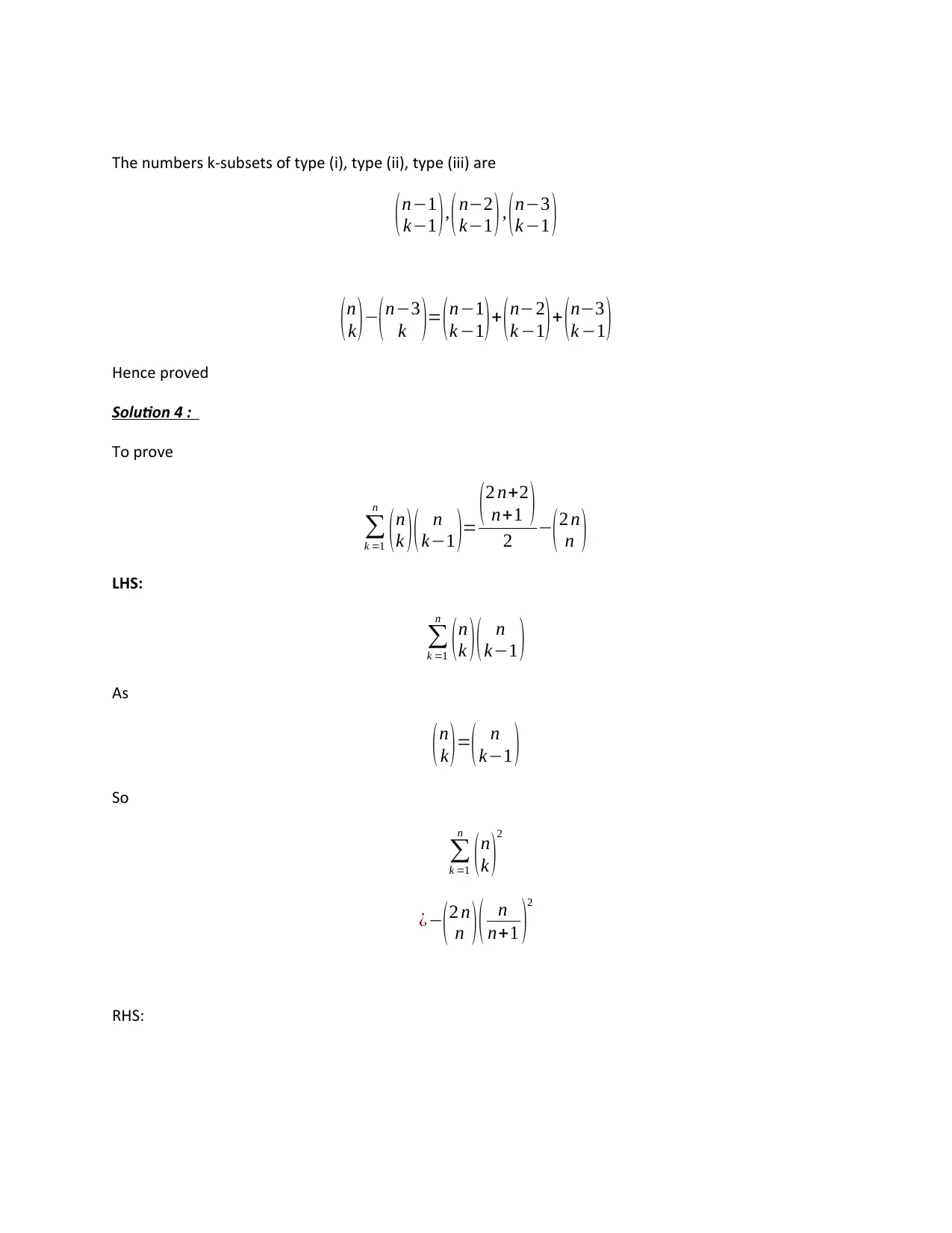
The numbers k-subsets of type (i), type (ii), type (iii) are
( n1
k1 ) , ( n2
k1 ) , ( n3
k 1 )
( n
k )
( n3
k )= ( n1
k 1 ) + ( n2
k 1 ) + ( n3
k 1 )
Hence proved
Solution 4 :
To prove

k =1
n
(n
k )( n
k1 )= (2 n+2
n+1 )
2 (2 n
n )
LHS:

k =1
n
(n
k )( n
k1 )
As
( n
k ) =
( n
k1 )
So

k =1
n
(n
k )2
¿
( 2 n
n ) ( n
n+1 )
2
RHS:
Document Page
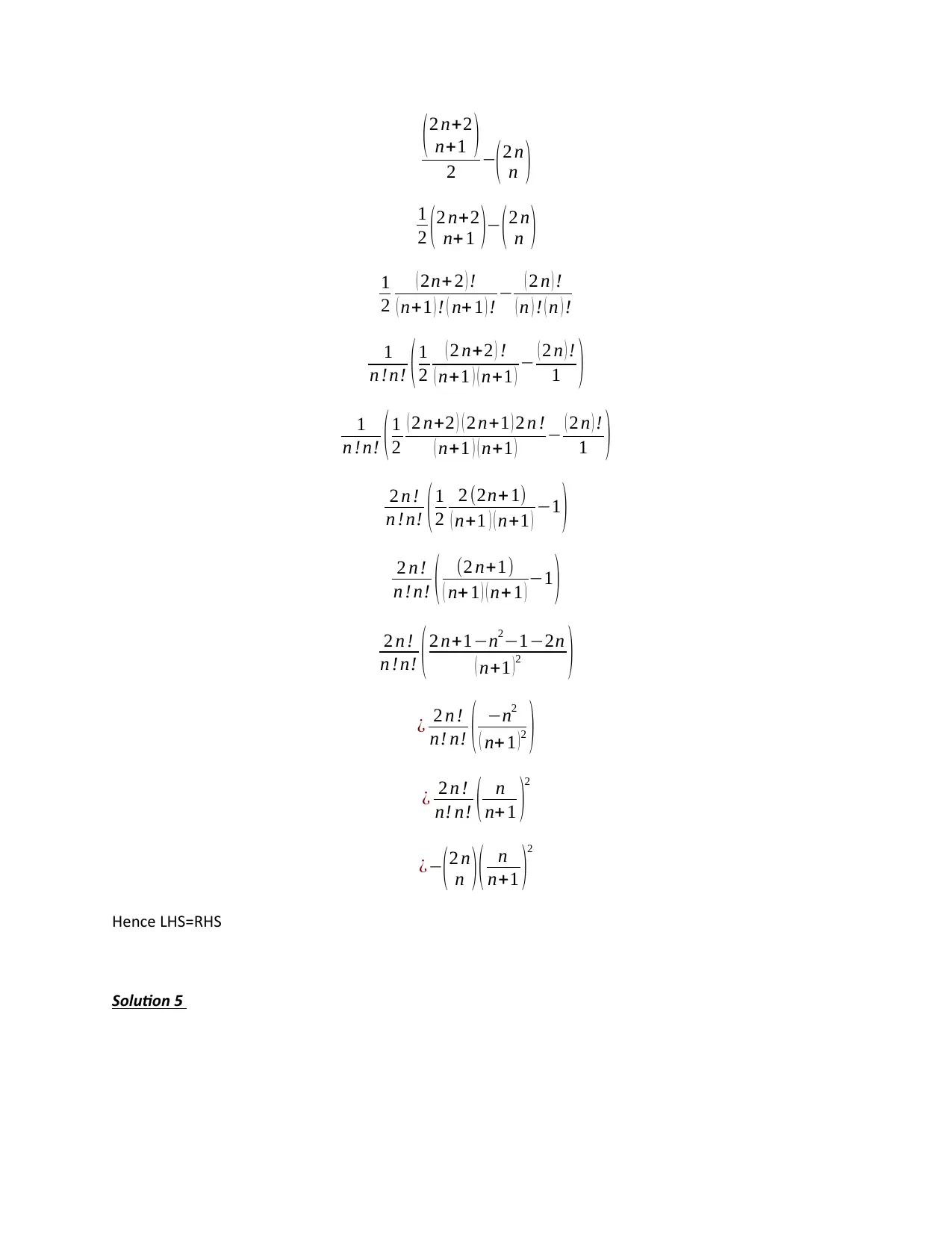
( 2 n+2
n+1 )
2
( 2 n
n )
1
2 (2 n+2
n+ 1 ) (2 n
n )
1
2
( 2n+ 2 ) !
( n+1 ) ! ( n+ 1 ) ! ( 2 n ) !
( n ) ! ( n ) !
1
n !n! ( 1
2
( 2 n+2 ) !
( n+1 ) ( n+1 ) ( 2 n ) !
1 )
1
n ! n! ( 1
2
( 2 n+2 ) ( 2 n+1 ) 2 n !
( n+1 ) ( n+1 ) ( 2 n ) !
1 )
2 n !
n ! n! (1
2
2 (2n+ 1)
( n+1 ) ( n+1 ) 1 )
2 n !
n ! n! ( (2 n+1)
( n+1 ) ( n+ 1 ) 1 )
2 n !
n ! n! (2 n+1n212n
( n+1 )2 )
¿ 2 n !
n! n! ( n2
( n+ 1 )2 )
¿ 2 n !
n! n! ( n
n+ 1 )2
¿( 2 n
n ) ( n
n+1 )
2
Hence LHS=RHS
Solution 5
tabler-icon-diamond-filled.svg

Paraphrase This Document

Need a fresh take? Get an instant paraphrase of this document with our AI Paraphraser
Document Page
Document Page
Document Page
Solution 6 :
Given that
0, 0, 0, 0, 6, -6, 6, -6, 6, -6, . . …….
Assume the generating function
f ( x ) =a0 +a1 x+ a2 x2 +a3 x3 +a4 x4 + ¿…………………………………………….
But, the given sequence is {0, 0, 0, 0, 6, -6, 6, -6, 6, -6……}. Using this sequence, the expression above
becomes,
f ( x )=0+0 x+ 0 x2 +0 x3 +6 x46 x5 +¿……………………………………..
= 0 +0 + 0 + 0 + 6 x4 6 x5 + ……………………………….
= 6 x4 6 x5
= 6 x4 ¿
= Accordingly, f ( x )= 6 x4 ¿is the generating function for the given sequence {0, 0, 0, 0, 6, -6, 6, -6, 6, -
6……}.
tabler-icon-diamond-filled.svg

Paraphrase This Document

Need a fresh take? Get an instant paraphrase of this document with our AI Paraphraser
Document Page
Solution 7 :
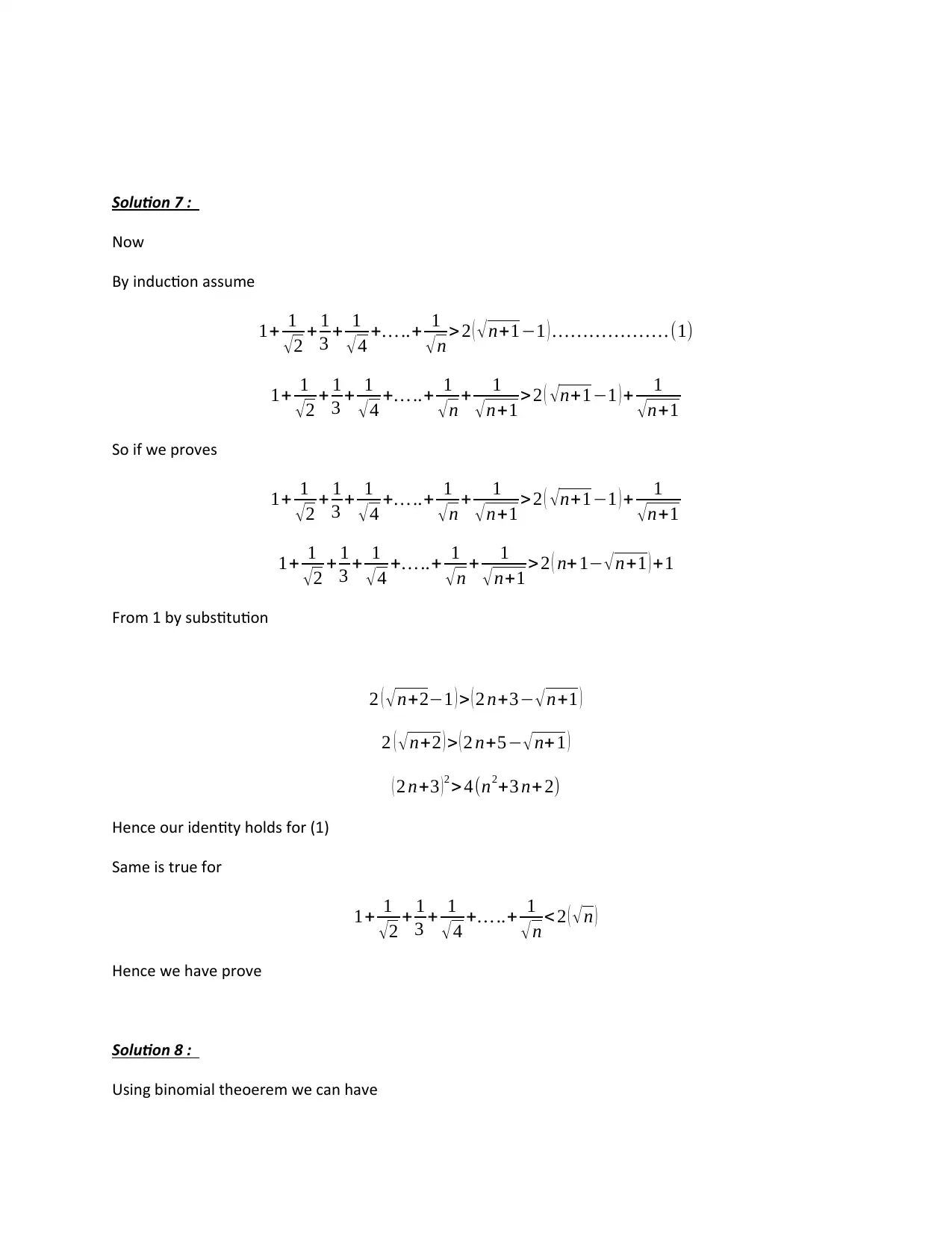
Now
By induction assume
1+ 1
2 + 1
3 + 1
4 + ..+ 1
n > 2 ( n+11 ) .(1)
1+ 1
2 + 1
3 + 1
4 + ..+ 1
n + 1
n+1 > 2 ( n+11 ) + 1
n+1
So if we proves
1+ 1
2 + 1
3 + 1
4 + ..+ 1
n + 1
n+1 > 2 ( n+11 ) + 1
n+1
1+ 1
2 + 1
3 + 1
4 + ..+ 1
n + 1
n+1 > 2 ( n+ 1 n+1 ) +1
From 1 by substitution
2 ( n+21 ) > ( 2 n+3 n+1 )
2 ( n+2 ) > ( 2 n+5 n+1 )
( 2 n+3 ) 2 > 4(n2+3 n+ 2)
Hence our identity holds for (1)
Same is true for
1+ 1
2 + 1
3 + 1
4 + ..+ 1
n < 2 ( n )
Hence we have prove
Solution 8 :
Using binomial theoerem we can have
Document Page
( x + y )n=
k=0
n
(n
k ) xnk yk
Now as we have

i=1
n
i4 = n(n+1)(2 n+1)(3 n3 +3 n1)
30

i=1
n
i5= ( 1
6 )n6 + ( 1
2 )n5+ ( 5
12 )n4 ( 1
12 )n2
Solution 9
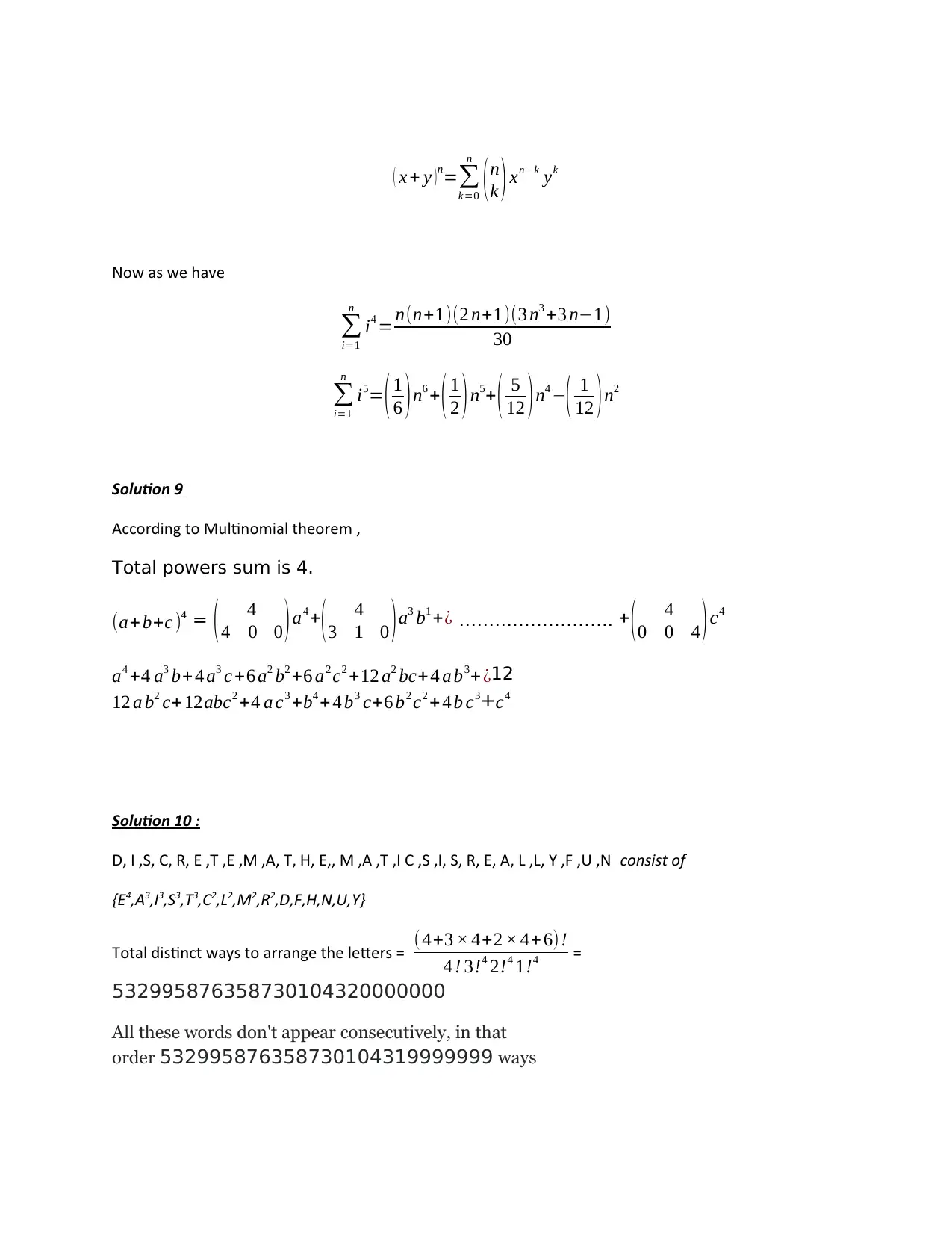
According to Multinomial theorem ,
Total powers sum is 4.
(a+ b+c )4 = ( 4
4 0 0 ) a4 +
( 4
3 1 0 ) a3 b1 +¿ …………………….. + ( 4
0 0 4 )c4
a4 +4 a3 b+ 4 a3 c +6 a2 b2 +6 a2 c2 +12 a2 bc+4 a b3+ ¿12
12 a b2 c+ 12abc2 +4 a c3 +b4 + 4 b3 c+6 b2 c2 + 4 b c3+c4
Solution 10 :
D, I ,S, C, R, E ,T ,E ,M ,A, T, H, E,, M ,A ,T ,I C ,S ,I, S, R, E, A, L ,L, Y ,F ,U ,N consist of
{E4,A3,I3,S3,T3,C2,L2,M2,R2,D,F,H,N,U,Y}
Total distinct ways to arrange the letters = ( 4+3 × 4+2 × 4+ 6) !
4 ! 3!4 2!4 1!4 =
532995876358730104320000000
All these words don't appear consecutively, in that
order 532995876358730104319999999 ways
Document Page
chevron_up_icon
1 out of 10
circle_padding
hide_on_mobile
zoom_out_icon
[object Object]