Destination Strategy Report: Citizen Participation and SWOT Analysis
VerifiedAdded on 2023/06/15
|8
|1111
|400
Report
AI Summary
This report provides a detailed analysis of destination strategy, focusing on the application of Arnstein's Ladder of citizen participation and SWOT analysis. It begins by introducing destination management and its importance, particularly for organizations promoting tourism. The report then delves into Arnstein's Ladder, explaining each of its eight rungs in the context of implementing a strategic plan for Birmingham, highlighting the levels of citizen involvement from manipulation to citizen control. Furthermore, the report employs SWOT analysis to identify Birmingham's strengths, weaknesses, opportunities, and threats as a tourist destination, considering factors such as natural and cultural attractions, seasonality, air transport infrastructure, income levels, competition, and political intervention. The analysis aims to inform strategic planning and decision-making to enhance Birmingham's attractiveness and competitiveness in the tourism sector. Desklib offers this report and many other resources to aid students in their studies.
Destination Strategy
Report
Report
Paraphrase This Document
Need a fresh take? Get an instant paraphrase of this document with our AI Paraphraser

Table of Contents
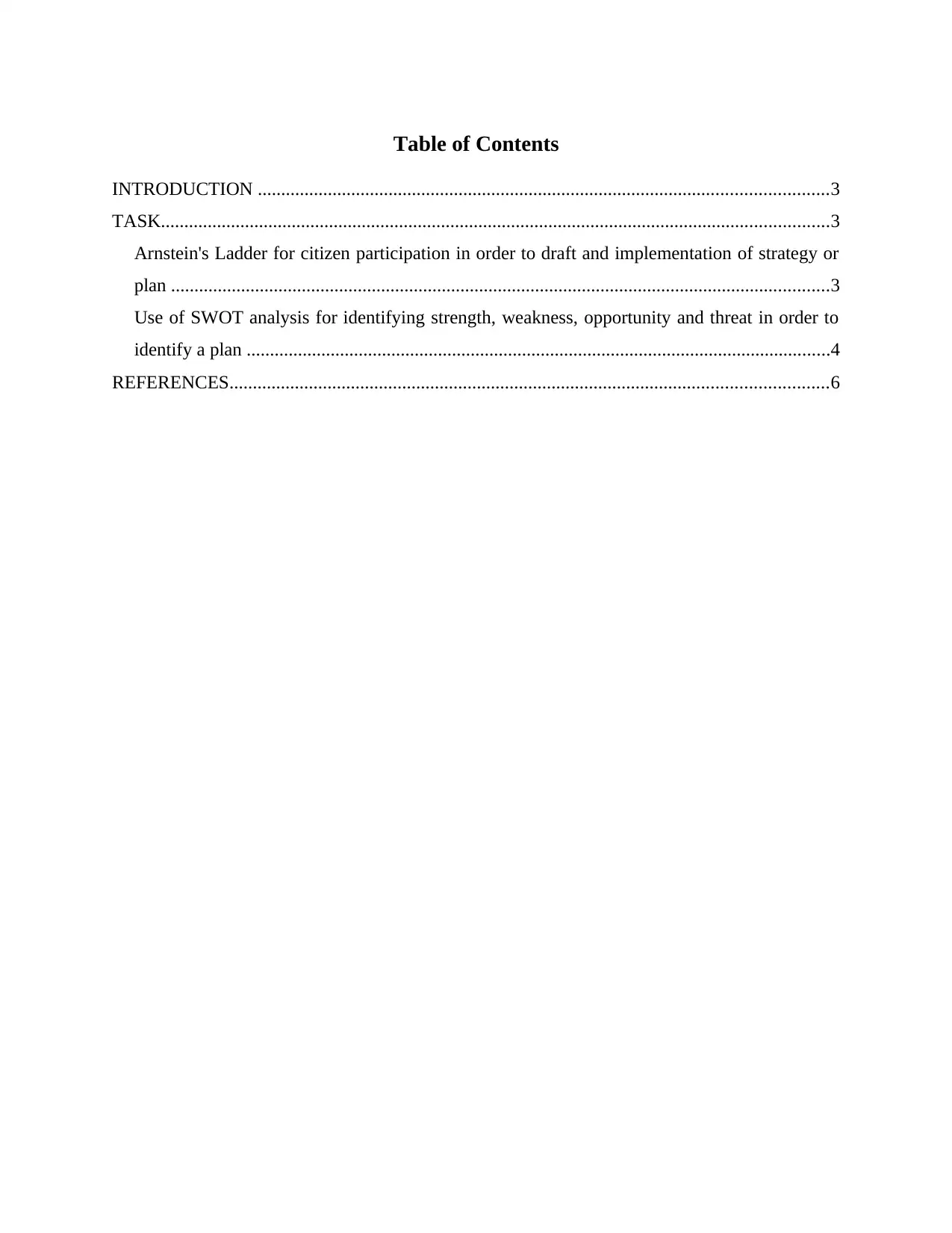
INTRODUCTION ..........................................................................................................................3
TASK...............................................................................................................................................3
Arnstein's Ladder for citizen participation in order to draft and implementation of strategy or
plan .............................................................................................................................................3
Use of SWOT analysis for identifying strength, weakness, opportunity and threat in order to
identify a plan .............................................................................................................................4
REFERENCES................................................................................................................................6
INTRODUCTION ..........................................................................................................................3
TASK...............................................................................................................................................3
Arnstein's Ladder for citizen participation in order to draft and implementation of strategy or
plan .............................................................................................................................................3
Use of SWOT analysis for identifying strength, weakness, opportunity and threat in order to
identify a plan .............................................................................................................................4
REFERENCES................................................................................................................................6

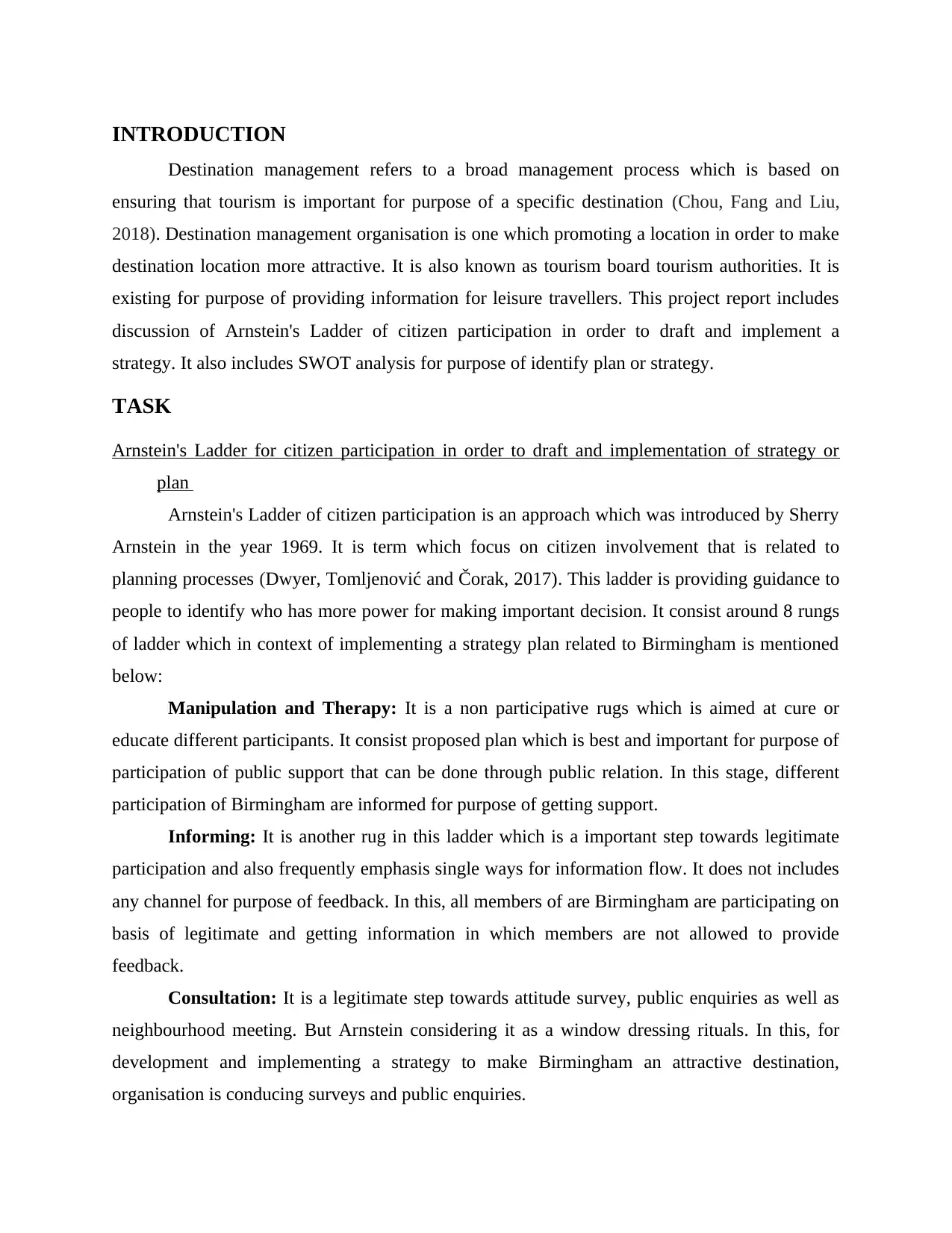
INTRODUCTION
Destination management refers to a broad management process which is based on
ensuring that tourism is important for purpose of a specific destination (Chou, Fang and Liu,
2018). Destination management organisation is one which promoting a location in order to make
destination location more attractive. It is also known as tourism board tourism authorities. It is
existing for purpose of providing information for leisure travellers. This project report includes
discussion of Arnstein's Ladder of citizen participation in order to draft and implement a
strategy. It also includes SWOT analysis for purpose of identify plan or strategy.
TASK
Arnstein's Ladder for citizen participation in order to draft and implementation of strategy or
plan
Arnstein's Ladder of citizen participation is an approach which was introduced by Sherry
Arnstein in the year 1969. It is term which focus on citizen involvement that is related to
planning processes (Dwyer, Tomljenović and Čorak, 2017). This ladder is providing guidance to
people to identify who has more power for making important decision. It consist around 8 rungs
of ladder which in context of implementing a strategy plan related to Birmingham is mentioned
below:
Manipulation and Therapy: It is a non participative rugs which is aimed at cure or
educate different participants. It consist proposed plan which is best and important for purpose of
participation of public support that can be done through public relation. In this stage, different
participation of Birmingham are informed for purpose of getting support.
Informing: It is another rug in this ladder which is a important step towards legitimate
participation and also frequently emphasis single ways for information flow. It does not includes
any channel for purpose of feedback. In this, all members of are Birmingham are participating on
basis of legitimate and getting information in which members are not allowed to provide
feedback.
Consultation: It is a legitimate step towards attitude survey, public enquiries as well as
neighbourhood meeting. But Arnstein considering it as a window dressing rituals. In this, for
development and implementing a strategy to make Birmingham an attractive destination,
organisation is conducing surveys and public enquiries.
Destination management refers to a broad management process which is based on
ensuring that tourism is important for purpose of a specific destination (Chou, Fang and Liu,
2018). Destination management organisation is one which promoting a location in order to make
destination location more attractive. It is also known as tourism board tourism authorities. It is
existing for purpose of providing information for leisure travellers. This project report includes
discussion of Arnstein's Ladder of citizen participation in order to draft and implement a
strategy. It also includes SWOT analysis for purpose of identify plan or strategy.
TASK
Arnstein's Ladder for citizen participation in order to draft and implementation of strategy or
plan
Arnstein's Ladder of citizen participation is an approach which was introduced by Sherry
Arnstein in the year 1969. It is term which focus on citizen involvement that is related to
planning processes (Dwyer, Tomljenović and Čorak, 2017). This ladder is providing guidance to
people to identify who has more power for making important decision. It consist around 8 rungs
of ladder which in context of implementing a strategy plan related to Birmingham is mentioned
below:
Manipulation and Therapy: It is a non participative rugs which is aimed at cure or
educate different participants. It consist proposed plan which is best and important for purpose of
participation of public support that can be done through public relation. In this stage, different
participation of Birmingham are informed for purpose of getting support.
Informing: It is another rug in this ladder which is a important step towards legitimate
participation and also frequently emphasis single ways for information flow. It does not includes
any channel for purpose of feedback. In this, all members of are Birmingham are participating on
basis of legitimate and getting information in which members are not allowed to provide
feedback.
Consultation: It is a legitimate step towards attitude survey, public enquiries as well as
neighbourhood meeting. But Arnstein considering it as a window dressing rituals. In this, for
development and implementing a strategy to make Birmingham an attractive destination,
organisation is conducing surveys and public enquiries.
⊘ This is a preview!⊘
Do you want full access?
Subscribe today to unlock all pages.

Trusted by 1+ million students worldwide

Placation: It is concerned with corporation which is of hand picked worthies that can be
onto a committees (Liu, Jiang and Gan, 2021). It is important for purpose of allowing citizen for
providing advise or plan and can retain for power holder for right to judge the legitimacy as well
as feasibility for providing advice.
Partnership: In this, power is redistributed which can be done through negotiation
among power holders and citizens. In implementing a strategy related to Birmingham, different
responsibilities like decision making and planning can be shared through joint committees.
Delegation: Citizen are also holding clear majority of seats which can be done on
committees that is delegated with power in order to make decision. In this, public also has power
for purpose of assuring accountability related to a programs.
Citizen control: In this rugs, it is important to have not handle for purpose of policy
making, managing program, planning for instance, neighbourhood corporation that can be with
no intermediaries among it as well as source of funds (LOPES and COSTA, 2017).
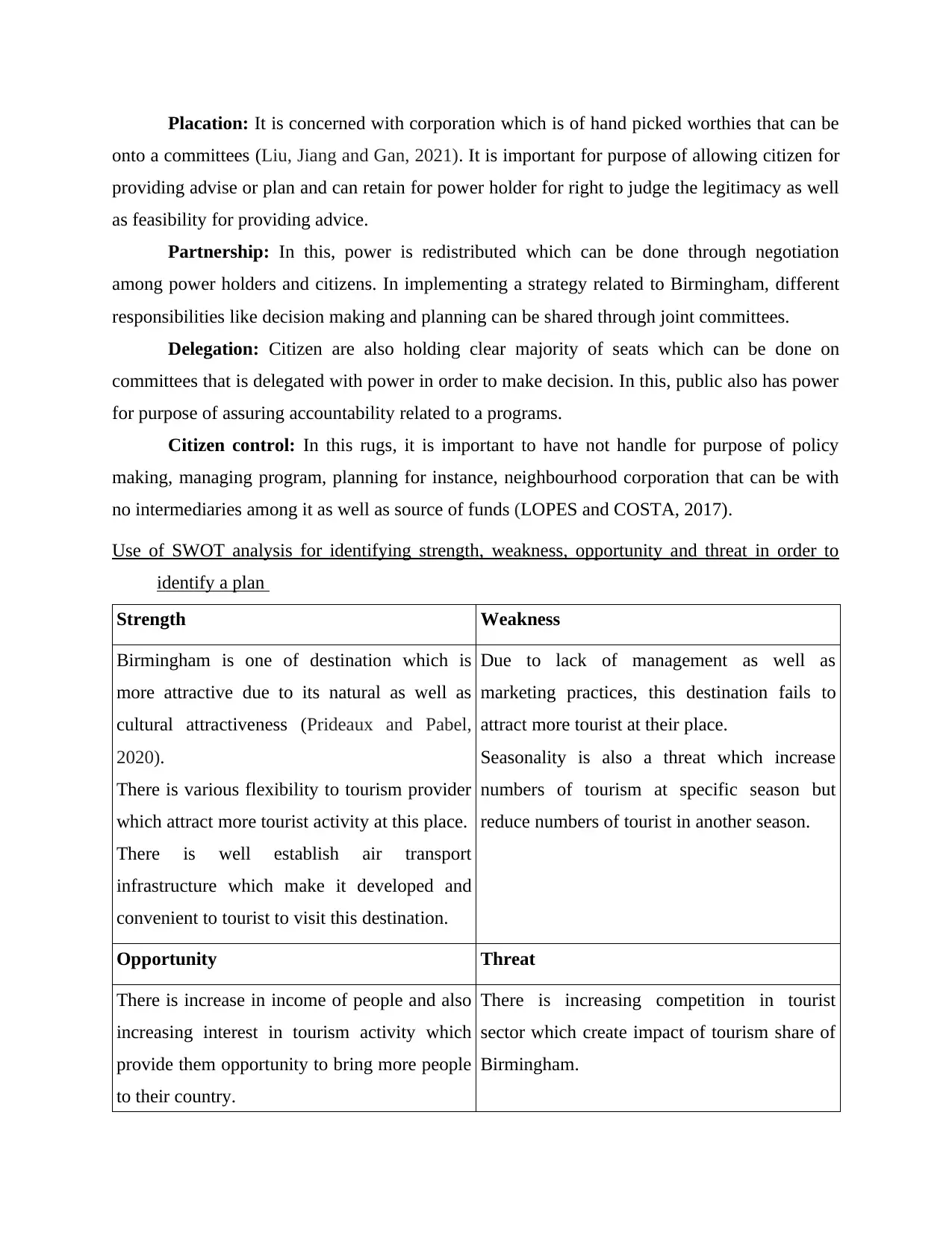
Use of SWOT analysis for identifying strength, weakness, opportunity and threat in order to
identify a plan
Strength Weakness
Birmingham is one of destination which is
more attractive due to its natural as well as
cultural attractiveness (Prideaux and Pabel,
2020).
There is various flexibility to tourism provider
which attract more tourist activity at this place.
There is well establish air transport
infrastructure which make it developed and
convenient to tourist to visit this destination.
Due to lack of management as well as
marketing practices, this destination fails to
attract more tourist at their place.
Seasonality is also a threat which increase
numbers of tourism at specific season but
reduce numbers of tourist in another season.
Opportunity Threat
There is increase in income of people and also
increasing interest in tourism activity which
provide them opportunity to bring more people
to their country.
There is increasing competition in tourist
sector which create impact of tourism share of
Birmingham.
onto a committees (Liu, Jiang and Gan, 2021). It is important for purpose of allowing citizen for
providing advise or plan and can retain for power holder for right to judge the legitimacy as well
as feasibility for providing advice.
Partnership: In this, power is redistributed which can be done through negotiation
among power holders and citizens. In implementing a strategy related to Birmingham, different
responsibilities like decision making and planning can be shared through joint committees.
Delegation: Citizen are also holding clear majority of seats which can be done on
committees that is delegated with power in order to make decision. In this, public also has power
for purpose of assuring accountability related to a programs.
Citizen control: In this rugs, it is important to have not handle for purpose of policy
making, managing program, planning for instance, neighbourhood corporation that can be with
no intermediaries among it as well as source of funds (LOPES and COSTA, 2017).
Use of SWOT analysis for identifying strength, weakness, opportunity and threat in order to
identify a plan
Strength Weakness
Birmingham is one of destination which is
more attractive due to its natural as well as
cultural attractiveness (Prideaux and Pabel,
2020).
There is various flexibility to tourism provider
which attract more tourist activity at this place.
There is well establish air transport
infrastructure which make it developed and
convenient to tourist to visit this destination.
Due to lack of management as well as
marketing practices, this destination fails to
attract more tourist at their place.
Seasonality is also a threat which increase
numbers of tourism at specific season but
reduce numbers of tourist in another season.
Opportunity Threat
There is increase in income of people and also
increasing interest in tourism activity which
provide them opportunity to bring more people
to their country.
There is increasing competition in tourist
sector which create impact of tourism share of
Birmingham.
Paraphrase This Document
Need a fresh take? Get an instant paraphrase of this document with our AI Paraphraser

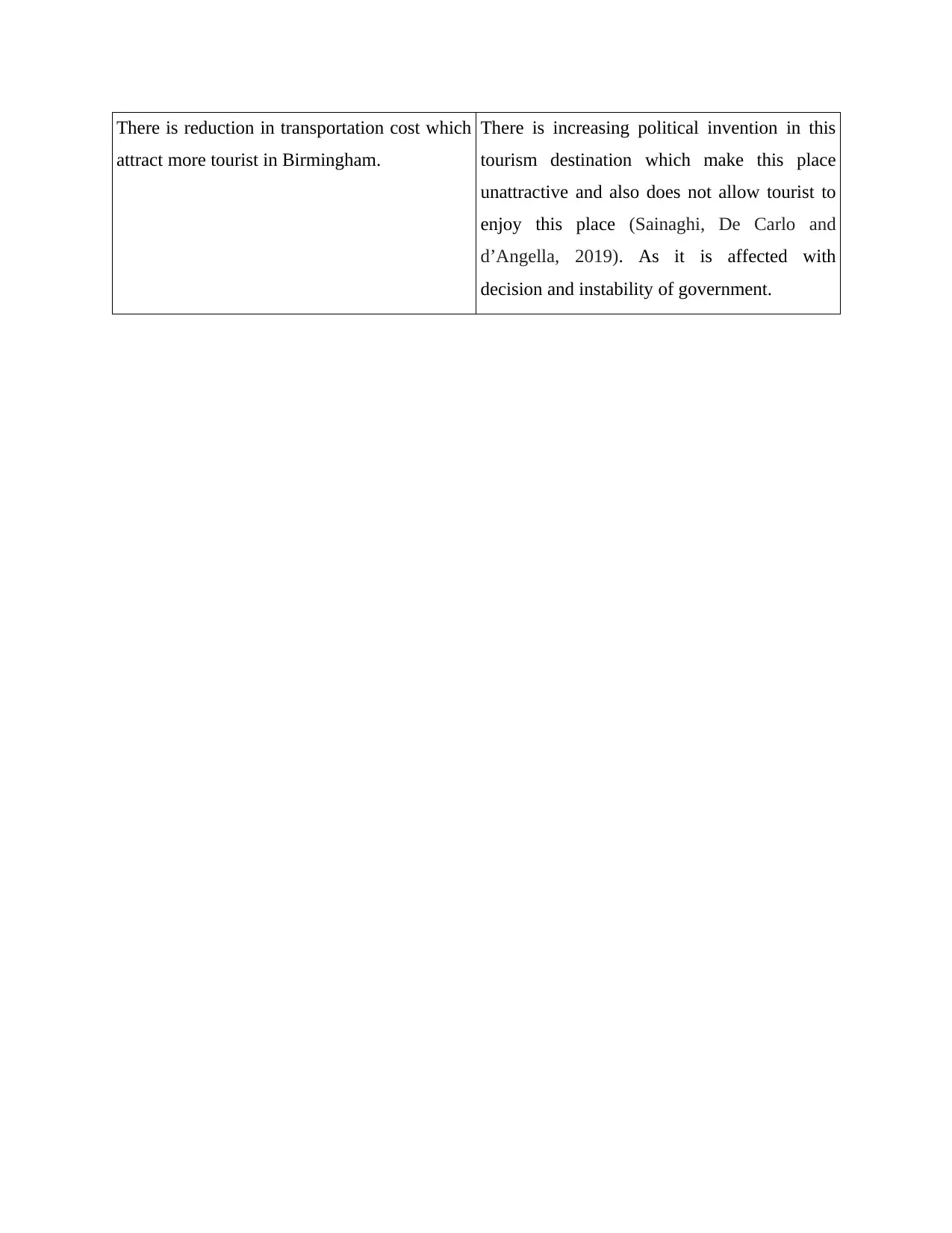
There is reduction in transportation cost which
attract more tourist in Birmingham.
There is increasing political invention in this
tourism destination which make this place
unattractive and also does not allow tourist to
enjoy this place (Sainaghi, De Carlo and
d’Angella, 2019). As it is affected with
decision and instability of government.
attract more tourist in Birmingham.
There is increasing political invention in this
tourism destination which make this place
unattractive and also does not allow tourist to
enjoy this place (Sainaghi, De Carlo and
d’Angella, 2019). As it is affected with
decision and instability of government.

REFERENCES
Books and Journals
Chou, S.F., Fang, Y.P. and Liu, C.H., 2018. Destination marketing analysis of city culinary
tourism strategy. 觀觀觀觀觀觀觀觀, 13(1), pp.1-31.
Dwyer, L., Tomljenović, R. and Čorak, S., 2017. Evolution of Destination Planning and
Strategy. The Rise Of Tourism In Croatia.
Liu, C.H., Jiang, J.F. and Gan, B., 2021. The antecedent and consequence behaviour of
sustainable tourism: integrating the concepts of marketing strategy and destination
image. Asia Pacific Journal of Tourism Research, 26(8), pp.829-848.
LOPES, T. and COSTA, R., 2017. How to work for an integrated multilevel destination strategy?
The case of Centro de Portugal. Revista Turismo & Desenvolvimento (RT&D)/Journal
of Tourism & Development.
Prideaux, B. and Pabel, A., 2020. Degrowth as a strategy for adjusting to the adverse impacts of
climate change in a nature-based destination. In Degrowth and Tourism (pp. 116-131).
Routledge.
Sainaghi, R., De Carlo, M. and d’Angella, F., 2019. Development of a tourism destination:
Exploring the role of destination capabilities. Journal of Hospitality & Tourism
Research, 43(4), pp.517-543.
Books and Journals
Chou, S.F., Fang, Y.P. and Liu, C.H., 2018. Destination marketing analysis of city culinary
tourism strategy. 觀觀觀觀觀觀觀觀, 13(1), pp.1-31.
Dwyer, L., Tomljenović, R. and Čorak, S., 2017. Evolution of Destination Planning and
Strategy. The Rise Of Tourism In Croatia.
Liu, C.H., Jiang, J.F. and Gan, B., 2021. The antecedent and consequence behaviour of
sustainable tourism: integrating the concepts of marketing strategy and destination
image. Asia Pacific Journal of Tourism Research, 26(8), pp.829-848.
LOPES, T. and COSTA, R., 2017. How to work for an integrated multilevel destination strategy?
The case of Centro de Portugal. Revista Turismo & Desenvolvimento (RT&D)/Journal
of Tourism & Development.
Prideaux, B. and Pabel, A., 2020. Degrowth as a strategy for adjusting to the adverse impacts of
climate change in a nature-based destination. In Degrowth and Tourism (pp. 116-131).
Routledge.
Sainaghi, R., De Carlo, M. and d’Angella, F., 2019. Development of a tourism destination:
Exploring the role of destination capabilities. Journal of Hospitality & Tourism
Research, 43(4), pp.517-543.
⊘ This is a preview!⊘
Do you want full access?
Subscribe today to unlock all pages.

Trusted by 1+ million students worldwide

Paraphrase This Document
Need a fresh take? Get an instant paraphrase of this document with our AI Paraphraser

1 out of 8
Related Documents
Your All-in-One AI-Powered Toolkit for Academic Success.
+13062052269
info@desklib.com
Available 24*7 on WhatsApp / Email
Unlock your academic potential
Copyright © 2020–2026 A2Z Services. All Rights Reserved. Developed and managed by ZUCOL.