Business Development: Sampling Methods, Error Analysis, and Selection

Verified

Added on  2020/01/07

|6
|879
|201
Homework Assignment
AI Summary
This assignment analyzes and compares two primary sampling methods: random and systematic selection. It differentiates between these methods, highlighting their applications and characteristics. Furthermore, it critiques a specific method of selection and suggests alternative approaches. The document also categorizes different types of errors, such as those related to goods in transit, costing errors on invoices, and invoices posted to the wrong accounts, and provides an analysis of these errors including projected error percentages. The work includes references to academic journals and online resources to support the analysis.

Document Page
Question 22
1
tabler-icon-diamond-filled.svg

Paraphrase This Document

Need a fresh take? Get an instant paraphrase of this document with our AI Paraphraser
Document Page
TABLE OF CONTENTS
A) COMPARE AND CONTRAST THE RANDOM METHOD OF SELECTION AND
SYSTEMATIC SELECTION..........................................................................................................3
B) BRIAN'S METHOD OF SELECTION AND SUGGESTION FOR ALTERNATIVE MEANS
OF SAMPLE SELECTION.............................................................................................................3
C) CATEGORIES OF ERROR/DIFFERENCE .............................................................................3
D) ANALYSIS ................................................................................................................................4
REFERENCES................................................................................................................................5
2
Document Page
A) COMPARE AND CONTRAST THE RANDOM METHOD OF
SELECTION AND SYSTEMATIC SELECTION
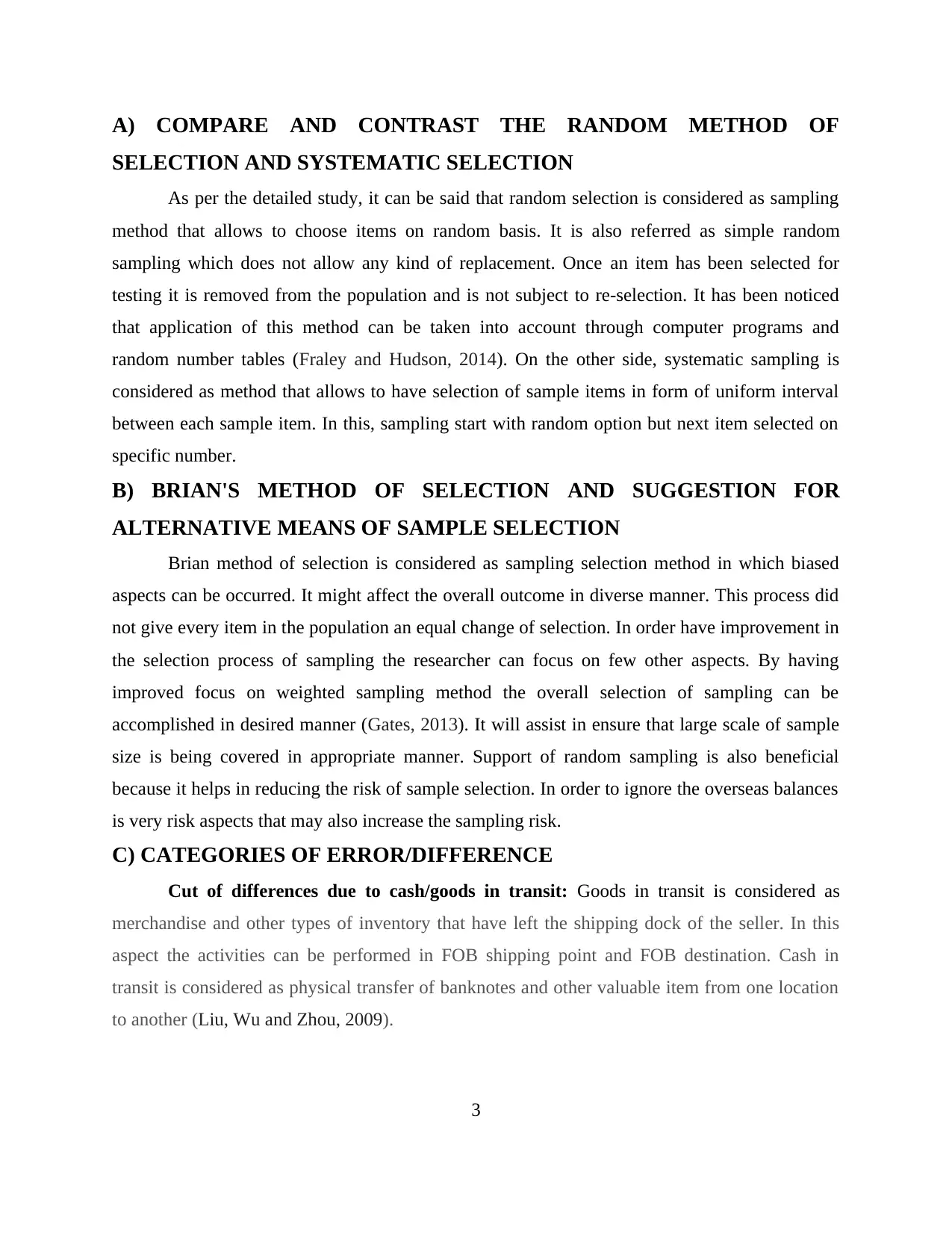
As per the detailed study, it can be said that random selection is considered as sampling
method that allows to choose items on random basis. It is also referred as simple random
sampling which does not allow any kind of replacement. Once an item has been selected for
testing it is removed from the population and is not subject to re-selection. It has been noticed
that application of this method can be taken into account through computer programs and
random number tables (Fraley and Hudson, 2014). On the other side, systematic sampling is
considered as method that allows to have selection of sample items in form of uniform interval
between each sample item. In this, sampling start with random option but next item selected on
specific number.
B) BRIAN'S METHOD OF SELECTION AND SUGGESTION FOR
ALTERNATIVE MEANS OF SAMPLE SELECTION
Brian method of selection is considered as sampling selection method in which biased
aspects can be occurred. It might affect the overall outcome in diverse manner. This process did
not give every item in the population an equal change of selection. In order have improvement in
the selection process of sampling the researcher can focus on few other aspects. By having
improved focus on weighted sampling method the overall selection of sampling can be
accomplished in desired manner (Gates, 2013). It will assist in ensure that large scale of sample
size is being covered in appropriate manner. Support of random sampling is also beneficial
because it helps in reducing the risk of sample selection. In order to ignore the overseas balances
is very risk aspects that may also increase the sampling risk.
C) CATEGORIES OF ERROR/DIFFERENCE
Cut of differences due to cash/goods in transit: Goods in transit is considered as
merchandise and other types of inventory that have left the shipping dock of the seller. In this
aspect the activities can be performed in FOB shipping point and FOB destination. Cash in
transit is considered as physical transfer of banknotes and other valuable item from one location
to another (Liu, Wu and Zhou, 2009).
3
Document Page
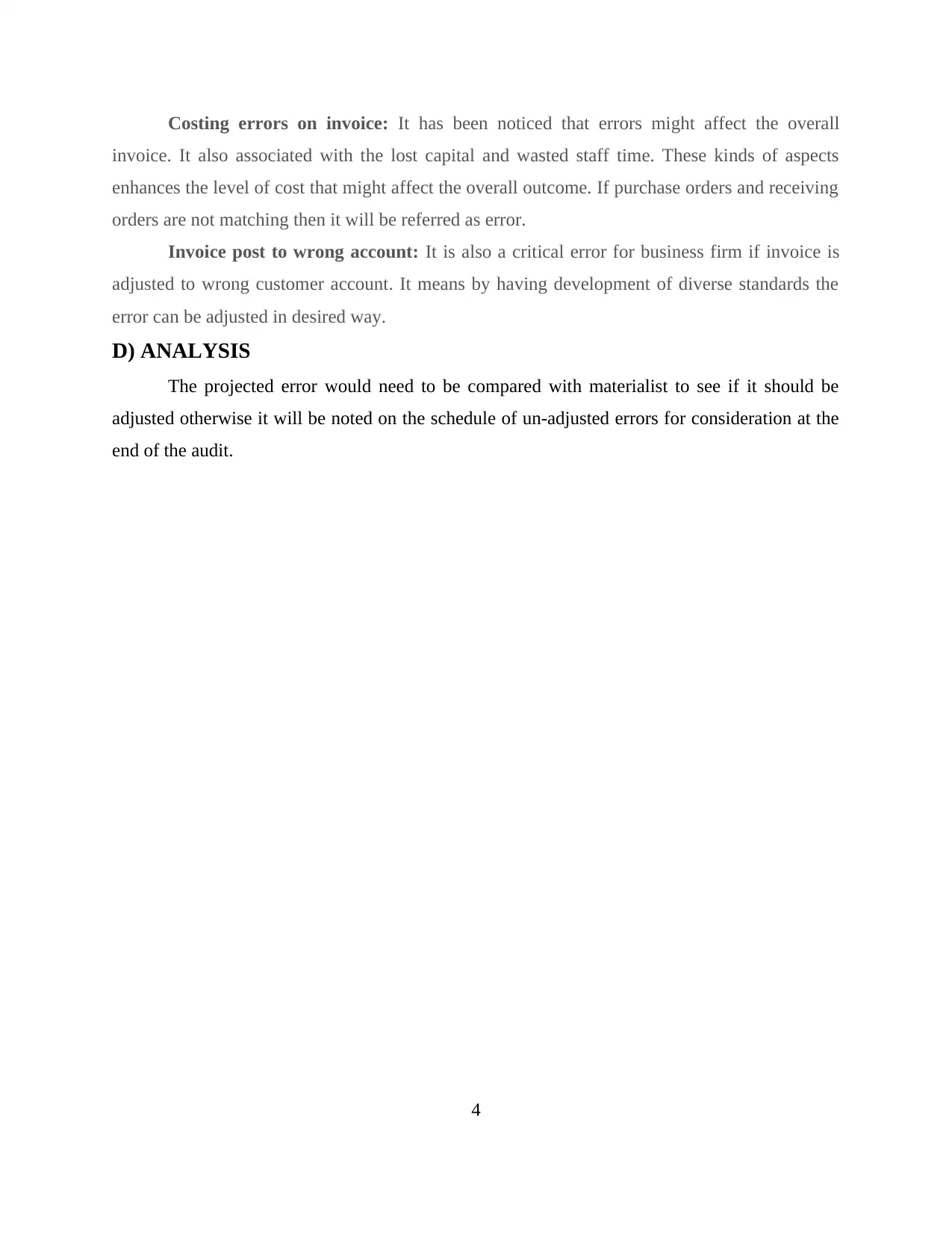
Costing errors on invoice: It has been noticed that errors might affect the overall
invoice. It also associated with the lost capital and wasted staff time. These kinds of aspects
enhances the level of cost that might affect the overall outcome. If purchase orders and receiving
orders are not matching then it will be referred as error.
Invoice post to wrong account: It is also a critical error for business firm if invoice is
adjusted to wrong customer account. It means by having development of diverse standards the
error can be adjusted in desired way.
D) ANALYSIS
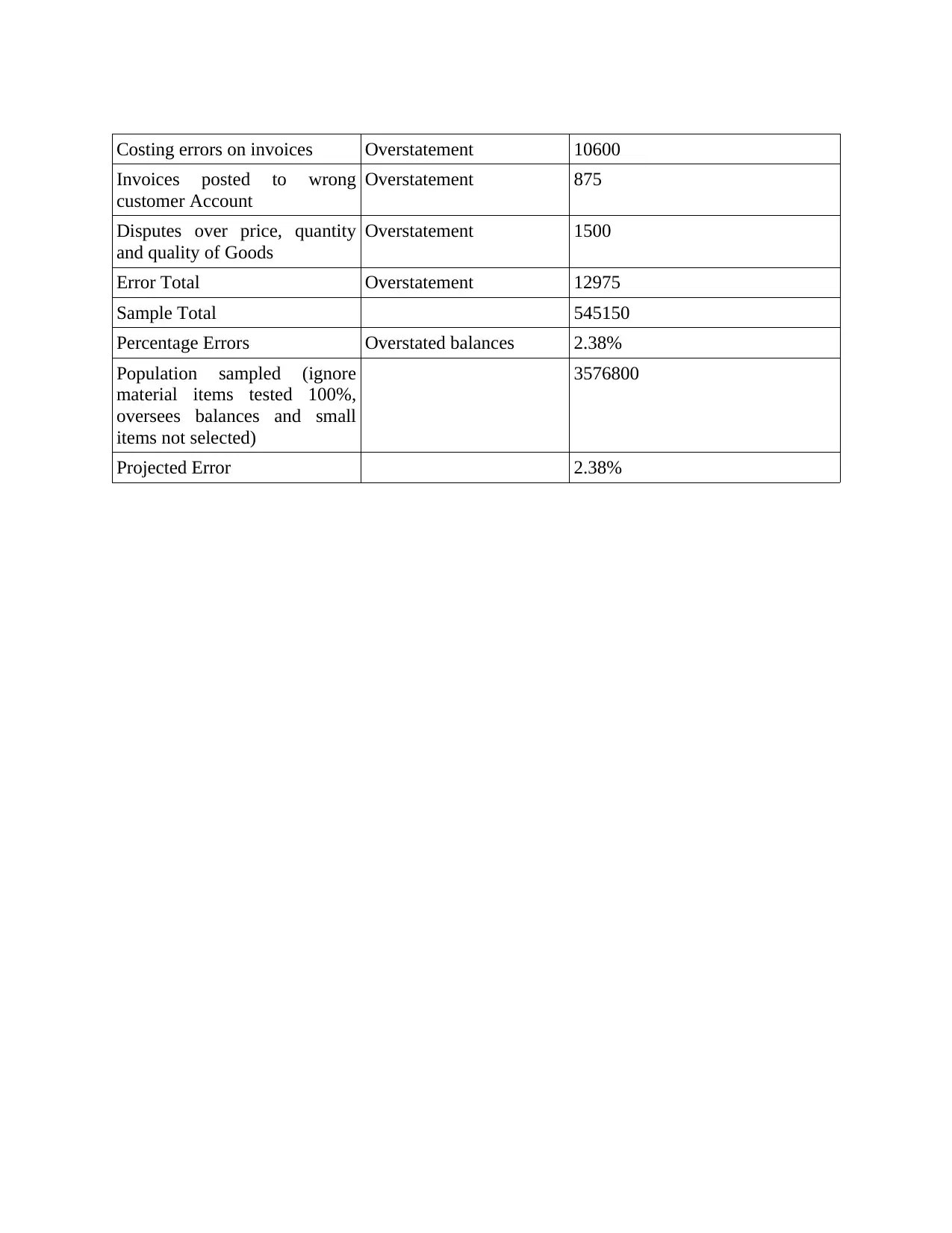
The projected error would need to be compared with materialist to see if it should be
adjusted otherwise it will be noted on the schedule of un-adjusted errors for consideration at the
end of the audit.
4
tabler-icon-diamond-filled.svg

Paraphrase This Document

Need a fresh take? Get an instant paraphrase of this document with our AI Paraphraser
Document Page
Costing errors on invoices Overstatement 10600
Invoices posted to wrong
customer Account
Overstatement 875
Disputes over price, quantity
and quality of Goods
Overstatement 1500
Error Total Overstatement 12975
Sample Total 545150
Percentage Errors Overstated balances 2.38%
Population sampled (ignore
material items tested 100%,
oversees balances and small
items not selected)
3576800
Projected Error 2.38%
Document Page
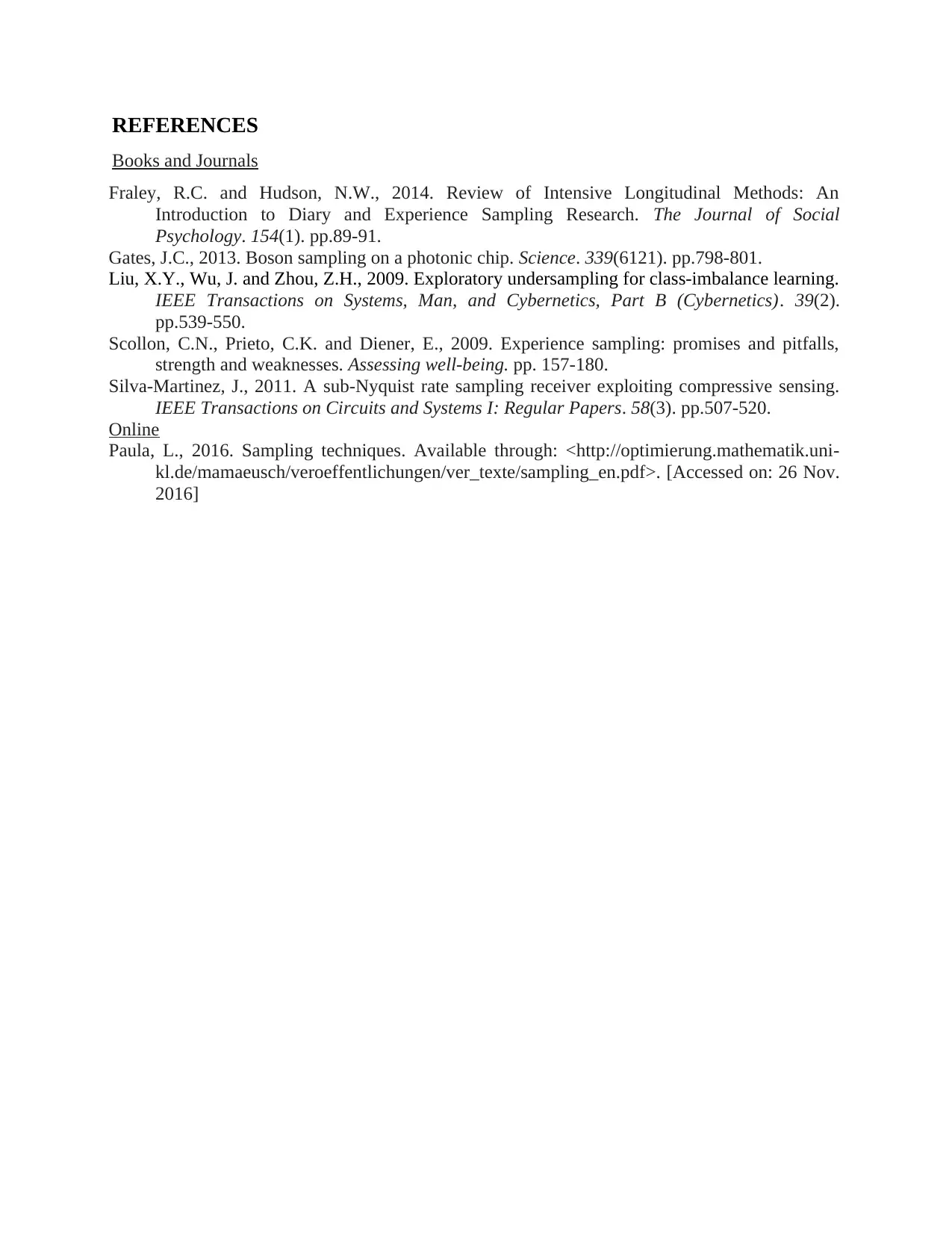
REFERENCES
Books and Journals
Fraley, R.C. and Hudson, N.W., 2014. Review of Intensive Longitudinal Methods: An
Introduction to Diary and Experience Sampling Research. The Journal of Social
Psychology. 154(1). pp.89-91.
Gates, J.C., 2013. Boson sampling on a photonic chip. Science. 339(6121). pp.798-801.
Liu, X.Y., Wu, J. and Zhou, Z.H., 2009. Exploratory undersampling for class-imbalance learning.
IEEE Transactions on Systems, Man, and Cybernetics, Part B (Cybernetics). 39(2).
pp.539-550.
Scollon, C.N., Prieto, C.K. and Diener, E., 2009. Experience sampling: promises and pitfalls,
strength and weaknesses. Assessing well-being. pp. 157-180.
Silva-Martinez, J., 2011. A sub-Nyquist rate sampling receiver exploiting compressive sensing.
IEEE Transactions on Circuits and Systems I: Regular Papers. 58(3). pp.507-520.
Online
Paula, L., 2016. Sampling techniques. Available through: <http://optimierung.mathematik.uni-
kl.de/mamaeusch/veroeffentlichungen/ver_texte/sampling_en.pdf>. [Accessed on: 26 Nov.
2016]
chevron_up_icon
1 out of 6
circle_padding
hide_on_mobile
zoom_out_icon
[object Object]