Faculty of Engineering: C++ Program for DFT & Signal Processing
VerifiedAdded on 2023/06/15
|11
|4140
|441
Practical Assignment
AI Summary
This assignment showcases several C++ programs designed to perform a Discrete Fourier Transform (DFT) on input signals. The programs read signal values, calculate the DFT using different approaches, including brute force and twiddle factors, and output the results to a MATLAB/Octave-compatible file for plotting. The DFT process involves calculating real and imaginary parts of the DFT coefficients to identify frequency components. The code includes signal generation, DFT calculation, and power spectrum computation, with the final output visualized through plots of the original signal, real and imaginary parts of the DFT, and the power spectrum. Desklib provides this assignment as a resource for students studying signal processing and DFT implementations.
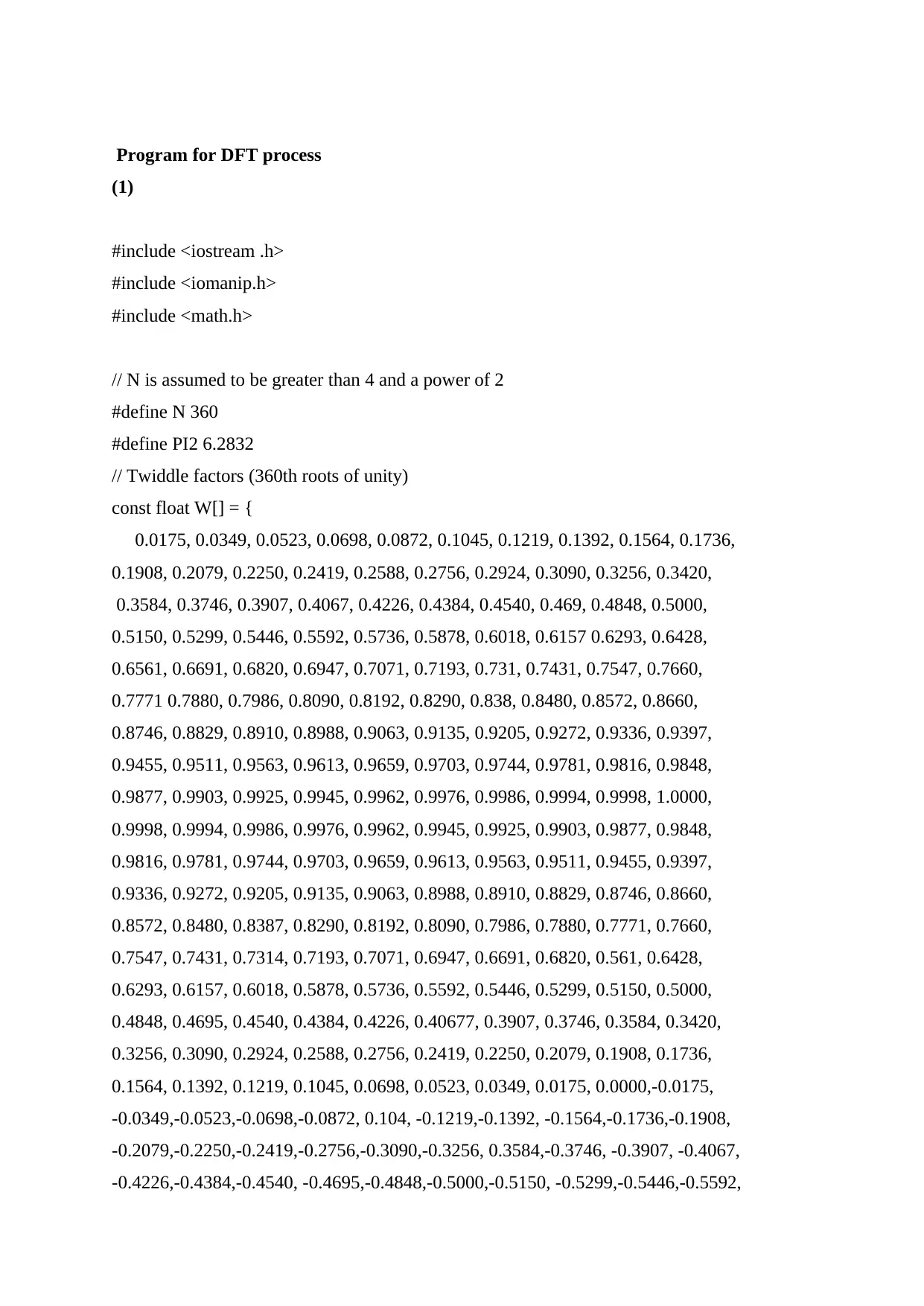
Program for DFT process
(1)
#include <iostream .h>
#include <iomanip.h>
#include <math.h>
// N is assumed to be greater than 4 and a power of 2
#define N 360
#define PI2 6.2832
// Twiddle factors (360th roots of unity)
const float W[] = {
0.0175, 0.0349, 0.0523, 0.0698, 0.0872, 0.1045, 0.1219, 0.1392, 0.1564, 0.1736,
0.1908, 0.2079, 0.2250, 0.2419, 0.2588, 0.2756, 0.2924, 0.3090, 0.3256, 0.3420,
0.3584, 0.3746, 0.3907, 0.4067, 0.4226, 0.4384, 0.4540, 0.469, 0.4848, 0.5000,
0.5150, 0.5299, 0.5446, 0.5592, 0.5736, 0.5878, 0.6018, 0.6157 0.6293, 0.6428,
0.6561, 0.6691, 0.6820, 0.6947, 0.7071, 0.7193, 0.731, 0.7431, 0.7547, 0.7660,
0.7771 0.7880, 0.7986, 0.8090, 0.8192, 0.8290, 0.838, 0.8480, 0.8572, 0.8660,
0.8746, 0.8829, 0.8910, 0.8988, 0.9063, 0.9135, 0.9205, 0.9272, 0.9336, 0.9397,
0.9455, 0.9511, 0.9563, 0.9613, 0.9659, 0.9703, 0.9744, 0.9781, 0.9816, 0.9848,
0.9877, 0.9903, 0.9925, 0.9945, 0.9962, 0.9976, 0.9986, 0.9994, 0.9998, 1.0000,
0.9998, 0.9994, 0.9986, 0.9976, 0.9962, 0.9945, 0.9925, 0.9903, 0.9877, 0.9848,
0.9816, 0.9781, 0.9744, 0.9703, 0.9659, 0.9613, 0.9563, 0.9511, 0.9455, 0.9397,
0.9336, 0.9272, 0.9205, 0.9135, 0.9063, 0.8988, 0.8910, 0.8829, 0.8746, 0.8660,
0.8572, 0.8480, 0.8387, 0.8290, 0.8192, 0.8090, 0.7986, 0.7880, 0.7771, 0.7660,
0.7547, 0.7431, 0.7314, 0.7193, 0.7071, 0.6947, 0.6691, 0.6820, 0.561, 0.6428,
0.6293, 0.6157, 0.6018, 0.5878, 0.5736, 0.5592, 0.5446, 0.5299, 0.5150, 0.5000,
0.4848, 0.4695, 0.4540, 0.4384, 0.4226, 0.40677, 0.3907, 0.3746, 0.3584, 0.3420,
0.3256, 0.3090, 0.2924, 0.2588, 0.2756, 0.2419, 0.2250, 0.2079, 0.1908, 0.1736,
0.1564, 0.1392, 0.1219, 0.1045, 0.0698, 0.0523, 0.0349, 0.0175, 0.0000,-0.0175,
-0.0349,-0.0523,-0.0698,-0.0872, 0.104, -0.1219,-0.1392, -0.1564,-0.1736,-0.1908,
-0.2079,-0.2250,-0.2419,-0.2756,-0.3090,-0.3256, 0.3584,-0.3746, -0.3907, -0.4067,
-0.4226,-0.4384,-0.4540, -0.4695,-0.4848,-0.5000,-0.5150, -0.5299,-0.5446,-0.5592,
(1)
#include <iostream .h>
#include <iomanip.h>
#include <math.h>
// N is assumed to be greater than 4 and a power of 2
#define N 360
#define PI2 6.2832
// Twiddle factors (360th roots of unity)
const float W[] = {
0.0175, 0.0349, 0.0523, 0.0698, 0.0872, 0.1045, 0.1219, 0.1392, 0.1564, 0.1736,
0.1908, 0.2079, 0.2250, 0.2419, 0.2588, 0.2756, 0.2924, 0.3090, 0.3256, 0.3420,
0.3584, 0.3746, 0.3907, 0.4067, 0.4226, 0.4384, 0.4540, 0.469, 0.4848, 0.5000,
0.5150, 0.5299, 0.5446, 0.5592, 0.5736, 0.5878, 0.6018, 0.6157 0.6293, 0.6428,
0.6561, 0.6691, 0.6820, 0.6947, 0.7071, 0.7193, 0.731, 0.7431, 0.7547, 0.7660,
0.7771 0.7880, 0.7986, 0.8090, 0.8192, 0.8290, 0.838, 0.8480, 0.8572, 0.8660,
0.8746, 0.8829, 0.8910, 0.8988, 0.9063, 0.9135, 0.9205, 0.9272, 0.9336, 0.9397,
0.9455, 0.9511, 0.9563, 0.9613, 0.9659, 0.9703, 0.9744, 0.9781, 0.9816, 0.9848,
0.9877, 0.9903, 0.9925, 0.9945, 0.9962, 0.9976, 0.9986, 0.9994, 0.9998, 1.0000,
0.9998, 0.9994, 0.9986, 0.9976, 0.9962, 0.9945, 0.9925, 0.9903, 0.9877, 0.9848,
0.9816, 0.9781, 0.9744, 0.9703, 0.9659, 0.9613, 0.9563, 0.9511, 0.9455, 0.9397,
0.9336, 0.9272, 0.9205, 0.9135, 0.9063, 0.8988, 0.8910, 0.8829, 0.8746, 0.8660,
0.8572, 0.8480, 0.8387, 0.8290, 0.8192, 0.8090, 0.7986, 0.7880, 0.7771, 0.7660,
0.7547, 0.7431, 0.7314, 0.7193, 0.7071, 0.6947, 0.6691, 0.6820, 0.561, 0.6428,
0.6293, 0.6157, 0.6018, 0.5878, 0.5736, 0.5592, 0.5446, 0.5299, 0.5150, 0.5000,
0.4848, 0.4695, 0.4540, 0.4384, 0.4226, 0.40677, 0.3907, 0.3746, 0.3584, 0.3420,
0.3256, 0.3090, 0.2924, 0.2588, 0.2756, 0.2419, 0.2250, 0.2079, 0.1908, 0.1736,
0.1564, 0.1392, 0.1219, 0.1045, 0.0698, 0.0523, 0.0349, 0.0175, 0.0000,-0.0175,
-0.0349,-0.0523,-0.0698,-0.0872, 0.104, -0.1219,-0.1392, -0.1564,-0.1736,-0.1908,
-0.2079,-0.2250,-0.2419,-0.2756,-0.3090,-0.3256, 0.3584,-0.3746, -0.3907, -0.4067,
-0.4226,-0.4384,-0.4540, -0.4695,-0.4848,-0.5000,-0.5150, -0.5299,-0.5446,-0.5592,

Paraphrase This Document
Need a fresh take? Get an instant paraphrase of this document with our AI Paraphraser
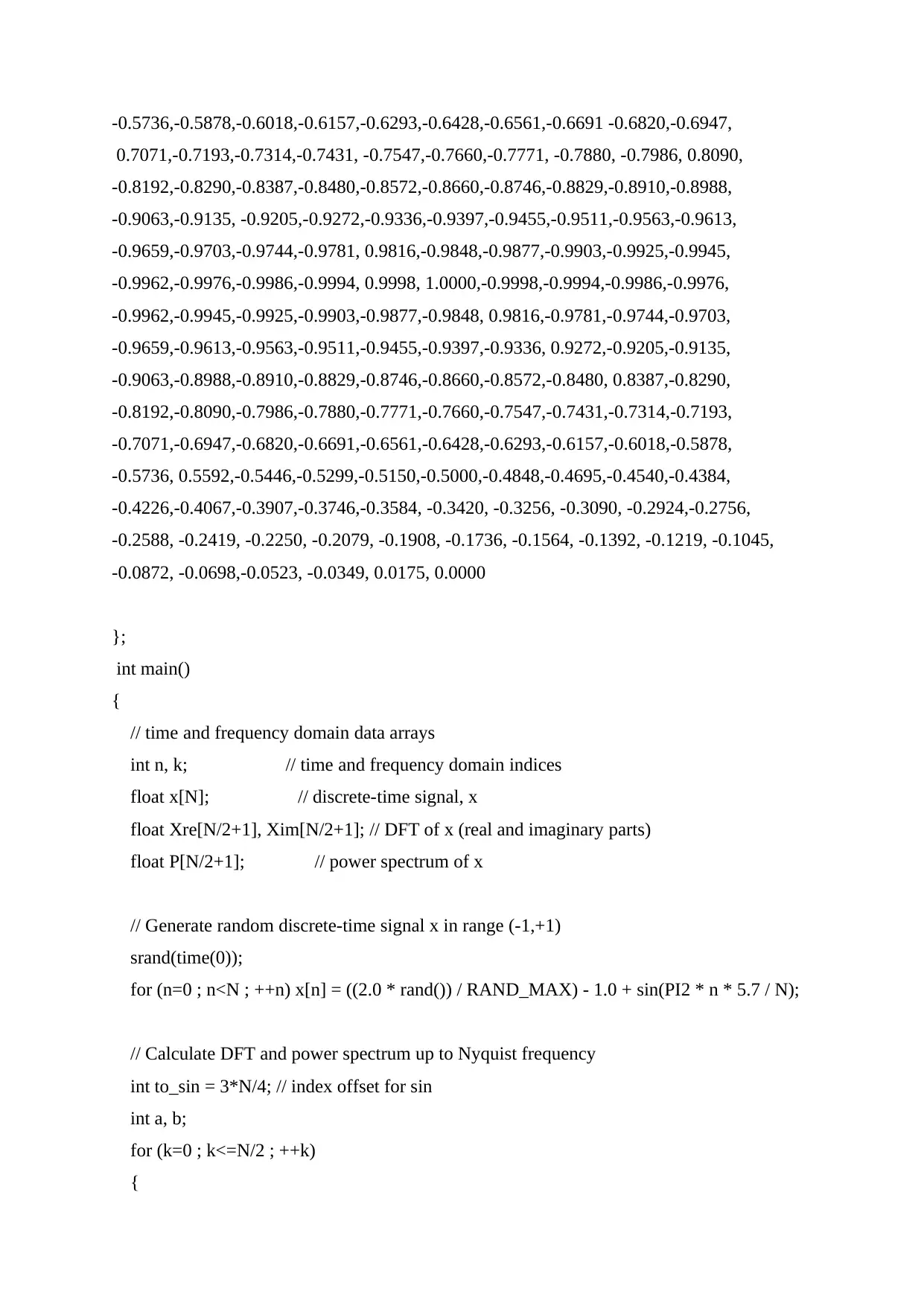
-0.5736,-0.5878,-0.6018,-0.6157,-0.6293,-0.6428,-0.6561,-0.6691 -0.6820,-0.6947,
0.7071,-0.7193,-0.7314,-0.7431, -0.7547,-0.7660,-0.7771, -0.7880, -0.7986, 0.8090,
-0.8192,-0.8290,-0.8387,-0.8480,-0.8572,-0.8660,-0.8746,-0.8829,-0.8910,-0.8988,
-0.9063,-0.9135, -0.9205,-0.9272,-0.9336,-0.9397,-0.9455,-0.9511,-0.9563,-0.9613,
-0.9659,-0.9703,-0.9744,-0.9781, 0.9816,-0.9848,-0.9877,-0.9903,-0.9925,-0.9945,
-0.9962,-0.9976,-0.9986,-0.9994, 0.9998, 1.0000,-0.9998,-0.9994,-0.9986,-0.9976,
-0.9962,-0.9945,-0.9925,-0.9903,-0.9877,-0.9848, 0.9816,-0.9781,-0.9744,-0.9703,
-0.9659,-0.9613,-0.9563,-0.9511,-0.9455,-0.9397,-0.9336, 0.9272,-0.9205,-0.9135,
-0.9063,-0.8988,-0.8910,-0.8829,-0.8746,-0.8660,-0.8572,-0.8480, 0.8387,-0.8290,
-0.8192,-0.8090,-0.7986,-0.7880,-0.7771,-0.7660,-0.7547,-0.7431,-0.7314,-0.7193,
-0.7071,-0.6947,-0.6820,-0.6691,-0.6561,-0.6428,-0.6293,-0.6157,-0.6018,-0.5878,
-0.5736, 0.5592,-0.5446,-0.5299,-0.5150,-0.5000,-0.4848,-0.4695,-0.4540,-0.4384,
-0.4226,-0.4067,-0.3907,-0.3746,-0.3584, -0.3420, -0.3256, -0.3090, -0.2924,-0.2756,
-0.2588, -0.2419, -0.2250, -0.2079, -0.1908, -0.1736, -0.1564, -0.1392, -0.1219, -0.1045,
-0.0872, -0.0698,-0.0523, -0.0349, 0.0175, 0.0000
};
int main()
{
// time and frequency domain data arrays
int n, k; // time and frequency domain indices
float x[N]; // discrete-time signal, x
float Xre[N/2+1], Xim[N/2+1]; // DFT of x (real and imaginary parts)
float P[N/2+1]; // power spectrum of x
// Generate random discrete-time signal x in range (-1,+1)
srand(time(0));
for (n=0 ; n<N ; ++n) x[n] = ((2.0 * rand()) / RAND_MAX) - 1.0 + sin(PI2 * n * 5.7 / N);
// Calculate DFT and power spectrum up to Nyquist frequency
int to_sin = 3*N/4; // index offset for sin
int a, b;
for (k=0 ; k<=N/2 ; ++k)
{
0.7071,-0.7193,-0.7314,-0.7431, -0.7547,-0.7660,-0.7771, -0.7880, -0.7986, 0.8090,
-0.8192,-0.8290,-0.8387,-0.8480,-0.8572,-0.8660,-0.8746,-0.8829,-0.8910,-0.8988,
-0.9063,-0.9135, -0.9205,-0.9272,-0.9336,-0.9397,-0.9455,-0.9511,-0.9563,-0.9613,
-0.9659,-0.9703,-0.9744,-0.9781, 0.9816,-0.9848,-0.9877,-0.9903,-0.9925,-0.9945,
-0.9962,-0.9976,-0.9986,-0.9994, 0.9998, 1.0000,-0.9998,-0.9994,-0.9986,-0.9976,
-0.9962,-0.9945,-0.9925,-0.9903,-0.9877,-0.9848, 0.9816,-0.9781,-0.9744,-0.9703,
-0.9659,-0.9613,-0.9563,-0.9511,-0.9455,-0.9397,-0.9336, 0.9272,-0.9205,-0.9135,
-0.9063,-0.8988,-0.8910,-0.8829,-0.8746,-0.8660,-0.8572,-0.8480, 0.8387,-0.8290,
-0.8192,-0.8090,-0.7986,-0.7880,-0.7771,-0.7660,-0.7547,-0.7431,-0.7314,-0.7193,
-0.7071,-0.6947,-0.6820,-0.6691,-0.6561,-0.6428,-0.6293,-0.6157,-0.6018,-0.5878,
-0.5736, 0.5592,-0.5446,-0.5299,-0.5150,-0.5000,-0.4848,-0.4695,-0.4540,-0.4384,
-0.4226,-0.4067,-0.3907,-0.3746,-0.3584, -0.3420, -0.3256, -0.3090, -0.2924,-0.2756,
-0.2588, -0.2419, -0.2250, -0.2079, -0.1908, -0.1736, -0.1564, -0.1392, -0.1219, -0.1045,
-0.0872, -0.0698,-0.0523, -0.0349, 0.0175, 0.0000
};
int main()
{
// time and frequency domain data arrays
int n, k; // time and frequency domain indices
float x[N]; // discrete-time signal, x
float Xre[N/2+1], Xim[N/2+1]; // DFT of x (real and imaginary parts)
float P[N/2+1]; // power spectrum of x
// Generate random discrete-time signal x in range (-1,+1)
srand(time(0));
for (n=0 ; n<N ; ++n) x[n] = ((2.0 * rand()) / RAND_MAX) - 1.0 + sin(PI2 * n * 5.7 / N);
// Calculate DFT and power spectrum up to Nyquist frequency
int to_sin = 3*N/4; // index offset for sin
int a, b;
for (k=0 ; k<=N/2 ; ++k)
{
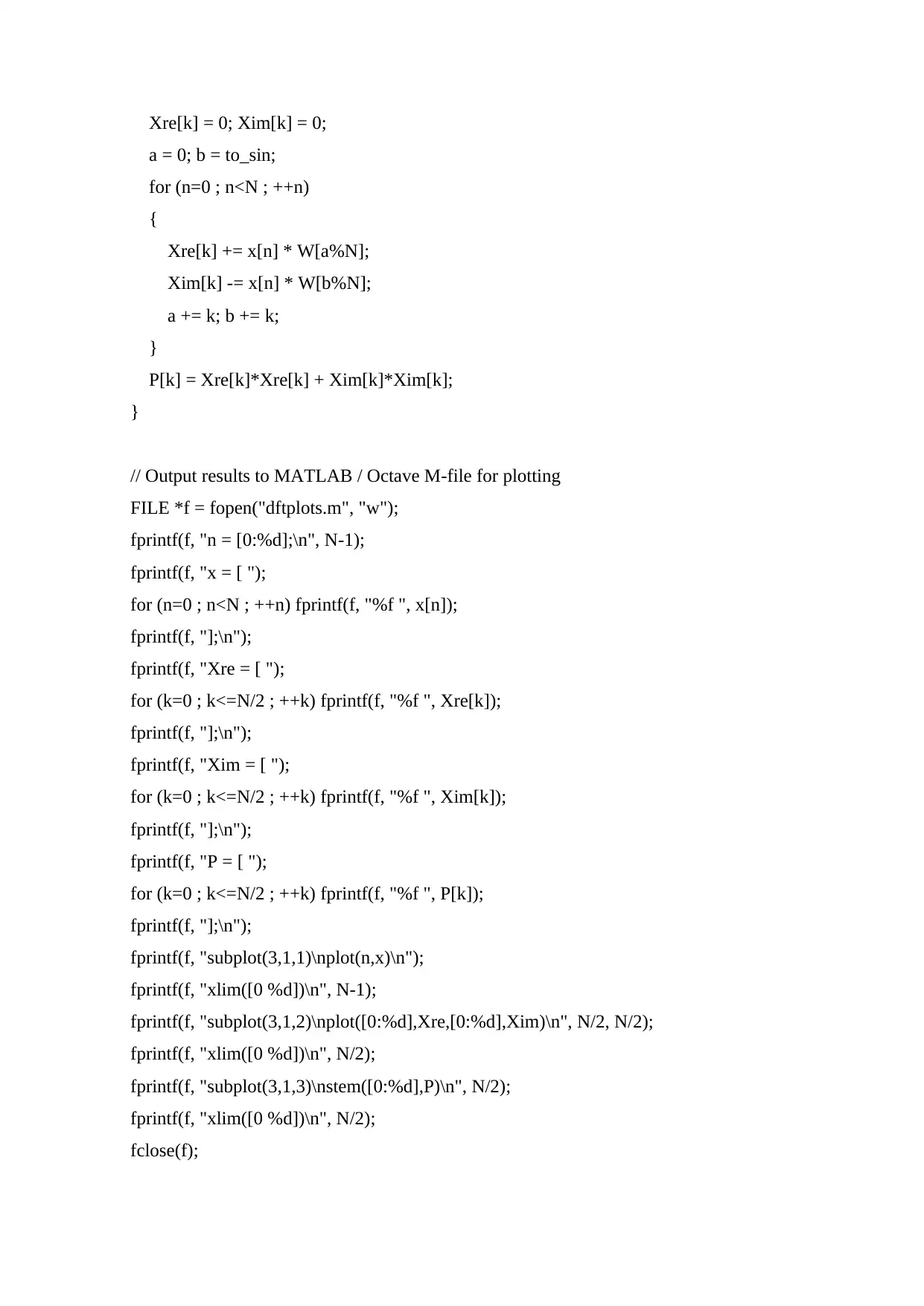
Xre[k] = 0; Xim[k] = 0;
a = 0; b = to_sin;
for (n=0 ; n<N ; ++n)
{
Xre[k] += x[n] * W[a%N];
Xim[k] -= x[n] * W[b%N];
a += k; b += k;
}
P[k] = Xre[k]*Xre[k] + Xim[k]*Xim[k];
}
// Output results to MATLAB / Octave M-file for plotting
FILE *f = fopen("dftplots.m", "w");
fprintf(f, "n = [0:%d];\n", N-1);
fprintf(f, "x = [ ");
for (n=0 ; n<N ; ++n) fprintf(f, "%f ", x[n]);
fprintf(f, "];\n");
fprintf(f, "Xre = [ ");
for (k=0 ; k<=N/2 ; ++k) fprintf(f, "%f ", Xre[k]);
fprintf(f, "];\n");
fprintf(f, "Xim = [ ");
for (k=0 ; k<=N/2 ; ++k) fprintf(f, "%f ", Xim[k]);
fprintf(f, "];\n");
fprintf(f, "P = [ ");
for (k=0 ; k<=N/2 ; ++k) fprintf(f, "%f ", P[k]);
fprintf(f, "];\n");
fprintf(f, "subplot(3,1,1)\nplot(n,x)\n");
fprintf(f, "xlim([0 %d])\n", N-1);
fprintf(f, "subplot(3,1,2)\nplot([0:%d],Xre,[0:%d],Xim)\n", N/2, N/2);
fprintf(f, "xlim([0 %d])\n", N/2);
fprintf(f, "subplot(3,1,3)\nstem([0:%d],P)\n", N/2);
fprintf(f, "xlim([0 %d])\n", N/2);
fclose(f);
a = 0; b = to_sin;
for (n=0 ; n<N ; ++n)
{
Xre[k] += x[n] * W[a%N];
Xim[k] -= x[n] * W[b%N];
a += k; b += k;
}
P[k] = Xre[k]*Xre[k] + Xim[k]*Xim[k];
}
// Output results to MATLAB / Octave M-file for plotting
FILE *f = fopen("dftplots.m", "w");
fprintf(f, "n = [0:%d];\n", N-1);
fprintf(f, "x = [ ");
for (n=0 ; n<N ; ++n) fprintf(f, "%f ", x[n]);
fprintf(f, "];\n");
fprintf(f, "Xre = [ ");
for (k=0 ; k<=N/2 ; ++k) fprintf(f, "%f ", Xre[k]);
fprintf(f, "];\n");
fprintf(f, "Xim = [ ");
for (k=0 ; k<=N/2 ; ++k) fprintf(f, "%f ", Xim[k]);
fprintf(f, "];\n");
fprintf(f, "P = [ ");
for (k=0 ; k<=N/2 ; ++k) fprintf(f, "%f ", P[k]);
fprintf(f, "];\n");
fprintf(f, "subplot(3,1,1)\nplot(n,x)\n");
fprintf(f, "xlim([0 %d])\n", N-1);
fprintf(f, "subplot(3,1,2)\nplot([0:%d],Xre,[0:%d],Xim)\n", N/2, N/2);
fprintf(f, "xlim([0 %d])\n", N/2);
fprintf(f, "subplot(3,1,3)\nstem([0:%d],P)\n", N/2);
fprintf(f, "xlim([0 %d])\n", N/2);
fclose(f);
⊘ This is a preview!⊘
Do you want full access?
Subscribe today to unlock all pages.

Trusted by 1+ million students worldwide
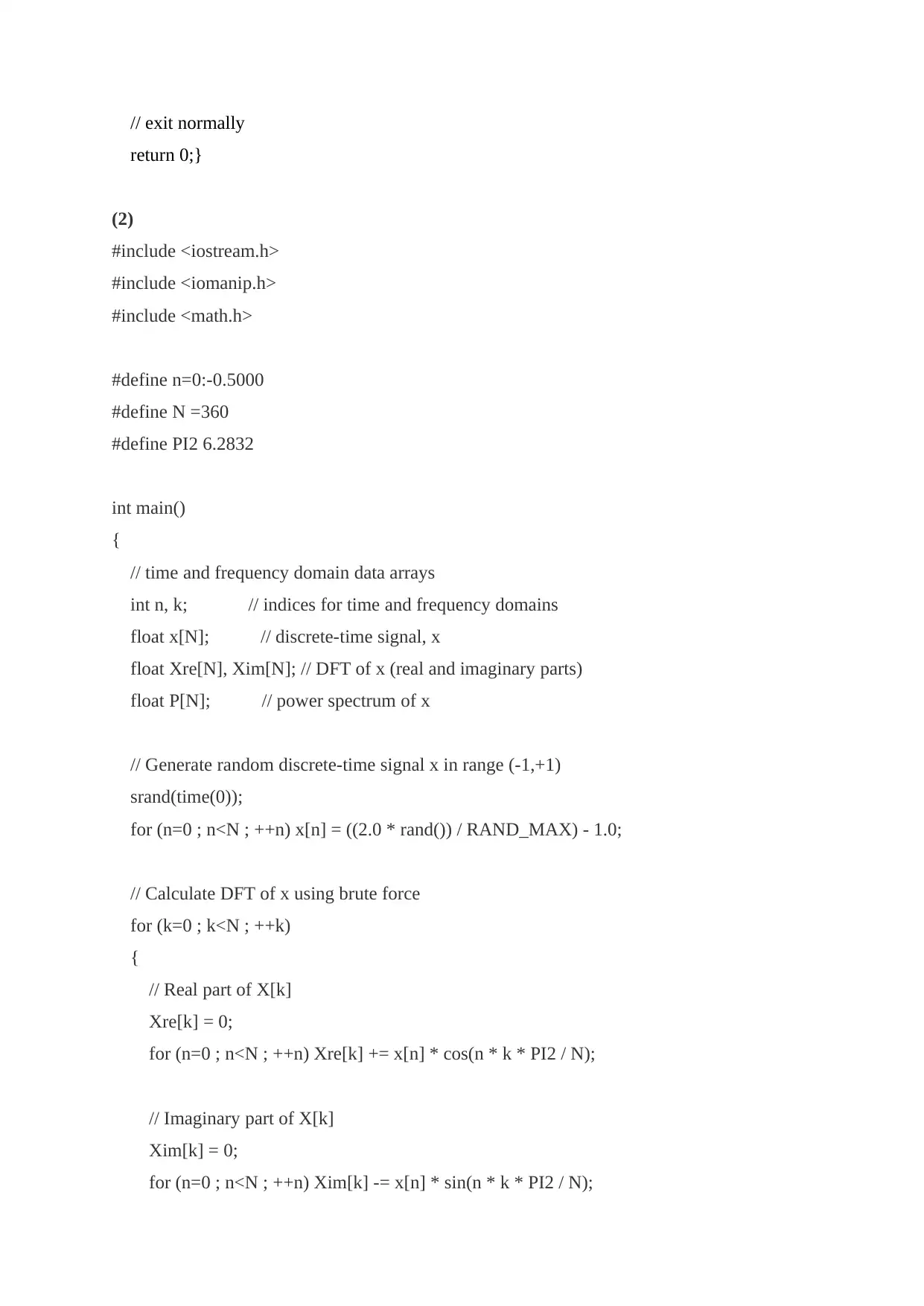
// exit normally
return 0;}
(2)
#include <iostream.h>
#include <iomanip.h>
#include <math.h>
#define n=0:-0.5000
#define N =360
#define PI2 6.2832
int main()
{
// time and frequency domain data arrays
int n, k; // indices for time and frequency domains
float x[N]; // discrete-time signal, x
float Xre[N], Xim[N]; // DFT of x (real and imaginary parts)
float P[N]; // power spectrum of x
// Generate random discrete-time signal x in range (-1,+1)
srand(time(0));
for (n=0 ; n<N ; ++n) x[n] = ((2.0 * rand()) / RAND_MAX) - 1.0;
// Calculate DFT of x using brute force
for (k=0 ; k<N ; ++k)
{
// Real part of X[k]
Xre[k] = 0;
for (n=0 ; n<N ; ++n) Xre[k] += x[n] * cos(n * k * PI2 / N);
// Imaginary part of X[k]
Xim[k] = 0;
for (n=0 ; n<N ; ++n) Xim[k] -= x[n] * sin(n * k * PI2 / N);
return 0;}
(2)
#include <iostream.h>
#include <iomanip.h>
#include <math.h>
#define n=0:-0.5000
#define N =360
#define PI2 6.2832
int main()
{
// time and frequency domain data arrays
int n, k; // indices for time and frequency domains
float x[N]; // discrete-time signal, x
float Xre[N], Xim[N]; // DFT of x (real and imaginary parts)
float P[N]; // power spectrum of x
// Generate random discrete-time signal x in range (-1,+1)
srand(time(0));
for (n=0 ; n<N ; ++n) x[n] = ((2.0 * rand()) / RAND_MAX) - 1.0;
// Calculate DFT of x using brute force
for (k=0 ; k<N ; ++k)
{
// Real part of X[k]
Xre[k] = 0;
for (n=0 ; n<N ; ++n) Xre[k] += x[n] * cos(n * k * PI2 / N);
// Imaginary part of X[k]
Xim[k] = 0;
for (n=0 ; n<N ; ++n) Xim[k] -= x[n] * sin(n * k * PI2 / N);
Paraphrase This Document
Need a fresh take? Get an instant paraphrase of this document with our AI Paraphraser
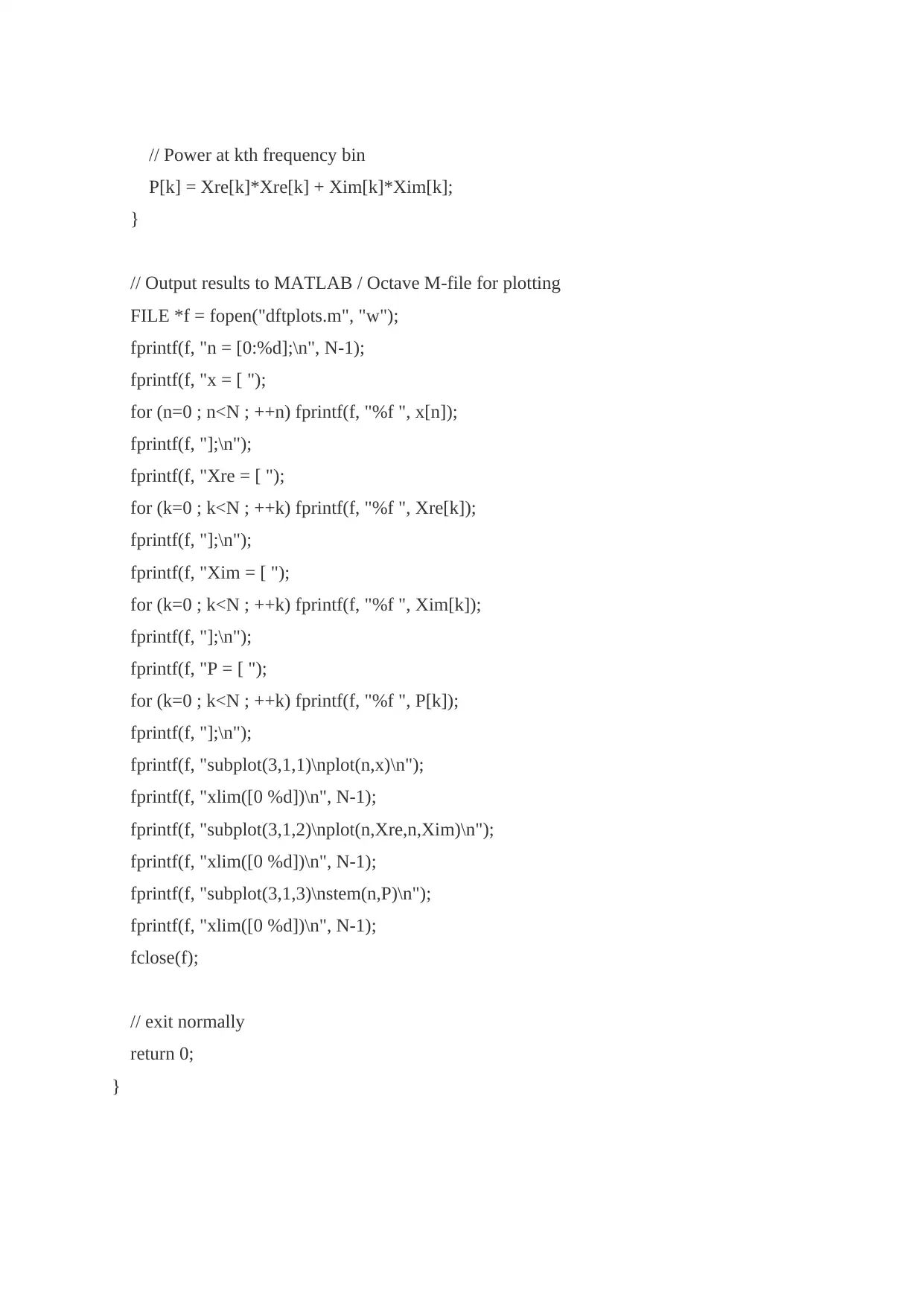
// Power at kth frequency bin
P[k] = Xre[k]*Xre[k] + Xim[k]*Xim[k];
}
// Output results to MATLAB / Octave M-file for plotting
FILE *f = fopen("dftplots.m", "w");
fprintf(f, "n = [0:%d];\n", N-1);
fprintf(f, "x = [ ");
for (n=0 ; n<N ; ++n) fprintf(f, "%f ", x[n]);
fprintf(f, "];\n");
fprintf(f, "Xre = [ ");
for (k=0 ; k<N ; ++k) fprintf(f, "%f ", Xre[k]);
fprintf(f, "];\n");
fprintf(f, "Xim = [ ");
for (k=0 ; k<N ; ++k) fprintf(f, "%f ", Xim[k]);
fprintf(f, "];\n");
fprintf(f, "P = [ ");
for (k=0 ; k<N ; ++k) fprintf(f, "%f ", P[k]);
fprintf(f, "];\n");
fprintf(f, "subplot(3,1,1)\nplot(n,x)\n");
fprintf(f, "xlim([0 %d])\n", N-1);
fprintf(f, "subplot(3,1,2)\nplot(n,Xre,n,Xim)\n");
fprintf(f, "xlim([0 %d])\n", N-1);
fprintf(f, "subplot(3,1,3)\nstem(n,P)\n");
fprintf(f, "xlim([0 %d])\n", N-1);
fclose(f);
// exit normally
return 0;
}
P[k] = Xre[k]*Xre[k] + Xim[k]*Xim[k];
}
// Output results to MATLAB / Octave M-file for plotting
FILE *f = fopen("dftplots.m", "w");
fprintf(f, "n = [0:%d];\n", N-1);
fprintf(f, "x = [ ");
for (n=0 ; n<N ; ++n) fprintf(f, "%f ", x[n]);
fprintf(f, "];\n");
fprintf(f, "Xre = [ ");
for (k=0 ; k<N ; ++k) fprintf(f, "%f ", Xre[k]);
fprintf(f, "];\n");
fprintf(f, "Xim = [ ");
for (k=0 ; k<N ; ++k) fprintf(f, "%f ", Xim[k]);
fprintf(f, "];\n");
fprintf(f, "P = [ ");
for (k=0 ; k<N ; ++k) fprintf(f, "%f ", P[k]);
fprintf(f, "];\n");
fprintf(f, "subplot(3,1,1)\nplot(n,x)\n");
fprintf(f, "xlim([0 %d])\n", N-1);
fprintf(f, "subplot(3,1,2)\nplot(n,Xre,n,Xim)\n");
fprintf(f, "xlim([0 %d])\n", N-1);
fprintf(f, "subplot(3,1,3)\nstem(n,P)\n");
fprintf(f, "xlim([0 %d])\n", N-1);
fclose(f);
// exit normally
return 0;
}
(3)
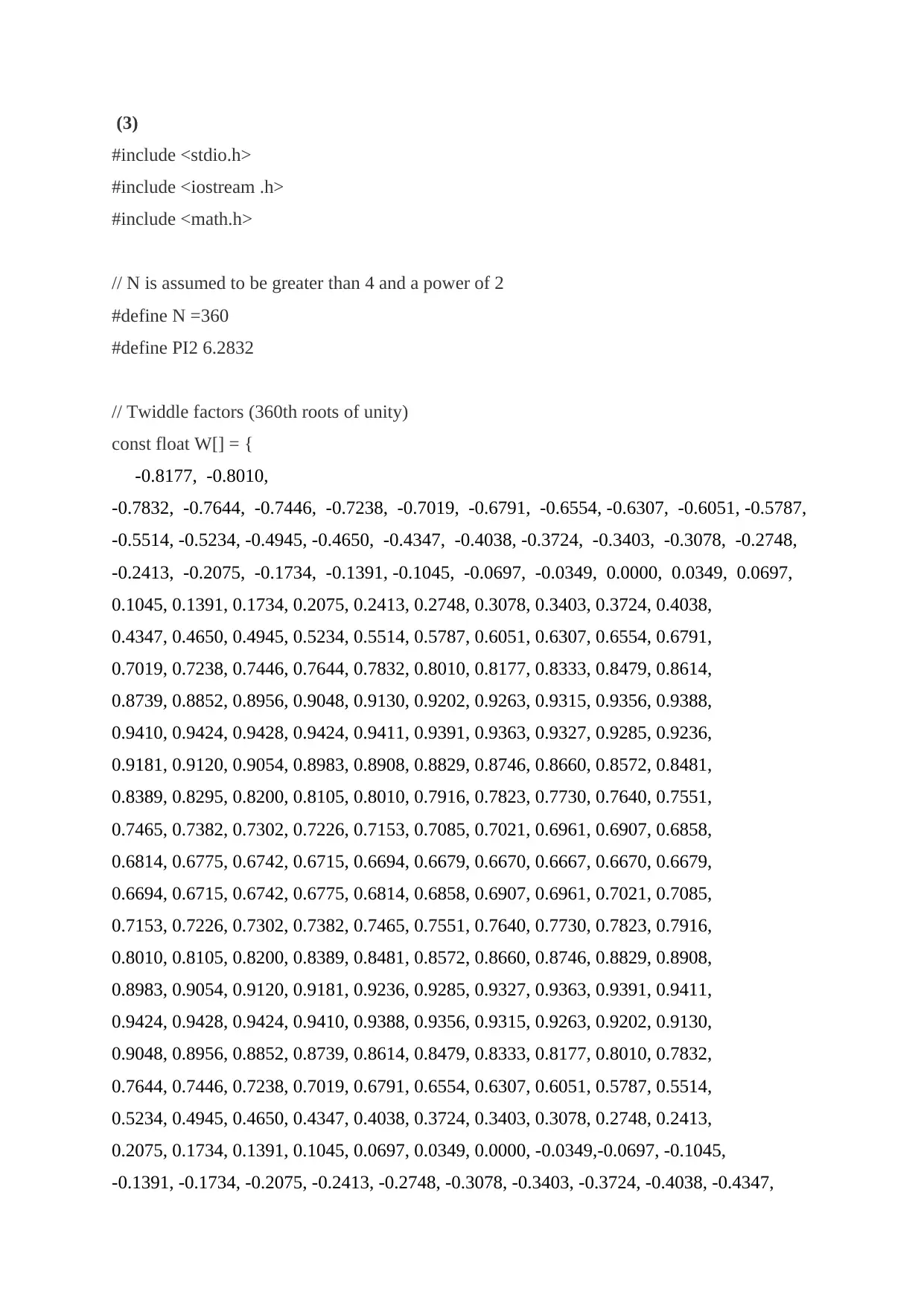
#include <stdio.h>
#include <iostream .h>
#include <math.h>
// N is assumed to be greater than 4 and a power of 2
#define N =360
#define PI2 6.2832
// Twiddle factors (360th roots of unity)
const float W[] = {
-0.8177, -0.8010,
-0.7832, -0.7644, -0.7446, -0.7238, -0.7019, -0.6791, -0.6554, -0.6307, -0.6051, -0.5787,
-0.5514, -0.5234, -0.4945, -0.4650, -0.4347, -0.4038, -0.3724, -0.3403, -0.3078, -0.2748,
-0.2413, -0.2075, -0.1734, -0.1391, -0.1045, -0.0697, -0.0349, 0.0000, 0.0349, 0.0697,
0.1045, 0.1391, 0.1734, 0.2075, 0.2413, 0.2748, 0.3078, 0.3403, 0.3724, 0.4038,
0.4347, 0.4650, 0.4945, 0.5234, 0.5514, 0.5787, 0.6051, 0.6307, 0.6554, 0.6791,
0.7019, 0.7238, 0.7446, 0.7644, 0.7832, 0.8010, 0.8177, 0.8333, 0.8479, 0.8614,
0.8739, 0.8852, 0.8956, 0.9048, 0.9130, 0.9202, 0.9263, 0.9315, 0.9356, 0.9388,
0.9410, 0.9424, 0.9428, 0.9424, 0.9411, 0.9391, 0.9363, 0.9327, 0.9285, 0.9236,
0.9181, 0.9120, 0.9054, 0.8983, 0.8908, 0.8829, 0.8746, 0.8660, 0.8572, 0.8481,
0.8389, 0.8295, 0.8200, 0.8105, 0.8010, 0.7916, 0.7823, 0.7730, 0.7640, 0.7551,
0.7465, 0.7382, 0.7302, 0.7226, 0.7153, 0.7085, 0.7021, 0.6961, 0.6907, 0.6858,
0.6814, 0.6775, 0.6742, 0.6715, 0.6694, 0.6679, 0.6670, 0.6667, 0.6670, 0.6679,
0.6694, 0.6715, 0.6742, 0.6775, 0.6814, 0.6858, 0.6907, 0.6961, 0.7021, 0.7085,
0.7153, 0.7226, 0.7302, 0.7382, 0.7465, 0.7551, 0.7640, 0.7730, 0.7823, 0.7916,
0.8010, 0.8105, 0.8200, 0.8389, 0.8481, 0.8572, 0.8660, 0.8746, 0.8829, 0.8908,
0.8983, 0.9054, 0.9120, 0.9181, 0.9236, 0.9285, 0.9327, 0.9363, 0.9391, 0.9411,
0.9424, 0.9428, 0.9424, 0.9410, 0.9388, 0.9356, 0.9315, 0.9263, 0.9202, 0.9130,
0.9048, 0.8956, 0.8852, 0.8739, 0.8614, 0.8479, 0.8333, 0.8177, 0.8010, 0.7832,
0.7644, 0.7446, 0.7238, 0.7019, 0.6791, 0.6554, 0.6307, 0.6051, 0.5787, 0.5514,
0.5234, 0.4945, 0.4650, 0.4347, 0.4038, 0.3724, 0.3403, 0.3078, 0.2748, 0.2413,
0.2075, 0.1734, 0.1391, 0.1045, 0.0697, 0.0349, 0.0000, -0.0349,-0.0697, -0.1045,
-0.1391, -0.1734, -0.2075, -0.2413, -0.2748, -0.3078, -0.3403, -0.3724, -0.4038, -0.4347,
#include <stdio.h>
#include <iostream .h>
#include <math.h>
// N is assumed to be greater than 4 and a power of 2
#define N =360
#define PI2 6.2832
// Twiddle factors (360th roots of unity)
const float W[] = {
-0.8177, -0.8010,
-0.7832, -0.7644, -0.7446, -0.7238, -0.7019, -0.6791, -0.6554, -0.6307, -0.6051, -0.5787,
-0.5514, -0.5234, -0.4945, -0.4650, -0.4347, -0.4038, -0.3724, -0.3403, -0.3078, -0.2748,
-0.2413, -0.2075, -0.1734, -0.1391, -0.1045, -0.0697, -0.0349, 0.0000, 0.0349, 0.0697,
0.1045, 0.1391, 0.1734, 0.2075, 0.2413, 0.2748, 0.3078, 0.3403, 0.3724, 0.4038,
0.4347, 0.4650, 0.4945, 0.5234, 0.5514, 0.5787, 0.6051, 0.6307, 0.6554, 0.6791,
0.7019, 0.7238, 0.7446, 0.7644, 0.7832, 0.8010, 0.8177, 0.8333, 0.8479, 0.8614,
0.8739, 0.8852, 0.8956, 0.9048, 0.9130, 0.9202, 0.9263, 0.9315, 0.9356, 0.9388,
0.9410, 0.9424, 0.9428, 0.9424, 0.9411, 0.9391, 0.9363, 0.9327, 0.9285, 0.9236,
0.9181, 0.9120, 0.9054, 0.8983, 0.8908, 0.8829, 0.8746, 0.8660, 0.8572, 0.8481,
0.8389, 0.8295, 0.8200, 0.8105, 0.8010, 0.7916, 0.7823, 0.7730, 0.7640, 0.7551,
0.7465, 0.7382, 0.7302, 0.7226, 0.7153, 0.7085, 0.7021, 0.6961, 0.6907, 0.6858,
0.6814, 0.6775, 0.6742, 0.6715, 0.6694, 0.6679, 0.6670, 0.6667, 0.6670, 0.6679,
0.6694, 0.6715, 0.6742, 0.6775, 0.6814, 0.6858, 0.6907, 0.6961, 0.7021, 0.7085,
0.7153, 0.7226, 0.7302, 0.7382, 0.7465, 0.7551, 0.7640, 0.7730, 0.7823, 0.7916,
0.8010, 0.8105, 0.8200, 0.8389, 0.8481, 0.8572, 0.8660, 0.8746, 0.8829, 0.8908,
0.8983, 0.9054, 0.9120, 0.9181, 0.9236, 0.9285, 0.9327, 0.9363, 0.9391, 0.9411,
0.9424, 0.9428, 0.9424, 0.9410, 0.9388, 0.9356, 0.9315, 0.9263, 0.9202, 0.9130,
0.9048, 0.8956, 0.8852, 0.8739, 0.8614, 0.8479, 0.8333, 0.8177, 0.8010, 0.7832,
0.7644, 0.7446, 0.7238, 0.7019, 0.6791, 0.6554, 0.6307, 0.6051, 0.5787, 0.5514,
0.5234, 0.4945, 0.4650, 0.4347, 0.4038, 0.3724, 0.3403, 0.3078, 0.2748, 0.2413,
0.2075, 0.1734, 0.1391, 0.1045, 0.0697, 0.0349, 0.0000, -0.0349,-0.0697, -0.1045,
-0.1391, -0.1734, -0.2075, -0.2413, -0.2748, -0.3078, -0.3403, -0.3724, -0.4038, -0.4347,
⊘ This is a preview!⊘
Do you want full access?
Subscribe today to unlock all pages.
Trusted by 1+ million students worldwide
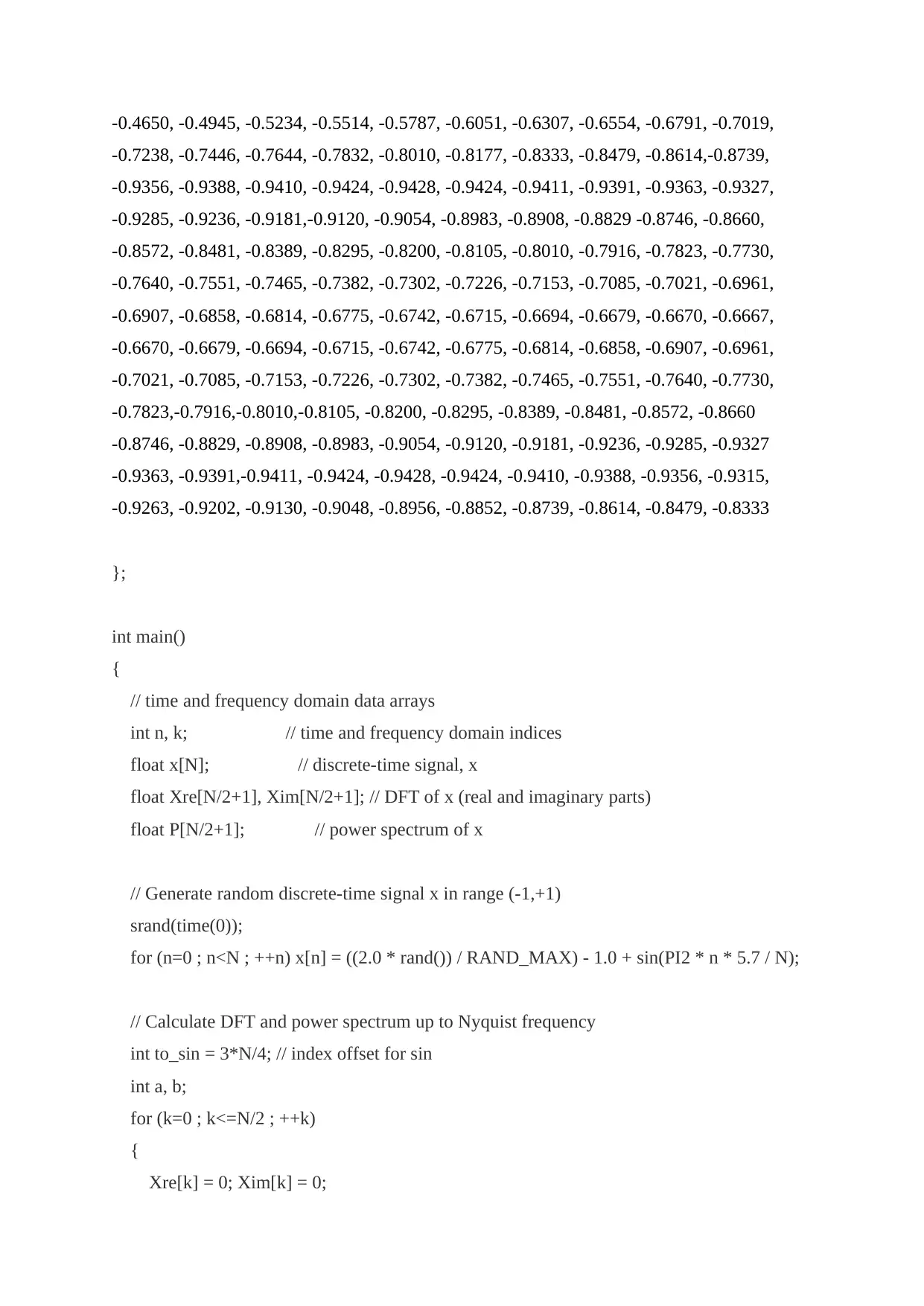
-0.4650, -0.4945, -0.5234, -0.5514, -0.5787, -0.6051, -0.6307, -0.6554, -0.6791, -0.7019,
-0.7238, -0.7446, -0.7644, -0.7832, -0.8010, -0.8177, -0.8333, -0.8479, -0.8614,-0.8739,
-0.9356, -0.9388, -0.9410, -0.9424, -0.9428, -0.9424, -0.9411, -0.9391, -0.9363, -0.9327,
-0.9285, -0.9236, -0.9181,-0.9120, -0.9054, -0.8983, -0.8908, -0.8829 -0.8746, -0.8660,
-0.8572, -0.8481, -0.8389, -0.8295, -0.8200, -0.8105, -0.8010, -0.7916, -0.7823, -0.7730,
-0.7640, -0.7551, -0.7465, -0.7382, -0.7302, -0.7226, -0.7153, -0.7085, -0.7021, -0.6961,
-0.6907, -0.6858, -0.6814, -0.6775, -0.6742, -0.6715, -0.6694, -0.6679, -0.6670, -0.6667,
-0.6670, -0.6679, -0.6694, -0.6715, -0.6742, -0.6775, -0.6814, -0.6858, -0.6907, -0.6961,
-0.7021, -0.7085, -0.7153, -0.7226, -0.7302, -0.7382, -0.7465, -0.7551, -0.7640, -0.7730,
-0.7823,-0.7916,-0.8010,-0.8105, -0.8200, -0.8295, -0.8389, -0.8481, -0.8572, -0.8660
-0.8746, -0.8829, -0.8908, -0.8983, -0.9054, -0.9120, -0.9181, -0.9236, -0.9285, -0.9327
-0.9363, -0.9391,-0.9411, -0.9424, -0.9428, -0.9424, -0.9410, -0.9388, -0.9356, -0.9315,
-0.9263, -0.9202, -0.9130, -0.9048, -0.8956, -0.8852, -0.8739, -0.8614, -0.8479, -0.8333
};
int main()
{
// time and frequency domain data arrays
int n, k; // time and frequency domain indices
float x[N]; // discrete-time signal, x
float Xre[N/2+1], Xim[N/2+1]; // DFT of x (real and imaginary parts)
float P[N/2+1]; // power spectrum of x
// Generate random discrete-time signal x in range (-1,+1)
srand(time(0));
for (n=0 ; n<N ; ++n) x[n] = ((2.0 * rand()) / RAND_MAX) - 1.0 + sin(PI2 * n * 5.7 / N);
// Calculate DFT and power spectrum up to Nyquist frequency
int to_sin = 3*N/4; // index offset for sin
int a, b;
for (k=0 ; k<=N/2 ; ++k)
{
Xre[k] = 0; Xim[k] = 0;
-0.7238, -0.7446, -0.7644, -0.7832, -0.8010, -0.8177, -0.8333, -0.8479, -0.8614,-0.8739,
-0.9356, -0.9388, -0.9410, -0.9424, -0.9428, -0.9424, -0.9411, -0.9391, -0.9363, -0.9327,
-0.9285, -0.9236, -0.9181,-0.9120, -0.9054, -0.8983, -0.8908, -0.8829 -0.8746, -0.8660,
-0.8572, -0.8481, -0.8389, -0.8295, -0.8200, -0.8105, -0.8010, -0.7916, -0.7823, -0.7730,
-0.7640, -0.7551, -0.7465, -0.7382, -0.7302, -0.7226, -0.7153, -0.7085, -0.7021, -0.6961,
-0.6907, -0.6858, -0.6814, -0.6775, -0.6742, -0.6715, -0.6694, -0.6679, -0.6670, -0.6667,
-0.6670, -0.6679, -0.6694, -0.6715, -0.6742, -0.6775, -0.6814, -0.6858, -0.6907, -0.6961,
-0.7021, -0.7085, -0.7153, -0.7226, -0.7302, -0.7382, -0.7465, -0.7551, -0.7640, -0.7730,
-0.7823,-0.7916,-0.8010,-0.8105, -0.8200, -0.8295, -0.8389, -0.8481, -0.8572, -0.8660
-0.8746, -0.8829, -0.8908, -0.8983, -0.9054, -0.9120, -0.9181, -0.9236, -0.9285, -0.9327
-0.9363, -0.9391,-0.9411, -0.9424, -0.9428, -0.9424, -0.9410, -0.9388, -0.9356, -0.9315,
-0.9263, -0.9202, -0.9130, -0.9048, -0.8956, -0.8852, -0.8739, -0.8614, -0.8479, -0.8333
};
int main()
{
// time and frequency domain data arrays
int n, k; // time and frequency domain indices
float x[N]; // discrete-time signal, x
float Xre[N/2+1], Xim[N/2+1]; // DFT of x (real and imaginary parts)
float P[N/2+1]; // power spectrum of x
// Generate random discrete-time signal x in range (-1,+1)
srand(time(0));
for (n=0 ; n<N ; ++n) x[n] = ((2.0 * rand()) / RAND_MAX) - 1.0 + sin(PI2 * n * 5.7 / N);
// Calculate DFT and power spectrum up to Nyquist frequency
int to_sin = 3*N/4; // index offset for sin
int a, b;
for (k=0 ; k<=N/2 ; ++k)
{
Xre[k] = 0; Xim[k] = 0;
Paraphrase This Document
Need a fresh take? Get an instant paraphrase of this document with our AI Paraphraser
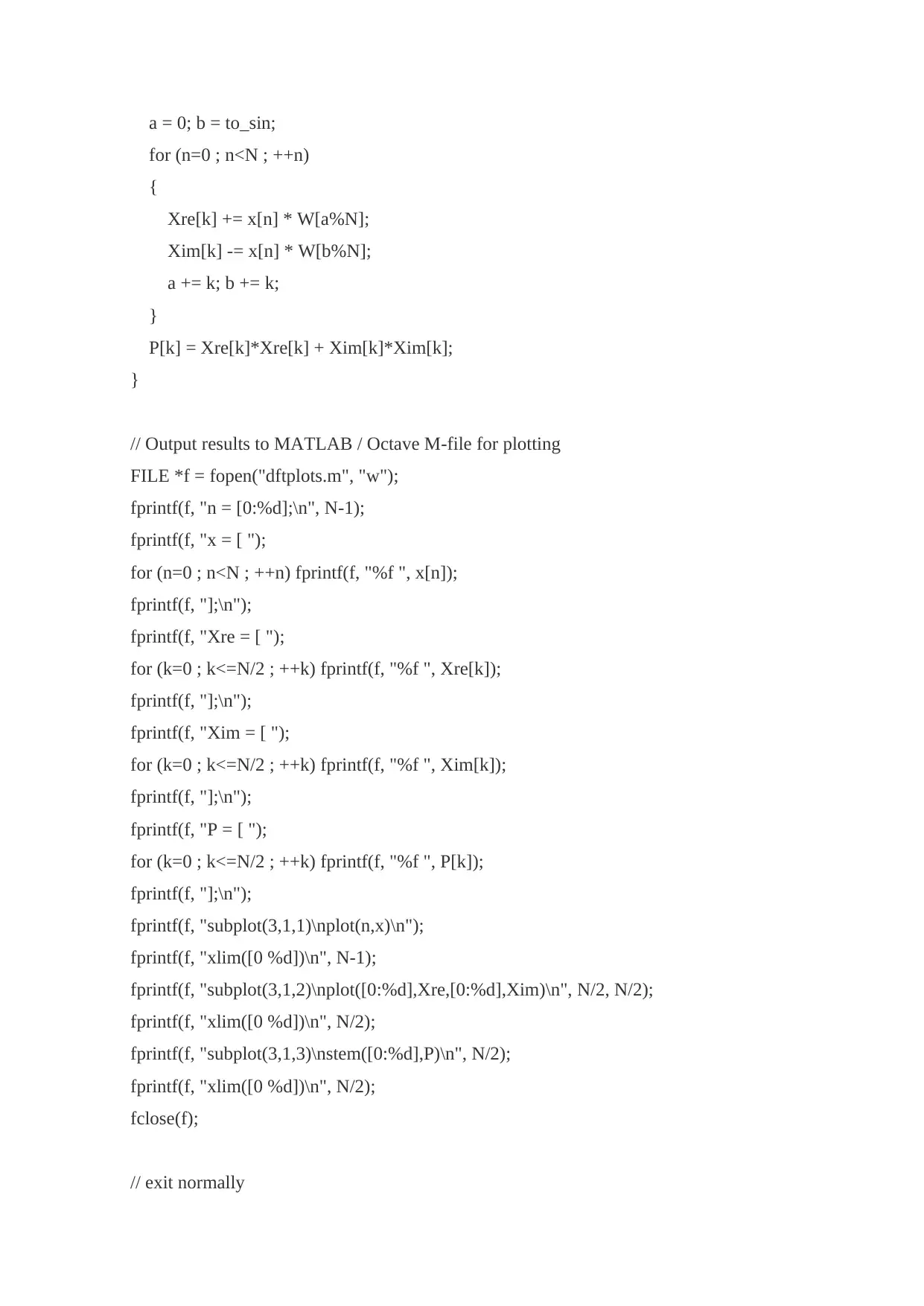
a = 0; b = to_sin;
for (n=0 ; n<N ; ++n)
{
Xre[k] += x[n] * W[a%N];
Xim[k] -= x[n] * W[b%N];
a += k; b += k;
}
P[k] = Xre[k]*Xre[k] + Xim[k]*Xim[k];
}
// Output results to MATLAB / Octave M-file for plotting
FILE *f = fopen("dftplots.m", "w");
fprintf(f, "n = [0:%d];\n", N-1);
fprintf(f, "x = [ ");
for (n=0 ; n<N ; ++n) fprintf(f, "%f ", x[n]);
fprintf(f, "];\n");
fprintf(f, "Xre = [ ");
for (k=0 ; k<=N/2 ; ++k) fprintf(f, "%f ", Xre[k]);
fprintf(f, "];\n");
fprintf(f, "Xim = [ ");
for (k=0 ; k<=N/2 ; ++k) fprintf(f, "%f ", Xim[k]);
fprintf(f, "];\n");
fprintf(f, "P = [ ");
for (k=0 ; k<=N/2 ; ++k) fprintf(f, "%f ", P[k]);
fprintf(f, "];\n");
fprintf(f, "subplot(3,1,1)\nplot(n,x)\n");
fprintf(f, "xlim([0 %d])\n", N-1);
fprintf(f, "subplot(3,1,2)\nplot([0:%d],Xre,[0:%d],Xim)\n", N/2, N/2);
fprintf(f, "xlim([0 %d])\n", N/2);
fprintf(f, "subplot(3,1,3)\nstem([0:%d],P)\n", N/2);
fprintf(f, "xlim([0 %d])\n", N/2);
fclose(f);
// exit normally
for (n=0 ; n<N ; ++n)
{
Xre[k] += x[n] * W[a%N];
Xim[k] -= x[n] * W[b%N];
a += k; b += k;
}
P[k] = Xre[k]*Xre[k] + Xim[k]*Xim[k];
}
// Output results to MATLAB / Octave M-file for plotting
FILE *f = fopen("dftplots.m", "w");
fprintf(f, "n = [0:%d];\n", N-1);
fprintf(f, "x = [ ");
for (n=0 ; n<N ; ++n) fprintf(f, "%f ", x[n]);
fprintf(f, "];\n");
fprintf(f, "Xre = [ ");
for (k=0 ; k<=N/2 ; ++k) fprintf(f, "%f ", Xre[k]);
fprintf(f, "];\n");
fprintf(f, "Xim = [ ");
for (k=0 ; k<=N/2 ; ++k) fprintf(f, "%f ", Xim[k]);
fprintf(f, "];\n");
fprintf(f, "P = [ ");
for (k=0 ; k<=N/2 ; ++k) fprintf(f, "%f ", P[k]);
fprintf(f, "];\n");
fprintf(f, "subplot(3,1,1)\nplot(n,x)\n");
fprintf(f, "xlim([0 %d])\n", N-1);
fprintf(f, "subplot(3,1,2)\nplot([0:%d],Xre,[0:%d],Xim)\n", N/2, N/2);
fprintf(f, "xlim([0 %d])\n", N/2);
fprintf(f, "subplot(3,1,3)\nstem([0:%d],P)\n", N/2);
fprintf(f, "xlim([0 %d])\n", N/2);
fclose(f);
// exit normally
return 0;
}
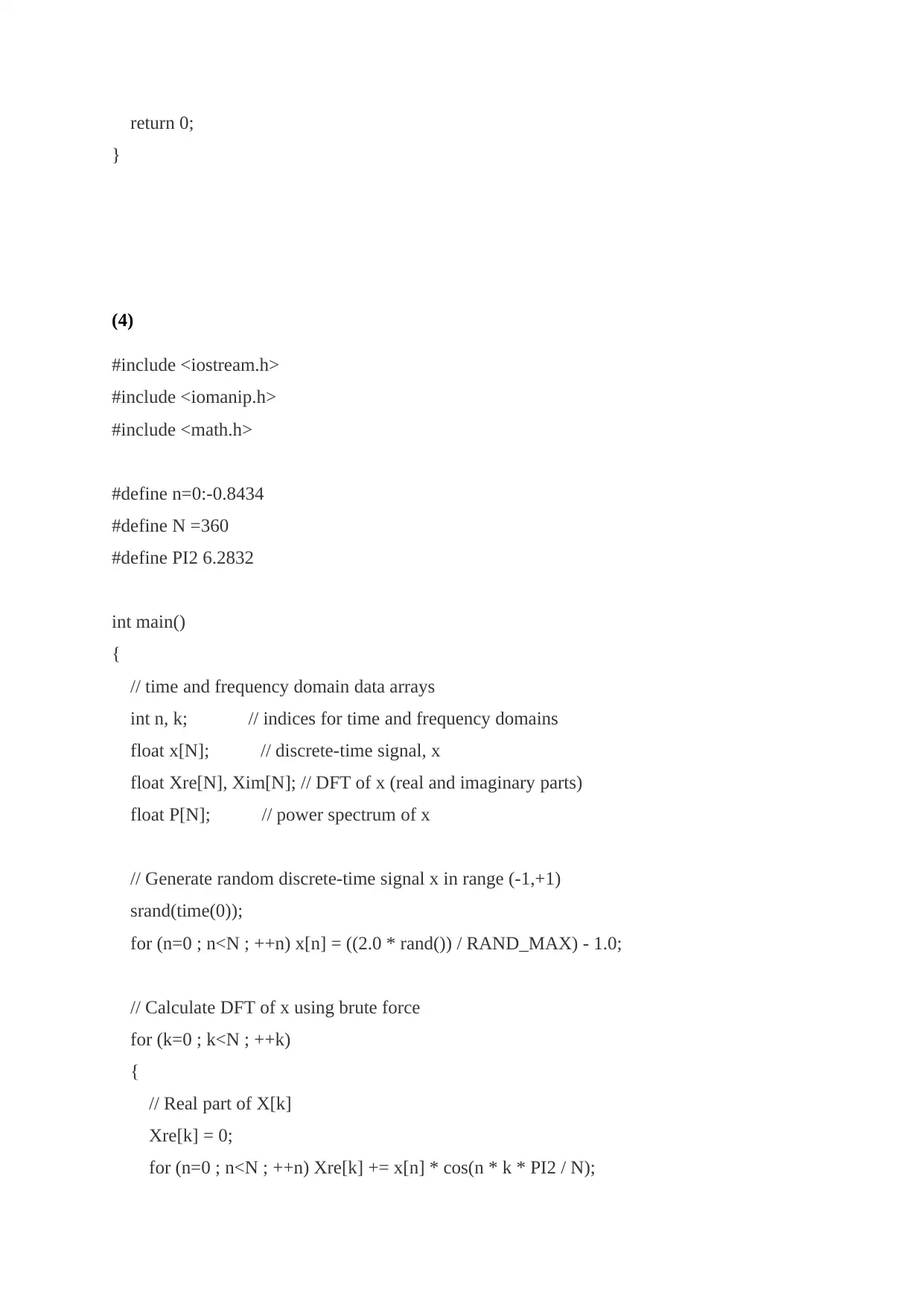
(4)
#include <iostream.h>
#include <iomanip.h>
#include <math.h>
#define n=0:-0.8434
#define N =360
#define PI2 6.2832
int main()
{
// time and frequency domain data arrays
int n, k; // indices for time and frequency domains
float x[N]; // discrete-time signal, x
float Xre[N], Xim[N]; // DFT of x (real and imaginary parts)
float P[N]; // power spectrum of x
// Generate random discrete-time signal x in range (-1,+1)
srand(time(0));
for (n=0 ; n<N ; ++n) x[n] = ((2.0 * rand()) / RAND_MAX) - 1.0;
// Calculate DFT of x using brute force
for (k=0 ; k<N ; ++k)
{
// Real part of X[k]
Xre[k] = 0;
for (n=0 ; n<N ; ++n) Xre[k] += x[n] * cos(n * k * PI2 / N);
}
(4)
#include <iostream.h>
#include <iomanip.h>
#include <math.h>
#define n=0:-0.8434
#define N =360
#define PI2 6.2832
int main()
{
// time and frequency domain data arrays
int n, k; // indices for time and frequency domains
float x[N]; // discrete-time signal, x
float Xre[N], Xim[N]; // DFT of x (real and imaginary parts)
float P[N]; // power spectrum of x
// Generate random discrete-time signal x in range (-1,+1)
srand(time(0));
for (n=0 ; n<N ; ++n) x[n] = ((2.0 * rand()) / RAND_MAX) - 1.0;
// Calculate DFT of x using brute force
for (k=0 ; k<N ; ++k)
{
// Real part of X[k]
Xre[k] = 0;
for (n=0 ; n<N ; ++n) Xre[k] += x[n] * cos(n * k * PI2 / N);
⊘ This is a preview!⊘
Do you want full access?
Subscribe today to unlock all pages.
Trusted by 1+ million students worldwide
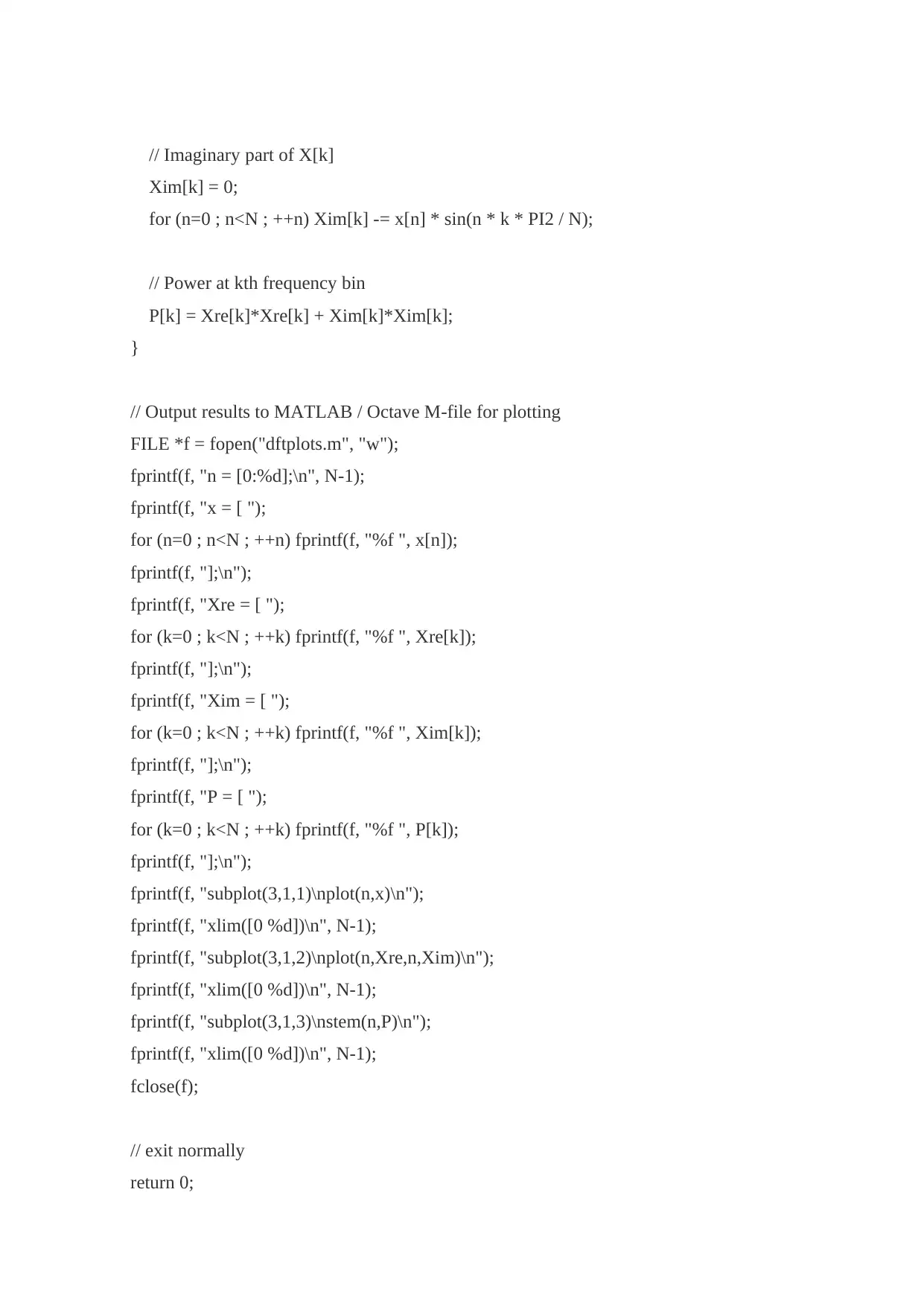
// Imaginary part of X[k]
Xim[k] = 0;
for (n=0 ; n<N ; ++n) Xim[k] -= x[n] * sin(n * k * PI2 / N);
// Power at kth frequency bin
P[k] = Xre[k]*Xre[k] + Xim[k]*Xim[k];
}
// Output results to MATLAB / Octave M-file for plotting
FILE *f = fopen("dftplots.m", "w");
fprintf(f, "n = [0:%d];\n", N-1);
fprintf(f, "x = [ ");
for (n=0 ; n<N ; ++n) fprintf(f, "%f ", x[n]);
fprintf(f, "];\n");
fprintf(f, "Xre = [ ");
for (k=0 ; k<N ; ++k) fprintf(f, "%f ", Xre[k]);
fprintf(f, "];\n");
fprintf(f, "Xim = [ ");
for (k=0 ; k<N ; ++k) fprintf(f, "%f ", Xim[k]);
fprintf(f, "];\n");
fprintf(f, "P = [ ");
for (k=0 ; k<N ; ++k) fprintf(f, "%f ", P[k]);
fprintf(f, "];\n");
fprintf(f, "subplot(3,1,1)\nplot(n,x)\n");
fprintf(f, "xlim([0 %d])\n", N-1);
fprintf(f, "subplot(3,1,2)\nplot(n,Xre,n,Xim)\n");
fprintf(f, "xlim([0 %d])\n", N-1);
fprintf(f, "subplot(3,1,3)\nstem(n,P)\n");
fprintf(f, "xlim([0 %d])\n", N-1);
fclose(f);
// exit normally
return 0;
Xim[k] = 0;
for (n=0 ; n<N ; ++n) Xim[k] -= x[n] * sin(n * k * PI2 / N);
// Power at kth frequency bin
P[k] = Xre[k]*Xre[k] + Xim[k]*Xim[k];
}
// Output results to MATLAB / Octave M-file for plotting
FILE *f = fopen("dftplots.m", "w");
fprintf(f, "n = [0:%d];\n", N-1);
fprintf(f, "x = [ ");
for (n=0 ; n<N ; ++n) fprintf(f, "%f ", x[n]);
fprintf(f, "];\n");
fprintf(f, "Xre = [ ");
for (k=0 ; k<N ; ++k) fprintf(f, "%f ", Xre[k]);
fprintf(f, "];\n");
fprintf(f, "Xim = [ ");
for (k=0 ; k<N ; ++k) fprintf(f, "%f ", Xim[k]);
fprintf(f, "];\n");
fprintf(f, "P = [ ");
for (k=0 ; k<N ; ++k) fprintf(f, "%f ", P[k]);
fprintf(f, "];\n");
fprintf(f, "subplot(3,1,1)\nplot(n,x)\n");
fprintf(f, "xlim([0 %d])\n", N-1);
fprintf(f, "subplot(3,1,2)\nplot(n,Xre,n,Xim)\n");
fprintf(f, "xlim([0 %d])\n", N-1);
fprintf(f, "subplot(3,1,3)\nstem(n,P)\n");
fprintf(f, "xlim([0 %d])\n", N-1);
fclose(f);
// exit normally
return 0;
Paraphrase This Document
Need a fresh take? Get an instant paraphrase of this document with our AI Paraphraser

}

1 out of 11


Your All-in-One AI-Powered Toolkit for Academic Success.
+13062052269
info@desklib.com
Available 24*7 on WhatsApp / Email
![[object Object]](/_next/static/media/star-bottom.7253800d.svg)
Unlock your academic potential
Copyright © 2020–2025 A2Z Services. All Rights Reserved. Developed and managed by ZUCOL.