Diagnostic Model: Assessing Change in the Music Industry (Miles Davis)

Verified

Added on  2021/04/17

|8
|1356
|74
Report
AI Summary
This report examines the application of diagnostic models to understand and manage technological change within the music industry, using the case of trumpeter Miles Davis as a focal point. Davis, known for his innovative approach to jazz, faced the challenge of adapting to a rapidly evolving musical landscape. The report identifies the core problem as Davis's need to evolve his music in response to changing audience tastes and technological advancements, such as the shift from 78-rpm records to vinyl. To address this, the report proposes the use of three diagnostic models: the Interpretive Structural Modeling (ISM) model to assess relationships between factors, the Strategic Change Process Model to guide the implementation of change, and the Goffee and Jones cultural change framework to manage internal issues and maintain cultural harmony. The analysis highlights how these models could have been utilized to navigate the challenges of technological change and ensure the continued success of Davis's musical innovations, considering the evolving preferences of the audience and the impact of new technologies. The report concludes that the implementation of these diagnostic models would have helped Davis successfully adapt to the changing dynamics of the music industry.

Document Page
Running head: DIAGNOSTIC MODEL TO IDENTIFY TECHNOLOGICAL CHANGE
Diagnostic Model to identify Technological Change
Name of the Student
Name of the University
Author Note
tabler-icon-diamond-filled.svg

Paraphrase This Document

Need a fresh take? Get an instant paraphrase of this document with our AI Paraphraser
Document Page
1DIAGNOSTIC MODEL TO IDENTIFY TECHNOLOGICAL CHANGE
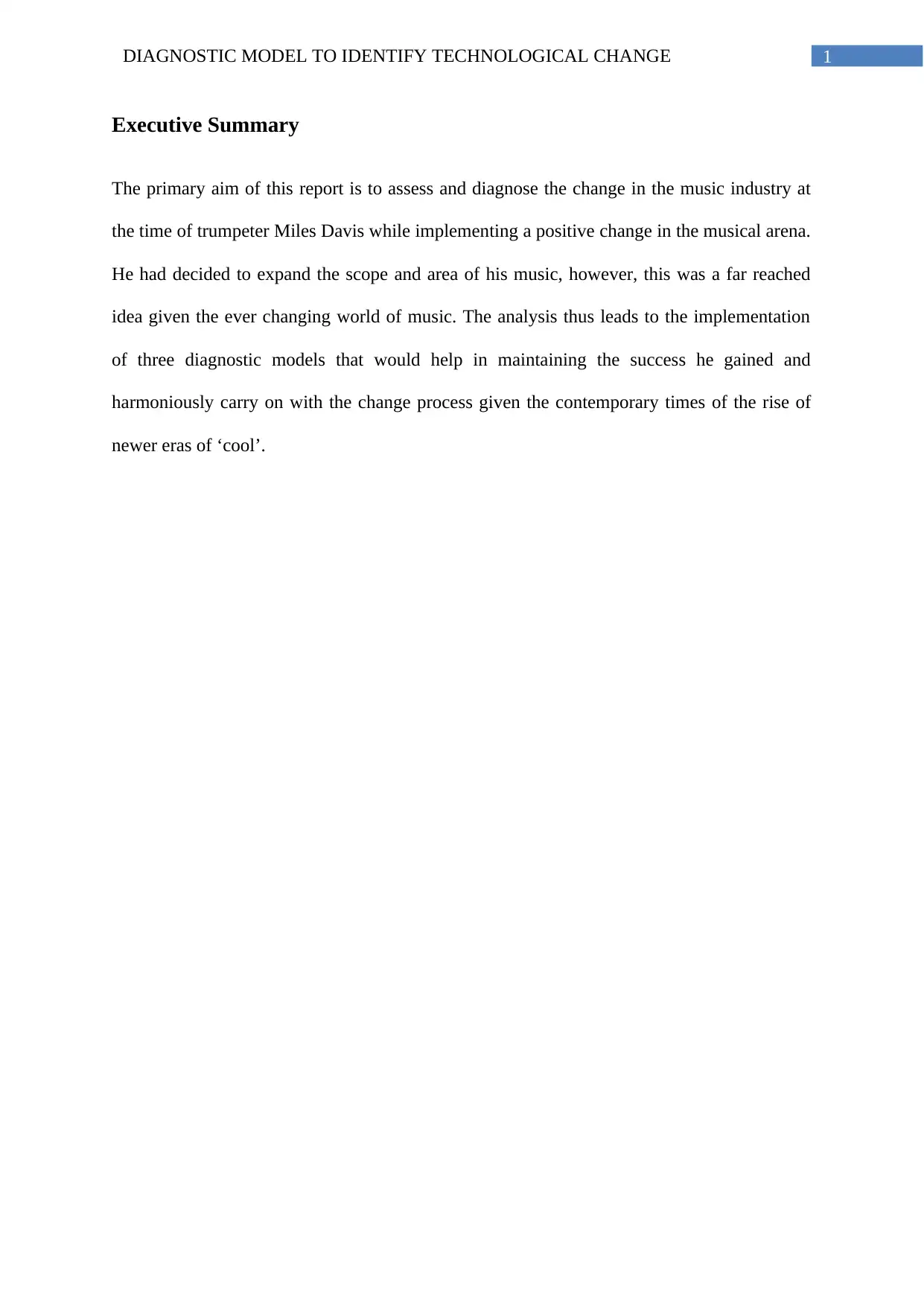
Executive Summary
The primary aim of this report is to assess and diagnose the change in the music industry at
the time of trumpeter Miles Davis while implementing a positive change in the musical arena.
He had decided to expand the scope and area of his music, however, this was a far reached
idea given the ever changing world of music. The analysis thus leads to the implementation
of three diagnostic models that would help in maintaining the success he gained and
harmoniously carry on with the change process given the contemporary times of the rise of
newer eras of ‘cool’.
Document Page
2DIAGNOSTIC MODEL TO IDENTIFY TECHNOLOGICAL CHANGE
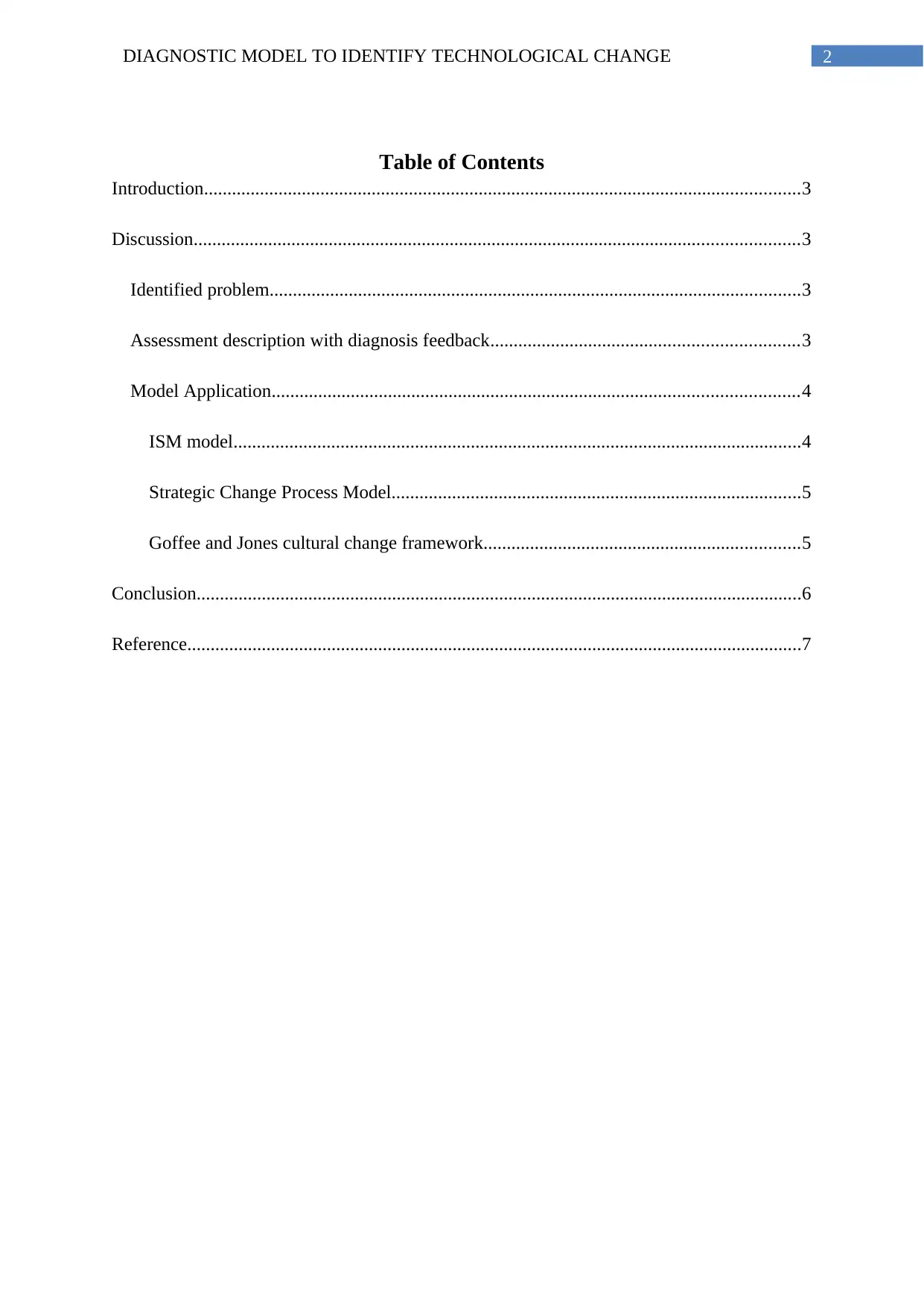
Table of Contents
Introduction................................................................................................................................3
Discussion..................................................................................................................................3
Identified problem..................................................................................................................3
Assessment description with diagnosis feedback..................................................................3
Model Application.................................................................................................................4
ISM model..........................................................................................................................4
Strategic Change Process Model........................................................................................5
Goffee and Jones cultural change framework....................................................................5
Conclusion..................................................................................................................................6
Reference....................................................................................................................................7
Document Page
3DIAGNOSTIC MODEL TO IDENTIFY TECHNOLOGICAL CHANGE
Introduction
Change is the only prominence in every aspect of life, especially in the world of
music. Competitors and the audience taste change so drastically that a musician needs to
upgrade their zone of expertise every now and then along with the technology (Burgess,
2015). However, this can be risky at times as there are many factors working behind the
change management of an artiste. This would be identified in the following report with a
diagnosis feedback and the diagnostic models used for conducting the assessment.
Discussion
Identified problem
Miles Davis was the musical persona everybody would look up to in the early 1959
(Jarrett, 2016). Being a trumpeter specialized in Jazz music, he created the most complex
incredibly successful albums Milestones, Miles Ahead, Round About Midnight and many
more. However, the music he created were so complex that there was not any scope of
deriving any more complex music from it, therefore limiting the area to create variations in
synchronization with the ever-changing world of music. His technical abilities were of top-
notch. That is why he was the most celebrated musician of his time, but he himself was on the
road to redeem himself in creating innovative music so that he could upgrade himself with
the changing ears of the audience.
Assessment description with diagnosis feedback
The main problem was caused when musical world was constantly upgrading itself
from jazz right from when Davis was on the way to find out a way to redeem his music by
creating a band. Economics of the people investing in the music business also started to affect
tabler-icon-diamond-filled.svg

Paraphrase This Document

Need a fresh take? Get an instant paraphrase of this document with our AI Paraphraser
Document Page
4DIAGNOSTIC MODEL TO IDENTIFY TECHNOLOGICAL CHANGE
this way. Change was implemented when 78-rpm music storage shifted to vinyl records,
which had the capacity to hold more numbers of songs in a single record rather than the
previous technology of holding just one (Conte, 2017). The new technology also had an
impact on the music arrangers.
As far as the assessment states, frameworks were needed to be implemented right at the
first place including feedback and discussion of the progress so far. To dig deep into
analysing and ending the problems that were about to suspend the change management, three
diagnostic models needed to be put into operation (Bartmanski & Woodward, 2015). These
are:
The ISM Model
The Strategic Change Process Model
The Goffee and Jones cultural change framework model
Model Application
ISM model
The interpretive structural modelling or ISM is an ingrained methodology to identify
relationships amongst specific items, defining a problem or an issue. In the given study, this
could be done by taking a feedback from artistes about the implementation of the new
technology for the improvement of their musical skills (Bartmanski & Woodward, 2015).
This would help in knowing the effectiveness and feasibility of the musical performances.
The way Miles Davis wanted to offer something innovative and new to the world could be
justified with the audience acceptance and criticism ratio.
Document Page
5DIAGNOSTIC MODEL TO IDENTIFY TECHNOLOGICAL CHANGE
Strategic Change Process Model
Change implementation is indeed a positive approach towards the flourishing of a
business, be it technological or cultural. Although it is needed to ensure that every artiste
must believe that change are acceptable to the audience ears, otherwise there would not be a
sustainable quality of music presented (Vulliamy, 2016). Therefore, there needs to be a
theoretical approach towards the change implementation to gain positive results. In this case
applying the Strategic Change Process Model would have helped Davis so that he could
receive feedback from his audience and make changes according to it and also the changing
musical arena. The Strategic Change Process Model has a theoretical approach where the
justification of the project undertaking is described along with the importance, urgency and
vision of the project to implement the change. If all these are maintained then it would be
easier to bridge the gap between an artiste and the audience in the entertainment industry.
Goffee and Jones cultural change framework
Productivity in a project decreases with time when there are internal issues within the
technical and the classical approach of music production. The more neglect the issues face,
the weaker the productivity becomes. These could be characterized by the difference of
opinion within the artistes and the technicians (Santo, 2017). It was essential the Davis need
to think about the characteristic of setting up frameworks to manage and measure the change.
Implementing the Goffee and Jones cultural change framework would be ideal in this matter.
The two aspects that the model depends on is the solidarity and sociability. If represented in a
matrix, there are four components found in this framework. They are, mercenary, fragmented,
networked and communal. Maintaining all these aspects would bring about cultural harmony,
adhering to the cultural diversity in the audience.
Document Page
6DIAGNOSTIC MODEL TO IDENTIFY TECHNOLOGICAL CHANGE
Conclusion
The assessment of the above case clearly points out that renowned trumpeter Miles
Davis was keen on bringing about a change in the musical industry by expanding the ground
and capacity of his own music. However, cultural diversity within the audience had made it
quite difficult to implement any positive change along with the implementation of newest
technology to store the recorded songs. Nevertheless, it could be concluded that by
implementing the three diagnostic models, like, the ISM model, the Strategic Change Process
Model, and Goffee and Jones cultural change framework, the problems can be eradicated.
tabler-icon-diamond-filled.svg

Paraphrase This Document

Need a fresh take? Get an instant paraphrase of this document with our AI Paraphraser
Document Page
7DIAGNOSTIC MODEL TO IDENTIFY TECHNOLOGICAL CHANGE
Reference
Jarrett, M. (2016). Pressed for All Time: Producing the Great Jazz Albums from Louis
Armstrong and Billie Holiday to Miles Davis and Diana Krall. UNC Press Books.
Burgess, R. J. (2015). Structural change in the music industry: the evolving role of the
musician (Doctoral dissertation, University of Glamorgan).
Conte, G. A. (2017). Waiting on the (Music) World to Change: Licensing in the Digital Age
of Music. Brook. L. Rev., 83, 323.
Santo, C. A. (2017). Orchestrating Community Change through Music and Heritage:
Soulsville USA. In Handbook of Research on the Facilitation of Civic Engagement
through Community Art (pp. 455-475). IGI Global.
Vulliamy, G. (2016). Jazz & Blues (Vol. 4). Routledge.
Bartmanski, D., & Woodward, I. (2015). The vinyl: The analogue medium in the age of
digital reproduction. Journal of consumer culture, 15(1), 3-27.
chevron_up_icon
1 out of 8
circle_padding
hide_on_mobile
zoom_out_icon
[object Object]