Comparative Analysis: Healthcare Systems of India and Canada

Verified

Added on  2022/08/13

|5
|1186
|33
Essay
AI Summary
This essay provides a comparative analysis of the healthcare systems in India and Canada, focusing on both medical and non-medical features. The essay defines medical features as encompassing primary care, treatment, and quality monitoring, while non-medical features include accessibility, funding, and government involvement. The comparison highlights differences in regulatory frameworks, compliance with medical standards, and the presence of community-based care models. The essay contrasts the two-tier system in India with the single-payer system in Canada, discussing the impact of government funding and policy on accessibility and service quality. The conclusion emphasizes the importance of considering both medical and non-medical aspects for comprehensive healthcare, and it highlights the implications of these differences on patient outcomes, such as mortality rates and hospital stays related to clinical errors. References are provided to support the analysis.

Document Page
Running head: DIFFERENCE BETWEEN HEALTH CARE SYSTEMS
DIFFERENCE BETWEEN HEALTH CARE SYSTEMS
Name of the student:
Name of the university:
Author note:
tabler-icon-diamond-filled.svg

Paraphrase This Document

Need a fresh take? Get an instant paraphrase of this document with our AI Paraphraser
Document Page
1DIFFERENCE BETWEEN HEALTH CARE SYSTEMS
Introduction:
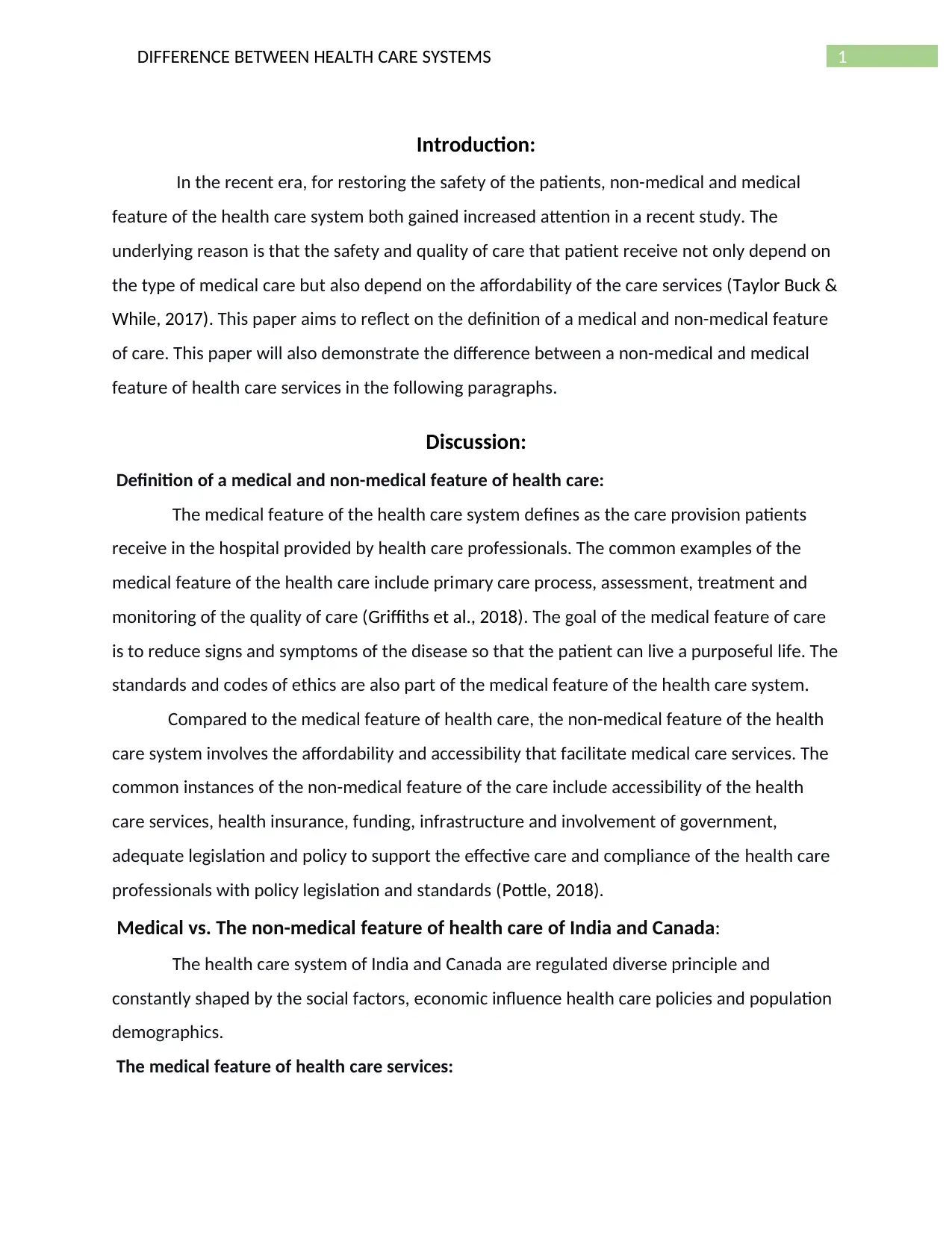
In the recent era, for restoring the safety of the patients, non-medical and medical
feature of the health care system both gained increased attention in a recent study. The
underlying reason is that the safety and quality of care that patient receive not only depend on
the type of medical care but also depend on the affordability of the care services (Taylor Buck &
While, 2017). This paper aims to reflect on the definition of a medical and non-medical feature
of care. This paper will also demonstrate the difference between a non-medical and medical
feature of health care services in the following paragraphs.
Discussion:
Definition of a medical and non-medical feature of health care:
The medical feature of the health care system defines as the care provision patients
receive in the hospital provided by health care professionals. The common examples of the
medical feature of the health care include primary care process, assessment, treatment and
monitoring of the quality of care (Griffiths et al., 2018). The goal of the medical feature of care
is to reduce signs and symptoms of the disease so that the patient can live a purposeful life. The
standards and codes of ethics are also part of the medical feature of the health care system.
Compared to the medical feature of health care, the non-medical feature of the health
care system involves the affordability and accessibility that facilitate medical care services. The
common instances of the non-medical feature of the care include accessibility of the health
care services, health insurance, funding, infrastructure and involvement of government,
adequate legislation and policy to support the effective care and compliance of the health care
professionals with policy legislation and standards (Pottle, 2018).
Medical vs. The non-medical feature of health care of India and Canada:
The health care system of India and Canada are regulated diverse principle and
constantly shaped by the social factors, economic influence health care policies and population
demographics.
The medical feature of health care services:
Document Page
2DIFFERENCE BETWEEN HEALTH CARE SYSTEMS
Monitoring and controlling the quality of care is involved in regulation of health care.
The Canadian health care system has a comprehensive regulation and monitoring of the quality
of care that patients that enable health care professionals and management to identify and
mitigate clinical errors. On the other hand, compared to the Canadian health care system, the
Indian health care system has less comprehensive monitoring and regulation that hindered the
immediate mitigation of clinical errors (Agarwal et al., 2013). The health care professionals in
Canada are high compliance of the medical standard that support the safety of the patient,
unlike the Indian health care system where lack of maintenance is highly prevalent. In Indian
health care, community-based health care model is absent for supporting active ageing of the
older population unlike the health care system of Canada where community-based health care
model is present to support active ageing (Agarwal et al., 2013). Consequent, mortality rate and
hospital stays associated with clinical errors are higher in the Indian medical system compared
to the Canadian medical system.
The non-medical feature of care:
Public health care services are financing mechanisms are regulated by government and
policy-based infrastructure in both countries. However, unlike the Canadian health care system
where government mostly fund the health care services, it is an out of pocket expenditure and
a challenge for the Indian Healthcare system. The underlying reason can be the Indian health
care system is two tiers whereas the Canadian health care system is two tiers. The Canadian
health care system is primarily public in nature, unlike Indian health care system.
Consequently, Indian health care system experience lack of accessibility due to high
expenditure and Canadian experience lack of accessibility due to increased time (Martin et al.
2018). However, due to government involvement and extensive policy implementations, the
service quality of the Canadian health care system is significantly improved compared to health
care services. The Indian health care system has poor infrastructure due to less involvement of
government, unlike the Canadian health care system where government involvement is higher
(Dang & Manjunath, 2016).
Document Page
3DIFFERENCE BETWEEN HEALTH CARE SYSTEMS
Conclusion:
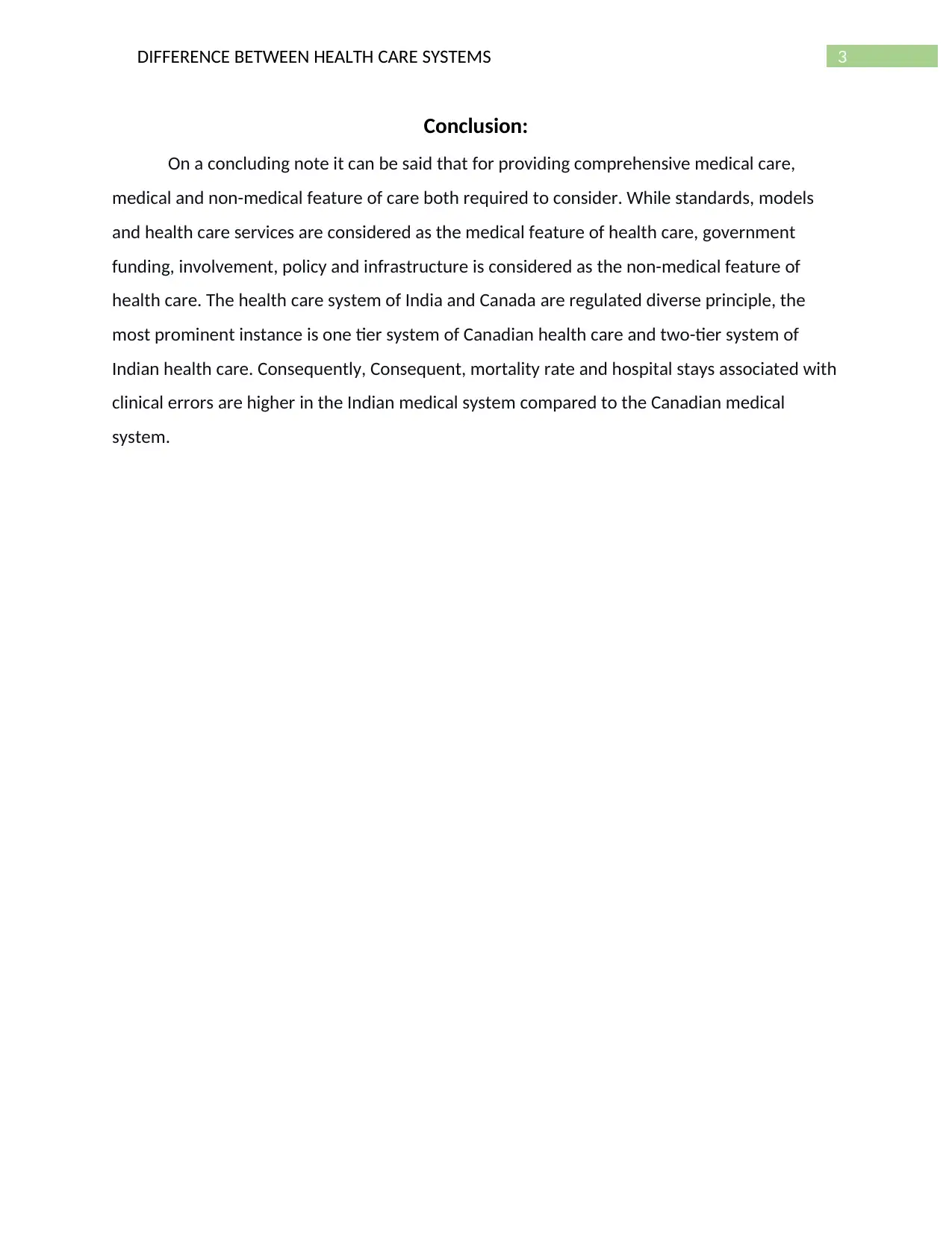
On a concluding note it can be said that for providing comprehensive medical care,
medical and non-medical feature of care both required to consider. While standards, models
and health care services are considered as the medical feature of health care, government
funding, involvement, policy and infrastructure is considered as the non-medical feature of
health care. The health care system of India and Canada are regulated diverse principle, the
most prominent instance is one tier system of Canadian health care and two-tier system of
Indian health care. Consequently, Consequent, mortality rate and hospital stays associated with
clinical errors are higher in the Indian medical system compared to the Canadian medical
system.
tabler-icon-diamond-filled.svg

Paraphrase This Document

Need a fresh take? Get an instant paraphrase of this document with our AI Paraphraser
Document Page
4DIFFERENCE BETWEEN HEALTH CARE SYSTEMS
References:
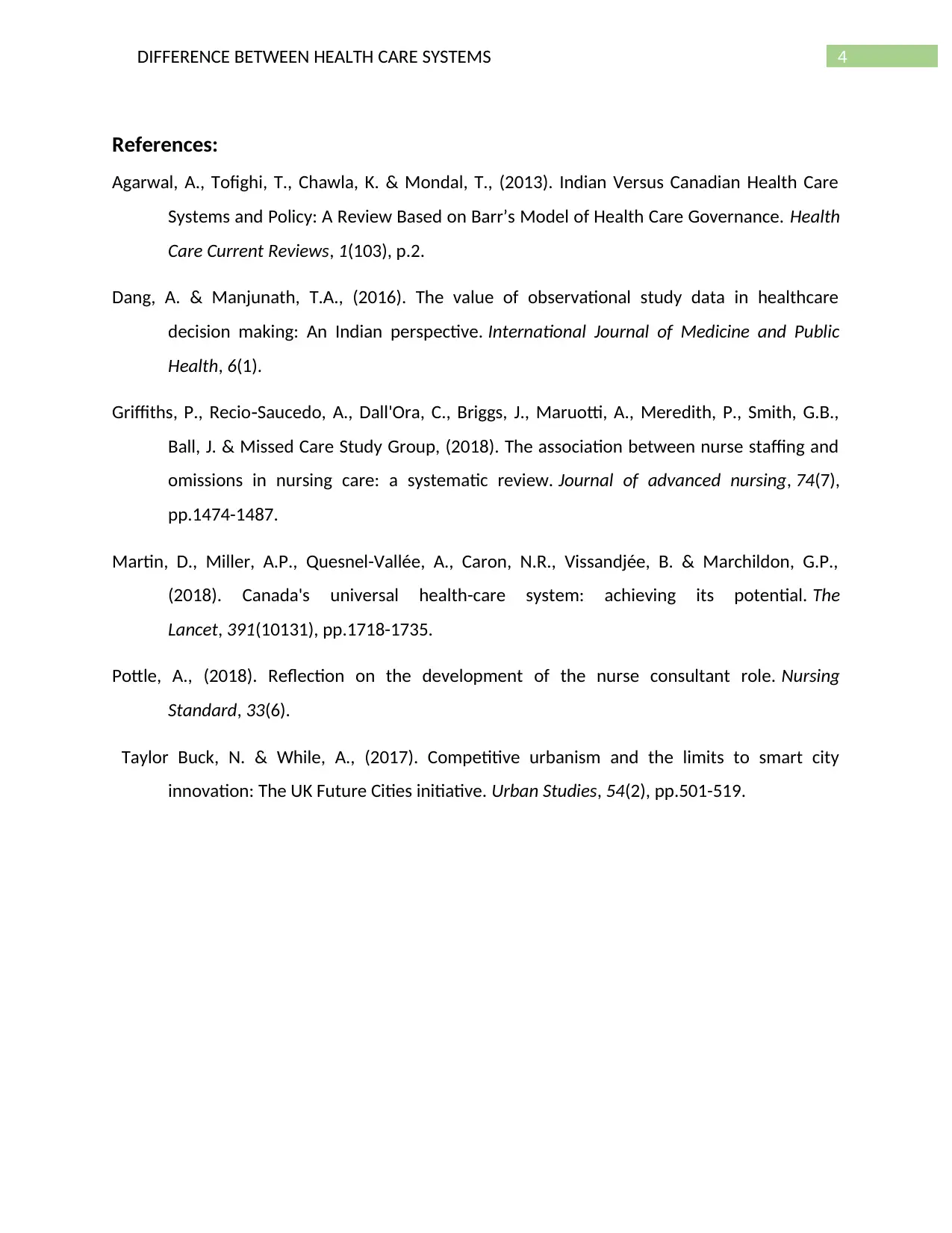
Agarwal, A., Tofighi, T., Chawla, K. & Mondal, T., (2013). Indian Versus Canadian Health Care
Systems and Policy: A Review Based on Barr’s Model of Health Care Governance. Health
Care Current Reviews, 1(103), p.2.
Dang, A. & Manjunath, T.A., (2016). The value of observational study data in healthcare
decision making: An Indian perspective. International Journal of Medicine and Public
Health, 6(1).
Griffiths, P., Recio Saucedo, A., Dall'Ora, C., Briggs, J., Maruotti, A., Meredith, P., Smith, G.B.,
Ball, J. & Missed Care Study Group, (2018). The association between nurse staffing and
omissions in nursing care: a systematic review. Journal of advanced nursing, 74(7),
pp.1474-1487.
Martin, D., Miller, A.P., Quesnel-Vallée, A., Caron, N.R., Vissandjée, B. & Marchildon, G.P.,
(2018). Canada's universal health-care system: achieving its potential. The
Lancet, 391(10131), pp.1718-1735.
Pottle, A., (2018). Reflection on the development of the nurse consultant role. Nursing
Standard, 33(6).
Taylor Buck, N. & While, A., (2017). Competitive urbanism and the limits to smart city
innovation: The UK Future Cities initiative. Urban Studies, 54(2), pp.501-519.
chevron_up_icon
1 out of 5
circle_padding
hide_on_mobile
zoom_out_icon
[object Object]