Analysis of Simple Reaction Time in Young vs. Old Adults

Verified

Added on  2023/01/06

|1
|371
|64
Report
AI Summary
This report presents a study comparing the simple reaction times (SRT) of young and older adults. The research involved 100 participants, with 50 in each age group (18-50 years). A z-test was used to analyze the quantitative data, revealing mean values and variances for both groups. The findings indicate that younger adults generally exhibit shorter SRTs compared to older adults, supporting the hypothesis that age influences reaction time. The study also highlights the importance of considering individual variability and other factors, such as strength, intellect, and motor reflexes, when interpreting SRT results. The study references Hodgkins (2013) to provide context for the research. The results of this study are presented in a concise manner with a focus on the statistical analysis of the data. The study provides valuable insights into age-related differences in cognitive and motor function.
Document Page
Difference in Simple Reaction Time of Young versus Old
Adults Paper
Abstract
The degree of visual
reaction time is practiced
to assess the processing
levels of cognitive system
as well as, dexterity
between motor and
sensory structures in an
organism.
The present investigation
involve the 160
respondents where, 100
people were comes under
the age among 18 and 50
years. Furthermore, 50
male and 50 female adults
as well as, information
have been elaborated on
recommended hypothesis.
Introduction
Investigation indicate that
shorter reaction times could
be inductive of more feasible
outcome.
However, only in association
with other factors such as
strength, intellect as well as,
motor reflexes. Hence, the aim
of this research is to assess
the impact of age on an
individual’s simple reaction
time in the context of their
visual stimuli (Hodgkins,
2013).
References
Hodgkins, J. (2013). Reaction Time
and Speed of Movement in Males
and Females of Various Ages Pages.
Journal Research Quarterly, 1(1),
335-343.
Method
Discussion
Results
Inferential Table
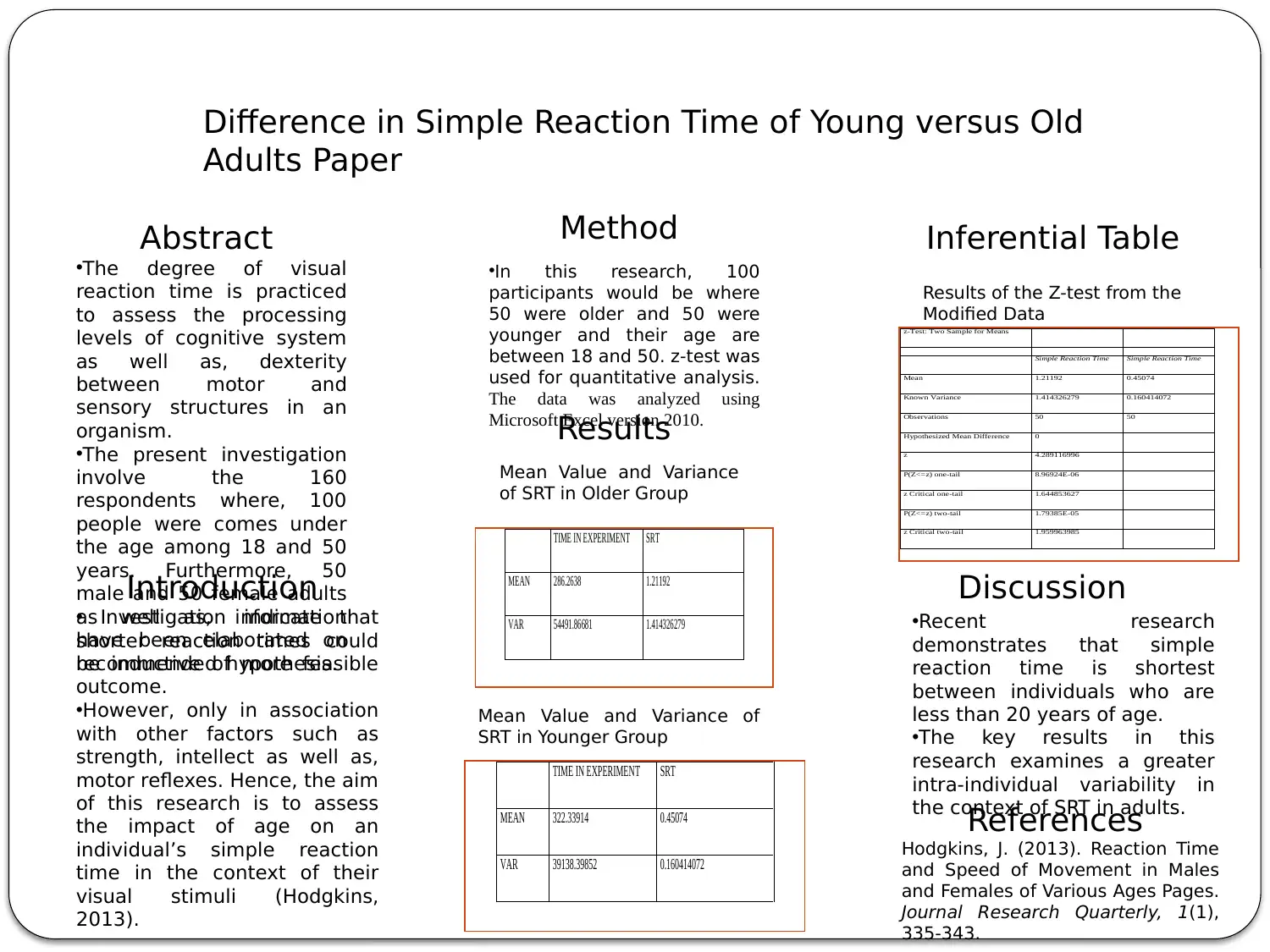
Mean Value and Variance
of SRT in Older Group
Recent research
demonstrates that simple
reaction time is shortest
between individuals who are
less than 20 years of age.
The key results in this
research examines a greater
intra-individual variability in
the context of SRT in adults.
In this research, 100
participants would be where
50 were older and 50 were
younger and their age are
between 18 and 50. z-test was
used for quantitative analysis.
The data was analyzed using
Microsoft Excel version 2010.
z-Test: Two Sample for Means
Simple Reaction Time Simple Reaction Time
Mean 1.21192 0.45074
Known Variance 1.414326279 0.160414072
Observations 50 50
Hypothesized Mean Difference 0
z 4.289116996
P(Z<=z) one-tail 8.96924E-06
z Critical one-tail 1.644853627
P(Z<=z) two-tail 1.79385E-05
z Critical two-tail 1.959963985
TIME IN EXPERIMENT SRT
MEAN 286.2638 1.21192
VAR 54491.86681 1.414326279
Mean Value and Variance of
SRT in Younger Group
TIME IN EXPERIMENT SRT
MEAN 322.33914 0.45074
VAR 39138.39852 0.160414072
Results of the Z-test from the
Modified Data
tabler-icon-diamond-filled.svg

Paraphrase This Document

Need a fresh take? Get an instant paraphrase of this document with our AI Paraphraser
[object Object]