The Sociological Impact: Fear of Crime vs. Actual Crime Rates

Verified

Added on  2022/08/22

|4
|1499
|16
Report
AI Summary
This report delves into the sociological significance of the 'fear of crime,' contrasting it with actual crime rates to understand their differing impacts. The analysis highlights how the perception of crime, influenced by psychological factors and media representation, can be more impactful than the real risk of victimization. Drawing on studies from various regions, including the US, England, and Wales, the report explores the discrepancy between perceived fear and actual crime statistics. The study also examines the emotional and behavioral consequences of the 'fear of crime,' such as reduced community engagement and altered daily routines. The report references several academic sources, including works by Ditton, Farrall, LaGrange, Ferraro, Lewis, and Salem, to support its claims and provide a comprehensive understanding of the subject. It emphasizes the subjective nature of fear, its impact on personal well-being, and its broader implications for societal stability and social change. The report concludes by underscoring the importance of understanding the psychological underpinnings of fear to address its negative effects on individuals and communities.
Document Page
FEAR OF
CRIME
W H Y T H E ‘ F E A R O F C R I M E ’ I S S O M E T I M E S D E S C R I B E D
A S M O R E I M P O R T A N T A N D I M P A C T F U L T H A N ‘ A C T U A L
C R I M E ’ ?
tabler-icon-diamond-filled.svg

Paraphrase This Document

Need a fresh take? Get an instant paraphrase of this document with our AI Paraphraser
Document Page
Fear of Crime” is referred as being the victim of the crime and it is
completely different to the actual probability of “being the victim of the
crime. As per the western culture, the “Fear of Crime” or the “fear of
youth” is referred to as “time immemorial”. It can be observed that “Fear
of Crime” is more noticed within persons who are theoretical minded
while persons who are not much re-focused in handling the “Fear of
Crime” often do not realize this in the elementary stage. It can be noticed
that “Fear of Crime” is mostly present within the persons, who have a fear
to get victimised through the hands of others in some places unknowingly.
The most actual victimization happens with the fear of death.
The study is very interesting because the elaboration is attached to
different psychological concepts and mind-sets of people, who have done
some wrong deeds in the past. On the other hand, the study also elaborates
about the phases that are related to the criminal victimization and the fear,
which can be influenced by other factors as well. It also includes the
general sense of vulnerability, augmentation of social decay as well as
physical decay along with the inter-group conflict. (Ditton and Farrall
2017).
In case of understanding the main concept and
theme of the study, it is understood that fear of
crime is more impactful than that of the risk of
crime because “Fear of Crime” is wholly a
personal thing and outlook and it is also
subjective in nature. The person also feels unique
while experiencing the “Fear of Crime” which is
also influenced by other factors as well. It
conducts some general sense of vulnerabilities,
from where the risk establishes and it also has a
probable effect at the same time frame.
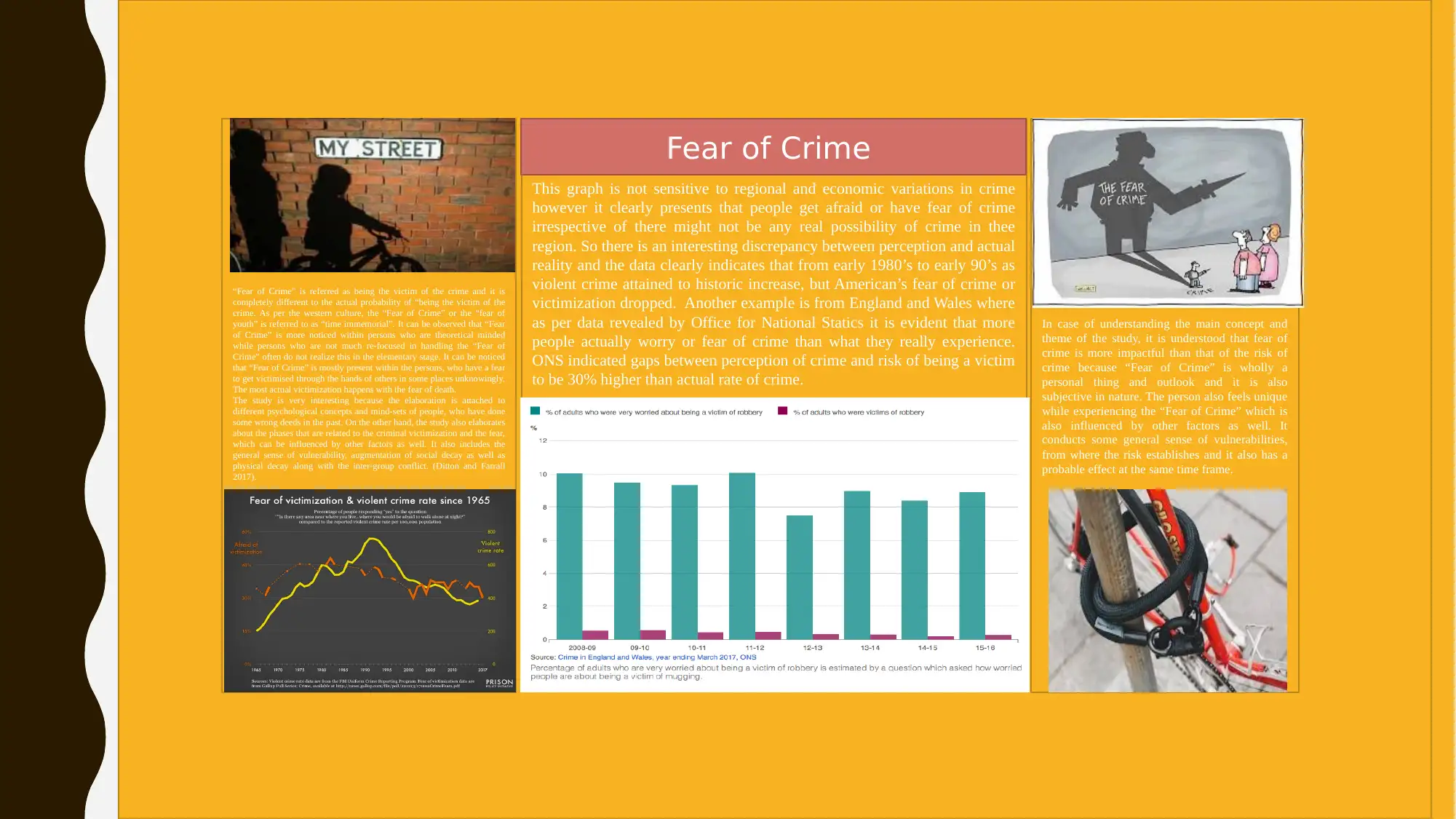
This graph is not sensitive to regional and economic variations in crime
however it clearly presents that people get afraid or have fear of crime
irrespective of there might not be any real possibility of crime in thee
region. So there is an interesting discrepancy between perception and actual
reality and the data clearly indicates that from early 1980’s to early 90’s as
violent crime attained to historic increase, but American’s fear of crime or
victimization dropped. Another example is from England and Wales where
as per data revealed by Office for National Statics it is evident that more
people actually worry or fear of crime than what they really experience.
ONS indicated gaps between perception of crime and risk of being a victim
to be 30% higher than actual rate of crime.
Fear of Crime
Document Page
W H Y T H E ‘ F E A R O F C R I M E ’ I S S O M E T I M E S D E S C R I B E D A S M O R E I M P O RTA N T A N D
I M PA C T F U L T H A N ‘ A C T U A L C R I M E ’ ?
"Fear of Crime" is referred to as being the victim of crime and it is completely different to the actual probability of "being the victim of the crime. As per the western
culture, the “Fear of Crime” or the “fear of youth” is referred to as “time immemorial”. It can be observed that “Fear of Crime” is more noticed amongst persons who are
theoretical minded and those who are not much re-focused in handling the “Fear of Crime” as they do not realize it in the basic stage. It can be noticed that “Fear of
Crime” is mostly present within the persons, who have a fear to get victimised from the hands of others in some places unknowingly. The most actual victimization
happens with the fear of death.
The study is very interesting because the elaboration is attached to different psychological concepts and mind-sets of people, who have done some wrong deeds in the
past. On the other hand, the study also elaborates about the phases that are related to criminal victimization and the fear, which can be influenced by other factors as
well. It also includes the general sense of vulnerability, augmentation of social decay as well as physical decay along with the inter-group conflict (Ditton and Farrall
2017).
In case of understanding the main concept and theme of the study, it is understood that fear of crime is more impactful than that of the risk of crime because “Fear of
Crime” is wholly a personal thing and perception and is also subjective. The person also feels unique while experiencing the “Fear of Crime” which are also influenced by
other factors. It conducts some general sense of vulnerabilities, from where the risk establishes and it also has a probable effect at the same time frame.
Rational of the concept
It can be observed that “Fear of Crime” is much more impactful than the "actual instances of the crime", because it includes some of the common and understandable
reactions that are evaluated by many criminologists around the world. However, in the actual risk of crime, the person knows that he is going to be the next victim. This
kind of fear is common in many individuals all over the world however the “Fear of Crime” is very emotional and susceptive. It includes numerous occasions, feelings,
behaviours and thoughts which have several functional and dysfunctional effects and memorandums (Salem and Lewis 2016). It affects the personal balance of life and
well-being at the same time frame. It has mostly the negative aspects as the person is not sure whether they will be killed or not. This situation is the worst for a human
being because this erodes the core health of the individual and they also cannot alter their routine habits and activities due to the “Fear of Crime” in them.
At the same time, the persons who are possessing “Fear of Crime” , do not contribute to the community and also disregard the core neighbourhood stability and routine
activities. It is much more impactful than that of the actual scene and fear of crime because it includes the core psychology of risk perceptions. It also circulates the core
representations and the “risk of victimization”. Moreover, influence of the core “Fear of Crime” also includes some of the psychologies that are attached to the risk
perception which circulates to core representations in “rise of victimization” that are pillared from the mass media and interpersonal communication. It can be noted that
“Fear of Crime” is much more anxious and impactful than the actual fear of crime because the former does not include public perceptions that are based on the
neighbourhood stability and breakdown (LaGrange and Ferraro 2017). These are the broader factors and concepts that are much influenced by the “direction of social
change”. It is attached with the “Fear of Crime” and there are also some important variables which are included within the wider cultural aspects and features. The “Fear
of Crime” is much more inclusive and has more negative aspects because it is ranged with different kinds of emotions that are related to possibilities of victimization.
There are some people who are more outraged and become angry after the assumption of the core prospect of crime and this threatens personal feeling which transpires
them throughout every moment leading to imagination of crime. The phenomenon also includes some of the elements such as “ambient anxiety” that are present within
30% to 50% population of the United Kingdom and Wales (Lewis and Salem 2017).
Document Page
RE FE RE NCE S
Ditton, J. and Farrall, S. eds., (2017). The fear of crime. Routledge.
LaGrange, R.L. and Ferraro, K.F., (2017). The elderly’s fear of crime: A critical
examination of the research. In The fear of crime (pp. 77-96). Routledge.
Lewis, D.A. and Salem, G.W., (2017). Fear of crime. Transaction Publishers.
Salem, G.W. and Lewis, D.A., (2016). Fear of crime: Incivility and the production
of a social problem. Transaction Publishers.
chevron_up_icon
1 out of 4
circle_padding
hide_on_mobile
zoom_out_icon
[object Object]