Case Studies: Application of Differential Reinforcement Procedures
VerifiedAdded on 2023/06/11
|9
|1707
|444
Essay
AI Summary
This essay provides a detailed analysis of differential reinforcement procedures applied in various case studies. It examines the use of Differential Reinforcement of Other Behaviors (DRO) for a child with autism, Differential Reinforcement of Incompatible Behaviors (DRI) for an adult with a developmental disorder, and Differential Reinforcement of Lower Rates of Behavior (DRL) for a child with autism and a child with ADHD. Each case study includes a description of the technique, data collection methods, and graphical representations of the results, demonstrating the effectiveness of these behavioral interventions in reducing undesirable behaviors and promoting positive outcomes. The essay highlights the importance of tailored reinforcement strategies in addressing specific behavioral challenges.
Running head: DIFFERENTIAL REINFORCEMENT PROCEDURE 1
Differential Reinforcement Procedure
Name
Institutional Affiliation
Differential Reinforcement Procedure
Name
Institutional Affiliation

Paraphrase This Document
Need a fresh take? Get an instant paraphrase of this document with our AI Paraphraser
DIFFERENTIAL REINFORCEMENT PROCEDURE 2
Case 1
Jack is definitely suffering from autism spectrum disorder. Though he can do a lot on his
own, his social skills are obviously underdeveloped (Matson, 2009). The most appropriate
technique to implement is Differential Reinforcement of Other Behaviors (DRO) (O'Donohue &
Fisher, 2009). Under this technique, a student is reinforced (rewarded) for each time that a
behavior that is not desirable is not displayed within a designated time period. Jack who has a
habit of kicking other students every 70 seconds will be differentially reinforced if he does not
display the behavior within the 70 seconds time period. However, the approach is of a positive
nature and the teacher is not to induce any kind of punishment.
Data is to be collected by direct observation of jack’s behavior pattern. The teacher
should clearly spell out to Jack the kind of reward that he is to receive as the first way to induce
behavior change. Frequency count is to be conducted to figure out whether introduction of a
reward is reducing the occurrence of the behavior. The reward will be based on a pre-set time
interval that jack must be able to withhold the undesirable behavior of kicking and hitting other
students. If the behavior prevails within the designated time period, it will signify the
commencement of another interval. Due to Jack’s small age, the teacher would consider
restraining the behavior e.g. by holding his hands and/or legs while telling him not to kick or hit
other children.
He should also be allowed sufficient time on the trampoline to ease his state. The above
procedure should be able to reduce his kicking intervals gradually from every 70 seconds to 3
minutes, 10 minutes and so on until the behavior is completely eradicated.
Case 1
Jack is definitely suffering from autism spectrum disorder. Though he can do a lot on his
own, his social skills are obviously underdeveloped (Matson, 2009). The most appropriate
technique to implement is Differential Reinforcement of Other Behaviors (DRO) (O'Donohue &
Fisher, 2009). Under this technique, a student is reinforced (rewarded) for each time that a
behavior that is not desirable is not displayed within a designated time period. Jack who has a
habit of kicking other students every 70 seconds will be differentially reinforced if he does not
display the behavior within the 70 seconds time period. However, the approach is of a positive
nature and the teacher is not to induce any kind of punishment.
Data is to be collected by direct observation of jack’s behavior pattern. The teacher
should clearly spell out to Jack the kind of reward that he is to receive as the first way to induce
behavior change. Frequency count is to be conducted to figure out whether introduction of a
reward is reducing the occurrence of the behavior. The reward will be based on a pre-set time
interval that jack must be able to withhold the undesirable behavior of kicking and hitting other
students. If the behavior prevails within the designated time period, it will signify the
commencement of another interval. Due to Jack’s small age, the teacher would consider
restraining the behavior e.g. by holding his hands and/or legs while telling him not to kick or hit
other children.
He should also be allowed sufficient time on the trampoline to ease his state. The above
procedure should be able to reduce his kicking intervals gradually from every 70 seconds to 3
minutes, 10 minutes and so on until the behavior is completely eradicated.
DIFFERENTIAL REINFORCEMENT PROCEDURE 3
0 - 10 011 - 20 21 - 30 31 - 40 41 - 50 51 - 60
0
1
2
3
4
5
6
7
8
9
10
Frequency of undesirable behavior.
Frequency of undesirable behavior.
Time intervals of 10 mins
No of occurences of the undesirable behavior.
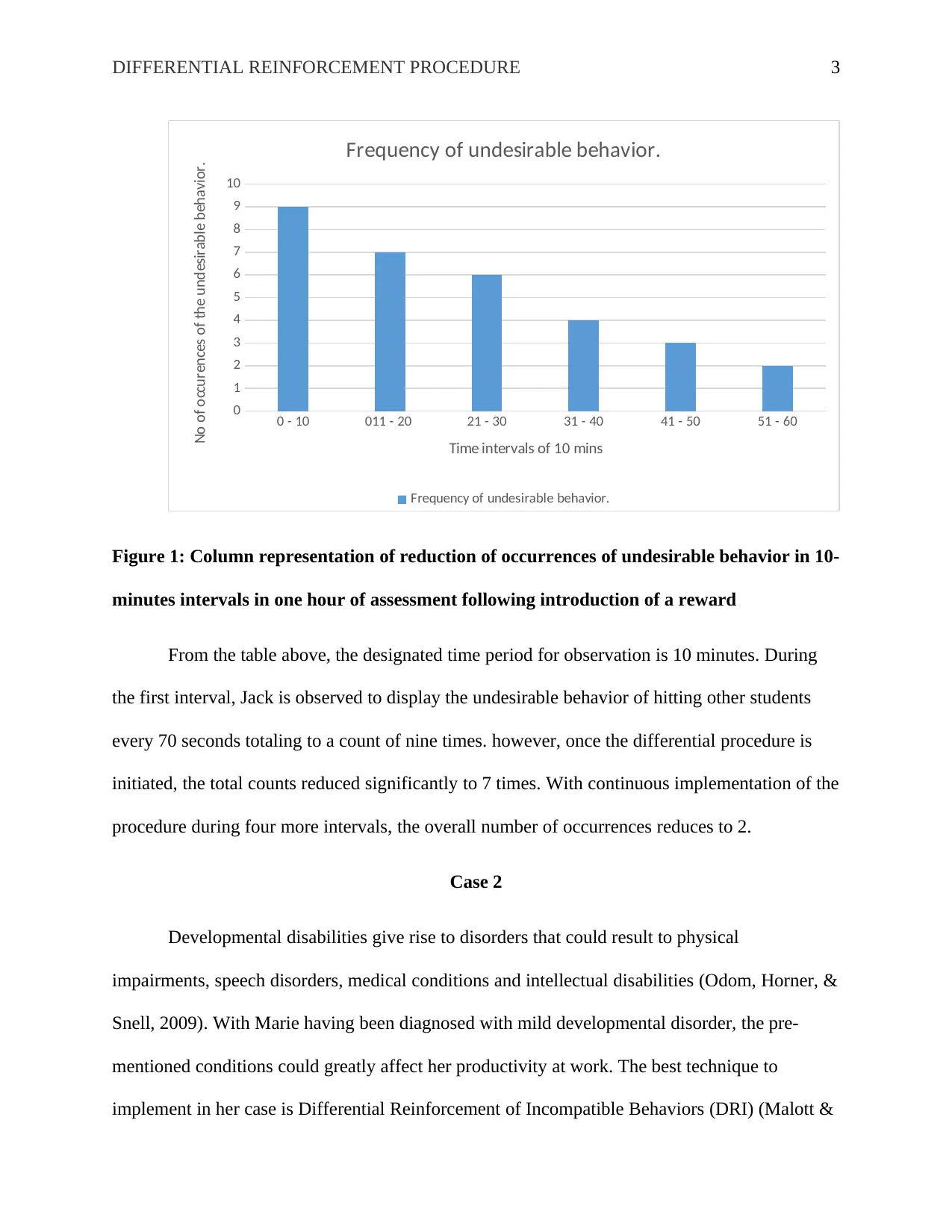
Figure 1: Column representation of reduction of occurrences of undesirable behavior in 10-
minutes intervals in one hour of assessment following introduction of a reward
From the table above, the designated time period for observation is 10 minutes. During
the first interval, Jack is observed to display the undesirable behavior of hitting other students
every 70 seconds totaling to a count of nine times. however, once the differential procedure is
initiated, the total counts reduced significantly to 7 times. With continuous implementation of the
procedure during four more intervals, the overall number of occurrences reduces to 2.
Case 2
Developmental disabilities give rise to disorders that could result to physical
impairments, speech disorders, medical conditions and intellectual disabilities (Odom, Horner, &
Snell, 2009). With Marie having been diagnosed with mild developmental disorder, the pre-
mentioned conditions could greatly affect her productivity at work. The best technique to
implement in her case is Differential Reinforcement of Incompatible Behaviors (DRI) (Malott &
0 - 10 011 - 20 21 - 30 31 - 40 41 - 50 51 - 60
0
1
2
3
4
5
6
7
8
9
10
Frequency of undesirable behavior.
Frequency of undesirable behavior.
Time intervals of 10 mins
No of occurences of the undesirable behavior.
Figure 1: Column representation of reduction of occurrences of undesirable behavior in 10-
minutes intervals in one hour of assessment following introduction of a reward
From the table above, the designated time period for observation is 10 minutes. During
the first interval, Jack is observed to display the undesirable behavior of hitting other students
every 70 seconds totaling to a count of nine times. however, once the differential procedure is
initiated, the total counts reduced significantly to 7 times. With continuous implementation of the
procedure during four more intervals, the overall number of occurrences reduces to 2.
Case 2
Developmental disabilities give rise to disorders that could result to physical
impairments, speech disorders, medical conditions and intellectual disabilities (Odom, Horner, &
Snell, 2009). With Marie having been diagnosed with mild developmental disorder, the pre-
mentioned conditions could greatly affect her productivity at work. The best technique to
implement in her case is Differential Reinforcement of Incompatible Behaviors (DRI) (Malott &
⊘ This is a preview!⊘
Do you want full access?
Subscribe today to unlock all pages.

Trusted by 1+ million students worldwide
DIFFERENTIAL REINFORCEMENT PROCEDURE 4
Shane, 2015). Here, the better and desirable behavior is reinforced in attempt to curb the
undesirable behavior. Previously, Marie was achieving the desirable production rates until
recently that her rates dropped significantly bringing about negative implications.
Rather than punishing her for reduced number of assembled items, Marie could be
rewarded for achieving a set target of the number of items she ought to assemble per day. Data is
to be collected by taking count of the number of items that she is currently assembling. A target
is then to be set on the number expected of her and the same clearly communicated to her. She is
also to be notified on the reward she is to receive for hitting the target. The best reinforcement
could be receiving a 10% increment of her total dues on hitting the target. This will be enough
motivation for her to hit the target.
Assuming she had been previously assembling 30 items per day and later dropped to the
current number which could be 18, a target of 27 items could be set and could be easily achieved
with provision of the reinforcement mentioned above.
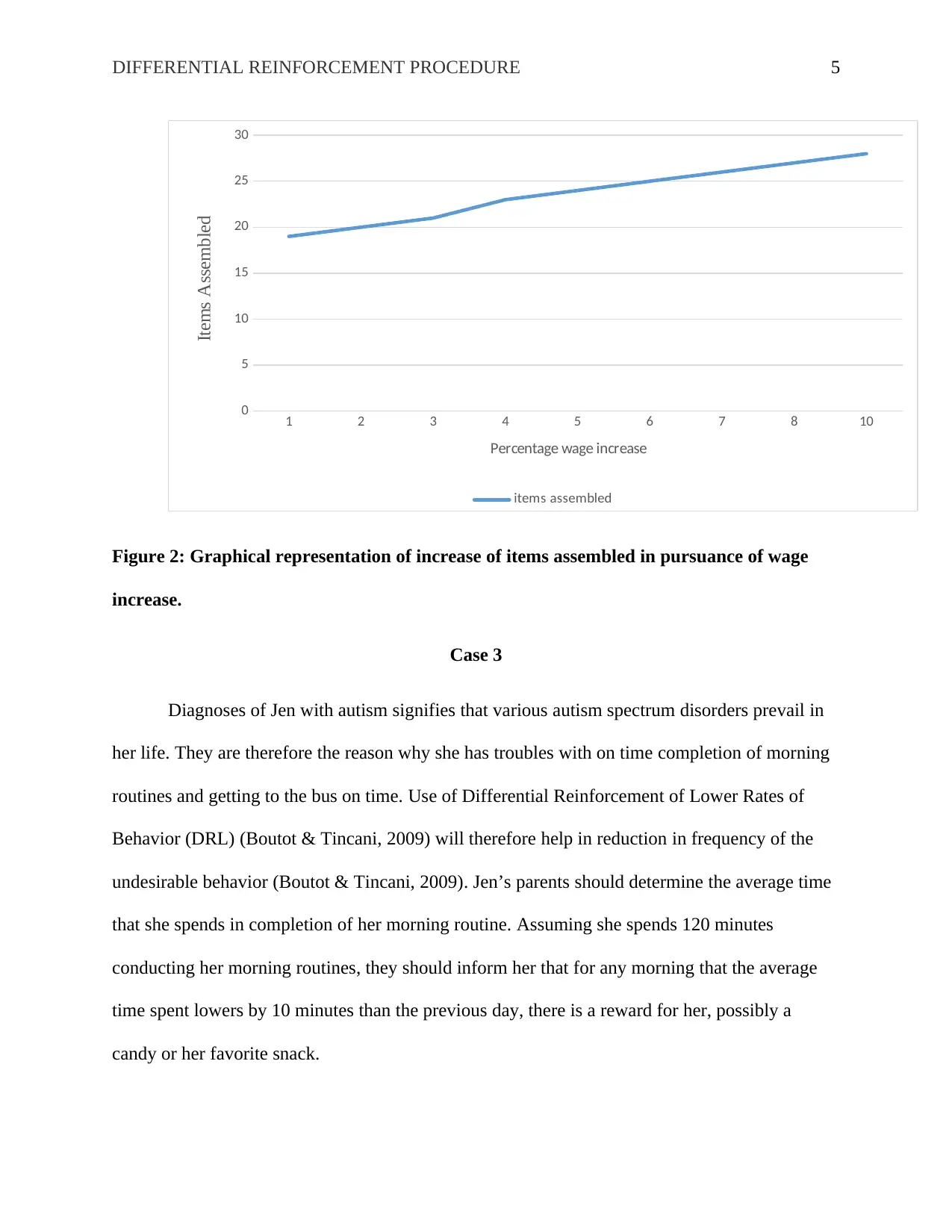
In the graph below, it is to be noted that initially, a 1%wage increase was implemented on
Marie’s wage and she was able to raise the number of items that she assembled by 1. As the
process is continuously repeated, with the percentage increment going up to 10%, she able to hit
the target of 28 items set for her.
Shane, 2015). Here, the better and desirable behavior is reinforced in attempt to curb the
undesirable behavior. Previously, Marie was achieving the desirable production rates until
recently that her rates dropped significantly bringing about negative implications.
Rather than punishing her for reduced number of assembled items, Marie could be
rewarded for achieving a set target of the number of items she ought to assemble per day. Data is
to be collected by taking count of the number of items that she is currently assembling. A target
is then to be set on the number expected of her and the same clearly communicated to her. She is
also to be notified on the reward she is to receive for hitting the target. The best reinforcement
could be receiving a 10% increment of her total dues on hitting the target. This will be enough
motivation for her to hit the target.
Assuming she had been previously assembling 30 items per day and later dropped to the
current number which could be 18, a target of 27 items could be set and could be easily achieved
with provision of the reinforcement mentioned above.
In the graph below, it is to be noted that initially, a 1%wage increase was implemented on
Marie’s wage and she was able to raise the number of items that she assembled by 1. As the
process is continuously repeated, with the percentage increment going up to 10%, she able to hit
the target of 28 items set for her.
Paraphrase This Document
Need a fresh take? Get an instant paraphrase of this document with our AI Paraphraser
DIFFERENTIAL REINFORCEMENT PROCEDURE 5
1 2 3 4 5 6 7 8 10
0
5
10
15
20
25
30
items assembled
Percentage wage increase
Items Assembled
Figure 2: Graphical representation of increase of items assembled in pursuance of wage
increase.
Case 3
Diagnoses of Jen with autism signifies that various autism spectrum disorders prevail in
her life. They are therefore the reason why she has troubles with on time completion of morning
routines and getting to the bus on time. Use of Differential Reinforcement of Lower Rates of
Behavior (DRL) (Boutot & Tincani, 2009) will therefore help in reduction in frequency of the
undesirable behavior (Boutot & Tincani, 2009). Jen’s parents should determine the average time
that she spends in completion of her morning routine. Assuming she spends 120 minutes
conducting her morning routines, they should inform her that for any morning that the average
time spent lowers by 10 minutes than the previous day, there is a reward for her, possibly a
candy or her favorite snack.
1 2 3 4 5 6 7 8 10
0
5
10
15
20
25
30
items assembled
Percentage wage increase
Items Assembled
Figure 2: Graphical representation of increase of items assembled in pursuance of wage
increase.
Case 3
Diagnoses of Jen with autism signifies that various autism spectrum disorders prevail in
her life. They are therefore the reason why she has troubles with on time completion of morning
routines and getting to the bus on time. Use of Differential Reinforcement of Lower Rates of
Behavior (DRL) (Boutot & Tincani, 2009) will therefore help in reduction in frequency of the
undesirable behavior (Boutot & Tincani, 2009). Jen’s parents should determine the average time
that she spends in completion of her morning routine. Assuming she spends 120 minutes
conducting her morning routines, they should inform her that for any morning that the average
time spent lowers by 10 minutes than the previous day, there is a reward for her, possibly a
candy or her favorite snack.
DIFFERENTIAL REINFORCEMENT PROCEDURE 6
Jen will definitely perform her routines faster as she desires to receive the reward and this
will gradually raise her speed. With time, she will even be in a position to catch the school bus
and her mother will no longer have to drive to school thus no more interruptions in her work
schedules.
1 2 3 4 5 6 7 8
0
20
40
60
80
100
120
140
Time spent
Time spent
Days
Time spent in minutes
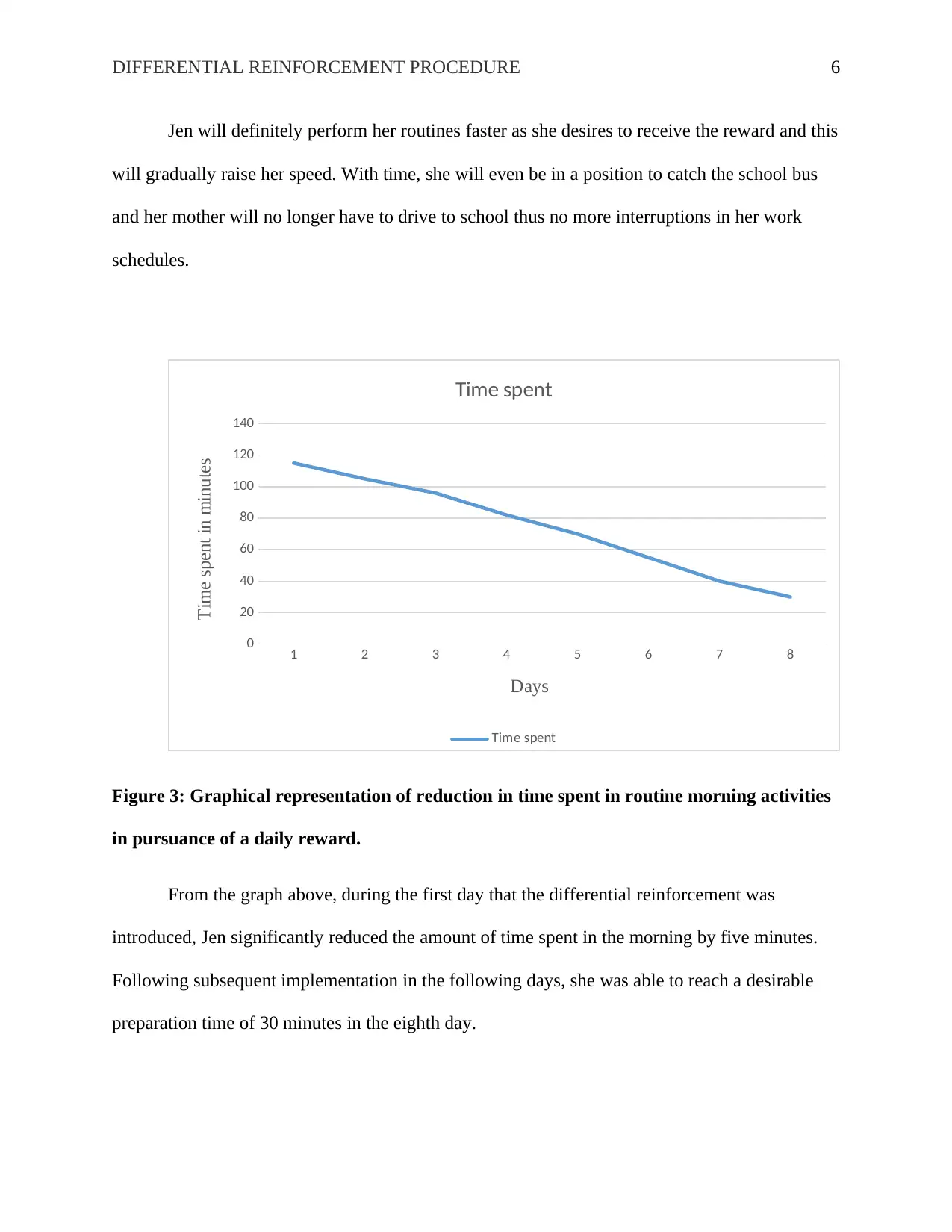
Figure 3: Graphical representation of reduction in time spent in routine morning activities
in pursuance of a daily reward.
From the graph above, during the first day that the differential reinforcement was
introduced, Jen significantly reduced the amount of time spent in the morning by five minutes.
Following subsequent implementation in the following days, she was able to reach a desirable
preparation time of 30 minutes in the eighth day.
Jen will definitely perform her routines faster as she desires to receive the reward and this
will gradually raise her speed. With time, she will even be in a position to catch the school bus
and her mother will no longer have to drive to school thus no more interruptions in her work
schedules.
1 2 3 4 5 6 7 8
0
20
40
60
80
100
120
140
Time spent
Time spent
Days
Time spent in minutes
Figure 3: Graphical representation of reduction in time spent in routine morning activities
in pursuance of a daily reward.
From the graph above, during the first day that the differential reinforcement was
introduced, Jen significantly reduced the amount of time spent in the morning by five minutes.
Following subsequent implementation in the following days, she was able to reach a desirable
preparation time of 30 minutes in the eighth day.
⊘ This is a preview!⊘
Do you want full access?
Subscribe today to unlock all pages.
Trusted by 1+ million students worldwide
DIFFERENTIAL REINFORCEMENT PROCEDURE 7
Case 4
Attention Deficit Hyperactivity Disorder is a brain malfunctioning condition that is
characterized by recurrent patterns of poor attention, hyperactivity and impulsivity (Millichap,
2009) as evident in Tom. Due to the high frequency of undesirable behavior, the best technique
to implement to reduce the frequency of such behavior would be Differential Reinforcement of
Lower Rates of Behavior (DRL) (Boutot & Tincani, 2009). The member of IEP team in charge
of Tom should inform him of the number of times per hour that he calls out in class without the
teacher’s permission, 15 to be precise.
Data is to be collected by direct observation and count of the frequency of the undesirable
behavior. Tom should then be informed that for each hour he reduces the frequency of the
behavior by 1, a reward is to be presented to him. Whenever Tom hits the mentioned target, the
promised reinforcement should be availed and then proceed by lowering the allowable frequency
of the incidents until the team hits an acceptable level. The reward could be a biscuit, candy or
any snack observed as Tom’s favorite.
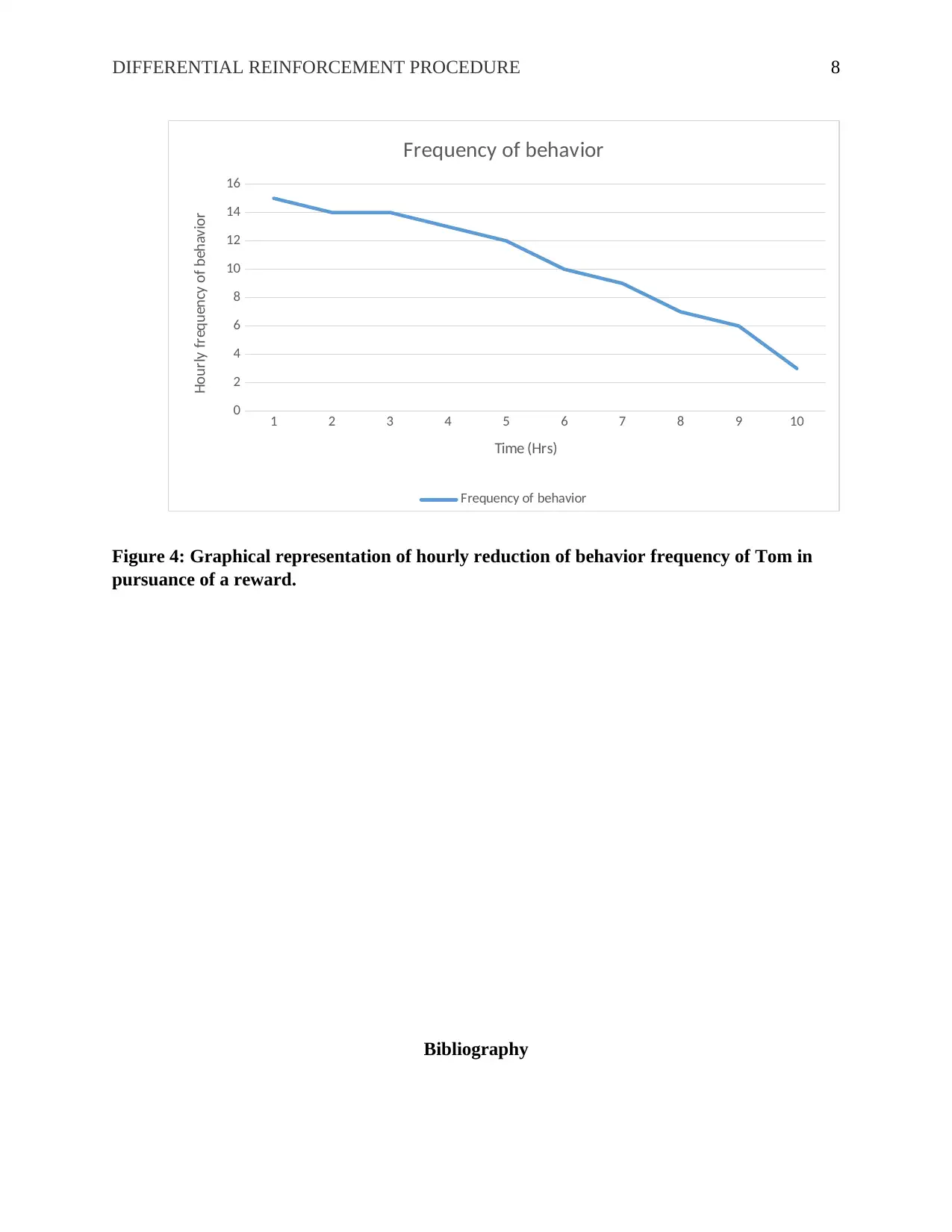
It is from the graph below that the results of implementing the differential reinforcement
mentioned can be visualized. Initially, Tom displayed the undesirable behavior 15 times per
hour. Following introduction of a reward, the frequency goes down to three time per hour in the
10th hour thus showing the effectiveness of this procedure.
Case 4
Attention Deficit Hyperactivity Disorder is a brain malfunctioning condition that is
characterized by recurrent patterns of poor attention, hyperactivity and impulsivity (Millichap,
2009) as evident in Tom. Due to the high frequency of undesirable behavior, the best technique
to implement to reduce the frequency of such behavior would be Differential Reinforcement of
Lower Rates of Behavior (DRL) (Boutot & Tincani, 2009). The member of IEP team in charge
of Tom should inform him of the number of times per hour that he calls out in class without the
teacher’s permission, 15 to be precise.
Data is to be collected by direct observation and count of the frequency of the undesirable
behavior. Tom should then be informed that for each hour he reduces the frequency of the
behavior by 1, a reward is to be presented to him. Whenever Tom hits the mentioned target, the
promised reinforcement should be availed and then proceed by lowering the allowable frequency
of the incidents until the team hits an acceptable level. The reward could be a biscuit, candy or
any snack observed as Tom’s favorite.
It is from the graph below that the results of implementing the differential reinforcement
mentioned can be visualized. Initially, Tom displayed the undesirable behavior 15 times per
hour. Following introduction of a reward, the frequency goes down to three time per hour in the
10th hour thus showing the effectiveness of this procedure.
Paraphrase This Document
Need a fresh take? Get an instant paraphrase of this document with our AI Paraphraser
DIFFERENTIAL REINFORCEMENT PROCEDURE 8
1 2 3 4 5 6 7 8 9 10
0
2
4
6
8
10
12
14
16
Frequency of behavior
Frequency of behavior
Time (Hrs)
Hourly frequency of behavior
Figure 4: Graphical representation of hourly reduction of behavior frequency of Tom in
pursuance of a reward.
Bibliography
1 2 3 4 5 6 7 8 9 10
0
2
4
6
8
10
12
14
16
Frequency of behavior
Frequency of behavior
Time (Hrs)
Hourly frequency of behavior
Figure 4: Graphical representation of hourly reduction of behavior frequency of Tom in
pursuance of a reward.
Bibliography
DIFFERENTIAL REINFORCEMENT PROCEDURE 9
Boutot, E. A., & Tincani, M. (2009). Autism Encyclopedia: The Complete Guide to Autism
Spectrum Disorders. Sourcebooks, Inc.
Malott, R., & Shane, J. T. (2015). Principles of Behavior: Seventh Edition. Psychology Press.
Matson, J. L. (2009). Applied Behavior Analysis for Children with Autism Spectrum Disorders.
Springer Science & Business Media.
Millichap, J. G. (2009). Attention Deficit Hyperactivity Disorder Handbook: A Physician's
Guide to ADHD (2 ed.). Springer Science & Business Media.
Odom, S. L., Horner, R. H., & Snell, M. E. (2009). Handbook of Developmental Disabilities.
Guilford Press.
O'Donohue, W. T., & Fisher, J. E. (2009). General Principles and Empirically Supported
Techniques of Cognitive Behavior Therapy. John Wiley & Sons.
Boutot, E. A., & Tincani, M. (2009). Autism Encyclopedia: The Complete Guide to Autism
Spectrum Disorders. Sourcebooks, Inc.
Malott, R., & Shane, J. T. (2015). Principles of Behavior: Seventh Edition. Psychology Press.
Matson, J. L. (2009). Applied Behavior Analysis for Children with Autism Spectrum Disorders.
Springer Science & Business Media.
Millichap, J. G. (2009). Attention Deficit Hyperactivity Disorder Handbook: A Physician's
Guide to ADHD (2 ed.). Springer Science & Business Media.
Odom, S. L., Horner, R. H., & Snell, M. E. (2009). Handbook of Developmental Disabilities.
Guilford Press.
O'Donohue, W. T., & Fisher, J. E. (2009). General Principles and Empirically Supported
Techniques of Cognitive Behavior Therapy. John Wiley & Sons.
⊘ This is a preview!⊘
Do you want full access?
Subscribe today to unlock all pages.
Trusted by 1+ million students worldwide

1 out of 9


Your All-in-One AI-Powered Toolkit for Academic Success.
+13062052269
info@desklib.com
Available 24*7 on WhatsApp / Email
![[object Object]](/_next/static/media/star-bottom.7253800d.svg)
Unlock your academic potential
Copyright © 2020–2026 A2Z Services. All Rights Reserved. Developed and managed by ZUCOL.