Digital Disruption Impact: A Case Study of Kodak's Challenges
VerifiedAdded on 2023/06/12
|11
|2338
|492
Case Study
AI Summary
This case study examines the impact of digital disruption on the Kodak Company, once a dominant force in the photographic industry. The analysis uses a work centered analysis (WCA) framework to assess Kodak's situation before and after the digital disruption event. The report identifies the problems Kodak faced due to its failure to adapt to technological advancements, such as the rise of digital cameras. It provides recommendations for how Kodak could have better managed the disruption, including embracing new technologies, reshuffling management, and establishing a dedicated IT department. The report concludes with an implementation plan outlining the roles and responsibilities of the management and IT department in executing the recommendations. The study emphasizes that digital disruption can be positive or negative depending on how a business welcomes new inventions, highlighting that Kodak's attempt to fight new technology led to its decline. Desklib offers a variety of resources to aid students such as past papers and solved assignments.
Surname 1
DIGITAL DISRUPTION
Author name
Tutors name
Course
Date
DIGITAL DISRUPTION
Author name
Tutors name
Course
Date

Paraphrase This Document
Need a fresh take? Get an instant paraphrase of this document with our AI Paraphraser
Surname 2
Abstract
The introductions has two parts. The first part describes the process of digital disruption
while the other part describes the case study which is the Kodak Company.
The body has three sections. Problems, recommendations and implementation. Problems
section describes the implication of digital disruption in the company. Recommendations
describes possible measures to be taken while implementations sections talks about who should
act.
There is the conclusion which gives the summary.
Abstract
The introductions has two parts. The first part describes the process of digital disruption
while the other part describes the case study which is the Kodak Company.
The body has three sections. Problems, recommendations and implementation. Problems
section describes the implication of digital disruption in the company. Recommendations
describes possible measures to be taken while implementations sections talks about who should
act.
There is the conclusion which gives the summary.
Surname 3
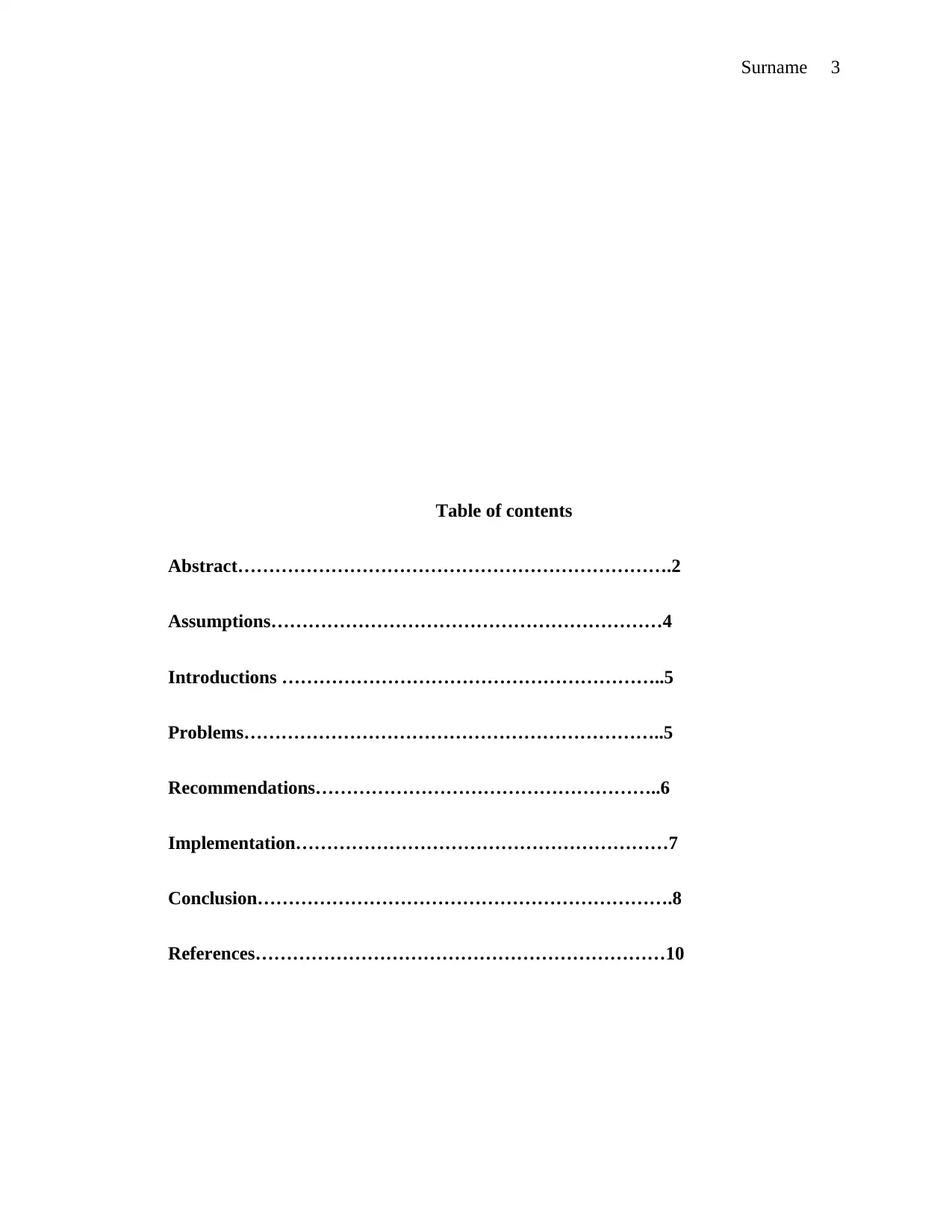
Table of contents
Abstract…………………………………………………………….2
Assumptions………………………………………………………4
Introductions ……………………………………………………..5
Problems…………………………………………………………..5
Recommendations………………………………………………..6
Implementation……………………………………………………7
Conclusion………………………………………………………….8
References…………………………………………………………10
Table of contents
Abstract…………………………………………………………….2
Assumptions………………………………………………………4
Introductions ……………………………………………………..5
Problems…………………………………………………………..5
Recommendations………………………………………………..6
Implementation……………………………………………………7
Conclusion………………………………………………………….8
References…………………………………………………………10
⊘ This is a preview!⊘
Do you want full access?
Subscribe today to unlock all pages.

Trusted by 1+ million students worldwide
Surname 4
Assumptions
The people in management have been there for a long time
The Kodak company ignored advice on new inventions
Abbreviations
WCA: Work centered analysis
Assumptions
The people in management have been there for a long time
The Kodak company ignored advice on new inventions
Abbreviations
WCA: Work centered analysis
Paraphrase This Document
Need a fresh take? Get an instant paraphrase of this document with our AI Paraphraser
Surname 5
Digital Disruption
The world is said to be changing to be a global village (Karimi and Walter, 2015, 80).
The reason behind that statement is the continuous growth of the technological invention in the
world. Every minute, there are great minds somewhere inventing something that different sectors
can use. One of the sectors that has really benefited from the technological invention is the
business sector. Furthermore, that’s why people invent so that they can earn a living and help the
community at large to benefit from the invention. There will be forever inventions nowadays
unlike the old days. Globalization and technology advancements leads to digital disruption.
Digital disruption is the process by which new technologies affect the value of products and
services generated by a certain company. It is a force that can never be stopped no matter what. It
is a factor that is affecting the business nowadays. People are misguided thinking that digital
disruption is negative, they are very wrong. If a business fights digital disruption, that’s the end
of the company but when a business appreciates the trend and revolve together with technology,
then the disruption will act positively to their market. When digital disruption happen, consumers
taste changes hence customers will run to the company that will satisfy their needs.
Case study
The case study is based on the Kodak Company. Sometimes back it was the only and the
leading photographic company in the world but later things changed (Bustamante, 2014, 820).
The company enjoyed the merit of monopoly in the 20th century. It is clear that in the 20th century
and during the company establishment, technology was way low compared to the recent decade.
The Kodak company main products were filming, producing image frames, making of camera
Digital Disruption
The world is said to be changing to be a global village (Karimi and Walter, 2015, 80).
The reason behind that statement is the continuous growth of the technological invention in the
world. Every minute, there are great minds somewhere inventing something that different sectors
can use. One of the sectors that has really benefited from the technological invention is the
business sector. Furthermore, that’s why people invent so that they can earn a living and help the
community at large to benefit from the invention. There will be forever inventions nowadays
unlike the old days. Globalization and technology advancements leads to digital disruption.
Digital disruption is the process by which new technologies affect the value of products and
services generated by a certain company. It is a force that can never be stopped no matter what. It
is a factor that is affecting the business nowadays. People are misguided thinking that digital
disruption is negative, they are very wrong. If a business fights digital disruption, that’s the end
of the company but when a business appreciates the trend and revolve together with technology,
then the disruption will act positively to their market. When digital disruption happen, consumers
taste changes hence customers will run to the company that will satisfy their needs.
Case study
The case study is based on the Kodak Company. Sometimes back it was the only and the
leading photographic company in the world but later things changed (Bustamante, 2014, 820).
The company enjoyed the merit of monopoly in the 20th century. It is clear that in the 20th century
and during the company establishment, technology was way low compared to the recent decade.
The Kodak company main products were filming, producing image frames, making of camera
Surname 6
and printing among others. During those periods, the images that were taken and produced were
white and black images or videos. The quality was way too low compared to nowadays. The
cameras produced by this company were big and long. The images taken took sometime in the
studio so that they could have been produced for viewing. Those days, this was the best such a
Company could have done in terms of its products and services.
Before the digital disruption on the Company, it was a beast and no other company had
started producing its services (Downes and Mui, 2018, 00). According to the 20th century
technology, it was the best company since no other film company produced the kind of services
Kodak were providing. That’s the explanation why the company was on top. According to work
centered analysis, there are the certain business process that were happening by then. The
services and products were the best since there were no competitors. The company had
customers all over the earth. It was one of the companies that enjoyed monopoly worldwide
instead of just region monopoly. The clients and customers had no choice other than Kodak.
Problems
After series of digital disruption, the company experienced serious challenges
(McQuivey, 2013, 00). When technology evolve, if a business does not recognize it, other
business might adapt it and take the lead. The company forgot that the era of the 20th century was
over and they were ignorant to know there were changes. Other companies like Sony took
advantage and started producing camera’s that were pocket friendly in terms of cost and size.
The cameras that were being produced in the 21st century were producing images that were very
clear and of high quality which took the color of the object. Kodak forgot that technology does
not only change a company but also changes customers tastes and expectations. Customers
seeing that the company was not producing the best, they shifted to other companies. Technology
and printing among others. During those periods, the images that were taken and produced were
white and black images or videos. The quality was way too low compared to nowadays. The
cameras produced by this company were big and long. The images taken took sometime in the
studio so that they could have been produced for viewing. Those days, this was the best such a
Company could have done in terms of its products and services.
Before the digital disruption on the Company, it was a beast and no other company had
started producing its services (Downes and Mui, 2018, 00). According to the 20th century
technology, it was the best company since no other film company produced the kind of services
Kodak were providing. That’s the explanation why the company was on top. According to work
centered analysis, there are the certain business process that were happening by then. The
services and products were the best since there were no competitors. The company had
customers all over the earth. It was one of the companies that enjoyed monopoly worldwide
instead of just region monopoly. The clients and customers had no choice other than Kodak.
Problems
After series of digital disruption, the company experienced serious challenges
(McQuivey, 2013, 00). When technology evolve, if a business does not recognize it, other
business might adapt it and take the lead. The company forgot that the era of the 20th century was
over and they were ignorant to know there were changes. Other companies like Sony took
advantage and started producing camera’s that were pocket friendly in terms of cost and size.
The cameras that were being produced in the 21st century were producing images that were very
clear and of high quality which took the color of the object. Kodak forgot that technology does
not only change a company but also changes customers tastes and expectations. Customers
seeing that the company was not producing the best, they shifted to other companies. Technology
⊘ This is a preview!⊘
Do you want full access?
Subscribe today to unlock all pages.
Trusted by 1+ million students worldwide
Surname 7
changes the business process of an organization. Technology changes the value of product and
services (Productivity Commission, 2016, 00). All these brought problems to the Kodak
Company.
In the 21st century, the Company experienced major challenges on their services and
products (Cunningham and Silver, 2012, 33). As indicated above, clients taste were changed due
to technology and customers wanted quality. Customers wanted something better but the
company failed to produce what the clients wanted. Clients shifted to other companies like Sony
which gave better services than Kodak. Kodak tried to fight digital disruption which was not
possible. One of the problems is that all their clients started going to other Film Companies.
Customers are the primary aim of having a business. If customers started shifting, then their
profit levels also reduced by a very great margin while their losses increased. The business
processes were triggered but negatively since the company did not recognize one of the 6
elements of the WCA. Technology. In every business technology must change hence the
business structure should be ready and flexible to change as technology advances, if that is not
the case, then the business can only end up falling down (Doz and De Roover, 2017, 82). It is the
year 2012 that the company was declared bankrupt and sold its assets to other companies which
had appreciated digital disruption. The company ended there but tried to provide other kind of
services.
Recommendations
There are certain things that Kodak would have streamlined to be able to hold its
monopoly positions in the 21st century. One of the ways they would have changed is their
reasoning. The management reasoned like half learned people by trying to fight technological
inventions. In its decision to not change their products and to follow the olden ways, they would
changes the business process of an organization. Technology changes the value of product and
services (Productivity Commission, 2016, 00). All these brought problems to the Kodak
Company.
In the 21st century, the Company experienced major challenges on their services and
products (Cunningham and Silver, 2012, 33). As indicated above, clients taste were changed due
to technology and customers wanted quality. Customers wanted something better but the
company failed to produce what the clients wanted. Clients shifted to other companies like Sony
which gave better services than Kodak. Kodak tried to fight digital disruption which was not
possible. One of the problems is that all their clients started going to other Film Companies.
Customers are the primary aim of having a business. If customers started shifting, then their
profit levels also reduced by a very great margin while their losses increased. The business
processes were triggered but negatively since the company did not recognize one of the 6
elements of the WCA. Technology. In every business technology must change hence the
business structure should be ready and flexible to change as technology advances, if that is not
the case, then the business can only end up falling down (Doz and De Roover, 2017, 82). It is the
year 2012 that the company was declared bankrupt and sold its assets to other companies which
had appreciated digital disruption. The company ended there but tried to provide other kind of
services.
Recommendations
There are certain things that Kodak would have streamlined to be able to hold its
monopoly positions in the 21st century. One of the ways they would have changed is their
reasoning. The management reasoned like half learned people by trying to fight technological
inventions. In its decision to not change their products and to follow the olden ways, they would
Paraphrase This Document
Need a fresh take? Get an instant paraphrase of this document with our AI Paraphraser
Surname 8
have invited people who are IT experts to help them see the important of appreciating the
change. Their issue started the moment the Company tried to be ignorant and thought they know
everything as they have always been doing. The management did not understand that people
used their services because by then it was the only good services, if they went on with the trend
of being the best they would have maintained the Company.
Another recommendation is that the management should be reshuffled and be informed
about technology (Bradley, et al. 2015, 00). The highest probability is that during the company
failure, the management who were making the poor decisions were the same people who have
been leading the companies in the old decades. They made the decision based on their past
experiences without considering there are changes in business. If the management is reshuffled
and be given to people who understand that technology has a very big impact to the business
running, the Company can go back to its leading level since it already had a good reputation.
One of the elements of the WCA is technology which affects all business processes and
product value. The company should set aside some capital to establish an IT departments with all
kind of professionals who can be responsible in producing products and services while at the
same time giving technical advice and assistance. Today, things are changing daily, there is a
high probability the IT team before in such a company were not equipped well since they failed
to notice that there can be improvements in the services and product they deliver. The new team
should be unique in terms of skill and innovation passion. Considering the current trend, to
survive in the market, people need excellent products and services, if Kodak produces these
services back, they can be ready to be giants again. Since change is inevitable, the only solution
is to accept it and comply with the digital disruption.
Implementation
have invited people who are IT experts to help them see the important of appreciating the
change. Their issue started the moment the Company tried to be ignorant and thought they know
everything as they have always been doing. The management did not understand that people
used their services because by then it was the only good services, if they went on with the trend
of being the best they would have maintained the Company.
Another recommendation is that the management should be reshuffled and be informed
about technology (Bradley, et al. 2015, 00). The highest probability is that during the company
failure, the management who were making the poor decisions were the same people who have
been leading the companies in the old decades. They made the decision based on their past
experiences without considering there are changes in business. If the management is reshuffled
and be given to people who understand that technology has a very big impact to the business
running, the Company can go back to its leading level since it already had a good reputation.
One of the elements of the WCA is technology which affects all business processes and
product value. The company should set aside some capital to establish an IT departments with all
kind of professionals who can be responsible in producing products and services while at the
same time giving technical advice and assistance. Today, things are changing daily, there is a
high probability the IT team before in such a company were not equipped well since they failed
to notice that there can be improvements in the services and product they deliver. The new team
should be unique in terms of skill and innovation passion. Considering the current trend, to
survive in the market, people need excellent products and services, if Kodak produces these
services back, they can be ready to be giants again. Since change is inevitable, the only solution
is to accept it and comply with the digital disruption.
Implementation
Surname 9
The recommendations can never be of use if there are no people responsible in reading
and taking actions (Stewart, Schatz and Khare, 2017, 21). The main group responsible in the
implementation is the management through the board of directors. They are the one that can
make sure the people that were employed in the company are reshuffled and new put into place.
Since they have witnessed the current trends, they can never ignore what is happening in the new
world. The new management can be responsible in making sure, all the trends are well followed
and the IT team is under the best management so that the CTO can always report back to the
management on the current issues and what should be done and what shouldn’t be done.
It was also the work of the IT department to make sure they deliver the best (Sullivan, et
al. 2016, 386). In such a company, these guys are the backbones. Whatever they deliver can
make the company raise or fall. They should be under a good CTO who can really motivates his
and her employees to come up with projects that can hit the market and reduce competition or if
possible eliminate the competition. The better the products and services, the higher the number
of customers and the higher the profit margins.
In conclusion, digital disruption can either be positive or negative (Weill and Woerner.
2016, 66). It all depends on how the business welcomes the new inventions. If a business tries to
fight the new technology then failure began from that point and the vice versa is true. Kodak
being a monopoly for a very long period forgot that they can try and fight the new technology
but they can never control the consumer’s interest while they operate in the past. Digital
disruptions changes consumer tastes and expectations. The recommendations should be
implemented by the concerned parties to help the organization rise again. All the elements of the
WCA matters and if any is ignored, it can lead to the failure of the whole business.
The recommendations can never be of use if there are no people responsible in reading
and taking actions (Stewart, Schatz and Khare, 2017, 21). The main group responsible in the
implementation is the management through the board of directors. They are the one that can
make sure the people that were employed in the company are reshuffled and new put into place.
Since they have witnessed the current trends, they can never ignore what is happening in the new
world. The new management can be responsible in making sure, all the trends are well followed
and the IT team is under the best management so that the CTO can always report back to the
management on the current issues and what should be done and what shouldn’t be done.
It was also the work of the IT department to make sure they deliver the best (Sullivan, et
al. 2016, 386). In such a company, these guys are the backbones. Whatever they deliver can
make the company raise or fall. They should be under a good CTO who can really motivates his
and her employees to come up with projects that can hit the market and reduce competition or if
possible eliminate the competition. The better the products and services, the higher the number
of customers and the higher the profit margins.
In conclusion, digital disruption can either be positive or negative (Weill and Woerner.
2016, 66). It all depends on how the business welcomes the new inventions. If a business tries to
fight the new technology then failure began from that point and the vice versa is true. Kodak
being a monopoly for a very long period forgot that they can try and fight the new technology
but they can never control the consumer’s interest while they operate in the past. Digital
disruptions changes consumer tastes and expectations. The recommendations should be
implemented by the concerned parties to help the organization rise again. All the elements of the
WCA matters and if any is ignored, it can lead to the failure of the whole business.
⊘ This is a preview!⊘
Do you want full access?
Subscribe today to unlock all pages.
Trusted by 1+ million students worldwide
Surname 10
References
Bradley, J., Loucks, J., Macaulay, J., Noronha, A. and Wade, M., 2015. Digital vortex: How
digital disruption is redefining industries. Global Center for Digital Business Transformation:
An IMD and Cisco initiative.
Bustamante, E., 2014. Cultural industries in the digital age: some provisional
conclusions. Media, Culture & Society, 26(6), pp.803-820.
Cunningham, S.D. and Silver, J., 2012. On-line film distribution: Its history and global
complexion. In Digital Disruption: Cinema Moves Online (pp. 33-66). St Andrews Film Studies,
University of St Andrews.
Downes, L. and Mui, C., 2018. Unleashing the killer app: digital strategies for market. Harvard
Business School Press, Cambridge, MA.
Doz, Y.L. and De Roover, B., 2017. Responding to Digital Disruption Through Alliances.
Gilbert, R.J., 2015. E-books: A tale of digital disruption. Journal of Economic
Perspectives, 29(3), pp.165-84.
Karimi, J. and Walter, Z., 2015. The role of dynamic capabilities in responding to digital
disruption: A factor-based study of the newspaper industry. Journal of Management Information
Systems, 32(1), pp.39-81.
McQuivey, J., 2013. Digital disruption: Unleashing the next wave of innovation.
Productivity Commission, 2016. Digital Disruption: What do governments need to do?,
Commission Research Paper, Canberra.
References
Bradley, J., Loucks, J., Macaulay, J., Noronha, A. and Wade, M., 2015. Digital vortex: How
digital disruption is redefining industries. Global Center for Digital Business Transformation:
An IMD and Cisco initiative.
Bustamante, E., 2014. Cultural industries in the digital age: some provisional
conclusions. Media, Culture & Society, 26(6), pp.803-820.
Cunningham, S.D. and Silver, J., 2012. On-line film distribution: Its history and global
complexion. In Digital Disruption: Cinema Moves Online (pp. 33-66). St Andrews Film Studies,
University of St Andrews.
Downes, L. and Mui, C., 2018. Unleashing the killer app: digital strategies for market. Harvard
Business School Press, Cambridge, MA.
Doz, Y.L. and De Roover, B., 2017. Responding to Digital Disruption Through Alliances.
Gilbert, R.J., 2015. E-books: A tale of digital disruption. Journal of Economic
Perspectives, 29(3), pp.165-84.
Karimi, J. and Walter, Z., 2015. The role of dynamic capabilities in responding to digital
disruption: A factor-based study of the newspaper industry. Journal of Management Information
Systems, 32(1), pp.39-81.
McQuivey, J., 2013. Digital disruption: Unleashing the next wave of innovation.
Productivity Commission, 2016. Digital Disruption: What do governments need to do?,
Commission Research Paper, Canberra.
Paraphrase This Document
Need a fresh take? Get an instant paraphrase of this document with our AI Paraphraser
Surname 11
Stewart, B., Schatz, R. and Khare, A., 2017. Making Sense of Digital Disruption Using a
Conceptual Two-Order Model. In Phantom Ex Machina (pp. 3-21). Springer, Cham.
Sullivan, C., Staib, A., Ayre, S., Daly, M., Collins, R., Draheim, M. and Ashby, R., 2016.
Pioneering digital disruption: Australia’s first integrated digital tertiary hospital. The Medical
journal of Australia, 205(9), pp.386-389.
Weill, P. and Woerner, S.L., 2016. Becoming better prepared for digital disruption. NACD
Directorship, Washington, DC. March/April, pp.64-66.
Stewart, B., Schatz, R. and Khare, A., 2017. Making Sense of Digital Disruption Using a
Conceptual Two-Order Model. In Phantom Ex Machina (pp. 3-21). Springer, Cham.
Sullivan, C., Staib, A., Ayre, S., Daly, M., Collins, R., Draheim, M. and Ashby, R., 2016.
Pioneering digital disruption: Australia’s first integrated digital tertiary hospital. The Medical
journal of Australia, 205(9), pp.386-389.
Weill, P. and Woerner, S.L., 2016. Becoming better prepared for digital disruption. NACD
Directorship, Washington, DC. March/April, pp.64-66.

1 out of 11


Your All-in-One AI-Powered Toolkit for Academic Success.
+13062052269
info@desklib.com
Available 24*7 on WhatsApp / Email
![[object Object]](/_next/static/media/star-bottom.7253800d.svg)
Unlock your academic potential
Copyright © 2020–2026 A2Z Services. All Rights Reserved. Developed and managed by ZUCOL.