INF6400 Essay: Digital Economy Patterns of Work, Production, Trade
VerifiedAdded on 2023/06/11
|9
|2016
|100
Essay
AI Summary
This essay examines the patterns of work, production, and trade within the digital economy, focusing on the factors influencing ICT adoption and the affordances of technology design. It discusses the impact of the digital economy on classroom environments, emphasizing the use of digital tools for financial literacy and online learning. The study also highlights the importance of security measures in digital systems and the role of online platforms in fostering collaboration and knowledge sharing. Ultimately, the essay concludes that digital applications are crucial for students and educators alike, aiding in wise money management and enhancing the overall learning experience. Desklib offers a wealth of similar resources for students seeking academic support.
Running head: DIGITAL ECONOMY PATTERNS OF WORK, PRODUCTION AND TRADE
Digital economy patterns of work, production and trade
Name of the Student:
Name of the University:
Digital economy patterns of work, production and trade
Name of the Student:
Name of the University:

Paraphrase This Document
Need a fresh take? Get an instant paraphrase of this document with our AI Paraphraser
1DIGITAL ECONOMY PATTERNS OF WORK, PRODUCTION AND TRADE
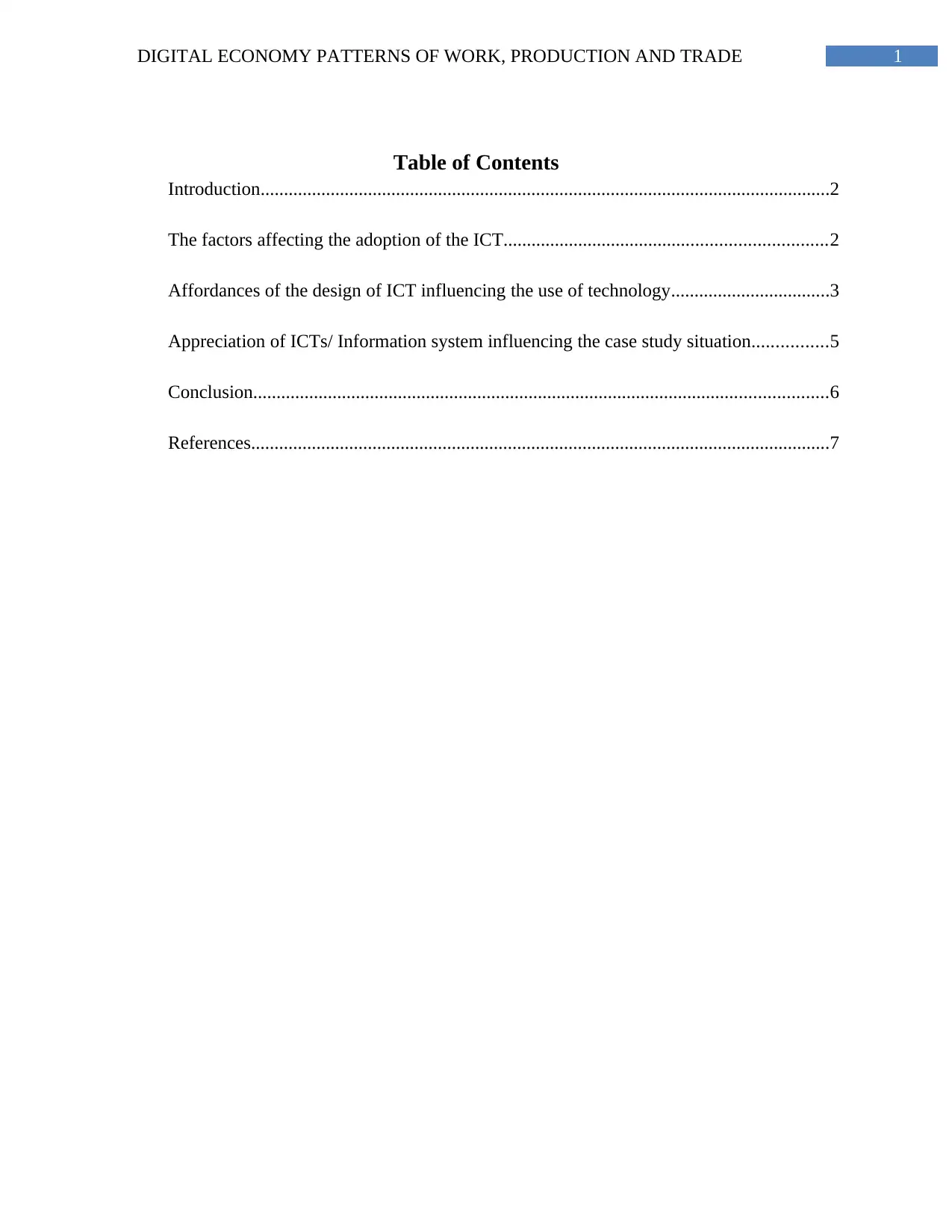
Table of Contents
Introduction..........................................................................................................................2
The factors affecting the adoption of the ICT.....................................................................2
Affordances of the design of ICT influencing the use of technology..................................3
Appreciation of ICTs/ Information system influencing the case study situation................5
Conclusion...........................................................................................................................6
References............................................................................................................................7
Table of Contents
Introduction..........................................................................................................................2
The factors affecting the adoption of the ICT.....................................................................2
Affordances of the design of ICT influencing the use of technology..................................3
Appreciation of ICTs/ Information system influencing the case study situation................5
Conclusion...........................................................................................................................6
References............................................................................................................................7
2DIGITAL ECONOMY PATTERNS OF WORK, PRODUCTION AND TRADE
Introduction
The digital economy has captured financial data transaction that is planned for
developing standard of the students and assist theme to use money wisely. Money management
assists to severe the issues that can be helpful for the students. On the other hand, classroom
economics assists the students to manage the process and helps to improve their lifestyle.
Classroom economics also engages the students in banking. The digital economy applications in
mobiles are able in learning the applications to understand the process of managing the
applications so that it will be helpful to manage the process. In the current study, the factors that
affect the process of adopting the ICT process that can be helpful understand the process and
reason of adopting digital economy. In addition, affordances of designing the use of technology
are described in the paper. Appreciation of the information system that influence the situation is
also explained in the study.
The factors affecting the adoption of the ICT
In order to survive in this new era of technology this particular concept is very much
useful. In order to drive digital transformation all specific factors are needed to be identified and
applied for business success (Weller, Kleer & Piller, 2015). The issues associated to the business
application will be optimized with proper application of the digital economy factors. The details
of the factors are illustrated in the below section:
The third wave of capitalization: The third wave of the capitalism is referred to as a
mature digital economy that is widely operated in the classroom environment. The digital system
will not have the transformed consumer behavior but also it has the ability to force the
Introduction
The digital economy has captured financial data transaction that is planned for
developing standard of the students and assist theme to use money wisely. Money management
assists to severe the issues that can be helpful for the students. On the other hand, classroom
economics assists the students to manage the process and helps to improve their lifestyle.
Classroom economics also engages the students in banking. The digital economy applications in
mobiles are able in learning the applications to understand the process of managing the
applications so that it will be helpful to manage the process. In the current study, the factors that
affect the process of adopting the ICT process that can be helpful understand the process and
reason of adopting digital economy. In addition, affordances of designing the use of technology
are described in the paper. Appreciation of the information system that influence the situation is
also explained in the study.
The factors affecting the adoption of the ICT
In order to survive in this new era of technology this particular concept is very much
useful. In order to drive digital transformation all specific factors are needed to be identified and
applied for business success (Weller, Kleer & Piller, 2015). The issues associated to the business
application will be optimized with proper application of the digital economy factors. The details
of the factors are illustrated in the below section:
The third wave of capitalization: The third wave of the capitalism is referred to as a
mature digital economy that is widely operated in the classroom environment. The digital system
will not have the transformed consumer behavior but also it has the ability to force the
⊘ This is a preview!⊘
Do you want full access?
Subscribe today to unlock all pages.

Trusted by 1+ million students worldwide
3DIGITAL ECONOMY PATTERNS OF WORK, PRODUCTION AND TRADE
organizations to be a more flexible as well as nimble one (Graham, Hjorth & Lehdonvirta, 2017).
The four of the universal phenomena that, impacts and drive the emerging economy in terms of
mobility, cloud computing, business intelligence, social media etc. In order to design the system
as a globalized one it is necessary for the developers to design the digital system in such a way
so that it can effectively be operated in any sort of digital environment (Jones & Pimdee, 2017).
The issues that may negatively impact the traditional system will be resolved with the successful
implementation of the digitally transformed system. However, instead of direct transformation
some of the activities cal also be modified accordingly to minimize the system level application
errors.
Corporate growth strategy: This is another important factor that has to be considered
by the system developers for mote business appreciation and business improved productivity.
Based on the purchasing and selling power the business success strategy should have to be
prepared by the system developer.
Affordances of the design of ICT influencing the use of technology
With the changing technical era the concept of technology and its application in different
fields are also changing accordingly. It is the role of the company and the organization owners to
adopt the most suitable digital economy pattern. For this specific report the digital economy
pattern that has been nominated is the classroom economy. This approach is merely used in the
classroom and helps the students to define the set of rules about what is correct and what is
wrong. (Sundararajan, 2014). For this specific paper the classroom digital economy is being
considered. With the help of the classroom economy the students will be able to discriminate
right and wrong perspectives and the purposes for which the money should be used. In current
organizations to be a more flexible as well as nimble one (Graham, Hjorth & Lehdonvirta, 2017).
The four of the universal phenomena that, impacts and drive the emerging economy in terms of
mobility, cloud computing, business intelligence, social media etc. In order to design the system
as a globalized one it is necessary for the developers to design the digital system in such a way
so that it can effectively be operated in any sort of digital environment (Jones & Pimdee, 2017).
The issues that may negatively impact the traditional system will be resolved with the successful
implementation of the digitally transformed system. However, instead of direct transformation
some of the activities cal also be modified accordingly to minimize the system level application
errors.
Corporate growth strategy: This is another important factor that has to be considered
by the system developers for mote business appreciation and business improved productivity.
Based on the purchasing and selling power the business success strategy should have to be
prepared by the system developer.
Affordances of the design of ICT influencing the use of technology
With the changing technical era the concept of technology and its application in different
fields are also changing accordingly. It is the role of the company and the organization owners to
adopt the most suitable digital economy pattern. For this specific report the digital economy
pattern that has been nominated is the classroom economy. This approach is merely used in the
classroom and helps the students to define the set of rules about what is correct and what is
wrong. (Sundararajan, 2014). For this specific paper the classroom digital economy is being
considered. With the help of the classroom economy the students will be able to discriminate
right and wrong perspectives and the purposes for which the money should be used. In current
Paraphrase This Document
Need a fresh take? Get an instant paraphrase of this document with our AI Paraphraser
4DIGITAL ECONOMY PATTERNS OF WORK, PRODUCTION AND TRADE
days the money management has arose as a serious issue. The classroom economy will help
them to learn the ways through which their knowledge and skill can be applied to earn money in
the upcoming future. This application also holds the banking and financial records of the
students and keep them safe from the external unreliable users (Scholz, 2017). They will be able
to gain ideas regarding wise usage of the money. Again, the digital economy also defines the
online learning app. It helps t o develop a virtual classroom for the students where the students
will feel free to ask for their queries to the teachers regardless of time and their location s well. It
has been found that the online learning app is a web based application that delivers a less costly
concept of classroom for both the students and the teachers.
This kind of digitized system is user friendly and provides wide space to the users at the
same time. Through the digital platform the users in terms of both the learners and the students
will be able to gain usability success (Postigo, 2016). These kinds of applications are not costly
as well, only in order to become the pat of the virtual classroom a subscription package is
needed. In case of physical classroom both students and the teachers have to follow the time
boundary. The digital trend developers must follow forward looking mobile strategies to make
sure that the usage of the internet access details are accurately being followed by the system
developers and the users as well.
Moreover, it is also defined that this kind of systems are enough secured from the rest f
the systems. As, in this case all the documents related to students and the teachers are stored
digitally thus proper digital strategies are also applied on those in order to keep the information
safe from the external attackers (Nakamura, Samuels & Soloveichik, 2017). Encryption and
firewall are the two different security mechanisms applied in the system to make sure that n0ne
days the money management has arose as a serious issue. The classroom economy will help
them to learn the ways through which their knowledge and skill can be applied to earn money in
the upcoming future. This application also holds the banking and financial records of the
students and keep them safe from the external unreliable users (Scholz, 2017). They will be able
to gain ideas regarding wise usage of the money. Again, the digital economy also defines the
online learning app. It helps t o develop a virtual classroom for the students where the students
will feel free to ask for their queries to the teachers regardless of time and their location s well. It
has been found that the online learning app is a web based application that delivers a less costly
concept of classroom for both the students and the teachers.
This kind of digitized system is user friendly and provides wide space to the users at the
same time. Through the digital platform the users in terms of both the learners and the students
will be able to gain usability success (Postigo, 2016). These kinds of applications are not costly
as well, only in order to become the pat of the virtual classroom a subscription package is
needed. In case of physical classroom both students and the teachers have to follow the time
boundary. The digital trend developers must follow forward looking mobile strategies to make
sure that the usage of the internet access details are accurately being followed by the system
developers and the users as well.
Moreover, it is also defined that this kind of systems are enough secured from the rest f
the systems. As, in this case all the documents related to students and the teachers are stored
digitally thus proper digital strategies are also applied on those in order to keep the information
safe from the external attackers (Nakamura, Samuels & Soloveichik, 2017). Encryption and
firewall are the two different security mechanisms applied in the system to make sure that n0ne
5DIGITAL ECONOMY PATTERNS OF WORK, PRODUCTION AND TRADE
of the external users are capable to access information from the server without permission from
the users’ authenticated person.
It has been found that, cloud marketing and storage virtualizations are obtaining ground.
In order to make system level storage safeguard all the digital operations are needed to be
designed based on the consumers requirements priority (Van Ark, 2016). If the security
practices are avoided by the system developers then it will cause operational and functional
issues which may again negatively impact the users. Based on the requirements of the emerging
market the digital transformation requirements and specifications should be incorporated.
Appreciation of ICTs/ Information system influencing the case study situation
In the online discussion forum the students will be able to share their creativity and ideas
with the rest of the students also. There are many factors that are affecting the adoption process
of the digital economy pattern (Black & Edwards, 2015). Not only classroom but the small and
medium sized enterprises are also getting affected with the digital economy patterns. Due to the
excessive usage of the digital economy the classroom landscape is very frequently evolving
largely due to the digital technologies. On the other hand the digital technology also helps to
create a strong connectivity between the service providers and the consumers. For this particular
case the service providers are the digital application developers and the consumers are the
teachers and the learners who are using this digital app for increasing the business efficiency and
effectively simultaneously (Fuller, Warren & Rahman, 2015). In order to explore new business
platform the concept of emerging economy should have to be identified and applied accordingly.
The subsystems that are considered for the online system are based on mobile application.
of the external users are capable to access information from the server without permission from
the users’ authenticated person.
It has been found that, cloud marketing and storage virtualizations are obtaining ground.
In order to make system level storage safeguard all the digital operations are needed to be
designed based on the consumers requirements priority (Van Ark, 2016). If the security
practices are avoided by the system developers then it will cause operational and functional
issues which may again negatively impact the users. Based on the requirements of the emerging
market the digital transformation requirements and specifications should be incorporated.
Appreciation of ICTs/ Information system influencing the case study situation
In the online discussion forum the students will be able to share their creativity and ideas
with the rest of the students also. There are many factors that are affecting the adoption process
of the digital economy pattern (Black & Edwards, 2015). Not only classroom but the small and
medium sized enterprises are also getting affected with the digital economy patterns. Due to the
excessive usage of the digital economy the classroom landscape is very frequently evolving
largely due to the digital technologies. On the other hand the digital technology also helps to
create a strong connectivity between the service providers and the consumers. For this particular
case the service providers are the digital application developers and the consumers are the
teachers and the learners who are using this digital app for increasing the business efficiency and
effectively simultaneously (Fuller, Warren & Rahman, 2015). In order to explore new business
platform the concept of emerging economy should have to be identified and applied accordingly.
The subsystems that are considered for the online system are based on mobile application.
⊘ This is a preview!⊘
Do you want full access?
Subscribe today to unlock all pages.
Trusted by 1+ million students worldwide
6DIGITAL ECONOMY PATTERNS OF WORK, PRODUCTION AND TRADE
Conclusion
From the above study, it concludes that application of digital economy is important for
the students. The design of applications, it is important to manage the process. With respect to
the applications, peer learning and individual evaluation is important in this aspect. Hence,
studying the factors will be helpful to understand the challenges faced while using the
applications. The students use the application in real world scenario. In addition, it is required to
manage the process that provides help to use money wisely. On the other hand, the new digital
application can be helpful to the teachers and students.
Conclusion
From the above study, it concludes that application of digital economy is important for
the students. The design of applications, it is important to manage the process. With respect to
the applications, peer learning and individual evaluation is important in this aspect. Hence,
studying the factors will be helpful to understand the challenges faced while using the
applications. The students use the application in real world scenario. In addition, it is required to
manage the process that provides help to use money wisely. On the other hand, the new digital
application can be helpful to the teachers and students.
Paraphrase This Document
Need a fresh take? Get an instant paraphrase of this document with our AI Paraphraser
7DIGITAL ECONOMY PATTERNS OF WORK, PRODUCTION AND TRADE
References
Black, S., & Edwards, M. J. (2015). What's Digtial about Fashion Design? Fashion, Technology
and the Digital Economy.
Fuller, T., Warren, L., & Rahman, M. (2015). Business model innovation in a global digital
economy, an anticipatory perspective to researching rural enterprises.
Graham, M., Hjorth, I., & Lehdonvirta, V. (2017). Digital labour and development: impacts of
global digital labour platforms and the gig economy on worker livelihoods. Transfer:
European Review of Labour and Research, 23(2), 135-162.
Jones, C., & Pimdee, P. (2017). Innovative ideas: Thailand 4.0 and the fourth industrial
revolution. Asian International Journal of Social Sciences, 17(1), 4-35.
Nakamura, L. I., Samuels, J. D., & Soloveichik, R. H. (2017). Measuring the “free” digital
economy within the GDP and productivity accounts.
Postigo, H. (2016). The socio-technical architecture of digital labor: Converting play into
YouTube money. New Media & Society, 18(2), 332-349.
Scholz, T. (2017). Uberworked and underpaid: How workers are disrupting the digital economy.
John Wiley & Sons.
Sundararajan, A. (2014). Peer-to-peer businesses and the sharing (collaborative) economy:
Overview, economic effects and regulatory issues. Written testimony for the hearing
titled The Power of Connection: Peer to Peer Businesses.
References
Black, S., & Edwards, M. J. (2015). What's Digtial about Fashion Design? Fashion, Technology
and the Digital Economy.
Fuller, T., Warren, L., & Rahman, M. (2015). Business model innovation in a global digital
economy, an anticipatory perspective to researching rural enterprises.
Graham, M., Hjorth, I., & Lehdonvirta, V. (2017). Digital labour and development: impacts of
global digital labour platforms and the gig economy on worker livelihoods. Transfer:
European Review of Labour and Research, 23(2), 135-162.
Jones, C., & Pimdee, P. (2017). Innovative ideas: Thailand 4.0 and the fourth industrial
revolution. Asian International Journal of Social Sciences, 17(1), 4-35.
Nakamura, L. I., Samuels, J. D., & Soloveichik, R. H. (2017). Measuring the “free” digital
economy within the GDP and productivity accounts.
Postigo, H. (2016). The socio-technical architecture of digital labor: Converting play into
YouTube money. New Media & Society, 18(2), 332-349.
Scholz, T. (2017). Uberworked and underpaid: How workers are disrupting the digital economy.
John Wiley & Sons.
Sundararajan, A. (2014). Peer-to-peer businesses and the sharing (collaborative) economy:
Overview, economic effects and regulatory issues. Written testimony for the hearing
titled The Power of Connection: Peer to Peer Businesses.
8DIGITAL ECONOMY PATTERNS OF WORK, PRODUCTION AND TRADE
Valenduc, G., & Vendramin, P. (2016). Work in the digital economy: sorting the old from the
new (No. UCL-Université Catholique de Louvain). Brussels: European Trade Union
Institute.
Valenduc, G., & Vendramin, P. (2016). Work in the digital economy: sorting the old from the
new (No. UCL-Université Catholique de Louvain). Brussels: European Trade Union
Institute.
Van Ark, B. (2016). The productivity paradox of the new digital economy. International
Productivity Monitor, (31), 3.
Weller, C., Kleer, R., & Piller, F. T. (2015). Economic implications of 3D printing: Market
structure models in light of additive manufacturing revisited. International Journal of
Production Economics, 164, 43-56.
Valenduc, G., & Vendramin, P. (2016). Work in the digital economy: sorting the old from the
new (No. UCL-Université Catholique de Louvain). Brussels: European Trade Union
Institute.
Valenduc, G., & Vendramin, P. (2016). Work in the digital economy: sorting the old from the
new (No. UCL-Université Catholique de Louvain). Brussels: European Trade Union
Institute.
Van Ark, B. (2016). The productivity paradox of the new digital economy. International
Productivity Monitor, (31), 3.
Weller, C., Kleer, R., & Piller, F. T. (2015). Economic implications of 3D printing: Market
structure models in light of additive manufacturing revisited. International Journal of
Production Economics, 164, 43-56.
⊘ This is a preview!⊘
Do you want full access?
Subscribe today to unlock all pages.
Trusted by 1+ million students worldwide

1 out of 9


Related Documents


Your All-in-One AI-Powered Toolkit for Academic Success.
+13062052269
info@desklib.com
Available 24*7 on WhatsApp / Email
![[object Object]](/_next/static/media/star-bottom.7253800d.svg)
Unlock your academic potential
Copyright © 2020–2026 A2Z Services. All Rights Reserved. Developed and managed by ZUCOL.