Digital Innovation: Mobile Technology Sensors - Opportunities
VerifiedAdded on 2023/05/29
|14
|2971
|143
Literature Review
AI Summary
This literature review provides an overview of mobile devices, focusing on the crucial role of sensors in their functionality and the digital revolution. It traces the evolution of mobile technology, emphasizing the increasing importance of smartphones and the sensors that enable their smart capabilities. The review identifies various types of sensors used in mobile devices, such as magnetometers, gyroscopes, and accelerometers, and discusses their applications. It further explores the opportunities and challenges associated with emerging sensor technologies, including ultrasonic sensors, while also noting the ethical, health, environmental, and legal implications that require further investigation. The review concludes by highlighting the need for thorough risk assessment and ethical considerations before the widespread adoption of new sensor technologies in mobile devices, addressing the identified gap in the existing literature. Desklib is a platform where you can find this assignment and many more solved assignments and past papers.
Running Head: DIGITAL INNOVATION_MOBILE TECHNOLOGY
DIGITAL INNOVATION_MOBILE TECHNOLOGY
Name of the Student
Name of the University
Author Note
DIGITAL INNOVATION_MOBILE TECHNOLOGY
Name of the Student
Name of the University
Author Note

Paraphrase This Document
Need a fresh take? Get an instant paraphrase of this document with our AI Paraphraser
1DIGITAL INNOVATION_MOBILE TECHNOLOGY
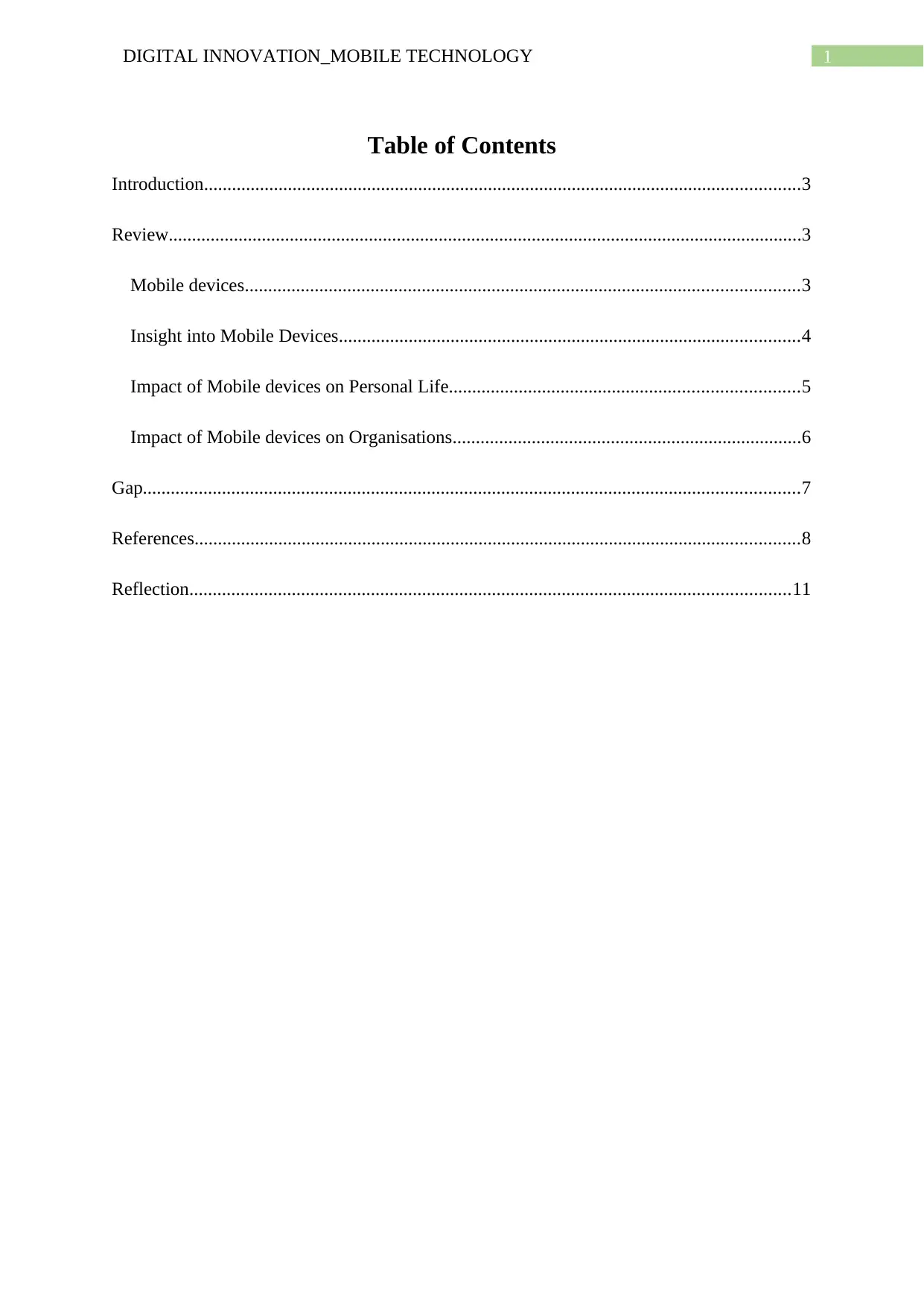
Table of Contents
Introduction................................................................................................................................3
Review........................................................................................................................................3
Mobile devices.......................................................................................................................3
Insight into Mobile Devices...................................................................................................4
Impact of Mobile devices on Personal Life...........................................................................5
Impact of Mobile devices on Organisations...........................................................................6
Gap.............................................................................................................................................7
References..................................................................................................................................8
Reflection.................................................................................................................................11
Table of Contents
Introduction................................................................................................................................3
Review........................................................................................................................................3
Mobile devices.......................................................................................................................3
Insight into Mobile Devices...................................................................................................4
Impact of Mobile devices on Personal Life...........................................................................5
Impact of Mobile devices on Organisations...........................................................................6
Gap.............................................................................................................................................7
References..................................................................................................................................8
Reflection.................................................................................................................................11
2DIGITAL INNOVATION_MOBILE TECHNOLOGY
Literature Review
Literature Review
⊘ This is a preview!⊘
Do you want full access?
Subscribe today to unlock all pages.

Trusted by 1+ million students worldwide
3DIGITAL INNOVATION_MOBILE TECHNOLOGY
Introduction
Digital Revolution can be considered as the most prominent technological
development of the recent era (Kaplan and Haenlein 2016). One of the most crucial aspects of
the digital revolution is the sensors and the devices build on them. The embedded systems are
the most viable development of the sensor based devices. On further filtration Computing
devices such as computers, smartphones and others are paving way for future advancement
(Collins and Halverson 2018). The discussed paper is aimed at putting an emphasises on the
mobile devices such as smartphones, tablets and others and what is the role of sensors in
those devices. Mobile devices are electronic devices with long range that are portable and are
used most prominently for mobile communication. Their capability of offering different
computing solutions and that too with the advantage of mobility is offering them dominance
over the other computing systems (Anshari et al. 2017). The sensors are playing the most
vital role in offering dominance to the mobiles and hence has been taken as part of the
consideration.
The emphasise on the topic has been given through review of the literary work. The
review of the literary work is done to develop an insight into the current status of knowledge
over the subject that is being reviewed. Hence, the paper in context has aimed at identifying
the current status of knowledge that is available over the mobile devices and their sensors.
The following section has reviewed several literary work along with the articles from reliable
sources such as the newspaper articles government publications, reliable company’s blog and
others to summarise them in sub-sections to offer a better understanding of the identified
knowledge. Finally, all the findings have been summarised to conclude on the paper.
Introduction
Digital Revolution can be considered as the most prominent technological
development of the recent era (Kaplan and Haenlein 2016). One of the most crucial aspects of
the digital revolution is the sensors and the devices build on them. The embedded systems are
the most viable development of the sensor based devices. On further filtration Computing
devices such as computers, smartphones and others are paving way for future advancement
(Collins and Halverson 2018). The discussed paper is aimed at putting an emphasises on the
mobile devices such as smartphones, tablets and others and what is the role of sensors in
those devices. Mobile devices are electronic devices with long range that are portable and are
used most prominently for mobile communication. Their capability of offering different
computing solutions and that too with the advantage of mobility is offering them dominance
over the other computing systems (Anshari et al. 2017). The sensors are playing the most
vital role in offering dominance to the mobiles and hence has been taken as part of the
consideration.
The emphasise on the topic has been given through review of the literary work. The
review of the literary work is done to develop an insight into the current status of knowledge
over the subject that is being reviewed. Hence, the paper in context has aimed at identifying
the current status of knowledge that is available over the mobile devices and their sensors.
The following section has reviewed several literary work along with the articles from reliable
sources such as the newspaper articles government publications, reliable company’s blog and
others to summarise them in sub-sections to offer a better understanding of the identified
knowledge. Finally, all the findings have been summarised to conclude on the paper.
Paraphrase This Document
Need a fresh take? Get an instant paraphrase of this document with our AI Paraphraser
4DIGITAL INNOVATION_MOBILE TECHNOLOGY
Review
Mobile devices
Mobile devices have find themselves a place in the history from as early as 1917
when Eric Tigerstedt, the developer of Finnish, filed a patent for a folding telephone that can
be carried around (Barrière 2016). However, no models or prototype for the phone was
available until John F Mitchell along with Martin Cooper of the Electronic Giant, Motorola
demonstrated a 4.4-pound handset (Chowdhury and Rahman 2015). Since then the mobile
devices have witnessed different stages of development and has upgraded itself to the
currently used smartphones. The device in discussion was first developed for the purpose of
an ease of calling facilities that used radio frequency link. The radio frequency was first
limited to particular areas which limited the capability of the mobile devices however with
time the chain grew and the now entire world is the service area for mobile devices
(Chowdhury and Rahman 2016).
The devices in discussion has been added with new features to upgrade its quality
with an aim of upgrading its functionality. The features included text messaging and kept on
growing to a number of other features such as emails, MMS, Internet accessibility, wireless
communication using Bluetooth and infrared, photography and video recording, games and it
is continuously growing (Noonari and Memon 2018). The capability of the mobile phones
earned an exponential boost with the introduction of smartphones. With time the smartphones
have enabled the mobile phones to cope up with the other computing devices such as
computers in terms of certain features and others along with additional benefits of mobility,
ease of use, inexpensiveness and others.
So, to summarise the above discussion it would be adequate to state that mobile
devices are capable of offering prominent opportunities to its user that includes computing
Review
Mobile devices
Mobile devices have find themselves a place in the history from as early as 1917
when Eric Tigerstedt, the developer of Finnish, filed a patent for a folding telephone that can
be carried around (Barrière 2016). However, no models or prototype for the phone was
available until John F Mitchell along with Martin Cooper of the Electronic Giant, Motorola
demonstrated a 4.4-pound handset (Chowdhury and Rahman 2015). Since then the mobile
devices have witnessed different stages of development and has upgraded itself to the
currently used smartphones. The device in discussion was first developed for the purpose of
an ease of calling facilities that used radio frequency link. The radio frequency was first
limited to particular areas which limited the capability of the mobile devices however with
time the chain grew and the now entire world is the service area for mobile devices
(Chowdhury and Rahman 2016).
The devices in discussion has been added with new features to upgrade its quality
with an aim of upgrading its functionality. The features included text messaging and kept on
growing to a number of other features such as emails, MMS, Internet accessibility, wireless
communication using Bluetooth and infrared, photography and video recording, games and it
is continuously growing (Noonari and Memon 2018). The capability of the mobile phones
earned an exponential boost with the introduction of smartphones. With time the smartphones
have enabled the mobile phones to cope up with the other computing devices such as
computers in terms of certain features and others along with additional benefits of mobility,
ease of use, inexpensiveness and others.
So, to summarise the above discussion it would be adequate to state that mobile
devices are capable of offering prominent opportunities to its user that includes computing
5DIGITAL INNOVATION_MOBILE TECHNOLOGY
features along with mobility, ease of use and others and is the prominent reason for mass
adoption.
Insight into Mobile Devices
The number of mobile phone users is estimated to be over 4.57 billion users currently
and by the next year is estimated to reach by the number of 4.68 billion (Statista 2018). The
statistics discussed above shows the mass number of mobile phones in use and will
continuously increase. The number discussed contains different types of mobile devices
however some of the components of the discussed devices are constant. The discussed
components are CPU that is the processor of the device which controls all the functionality,
battery for power backup, User Interface options for the interaction purpose, display for the
output from device and SIM (Subscriber Identity Module) for calling and other purposes
(Halpern, Zhu and Reddi 2016). Smartphones however have additional features and hence
needs additional components that includes Internet capabilities different sensors for different
purposes, Operating Systems (OS) such as Android, IOS, Windows and others (Opoku, Davis
and Nimbe 2015). Additional components are also added to the mobile devices for adding
different features to the mobile devices.
The discussion above has offered an insight into the core components of the mobile
devices which will enable the readers to gain a better understanding of the core components
of the mobile devices and in the process mobile device.
Sensors
Sensors are electronic devices that are capable of detecting or measuring physical
properties and processes the properties. The properties are recorded, indicated or in the
contrary the device responds to it (Shoaib et al. 2014). As it has been detected in the review
above the mobile devices specially the smart ones come with capability of smartness. The
features along with mobility, ease of use and others and is the prominent reason for mass
adoption.
Insight into Mobile Devices
The number of mobile phone users is estimated to be over 4.57 billion users currently
and by the next year is estimated to reach by the number of 4.68 billion (Statista 2018). The
statistics discussed above shows the mass number of mobile phones in use and will
continuously increase. The number discussed contains different types of mobile devices
however some of the components of the discussed devices are constant. The discussed
components are CPU that is the processor of the device which controls all the functionality,
battery for power backup, User Interface options for the interaction purpose, display for the
output from device and SIM (Subscriber Identity Module) for calling and other purposes
(Halpern, Zhu and Reddi 2016). Smartphones however have additional features and hence
needs additional components that includes Internet capabilities different sensors for different
purposes, Operating Systems (OS) such as Android, IOS, Windows and others (Opoku, Davis
and Nimbe 2015). Additional components are also added to the mobile devices for adding
different features to the mobile devices.
The discussion above has offered an insight into the core components of the mobile
devices which will enable the readers to gain a better understanding of the core components
of the mobile devices and in the process mobile device.
Sensors
Sensors are electronic devices that are capable of detecting or measuring physical
properties and processes the properties. The properties are recorded, indicated or in the
contrary the device responds to it (Shoaib et al. 2014). As it has been detected in the review
above the mobile devices specially the smart ones come with capability of smartness. The
⊘ This is a preview!⊘
Do you want full access?
Subscribe today to unlock all pages.
Trusted by 1+ million students worldwide
6DIGITAL INNOVATION_MOBILE TECHNOLOGY
discussed smartness is enabled in the smart phones with support of the sensors. Some of the
most prominently used sensors in mobile devices are magnetometer, GPS, Gyroscope,
Accelerometer, Proximity sensors and multiple others (Shu, Tong and Ji 2014).
One of the sensors that is the basic part of mobile devices is magnetometer that
supports the GPS and both in the process enables determination of location. Magnetometer, is
designed to sense the magnetic field which in conjunction with the GPS sensor determines
the location of the phone and enables the users to live track the distance through the
connection of GPS with the satellites (Monteiro, Cabeza and Marti 2015). Gyroscope is
another sensor that plays the role of rotation in the device, the sensor determines the
movement of the device based on angular velocity around the 3 dimensional axis and offers
smartness. The accelerometer determines the acceleration at which the phone is moving in the
provided linear direction (Chen et al. 2015). Barometers are used for detecting atmospheric
pressure and eventually predicts the weather. Other sensors such as ambient light sensor,
fingerprint sensor, camera sensors, microphone sensors and multiple others are ensuring that
mobile phones stay smart and continues to do so.
Hence, in summary it would be adequate to state that mobile devices are attaining
their smartness because of the sensors and will continue to evolve with the introduction of
new sensors with different capabilities.
Opportunities and challenges of sensors in mobile devices
The review from the discussion above have made it evident that sensors are playing a
crucial role in the smartness of the mobile phones. Furthermore, it has also been identified
that the mobile phone market is continuously growing and will continue to grow in the
coming era. The development of smartphones will be dependent on sensors and hence,
several sensors are being developed.
discussed smartness is enabled in the smart phones with support of the sensors. Some of the
most prominently used sensors in mobile devices are magnetometer, GPS, Gyroscope,
Accelerometer, Proximity sensors and multiple others (Shu, Tong and Ji 2014).
One of the sensors that is the basic part of mobile devices is magnetometer that
supports the GPS and both in the process enables determination of location. Magnetometer, is
designed to sense the magnetic field which in conjunction with the GPS sensor determines
the location of the phone and enables the users to live track the distance through the
connection of GPS with the satellites (Monteiro, Cabeza and Marti 2015). Gyroscope is
another sensor that plays the role of rotation in the device, the sensor determines the
movement of the device based on angular velocity around the 3 dimensional axis and offers
smartness. The accelerometer determines the acceleration at which the phone is moving in the
provided linear direction (Chen et al. 2015). Barometers are used for detecting atmospheric
pressure and eventually predicts the weather. Other sensors such as ambient light sensor,
fingerprint sensor, camera sensors, microphone sensors and multiple others are ensuring that
mobile phones stay smart and continues to do so.
Hence, in summary it would be adequate to state that mobile devices are attaining
their smartness because of the sensors and will continue to evolve with the introduction of
new sensors with different capabilities.
Opportunities and challenges of sensors in mobile devices
The review from the discussion above have made it evident that sensors are playing a
crucial role in the smartness of the mobile phones. Furthermore, it has also been identified
that the mobile phone market is continuously growing and will continue to grow in the
coming era. The development of smartphones will be dependent on sensors and hence,
several sensors are being developed.
Paraphrase This Document
Need a fresh take? Get an instant paraphrase of this document with our AI Paraphraser
7DIGITAL INNOVATION_MOBILE TECHNOLOGY
Some of the most coming age sensors are based on the ultrasonic principles. The
proximity sensors are being replace by ultrasonic sensors which are based on the
echolocation principle used by the bats, to determine the location and distance of the mobile
from its users (Lim et al. 2014). In an another major development Qualcomm have developed
an ultrasonic in-screen fingerprint sensor for Samsung that penetrates the skin and presents a
3D model for the finger print (Hassan and Kim 2018). Embedded multiple sensor based
interaction are also coming age sensor technology that is developing potential for the future
revolution in mobile devices. With all the discussed sensors and more to come the future of
smartphones is looking secure however, the assessment of the risks is yet to be done.
The sensors of coming age will revolutionise the mobile devices however, they might
be challenges in successful attaining of the objectives for the development of the devices. The
challenges may include the health issues due to excessive exposure to the ultrasonic based
devices. Furthermore, the lifespan of the new sensors and their environmental effects are also
a matter that needs to be accounted for.
So, in summary it would be efficient to state that the future of mobile devices is bright
due to the introduction of smart and disruptive sensors however, improper risk assessment of
the sensors is a challenge that should be accounted for.
Gap
Th discussion above has made it evident that mobile devices are one of the most
needs of the time and their capability is because of the sensors installed in them. The sensors
are further enhanced to increase the capability of the mobile devices however, the ethical,
health, environmental and legal implications of the disruptive sensors is a matter of
discussion that has not been discussed. Furthermore, the increased use of the ultrasonic
sensors is evident from the review and hence, it becomes crucial to determine the
Some of the most coming age sensors are based on the ultrasonic principles. The
proximity sensors are being replace by ultrasonic sensors which are based on the
echolocation principle used by the bats, to determine the location and distance of the mobile
from its users (Lim et al. 2014). In an another major development Qualcomm have developed
an ultrasonic in-screen fingerprint sensor for Samsung that penetrates the skin and presents a
3D model for the finger print (Hassan and Kim 2018). Embedded multiple sensor based
interaction are also coming age sensor technology that is developing potential for the future
revolution in mobile devices. With all the discussed sensors and more to come the future of
smartphones is looking secure however, the assessment of the risks is yet to be done.
The sensors of coming age will revolutionise the mobile devices however, they might
be challenges in successful attaining of the objectives for the development of the devices. The
challenges may include the health issues due to excessive exposure to the ultrasonic based
devices. Furthermore, the lifespan of the new sensors and their environmental effects are also
a matter that needs to be accounted for.
So, in summary it would be efficient to state that the future of mobile devices is bright
due to the introduction of smart and disruptive sensors however, improper risk assessment of
the sensors is a challenge that should be accounted for.
Gap
Th discussion above has made it evident that mobile devices are one of the most
needs of the time and their capability is because of the sensors installed in them. The sensors
are further enhanced to increase the capability of the mobile devices however, the ethical,
health, environmental and legal implications of the disruptive sensors is a matter of
discussion that has not been discussed. Furthermore, the increased use of the ultrasonic
sensors is evident from the review and hence, it becomes crucial to determine the
8DIGITAL INNOVATION_MOBILE TECHNOLOGY
implications of the ultrasonic sensors and fill the gap in literature so that the technology can
be leveraged without any ethical constraints.
Conclusion
The review of the literary works has offered an insight into the mobile devices and the
crucial aspects of the mobile devices. Furthermore, it has also been identified that the smart
capability of the smartphones is derived from the sensors and the paper have reviewed the
opportunities offered by the mobile devices, Additionally the challenges has also been
discussed which has led to determination of the gap in literature and the gap in review is
determination of the ethical, health, environmental and legal implications of the disruptive
sensors. The review of ultrasonic sensors is the most prominent gap because of mass adoption
of the technology and needs to be discussed. So, the discussion could be summarised to state
that the mobile technologies and sensors are offering prominent benefits to the users
however, before being used in service they should be tested for vulnerabilities so that no
ethical or other volatiles are left unchecked.
implications of the ultrasonic sensors and fill the gap in literature so that the technology can
be leveraged without any ethical constraints.
Conclusion
The review of the literary works has offered an insight into the mobile devices and the
crucial aspects of the mobile devices. Furthermore, it has also been identified that the smart
capability of the smartphones is derived from the sensors and the paper have reviewed the
opportunities offered by the mobile devices, Additionally the challenges has also been
discussed which has led to determination of the gap in literature and the gap in review is
determination of the ethical, health, environmental and legal implications of the disruptive
sensors. The review of ultrasonic sensors is the most prominent gap because of mass adoption
of the technology and needs to be discussed. So, the discussion could be summarised to state
that the mobile technologies and sensors are offering prominent benefits to the users
however, before being used in service they should be tested for vulnerabilities so that no
ethical or other volatiles are left unchecked.
⊘ This is a preview!⊘
Do you want full access?
Subscribe today to unlock all pages.
Trusted by 1+ million students worldwide
9DIGITAL INNOVATION_MOBILE TECHNOLOGY
References
Anshari, M., Almunawar, M.N., Shahrill, M., Wicaksono, D.K. and Huda, M., 2017.
Smartphones usage in the classrooms: Learning aid or interference?. Education and
Information Technologies, 22(6), pp.3063-3079.
Barrière, C., 2016. Bilingual Corpora. In Natural Language Understanding in a Semantic
Web Context (pp. 105-125). Springer, Cham.
Chen, Z., Zhu, Q., Jiang, H. and Soh, Y.C., 2015, June. Indoor localization using smartphone
sensors and iBeacons. In Industrial Electronics and Applications (ICIEA), 2015 IEEE 10th
Conference on (pp. 1723-1728). IEEE.
Chowdhury, M.T. and Rahman, M.T., 2015. Consumer Attitude Towards the Cell Phone: A
study on Young Generations of Chittagong Metropolitan City, Bangladesh. Asian Business
Review, 3(3), pp.16-20.
Collins, A. and Halverson, R., 2018. Rethinking education in the age of technology: The
digital revolution and schooling in America. Teachers College Press.
Halpern, M., Zhu, Y. and Reddi, V.J., 2016, March. Mobile cpu's rise to power: Quantifying
the impact of generational mobile cpu design trends on performance, energy, and user
satisfaction. In High Performance Computer Architecture (HPCA), 2016 IEEE International
Symposium on (pp. 64-76). IEEE.
Hassan, H. and Kim, H.W., 2018. CMOS Capacitive Fingerprint Sensor Based on
Differential Sensing Circuit with Noise Cancellation. Sensors, 18(7), p.2200.
Kaplan, A.M. and Haenlein, M., 2016. Higher education and the digital revolution: About
MOOCs, SPOCs, social media, and the Cookie Monster. Business Horizons, 59(4), pp.441-
450.
References
Anshari, M., Almunawar, M.N., Shahrill, M., Wicaksono, D.K. and Huda, M., 2017.
Smartphones usage in the classrooms: Learning aid or interference?. Education and
Information Technologies, 22(6), pp.3063-3079.
Barrière, C., 2016. Bilingual Corpora. In Natural Language Understanding in a Semantic
Web Context (pp. 105-125). Springer, Cham.
Chen, Z., Zhu, Q., Jiang, H. and Soh, Y.C., 2015, June. Indoor localization using smartphone
sensors and iBeacons. In Industrial Electronics and Applications (ICIEA), 2015 IEEE 10th
Conference on (pp. 1723-1728). IEEE.
Chowdhury, M.T. and Rahman, M.T., 2015. Consumer Attitude Towards the Cell Phone: A
study on Young Generations of Chittagong Metropolitan City, Bangladesh. Asian Business
Review, 3(3), pp.16-20.
Collins, A. and Halverson, R., 2018. Rethinking education in the age of technology: The
digital revolution and schooling in America. Teachers College Press.
Halpern, M., Zhu, Y. and Reddi, V.J., 2016, March. Mobile cpu's rise to power: Quantifying
the impact of generational mobile cpu design trends on performance, energy, and user
satisfaction. In High Performance Computer Architecture (HPCA), 2016 IEEE International
Symposium on (pp. 64-76). IEEE.
Hassan, H. and Kim, H.W., 2018. CMOS Capacitive Fingerprint Sensor Based on
Differential Sensing Circuit with Noise Cancellation. Sensors, 18(7), p.2200.
Kaplan, A.M. and Haenlein, M., 2016. Higher education and the digital revolution: About
MOOCs, SPOCs, social media, and the Cookie Monster. Business Horizons, 59(4), pp.441-
450.
Paraphrase This Document
Need a fresh take? Get an instant paraphrase of this document with our AI Paraphraser
10DIGITAL INNOVATION_MOBILE TECHNOLOGY
Lim, J., Lee, S.J., Tewolde, G. and Kwon, J., 2014, June. Ultrasonic-sensor deployment
strategies and use of smartphone sensors for mobile robot navigation in indoor environment.
In Electro/Information Technology (EIT), 2014 IEEE International Conference on (pp. 593-
598). IEEE.
Liu, H., Li, R., Liu, S., Tian, S. and Du, J., 2015. SmartCare: Energy-efficient long-term
physical activity tracking using smartphones. Tsinghua Science and Technology, 20(4),
pp.348-363.
Monteiro, M., Cabeza, C. and Marti, A.C., 2015. Acceleration measurements using
smartphone sensors: Dealing with the equivalence principle. Revista Brasileira de Ensino de
Física, 37(1), p.1303.
Noonari, M.A. and Memon, Z.N., 2018, March. IMPACT OF MOBILE SERVICE ON
STUDY AREA. In 16th International Conference on Statistical Sciences (p. 311).
OPOKU, M., DAVIS, J.G. and NIMBE, P., 2015. EVALUATION OF THE SMARTPHONE
PLATFORMS A CASE STUDY WITH ANDROID, iOS AND WINDOWS PHONES.
Asian Journal of Mathematics and Computer Research, pp.72-92.
Shoaib, M., Bosch, S., Incel, O.D., Scholten, H. and Havinga, P.J., 2014. Fusion of
smartphone motion sensors for physical activity recognition. Sensors, 14(6), pp.10146-10176.
Statista. (2018). Number of mobile phone users worldwide 2015-2020 | Statista. [online]
Available at: https://www.statista.com/statistics/274774/forecast-of-mobile-phone-users-
worldwide/ [Accessed 23 Nov. 2018].
Su, X., Tong, H. and Ji, P., 2014. Activity recognition with smartphone sensors. Tsinghua
science and technology, 19(3), pp.235-249.
Lim, J., Lee, S.J., Tewolde, G. and Kwon, J., 2014, June. Ultrasonic-sensor deployment
strategies and use of smartphone sensors for mobile robot navigation in indoor environment.
In Electro/Information Technology (EIT), 2014 IEEE International Conference on (pp. 593-
598). IEEE.
Liu, H., Li, R., Liu, S., Tian, S. and Du, J., 2015. SmartCare: Energy-efficient long-term
physical activity tracking using smartphones. Tsinghua Science and Technology, 20(4),
pp.348-363.
Monteiro, M., Cabeza, C. and Marti, A.C., 2015. Acceleration measurements using
smartphone sensors: Dealing with the equivalence principle. Revista Brasileira de Ensino de
Física, 37(1), p.1303.
Noonari, M.A. and Memon, Z.N., 2018, March. IMPACT OF MOBILE SERVICE ON
STUDY AREA. In 16th International Conference on Statistical Sciences (p. 311).
OPOKU, M., DAVIS, J.G. and NIMBE, P., 2015. EVALUATION OF THE SMARTPHONE
PLATFORMS A CASE STUDY WITH ANDROID, iOS AND WINDOWS PHONES.
Asian Journal of Mathematics and Computer Research, pp.72-92.
Shoaib, M., Bosch, S., Incel, O.D., Scholten, H. and Havinga, P.J., 2014. Fusion of
smartphone motion sensors for physical activity recognition. Sensors, 14(6), pp.10146-10176.
Statista. (2018). Number of mobile phone users worldwide 2015-2020 | Statista. [online]
Available at: https://www.statista.com/statistics/274774/forecast-of-mobile-phone-users-
worldwide/ [Accessed 23 Nov. 2018].
Su, X., Tong, H. and Ji, P., 2014. Activity recognition with smartphone sensors. Tsinghua
science and technology, 19(3), pp.235-249.
11DIGITAL INNOVATION_MOBILE TECHNOLOGY
Reflection
Reflection
⊘ This is a preview!⊘
Do you want full access?
Subscribe today to unlock all pages.
Trusted by 1+ million students worldwide

1 out of 14


Related Documents


Your All-in-One AI-Powered Toolkit for Academic Success.
+13062052269
info@desklib.com
Available 24*7 on WhatsApp / Email
![[object Object]](/_next/static/media/star-bottom.7253800d.svg)
Unlock your academic potential
Copyright © 2020–2026 A2Z Services. All Rights Reserved. Developed and managed by ZUCOL.