Self-Reflection Report on Teamwork and Classroom Environment

Verified

Added on  2020/02/24

|1
|359
|1350
Report
AI Summary
This self-reflection report explores the dynamics of teamwork and its impact on the classroom environment. The author reflects on personal learning experiences, emphasizing the importance of both 'deep knowledge' and 'deep understanding' in a team setting. The report highlights the significance of focusing on problem-solving within the task and how this approach can enhance team involvement and engagement, as demonstrated through diary entries and the development of character strengths. Key references include Boud, Keogh & Walker (2013), and Parent (2016), which are used to support the analysis of the classroom environment and the process of self-reflection. The report emphasizes the importance of creating a supportive classroom environment that encourages deep learning and effective teamwork.
Document Page
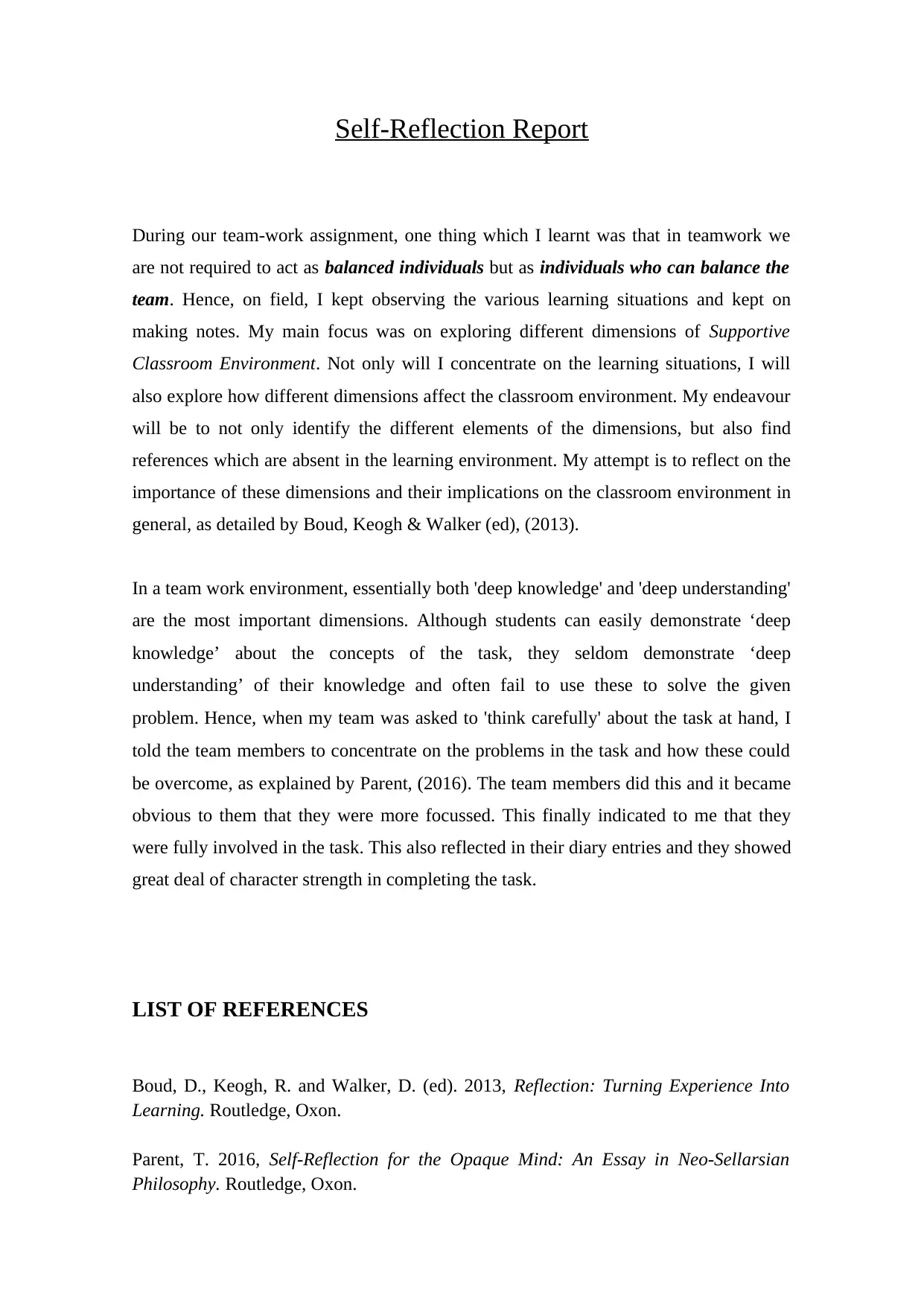
Self-Reflection Report
During our team-work assignment, one thing which I learnt was that in teamwork we
are not required to act as balanced individuals but as individuals who can balance the
team. Hence, on field, I kept observing the various learning situations and kept on
making notes. My main focus was on exploring different dimensions of Supportive
Classroom Environment. Not only will I concentrate on the learning situations, I will
also explore how different dimensions affect the classroom environment. My endeavour
will be to not only identify the different elements of the dimensions, but also find
references which are absent in the learning environment. My attempt is to reflect on the
importance of these dimensions and their implications on the classroom environment in
general, as detailed by Boud, Keogh & Walker (ed), (2013).
In a team work environment, essentially both 'deep knowledge' and 'deep understanding'
are the most important dimensions. Although students can easily demonstrate ‘deep
knowledge’ about the concepts of the task, they seldom demonstrate ‘deep
understanding’ of their knowledge and often fail to use these to solve the given
problem. Hence, when my team was asked to 'think carefully' about the task at hand, I
told the team members to concentrate on the problems in the task and how these could
be overcome, as explained by Parent, (2016). The team members did this and it became
obvious to them that they were more focussed. This finally indicated to me that they
were fully involved in the task. This also reflected in their diary entries and they showed
great deal of character strength in completing the task.
LIST OF REFERENCES
Boud, D., Keogh, R. and Walker, D. (ed). 2013, Reflection: Turning Experience Into
Learning. Routledge, Oxon.
Parent, T. 2016, Self-Reflection for the Opaque Mind: An Essay in Neo-Sellarsian
Philosophy. Routledge, Oxon.
tabler-icon-diamond-filled.svg

Paraphrase This Document

Need a fresh take? Get an instant paraphrase of this document with our AI Paraphraser
[object Object]