Diploma of Engineering Case Study
VerifiedAdded on 2019/09/30
|12
|2951
|187
Report
AI Summary
This report is a case study analyzing the catastrophic failure of the St. Francis Dam in 1928. It explores the root causes of the failure, primarily focusing on the inadequate foundation and poor decision-making during construction. The report details the impact of micro and macro factors, including the loss of life and widespread destruction. It emphasizes the importance of reflective practice in engineering, highlighting the lessons learned from this disaster. The analysis includes an examination of accountability, risk mitigation strategies, and recommendations for future construction projects. The report concludes by stressing the crucial roles of proper planning, risk assessment, effective decision-making, and resource utilization in preventing similar catastrophic events.

Diploma of Engineering

Paraphrase This Document
Need a fresh take? Get an instant paraphrase of this document with our AI Paraphraser

Table of Contents
INTRODUCTION...........................................................................................................................3
WHAT IS REFLECTIVE PRACTICE?..........................................................................................3
KEY ISSUES...................................................................................................................................4
OVERVIEW OF CASE STUDY....................................................................................................5
Root Cause OF Failure................................................................................................................5
Failure Accountability.................................................................................................................6
Could the Failure Risk be Mitigated?..........................................................................................6
Impact of Micro and Macro Factors............................................................................................6
GRAPHICS......................................................................................................................................7
LESSONS LEARNT.......................................................................................................................7
Knowledge with Lessons on Other Circumstances.....................................................................7
RECOMMENDATIONS.................................................................................................................7
CONCLUSION................................................................................................................................7
REFERENCES................................................................................................................................8
2 | P a g e
INTRODUCTION...........................................................................................................................3
WHAT IS REFLECTIVE PRACTICE?..........................................................................................3
KEY ISSUES...................................................................................................................................4
OVERVIEW OF CASE STUDY....................................................................................................5
Root Cause OF Failure................................................................................................................5
Failure Accountability.................................................................................................................6
Could the Failure Risk be Mitigated?..........................................................................................6
Impact of Micro and Macro Factors............................................................................................6
GRAPHICS......................................................................................................................................7
LESSONS LEARNT.......................................................................................................................7
Knowledge with Lessons on Other Circumstances.....................................................................7
RECOMMENDATIONS.................................................................................................................7
CONCLUSION................................................................................................................................7
REFERENCES................................................................................................................................8
2 | P a g e
INTRODUCTION
Engineering is an area of study was the technicalities and principles of the theory are observed
with practical demonstration. Relating to Information Technology and Computers, the aspect of
visualization of learnings through theoretical principles is difficult to relate to new the world.
Hence the mechanism of engineering can be witnessed and viewed by the mechanism of
communication in the digital structure. A message sent from one source, it reaches the
destination, the communication channel is thus established and created effectively. This provides
a proof, that the mode of communication is important when it comes to Engineering concepts in
IT.
The report presented below is a crafted summary of the concepts of communication and an
analysis of the case, to identify the role of communication in the entire cycle. The value of
communication is described through the case in a manner that covers the case background, with
issues faced risks identified, the impact of micro and macro environmental factors. The report
also an emphasis on the lessons learnt from the analysis which is presented as suggestions in the
later part of the report. The report ends with a conclusion, that crafts the summary of the report
with the case in the centre.
WHAT IS REFLECTIVE PRACTICE?
Communication is important, it is an essential part of any structure, be it humanly enabled, or
machine is driven. Communication brings together the elements and components of overall
systems together. The approaches of communication can be different with different people, but
for an interaction with self, often the standard combination procedures fail. The mechanism of
listening to oneself, while paying attention to what has gone by, looking at the previously taken
actions and focusing attention to practical values in order to improve the object, or learn from the
mistakes or circumstances, is what comes under self-talk. This self-talk when done with a
concentration at the reflective outcome to plan any futuristic risk handling or mitigation of the
same is often termed as Reflective Practice. To look back into actions or steps to improve the
future steps by learning from already occurred mistakes is what the term liberates.
3 | P a g e
Engineering is an area of study was the technicalities and principles of the theory are observed
with practical demonstration. Relating to Information Technology and Computers, the aspect of
visualization of learnings through theoretical principles is difficult to relate to new the world.
Hence the mechanism of engineering can be witnessed and viewed by the mechanism of
communication in the digital structure. A message sent from one source, it reaches the
destination, the communication channel is thus established and created effectively. This provides
a proof, that the mode of communication is important when it comes to Engineering concepts in
IT.
The report presented below is a crafted summary of the concepts of communication and an
analysis of the case, to identify the role of communication in the entire cycle. The value of
communication is described through the case in a manner that covers the case background, with
issues faced risks identified, the impact of micro and macro environmental factors. The report
also an emphasis on the lessons learnt from the analysis which is presented as suggestions in the
later part of the report. The report ends with a conclusion, that crafts the summary of the report
with the case in the centre.
WHAT IS REFLECTIVE PRACTICE?
Communication is important, it is an essential part of any structure, be it humanly enabled, or
machine is driven. Communication brings together the elements and components of overall
systems together. The approaches of communication can be different with different people, but
for an interaction with self, often the standard combination procedures fail. The mechanism of
listening to oneself, while paying attention to what has gone by, looking at the previously taken
actions and focusing attention to practical values in order to improve the object, or learn from the
mistakes or circumstances, is what comes under self-talk. This self-talk when done with a
concentration at the reflective outcome to plan any futuristic risk handling or mitigation of the
same is often termed as Reflective Practice. To look back into actions or steps to improve the
future steps by learning from already occurred mistakes is what the term liberates.
3 | P a g e
⊘ This is a preview!⊘
Do you want full access?
Subscribe today to unlock all pages.

Trusted by 1+ million students worldwide
The case for reference to understand the concept of the importance of communication is the
Virtual Simulation of the Catastrophic Damage to St. Francis Dam. The breakout of Dam in the
year 1928 with over 500 casualties and estimated damage ranging between $10-25 million USD
surfaced as a big lesson in the industry of civil engineering (Begnudelli & Sanders,2007). It is
thus from the learnings of absolute failure are the lessons learnt by reflective practice. The
insight analysis of causes of failure amongst the other factors, the technical modelling of causes
and simulation drawing of the scenario is an opportunity to understand the role of Information
Technology and communication techniques utilized in the analysis of recording the learnings
from an unfortunate incident. The analysis of predictive flooding, estimation of damage cost with
an understanding of the mechanism of causes of failure is all enabled with the use of technology
bridged by Information systems and different modes of communication.
KEY ISSUES
The issues associated with the catastrophic discussion of the St. Francis Dam are unique in its
own nature. The Dam was a curved concrete structure that was designed and developed between
1924 and 1926 (Begnudelli & Sanders,2007). The dam was designed to support and hold 43
million cubic meter water (Begnudelli & Sanders,2007). It is was at the very first time that the
complete potential threshold was put to test, that this unfortunate incident happened. The
destruction caused by it, soon after its collapse was magnanimous and surprisingly it, later on,
came out in the simulations, that originally, the foundation of the dam was with a fault.
The left and right support structures of the bridge mass which are the abutment was
identified to be faulted with the fault being identified and raised two days earlier to the collapse
(Begnudelli & Sanders,2007). The primary reason indicates the poor foundational structure of
the bridge with the west abutment was said to be standing and constructed over a fault whereas
the other abutment on the east side was standing with Mica schist having a greasy texture. The
leakage in water was detected and observed earlier than the bridge collapsed. The bridge got
destabilized when it was completely filled with water and started cracking in several places.
The Dam break modelling is crucial when it comes to crafting safety procedures in case
of these difficult and catastrophic scenarios. Also, the emergency support systems and the alert
mechanisms are to be in sync and structured in parallel to ensure minimal damage to livelihood.
4 | P a g e
Virtual Simulation of the Catastrophic Damage to St. Francis Dam. The breakout of Dam in the
year 1928 with over 500 casualties and estimated damage ranging between $10-25 million USD
surfaced as a big lesson in the industry of civil engineering (Begnudelli & Sanders,2007). It is
thus from the learnings of absolute failure are the lessons learnt by reflective practice. The
insight analysis of causes of failure amongst the other factors, the technical modelling of causes
and simulation drawing of the scenario is an opportunity to understand the role of Information
Technology and communication techniques utilized in the analysis of recording the learnings
from an unfortunate incident. The analysis of predictive flooding, estimation of damage cost with
an understanding of the mechanism of causes of failure is all enabled with the use of technology
bridged by Information systems and different modes of communication.
KEY ISSUES
The issues associated with the catastrophic discussion of the St. Francis Dam are unique in its
own nature. The Dam was a curved concrete structure that was designed and developed between
1924 and 1926 (Begnudelli & Sanders,2007). The dam was designed to support and hold 43
million cubic meter water (Begnudelli & Sanders,2007). It is was at the very first time that the
complete potential threshold was put to test, that this unfortunate incident happened. The
destruction caused by it, soon after its collapse was magnanimous and surprisingly it, later on,
came out in the simulations, that originally, the foundation of the dam was with a fault.
The left and right support structures of the bridge mass which are the abutment was
identified to be faulted with the fault being identified and raised two days earlier to the collapse
(Begnudelli & Sanders,2007). The primary reason indicates the poor foundational structure of
the bridge with the west abutment was said to be standing and constructed over a fault whereas
the other abutment on the east side was standing with Mica schist having a greasy texture. The
leakage in water was detected and observed earlier than the bridge collapsed. The bridge got
destabilized when it was completely filled with water and started cracking in several places.
The Dam break modelling is crucial when it comes to crafting safety procedures in case
of these difficult and catastrophic scenarios. Also, the emergency support systems and the alert
mechanisms are to be in sync and structured in parallel to ensure minimal damage to livelihood.
4 | P a g e
Paraphrase This Document
Need a fresh take? Get an instant paraphrase of this document with our AI Paraphraser
Earlier the ad-hoc services acting as flood forecasts were phone calls and a motorcyclist running
ahead of the water flow. But these resources and their reach were limited that made situations
like these to be very damaging in life.
OVERVIEW OF CASE STUDY
The case reflects the damage done by the failure of a newly built and at the moment of a full
potential test of the bridge, where even the potential testing was not even alerted to the people
falling under the water stream flow, in case of a mishappening, which unfortunately occurred.
The below sections identify the basic cause of failure as depicted and analyzed through the
simulations being crafted on failure incident sequence of activities. The major responsibility and
accountability for once such major artificial disaster was owned by whom and also, was there
any mechanism to observe, which could have saved this incident or prevented the absolute
failure from happening. The latter part of the case analysis identifies the macro and
microenvironmental factors that play a role with the impact of the effect of overall failure.
Root Cause OF Failure
The ultimate cause of failure was the poor foundation where the dam was being constructed. No
centres or trial of the establishment shake were embraced. There were no formal estimations
made. Various occasions of misguided thinking by Mulholland and a few of his subordinates
essentially added to the reason for the failure.
The stature of the dam was raised by ten feet on two separate events to give extra repository
stockpiling expected to support the developing network encompassing the dam (Begnudelli &
Sanders,2007). Even though these adjustments expanded the dam's stature by twenty feet, no
progressions were made to its base width. Accordingly, the proposed security edge for auxiliary
soundness diminished essentially.
Mulholland's group perceived this impact, anyway the building investigation, obtaining of extra
materials, and stretched out development time to legitimately moderate the stature increment
were viewed as too expensive to the task and to those partners who have fiscally put resources
into the fruition and activity of the dam. For a significant period paving the way to the last
5 | P a g e
ahead of the water flow. But these resources and their reach were limited that made situations
like these to be very damaging in life.
OVERVIEW OF CASE STUDY
The case reflects the damage done by the failure of a newly built and at the moment of a full
potential test of the bridge, where even the potential testing was not even alerted to the people
falling under the water stream flow, in case of a mishappening, which unfortunately occurred.
The below sections identify the basic cause of failure as depicted and analyzed through the
simulations being crafted on failure incident sequence of activities. The major responsibility and
accountability for once such major artificial disaster was owned by whom and also, was there
any mechanism to observe, which could have saved this incident or prevented the absolute
failure from happening. The latter part of the case analysis identifies the macro and
microenvironmental factors that play a role with the impact of the effect of overall failure.
Root Cause OF Failure
The ultimate cause of failure was the poor foundation where the dam was being constructed. No
centres or trial of the establishment shake were embraced. There were no formal estimations
made. Various occasions of misguided thinking by Mulholland and a few of his subordinates
essentially added to the reason for the failure.
The stature of the dam was raised by ten feet on two separate events to give extra repository
stockpiling expected to support the developing network encompassing the dam (Begnudelli &
Sanders,2007). Even though these adjustments expanded the dam's stature by twenty feet, no
progressions were made to its base width. Accordingly, the proposed security edge for auxiliary
soundness diminished essentially.
Mulholland's group perceived this impact, anyway the building investigation, obtaining of extra
materials, and stretched out development time to legitimately moderate the stature increment
were viewed as too expensive to the task and to those partners who have fiscally put resources
into the fruition and activity of the dam. For a significant period paving the way to the last
5 | P a g e
assessment, spilling splits were seen inside the principle dam and at its projections which were
rejected as conditions commonplace of the dam type.
When examining the reason for disappointment, plainly the proposed St. Francis Dam
configuration was not inspected by any autonomous gathering. It was moreover clear that it was
intended to anticipate little establishment focuses just and not suit full elevate. It is evaluated that
the structure displayed a security factor short of what one while Mulholland asserted it was
planned to utilize a wellbeing variable of four.
Failure Accountability
Mulholland has taken full accountability for the mishap. Although the dam was initially expected
to be a gravity dam, he did not consider inspiring weights acting along the base of the dam. So,
the disappointment of the St. Francis Dam was not caused by whatever Mulholland did, but
rather considering things he didn't have the foggiest idea. As weights manufactured, the
extraordinary dam was lifted upward. In the meantime, the east abutment region had turned out
to be immersed with moisture and as the whole structure lifted, the mountainside on the east side
slid into the repository making a monster opening for the water to get away. As the dilute began
its surge gorge, the dam inclined toward the east and broke separated. As the dam fell in massive
pieces, a surge wave assessed at 1.7 million cubic feet for each second started its race to the
Pacific Ocean (Begnudelli & Sanders,2007).
Flood can impact the nature of soil to a significant extent. Exposure to flood, therefore can affect
strength of the land surrounding a structure (Orr, 1973). As an effect, strength of the structure
can also be affected. So, while designing a large structure, considering the factors such as
flooding is necessary.
Could the Failure Risk be Mitigated?
Yes, the failure risk might have been mitigated if the foundation of the dam construction was
strong. On the off chance that land conditions were good the flood had created less havoc.
Another factor which might have helped in mitigation of risk failure is the decision-making
capability of Mulholland. If, Mulholland would have not stopped up the shrinkage splits on the
downstream face with oakum, the loss would not be so severe. That was the most exceedingly
6 | P a g e
rejected as conditions commonplace of the dam type.
When examining the reason for disappointment, plainly the proposed St. Francis Dam
configuration was not inspected by any autonomous gathering. It was moreover clear that it was
intended to anticipate little establishment focuses just and not suit full elevate. It is evaluated that
the structure displayed a security factor short of what one while Mulholland asserted it was
planned to utilize a wellbeing variable of four.
Failure Accountability
Mulholland has taken full accountability for the mishap. Although the dam was initially expected
to be a gravity dam, he did not consider inspiring weights acting along the base of the dam. So,
the disappointment of the St. Francis Dam was not caused by whatever Mulholland did, but
rather considering things he didn't have the foggiest idea. As weights manufactured, the
extraordinary dam was lifted upward. In the meantime, the east abutment region had turned out
to be immersed with moisture and as the whole structure lifted, the mountainside on the east side
slid into the repository making a monster opening for the water to get away. As the dilute began
its surge gorge, the dam inclined toward the east and broke separated. As the dam fell in massive
pieces, a surge wave assessed at 1.7 million cubic feet for each second started its race to the
Pacific Ocean (Begnudelli & Sanders,2007).
Flood can impact the nature of soil to a significant extent. Exposure to flood, therefore can affect
strength of the land surrounding a structure (Orr, 1973). As an effect, strength of the structure
can also be affected. So, while designing a large structure, considering the factors such as
flooding is necessary.
Could the Failure Risk be Mitigated?
Yes, the failure risk might have been mitigated if the foundation of the dam construction was
strong. On the off chance that land conditions were good the flood had created less havoc.
Another factor which might have helped in mitigation of risk failure is the decision-making
capability of Mulholland. If, Mulholland would have not stopped up the shrinkage splits on the
downstream face with oakum, the loss would not be so severe. That was the most exceedingly
6 | P a g e
⊘ This is a preview!⊘
Do you want full access?
Subscribe today to unlock all pages.
Trusted by 1+ million students worldwide
awful conceivable thing he did because then there was full repository hydrostatic weight inside
the dam pushing against the sides. So, he had full inspire going. In case of grout shrinkage
breaks, he needs to do it on the upstream end of the dam, not on the downstream base. The issue
was they didn't plan it for inspiration. The inclining projections didn't have to elevate assurance
and they fizzled. It was really a left projection disappointment and afterwards, the correct
projection bombed after seventy-five per cent of the supply depleted.
Impact of Micro and Macro Factors
An expected 37.5 square of farmland was cleared away (Begnudelli & Sanders,2007). The
avalanche of water streamed into the Santa Clara Riverbed and finished it a few towns. There
was nothing taking after guidance ahead of time framework, which may have given inhabitants
downstream from the surge of water with time to clear. Rather, phone administrators called
networks in the water's way and bike officers dashed ahead to networks in risk, the Los Angeles
Times reported. The loss of life was assessed at more than 450, however, specialists say that
figure could be a lot higher. Bodies were found a very long time after the fall, others were
washed out to the ocean. The water conveyed trash, stones, mud, trees and whatever else in its
way away in a persistent rush of obliteration. Many houses, scaffolds, streets and different
structures were obliterated, as indicated by the California Department of Water Resources. The
power of the water and garbage was so amazing, it contorted a stretch of railroad track between
Castaic Junction and Piru. It obliterated 1,200 houses, washed out 10 connects and thumped out
electrical cables. Bodies would wash shoreward as far south as San Diego.
7 | P a g e
the dam pushing against the sides. So, he had full inspire going. In case of grout shrinkage
breaks, he needs to do it on the upstream end of the dam, not on the downstream base. The issue
was they didn't plan it for inspiration. The inclining projections didn't have to elevate assurance
and they fizzled. It was really a left projection disappointment and afterwards, the correct
projection bombed after seventy-five per cent of the supply depleted.
Impact of Micro and Macro Factors
An expected 37.5 square of farmland was cleared away (Begnudelli & Sanders,2007). The
avalanche of water streamed into the Santa Clara Riverbed and finished it a few towns. There
was nothing taking after guidance ahead of time framework, which may have given inhabitants
downstream from the surge of water with time to clear. Rather, phone administrators called
networks in the water's way and bike officers dashed ahead to networks in risk, the Los Angeles
Times reported. The loss of life was assessed at more than 450, however, specialists say that
figure could be a lot higher. Bodies were found a very long time after the fall, others were
washed out to the ocean. The water conveyed trash, stones, mud, trees and whatever else in its
way away in a persistent rush of obliteration. Many houses, scaffolds, streets and different
structures were obliterated, as indicated by the California Department of Water Resources. The
power of the water and garbage was so amazing, it contorted a stretch of railroad track between
Castaic Junction and Piru. It obliterated 1,200 houses, washed out 10 connects and thumped out
electrical cables. Bodies would wash shoreward as far south as San Diego.
7 | P a g e
Paraphrase This Document
Need a fresh take? Get an instant paraphrase of this document with our AI Paraphraser
GRAPHICS
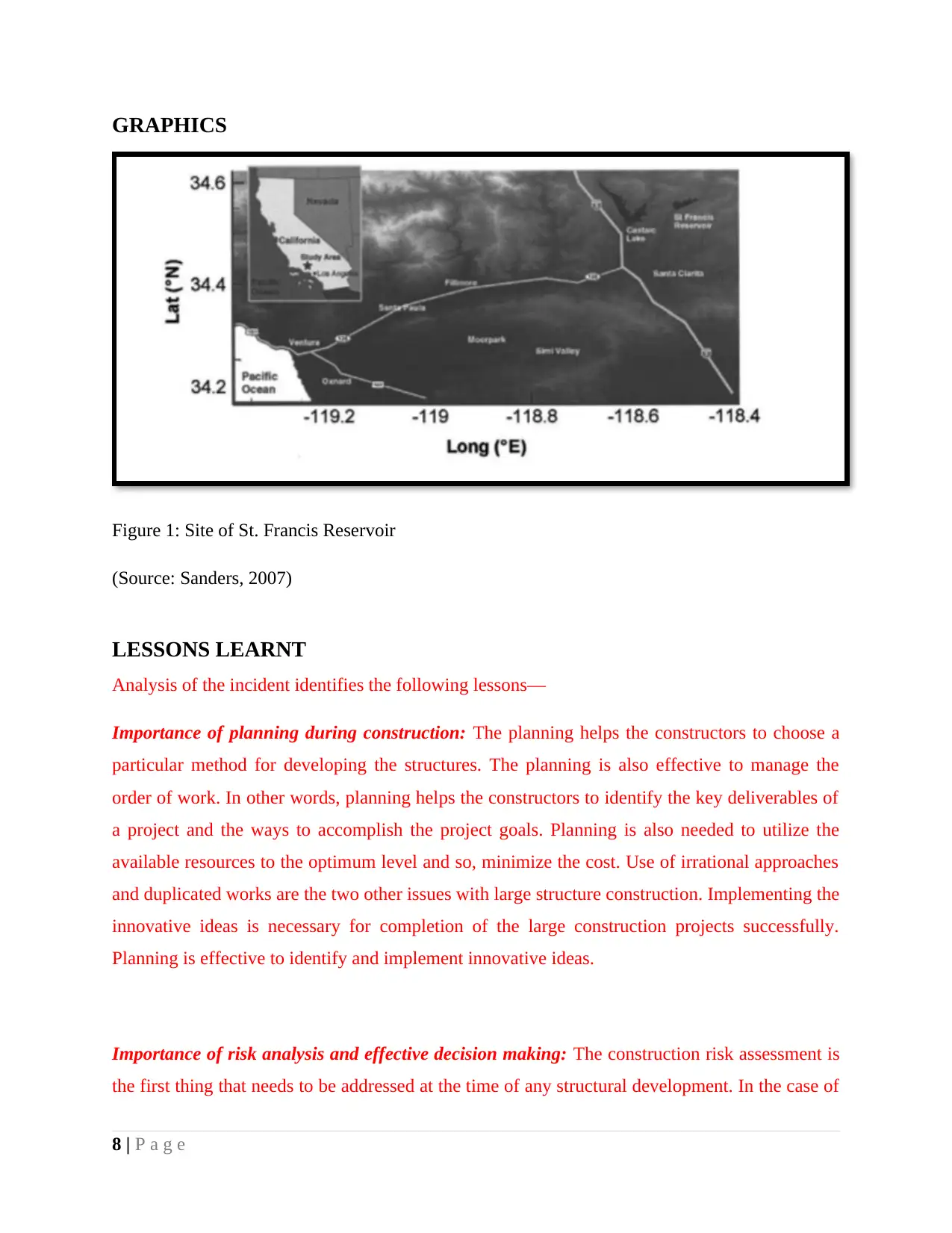
Figure 1: Site of St. Francis Reservoir
(Source: Sanders, 2007)
LESSONS LEARNT
Analysis of the incident identifies the following lessons—
Importance of planning during construction: The planning helps the constructors to choose a
particular method for developing the structures. The planning is also effective to manage the
order of work. In other words, planning helps the constructors to identify the key deliverables of
a project and the ways to accomplish the project goals. Planning is also needed to utilize the
available resources to the optimum level and so, minimize the cost. Use of irrational approaches
and duplicated works are the two other issues with large structure construction. Implementing the
innovative ideas is necessary for completion of the large construction projects successfully.
Planning is effective to identify and implement innovative ideas.
Importance of risk analysis and effective decision making: The construction risk assessment is
the first thing that needs to be addressed at the time of any structural development. In the case of
8 | P a g e
Figure 1: Site of St. Francis Reservoir
(Source: Sanders, 2007)
LESSONS LEARNT
Analysis of the incident identifies the following lessons—
Importance of planning during construction: The planning helps the constructors to choose a
particular method for developing the structures. The planning is also effective to manage the
order of work. In other words, planning helps the constructors to identify the key deliverables of
a project and the ways to accomplish the project goals. Planning is also needed to utilize the
available resources to the optimum level and so, minimize the cost. Use of irrational approaches
and duplicated works are the two other issues with large structure construction. Implementing the
innovative ideas is necessary for completion of the large construction projects successfully.
Planning is effective to identify and implement innovative ideas.
Importance of risk analysis and effective decision making: The construction risk assessment is
the first thing that needs to be addressed at the time of any structural development. In the case of
8 | P a g e
the current dam, the risks associated with shrinkage splits were not associated in advance. Later,
the improper treatment with the shrinkage splits caused failure of the entire dam. So, on
completion of the design, it is necessary to assess the risks and take actions accordingly. The
foundation of a structure is one of the most important parts. Cracks in the foundation can
collapse the entire structure (Scott, 2013). So, special attention needs to be given for planning
and analyzing risk to the foundation.
RECOMMENDATIONS
The following recommendations can be incorporated while executing a construction project—
Reviewing the design regularly-- While construction a complex structure, different parts of it can
be changed. However, in a structure, the strength of a part can be dependent on the others. So,
while modifying any single part of the structure, the entire design needs to be reviewed and the
necessary changes should be incorporated.
Implementing effective decision-making system-- A multistage decision-making system can be
incorporated during the development of a complex construction. A decision on the resource
utilization or the structural modification can be reviewed by different professionals at different
stages before being implemented.
CONCLUSION
The discussion on the failure of St. Francis dam reveals some key issues in the field of
engineering. Analysis of the Francis Dam failure indicates that the lack of planning was one of
the key reasons behind the collapse. During construction, the structure was modified but its base
was not changed accordingly. The lack of proper base affected the strength of the structure and it
caused the collapse later. The incident reveals that lack of planning played a key role behind the
collapse. While developing large structures, planning is important. All parts of a civil structure,
especially the base, influence the strength. When a part of the structure is altered, the design of
the base also needs to be changed accordingly to avoid collapse. In the current case, lack of
planning to modify the base with every change in the structure had adverse effects on the dam.
9 | P a g e
the improper treatment with the shrinkage splits caused failure of the entire dam. So, on
completion of the design, it is necessary to assess the risks and take actions accordingly. The
foundation of a structure is one of the most important parts. Cracks in the foundation can
collapse the entire structure (Scott, 2013). So, special attention needs to be given for planning
and analyzing risk to the foundation.
RECOMMENDATIONS
The following recommendations can be incorporated while executing a construction project—
Reviewing the design regularly-- While construction a complex structure, different parts of it can
be changed. However, in a structure, the strength of a part can be dependent on the others. So,
while modifying any single part of the structure, the entire design needs to be reviewed and the
necessary changes should be incorporated.
Implementing effective decision-making system-- A multistage decision-making system can be
incorporated during the development of a complex construction. A decision on the resource
utilization or the structural modification can be reviewed by different professionals at different
stages before being implemented.
CONCLUSION
The discussion on the failure of St. Francis dam reveals some key issues in the field of
engineering. Analysis of the Francis Dam failure indicates that the lack of planning was one of
the key reasons behind the collapse. During construction, the structure was modified but its base
was not changed accordingly. The lack of proper base affected the strength of the structure and it
caused the collapse later. The incident reveals that lack of planning played a key role behind the
collapse. While developing large structures, planning is important. All parts of a civil structure,
especially the base, influence the strength. When a part of the structure is altered, the design of
the base also needs to be changed accordingly to avoid collapse. In the current case, lack of
planning to modify the base with every change in the structure had adverse effects on the dam.
9 | P a g e
⊘ This is a preview!⊘
Do you want full access?
Subscribe today to unlock all pages.
Trusted by 1+ million students worldwide

The lack of effective decision making was another factor that caused the failure of the dam.
Analysis of the incident also indicates that the strength of the dam was also affected due to its
position against the tide. The shrinkage splits in the dam were stopped on the downstream side.
Because of it, the dam experienced huge hydrostatic pressure which pushed the entire structure
by side. The excessive pressure on the dam also affected the strength and caused the failure. The
incident also indicates that the huge loss could be avoided by working on the shrinkage breaks in
the upstream. It indicates the evidence of ineffective decision making during the construction.
The lack of proper resource utilization was another factor behind the collapse. During a
construction, the resource needs to be utilized in the proper manner to finish the entire project
within the stipulated time and cost. In this case, the lack of proper resource utilization was
another factor that reduced the effectiveness of the project. In the current case, the structural
modification was done after a huge portion of the resources were depleted. So, the construction
project failed to be finished effectively. As evident from the research, the issues associated with
the construction of a complex structure can be mitigated by reviewing the design several times
and implementing a decision-making system.
10 | P a g e
Analysis of the incident also indicates that the strength of the dam was also affected due to its
position against the tide. The shrinkage splits in the dam were stopped on the downstream side.
Because of it, the dam experienced huge hydrostatic pressure which pushed the entire structure
by side. The excessive pressure on the dam also affected the strength and caused the failure. The
incident also indicates that the huge loss could be avoided by working on the shrinkage breaks in
the upstream. It indicates the evidence of ineffective decision making during the construction.
The lack of proper resource utilization was another factor behind the collapse. During a
construction, the resource needs to be utilized in the proper manner to finish the entire project
within the stipulated time and cost. In this case, the lack of proper resource utilization was
another factor that reduced the effectiveness of the project. In the current case, the structural
modification was done after a huge portion of the resources were depleted. So, the construction
project failed to be finished effectively. As evident from the research, the issues associated with
the construction of a complex structure can be mitigated by reviewing the design several times
and implementing a decision-making system.
10 | P a g e
Paraphrase This Document
Need a fresh take? Get an instant paraphrase of this document with our AI Paraphraser

11 | P a g e

REFERENCES
Begnudelli, L., & Sanders, B. F. (2007). Simulation of the St. Francis dam-break flood. Journal
of Engineering Mechanics, 133(11), 1200-1212.
Orr, H. K. (1973, March). THE BLACK HILLS (South Dakota) FLOODS OF JUNE 1972:
IMPACTS AND IMPLICATIONS. Retrieved from
https://www.fs.fed.us/rm/pubs_exp_for/black_hills/exp_for_black_hills_1973_orr.pdf
Sanders, L. B. (2007). Simulation of the St. Francis Dam-Break Flood.
Scott, G. A. (2013, May 16). Austin (Bayless) Dam Lessons in Penny - Pinching. Retrieved from
https://cdn.ymaws.com/www.aegweb.org/resource/resmgr/Dams/6-
scott_austin_bayless_dam.pdf?sfvrsn=2
12 | P a g e
Begnudelli, L., & Sanders, B. F. (2007). Simulation of the St. Francis dam-break flood. Journal
of Engineering Mechanics, 133(11), 1200-1212.
Orr, H. K. (1973, March). THE BLACK HILLS (South Dakota) FLOODS OF JUNE 1972:
IMPACTS AND IMPLICATIONS. Retrieved from
https://www.fs.fed.us/rm/pubs_exp_for/black_hills/exp_for_black_hills_1973_orr.pdf
Sanders, L. B. (2007). Simulation of the St. Francis Dam-Break Flood.
Scott, G. A. (2013, May 16). Austin (Bayless) Dam Lessons in Penny - Pinching. Retrieved from
https://cdn.ymaws.com/www.aegweb.org/resource/resmgr/Dams/6-
scott_austin_bayless_dam.pdf?sfvrsn=2
12 | P a g e
⊘ This is a preview!⊘
Do you want full access?
Subscribe today to unlock all pages.
Trusted by 1+ million students worldwide

1 out of 12


Your All-in-One AI-Powered Toolkit for Academic Success.
+13062052269
info@desklib.com
Available 24*7 on WhatsApp / Email
![[object Object]](/_next/static/media/star-bottom.7253800d.svg)
Unlock your academic potential
Copyright © 2020–2026 A2Z Services. All Rights Reserved. Developed and managed by ZUCOL.