Legal and Ethical Compliance: Disability Support Workbook Assessment
VerifiedAdded on 2023/01/06
|107
|14733
|46
Homework Assignment
AI Summary
This assignment is a comprehensive assessment workbook focused on legal and ethical compliance within the context of disability support services. It covers key areas such as human rights, human needs, and the application of human rights instruments in the workplace. The assessment delves into the responsibilities and rights of employers, workers, and clients, and explores prohibited practices and effective techniques for monitoring compliance. Furthermore, it examines the auditing and inspection framework of the NDIS Quality and Safeguarding Framework and the sanctions imposed for non-compliance under the Disability Services Act 1986. The assignment also covers mandatory certifications and training requirements for disability support workers, and provides information on NDIS registration and required business insurances for service providers.
Assessment Workbook
2
Page 1
Version No. 2.7 Produced 02 June
2020
© Compliant Learning Resources
Disability workbook
2
Page 1
Version No. 2.7 Produced 02 June
2020
© Compliant Learning Resources
Disability workbook
Paraphrase This Document
Need a fresh take? Get an instant paraphrase of this document with our AI Paraphraser

Assessment Workbook
2
Page 2
Version No. 2.7 Produced 02 June
2020
© Compliant Learning Resources
KNOWLEDGE ASSESSMENT
Part 1A – Legal and Ethical Compliance
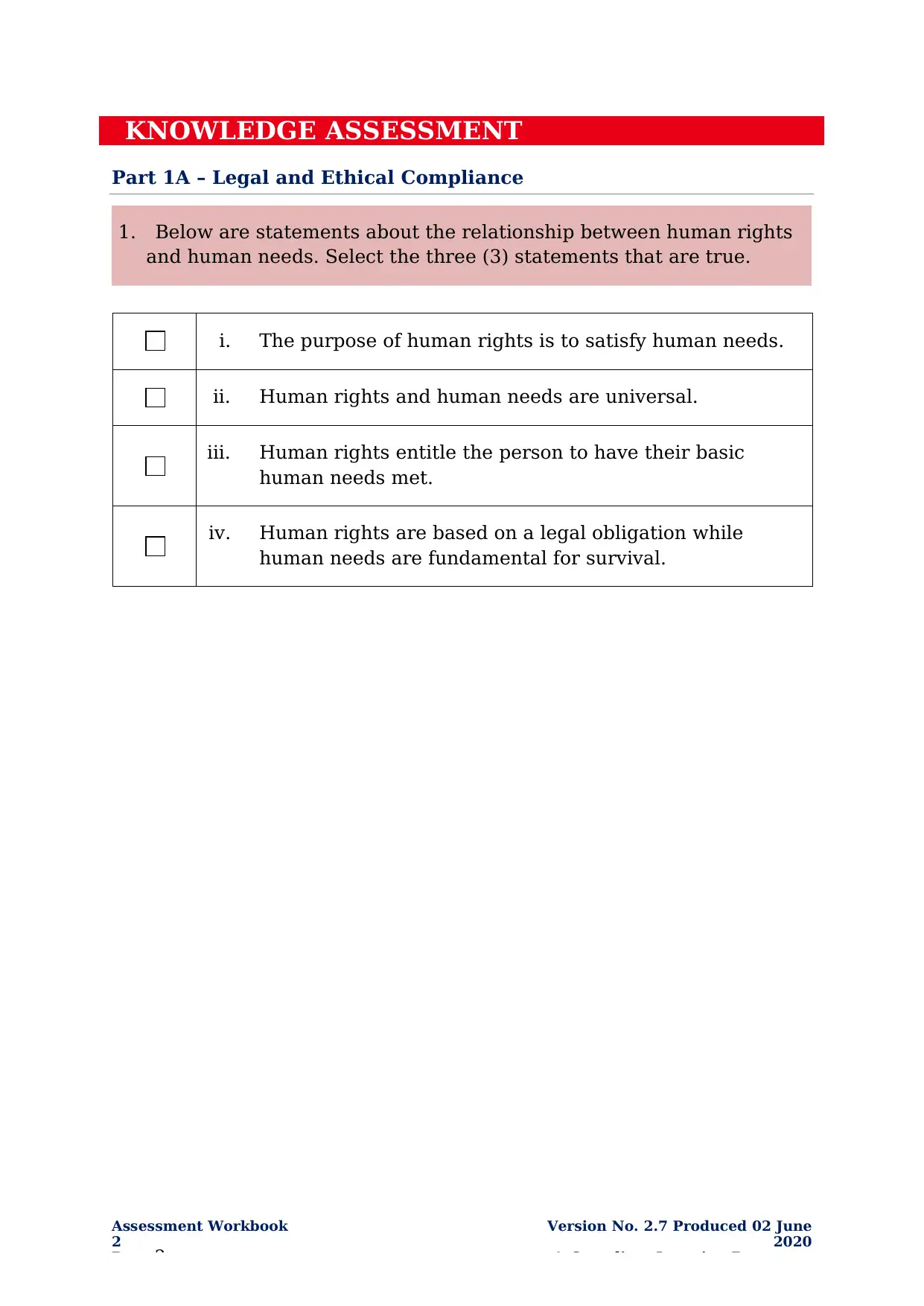
i. The purpose of human rights is to satisfy human needs.
ii. Human rights and human needs are universal.
iii. Human rights entitle the person to have their basic
human needs met.
iv. Human rights are based on a legal obligation while
human needs are fundamental for survival.
1. Below are statements about the relationship between human rights
and human needs. Select the three (3) statements that are true.
2
Page 2
Version No. 2.7 Produced 02 June
2020
© Compliant Learning Resources
KNOWLEDGE ASSESSMENT
Part 1A – Legal and Ethical Compliance
i. The purpose of human rights is to satisfy human needs.
ii. Human rights and human needs are universal.
iii. Human rights entitle the person to have their basic
human needs met.
iv. Human rights are based on a legal obligation while
human needs are fundamental for survival.
1. Below are statements about the relationship between human rights
and human needs. Select the three (3) statements that are true.

Assessment Workbook
2
Page 3
Version No. 2.7 Produced 02 June
2020
© Compliant Learning Resources
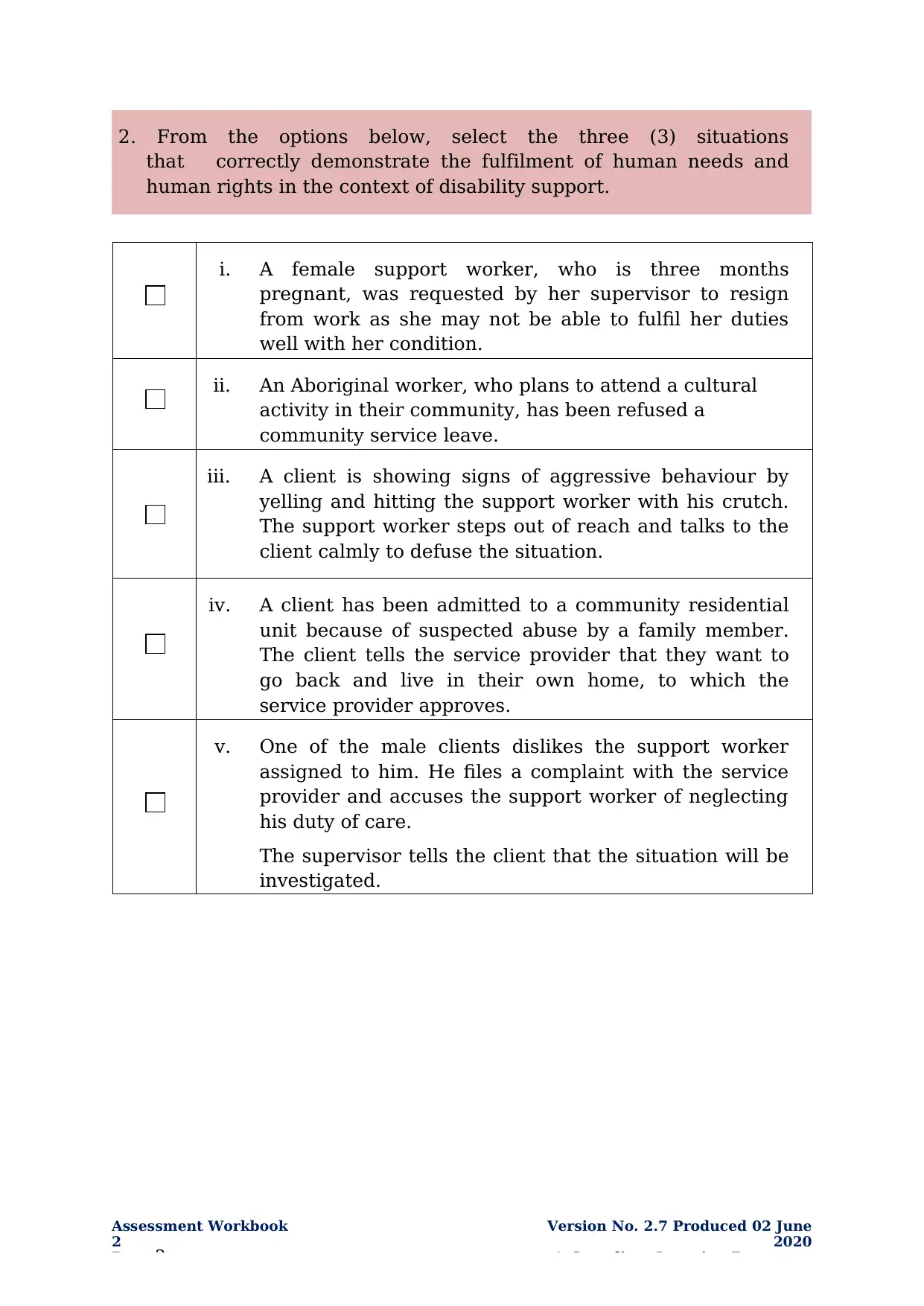
i. A female support worker, who is three months
pregnant, was requested by her supervisor to resign
from work as she may not be able to fulfil her duties
well with her condition.
ii. An Aboriginal worker, who plans to attend a cultural
activity in their community, has been refused a
community service leave.
iii. A client is showing signs of aggressive behaviour by
yelling and hitting the support worker with his crutch.
The support worker steps out of reach and talks to the
client calmly to defuse the situation.
iv. A client has been admitted to a community residential
unit because of suspected abuse by a family member.
The client tells the service provider that they want to
go back and live in their own home, to which the
service provider approves.
v. One of the male clients dislikes the support worker
assigned to him. He files a complaint with the service
provider and accuses the support worker of neglecting
his duty of care.
The supervisor tells the client that the situation will be
investigated.
2. From the options below, select the three (3) situations
that correctly demonstrate the fulfilment of human needs and
human rights in the context of disability support.
2
Page 3
Version No. 2.7 Produced 02 June
2020
© Compliant Learning Resources
i. A female support worker, who is three months
pregnant, was requested by her supervisor to resign
from work as she may not be able to fulfil her duties
well with her condition.
ii. An Aboriginal worker, who plans to attend a cultural
activity in their community, has been refused a
community service leave.
iii. A client is showing signs of aggressive behaviour by
yelling and hitting the support worker with his crutch.
The support worker steps out of reach and talks to the
client calmly to defuse the situation.
iv. A client has been admitted to a community residential
unit because of suspected abuse by a family member.
The client tells the service provider that they want to
go back and live in their own home, to which the
service provider approves.
v. One of the male clients dislikes the support worker
assigned to him. He files a complaint with the service
provider and accuses the support worker of neglecting
his duty of care.
The supervisor tells the client that the situation will be
investigated.
2. From the options below, select the three (3) situations
that correctly demonstrate the fulfilment of human needs and
human rights in the context of disability support.
⊘ This is a preview!⊘
Do you want full access?
Subscribe today to unlock all pages.

Trusted by 1+ million students worldwide

Assessment Workbook
2
Page 4
Version No. 2.7 Produced 02 June
2020
© Compliant Learning Resources
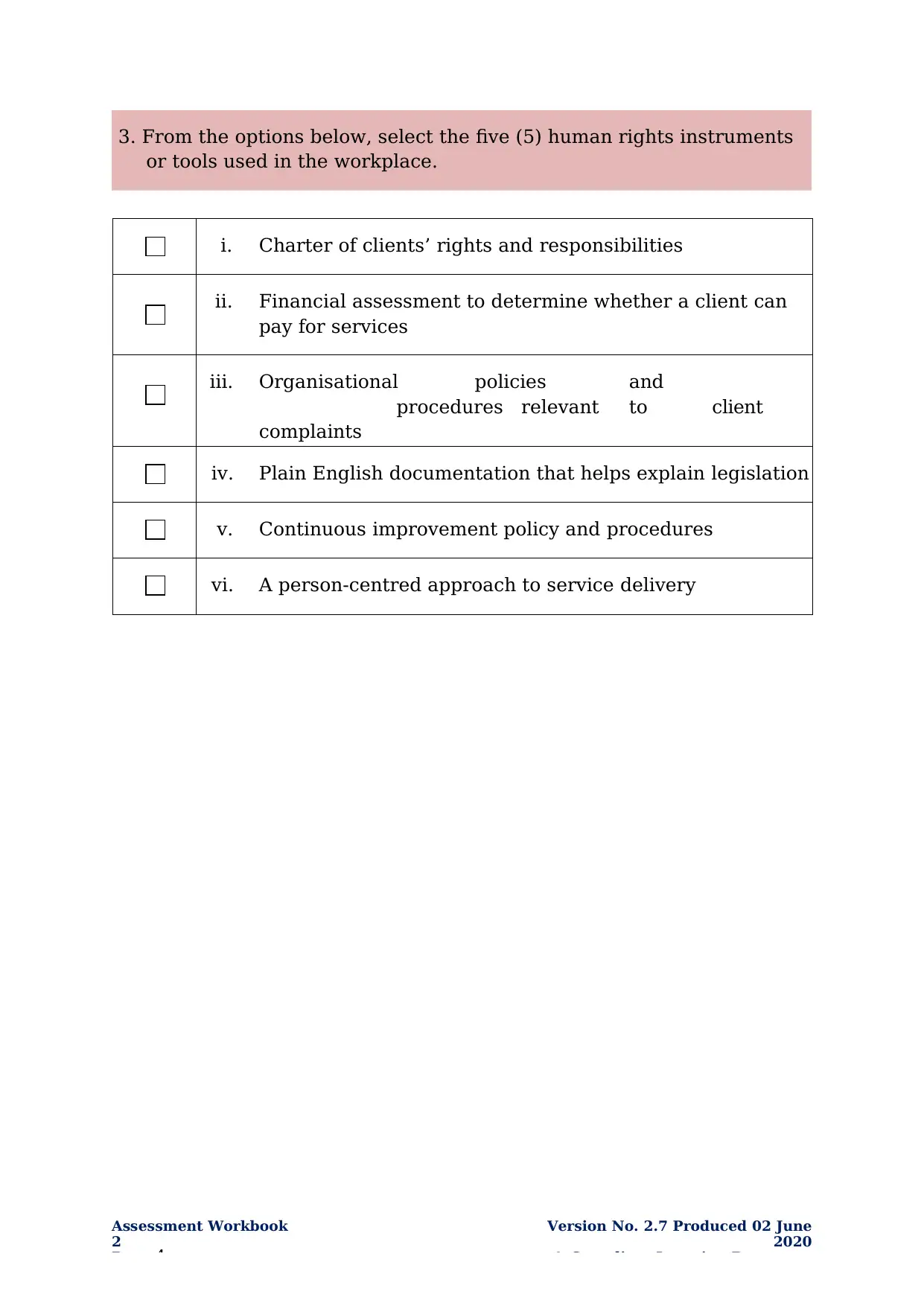
i. Charter of clients’ rights and responsibilities
ii. Financial assessment to determine whether a client can
pay for services
iii. Organisational policies and
procedures relevant to client
complaints
iv. Plain English documentation that helps explain legislation
v. Continuous improvement policy and procedures
vi. A person-centred approach to service delivery
3. From the options below, select the five (5) human rights instruments
or tools used in the workplace.
2
Page 4
Version No. 2.7 Produced 02 June
2020
© Compliant Learning Resources
i. Charter of clients’ rights and responsibilities
ii. Financial assessment to determine whether a client can
pay for services
iii. Organisational policies and
procedures relevant to client
complaints
iv. Plain English documentation that helps explain legislation
v. Continuous improvement policy and procedures
vi. A person-centred approach to service delivery
3. From the options below, select the five (5) human rights instruments
or tools used in the workplace.
Paraphrase This Document
Need a fresh take? Get an instant paraphrase of this document with our AI Paraphraser

Assessment Workbook
2
Page 5
Version No. 2.7 Produced 02 June
2020
© Compliant Learning Resources
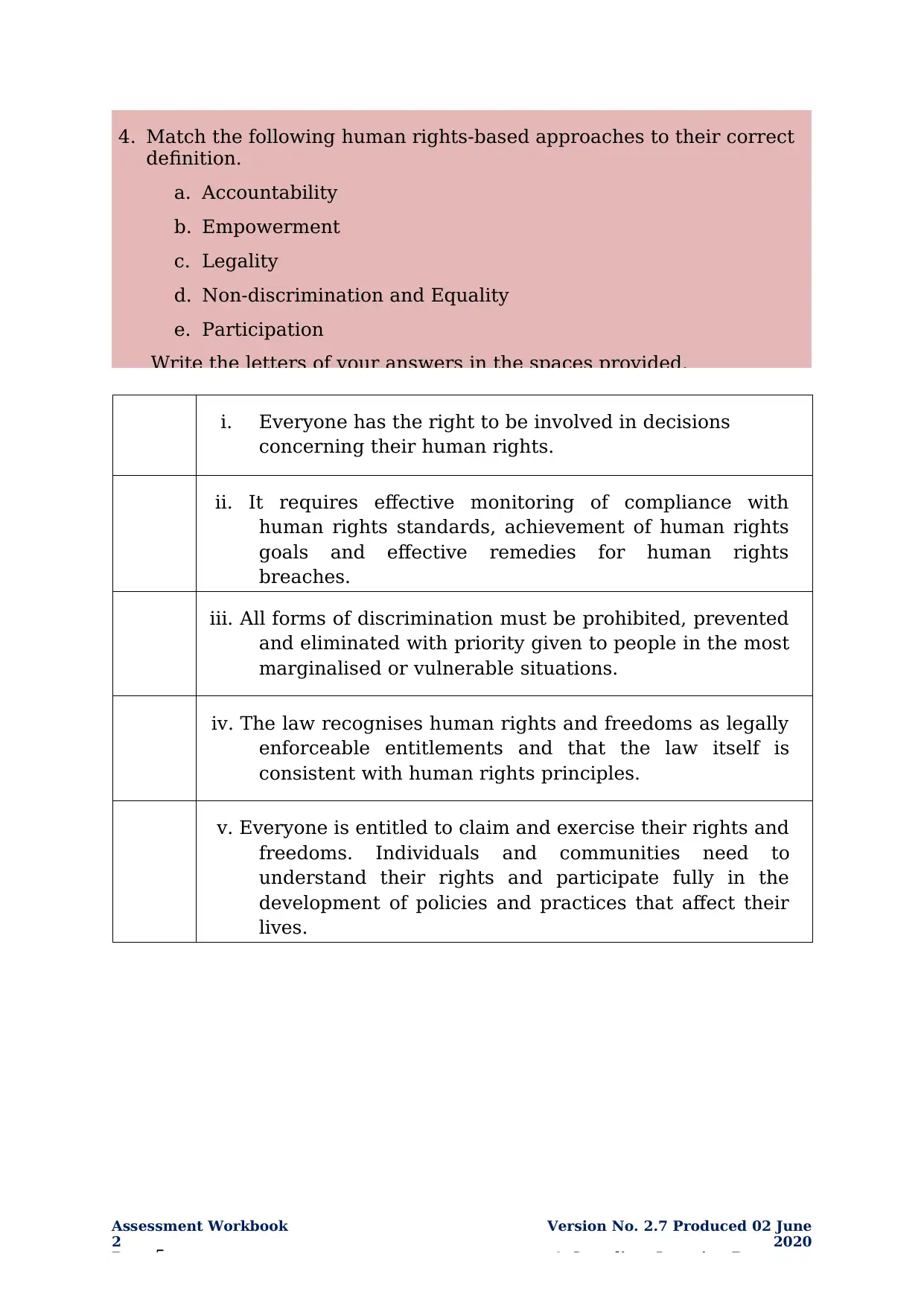
i. Everyone has the right to be involved in decisions
concerning their human rights.
ii. It requires effective monitoring of compliance with
human rights standards, achievement of human rights
goals and effective remedies for human rights
breaches.
iii. All forms of discrimination must be prohibited, prevented
and eliminated with priority given to people in the most
marginalised or vulnerable situations.
iv. The law recognises human rights and freedoms as legally
enforceable entitlements and that the law itself is
consistent with human rights principles.
v. Everyone is entitled to claim and exercise their rights and
freedoms. Individuals and communities need to
understand their rights and participate fully in the
development of policies and practices that affect their
lives.
4. Match the following human rights-based approaches to their correct
definition.
a. Accountability
b. Empowerment
c. Legality
d. Non-discrimination and Equality
e. Participation
Write the letters of your answers in the spaces provided.
2
Page 5
Version No. 2.7 Produced 02 June
2020
© Compliant Learning Resources
i. Everyone has the right to be involved in decisions
concerning their human rights.
ii. It requires effective monitoring of compliance with
human rights standards, achievement of human rights
goals and effective remedies for human rights
breaches.
iii. All forms of discrimination must be prohibited, prevented
and eliminated with priority given to people in the most
marginalised or vulnerable situations.
iv. The law recognises human rights and freedoms as legally
enforceable entitlements and that the law itself is
consistent with human rights principles.
v. Everyone is entitled to claim and exercise their rights and
freedoms. Individuals and communities need to
understand their rights and participate fully in the
development of policies and practices that affect their
lives.
4. Match the following human rights-based approaches to their correct
definition.
a. Accountability
b. Empowerment
c. Legality
d. Non-discrimination and Equality
e. Participation
Write the letters of your answers in the spaces provided.

Assessment Workbook
2
Page 6
Version No. 2.7 Produced 02 June
2020
© Compliant Learning Resources
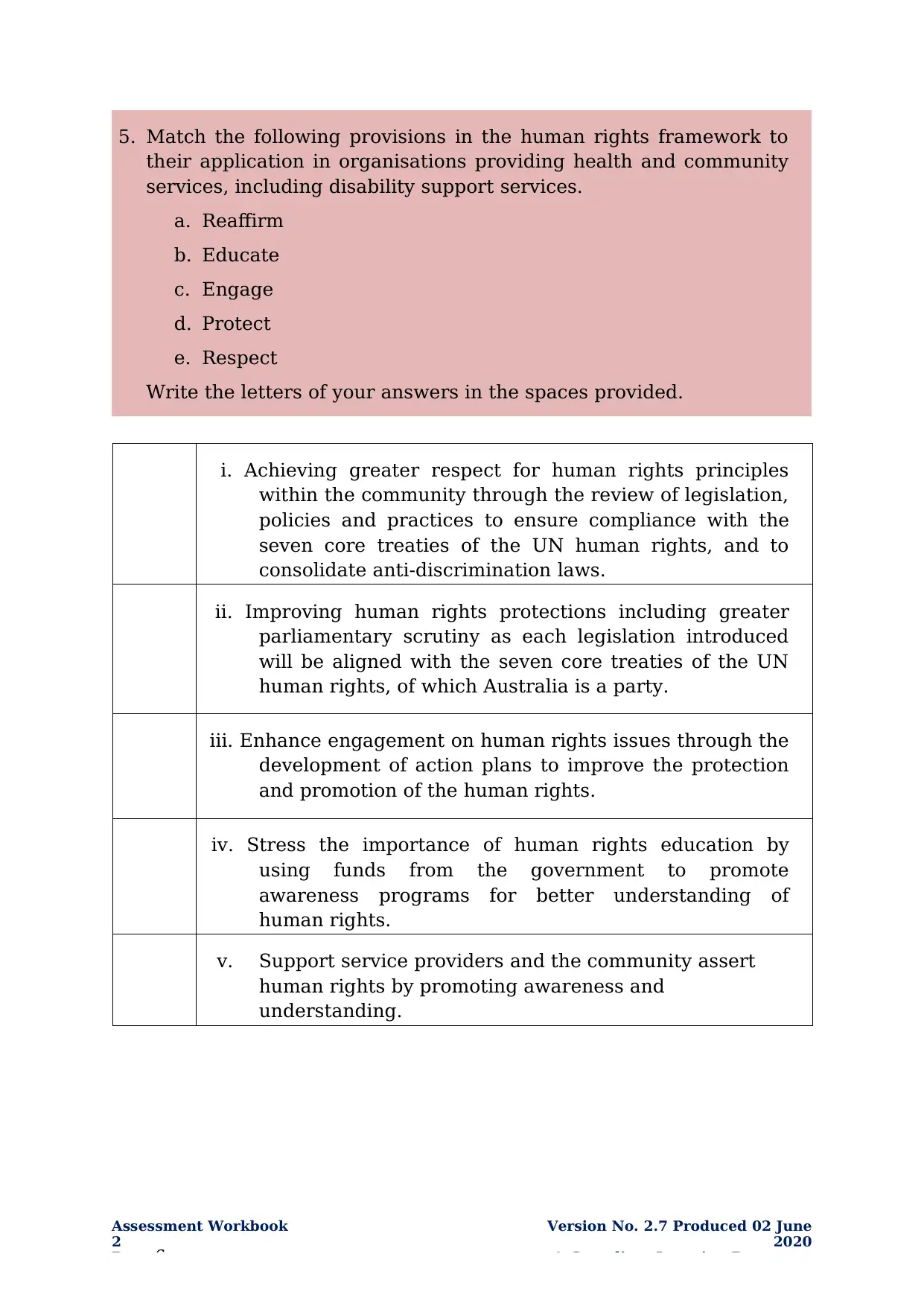
i. Achieving greater respect for human rights principles
within the community through the review of legislation,
policies and practices to ensure compliance with the
seven core treaties of the UN human rights, and to
consolidate anti-discrimination laws.
ii. Improving human rights protections including greater
parliamentary scrutiny as each legislation introduced
will be aligned with the seven core treaties of the UN
human rights, of which Australia is a party.
iii. Enhance engagement on human rights issues through the
development of action plans to improve the protection
and promotion of the human rights.
iv. Stress the importance of human rights education by
using funds from the government to promote
awareness programs for better understanding of
human rights.
v. Support service providers and the community assert
human rights by promoting awareness and
understanding.
5. Match the following provisions in the human rights framework to
their application in organisations providing health and community
services, including disability support services.
a. Reaffirm
b. Educate
c. Engage
d. Protect
e. Respect
Write the letters of your answers in the spaces provided.
2
Page 6
Version No. 2.7 Produced 02 June
2020
© Compliant Learning Resources
i. Achieving greater respect for human rights principles
within the community through the review of legislation,
policies and practices to ensure compliance with the
seven core treaties of the UN human rights, and to
consolidate anti-discrimination laws.
ii. Improving human rights protections including greater
parliamentary scrutiny as each legislation introduced
will be aligned with the seven core treaties of the UN
human rights, of which Australia is a party.
iii. Enhance engagement on human rights issues through the
development of action plans to improve the protection
and promotion of the human rights.
iv. Stress the importance of human rights education by
using funds from the government to promote
awareness programs for better understanding of
human rights.
v. Support service providers and the community assert
human rights by promoting awareness and
understanding.
5. Match the following provisions in the human rights framework to
their application in organisations providing health and community
services, including disability support services.
a. Reaffirm
b. Educate
c. Engage
d. Protect
e. Respect
Write the letters of your answers in the spaces provided.
⊘ This is a preview!⊘
Do you want full access?
Subscribe today to unlock all pages.

Trusted by 1+ million students worldwide

Assessment Workbook
2
Page 7
Version No. 2.7 Produced 02 June
2020
© Compliant Learning Resources
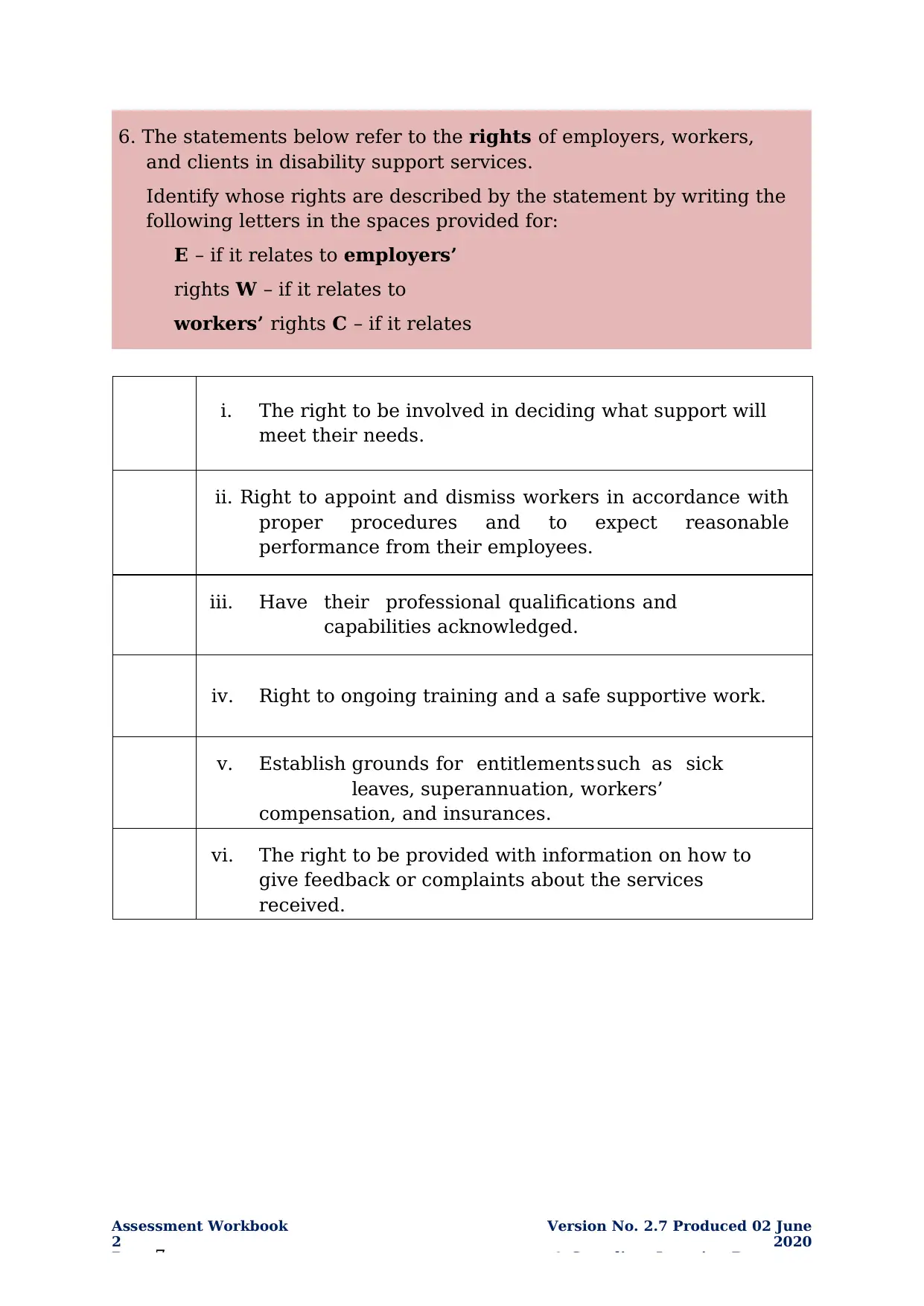
i. The right to be involved in deciding what support will
meet their needs.
ii. Right to appoint and dismiss workers in accordance with
proper procedures and to expect reasonable
performance from their employees.
iii. Have their professional qualifications and
capabilities acknowledged.
iv. Right to ongoing training and a safe supportive work.
v. Establish grounds for entitlementssuch as sick
leaves, superannuation, workers’
compensation, and insurances.
vi. The right to be provided with information on how to
give feedback or complaints about the services
received.
6. The statements below refer to the rights of employers, workers,
and clients in disability support services.
Identify whose rights are described by the statement by writing the
following letters in the spaces provided for:
E – if it relates to employers’
rights W – if it relates to
workers’ rights C – if it relates
to clients’ rights
2
Page 7
Version No. 2.7 Produced 02 June
2020
© Compliant Learning Resources
i. The right to be involved in deciding what support will
meet their needs.
ii. Right to appoint and dismiss workers in accordance with
proper procedures and to expect reasonable
performance from their employees.
iii. Have their professional qualifications and
capabilities acknowledged.
iv. Right to ongoing training and a safe supportive work.
v. Establish grounds for entitlementssuch as sick
leaves, superannuation, workers’
compensation, and insurances.
vi. The right to be provided with information on how to
give feedback or complaints about the services
received.
6. The statements below refer to the rights of employers, workers,
and clients in disability support services.
Identify whose rights are described by the statement by writing the
following letters in the spaces provided for:
E – if it relates to employers’
rights W – if it relates to
workers’ rights C – if it relates
to clients’ rights
Paraphrase This Document
Need a fresh take? Get an instant paraphrase of this document with our AI Paraphraser

Assessment Workbook
2
Page 8
Version No. 2.7 Produced 02 June
2020
© Compliant Learning Resources
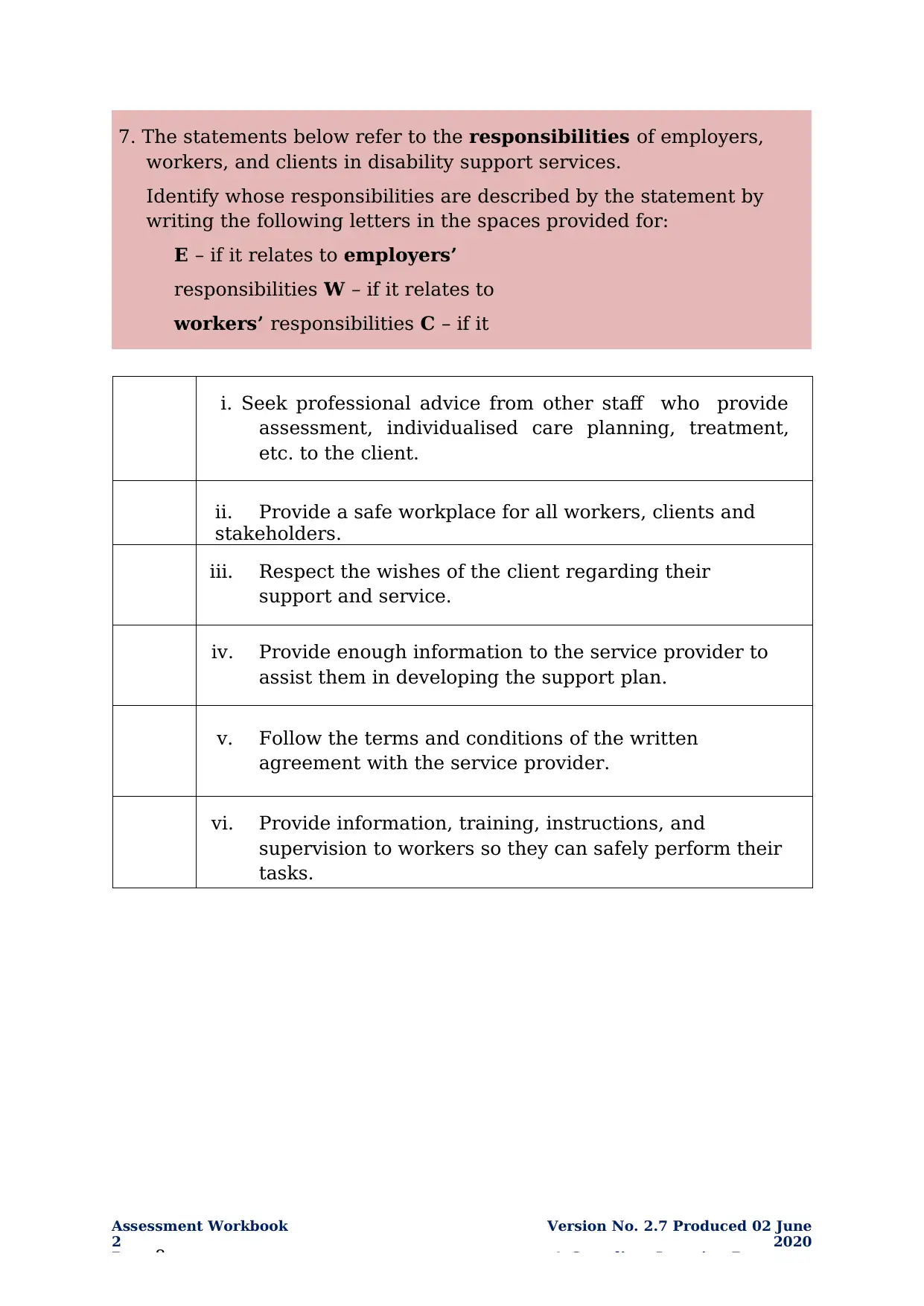
i. Seek professional advice from other staff who provide
assessment, individualised care planning, treatment,
etc. to the client.
ii. Provide a safe workplace for all workers, clients and
stakeholders.
iii. Respect the wishes of the client regarding their
support and service.
iv. Provide enough information to the service provider to
assist them in developing the support plan.
v. Follow the terms and conditions of the written
agreement with the service provider.
vi. Provide information, training, instructions, and
supervision to workers so they can safely perform their
tasks.
7. The statements below refer to the responsibilities of employers,
workers, and clients in disability support services.
Identify whose responsibilities are described by the statement by
writing the following letters in the spaces provided for:
E – if it relates to employers’
responsibilities W – if it relates to
workers’ responsibilities C – if it
relates to clients’ responsibilities
2
Page 8
Version No. 2.7 Produced 02 June
2020
© Compliant Learning Resources
i. Seek professional advice from other staff who provide
assessment, individualised care planning, treatment,
etc. to the client.
ii. Provide a safe workplace for all workers, clients and
stakeholders.
iii. Respect the wishes of the client regarding their
support and service.
iv. Provide enough information to the service provider to
assist them in developing the support plan.
v. Follow the terms and conditions of the written
agreement with the service provider.
vi. Provide information, training, instructions, and
supervision to workers so they can safely perform their
tasks.
7. The statements below refer to the responsibilities of employers,
workers, and clients in disability support services.
Identify whose responsibilities are described by the statement by
writing the following letters in the spaces provided for:
E – if it relates to employers’
responsibilities W – if it relates to
workers’ responsibilities C – if it
relates to clients’ responsibilities

Assessment Workbook
2
Page 9
Version No. 2.7 Produced 02 June
2020
© Compliant Learning Resources
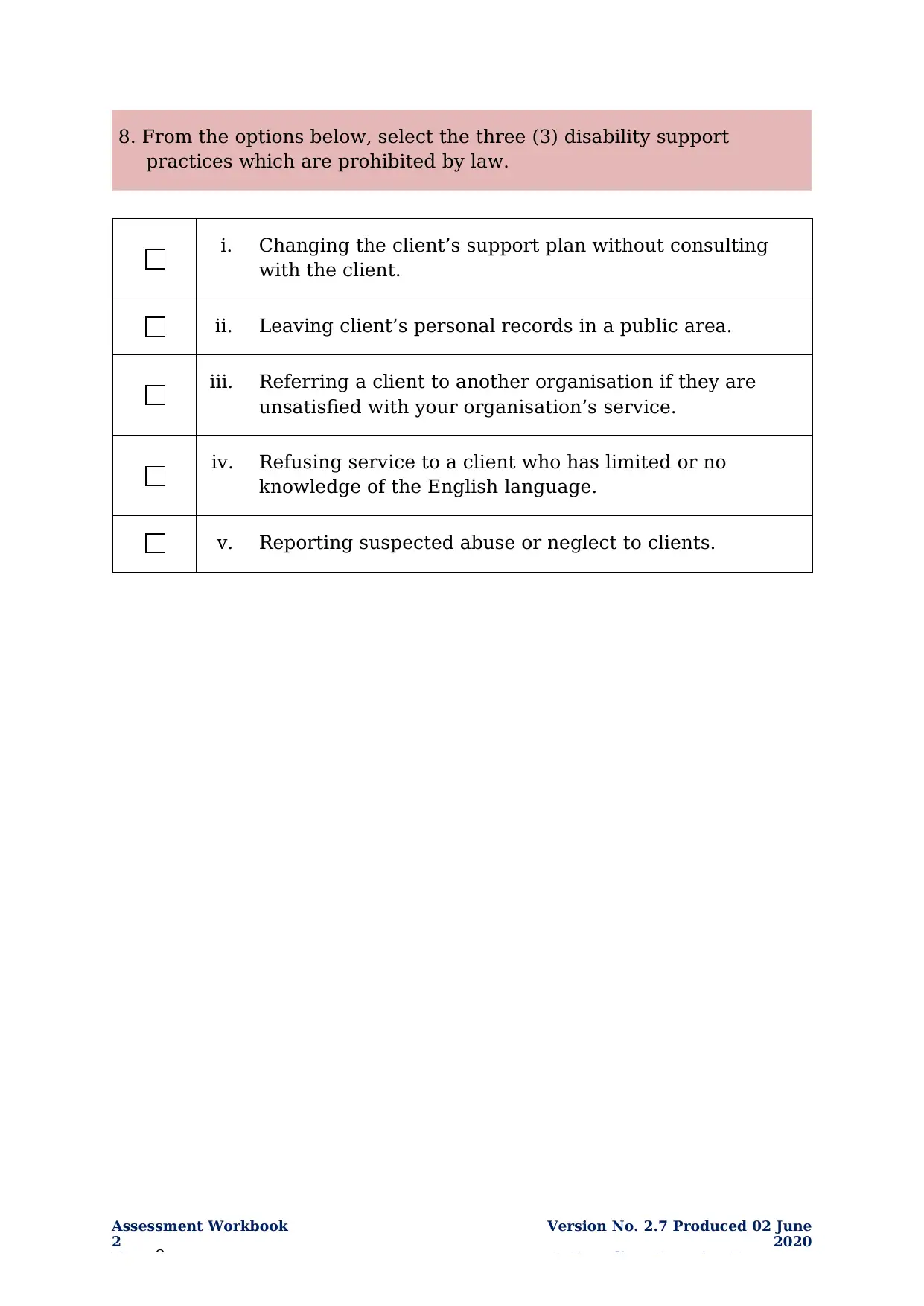
i. Changing the client’s support plan without consulting
with the client.
ii. Leaving client’s personal records in a public area.
iii. Referring a client to another organisation if they are
unsatisfied with your organisation’s service.
iv. Refusing service to a client who has limited or no
knowledge of the English language.
v. Reporting suspected abuse or neglect to clients.
8. From the options below, select the three (3) disability support
practices which are prohibited by law.
2
Page 9
Version No. 2.7 Produced 02 June
2020
© Compliant Learning Resources
i. Changing the client’s support plan without consulting
with the client.
ii. Leaving client’s personal records in a public area.
iii. Referring a client to another organisation if they are
unsatisfied with your organisation’s service.
iv. Refusing service to a client who has limited or no
knowledge of the English language.
v. Reporting suspected abuse or neglect to clients.
8. From the options below, select the three (3) disability support
practices which are prohibited by law.
⊘ This is a preview!⊘
Do you want full access?
Subscribe today to unlock all pages.

Trusted by 1+ million students worldwide

Assessment Workbook
2
Page 10
Version No. 2.7 Produced 02 June
2020
© Compliant Learning Resources
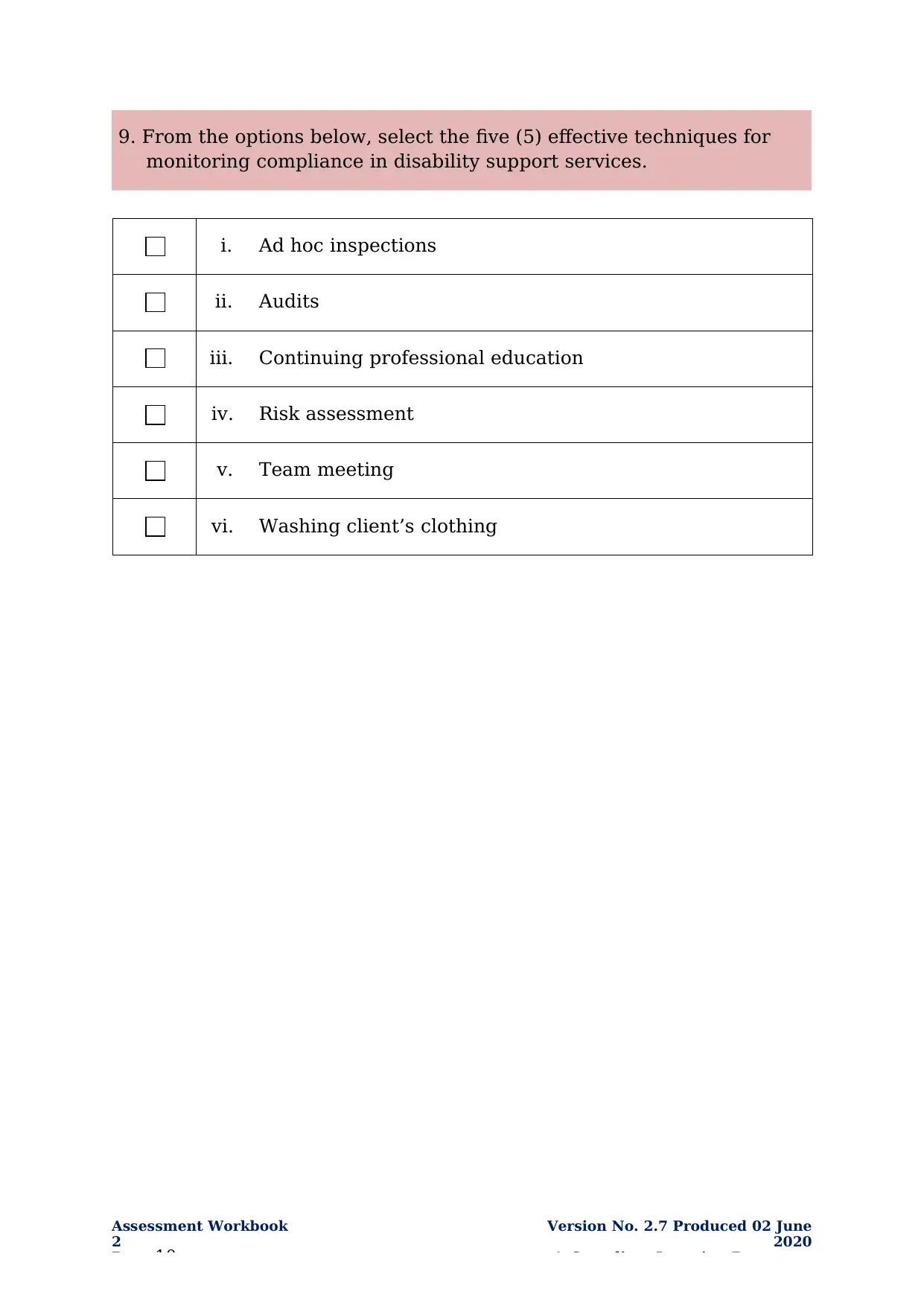
i. Ad hoc inspections
ii. Audits
iii. Continuing professional education
iv. Risk assessment
v. Team meeting
vi. Washing client’s clothing
9. From the options below, select the five (5) effective techniques for
monitoring compliance in disability support services.
2
Page 10
Version No. 2.7 Produced 02 June
2020
© Compliant Learning Resources
i. Ad hoc inspections
ii. Audits
iii. Continuing professional education
iv. Risk assessment
v. Team meeting
vi. Washing client’s clothing
9. From the options below, select the five (5) effective techniques for
monitoring compliance in disability support services.
Paraphrase This Document
Need a fresh take? Get an instant paraphrase of this document with our AI Paraphraser

Assessment Workbook
2
Page 11
Version No. 2.7 Produced 02 June
2020
© Compliant Learning Resources
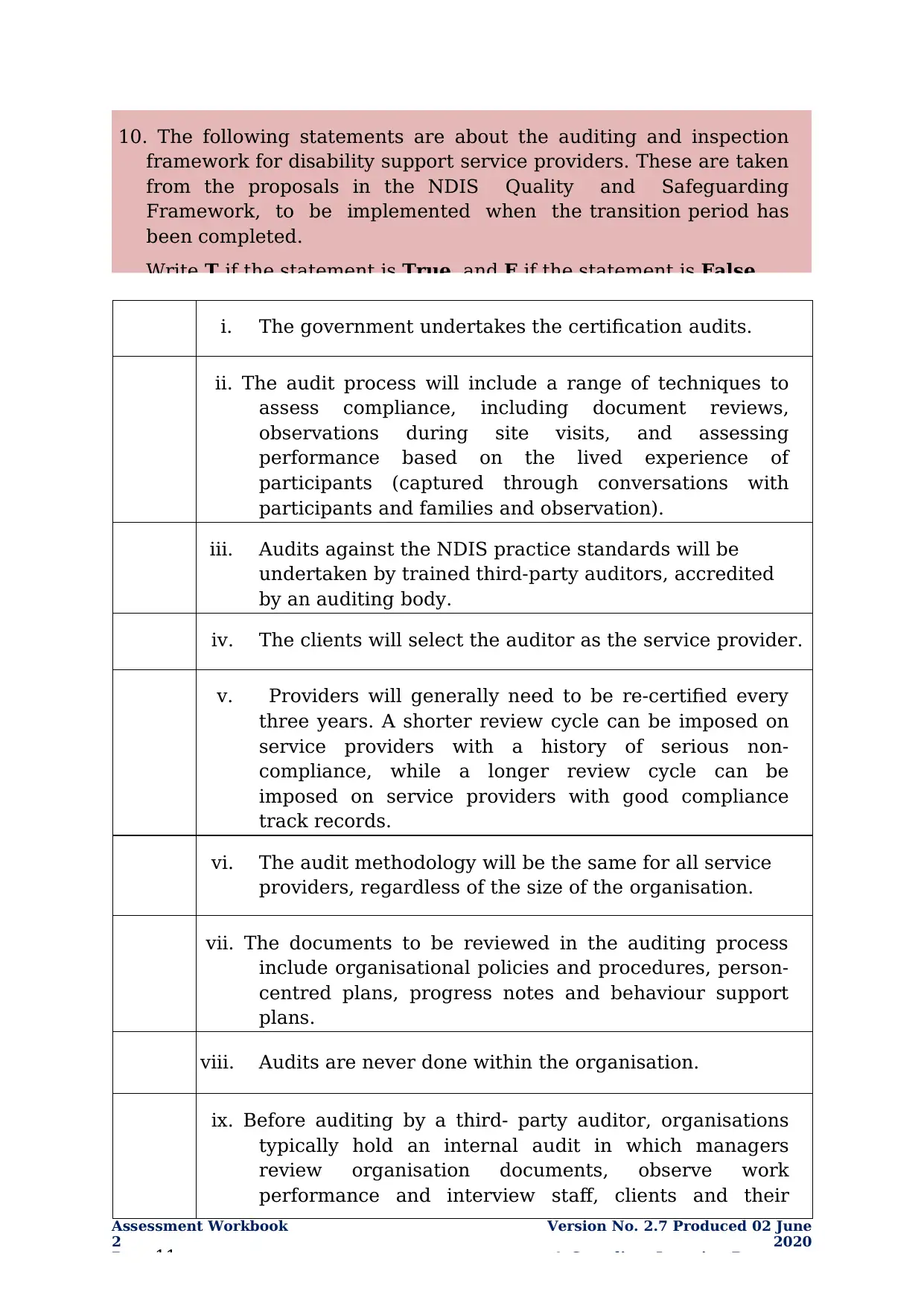
i. The government undertakes the certification audits.
ii. The audit process will include a range of techniques to
assess compliance, including document reviews,
observations during site visits, and assessing
performance based on the lived experience of
participants (captured through conversations with
participants and families and observation).
iii. Audits against the NDIS practice standards will be
undertaken by trained third-party auditors, accredited
by an auditing body.
iv. The clients will select the auditor as the service provider.
v. Providers will generally need to be re-certified every
three years. A shorter review cycle can be imposed on
service providers with a history of serious non-
compliance, while a longer review cycle can be
imposed on service providers with good compliance
track records.
vi. The audit methodology will be the same for all service
providers, regardless of the size of the organisation.
vii. The documents to be reviewed in the auditing process
include organisational policies and procedures, person-
centred plans, progress notes and behaviour support
plans.
viii. Audits are never done within the organisation.
ix. Before auditing by a third- party auditor, organisations
typically hold an internal audit in which managers
review organisation documents, observe work
performance and interview staff, clients and their
10. The following statements are about the auditing and inspection
framework for disability support service providers. These are taken
from the proposals in the NDIS Quality and Safeguarding
Framework, to be implemented when the transition period has
been completed.
Write T if the statement is True, and F if the statement is False.
2
Page 11
Version No. 2.7 Produced 02 June
2020
© Compliant Learning Resources
i. The government undertakes the certification audits.
ii. The audit process will include a range of techniques to
assess compliance, including document reviews,
observations during site visits, and assessing
performance based on the lived experience of
participants (captured through conversations with
participants and families and observation).
iii. Audits against the NDIS practice standards will be
undertaken by trained third-party auditors, accredited
by an auditing body.
iv. The clients will select the auditor as the service provider.
v. Providers will generally need to be re-certified every
three years. A shorter review cycle can be imposed on
service providers with a history of serious non-
compliance, while a longer review cycle can be
imposed on service providers with good compliance
track records.
vi. The audit methodology will be the same for all service
providers, regardless of the size of the organisation.
vii. The documents to be reviewed in the auditing process
include organisational policies and procedures, person-
centred plans, progress notes and behaviour support
plans.
viii. Audits are never done within the organisation.
ix. Before auditing by a third- party auditor, organisations
typically hold an internal audit in which managers
review organisation documents, observe work
performance and interview staff, clients and their
10. The following statements are about the auditing and inspection
framework for disability support service providers. These are taken
from the proposals in the NDIS Quality and Safeguarding
Framework, to be implemented when the transition period has
been completed.
Write T if the statement is True, and F if the statement is False.

Assessment Workbook
2
Page 12
Version No. 2.7 Produced 02 June
2020
© Compliant Learning Resources
families.
2
Page 12
Version No. 2.7 Produced 02 June
2020
© Compliant Learning Resources
families.
⊘ This is a preview!⊘
Do you want full access?
Subscribe today to unlock all pages.

Trusted by 1+ million students worldwide
1 out of 107
Related Documents
Your All-in-One AI-Powered Toolkit for Academic Success.
+13062052269
info@desklib.com
Available 24*7 on WhatsApp / Email
Unlock your academic potential
Copyright © 2020–2026 A2Z Services. All Rights Reserved. Developed and managed by ZUCOL.