PSY 101: Discussion Assignment 5 - Sleep-Wake Disorder Cases

Verified

Added on  2022/10/17

|4
|914
|21
Discussion Board Post
AI Summary
This discussion assignment analyzes five case studies of patients exhibiting symptoms of various sleep-wake disorders. The student identifies potential diagnoses for each patient based on the provided symptoms, DSM-5 criteria, and the patient's reported history. The student suggests appropriate treatments, including psychological interventions like Cognitive Behavioral Therapy (CBT) and medication, while also considering factors like patient age and potential co-occurring conditions. The assignment demonstrates an understanding of different sleep disorders such as narcolepsy, circadian rhythm sleep-wake disorder, non-rapid eye movement sleep arousal disorder, and obstructive sleep apnea hypopnea. The student also reflects on their learning experience, highlighting the relevance of the disorders and the diagnostic process.
Document Page
0
DISCUSSION ASSIGNMENT 5
tabler-icon-diamond-filled.svg

Paraphrase This Document

Need a fresh take? Get an instant paraphrase of this document with our AI Paraphraser
Document Page
1
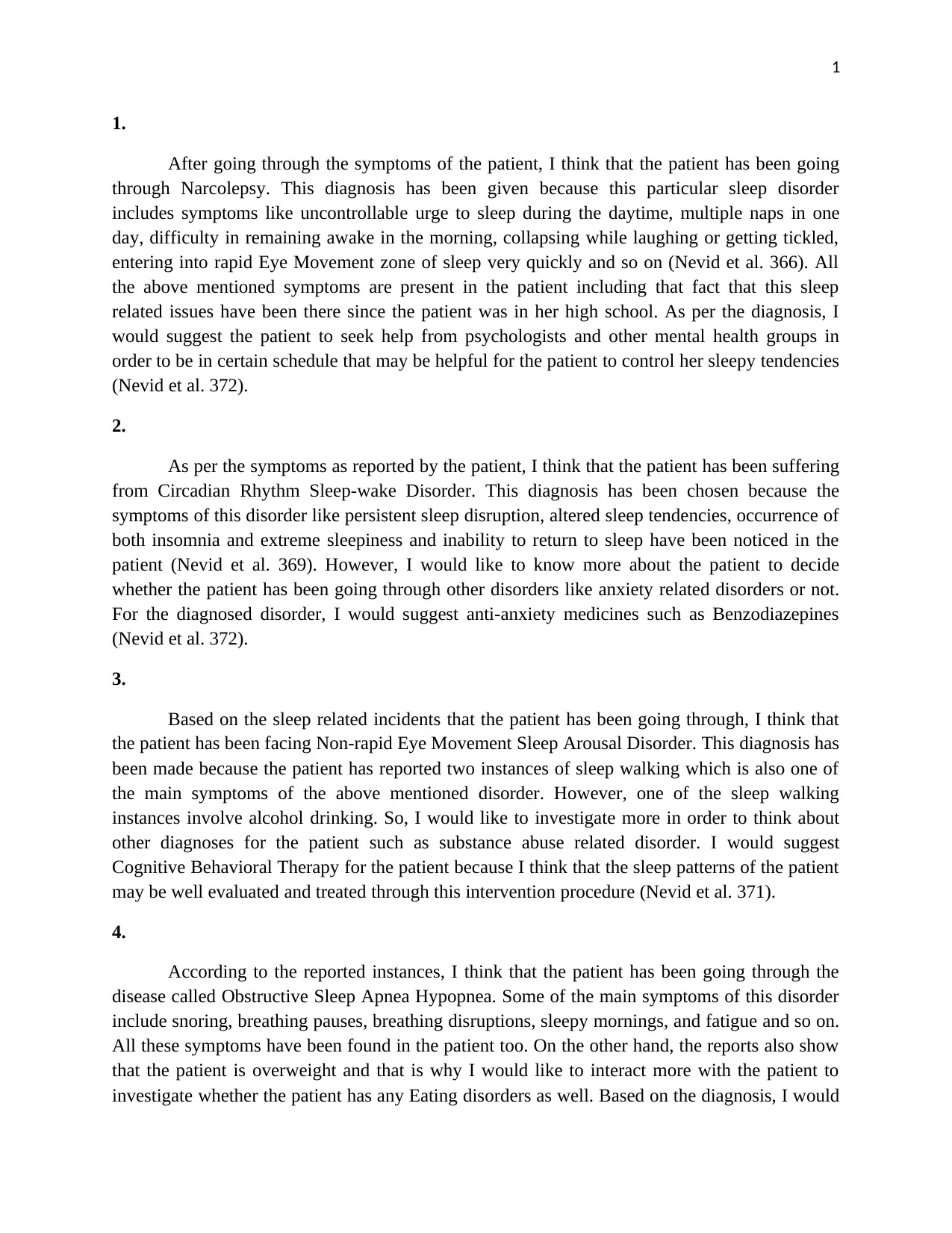
1.
After going through the symptoms of the patient, I think that the patient has been going
through Narcolepsy. This diagnosis has been given because this particular sleep disorder
includes symptoms like uncontrollable urge to sleep during the daytime, multiple naps in one
day, difficulty in remaining awake in the morning, collapsing while laughing or getting tickled,
entering into rapid Eye Movement zone of sleep very quickly and so on (Nevid et al. 366). All
the above mentioned symptoms are present in the patient including that fact that this sleep
related issues have been there since the patient was in her high school. As per the diagnosis, I
would suggest the patient to seek help from psychologists and other mental health groups in
order to be in certain schedule that may be helpful for the patient to control her sleepy tendencies
(Nevid et al. 372).
2.
As per the symptoms as reported by the patient, I think that the patient has been suffering
from Circadian Rhythm Sleep-wake Disorder. This diagnosis has been chosen because the
symptoms of this disorder like persistent sleep disruption, altered sleep tendencies, occurrence of
both insomnia and extreme sleepiness and inability to return to sleep have been noticed in the
patient (Nevid et al. 369). However, I would like to know more about the patient to decide
whether the patient has been going through other disorders like anxiety related disorders or not.
For the diagnosed disorder, I would suggest anti-anxiety medicines such as Benzodiazepines
(Nevid et al. 372).
3.
Based on the sleep related incidents that the patient has been going through, I think that
the patient has been facing Non-rapid Eye Movement Sleep Arousal Disorder. This diagnosis has
been made because the patient has reported two instances of sleep walking which is also one of
the main symptoms of the above mentioned disorder. However, one of the sleep walking
instances involve alcohol drinking. So, I would like to investigate more in order to think about
other diagnoses for the patient such as substance abuse related disorder. I would suggest
Cognitive Behavioral Therapy for the patient because I think that the sleep patterns of the patient
may be well evaluated and treated through this intervention procedure (Nevid et al. 371).
4.
According to the reported instances, I think that the patient has been going through the
disease called Obstructive Sleep Apnea Hypopnea. Some of the main symptoms of this disorder
include snoring, breathing pauses, breathing disruptions, sleepy mornings, and fatigue and so on.
All these symptoms have been found in the patient too. On the other hand, the reports also show
that the patient is overweight and that is why I would like to interact more with the patient to
investigate whether the patient has any Eating disorders as well. Based on the diagnosis, I would
Document Page
2
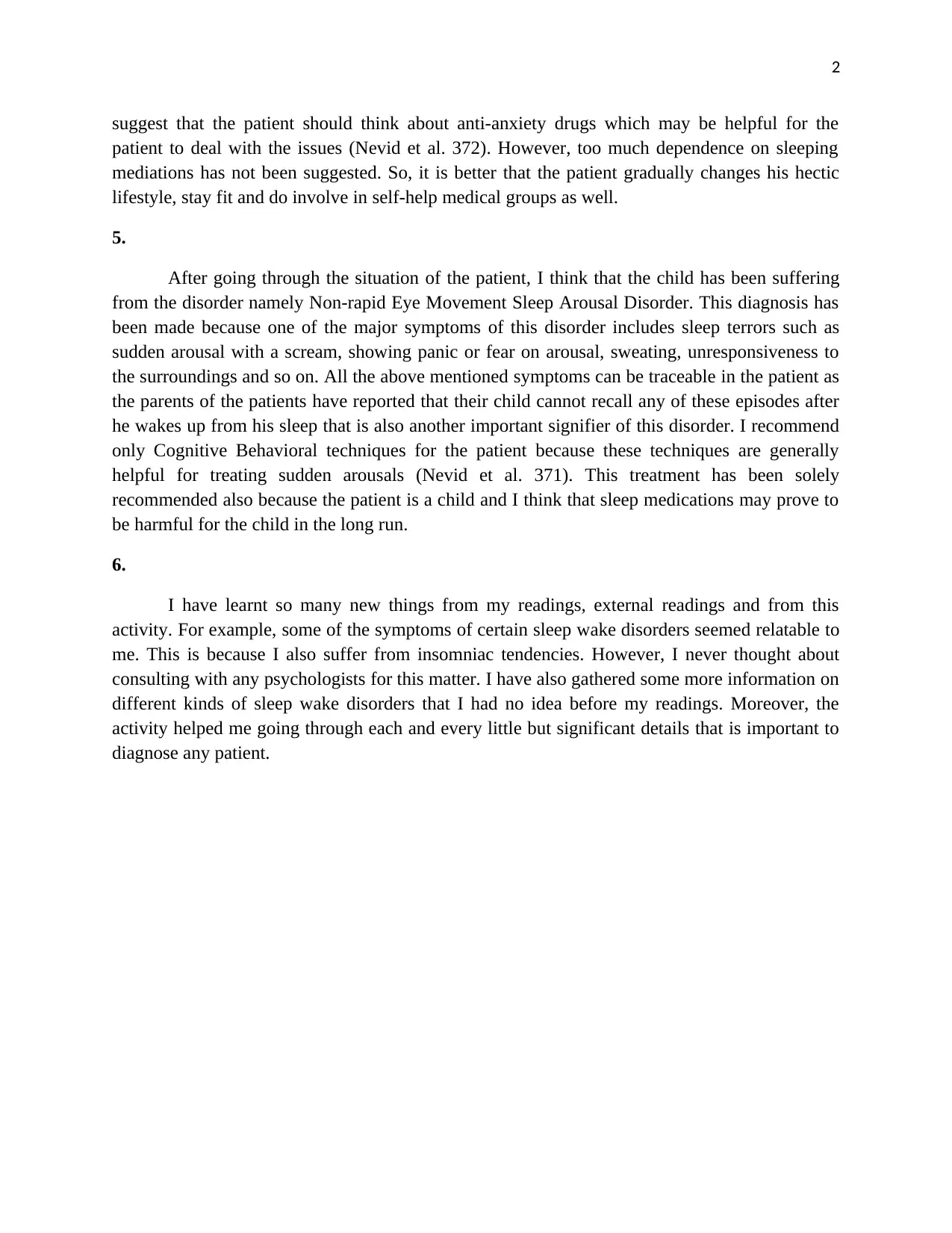
suggest that the patient should think about anti-anxiety drugs which may be helpful for the
patient to deal with the issues (Nevid et al. 372). However, too much dependence on sleeping
mediations has not been suggested. So, it is better that the patient gradually changes his hectic
lifestyle, stay fit and do involve in self-help medical groups as well.
5.
After going through the situation of the patient, I think that the child has been suffering
from the disorder namely Non-rapid Eye Movement Sleep Arousal Disorder. This diagnosis has
been made because one of the major symptoms of this disorder includes sleep terrors such as
sudden arousal with a scream, showing panic or fear on arousal, sweating, unresponsiveness to
the surroundings and so on. All the above mentioned symptoms can be traceable in the patient as
the parents of the patients have reported that their child cannot recall any of these episodes after
he wakes up from his sleep that is also another important signifier of this disorder. I recommend
only Cognitive Behavioral techniques for the patient because these techniques are generally
helpful for treating sudden arousals (Nevid et al. 371). This treatment has been solely
recommended also because the patient is a child and I think that sleep medications may prove to
be harmful for the child in the long run.
6.
I have learnt so many new things from my readings, external readings and from this
activity. For example, some of the symptoms of certain sleep wake disorders seemed relatable to
me. This is because I also suffer from insomniac tendencies. However, I never thought about
consulting with any psychologists for this matter. I have also gathered some more information on
different kinds of sleep wake disorders that I had no idea before my readings. Moreover, the
activity helped me going through each and every little but significant details that is important to
diagnose any patient.
Document Page
3
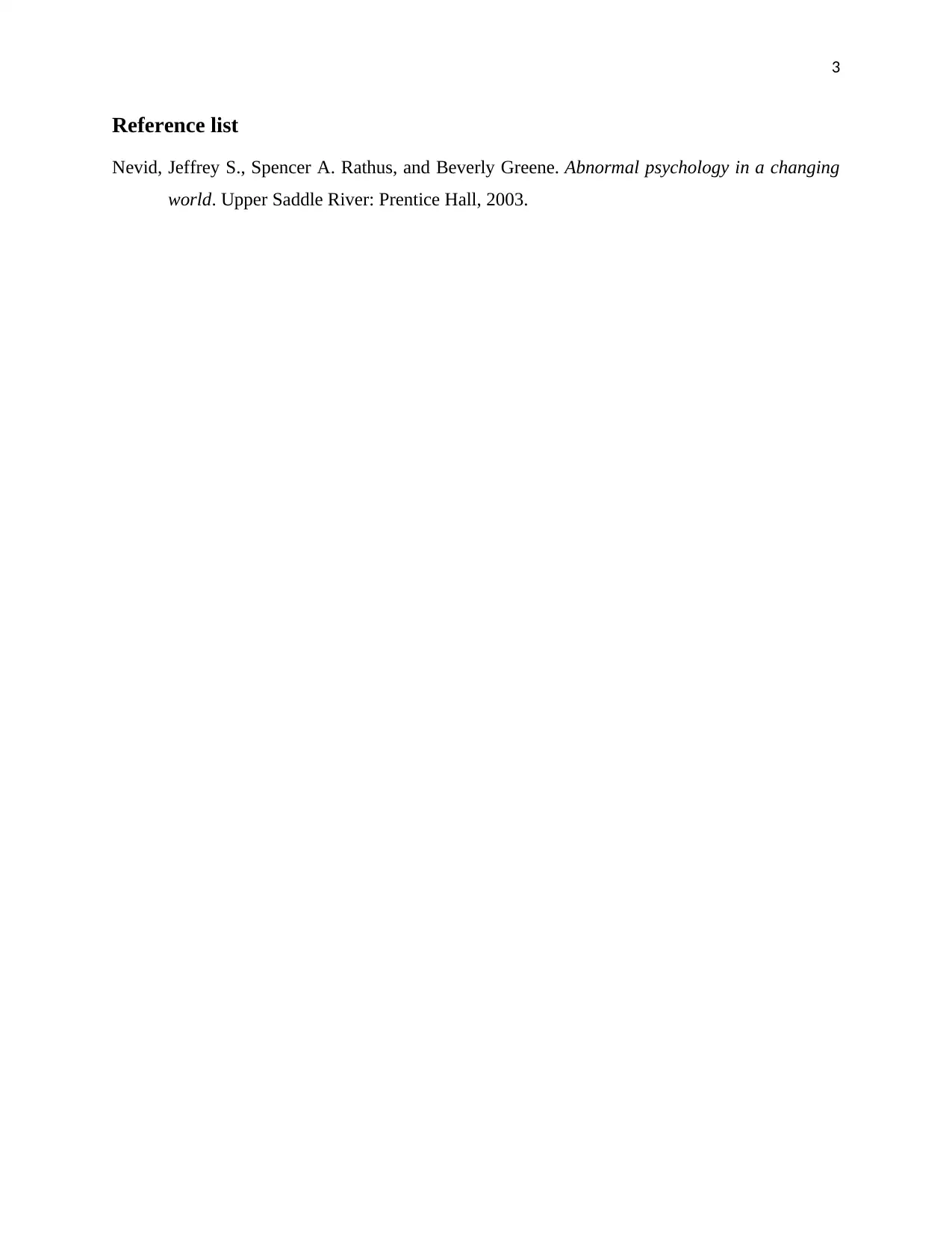
Reference list
Nevid, Jeffrey S., Spencer A. Rathus, and Beverly Greene. Abnormal psychology in a changing
world. Upper Saddle River: Prentice Hall, 2003.
chevron_up_icon
1 out of 4
circle_padding
hide_on_mobile
zoom_out_icon
[object Object]