Good Governance, International Relations & Nigeria's Economic Growth
VerifiedAdded on 2019/12/18
|37
|14119
|209
Dissertation
AI Summary
This dissertation critically analyzes the need for good governance to foster good international relationships and encourage local content-based economic development, aiming to make Nigeria a more credible and reliable entity within Sub-Saharan Africa. The research examines the role of good governance in developing international relations, the contribution of economic growth to Nigeria's reliability, and the current economic situation. It also evaluates factors impacting local content-based economic development in Nigeria. The study employs a structured approach, including literature review, research design, data analysis, and a conclusion with recommendations. The dissertation investigates the impact of factors such as corruption, political instability, and government initiatives on Nigeria's international standing and economic progress. It aims to explain the requirements for developing strong international relationships and promoting local content-based economic growth. The research provides a comprehensive overview of the challenges and opportunities facing Nigeria in its pursuit of good governance and economic advancement.

Dissertation

Paraphrase This Document
Need a fresh take? Get an instant paraphrase of this document with our AI Paraphraser

ACKNOWLEDGMENT
With love and sincerity, I express my gratitude to all those who dedicatedly have ensured the
completion of this work. I am particularly grateful for the hard work, devotion to duty, the love and
tolerance shown me by my supervisor. Special thanks go to my family and friends for their
assistance and co-operation in my data collection.
With love and sincerity, I express my gratitude to all those who dedicatedly have ensured the
completion of this work. I am particularly grateful for the hard work, devotion to duty, the love and
tolerance shown me by my supervisor. Special thanks go to my family and friends for their
assistance and co-operation in my data collection.
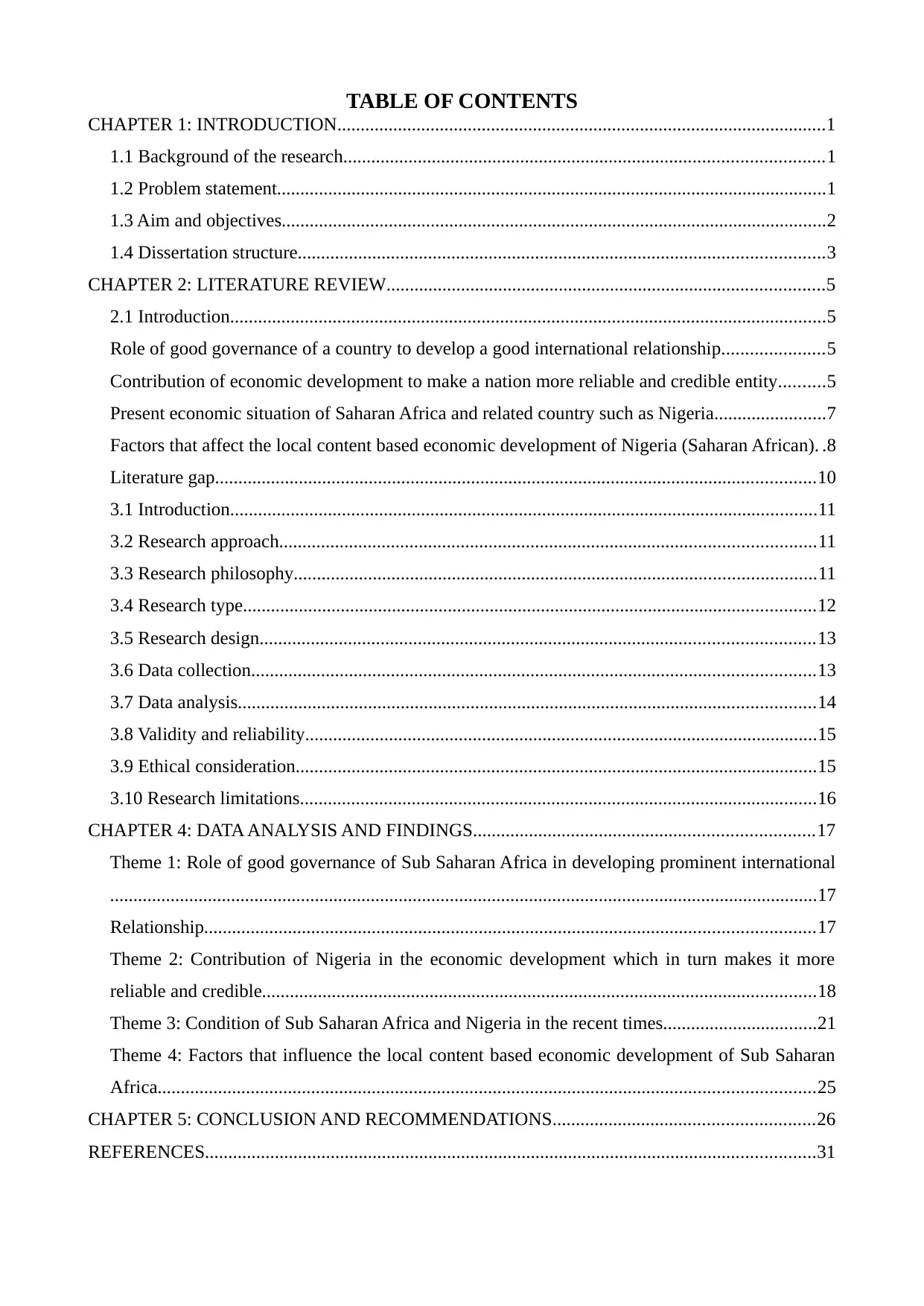
TABLE OF CONTENTS
CHAPTER 1: INTRODUCTION.........................................................................................................1
1.1 Background of the research.......................................................................................................1
1.2 Problem statement......................................................................................................................1
1.3 Aim and objectives.....................................................................................................................2
1.4 Dissertation structure.................................................................................................................3
CHAPTER 2: LITERATURE REVIEW..............................................................................................5
2.1 Introduction................................................................................................................................5
Role of good governance of a country to develop a good international relationship......................5
Contribution of economic development to make a nation more reliable and credible entity..........5
Present economic situation of Saharan Africa and related country such as Nigeria........................7
Factors that affect the local content based economic development of Nigeria (Saharan African). .8
Literature gap.................................................................................................................................10
3.1 Introduction..............................................................................................................................11
3.2 Research approach...................................................................................................................11
3.3 Research philosophy................................................................................................................11
3.4 Research type...........................................................................................................................12
3.5 Research design.......................................................................................................................13
3.6 Data collection.........................................................................................................................13
3.7 Data analysis............................................................................................................................14
3.8 Validity and reliability..............................................................................................................15
3.9 Ethical consideration................................................................................................................15
3.10 Research limitations...............................................................................................................16
CHAPTER 4: DATA ANALYSIS AND FINDINGS.........................................................................17
Theme 1: Role of good governance of Sub Saharan Africa in developing prominent international
........................................................................................................................................................17
Relationship...................................................................................................................................17
Theme 2: Contribution of Nigeria in the economic development which in turn makes it more
reliable and credible.......................................................................................................................18
Theme 3: Condition of Sub Saharan Africa and Nigeria in the recent times.................................21
Theme 4: Factors that influence the local content based economic development of Sub Saharan
Africa.............................................................................................................................................25
CHAPTER 5: CONCLUSION AND RECOMMENDATIONS........................................................26
REFERENCES...................................................................................................................................31
CHAPTER 1: INTRODUCTION.........................................................................................................1
1.1 Background of the research.......................................................................................................1
1.2 Problem statement......................................................................................................................1
1.3 Aim and objectives.....................................................................................................................2
1.4 Dissertation structure.................................................................................................................3
CHAPTER 2: LITERATURE REVIEW..............................................................................................5
2.1 Introduction................................................................................................................................5
Role of good governance of a country to develop a good international relationship......................5
Contribution of economic development to make a nation more reliable and credible entity..........5
Present economic situation of Saharan Africa and related country such as Nigeria........................7
Factors that affect the local content based economic development of Nigeria (Saharan African). .8
Literature gap.................................................................................................................................10
3.1 Introduction..............................................................................................................................11
3.2 Research approach...................................................................................................................11
3.3 Research philosophy................................................................................................................11
3.4 Research type...........................................................................................................................12
3.5 Research design.......................................................................................................................13
3.6 Data collection.........................................................................................................................13
3.7 Data analysis............................................................................................................................14
3.8 Validity and reliability..............................................................................................................15
3.9 Ethical consideration................................................................................................................15
3.10 Research limitations...............................................................................................................16
CHAPTER 4: DATA ANALYSIS AND FINDINGS.........................................................................17
Theme 1: Role of good governance of Sub Saharan Africa in developing prominent international
........................................................................................................................................................17
Relationship...................................................................................................................................17
Theme 2: Contribution of Nigeria in the economic development which in turn makes it more
reliable and credible.......................................................................................................................18
Theme 3: Condition of Sub Saharan Africa and Nigeria in the recent times.................................21
Theme 4: Factors that influence the local content based economic development of Sub Saharan
Africa.............................................................................................................................................25
CHAPTER 5: CONCLUSION AND RECOMMENDATIONS........................................................26
REFERENCES...................................................................................................................................31
⊘ This is a preview!⊘
Do you want full access?
Subscribe today to unlock all pages.

Trusted by 1+ million students worldwide

Paraphrase This Document
Need a fresh take? Get an instant paraphrase of this document with our AI Paraphraser
CHAPTER 1: INTRODUCTION
1.1 Background of the research
Saharan African is a land of young nation states where many of nations gained their freedom
from European colonisers between 1960 and 1980. Nigeria gained its independence in the year
1960. Nigeria broke into civil war from 1967 to 1970. It has been shuffling between democratically
elected civil government and dictatorship since then, it gained stability in 1999. Nigeria, like
Majority of African countries that have closed political systems i.e., the system, is closed to import
and export, no interaction with the outside world, it works in its own environment, have adopted
principles of democratic governance. Sub-Saharan Africa has faced longstanding issues such as
large debt, environmental disasters, ethnic divisions, HIV/ AIDS, poverty, etc. Some or all of these
factors may result in autocratic regimes, civil strife, weak institutions, corruption and unresponsive
political system of the continent. From the survey of Afrobarometer, it has been found that half of
Africans recognize their nation as a democratic and functions of democracy has satisfied them. This
survey was carried in 27 nations of Sub-Saharan African where people of 13 states have remarked
that election process of a continent has been reasonably fair and free (Asaolu, Adedokun and
Monday, 2016).
Saharan African stability cannot be taken for granted by other nations in the world. From
assessment, it has been identified that significant improvements have been made in Sub-Saharan
Africa. However, still, there are some deficiencies which impose risks and in front of sub-Saharan
Africa including Nigeria. In recent years, some examples of violence in Saharan African can be
seen. In 2008, post electoral violence has taken the lives of 1000 people in Kenya and in 2012,
many of the people died at the time of conflicts between South Africa unions. From these examples,
it can be said that democracy of Saharan African is insufficient and imperfect. There are only 8
nations out of 44 which have come under the category of fair and democratic.
1.2 Problem statement
The main focus of the present study is to analyze the aspects of good governance and
economic situation in the context of Nigeria. The Department of International Relations and
Cooperation’s (DIRCO) may be served as a foreign ministry of South African government. It has
focused on different things which directly relate to local economic development, social and political
relations etc. These all have given strength to Africa Agenda in the context of improved
international relations (Baylis, Owens and Smith, 2017). In the present time, Saharan African
continues to engage in the formulation of strategies that can mutually give benefits to local
economic development and foster good international relationships. In recent times, DIRCO has
1
1.1 Background of the research
Saharan African is a land of young nation states where many of nations gained their freedom
from European colonisers between 1960 and 1980. Nigeria gained its independence in the year
1960. Nigeria broke into civil war from 1967 to 1970. It has been shuffling between democratically
elected civil government and dictatorship since then, it gained stability in 1999. Nigeria, like
Majority of African countries that have closed political systems i.e., the system, is closed to import
and export, no interaction with the outside world, it works in its own environment, have adopted
principles of democratic governance. Sub-Saharan Africa has faced longstanding issues such as
large debt, environmental disasters, ethnic divisions, HIV/ AIDS, poverty, etc. Some or all of these
factors may result in autocratic regimes, civil strife, weak institutions, corruption and unresponsive
political system of the continent. From the survey of Afrobarometer, it has been found that half of
Africans recognize their nation as a democratic and functions of democracy has satisfied them. This
survey was carried in 27 nations of Sub-Saharan African where people of 13 states have remarked
that election process of a continent has been reasonably fair and free (Asaolu, Adedokun and
Monday, 2016).
Saharan African stability cannot be taken for granted by other nations in the world. From
assessment, it has been identified that significant improvements have been made in Sub-Saharan
Africa. However, still, there are some deficiencies which impose risks and in front of sub-Saharan
Africa including Nigeria. In recent years, some examples of violence in Saharan African can be
seen. In 2008, post electoral violence has taken the lives of 1000 people in Kenya and in 2012,
many of the people died at the time of conflicts between South Africa unions. From these examples,
it can be said that democracy of Saharan African is insufficient and imperfect. There are only 8
nations out of 44 which have come under the category of fair and democratic.
1.2 Problem statement
The main focus of the present study is to analyze the aspects of good governance and
economic situation in the context of Nigeria. The Department of International Relations and
Cooperation’s (DIRCO) may be served as a foreign ministry of South African government. It has
focused on different things which directly relate to local economic development, social and political
relations etc. These all have given strength to Africa Agenda in the context of improved
international relations (Baylis, Owens and Smith, 2017). In the present time, Saharan African
continues to engage in the formulation of strategies that can mutually give benefits to local
economic development and foster good international relationships. In recent times, DIRCO has
1
planned to follow United States’ African Growth and Opportunity Act to improve and maintain a
good relationship with the European Union by joint infrastructure projects. This will give strength
to relationships between Sub-Saharan African and the EU. It will help maintain the balance of
distribution of power at an international level and boost up local emerging economies with the
application of multilateral trading systems. But Sub-Saharan African politics have faced several
challenges in respect of developing international relations such as conflicts and violence between
regional political parties. These have developed misunderstandings and struggles in power related
aspects between two and more nations at a global level.
On the other hand, local regularities bodies should work with groups of citizens and local
communities to determine sustainable ways in order to attain economic and social needs so that
qualities of lives can be improved. It has been clearly demonstrated from this policy that local
government has not been responsible for creating jobs for the public. Some private companies,
NGOs etc have taken initiatives in the direction of local economic development (LED). In the last
two decades, local authorities of Sun-Saharan Africa have promoted within continent at a high level.
According to LED, it is a process where local government or community or both groups manage
their available resources and enter into partnership arrangements with the private sector with the
aim of developing new jobs that can stimulate economic activities of a nation (Cloete, Bailey and
Pillay, 2011).
From assessment, it has been identified that Nigeria is one of the biggest oil producer in
Africa but it is getting highly affected from undesirable activities like corruption. This has made a
large impact on local economic development. Along with this, less political stability and low
initiatives of the government to improve good international relationship have affected the growth of
the different countries of Saharan African. These have served to create barriers in the direction of
making this land credible and a reliable entity state (Cornelissen, Cheru and Shaw, 2016). These are
major motives that influence this analysis of the need for good governance to foster good
international relationships and encourage local content based on economic development to make a
country a more credible and reliable state. With the help of the present research, I will try to explain
the requirements of the development of a good international relationship and cheering local content
based on economic growth.
1.3 Aim and objectives
Aim: To critically analyze the need for good governance to foster good international relationships
and encourage local content based on economic development to make a country, a more credible
and reliable entity state: A study of Nigeria (Sub-Saharan African).
2
good relationship with the European Union by joint infrastructure projects. This will give strength
to relationships between Sub-Saharan African and the EU. It will help maintain the balance of
distribution of power at an international level and boost up local emerging economies with the
application of multilateral trading systems. But Sub-Saharan African politics have faced several
challenges in respect of developing international relations such as conflicts and violence between
regional political parties. These have developed misunderstandings and struggles in power related
aspects between two and more nations at a global level.
On the other hand, local regularities bodies should work with groups of citizens and local
communities to determine sustainable ways in order to attain economic and social needs so that
qualities of lives can be improved. It has been clearly demonstrated from this policy that local
government has not been responsible for creating jobs for the public. Some private companies,
NGOs etc have taken initiatives in the direction of local economic development (LED). In the last
two decades, local authorities of Sun-Saharan Africa have promoted within continent at a high level.
According to LED, it is a process where local government or community or both groups manage
their available resources and enter into partnership arrangements with the private sector with the
aim of developing new jobs that can stimulate economic activities of a nation (Cloete, Bailey and
Pillay, 2011).
From assessment, it has been identified that Nigeria is one of the biggest oil producer in
Africa but it is getting highly affected from undesirable activities like corruption. This has made a
large impact on local economic development. Along with this, less political stability and low
initiatives of the government to improve good international relationship have affected the growth of
the different countries of Saharan African. These have served to create barriers in the direction of
making this land credible and a reliable entity state (Cornelissen, Cheru and Shaw, 2016). These are
major motives that influence this analysis of the need for good governance to foster good
international relationships and encourage local content based on economic development to make a
country a more credible and reliable state. With the help of the present research, I will try to explain
the requirements of the development of a good international relationship and cheering local content
based on economic growth.
1.3 Aim and objectives
Aim: To critically analyze the need for good governance to foster good international relationships
and encourage local content based on economic development to make a country, a more credible
and reliable entity state: A study of Nigeria (Sub-Saharan African).
2
⊘ This is a preview!⊘
Do you want full access?
Subscribe today to unlock all pages.
Trusted by 1+ million students worldwide
Objectives:
To analyze the role of good governance of a country to develop a good international
relationship
To determine the contribution of economic growth as well as development in terms of
employment, growth etc. to make a Nigeria more reliable and credible entity.
To discuss the present economic situation in Nigeria (Sub-Saharan African).
To evaluate the factors that affect the local content based economic development of Nigeria of
Saharan African
Growth and development are both similar terms, in terms of growth the given content explains with
quantitative data.
1.4 Dissertation structure
The present dissertation is based on analysis of the need for good governance in fostering
good international relationship by encouraging local content based economic development to make
Saharan African, a more credible and reliable entity state. Following structure has been followed by
the researcher to complete such dissertation:
Chapter 1: Introduction- The purpose of the introduction is to tell the reader what the scope of the
dissertation is intended to be. It should include a statement of the purpose/object/aim of the thesis.
In this context of the present research, this chapter will include the background of the research and
problem statement in specific and brief basis. Rather than this, aim and objectives of the study will
also discuss by the researcher. At last, the whole format of an entire thesis in the form of chapters
will mention.
Chapter 2: Literature review- In the second chapter of dissertation or thesis, I will make an
evaluation of various articles that are based on Sub-Saharan Africa and Nigeria. Hence, by making
an evaluation of the positive and negative comments brief thesis will be prepared by the researcher.
Such a brief thesis is highly significant which in turn provides deeper insight to the researcher about
the topic which is going to be investigated and thereby helps in analysing data more effectively.
Theories related to governance in a democratic environment and economical aspect of Nigeria has
been added. Hence, by framing themes on good governance, economic growth, as well as situation
secondary investigation, has been conducted to attain the objective.
Chapter 3: Research design and methodology- In this chapter, researcher evaluates and selects
suitable tools as well as techniques that directly address research aims. In the context of the present
dissertation, different research techniques with significant justification will be given by the
researcher. Some models that will be used in the current thesis are data collection, research
3
To analyze the role of good governance of a country to develop a good international
relationship
To determine the contribution of economic growth as well as development in terms of
employment, growth etc. to make a Nigeria more reliable and credible entity.
To discuss the present economic situation in Nigeria (Sub-Saharan African).
To evaluate the factors that affect the local content based economic development of Nigeria of
Saharan African
Growth and development are both similar terms, in terms of growth the given content explains with
quantitative data.
1.4 Dissertation structure
The present dissertation is based on analysis of the need for good governance in fostering
good international relationship by encouraging local content based economic development to make
Saharan African, a more credible and reliable entity state. Following structure has been followed by
the researcher to complete such dissertation:
Chapter 1: Introduction- The purpose of the introduction is to tell the reader what the scope of the
dissertation is intended to be. It should include a statement of the purpose/object/aim of the thesis.
In this context of the present research, this chapter will include the background of the research and
problem statement in specific and brief basis. Rather than this, aim and objectives of the study will
also discuss by the researcher. At last, the whole format of an entire thesis in the form of chapters
will mention.
Chapter 2: Literature review- In the second chapter of dissertation or thesis, I will make an
evaluation of various articles that are based on Sub-Saharan Africa and Nigeria. Hence, by making
an evaluation of the positive and negative comments brief thesis will be prepared by the researcher.
Such a brief thesis is highly significant which in turn provides deeper insight to the researcher about
the topic which is going to be investigated and thereby helps in analysing data more effectively.
Theories related to governance in a democratic environment and economical aspect of Nigeria has
been added. Hence, by framing themes on good governance, economic growth, as well as situation
secondary investigation, has been conducted to attain the objective.
Chapter 3: Research design and methodology- In this chapter, researcher evaluates and selects
suitable tools as well as techniques that directly address research aims. In the context of the present
dissertation, different research techniques with significant justification will be given by the
researcher. Some models that will be used in the current thesis are data collection, research
3
Paraphrase This Document
Need a fresh take? Get an instant paraphrase of this document with our AI Paraphraser
philosophy, research type and approach, sampling, data analysis etc. These all will provide a
complete guide to the scholar to address the research issue and questions. In this, the methodology
is highly aligned by the researcher with the issue such as good governance and economic growth of
Nigeria.
Chapter 4: Result, analysis and discussion- To analyse the collected information, the researcher
will use various techniques and methods. The generated outcomes from the evaluation of present
dissertation will be represented in different forms such as charts, tables, figures etc. These all will
help readers to understand the result of the conducted investigation. The selection of data analysis
techniques will be based on the nature of the study. The chapter analyses on the basis of above
chapters, chapter 2 and 3 and a result are created from the analysis.
Chapter 5: Conclusion and recommendations- The following chapter will help the researcher to
draw a meaningful conclusion from the analysed data. Along with this, recommendations in the
context of overcoming the problems will be also discussed.
4
complete guide to the scholar to address the research issue and questions. In this, the methodology
is highly aligned by the researcher with the issue such as good governance and economic growth of
Nigeria.
Chapter 4: Result, analysis and discussion- To analyse the collected information, the researcher
will use various techniques and methods. The generated outcomes from the evaluation of present
dissertation will be represented in different forms such as charts, tables, figures etc. These all will
help readers to understand the result of the conducted investigation. The selection of data analysis
techniques will be based on the nature of the study. The chapter analyses on the basis of above
chapters, chapter 2 and 3 and a result are created from the analysis.
Chapter 5: Conclusion and recommendations- The following chapter will help the researcher to
draw a meaningful conclusion from the analysed data. Along with this, recommendations in the
context of overcoming the problems will be also discussed.
4
CHAPTER 2: LITERATURE REVIEW
2.1 Introduction
To carry out a careful research to address the objectives, it becomes important to conduct a
literature review. Performing a literature search and critique on it is an essential section of any
investigation. Once a scholar determines an area of study that is needed to be worked, a proper
research on related information sources helps to get the detailed knowledge about the topic. A
literature review can be defined as a text of a scholarly paper that contains knowledge about
substantive findings on a particular subject of research. It is a process of review of secondary
sources where several sources of information consider re-examining the past data in more effective
manner. In this context, the researcher will consider numerous scholars studies to conduct the study
to address different objectives.
Overview of Africa
As per the views of the author, African states have attained success in a double sense.
Moreover, states pertaining to Africa built a set of institutions including militaries, post-offices,
bureaucracies and legislatures etc. Along with this, states related to Africa have undertaken the
projects in relation to colonialism development. Further, from assessment, it has been identified that
during the time of independence, leader’s trade unions, merchant groups, farmer’s organizations etc
have accountability to perform activities by considering the interest of all. In addition to this,
African history presents that in the former year’s individuals are encouraged to form rich webs of
connections. Civic minded political culture placed emphasis on the responsibility of the leaders
towards the citizens. From assessment, it has been found that western government and international
institutions are willing to work with the gatekeeper states. Due to the corruption and ineffective
policy framework Africa faced several difficulties in the past years. Hence, with the motive to
improve the position several modifications have been done by African government in the existing
policy framework.
Role of good governance for the development of a good international relationship
According to Cornelissen, Cheru and Shaw (2016) “good governance is a term that is used
in the context of international development.” It defines how public institutions organize public
affairs and manage their existing and limited resources. The following concept emerges from a
model related to comparing ineffective regulatory bodies with viable economics or political groups.
In this context, Cloete, Bailey and Pillay, 2011 has stated that “good governance contains four
forms: international affairs, corporate sectors, local governments and scientific exploration” (Cloete,
5
2.1 Introduction
To carry out a careful research to address the objectives, it becomes important to conduct a
literature review. Performing a literature search and critique on it is an essential section of any
investigation. Once a scholar determines an area of study that is needed to be worked, a proper
research on related information sources helps to get the detailed knowledge about the topic. A
literature review can be defined as a text of a scholarly paper that contains knowledge about
substantive findings on a particular subject of research. It is a process of review of secondary
sources where several sources of information consider re-examining the past data in more effective
manner. In this context, the researcher will consider numerous scholars studies to conduct the study
to address different objectives.
Overview of Africa
As per the views of the author, African states have attained success in a double sense.
Moreover, states pertaining to Africa built a set of institutions including militaries, post-offices,
bureaucracies and legislatures etc. Along with this, states related to Africa have undertaken the
projects in relation to colonialism development. Further, from assessment, it has been identified that
during the time of independence, leader’s trade unions, merchant groups, farmer’s organizations etc
have accountability to perform activities by considering the interest of all. In addition to this,
African history presents that in the former year’s individuals are encouraged to form rich webs of
connections. Civic minded political culture placed emphasis on the responsibility of the leaders
towards the citizens. From assessment, it has been found that western government and international
institutions are willing to work with the gatekeeper states. Due to the corruption and ineffective
policy framework Africa faced several difficulties in the past years. Hence, with the motive to
improve the position several modifications have been done by African government in the existing
policy framework.
Role of good governance for the development of a good international relationship
According to Cornelissen, Cheru and Shaw (2016) “good governance is a term that is used
in the context of international development.” It defines how public institutions organize public
affairs and manage their existing and limited resources. The following concept emerges from a
model related to comparing ineffective regulatory bodies with viable economics or political groups.
In this context, Cloete, Bailey and Pillay, 2011 has stated that “good governance contains four
forms: international affairs, corporate sectors, local governments and scientific exploration” (Cloete,
5
⊘ This is a preview!⊘
Do you want full access?
Subscribe today to unlock all pages.
Trusted by 1+ million students worldwide
Bailey and Pillay, 2011). Good governance in international affairs can be analyzed in different ways
such as between administration and markets, regulatory bodies and public, management and private
sector etc. On the other hand, by following the aspects of government and corporate management,
authority and employee standards etc good governance in corporate sectors can be ensured. While
in the case of a good regime the local governments help in promoting relationships between
regulatory bodies and empowered citizens, community councils etc.
Contribution of economic development to make a nation more reliable and credible entity
As per the viewpoints of Inyang (2017), “economic development is a kind of procedure
through which a country or state brings the improvements in the economic, political, and social
well-being of its people.”. It is a policy that aims to ensure the social well-being and economic
growth of local communities. There are various methods by which a nation or continent can easily
measure economic development such as GDP per capita, social security and pensions, income
distribution, literacy and education rate, access to healthcare services etc. Asaolu, Adedokun and
Monday (2016) has stated in support of the above statement that “development of local content
economic has brought the various positive changes in a nation that makes it more reliable and
credible entity” (Asaolu, Adedokun and Monday, 2016). In the present time, the majority of the
world population lives in urban areas. This trend increases in developing countries such as Africa,
Asia and Latin America. 90% global urban growth is taking place in these states over the time.
Mshellia and et.al., (2016) has asserted in this respect that “local economic development helps
countrysides to move out of poverty” (Mshellia and et.al., 2016). The reason for this is an increase
in average income which has assisted in minimizing the poverty rate at a significant level in
developing areas such as Saharan Africa, Asia etc. although it should be noted that poverty
reduction in a country takes time. The poverty and inequality are broad terms which reduce with the
overall growth of the country in the long run. There are several examples related to countries where
the reduction in poverty due to local economic development takes place. Due to a rapid economic
growth between 1985 and 2001, China has lifted over 450 million people from the poverty line.
Along with this, in 1980, India has been able to attain a significant fall in poverty and in 1990; the
rate of it has again decreased. During both of these time periods, the impressive growth in the
direction of reduction of poverty level because of growth of local economic development has been
recorded. It has been shown from the above examples that economic development has played an
important role in the direction of make the nation reliable and credible in all aspects.
On the other hand, Baylis, Owens and Smith (2017) has stated that “local economic growth
of a nation has helped to increase the average income level of people” (Baylis, Owens and Smith,
6
such as between administration and markets, regulatory bodies and public, management and private
sector etc. On the other hand, by following the aspects of government and corporate management,
authority and employee standards etc good governance in corporate sectors can be ensured. While
in the case of a good regime the local governments help in promoting relationships between
regulatory bodies and empowered citizens, community councils etc.
Contribution of economic development to make a nation more reliable and credible entity
As per the viewpoints of Inyang (2017), “economic development is a kind of procedure
through which a country or state brings the improvements in the economic, political, and social
well-being of its people.”. It is a policy that aims to ensure the social well-being and economic
growth of local communities. There are various methods by which a nation or continent can easily
measure economic development such as GDP per capita, social security and pensions, income
distribution, literacy and education rate, access to healthcare services etc. Asaolu, Adedokun and
Monday (2016) has stated in support of the above statement that “development of local content
economic has brought the various positive changes in a nation that makes it more reliable and
credible entity” (Asaolu, Adedokun and Monday, 2016). In the present time, the majority of the
world population lives in urban areas. This trend increases in developing countries such as Africa,
Asia and Latin America. 90% global urban growth is taking place in these states over the time.
Mshellia and et.al., (2016) has asserted in this respect that “local economic development helps
countrysides to move out of poverty” (Mshellia and et.al., 2016). The reason for this is an increase
in average income which has assisted in minimizing the poverty rate at a significant level in
developing areas such as Saharan Africa, Asia etc. although it should be noted that poverty
reduction in a country takes time. The poverty and inequality are broad terms which reduce with the
overall growth of the country in the long run. There are several examples related to countries where
the reduction in poverty due to local economic development takes place. Due to a rapid economic
growth between 1985 and 2001, China has lifted over 450 million people from the poverty line.
Along with this, in 1980, India has been able to attain a significant fall in poverty and in 1990; the
rate of it has again decreased. During both of these time periods, the impressive growth in the
direction of reduction of poverty level because of growth of local economic development has been
recorded. It has been shown from the above examples that economic development has played an
important role in the direction of make the nation reliable and credible in all aspects.
On the other hand, Baylis, Owens and Smith (2017) has stated that “local economic growth
of a nation has helped to increase the average income level of people” (Baylis, Owens and Smith,
6
Paraphrase This Document
Need a fresh take? Get an instant paraphrase of this document with our AI Paraphraser
2017). In developing nations such as Saharan Africa, Asia etc have enjoyed a good economic
growth. It has allowed the companies in these areas to increase the salary of the employees and this
has brought the overall increment in the context of the income level of people. The result of this has
been that these countries have made more reliable and credible with the time at national and
international level. While Osemeke and Adegbite (2016) explains that in his point of view,
“economic development has played an essential role in creating new job opportunities for the local
communities” (Osemeke and Adegbite, 2016). This has given strength to demand of labour by
increasing employment ratio. In Saharan Africa, youth unemployment is a major issue. It is higher
when compared to average unemployment rates. It means that only 25% of the youth population of
the continent is employed and 47% are unemployed. In early 1990, the rate of global employment
was raised by 400 million. In this context, China and India both have taken advantage of the
development of local economies where the numbers of new job opportunities have increased. Wage
rates for low skilled jobs have increased because of overall enhancement in GDP growth at national
level. Therefore, it can be said that development of economies has made the countries more reliable
and credible.
Okoro (2014) has stated that “economic growth has not just only reduced poverty rate or
increase job opportunities in the nation but also helps in measuring human development” (Okoro,
2014). It is an essential part of expanding the substantive freedoms that people value. It brings the
significant improvement in the direction of living standards of the public that makes them become
healthier, eat better and live longer. For example, in developing nations such as Saharan Africa, Asia
etc strong growth of economies of nations have given opportunities to people to earn more income
and invest them in education by sending children to better schools. This human development in the
nations has made the states credible and more reliable in nature. In support of the above discussion,
Nwekeaku (2014) has stated that economic development has improved health and education aspects
of a country” (Nwekeaku, 2014). Higher income levels result in him or her living a better-quality
life. For example, a higher level of incomes reduced infant mortality in Saharan Africa because
many of the people have been able to access health care services due to good incomes. Along with
this, there has been an increase in enrollment rates of students in primary and secondary school due
to higher levels of per capita income. Hence, from the above discussion, it can be said that
economic development and its growth have assisted the nations to take various advantages and
make the states reliable and credible over time.
Present economic situation of Saharan Africa and related country such as Nigeria
According to the views of Fosu (2015), Sub-Saharan Africa has 12% of world’s population
7
growth. It has allowed the companies in these areas to increase the salary of the employees and this
has brought the overall increment in the context of the income level of people. The result of this has
been that these countries have made more reliable and credible with the time at national and
international level. While Osemeke and Adegbite (2016) explains that in his point of view,
“economic development has played an essential role in creating new job opportunities for the local
communities” (Osemeke and Adegbite, 2016). This has given strength to demand of labour by
increasing employment ratio. In Saharan Africa, youth unemployment is a major issue. It is higher
when compared to average unemployment rates. It means that only 25% of the youth population of
the continent is employed and 47% are unemployed. In early 1990, the rate of global employment
was raised by 400 million. In this context, China and India both have taken advantage of the
development of local economies where the numbers of new job opportunities have increased. Wage
rates for low skilled jobs have increased because of overall enhancement in GDP growth at national
level. Therefore, it can be said that development of economies has made the countries more reliable
and credible.
Okoro (2014) has stated that “economic growth has not just only reduced poverty rate or
increase job opportunities in the nation but also helps in measuring human development” (Okoro,
2014). It is an essential part of expanding the substantive freedoms that people value. It brings the
significant improvement in the direction of living standards of the public that makes them become
healthier, eat better and live longer. For example, in developing nations such as Saharan Africa, Asia
etc strong growth of economies of nations have given opportunities to people to earn more income
and invest them in education by sending children to better schools. This human development in the
nations has made the states credible and more reliable in nature. In support of the above discussion,
Nwekeaku (2014) has stated that economic development has improved health and education aspects
of a country” (Nwekeaku, 2014). Higher income levels result in him or her living a better-quality
life. For example, a higher level of incomes reduced infant mortality in Saharan Africa because
many of the people have been able to access health care services due to good incomes. Along with
this, there has been an increase in enrollment rates of students in primary and secondary school due
to higher levels of per capita income. Hence, from the above discussion, it can be said that
economic development and its growth have assisted the nations to take various advantages and
make the states reliable and credible over time.
Present economic situation of Saharan Africa and related country such as Nigeria
According to the views of Fosu (2015), Sub-Saharan Africa has 12% of world’s population
7
and accounts for 2% GDP. SSA has made a vital contribution in exports of travel services,
agriculture and other products such approximately 65%. Further, 5% exports of SSA are pertaining
to India, China and Brazil. In accordance with the views of African economy consist for trade,
industry and agriculture. Further, out of 65%, 30% export of SSA is associated with US. Nigeria is
the richest country in Africa in terms of resources and is continuously makes efforts to enhance
economic growth as well as development. However, in the year of 2013 Nigeria was considered as
poor inhabited continent. Moreover, government authorities assumed that income levels of people
will increase to significant levels. Nevertheless, African countries failed to meet the expectation
level in relation to attaining the status of middle income level. On a critical note, McIntire, Bourzat
and Prabhu (2016) stated that Nigeria was one the fastest growing countries in the world but due to
the occurrence of slowdown in growth rate it has deteriorated to a large extent. According to the
views of Storeygard (2016) the worst performance has been recorded over the two decades. In the
year of 2016, growth of the economy has fallen from 3.2% to 1.2. There are several reasons for this
and the economy of Saharan Africa has faced difficulties in managing the situation. Some factors
include low commodity prices, weak external demand, weather conditions and security problem.
Brent crude oil prices are declined to significant levels. Along with this, prices of many agricultural
and mineral commodities remain weak which in turn closely influences the trade terms of
commodity exporters. Further, during the period of 2015 and 2016, due to the situation of adverse
developments, negative shocks have been suffered by SSA. It has been assessed that weather is one
of the main phenomena which has placed negative impact on agricultural production. On the other
side, Ibraheem, Umar and Ajoke (2013) stated in their study that, oil exporters and South Africa
accounted for economic slowdowns. Moreover, Angola and Nigeria are the main two oil exporters
whose growth rate slowed to the significant level due to financial strains and difficulties. Heavy
decline took place in oil production due to aspects of lower investment in Angola and militants’
attacks which took place in Nigeria have resulted in low oil prices. Along with this, demand of
domestic people also reduced significantly due to the declining trend of revenue or income.
Moreover, spending levels of people are highly influenced by their income levels. Hence, reduction
took place in both crude oil prices and production compelled government to cut spending levels
significantly.
From their study, Iyke (2015) found that exporters of commodities like metal faced
difficulties in relation to adjusting the declining price levels. Hence, it is also one of the main causes
due to which undesirable situations were faced. In recent times, Sub-Saharan Africa is continuously
making efforts in relation to managing the declining prices of oil. Hence, such economies have set
down targets in relation to increasing the growth by 2.9% pertaining to oil prices. Along with this,
8
agriculture and other products such approximately 65%. Further, 5% exports of SSA are pertaining
to India, China and Brazil. In accordance with the views of African economy consist for trade,
industry and agriculture. Further, out of 65%, 30% export of SSA is associated with US. Nigeria is
the richest country in Africa in terms of resources and is continuously makes efforts to enhance
economic growth as well as development. However, in the year of 2013 Nigeria was considered as
poor inhabited continent. Moreover, government authorities assumed that income levels of people
will increase to significant levels. Nevertheless, African countries failed to meet the expectation
level in relation to attaining the status of middle income level. On a critical note, McIntire, Bourzat
and Prabhu (2016) stated that Nigeria was one the fastest growing countries in the world but due to
the occurrence of slowdown in growth rate it has deteriorated to a large extent. According to the
views of Storeygard (2016) the worst performance has been recorded over the two decades. In the
year of 2016, growth of the economy has fallen from 3.2% to 1.2. There are several reasons for this
and the economy of Saharan Africa has faced difficulties in managing the situation. Some factors
include low commodity prices, weak external demand, weather conditions and security problem.
Brent crude oil prices are declined to significant levels. Along with this, prices of many agricultural
and mineral commodities remain weak which in turn closely influences the trade terms of
commodity exporters. Further, during the period of 2015 and 2016, due to the situation of adverse
developments, negative shocks have been suffered by SSA. It has been assessed that weather is one
of the main phenomena which has placed negative impact on agricultural production. On the other
side, Ibraheem, Umar and Ajoke (2013) stated in their study that, oil exporters and South Africa
accounted for economic slowdowns. Moreover, Angola and Nigeria are the main two oil exporters
whose growth rate slowed to the significant level due to financial strains and difficulties. Heavy
decline took place in oil production due to aspects of lower investment in Angola and militants’
attacks which took place in Nigeria have resulted in low oil prices. Along with this, demand of
domestic people also reduced significantly due to the declining trend of revenue or income.
Moreover, spending levels of people are highly influenced by their income levels. Hence, reduction
took place in both crude oil prices and production compelled government to cut spending levels
significantly.
From their study, Iyke (2015) found that exporters of commodities like metal faced
difficulties in relation to adjusting the declining price levels. Hence, it is also one of the main causes
due to which undesirable situations were faced. In recent times, Sub-Saharan Africa is continuously
making efforts in relation to managing the declining prices of oil. Hence, such economies have set
down targets in relation to increasing the growth by 2.9% pertaining to oil prices. Along with this,
8
⊘ This is a preview!⊘
Do you want full access?
Subscribe today to unlock all pages.
Trusted by 1+ million students worldwide

1 out of 37


Related Documents


Your All-in-One AI-Powered Toolkit for Academic Success.
+13062052269
info@desklib.com
Available 24*7 on WhatsApp / Email
![[object Object]](/_next/static/media/star-bottom.7253800d.svg)
Unlock your academic potential
Copyright © 2020–2025 A2Z Services. All Rights Reserved. Developed and managed by ZUCOL.