DNA Identification and Analysis of Solanum Species: A Detailed Report
VerifiedAdded on 2023/06/17
|9
|2124
|159
Report
AI Summary
This report delves into the DNA identification of Solanum species, specifically Solanum melongena, Solanum aethiopicum, and Solanum lycopersicum, focusing on the analysis of their DNA sequences and genetic relationships. The study utilizes various molecular markers, including RAPD and ISSR, to evaluate genetic diversity and identify key genes responsible for specific traits. The report interprets data related to the genotype of Solanum melongena, highlighting the roles of adenine, guanine, cytosine, and thymine in DNA structure and function. It further investigates the genetic structure and regulatory mechanisms in Solanum aethiopicum, emphasizing the significance of allelic polymorphism and the MYB-bHLH-WD40 complex. The analysis extends to Solanum lycopersicum, examining the role of Snf2 proteins in chromatin remodeling and gene regulation. The report concludes by summarizing the importance of nitrogenous bases and DNA pairing rules in DNA identification and emphasizing the crucial role of amino acids and nucleotides in the configuration of DNA sequences.
DNA Identification

Paraphrase This Document
Need a fresh take? Get an instant paraphrase of this document with our AI Paraphraser
Table of Contents
INTRODUCTION...........................................................................................................................1
MAIN BODY...................................................................................................................................1
CONCLUSION................................................................................................................................4
Translation of DNA into the peptide sequence......................................................................5
REFERENCES................................................................................................................................7
INTRODUCTION...........................................................................................................................1
MAIN BODY...................................................................................................................................1
CONCLUSION................................................................................................................................4
Translation of DNA into the peptide sequence......................................................................5
REFERENCES................................................................................................................................7
INTRODUCTION
DNA is defined as the Deoxyribonucleic acid that refer a molecule inside the cell that
contain the genetic information which is responsible for the development and the function of
organism. Moreover, the DNA has the molecule which make the aspect which share the
information which is passed through the one generation to the others. In this, deoxyribonucleic
acid which is defined as the molecule which used to compose of the two polynucleotide chain
that used to carry around the each other in form of double helix which usually carry genetic
information. However, the DNA identification focus on the investigation into these non-coding
regions which used to revel the repeated unit of the DNA which may vary in the length among
the individual. Moreover, there are various research is being taken. Whereas, the report consists
of various sequence of DNA which help to provide essentials factor regards with the selected
short tandem repeat named STR which is relatively easily measured and they are compared with
the different level of prospects (Beh and et. al., 2019).
MAIN BODY
In this report, there are two kind of DNA in the body which majorly include the nuclear
DNA and mitochondrial DNA. As per this, the nuclear DNA comes from the cell nucleus which
have their function that is inherited from the both, half from the mother and they have half from
father. In this, the selected stimulus for the report is Solanum melongena, Solanum aethiopicum,
and Solanum lycopersicum which have various prompt include JQ63887, JQ638908, KF668233,
F04 SD, A04 SD, D04, C04, E04 and long purple Solanum melongena. Solanum melongena L. is
based on the economically important Solanaceous vegetable widely taken in the Asia, Europe
and America. In this, the genetic resource toward the Solanum melongena is co related with the
sustainable agriculture. In this, the molecular characterisation of this plant provide an avenue
which is based on germplasm of any selective breeding and the genetic improvement (Bolivar
and et. al., 2019).
The above described sequence of Solanum melongena show that the replication and their
core have a broad aspect which is set of polypeptide nucleus based where the Adenine and
Guanine make the sequence. The practical is done by using distinct method. There is some
information which include randomly amplified polymorphic DNA which is called the RAPD
marker which is effective for the evaluation of the genetic diversity due the application which is
1
DNA is defined as the Deoxyribonucleic acid that refer a molecule inside the cell that
contain the genetic information which is responsible for the development and the function of
organism. Moreover, the DNA has the molecule which make the aspect which share the
information which is passed through the one generation to the others. In this, deoxyribonucleic
acid which is defined as the molecule which used to compose of the two polynucleotide chain
that used to carry around the each other in form of double helix which usually carry genetic
information. However, the DNA identification focus on the investigation into these non-coding
regions which used to revel the repeated unit of the DNA which may vary in the length among
the individual. Moreover, there are various research is being taken. Whereas, the report consists
of various sequence of DNA which help to provide essentials factor regards with the selected
short tandem repeat named STR which is relatively easily measured and they are compared with
the different level of prospects (Beh and et. al., 2019).
MAIN BODY
In this report, there are two kind of DNA in the body which majorly include the nuclear
DNA and mitochondrial DNA. As per this, the nuclear DNA comes from the cell nucleus which
have their function that is inherited from the both, half from the mother and they have half from
father. In this, the selected stimulus for the report is Solanum melongena, Solanum aethiopicum,
and Solanum lycopersicum which have various prompt include JQ63887, JQ638908, KF668233,
F04 SD, A04 SD, D04, C04, E04 and long purple Solanum melongena. Solanum melongena L. is
based on the economically important Solanaceous vegetable widely taken in the Asia, Europe
and America. In this, the genetic resource toward the Solanum melongena is co related with the
sustainable agriculture. In this, the molecular characterisation of this plant provide an avenue
which is based on germplasm of any selective breeding and the genetic improvement (Bolivar
and et. al., 2019).
The above described sequence of Solanum melongena show that the replication and their
core have a broad aspect which is set of polypeptide nucleus based where the Adenine and
Guanine make the sequence. The practical is done by using distinct method. There is some
information which include randomly amplified polymorphic DNA which is called the RAPD
marker which is effective for the evaluation of the genetic diversity due the application which is
1
⊘ This is a preview!⊘
Do you want full access?
Subscribe today to unlock all pages.

Trusted by 1+ million students worldwide
in easy and connected with the low expensive compared with the other molecular markers. As
per this, the molecular characterisation is usually focus by the RAPD that they have marker that
is easy and rapid. Moreover, the RAPD marker which is being show the identification of the
relationship which is based on genetic among the cultivator. The initially which is based on
screening and selection of the RAPD that they have nine decamer primers namely OPA-18,
OPB-14, OPB-08, OPD-02, OPP-13 and OPW-18 which is selected and screen with the help of
polymerase chain reaction. It is usually help to enhance the ability to generate the polymorphic
amplified product which selected in the RAPD analysis (Chen and et. al., 2019).
In addition to this, the genetic relationship between ten the genotype of the Solanum
melongena which is studied using the ISSR that based on molecular markers. In this, the seven 7
out of 20 ISSR primers were used to assay that have level of the polymorphism among Solanum
melongena. Some variation is banding pattern which is analyse among the various genotype with
the 24 monomorphic and 47 polymorphic distinct fragments with the aspect of percentage it is
counted 61 percent which is appeared with the high level of polymorphism between them.
Moreover, genetic relationship based on the ISSR marker were developed using the technique
SPSS computer program. The results which is genetic relationship showed that the genotype
were the divided into the two main groups. Each group assembled of the genotype of the parents.
The first group comprised together the parents PIG-14, PIG-3, PIG-13, PIG 4, Jo=3 whereas, the
second cluster of Solanum melongena genotype include S6, Jo=2, S3 Moshtouhr (Parsons and et.
al., 2019).
Moreover, the data is interpreted with the various factor which is associated with the
Solanum melongena that genotype regards with details. The sequence of DNA shows the normal
growth which acquire some specific gene. The gene which is based on the process and procedure
regards with the gene computation that follow various flow back of gene. In this, Solanum
aethiopicum is also a plant that show aspect of bitter tomato and their gene identification
indicates various structure and the functions of these compound which have installed that the
regulating mechanism identify their accumulations and they are depending on environmental
condition and the genetic structure. Moreover, the biosynthesis and the degradation show the
mechanism of these compound based on 130 scientific analyses that have significant of the
consideration which is based on such mechanisms. The allelic polymorphism study shows the
knowledge of regulatory gene which is essential due to the fact that is based on structural
2
per this, the molecular characterisation is usually focus by the RAPD that they have marker that
is easy and rapid. Moreover, the RAPD marker which is being show the identification of the
relationship which is based on genetic among the cultivator. The initially which is based on
screening and selection of the RAPD that they have nine decamer primers namely OPA-18,
OPB-14, OPB-08, OPD-02, OPP-13 and OPW-18 which is selected and screen with the help of
polymerase chain reaction. It is usually help to enhance the ability to generate the polymorphic
amplified product which selected in the RAPD analysis (Chen and et. al., 2019).
In addition to this, the genetic relationship between ten the genotype of the Solanum
melongena which is studied using the ISSR that based on molecular markers. In this, the seven 7
out of 20 ISSR primers were used to assay that have level of the polymorphism among Solanum
melongena. Some variation is banding pattern which is analyse among the various genotype with
the 24 monomorphic and 47 polymorphic distinct fragments with the aspect of percentage it is
counted 61 percent which is appeared with the high level of polymorphism between them.
Moreover, genetic relationship based on the ISSR marker were developed using the technique
SPSS computer program. The results which is genetic relationship showed that the genotype
were the divided into the two main groups. Each group assembled of the genotype of the parents.
The first group comprised together the parents PIG-14, PIG-3, PIG-13, PIG 4, Jo=3 whereas, the
second cluster of Solanum melongena genotype include S6, Jo=2, S3 Moshtouhr (Parsons and et.
al., 2019).
Moreover, the data is interpreted with the various factor which is associated with the
Solanum melongena that genotype regards with details. The sequence of DNA shows the normal
growth which acquire some specific gene. The gene which is based on the process and procedure
regards with the gene computation that follow various flow back of gene. In this, Solanum
aethiopicum is also a plant that show aspect of bitter tomato and their gene identification
indicates various structure and the functions of these compound which have installed that the
regulating mechanism identify their accumulations and they are depending on environmental
condition and the genetic structure. Moreover, the biosynthesis and the degradation show the
mechanism of these compound based on 130 scientific analyses that have significant of the
consideration which is based on such mechanisms. The allelic polymorphism study shows the
knowledge of regulatory gene which is essential due to the fact that is based on structural
2
Paraphrase This Document
Need a fresh take? Get an instant paraphrase of this document with our AI Paraphraser
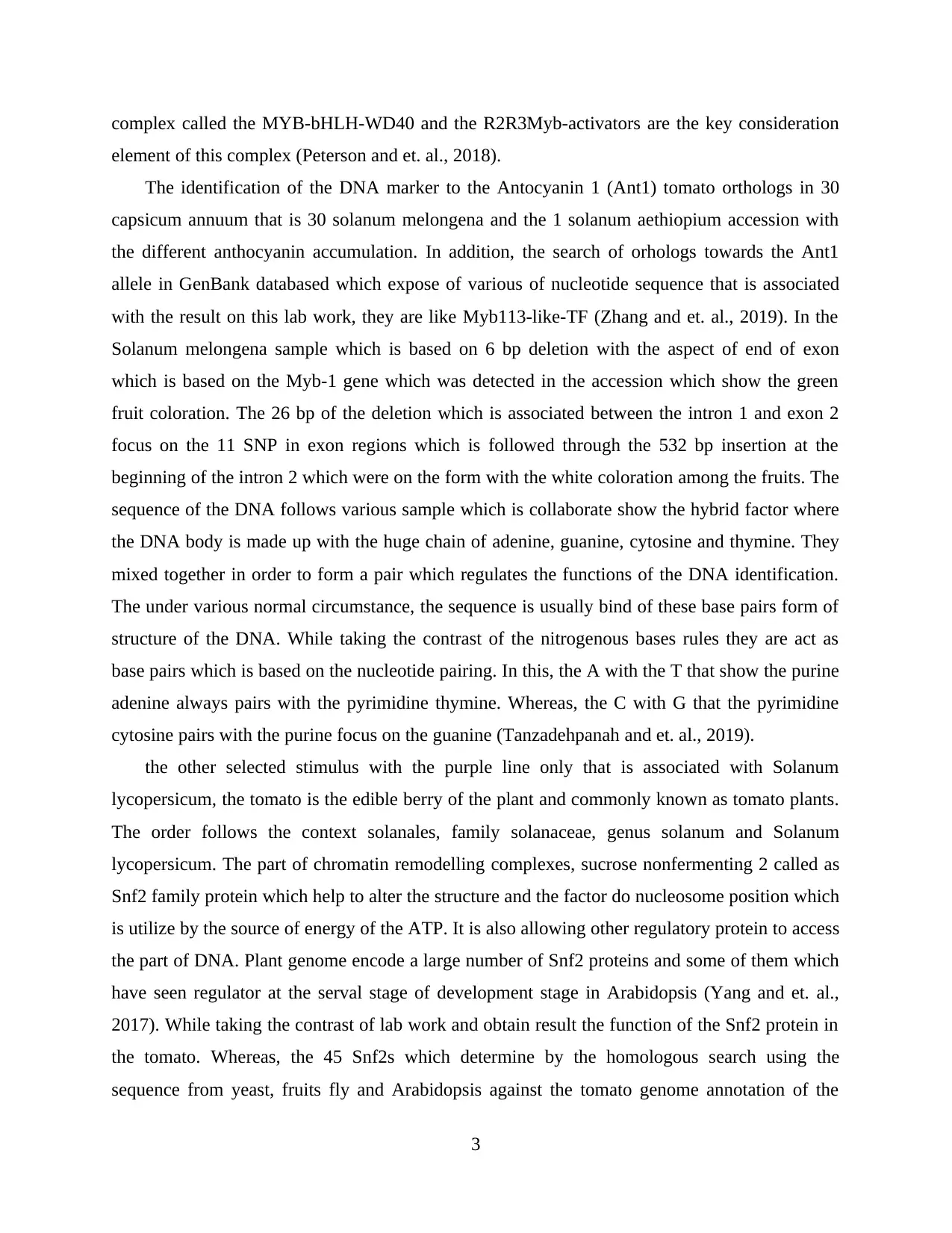
complex called the MYB-bHLH-WD40 and the R2R3Myb-activators are the key consideration
element of this complex (Peterson and et. al., 2018).
The identification of the DNA marker to the Antocyanin 1 (Ant1) tomato orthologs in 30
capsicum annuum that is 30 solanum melongena and the 1 solanum aethiopium accession with
the different anthocyanin accumulation. In addition, the search of orhologs towards the Ant1
allele in GenBank databased which expose of various of nucleotide sequence that is associated
with the result on this lab work, they are like Myb113-like-TF (Zhang and et. al., 2019). In the
Solanum melongena sample which is based on 6 bp deletion with the aspect of end of exon
which is based on the Myb-1 gene which was detected in the accession which show the green
fruit coloration. The 26 bp of the deletion which is associated between the intron 1 and exon 2
focus on the 11 SNP in exon regions which is followed through the 532 bp insertion at the
beginning of the intron 2 which were on the form with the white coloration among the fruits. The
sequence of the DNA follows various sample which is collaborate show the hybrid factor where
the DNA body is made up with the huge chain of adenine, guanine, cytosine and thymine. They
mixed together in order to form a pair which regulates the functions of the DNA identification.
The under various normal circumstance, the sequence is usually bind of these base pairs form of
structure of the DNA. While taking the contrast of the nitrogenous bases rules they are act as
base pairs which is based on the nucleotide pairing. In this, the A with the T that show the purine
adenine always pairs with the pyrimidine thymine. Whereas, the C with G that the pyrimidine
cytosine pairs with the purine focus on the guanine (Tanzadehpanah and et. al., 2019).
the other selected stimulus with the purple line only that is associated with Solanum
lycopersicum, the tomato is the edible berry of the plant and commonly known as tomato plants.
The order follows the context solanales, family solanaceae, genus solanum and Solanum
lycopersicum. The part of chromatin remodelling complexes, sucrose nonfermenting 2 called as
Snf2 family protein which help to alter the structure and the factor do nucleosome position which
is utilize by the source of energy of the ATP. It is also allowing other regulatory protein to access
the part of DNA. Plant genome encode a large number of Snf2 proteins and some of them which
have seen regulator at the serval stage of development stage in Arabidopsis (Yang and et. al.,
2017). While taking the contrast of lab work and obtain result the function of the Snf2 protein in
the tomato. Whereas, the 45 Snf2s which determine by the homologous search using the
sequence from yeast, fruits fly and Arabidopsis against the tomato genome annotation of the
3
element of this complex (Peterson and et. al., 2018).
The identification of the DNA marker to the Antocyanin 1 (Ant1) tomato orthologs in 30
capsicum annuum that is 30 solanum melongena and the 1 solanum aethiopium accession with
the different anthocyanin accumulation. In addition, the search of orhologs towards the Ant1
allele in GenBank databased which expose of various of nucleotide sequence that is associated
with the result on this lab work, they are like Myb113-like-TF (Zhang and et. al., 2019). In the
Solanum melongena sample which is based on 6 bp deletion with the aspect of end of exon
which is based on the Myb-1 gene which was detected in the accession which show the green
fruit coloration. The 26 bp of the deletion which is associated between the intron 1 and exon 2
focus on the 11 SNP in exon regions which is followed through the 532 bp insertion at the
beginning of the intron 2 which were on the form with the white coloration among the fruits. The
sequence of the DNA follows various sample which is collaborate show the hybrid factor where
the DNA body is made up with the huge chain of adenine, guanine, cytosine and thymine. They
mixed together in order to form a pair which regulates the functions of the DNA identification.
The under various normal circumstance, the sequence is usually bind of these base pairs form of
structure of the DNA. While taking the contrast of the nitrogenous bases rules they are act as
base pairs which is based on the nucleotide pairing. In this, the A with the T that show the purine
adenine always pairs with the pyrimidine thymine. Whereas, the C with G that the pyrimidine
cytosine pairs with the purine focus on the guanine (Tanzadehpanah and et. al., 2019).
the other selected stimulus with the purple line only that is associated with Solanum
lycopersicum, the tomato is the edible berry of the plant and commonly known as tomato plants.
The order follows the context solanales, family solanaceae, genus solanum and Solanum
lycopersicum. The part of chromatin remodelling complexes, sucrose nonfermenting 2 called as
Snf2 family protein which help to alter the structure and the factor do nucleosome position which
is utilize by the source of energy of the ATP. It is also allowing other regulatory protein to access
the part of DNA. Plant genome encode a large number of Snf2 proteins and some of them which
have seen regulator at the serval stage of development stage in Arabidopsis (Yang and et. al.,
2017). While taking the contrast of lab work and obtain result the function of the Snf2 protein in
the tomato. Whereas, the 45 Snf2s which determine by the homologous search using the
sequence from yeast, fruits fly and Arabidopsis against the tomato genome annotation of the
3
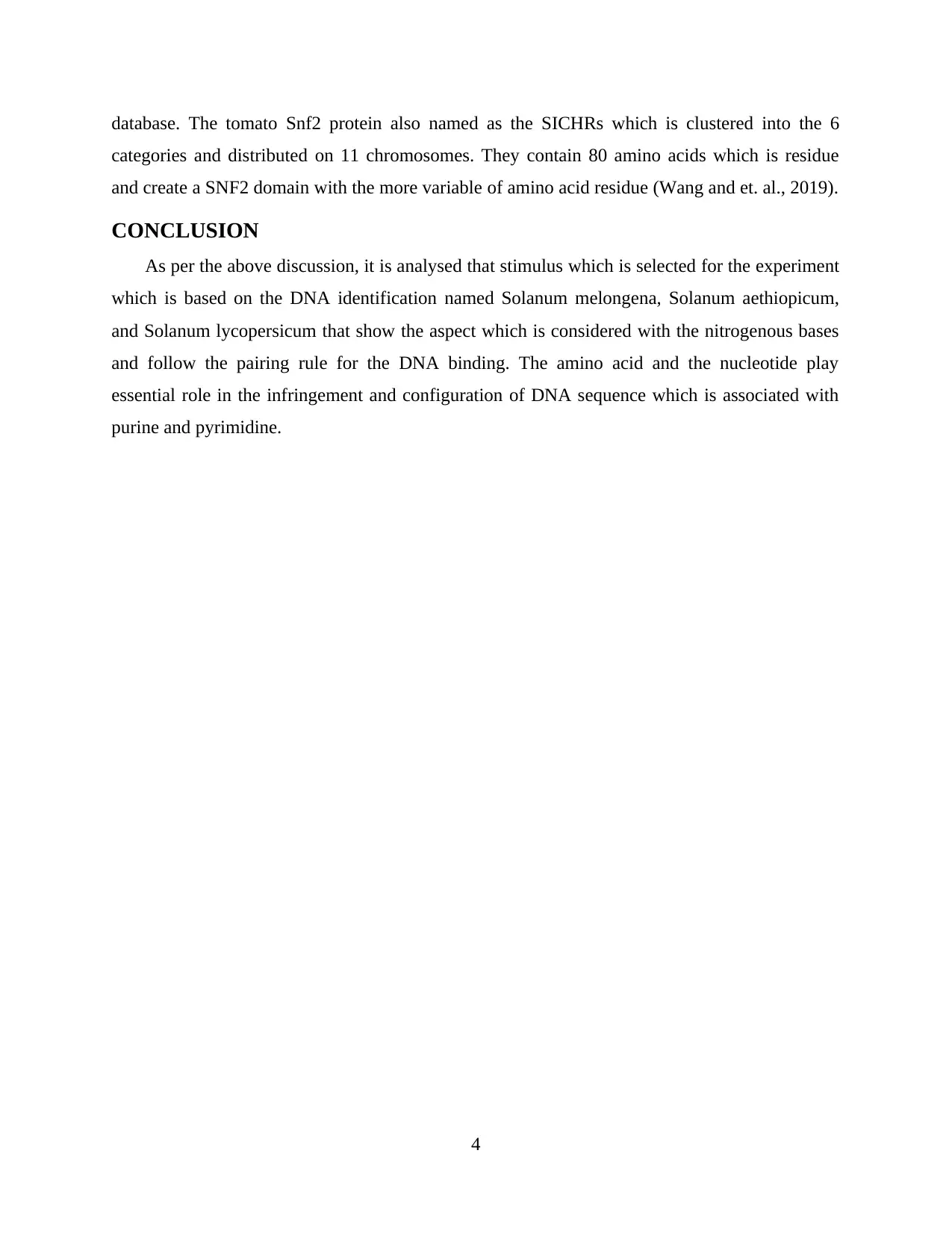
database. The tomato Snf2 protein also named as the SICHRs which is clustered into the 6
categories and distributed on 11 chromosomes. They contain 80 amino acids which is residue
and create a SNF2 domain with the more variable of amino acid residue (Wang and et. al., 2019).
CONCLUSION
As per the above discussion, it is analysed that stimulus which is selected for the experiment
which is based on the DNA identification named Solanum melongena, Solanum aethiopicum,
and Solanum lycopersicum that show the aspect which is considered with the nitrogenous bases
and follow the pairing rule for the DNA binding. The amino acid and the nucleotide play
essential role in the infringement and configuration of DNA sequence which is associated with
purine and pyrimidine.
4
categories and distributed on 11 chromosomes. They contain 80 amino acids which is residue
and create a SNF2 domain with the more variable of amino acid residue (Wang and et. al., 2019).
CONCLUSION
As per the above discussion, it is analysed that stimulus which is selected for the experiment
which is based on the DNA identification named Solanum melongena, Solanum aethiopicum,
and Solanum lycopersicum that show the aspect which is considered with the nitrogenous bases
and follow the pairing rule for the DNA binding. The amino acid and the nucleotide play
essential role in the infringement and configuration of DNA sequence which is associated with
purine and pyrimidine.
4
⊘ This is a preview!⊘
Do you want full access?
Subscribe today to unlock all pages.
Trusted by 1+ million students worldwide
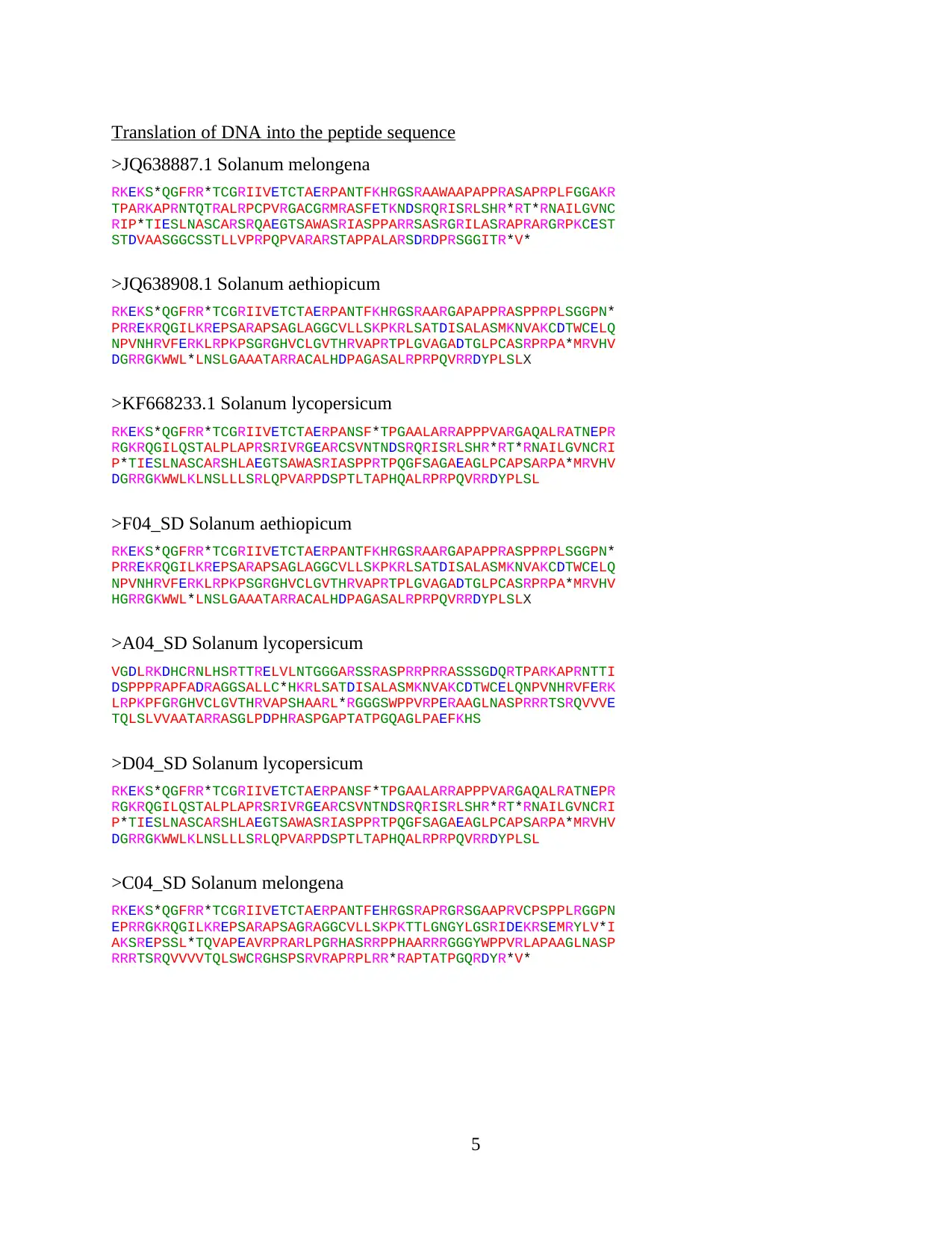
Translation of DNA into the peptide sequence
>JQ638887.1 Solanum melongena
RKEKS*QGFRR*TCGRIIVETCTAERPANTFKHRGSRAAWAAPAPPRASAPRPLFGGAKR
TPARKAPRNTQTRALRPCPVRGACGRMRASFETKNDSRQRISRLSHR*RT*RNAILGVNC
RIP*TIESLNASCARSRQAEGTSAWASRIASPPARRSASRGRILASRAPRARGRPKCEST
STDVAASGGCSSTLLVPRPQPVARARSTAPPALARSDRDPRSGGITR*V*
>JQ638908.1 Solanum aethiopicum
RKEKS*QGFRR*TCGRIIVETCTAERPANTFKHRGSRAARGAPAPPRASPPRPLSGGPN*
PRREKRQGILKREPSARAPSAGLAGGCVLLSKPKRLSATDISALASMKNVAKCDTWCELQ
NPVNHRVFERKLRPKPSGRGHVCLGVTHRVAPRTPLGVAGADTGLPCASRPRPA*MRVHV
DGRRGKWWL*LNSLGAAATARRACALHDPAGASALRPRPQVRRDYPLSLX
>KF668233.1 Solanum lycopersicum
RKEKS*QGFRR*TCGRIIVETCTAERPANSF*TPGAALARRAPPPVARGAQALRATNEPR
RGKRQGILQSTALPLAPRSRIVRGEARCSVNTNDSRQRISRLSHR*RT*RNAILGVNCRI
P*TIESLNASCARSHLAEGTSAWASRIASPPRTPQGFSAGAEAGLPCAPSARPA*MRVHV
DGRRGKWWLKLNSLLLSRLQPVARPDSPTLTAPHQALRPRPQVRRDYPLSL
>F04_SD Solanum aethiopicum
RKEKS*QGFRR*TCGRIIVETCTAERPANTFKHRGSRAARGAPAPPRASPPRPLSGGPN*
PRREKRQGILKREPSARAPSAGLAGGCVLLSKPKRLSATDISALASMKNVAKCDTWCELQ
NPVNHRVFERKLRPKPSGRGHVCLGVTHRVAPRTPLGVAGADTGLPCASRPRPA*MRVHV
HGRRGKWWL*LNSLGAAATARRACALHDPAGASALRPRPQVRRDYPLSLX
>A04_SD Solanum lycopersicum
VGDLRKDHCRNLHSRTTRELVLNTGGGARSSRASPRRPRRASSSGDQRTPARKAPRNTTI
DSPPPRAPFADRAGGSALLC*HKRLSATDISALASMKNVAKCDTWCELQNPVNHRVFERK
LRPKPFGRGHVCLGVTHRVAPSHAARL*RGGGSWPPVRPERAAGLNASPRRRTSRQVVVE
TQLSLVVAATARRASGLPDPHRASPGAPTATPGQAGLPAEFKHS
>D04_SD Solanum lycopersicum
RKEKS*QGFRR*TCGRIIVETCTAERPANSF*TPGAALARRAPPPVARGAQALRATNEPR
RGKRQGILQSTALPLAPRSRIVRGEARCSVNTNDSRQRISRLSHR*RT*RNAILGVNCRI
P*TIESLNASCARSHLAEGTSAWASRIASPPRTPQGFSAGAEAGLPCAPSARPA*MRVHV
DGRRGKWWLKLNSLLLSRLQPVARPDSPTLTAPHQALRPRPQVRRDYPLSL
>C04_SD Solanum melongena
RKEKS*QGFRR*TCGRIIVETCTAERPANTFEHRGSRAPRGRSGAAPRVCPSPPLRGGPN
EPRRGKRQGILKREPSARAPSAGRAGGCVLLSKPKTTLGNGYLGSRIDEKRSEMRYLV*I
AKSREPSSL*TQVAPEAVRPRARLPGRHASRRPPHAARRRGGGYWPPVRLAPAAGLNASP
RRRTSRQVVVVTQLSWCRGHSPSRVRAPRPLRR*RAPTATPGQRDYR*V*
5
>JQ638887.1 Solanum melongena
RKEKS*QGFRR*TCGRIIVETCTAERPANTFKHRGSRAAWAAPAPPRASAPRPLFGGAKR
TPARKAPRNTQTRALRPCPVRGACGRMRASFETKNDSRQRISRLSHR*RT*RNAILGVNC
RIP*TIESLNASCARSRQAEGTSAWASRIASPPARRSASRGRILASRAPRARGRPKCEST
STDVAASGGCSSTLLVPRPQPVARARSTAPPALARSDRDPRSGGITR*V*
>JQ638908.1 Solanum aethiopicum
RKEKS*QGFRR*TCGRIIVETCTAERPANTFKHRGSRAARGAPAPPRASPPRPLSGGPN*
PRREKRQGILKREPSARAPSAGLAGGCVLLSKPKRLSATDISALASMKNVAKCDTWCELQ
NPVNHRVFERKLRPKPSGRGHVCLGVTHRVAPRTPLGVAGADTGLPCASRPRPA*MRVHV
DGRRGKWWL*LNSLGAAATARRACALHDPAGASALRPRPQVRRDYPLSLX
>KF668233.1 Solanum lycopersicum
RKEKS*QGFRR*TCGRIIVETCTAERPANSF*TPGAALARRAPPPVARGAQALRATNEPR
RGKRQGILQSTALPLAPRSRIVRGEARCSVNTNDSRQRISRLSHR*RT*RNAILGVNCRI
P*TIESLNASCARSHLAEGTSAWASRIASPPRTPQGFSAGAEAGLPCAPSARPA*MRVHV
DGRRGKWWLKLNSLLLSRLQPVARPDSPTLTAPHQALRPRPQVRRDYPLSL
>F04_SD Solanum aethiopicum
RKEKS*QGFRR*TCGRIIVETCTAERPANTFKHRGSRAARGAPAPPRASPPRPLSGGPN*
PRREKRQGILKREPSARAPSAGLAGGCVLLSKPKRLSATDISALASMKNVAKCDTWCELQ
NPVNHRVFERKLRPKPSGRGHVCLGVTHRVAPRTPLGVAGADTGLPCASRPRPA*MRVHV
HGRRGKWWL*LNSLGAAATARRACALHDPAGASALRPRPQVRRDYPLSLX
>A04_SD Solanum lycopersicum
VGDLRKDHCRNLHSRTTRELVLNTGGGARSSRASPRRPRRASSSGDQRTPARKAPRNTTI
DSPPPRAPFADRAGGSALLC*HKRLSATDISALASMKNVAKCDTWCELQNPVNHRVFERK
LRPKPFGRGHVCLGVTHRVAPSHAARL*RGGGSWPPVRPERAAGLNASPRRRTSRQVVVE
TQLSLVVAATARRASGLPDPHRASPGAPTATPGQAGLPAEFKHS
>D04_SD Solanum lycopersicum
RKEKS*QGFRR*TCGRIIVETCTAERPANSF*TPGAALARRAPPPVARGAQALRATNEPR
RGKRQGILQSTALPLAPRSRIVRGEARCSVNTNDSRQRISRLSHR*RT*RNAILGVNCRI
P*TIESLNASCARSHLAEGTSAWASRIASPPRTPQGFSAGAEAGLPCAPSARPA*MRVHV
DGRRGKWWLKLNSLLLSRLQPVARPDSPTLTAPHQALRPRPQVRRDYPLSL
>C04_SD Solanum melongena
RKEKS*QGFRR*TCGRIIVETCTAERPANTFEHRGSRAPRGRSGAAPRVCPSPPLRGGPN
EPRRGKRQGILKREPSARAPSAGRAGGCVLLSKPKTTLGNGYLGSRIDEKRSEMRYLV*I
AKSREPSSL*TQVAPEAVRPRARLPGRHASRRPPHAARRRGGGYWPPVRLAPAAGLNASP
RRRTSRQVVVVTQLSWCRGHSPSRVRAPRPLRR*RAPTATPGQRDYR*V*
5
Paraphrase This Document
Need a fresh take? Get an instant paraphrase of this document with our AI Paraphraser
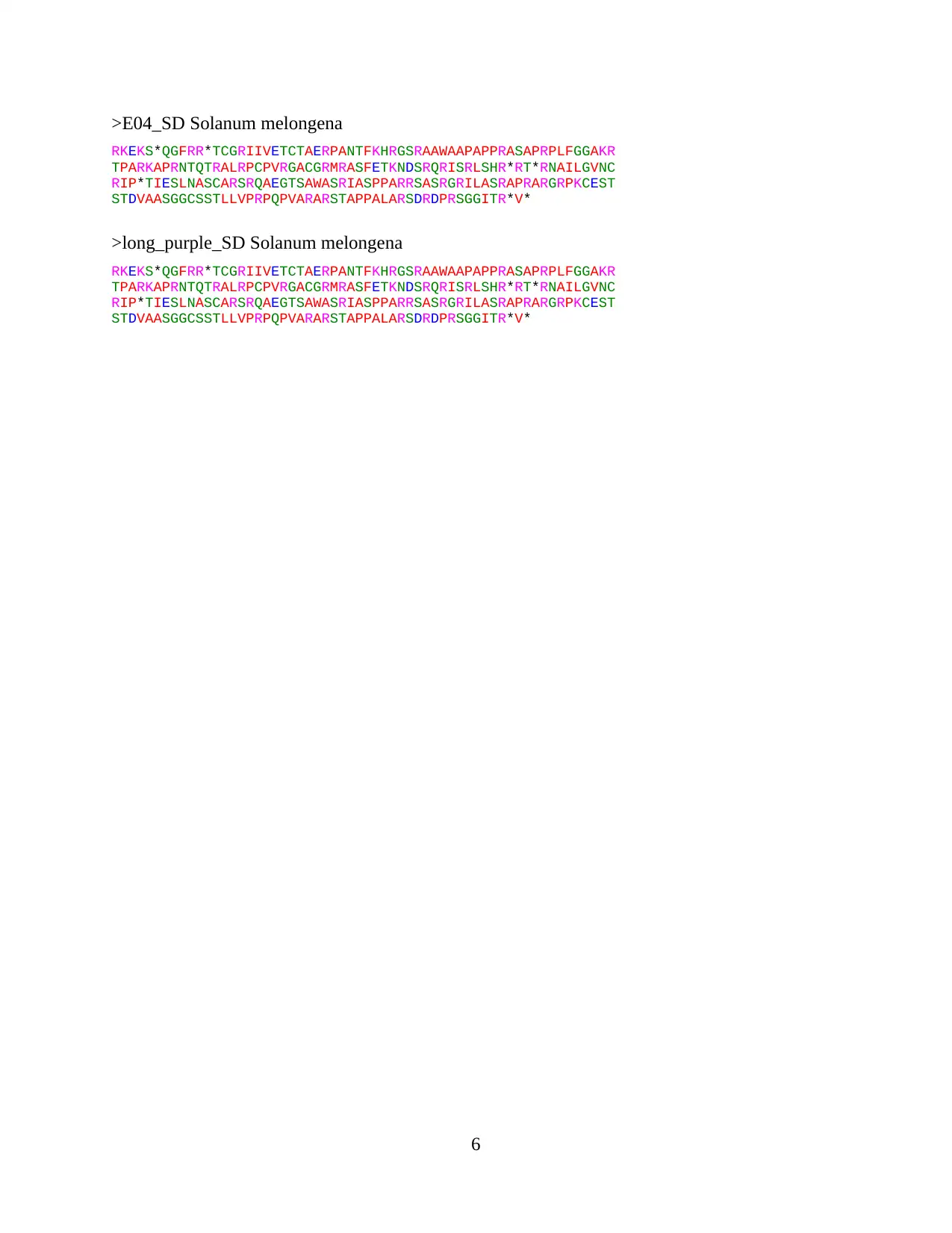
>E04_SD Solanum melongena
RKEKS*QGFRR*TCGRIIVETCTAERPANTFKHRGSRAAWAAPAPPRASAPRPLFGGAKR
TPARKAPRNTQTRALRPCPVRGACGRMRASFETKNDSRQRISRLSHR*RT*RNAILGVNC
RIP*TIESLNASCARSRQAEGTSAWASRIASPPARRSASRGRILASRAPRARGRPKCEST
STDVAASGGCSSTLLVPRPQPVARARSTAPPALARSDRDPRSGGITR*V*
>long_purple_SD Solanum melongena
RKEKS*QGFRR*TCGRIIVETCTAERPANTFKHRGSRAAWAAPAPPRASAPRPLFGGAKR
TPARKAPRNTQTRALRPCPVRGACGRMRASFETKNDSRQRISRLSHR*RT*RNAILGVNC
RIP*TIESLNASCARSRQAEGTSAWASRIASPPARRSASRGRILASRAPRARGRPKCEST
STDVAASGGCSSTLLVPRPQPVARARSTAPPALARSDRDPRSGGITR*V*
6
RKEKS*QGFRR*TCGRIIVETCTAERPANTFKHRGSRAAWAAPAPPRASAPRPLFGGAKR
TPARKAPRNTQTRALRPCPVRGACGRMRASFETKNDSRQRISRLSHR*RT*RNAILGVNC
RIP*TIESLNASCARSRQAEGTSAWASRIASPPARRSASRGRILASRAPRARGRPKCEST
STDVAASGGCSSTLLVPRPQPVARARSTAPPALARSDRDPRSGGITR*V*
>long_purple_SD Solanum melongena
RKEKS*QGFRR*TCGRIIVETCTAERPANTFKHRGSRAAWAAPAPPRASAPRPLFGGAKR
TPARKAPRNTQTRALRPCPVRGACGRMRASFETKNDSRQRISRLSHR*RT*RNAILGVNC
RIP*TIESLNASCARSRQAEGTSAWASRIASPPARRSASRGRILASRAPRARGRPKCEST
STDVAASGGCSSTLLVPRPQPVARARSTAPPALARSDRDPRSGGITR*V*
6
REFERENCES
Books and Journals
Beh and et. al., 2019. Identification of a DNA N6-adenine methyltransferase complex and its
impact on chromatin organization. Cell, 177(7), pp.1781-1796.
Bolivar and et. al., 2019. Targeted next-generation sequencing of endometrial cancer and
matched circulating tumor DNA: identification of plasma-based, tumor-associated
mutations in early stage patients. Modern Pathology, 32(3), pp.405-414.
Chen and et. al., 2019. Identification of common antigens of three pathogenic Nocardia species
and development of DNA vaccine against fish nocardiosis. Fish & shellfish
immunology, 95, pp.357-367.
Parsons and et. al., 2019. Large scale DNA identification: The ICMP experience. Forensic
Science International: Genetics, 38, pp.236-244.
Peterson and et. al., 2018. Identification of individual immobilized DNA molecules by their
hybridization kinetics using single-molecule fluorescence imaging. Analytical
chemistry, 90(8), pp.5007-5014.
Tanzadehpanah and et. al., 2019. Binding site identification of anticancer drug gefitinib to HSA
and DNA in the presence of five different probes. Journal of Biomolecular Structure and
Dynamics, 37(4), pp.823-836.
Wang and et. al., 2019. Identification and functional characterization of Histone‐like DNA‐
binding protein in Nocardia seriolae (NsHLP) involved in cell apoptosis. Journal of fish
diseases, 42(5), pp.657-666.
Yang and et. al., 2017. DMINDA 2.0: integrated and systematic views of regulatory DNA motif
identification and analyses. Bioinformatics, 33(16), pp.2586-2588.
Zhang and et. al., 2019. Identification of DNA–protein binding sites by bootstrap multiple
convolutional neural networks on sequence information. Engineering Applications of
Artificial Intelligence, 79, pp.58-66.
7
Books and Journals
Beh and et. al., 2019. Identification of a DNA N6-adenine methyltransferase complex and its
impact on chromatin organization. Cell, 177(7), pp.1781-1796.
Bolivar and et. al., 2019. Targeted next-generation sequencing of endometrial cancer and
matched circulating tumor DNA: identification of plasma-based, tumor-associated
mutations in early stage patients. Modern Pathology, 32(3), pp.405-414.
Chen and et. al., 2019. Identification of common antigens of three pathogenic Nocardia species
and development of DNA vaccine against fish nocardiosis. Fish & shellfish
immunology, 95, pp.357-367.
Parsons and et. al., 2019. Large scale DNA identification: The ICMP experience. Forensic
Science International: Genetics, 38, pp.236-244.
Peterson and et. al., 2018. Identification of individual immobilized DNA molecules by their
hybridization kinetics using single-molecule fluorescence imaging. Analytical
chemistry, 90(8), pp.5007-5014.
Tanzadehpanah and et. al., 2019. Binding site identification of anticancer drug gefitinib to HSA
and DNA in the presence of five different probes. Journal of Biomolecular Structure and
Dynamics, 37(4), pp.823-836.
Wang and et. al., 2019. Identification and functional characterization of Histone‐like DNA‐
binding protein in Nocardia seriolae (NsHLP) involved in cell apoptosis. Journal of fish
diseases, 42(5), pp.657-666.
Yang and et. al., 2017. DMINDA 2.0: integrated and systematic views of regulatory DNA motif
identification and analyses. Bioinformatics, 33(16), pp.2586-2588.
Zhang and et. al., 2019. Identification of DNA–protein binding sites by bootstrap multiple
convolutional neural networks on sequence information. Engineering Applications of
Artificial Intelligence, 79, pp.58-66.
7
⊘ This is a preview!⊘
Do you want full access?
Subscribe today to unlock all pages.
Trusted by 1+ million students worldwide

1 out of 9


Related Documents


Your All-in-One AI-Powered Toolkit for Academic Success.
+13062052269
info@desklib.com
Available 24*7 on WhatsApp / Email
![[object Object]](/_next/static/media/star-bottom.7253800d.svg)
Unlock your academic potential
Copyright © 2020–2026 A2Z Services. All Rights Reserved. Developed and managed by ZUCOL.