Stakeholder Analysis and Critical Evaluation: Dotcom Payroll Project
VerifiedAdded on 2023/06/11
|13
|3171
|409
Case Study
AI Summary
This case study provides a critical analysis of the Dotcom schools payroll system implementation, focusing on stakeholder identification, prioritization, and understanding. It identifies key stakeholders such as the board of trustees, school administrators, employees, the Ministry, the Project Board, Novopay Business Owners, PricewaterhouseCoopers, ministers, and the program director. The prioritization of stakeholders is based on their power and interest levels, categorizing them into groups that require close management, satisfaction, information, or monitoring. The analysis emphasizes the importance of understanding stakeholder needs and maintaining dynamic relationships to ensure project success. The document concludes by highlighting Desklib as a valuable resource for students seeking similar solved assignments and past papers.

Running head: ANALYSIS OF THE CASE STUDY WITH STAKEHOLDER ANALYSIS
Critical Analysis of the case study with Stakeholder Analysis
Name of the Student:
Name of the University:
Author note:
Critical Analysis of the case study with Stakeholder Analysis
Name of the Student:
Name of the University:
Author note:

Paraphrase This Document
Need a fresh take? Get an instant paraphrase of this document with our AI Paraphraser
1References
ANALYSIS OF THE CASE STUDY WITH STAKEHOLDER ANALYSIS
Table of Contents
Introduction..........................................................................................................................2
Identification of the Stakeholders........................................................................................2
Prioritising the Stakeholders................................................................................................4
Understanding of the key Stakeholders...............................................................................7
Conclusion...........................................................................................................................9
References..........................................................................................................................11
ANALYSIS OF THE CASE STUDY WITH STAKEHOLDER ANALYSIS
Table of Contents
Introduction..........................................................................................................................2
Identification of the Stakeholders........................................................................................2
Prioritising the Stakeholders................................................................................................4
Understanding of the key Stakeholders...............................................................................7
Conclusion...........................................................................................................................9
References..........................................................................................................................11
2References
ANALYSIS OF THE CASE STUDY WITH STAKEHOLDER ANALYSIS
Introduction
Stakeholders have an important role in a project. From the entire case study, there had
been several incident noticed during the entire process of implementing Dotcom schools payroll
system with a modern, technology-based solution. This would provide greater functionality to
provide a better user interface and more useful information about the national schools workforce.
If the tasks associated throughout the timeline of the project implementation are to be noticed,
the stakeholders involved within the system involved in the implementation can be figured out.
Identification of the Stakeholders
For identifying the stakeholders, it is necessary that all the events occurring in the project
implementation needs to be analyzed. The first set of event that occurred in October 2008
included direct customers, which are the board of trustees, and users, which are the principals
and the school administrators (Missonier & Loufrani-Fedida, 2014). These people can be
identified as the project stakeholders from this event occurrence. However, their involvement in
the project was very low compared to the others.
The next process of service design and development phase includes software designing,
testing and a larger set of employees needed for quality management. Therefore, the process
states that employees involved in this process are also a set of stakeholders in the project. These
stakeholders had thorough involvement within the project introduced in the case study.
Payroll administration in the project process included change management plans that the
ministry had suggested. Therefore, the Ministry, in this case, has also been direct stakeholders in
the entire project plan with the most involvement within the plan itself. The Project Board and
ANALYSIS OF THE CASE STUDY WITH STAKEHOLDER ANALYSIS
Introduction
Stakeholders have an important role in a project. From the entire case study, there had
been several incident noticed during the entire process of implementing Dotcom schools payroll
system with a modern, technology-based solution. This would provide greater functionality to
provide a better user interface and more useful information about the national schools workforce.
If the tasks associated throughout the timeline of the project implementation are to be noticed,
the stakeholders involved within the system involved in the implementation can be figured out.
Identification of the Stakeholders
For identifying the stakeholders, it is necessary that all the events occurring in the project
implementation needs to be analyzed. The first set of event that occurred in October 2008
included direct customers, which are the board of trustees, and users, which are the principals
and the school administrators (Missonier & Loufrani-Fedida, 2014). These people can be
identified as the project stakeholders from this event occurrence. However, their involvement in
the project was very low compared to the others.
The next process of service design and development phase includes software designing,
testing and a larger set of employees needed for quality management. Therefore, the process
states that employees involved in this process are also a set of stakeholders in the project. These
stakeholders had thorough involvement within the project introduced in the case study.
Payroll administration in the project process included change management plans that the
ministry had suggested. Therefore, the Ministry, in this case, has also been direct stakeholders in
the entire project plan with the most involvement within the plan itself. The Project Board and
⊘ This is a preview!⊘
Do you want full access?
Subscribe today to unlock all pages.

Trusted by 1+ million students worldwide
3References
ANALYSIS OF THE CASE STUDY WITH STAKEHOLDER ANALYSIS
the Novopay Business Owners can also be declared as the stakeholders in the project who are
directly involved within the project orientation and propagation. These stakeholders also have
active participation in the business process since the commencement of 9 February 2012 meeting
of the Project Board.
After the project Go Live on 14 August 2012, the project had two Confidence Points
acquired and endorsed by PricewaterhouseCoopers allowing the project stage gates (Cuppen,
2016). Therefore, since that time onwards, the project had active participation of that
organization making them the active stakeholders of the project.
The Minister of English, Parata and Foss approved the continuation of the project since
the time 15 August 2012, making them the active project stakeholders. However, during that
time, there had been no people to be appointed in the project for further development of the
project. Although this made the project suffer unruly manners of project propagation like,
missing project deadlines and project milestones; the project also missed having active and
important stakeholder involvements. The lack of a Program Director with overall accountability
reporting to the project’s Senior Responsible Officer meant that the Project Board and the
Business Owner were the effective points of integration for project planning and management
(Yang, 2014). Therefore, after the project Go Live, the Board decided to involve a Program
Director and a Senior Responsible Officer that would act as an active project stakeholder in the
project.
In spite of the range of assurance activities across this project, there was no overall
responsibility for Independent Quality Assurance, its scope did not take in the entire project, and
it was not provided continuously. Ministers, central agencies and the Ministry placed confidence
ANALYSIS OF THE CASE STUDY WITH STAKEHOLDER ANALYSIS
the Novopay Business Owners can also be declared as the stakeholders in the project who are
directly involved within the project orientation and propagation. These stakeholders also have
active participation in the business process since the commencement of 9 February 2012 meeting
of the Project Board.
After the project Go Live on 14 August 2012, the project had two Confidence Points
acquired and endorsed by PricewaterhouseCoopers allowing the project stage gates (Cuppen,
2016). Therefore, since that time onwards, the project had active participation of that
organization making them the active stakeholders of the project.
The Minister of English, Parata and Foss approved the continuation of the project since
the time 15 August 2012, making them the active project stakeholders. However, during that
time, there had been no people to be appointed in the project for further development of the
project. Although this made the project suffer unruly manners of project propagation like,
missing project deadlines and project milestones; the project also missed having active and
important stakeholder involvements. The lack of a Program Director with overall accountability
reporting to the project’s Senior Responsible Officer meant that the Project Board and the
Business Owner were the effective points of integration for project planning and management
(Yang, 2014). Therefore, after the project Go Live, the Board decided to involve a Program
Director and a Senior Responsible Officer that would act as an active project stakeholder in the
project.
In spite of the range of assurance activities across this project, there was no overall
responsibility for Independent Quality Assurance, its scope did not take in the entire project, and
it was not provided continuously. Ministers, central agencies and the Ministry placed confidence
Paraphrase This Document
Need a fresh take? Get an instant paraphrase of this document with our AI Paraphraser
4References
ANALYSIS OF THE CASE STUDY WITH STAKEHOLDER ANALYSIS
in the declaration activities being undertaken. Therefore, there were people appointed in this post
as well who would help in checking the quality in every step of the project development, making
them active and important stakeholders in the project.
The former Secretaries for Education took an unwarranted level of comfort from the
governance of the Novopay project. The lack of engagement with the project by the Ministry’s
Leadership Team and Audit and Assurance Committee, and the weaknesses in the project’s
governance, are matters for which a Chief Executive must take accountability. This discussion in
the project board meeting assured that Secretaries for the Education, Leadership Team and Audit
and Assurance Committee also were included as the stakeholders of the project. Along with
these stakeholders, the Chief Executive handling both these departments also was included as the
project stakeholders (Wüstemeyer et al., 2015). The schools and the students in concern with this
project are also the stakeholders of the project having an active participation in the project since
they are on the receiving end of the end product. Therefore, after all these processes involved in
the project propagation gives the idea of the list of stakeholders involved in the project encircling
the entire processes are listed as above.
Prioritising the Stakeholders
The entire project for the implementing Datacom schools payroll system with a modern,
technology-based solution had a lot of ups and downs during the entire project proceeding. There
had been a lot of failed attempts and changes in the courses of the project propagation. This also
compelled the Project Heads and the Board of Directors to add upon several posts and people
throughout the project course adding to the list of stakeholders directly and indirectly related to
the project.
ANALYSIS OF THE CASE STUDY WITH STAKEHOLDER ANALYSIS
in the declaration activities being undertaken. Therefore, there were people appointed in this post
as well who would help in checking the quality in every step of the project development, making
them active and important stakeholders in the project.
The former Secretaries for Education took an unwarranted level of comfort from the
governance of the Novopay project. The lack of engagement with the project by the Ministry’s
Leadership Team and Audit and Assurance Committee, and the weaknesses in the project’s
governance, are matters for which a Chief Executive must take accountability. This discussion in
the project board meeting assured that Secretaries for the Education, Leadership Team and Audit
and Assurance Committee also were included as the stakeholders of the project. Along with
these stakeholders, the Chief Executive handling both these departments also was included as the
project stakeholders (Wüstemeyer et al., 2015). The schools and the students in concern with this
project are also the stakeholders of the project having an active participation in the project since
they are on the receiving end of the end product. Therefore, after all these processes involved in
the project propagation gives the idea of the list of stakeholders involved in the project encircling
the entire processes are listed as above.
Prioritising the Stakeholders
The entire project for the implementing Datacom schools payroll system with a modern,
technology-based solution had a lot of ups and downs during the entire project proceeding. There
had been a lot of failed attempts and changes in the courses of the project propagation. This also
compelled the Project Heads and the Board of Directors to add upon several posts and people
throughout the project course adding to the list of stakeholders directly and indirectly related to
the project.
5References
ANALYSIS OF THE CASE STUDY WITH STAKEHOLDER ANALYSIS
The set of stakeholders include people such as, direct customers, which are the board of
trustees, and users, which are the principals and the school administrators. These people can be
identified as the project stakeholders from this event occurrence. The process states that
employees involved in the process of development and software testing are also a set of
stakeholders in the project. These stakeholders had thorough involvement within the project
introduced in the case study. Independent Quality Assurance checkers are also listed as the
stakeholders.
The Minister of English, Parata and Foss are also the stakeholders of the project as per
their participation is concerned. Ministers, central agencies and the Ministry is also stakeholders
of the project, as well as the people appointed for project development, making them active and
important stakeholders in the project (Martin & Rice, 2015). The Project Board and the Novopay
Business Owners can also be declared as the stakeholders in the project who are directly
involved within the project orientation and propagation. After the project Go Live, the Board
decided to involve a Program Director and a Senior Responsible Officer that would act as an
active project stakeholder in the project. The Ministry, in this case, has also been direct
stakeholders in the entire project plan with the most involvement within the plan itself. After the
project Go Live on 14 August 2012, the project had two Confidence Points acquired and
endorsed by PricewaterhouseCoopers allowing the project stage gates. Therefore, since that time
onwards, the project had active participation of that organization making them the active
stakeholders of the project.
The two most important factors of the priorities of stakeholders in the project propagation
are the power that the stakeholder possesses and the interest they show on the project
propagation. Therefore, it can be stated that the priority list of stakeholders are arranged with
ANALYSIS OF THE CASE STUDY WITH STAKEHOLDER ANALYSIS
The set of stakeholders include people such as, direct customers, which are the board of
trustees, and users, which are the principals and the school administrators. These people can be
identified as the project stakeholders from this event occurrence. The process states that
employees involved in the process of development and software testing are also a set of
stakeholders in the project. These stakeholders had thorough involvement within the project
introduced in the case study. Independent Quality Assurance checkers are also listed as the
stakeholders.
The Minister of English, Parata and Foss are also the stakeholders of the project as per
their participation is concerned. Ministers, central agencies and the Ministry is also stakeholders
of the project, as well as the people appointed for project development, making them active and
important stakeholders in the project (Martin & Rice, 2015). The Project Board and the Novopay
Business Owners can also be declared as the stakeholders in the project who are directly
involved within the project orientation and propagation. After the project Go Live, the Board
decided to involve a Program Director and a Senior Responsible Officer that would act as an
active project stakeholder in the project. The Ministry, in this case, has also been direct
stakeholders in the entire project plan with the most involvement within the plan itself. After the
project Go Live on 14 August 2012, the project had two Confidence Points acquired and
endorsed by PricewaterhouseCoopers allowing the project stage gates. Therefore, since that time
onwards, the project had active participation of that organization making them the active
stakeholders of the project.
The two most important factors of the priorities of stakeholders in the project propagation
are the power that the stakeholder possesses and the interest they show on the project
propagation. Therefore, it can be stated that the priority list of stakeholders are arranged with
⊘ This is a preview!⊘
Do you want full access?
Subscribe today to unlock all pages.
Trusted by 1+ million students worldwide
6References
ANALYSIS OF THE CASE STUDY WITH STAKEHOLDER ANALYSIS
respect to the power they possess in the project as well as the interest they deliver. It can be
specified that even if a stakeholder has low power, there are chances that they have high interest
in the project (Heslinga et al., 2017). On the other hand, it is also possible that there is high
power of a person needed in the task, though they do not show much interest in the project
propagation. The priority list in this project is decided as per the permutation and combination of
the power and interests of the stakeholders in the project. The situations state the project
propagation and the involvement of the stakeholders in it. After the analysis of the entire project,
the priority of the stakeholders can be arranged within the following ranges:
High power, highly interested people (to be managed closely): Requires full
involvement and engaging. It takes a huge amount of effort keeping these stakeholders
satisfied. This priority group includes people like the Ministers, Ministry, central
agencies, Minister of English, Parata and Foss, the Novopay Business Owners and
PricewaterhouseCoopers.
High power, less interested people (to be kept satisfied): It requires enough work with
these people to keep them satisfied, but it is not at all possible that they would become
bored with follow up messages. This list includes the people in the project like the Project
Board, the Program Director and the Senior Responsible Officer.
Low power, highly interested people (to be kept informed): It is required to
adequately inform these people. Talking to them to ensure that there are no major issues
that might be arising during the task. People in this category are often very helpful with
handling the detailed structure of a project. This list includes the employees and the
project heads in responsibility of making the software.
ANALYSIS OF THE CASE STUDY WITH STAKEHOLDER ANALYSIS
respect to the power they possess in the project as well as the interest they deliver. It can be
specified that even if a stakeholder has low power, there are chances that they have high interest
in the project (Heslinga et al., 2017). On the other hand, it is also possible that there is high
power of a person needed in the task, though they do not show much interest in the project
propagation. The priority list in this project is decided as per the permutation and combination of
the power and interests of the stakeholders in the project. The situations state the project
propagation and the involvement of the stakeholders in it. After the analysis of the entire project,
the priority of the stakeholders can be arranged within the following ranges:
High power, highly interested people (to be managed closely): Requires full
involvement and engaging. It takes a huge amount of effort keeping these stakeholders
satisfied. This priority group includes people like the Ministers, Ministry, central
agencies, Minister of English, Parata and Foss, the Novopay Business Owners and
PricewaterhouseCoopers.
High power, less interested people (to be kept satisfied): It requires enough work with
these people to keep them satisfied, but it is not at all possible that they would become
bored with follow up messages. This list includes the people in the project like the Project
Board, the Program Director and the Senior Responsible Officer.
Low power, highly interested people (to be kept informed): It is required to
adequately inform these people. Talking to them to ensure that there are no major issues
that might be arising during the task. People in this category are often very helpful with
handling the detailed structure of a project. This list includes the employees and the
project heads in responsibility of making the software.
Paraphrase This Document
Need a fresh take? Get an instant paraphrase of this document with our AI Paraphraser
7References
ANALYSIS OF THE CASE STUDY WITH STAKEHOLDER ANALYSIS
Low power, less interested people (to be monitored): It is required to monitor these
people however; these people are easily prone to become bored with excessive
communication and follow ups. These are the direct customers in the project, that is,
principals and the school administrators.
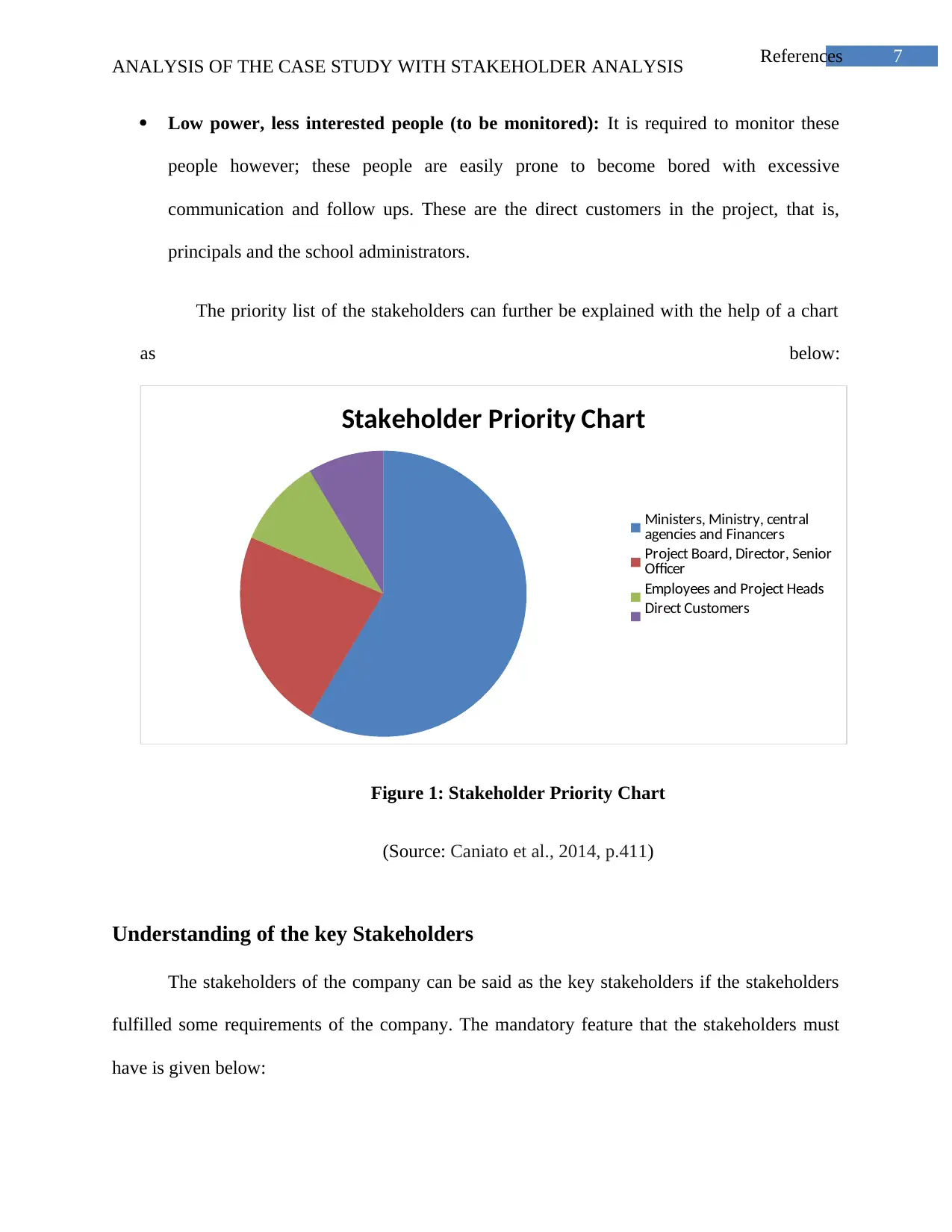
The priority list of the stakeholders can further be explained with the help of a chart
as below:
Stakeholder Priority Chart
Ministers, Ministry, central
agencies and Financers
Project Board, Director, Senior
Officer
Employees and Project Heads
Direct Customers
Figure 1: Stakeholder Priority Chart
(Source: Caniato et al., 2014, p.411)
Understanding of the key Stakeholders
The stakeholders of the company can be said as the key stakeholders if the stakeholders
fulfilled some requirements of the company. The mandatory feature that the stakeholders must
have is given below:
ANALYSIS OF THE CASE STUDY WITH STAKEHOLDER ANALYSIS
Low power, less interested people (to be monitored): It is required to monitor these
people however; these people are easily prone to become bored with excessive
communication and follow ups. These are the direct customers in the project, that is,
principals and the school administrators.
The priority list of the stakeholders can further be explained with the help of a chart
as below:
Stakeholder Priority Chart
Ministers, Ministry, central
agencies and Financers
Project Board, Director, Senior
Officer
Employees and Project Heads
Direct Customers
Figure 1: Stakeholder Priority Chart
(Source: Caniato et al., 2014, p.411)
Understanding of the key Stakeholders
The stakeholders of the company can be said as the key stakeholders if the stakeholders
fulfilled some requirements of the company. The mandatory feature that the stakeholders must
have is given below:
8References
ANALYSIS OF THE CASE STUDY WITH STAKEHOLDER ANALYSIS
The stakeholders can be said as the key stakeholders if the user is clearly
identified that what they want from the stakeholders. For an example like employees of a firms
strategic planning team know that that they want to generate good amount of revenue from the
clients (Caniato et al., 2014). They want innovation from the employees of the and they want
high funding from the company partners, though they could not clearly said what they want from
their community so the relationship cannot be said as the key. In this case study the authority
wants to hike they payroll so it is very clear that they management and the higher authorities just
want to generate revenue from its customers.
The relationship with the stakeholders have to be dynamic, that the thing is that
the user want to grow or not. For an example, like a company that runs many retired villages had
dynamic and strategic relation with the people of the residents. This wanted that the occupancy
increased so that the fees can be increased for the services. However, it’s strange that the
relationship with the university is static and focused operationally. This was the all what needed.
Though the university is not achieved the role of the key stakeholders. In this case study the
ministers and the project board leader want that the more students will take admission in the
school so the services charge will also be increased and it will benefited the school so they can
be said as the key stakeholders of the company.
Another criterion is whether the user can exists without changing the stakeholders or
replacing the stakeholders. For an example in an IT firm the Human Resource Manager who
taken a loan is listed the bank as the stakeholder. In that case the bank cannot be said as the key
stakeholders as the loan can be taken or refinanced from another source as well. In the case study
the ministry and the finance minister van be terms as the key stakeholders as they provide the
ANALYSIS OF THE CASE STUDY WITH STAKEHOLDER ANALYSIS
The stakeholders can be said as the key stakeholders if the user is clearly
identified that what they want from the stakeholders. For an example like employees of a firms
strategic planning team know that that they want to generate good amount of revenue from the
clients (Caniato et al., 2014). They want innovation from the employees of the and they want
high funding from the company partners, though they could not clearly said what they want from
their community so the relationship cannot be said as the key. In this case study the authority
wants to hike they payroll so it is very clear that they management and the higher authorities just
want to generate revenue from its customers.
The relationship with the stakeholders have to be dynamic, that the thing is that
the user want to grow or not. For an example, like a company that runs many retired villages had
dynamic and strategic relation with the people of the residents. This wanted that the occupancy
increased so that the fees can be increased for the services. However, it’s strange that the
relationship with the university is static and focused operationally. This was the all what needed.
Though the university is not achieved the role of the key stakeholders. In this case study the
ministers and the project board leader want that the more students will take admission in the
school so the services charge will also be increased and it will benefited the school so they can
be said as the key stakeholders of the company.
Another criterion is whether the user can exists without changing the stakeholders or
replacing the stakeholders. For an example in an IT firm the Human Resource Manager who
taken a loan is listed the bank as the stakeholder. In that case the bank cannot be said as the key
stakeholders as the loan can be taken or refinanced from another source as well. In the case study
the ministry and the finance minister van be terms as the key stakeholders as they provide the
⊘ This is a preview!⊘
Do you want full access?
Subscribe today to unlock all pages.
Trusted by 1+ million students worldwide
9References
ANALYSIS OF THE CASE STUDY WITH STAKEHOLDER ANALYSIS
finance that is required for the school. The project leader is also a key stake holder as the whole
project will be done by the same project manager the project manager cannot be easily replaced.
The questions are to be determined that the stakeholder is already identified with another
relationship or not. The response had to be no. for an example a department of the government
that is associated with a planning with the infrastructure that has listed the both of the unions and
the employees as the key stakeholders (Heslinga et al., 2017). However, this is not possible
because the union and the employee’s primary relationship in the organization represent the
interested of the employees. In this case study, none of the stakeholders are in another
relationship. All the stakeholders are dedicated to only their respective department only.
The several questions by which the identification of the key stakeholder made are
What motivates most of the stakeholders?
What information the stakeholder wanted from their customers?
What will win the stakeholders for the support of the project?
How the user will manage the opposition of the stakeholders?
Who will be influenced by the opinions of the stakeholders?
What is the stakeholder’s current opinion of the project?
Whether the opinion is based on the good or bad information?
Who influenced the opinions of the stakeholders for us?
The above question will help to understand the key holders for any company or any of the
business.
ANALYSIS OF THE CASE STUDY WITH STAKEHOLDER ANALYSIS
finance that is required for the school. The project leader is also a key stake holder as the whole
project will be done by the same project manager the project manager cannot be easily replaced.
The questions are to be determined that the stakeholder is already identified with another
relationship or not. The response had to be no. for an example a department of the government
that is associated with a planning with the infrastructure that has listed the both of the unions and
the employees as the key stakeholders (Heslinga et al., 2017). However, this is not possible
because the union and the employee’s primary relationship in the organization represent the
interested of the employees. In this case study, none of the stakeholders are in another
relationship. All the stakeholders are dedicated to only their respective department only.
The several questions by which the identification of the key stakeholder made are
What motivates most of the stakeholders?
What information the stakeholder wanted from their customers?
What will win the stakeholders for the support of the project?
How the user will manage the opposition of the stakeholders?
Who will be influenced by the opinions of the stakeholders?
What is the stakeholder’s current opinion of the project?
Whether the opinion is based on the good or bad information?
Who influenced the opinions of the stakeholders for us?
The above question will help to understand the key holders for any company or any of the
business.
Paraphrase This Document
Need a fresh take? Get an instant paraphrase of this document with our AI Paraphraser
10References
ANALYSIS OF THE CASE STUDY WITH STAKEHOLDER ANALYSIS
Conclusion
From the above study, it concludes that the stakeholders have to influence fundamentally
to the performance of the organization. For an example like a construction manager who
construct the houses decided, on the reflection that the council will not be s stakeholder. Despite
the local council set some rules for that the construction company had to follow but those rules
and the regulations does not affect too much on the profit of the company or the sales of the
customer what the customer did. In this case, the ministry, employees, project head, directors had
the direct impact on the schools payroll so they can be stated as the key stakeholders.
ANALYSIS OF THE CASE STUDY WITH STAKEHOLDER ANALYSIS
Conclusion
From the above study, it concludes that the stakeholders have to influence fundamentally
to the performance of the organization. For an example like a construction manager who
construct the houses decided, on the reflection that the council will not be s stakeholder. Despite
the local council set some rules for that the construction company had to follow but those rules
and the regulations does not affect too much on the profit of the company or the sales of the
customer what the customer did. In this case, the ministry, employees, project head, directors had
the direct impact on the schools payroll so they can be stated as the key stakeholders.
11References
ANALYSIS OF THE CASE STUDY WITH STAKEHOLDER ANALYSIS
References
Caniato, M., Vaccari, M., Visvanathan, C., & Zurbrügg, C. (2014). Using social network and
stakeholder analysis to help evaluate infectious waste management: A step towards a
holistic assessment. Waste Management, 34(5), 938-951.
Cuppen, E. (2016). 15 Stakeholder Analysis. Foresight in Organizations: Methods and Tools,
208.
Durand, M. A., Yen, R., Barr, P. J., Cochran, N., Aarts, J., Légaré, F., ... & Elwyn, G. (2017).
Assessing medical student knowledge and attitudes about shared decision making across
the curriculum: protocol for an international online survey and stakeholder analysis. BMJ
open, 7(6), e015945.
Heslinga, J., Groote, P., & Vanclay, F. (2017). Strengthening governance processes to improve
benefit-sharing from tourism in protected areas by using stakeholder analysis. Journal of
Sustainable Tourism, 1-15.
Martin, N., & Rice, J. (2015). Improving Australia's renewable energy project policy and
planning: A multiple stakeholder analysis. Energy Policy, 84, 128-141.
Missonier, S., & Loufrani-Fedida, S. (2014). Stakeholder analysis and engagement in projects:
From stakeholder relational perspective to stakeholder relational ontology. International
Journal of Project Management, 32(7), 1108-1122.
Paletto, A., Hamunen, K., & De Meo, I. (2015). Social network analysis to support stakeholder
analysis in participatory forest planning. Society & natural resources, 28(10), 1108-1125.
ANALYSIS OF THE CASE STUDY WITH STAKEHOLDER ANALYSIS
References
Caniato, M., Vaccari, M., Visvanathan, C., & Zurbrügg, C. (2014). Using social network and
stakeholder analysis to help evaluate infectious waste management: A step towards a
holistic assessment. Waste Management, 34(5), 938-951.
Cuppen, E. (2016). 15 Stakeholder Analysis. Foresight in Organizations: Methods and Tools,
208.
Durand, M. A., Yen, R., Barr, P. J., Cochran, N., Aarts, J., Légaré, F., ... & Elwyn, G. (2017).
Assessing medical student knowledge and attitudes about shared decision making across
the curriculum: protocol for an international online survey and stakeholder analysis. BMJ
open, 7(6), e015945.
Heslinga, J., Groote, P., & Vanclay, F. (2017). Strengthening governance processes to improve
benefit-sharing from tourism in protected areas by using stakeholder analysis. Journal of
Sustainable Tourism, 1-15.
Martin, N., & Rice, J. (2015). Improving Australia's renewable energy project policy and
planning: A multiple stakeholder analysis. Energy Policy, 84, 128-141.
Missonier, S., & Loufrani-Fedida, S. (2014). Stakeholder analysis and engagement in projects:
From stakeholder relational perspective to stakeholder relational ontology. International
Journal of Project Management, 32(7), 1108-1122.
Paletto, A., Hamunen, K., & De Meo, I. (2015). Social network analysis to support stakeholder
analysis in participatory forest planning. Society & natural resources, 28(10), 1108-1125.
⊘ This is a preview!⊘
Do you want full access?
Subscribe today to unlock all pages.
Trusted by 1+ million students worldwide

1 out of 13


Related Documents


Your All-in-One AI-Powered Toolkit for Academic Success.
+13062052269
info@desklib.com
Available 24*7 on WhatsApp / Email
![[object Object]](/_next/static/media/star-bottom.7253800d.svg)
Unlock your academic potential
Copyright © 2020–2026 A2Z Services. All Rights Reserved. Developed and managed by ZUCOL.