A Comprehensive Review: Is Cow's Milk a Healthy Beverage Choice?
VerifiedAdded on 2023/05/28
|11
|3263
|425
Essay
AI Summary
This essay delves into the ongoing debate surrounding the health implications of cow's milk consumption. It begins by highlighting the historical perception of milk as a health food, then transitions to the modern scrutiny it faces due to potential adverse effects. The essay provides a detailed overview of milk's nutritional composition, including vitamins, minerals, and proteins, while also acknowledging the variations based on animal species, breed, and diet. It explores both the positive and negative aspects of milk consumption, addressing concerns such as lactose intolerance, the presence of rBGH, and potential links to various health issues, including allergies, digestive problems, and even certain types of cancer. The essay further discusses alternative sources of calcium and nutrients, as well as the ethical considerations related to the dairy industry. It concludes by presenting a balanced view, weighing the benefits against the risks and providing a comprehensive analysis of the complex relationship between cow's milk and human health.

Is drinking cow’s milk healthy for humans?
Name
Professor
Subject
Date
Name
Professor
Subject
Date

Paraphrase This Document
Need a fresh take? Get an instant paraphrase of this document with our AI Paraphraser
Is drinking cow’s milk healthy for humans?
Is drinking cow’s milk healthy for humans?
Cow’s milk was typically considered good for health, but nowadays, people’s view regarding it
are changing. Debates have been going on for taking the product off the shelves from the stores
owing to some of its adverse effects on human health. Milk is an important dairy product
obtained from various animals including cows, goats, camels, llamas, sheep, buffalos, horses,
and reindeer. It is one of the most consumed beverages throughout the world as it provides
various vital nutrients such as vitamins (A, D, E, K, B1, B6, and B12), fat, calcium, magnesium,
selenium, riboflavin, potassium, and inorganic phosphorus. The gross composition of ingredients
present in different types of milk vary and depend on different factors such as the species, breed,
age, health, and lactation stage of the particular animal. Also, the food intake, surroundings, and
the ways of owner or caretaker to keep animals play important roles in the milk structure. Some
of its negative effects include allergies, digestive issues, and more (Milk 101: Nutrition Facts
And Health Effects).
Milk is a very popular dairy product owing to its presence in the refrigerators or kitchens of
almost all the people living in different regions. It is defined as the white fluid or liquid
composed of water, fat, minerals, vitamins, lactose, and proteins with trace amounts of pigments,
enzymes, and phospholipids. Milk is present in mammary glands of female mammals to serve
the main purpose of nourishing their young ones. As the first food of the newly-born, it
facilitates growth by providing building materials and body functions by providing energy. Milk
consists of small globules of fat suspended in a casein solution, milk sugar, albumin, and
inorganic salts. The three prominent proteins present in milk are casein, lactalbumin, and
Is drinking cow’s milk healthy for humans?
Cow’s milk was typically considered good for health, but nowadays, people’s view regarding it
are changing. Debates have been going on for taking the product off the shelves from the stores
owing to some of its adverse effects on human health. Milk is an important dairy product
obtained from various animals including cows, goats, camels, llamas, sheep, buffalos, horses,
and reindeer. It is one of the most consumed beverages throughout the world as it provides
various vital nutrients such as vitamins (A, D, E, K, B1, B6, and B12), fat, calcium, magnesium,
selenium, riboflavin, potassium, and inorganic phosphorus. The gross composition of ingredients
present in different types of milk vary and depend on different factors such as the species, breed,
age, health, and lactation stage of the particular animal. Also, the food intake, surroundings, and
the ways of owner or caretaker to keep animals play important roles in the milk structure. Some
of its negative effects include allergies, digestive issues, and more (Milk 101: Nutrition Facts
And Health Effects).
Milk is a very popular dairy product owing to its presence in the refrigerators or kitchens of
almost all the people living in different regions. It is defined as the white fluid or liquid
composed of water, fat, minerals, vitamins, lactose, and proteins with trace amounts of pigments,
enzymes, and phospholipids. Milk is present in mammary glands of female mammals to serve
the main purpose of nourishing their young ones. As the first food of the newly-born, it
facilitates growth by providing building materials and body functions by providing energy. Milk
consists of small globules of fat suspended in a casein solution, milk sugar, albumin, and
inorganic salts. The three prominent proteins present in milk are casein, lactalbumin, and
Is drinking cow’s milk healthy for humans?
lactoglobulin. Among these casein is not precipitated from acidic solution hence, whey or whey
cheeses consist of lactalbumin and lactoglobulin, which can be precipitated by applying heat.
People usually prefer to consume cow milk owing to ease of availability, comparatively lower
fats, and rich protein content over the other types().
Apart from the abovementioned information, that is the source animals, milk can also be
categorized based on the fat content. Generally, the different types of product available in the
market include whole milk with fat content above 3%, milk with reduced fat content of around
2%, milk with low fat content of nearly 1%, and nonfat or skim milk. The fat is accompanied by
eight grams of high quality protein and other essential nutrients. Obviously the quantity of milk
fat increases or decreases the number of calories in each serving, but, overall, every kind of milk
is a simple and wholesome food ranging from fat free or low fat to organic or lactose free milk.
Organic milk is produced in organic dairy farms following the stringent rules or standards set up
by the United States Department of Agriculture or USDA( Kocián et al.). The farmers of organic
dairy are restricted to use specially approved practices or rules by USDA on crops and animals,
such as, they do not use synthetic fertilizers, growth hormones, or antibiotics and they are not
allowed to feed their animals with genetically modified or GMO crops. Lactose free milk is the
milk obtained from real cow, in which lactose or natural sugar may be broken down into glucose
and galactose or sometimes filtered out by different dairy firms to facilitate its digestion for
lactose intolerant people. The information regarding the components are mentioned on the
package as well as represented by different colors of cap or packaging coding the fat content in
milk for the understanding and convenience of customers (Waage et. al.).
lactoglobulin. Among these casein is not precipitated from acidic solution hence, whey or whey
cheeses consist of lactalbumin and lactoglobulin, which can be precipitated by applying heat.
People usually prefer to consume cow milk owing to ease of availability, comparatively lower
fats, and rich protein content over the other types().
Apart from the abovementioned information, that is the source animals, milk can also be
categorized based on the fat content. Generally, the different types of product available in the
market include whole milk with fat content above 3%, milk with reduced fat content of around
2%, milk with low fat content of nearly 1%, and nonfat or skim milk. The fat is accompanied by
eight grams of high quality protein and other essential nutrients. Obviously the quantity of milk
fat increases or decreases the number of calories in each serving, but, overall, every kind of milk
is a simple and wholesome food ranging from fat free or low fat to organic or lactose free milk.
Organic milk is produced in organic dairy farms following the stringent rules or standards set up
by the United States Department of Agriculture or USDA( Kocián et al.). The farmers of organic
dairy are restricted to use specially approved practices or rules by USDA on crops and animals,
such as, they do not use synthetic fertilizers, growth hormones, or antibiotics and they are not
allowed to feed their animals with genetically modified or GMO crops. Lactose free milk is the
milk obtained from real cow, in which lactose or natural sugar may be broken down into glucose
and galactose or sometimes filtered out by different dairy firms to facilitate its digestion for
lactose intolerant people. The information regarding the components are mentioned on the
package as well as represented by different colors of cap or packaging coding the fat content in
milk for the understanding and convenience of customers (Waage et. al.).
⊘ This is a preview!⊘
Do you want full access?
Subscribe today to unlock all pages.

Trusted by 1+ million students worldwide
Is drinking cow’s milk healthy for humans?
As the world is becoming health and diet conscious, the main point of discussion is that whether
the consumption of cow’s milk by human is healthy or not. Milk consumption is increasingly
being criticized due to the issue of lactose intolerance and other problems in certain people
leading to its comparatively lesser utilization in different parts of the world specially the
developed nations. According to an article published in “The guardian”, milk consumption
among Americans has fallen by 37% compared to 1970s and dairy consumption in UK has
decreased by one third in last 20 years ( Sahni ).
To enlist the problems related with milk consumption, let us consider one of the essential facts
related to milk, that is, its calcium content, one of the most reckoned milk qualities. According to
a study by Centers for Disease Control and Prevention or CDC in 2007, a cup of calcium
strengthened orange juice owns the same quantity of calcium as a cup of milk. Also, a study
conducted by USDA in 2005 proved that a taco had more calcium content than milk as well as
breakfast cereals have four times more amount of calcium than same quantity of milk. In
addition, a statement by Physicians Committee for Responsible Medicine in 2007, said that green
leafy vegetables own calcium absorption rates of more than fifty percent while milk have the
calcium absorption rate of around thirty two percent. For example, broccoli, collards, and kale
are rich in readily absorbable calcium.
Lactose intolerance is one of the most common issues related to milk consumption and people
suffering from it experience difficulty in digesting dairy products. In this condition, the people’s
ability to digest lactose is impaired due to lack of the lactose digesting enzyme called lactase in
the body. According to National Institutes of Health (NIH), around 65% of the population have
As the world is becoming health and diet conscious, the main point of discussion is that whether
the consumption of cow’s milk by human is healthy or not. Milk consumption is increasingly
being criticized due to the issue of lactose intolerance and other problems in certain people
leading to its comparatively lesser utilization in different parts of the world specially the
developed nations. According to an article published in “The guardian”, milk consumption
among Americans has fallen by 37% compared to 1970s and dairy consumption in UK has
decreased by one third in last 20 years ( Sahni ).
To enlist the problems related with milk consumption, let us consider one of the essential facts
related to milk, that is, its calcium content, one of the most reckoned milk qualities. According to
a study by Centers for Disease Control and Prevention or CDC in 2007, a cup of calcium
strengthened orange juice owns the same quantity of calcium as a cup of milk. Also, a study
conducted by USDA in 2005 proved that a taco had more calcium content than milk as well as
breakfast cereals have four times more amount of calcium than same quantity of milk. In
addition, a statement by Physicians Committee for Responsible Medicine in 2007, said that green
leafy vegetables own calcium absorption rates of more than fifty percent while milk have the
calcium absorption rate of around thirty two percent. For example, broccoli, collards, and kale
are rich in readily absorbable calcium.
Lactose intolerance is one of the most common issues related to milk consumption and people
suffering from it experience difficulty in digesting dairy products. In this condition, the people’s
ability to digest lactose is impaired due to lack of the lactose digesting enzyme called lactase in
the body. According to National Institutes of Health (NIH), around 65% of the population have
Paraphrase This Document
Need a fresh take? Get an instant paraphrase of this document with our AI Paraphraser
Is drinking cow’s milk healthy for humans?
reduced or very less ability to digest lactose after infancy. The occurrence of lactose
intolerance is lesser or lowest among the populations having a long history of dependency on
unfermented milk products as a primary food source. For instance, people related to Northern
European descent have only about 5 percent lactose intolerant cases. Lactose, which is also
called as milk sugar, is the only major animal origin carbohydrate in man’s food supply. It is
split by the action of enzyme lactase into its two component sugars that is glucose and galactose
for further utilization by the body. The enzyme is present and utmost active in digestive tract of
humans during infancy but after the weaning age, 90% of the lactase activity is lost. Among
lactose intolerant people, undigested lactose reaches the colon and gets fermented by bacterial
colonies over there resulting in production of lactic acid that causes flatulence, bloating, cramps,
nausea, or diarrhea. Thus, such people are advised to drink lactose free milk, soy milk, yogurt,
cheese, and other foods (Milk 101: Nutrition Facts And Health Effects).
Cow’s milk is associated with another extremely serious issue, that is, the presence of the rBGH
(synthetic or recombinant bovine growth hormone), which is responsible for increasing the levels
of IGF-1 hormone (insulin-like growth factor) in humans. This hormone facilitates the growth of
our bodies in stages of infancy and is naturally present in our blood. The increase in the level of
IGF-1 paves the way for the growth of group of cells that have very high probability or tendency
to be transformed into cancer cells. Also, even if the hormone rBGH is absent, IGF-1 will be
present in the milk leading to high chances of uncontrolled cell growth and subsequently cancer.
It is a well known fact that cancer is a deadly disease and doesn’t have a clear-cut cure, proving
milk as a dangerous health risk to the people.
reduced or very less ability to digest lactose after infancy. The occurrence of lactose
intolerance is lesser or lowest among the populations having a long history of dependency on
unfermented milk products as a primary food source. For instance, people related to Northern
European descent have only about 5 percent lactose intolerant cases. Lactose, which is also
called as milk sugar, is the only major animal origin carbohydrate in man’s food supply. It is
split by the action of enzyme lactase into its two component sugars that is glucose and galactose
for further utilization by the body. The enzyme is present and utmost active in digestive tract of
humans during infancy but after the weaning age, 90% of the lactase activity is lost. Among
lactose intolerant people, undigested lactose reaches the colon and gets fermented by bacterial
colonies over there resulting in production of lactic acid that causes flatulence, bloating, cramps,
nausea, or diarrhea. Thus, such people are advised to drink lactose free milk, soy milk, yogurt,
cheese, and other foods (Milk 101: Nutrition Facts And Health Effects).
Cow’s milk is associated with another extremely serious issue, that is, the presence of the rBGH
(synthetic or recombinant bovine growth hormone), which is responsible for increasing the levels
of IGF-1 hormone (insulin-like growth factor) in humans. This hormone facilitates the growth of
our bodies in stages of infancy and is naturally present in our blood. The increase in the level of
IGF-1 paves the way for the growth of group of cells that have very high probability or tendency
to be transformed into cancer cells. Also, even if the hormone rBGH is absent, IGF-1 will be
present in the milk leading to high chances of uncontrolled cell growth and subsequently cancer.
It is a well known fact that cancer is a deadly disease and doesn’t have a clear-cut cure, proving
milk as a dangerous health risk to the people.
Is drinking cow’s milk healthy for humans?
In September, 2016, Michael Greger, MD, physician and founder of the Nutrition Facts website,
quoted through a post titled "Should Pregnant Women Avoid Cow's Milk?" that the hormones
usually present in cow's milk is possibly useful and played an important role in studying the
connection amid dairy products and human diseases, including certain acne, cancers, and male
reproductive defects. Also, the intake of milk has been linked with high threat of premature
puberty among females as well as chances of endometrial cancer among postmenopausal women
(FACLM). According to the book, Don't Drink Your Milk, written by Frank A. Oski, MD
(former director, Department of Pediatrics) at Johns Hopkins University, milk obtained from cow
has been associated to deficiency of iron among children or infants and is the reason behind
cramps or diarrhea in majority of the global population. It is also capable of causing multiple
forms of allergy and probably playing a fundamental role in the origins of heart attacks as well as
atherosclerosis. Therefore, based on the above-mentioned statements and different researches,
cow milk is capable of causing iron deficiency (anemia) and heart disease. Hence, it should be
substituted by calcium fortified orange juice, vitamin supplements, and green leafy vegetables.
According to a 2016 online journal by the founder of Synergistiq Integrative Health, Dr. Deepa
Verma (MD), the milk of cow is not meant for consumption by humans owing to the presence of
proteins that are more than three times in quantity compared to the proteins present in human
milk, thus, creating metabolic disorders resulting in pernicious bone health. Moreover, milk
along with other products of dairy are producing mucus as well as pro-inflammatory causing
risks of respiratory conditions, allergies, and development of arthritis (inflamed joints). This can
be quoted by an example that America owns high dairy consumption rates as well as high
In September, 2016, Michael Greger, MD, physician and founder of the Nutrition Facts website,
quoted through a post titled "Should Pregnant Women Avoid Cow's Milk?" that the hormones
usually present in cow's milk is possibly useful and played an important role in studying the
connection amid dairy products and human diseases, including certain acne, cancers, and male
reproductive defects. Also, the intake of milk has been linked with high threat of premature
puberty among females as well as chances of endometrial cancer among postmenopausal women
(FACLM). According to the book, Don't Drink Your Milk, written by Frank A. Oski, MD
(former director, Department of Pediatrics) at Johns Hopkins University, milk obtained from cow
has been associated to deficiency of iron among children or infants and is the reason behind
cramps or diarrhea in majority of the global population. It is also capable of causing multiple
forms of allergy and probably playing a fundamental role in the origins of heart attacks as well as
atherosclerosis. Therefore, based on the above-mentioned statements and different researches,
cow milk is capable of causing iron deficiency (anemia) and heart disease. Hence, it should be
substituted by calcium fortified orange juice, vitamin supplements, and green leafy vegetables.
According to a 2016 online journal by the founder of Synergistiq Integrative Health, Dr. Deepa
Verma (MD), the milk of cow is not meant for consumption by humans owing to the presence of
proteins that are more than three times in quantity compared to the proteins present in human
milk, thus, creating metabolic disorders resulting in pernicious bone health. Moreover, milk
along with other products of dairy are producing mucus as well as pro-inflammatory causing
risks of respiratory conditions, allergies, and development of arthritis (inflamed joints). This can
be quoted by an example that America owns high dairy consumption rates as well as high
⊘ This is a preview!⊘
Do you want full access?
Subscribe today to unlock all pages.
Trusted by 1+ million students worldwide
Is drinking cow’s milk healthy for humans?
osteoporosis rate. Moreover, a glass of milk consists of a lot of animal proteins that are acidic in
nature and capable of leeching calcium from feces components, pus cells, bones, antibiotics, and
bovine growth hormones. Also, milk contains useless fat, calories, and cholesterol; altogether
these components generate different types of imbalances in the body such as obesity, heart
problems, and other problems (Ford et. al.).
PETA or People for the Ethical Treatment of Animals stand against cow milk consumption
stating different reasons such as cholesterol, milk allergies, broken bones, antibiotics, saturated
fat, and ethical grounds (The Dairy Industry | PETA). Animal origin proteins produce acids
during their breaking down and calcium is known to be an excellent acid neutralizer. Thus, in
order to neutralize or remove the acids produced after milk consumption, our bodies utilize the
calcium in the milk as well as from the body stores, leaching calcium from our bones increasing
the probability of fractures. In addition, milk and cheese are linked with increased chances of
ovarian cancer, obesity, prostate cancer, and acne. Apart from that, a single serving of milk is
anticipated to contain about 24 milligrams of cholesterol and strong or dangerous reactions
among milk allergic people such as vomiting and anaphylaxis (Ford et.al.). Moreover, owners
involved in dairy business treat their cows with harmful antibiotics to keep them alive and
produce milk under filthy farm conditions. This is leading to surge in antibiotic-resistant bacteria
or superbugs capable of infecting humans. On ethical grounds PETA states that, apart from
humans and certain domestic animals, none of the species consume milk ahead of their natural
weaning age. Milk of the cow is suitable for dietary requirements of calves having four stomachs
and capable of gaining a lot of weight in less time period (ranging from few months to a year or
osteoporosis rate. Moreover, a glass of milk consists of a lot of animal proteins that are acidic in
nature and capable of leeching calcium from feces components, pus cells, bones, antibiotics, and
bovine growth hormones. Also, milk contains useless fat, calories, and cholesterol; altogether
these components generate different types of imbalances in the body such as obesity, heart
problems, and other problems (Ford et. al.).
PETA or People for the Ethical Treatment of Animals stand against cow milk consumption
stating different reasons such as cholesterol, milk allergies, broken bones, antibiotics, saturated
fat, and ethical grounds (The Dairy Industry | PETA). Animal origin proteins produce acids
during their breaking down and calcium is known to be an excellent acid neutralizer. Thus, in
order to neutralize or remove the acids produced after milk consumption, our bodies utilize the
calcium in the milk as well as from the body stores, leaching calcium from our bones increasing
the probability of fractures. In addition, milk and cheese are linked with increased chances of
ovarian cancer, obesity, prostate cancer, and acne. Apart from that, a single serving of milk is
anticipated to contain about 24 milligrams of cholesterol and strong or dangerous reactions
among milk allergic people such as vomiting and anaphylaxis (Ford et.al.). Moreover, owners
involved in dairy business treat their cows with harmful antibiotics to keep them alive and
produce milk under filthy farm conditions. This is leading to surge in antibiotic-resistant bacteria
or superbugs capable of infecting humans. On ethical grounds PETA states that, apart from
humans and certain domestic animals, none of the species consume milk ahead of their natural
weaning age. Milk of the cow is suitable for dietary requirements of calves having four stomachs
and capable of gaining a lot of weight in less time period (ranging from few months to a year or
Paraphrase This Document
Need a fresh take? Get an instant paraphrase of this document with our AI Paraphraser
Is drinking cow’s milk healthy for humans?
two). Thus, cow milk and its derivative consumption by humans cause many health related
problems.
There are many positive aspects in addition to the ones mentioned earlier and disapprovals
against the harms stated regarding cow milk consumption by humans. In a December, 2017
article "All about Milk" written for Medical News Today titled by Megan Ware, RDN, LD, and
Founder of Nutrition Awareness, it was stated that milk contains ample amount of calcium and
minerals that are vital for strong teeth and bones. It also contains vitamin D that plays an
important role in strengthening health of the bone. Potassium from cow’s milk enhances
vasodilation subsequently reducing blood pressure and the risk of cardiovascular disease (Aune
et. al.). In addition, choline is an important nutrient found in milk that supports memory
enhancement, learning, sleep, and muscle movement. It also facilitates the maintenance of the
cellular membranes structure, helps in nerve impulses transmissions, aids in the fat absorption,
and lessen chronic inflammation (Chrysant).
According to a resource published on the National Dairy Council (NDC) website in January
2017, titled "Is Milk Good for You?” the body requires certain nutrients for proper functioning
and milk has majority of those in it. For instance, calcium present in milk facilitates building and
maintenance of strong bones and teeth. The wide ranges of vitamin Bs such as niacin, vitamin
B12, pantothenic acid, and riboflavin, help in conversion of food into useful nutrients in the body.
Researchers in University of Copenhagen under the leadership of Tanja Kongerslev Thorning,
PhD (Postdoctoral Fellow in the Department of Nutrition, Exercise and Sports) and Arne Astrup,
MD, PhD (Director of the Department of Nutrition) stated that intake of milk and dairy products
two). Thus, cow milk and its derivative consumption by humans cause many health related
problems.
There are many positive aspects in addition to the ones mentioned earlier and disapprovals
against the harms stated regarding cow milk consumption by humans. In a December, 2017
article "All about Milk" written for Medical News Today titled by Megan Ware, RDN, LD, and
Founder of Nutrition Awareness, it was stated that milk contains ample amount of calcium and
minerals that are vital for strong teeth and bones. It also contains vitamin D that plays an
important role in strengthening health of the bone. Potassium from cow’s milk enhances
vasodilation subsequently reducing blood pressure and the risk of cardiovascular disease (Aune
et. al.). In addition, choline is an important nutrient found in milk that supports memory
enhancement, learning, sleep, and muscle movement. It also facilitates the maintenance of the
cellular membranes structure, helps in nerve impulses transmissions, aids in the fat absorption,
and lessen chronic inflammation (Chrysant).
According to a resource published on the National Dairy Council (NDC) website in January
2017, titled "Is Milk Good for You?” the body requires certain nutrients for proper functioning
and milk has majority of those in it. For instance, calcium present in milk facilitates building and
maintenance of strong bones and teeth. The wide ranges of vitamin Bs such as niacin, vitamin
B12, pantothenic acid, and riboflavin, help in conversion of food into useful nutrients in the body.
Researchers in University of Copenhagen under the leadership of Tanja Kongerslev Thorning,
PhD (Postdoctoral Fellow in the Department of Nutrition, Exercise and Sports) and Arne Astrup,
MD, PhD (Director of the Department of Nutrition) stated that intake of milk and dairy products
Is drinking cow’s milk healthy for humans?
prevents or reduce childhood obesity and improve body composition as well as facilitate weight
loss during energy restrictions among adults. The related article, available at the website of
National Center for Biotechnology Information (NCBI), was published in November 2016 in
the Journal of Food and Nutrition under the title "Milk and Dairy Products: Good or Bad for
Human Health? An Assessment of the Totality of Scientific Evidence". It also suggested that
dairy products and milk consumption is associated with neutralized or decreased probability of
type 2 diabetes and diseases related to cardiovascular system, mainly stroke. Furthermore, as per
the article, improved bone mineral density was another beneficial effect of milk and dairy. Also,
dairy products intake was linked with prevention against different cancers related to colorectal,
bladder, breast, and gastric system (Lu et. al.).
Considering all of the previously mentioned factors, it can be concluded that many lactose-
intolerant people are capable of accepting a milk glass or an ice cream scoop (Özdemir et al.).
Moreover, based on the availability of scientific evidence, it is obvious that milk obtained from
cow and synthetically made dairy products are nutritionally incomparable foods as well as milk
or dairy products consumption helps in meeting dietary recommendation and provide protection
from various prevailing or lifelong non-communicable disease along with lesser or negligible
reported harmful effects. Thus, drinking cow’s milk in a certain limit is not only harmless but
helps people with meeting the basic nutritional requirements of the body. Over consumption of
milk or any food such as peanuts or sea-foods can cause harms and should be avoided (Lipkin).
prevents or reduce childhood obesity and improve body composition as well as facilitate weight
loss during energy restrictions among adults. The related article, available at the website of
National Center for Biotechnology Information (NCBI), was published in November 2016 in
the Journal of Food and Nutrition under the title "Milk and Dairy Products: Good or Bad for
Human Health? An Assessment of the Totality of Scientific Evidence". It also suggested that
dairy products and milk consumption is associated with neutralized or decreased probability of
type 2 diabetes and diseases related to cardiovascular system, mainly stroke. Furthermore, as per
the article, improved bone mineral density was another beneficial effect of milk and dairy. Also,
dairy products intake was linked with prevention against different cancers related to colorectal,
bladder, breast, and gastric system (Lu et. al.).
Considering all of the previously mentioned factors, it can be concluded that many lactose-
intolerant people are capable of accepting a milk glass or an ice cream scoop (Özdemir et al.).
Moreover, based on the availability of scientific evidence, it is obvious that milk obtained from
cow and synthetically made dairy products are nutritionally incomparable foods as well as milk
or dairy products consumption helps in meeting dietary recommendation and provide protection
from various prevailing or lifelong non-communicable disease along with lesser or negligible
reported harmful effects. Thus, drinking cow’s milk in a certain limit is not only harmless but
helps people with meeting the basic nutritional requirements of the body. Over consumption of
milk or any food such as peanuts or sea-foods can cause harms and should be avoided (Lipkin).
⊘ This is a preview!⊘
Do you want full access?
Subscribe today to unlock all pages.
Trusted by 1+ million students worldwide
Is drinking cow’s milk healthy for humans?
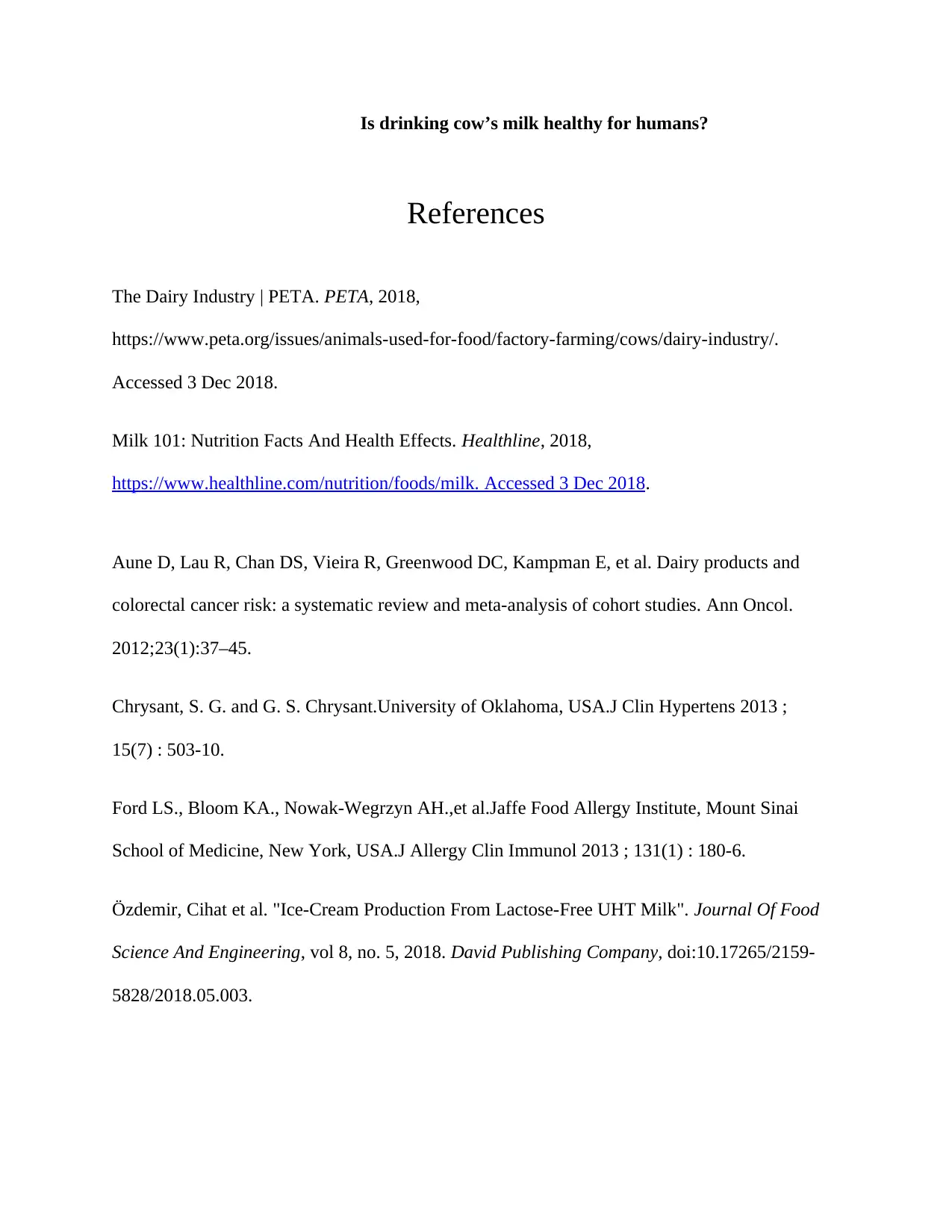
References
The Dairy Industry | PETA. PETA, 2018,
https://www.peta.org/issues/animals-used-for-food/factory-farming/cows/dairy-industry/.
Accessed 3 Dec 2018.
Milk 101: Nutrition Facts And Health Effects. Healthline, 2018,
https://www.healthline.com/nutrition/foods/milk. Accessed 3 Dec 2018.
Aune D, Lau R, Chan DS, Vieira R, Greenwood DC, Kampman E, et al. Dairy products and
colorectal cancer risk: a systematic review and meta-analysis of cohort studies. Ann Oncol.
2012;23(1):37–45.
Chrysant, S. G. and G. S. Chrysant.University of Oklahoma, USA.J Clin Hypertens 2013 ;
15(7) : 503-10.
Ford LS., Bloom KA., Nowak-Wegrzyn AH.,et al.Jaffe Food Allergy Institute, Mount Sinai
School of Medicine, New York, USA.J Allergy Clin Immunol 2013 ; 131(1) : 180-6.
Özdemir, Cihat et al. "Ice-Cream Production From Lactose-Free UHT Milk". Journal Of Food
Science And Engineering, vol 8, no. 5, 2018. David Publishing Company, doi:10.17265/2159-
5828/2018.05.003.
References
The Dairy Industry | PETA. PETA, 2018,
https://www.peta.org/issues/animals-used-for-food/factory-farming/cows/dairy-industry/.
Accessed 3 Dec 2018.
Milk 101: Nutrition Facts And Health Effects. Healthline, 2018,
https://www.healthline.com/nutrition/foods/milk. Accessed 3 Dec 2018.
Aune D, Lau R, Chan DS, Vieira R, Greenwood DC, Kampman E, et al. Dairy products and
colorectal cancer risk: a systematic review and meta-analysis of cohort studies. Ann Oncol.
2012;23(1):37–45.
Chrysant, S. G. and G. S. Chrysant.University of Oklahoma, USA.J Clin Hypertens 2013 ;
15(7) : 503-10.
Ford LS., Bloom KA., Nowak-Wegrzyn AH.,et al.Jaffe Food Allergy Institute, Mount Sinai
School of Medicine, New York, USA.J Allergy Clin Immunol 2013 ; 131(1) : 180-6.
Özdemir, Cihat et al. "Ice-Cream Production From Lactose-Free UHT Milk". Journal Of Food
Science And Engineering, vol 8, no. 5, 2018. David Publishing Company, doi:10.17265/2159-
5828/2018.05.003.
Paraphrase This Document
Need a fresh take? Get an instant paraphrase of this document with our AI Paraphraser
Is drinking cow’s milk healthy for humans?
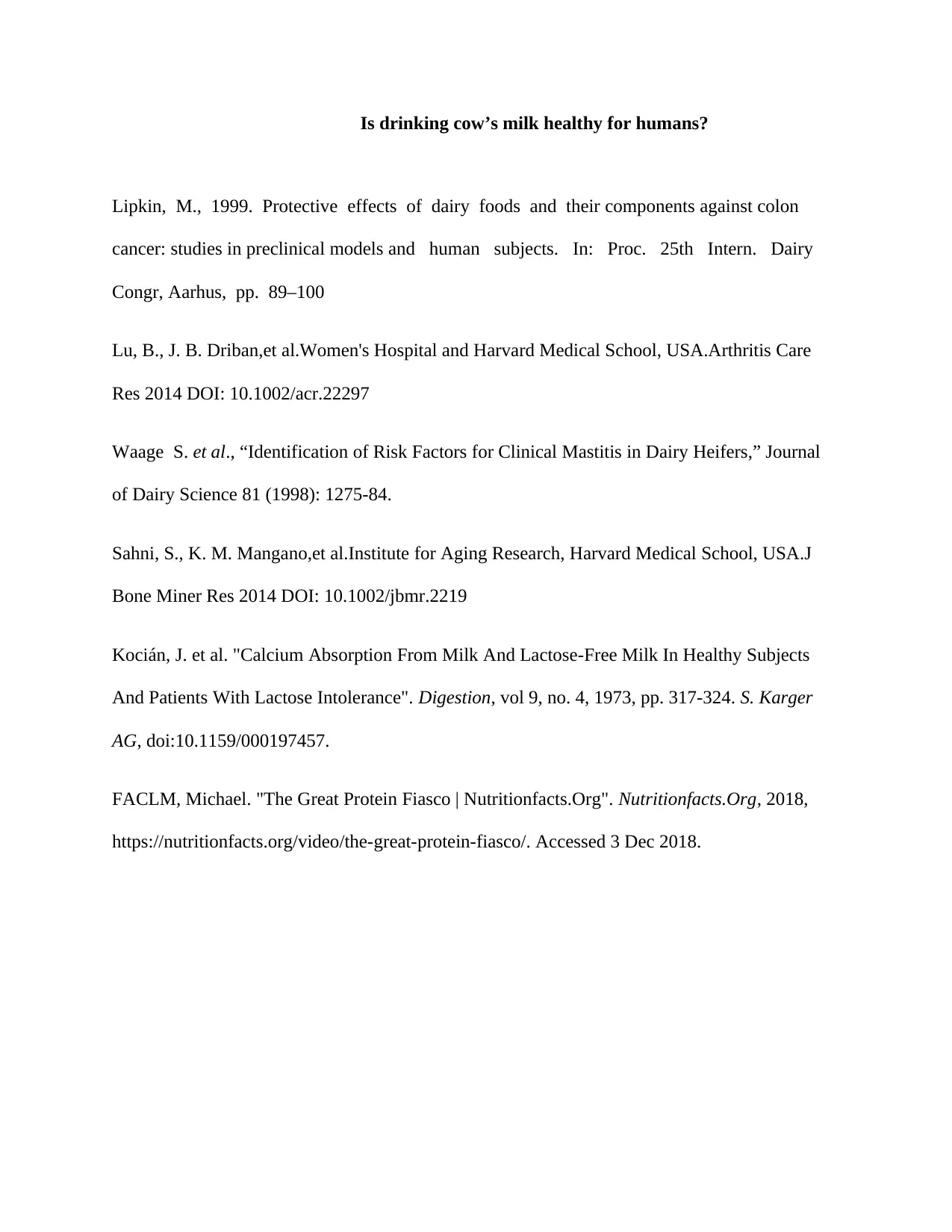
Lipkin, M., 1999. Protective effects of dairy foods and their components against colon
cancer: studies in preclinical models and human subjects. In: Proc. 25th Intern. Dairy
Congr, Aarhus, pp. 89–100
Lu, B., J. B. Driban,et al.Women's Hospital and Harvard Medical School, USA.Arthritis Care
Res 2014 DOI: 10.1002/acr.22297
Waage S. et al., “Identification of Risk Factors for Clinical Mastitis in Dairy Heifers,” Journal
of Dairy Science 81 (1998): 1275-84.
Sahni, S., K. M. Mangano,et al.Institute for Aging Research, Harvard Medical School, USA.J
Bone Miner Res 2014 DOI: 10.1002/jbmr.2219
Kocián, J. et al. "Calcium Absorption From Milk And Lactose-Free Milk In Healthy Subjects
And Patients With Lactose Intolerance". Digestion, vol 9, no. 4, 1973, pp. 317-324. S. Karger
AG, doi:10.1159/000197457.
FACLM, Michael. "The Great Protein Fiasco | Nutritionfacts.Org". Nutritionfacts.Org, 2018,
https://nutritionfacts.org/video/the-great-protein-fiasco/. Accessed 3 Dec 2018.
Lipkin, M., 1999. Protective effects of dairy foods and their components against colon
cancer: studies in preclinical models and human subjects. In: Proc. 25th Intern. Dairy
Congr, Aarhus, pp. 89–100
Lu, B., J. B. Driban,et al.Women's Hospital and Harvard Medical School, USA.Arthritis Care
Res 2014 DOI: 10.1002/acr.22297
Waage S. et al., “Identification of Risk Factors for Clinical Mastitis in Dairy Heifers,” Journal
of Dairy Science 81 (1998): 1275-84.
Sahni, S., K. M. Mangano,et al.Institute for Aging Research, Harvard Medical School, USA.J
Bone Miner Res 2014 DOI: 10.1002/jbmr.2219
Kocián, J. et al. "Calcium Absorption From Milk And Lactose-Free Milk In Healthy Subjects
And Patients With Lactose Intolerance". Digestion, vol 9, no. 4, 1973, pp. 317-324. S. Karger
AG, doi:10.1159/000197457.
FACLM, Michael. "The Great Protein Fiasco | Nutritionfacts.Org". Nutritionfacts.Org, 2018,
https://nutritionfacts.org/video/the-great-protein-fiasco/. Accessed 3 Dec 2018.

1 out of 11


Related Documents


Your All-in-One AI-Powered Toolkit for Academic Success.
+13062052269
info@desklib.com
Available 24*7 on WhatsApp / Email
![[object Object]](/_next/static/media/star-bottom.7253800d.svg)
Unlock your academic potential
Copyright © 2020–2026 A2Z Services. All Rights Reserved. Developed and managed by ZUCOL.